
At a glance
How a boy’s insect hunting and a Game Boy link cable grew into Pokémon, why collecting and trading kept it going for 30 years, and where to find it.
- The first games, Red and Green, came out for the Game Boy in Japan on February 27, 1996, with 151 Pokémon to collect.
- The core loop is catch, raise, trade and battle; each version has exclusive Pokémon that must be traded over a link cable.
- Creator Tajiri Satoshi grew up in Machida catching insects, and that memory is where Pokémon began.
- The anime began on April 1, 1997; Ash and Pikachu’s journey ran until March 2023.
- As of 2026, the National Pokédex lists more than 1,000 species.
In February 1996, two nearly identical cartridges for Nintendo’s monochrome Game Boy went on sale in Japan. One was called Red, the other Green. Neither had much advertising behind it, and the hardware was already seven years old. Within a couple of years the children of Japan, and then of America and much of the world, were swapping digital monsters through a cable, fighting over trading cards in schoolyards, and watching a yellow electric mouse on television every week. Three decades later Pokémon is by most estimates the highest-grossing media franchise in history. This piece explains where it came from, why its simple loop of catching, raising, trading and battling has held on for so long, and where a visitor to Japan can step inside it.
01A Boy Who Collected Insects
The story usually begins in Machida, on the western edge of Tokyo, where Tajiri Satoshi, born in Tokyo’s Setagaya ward in 1965, grew up. In the 1970s Machida still had rice paddies, ponds and patches of woodland, and the young Tajiri spent his days hunting stag beetles, rhinoceros beetles and crayfish. Classmates called him the class "insect doctor." As he grew up, the fields gave way to housing estates. Tajiri has said that he wanted children who grew up in cities to feel what he had felt turning over a stone or parting the grass and finding something alive underneath. That wish is the seed of Pokémon.
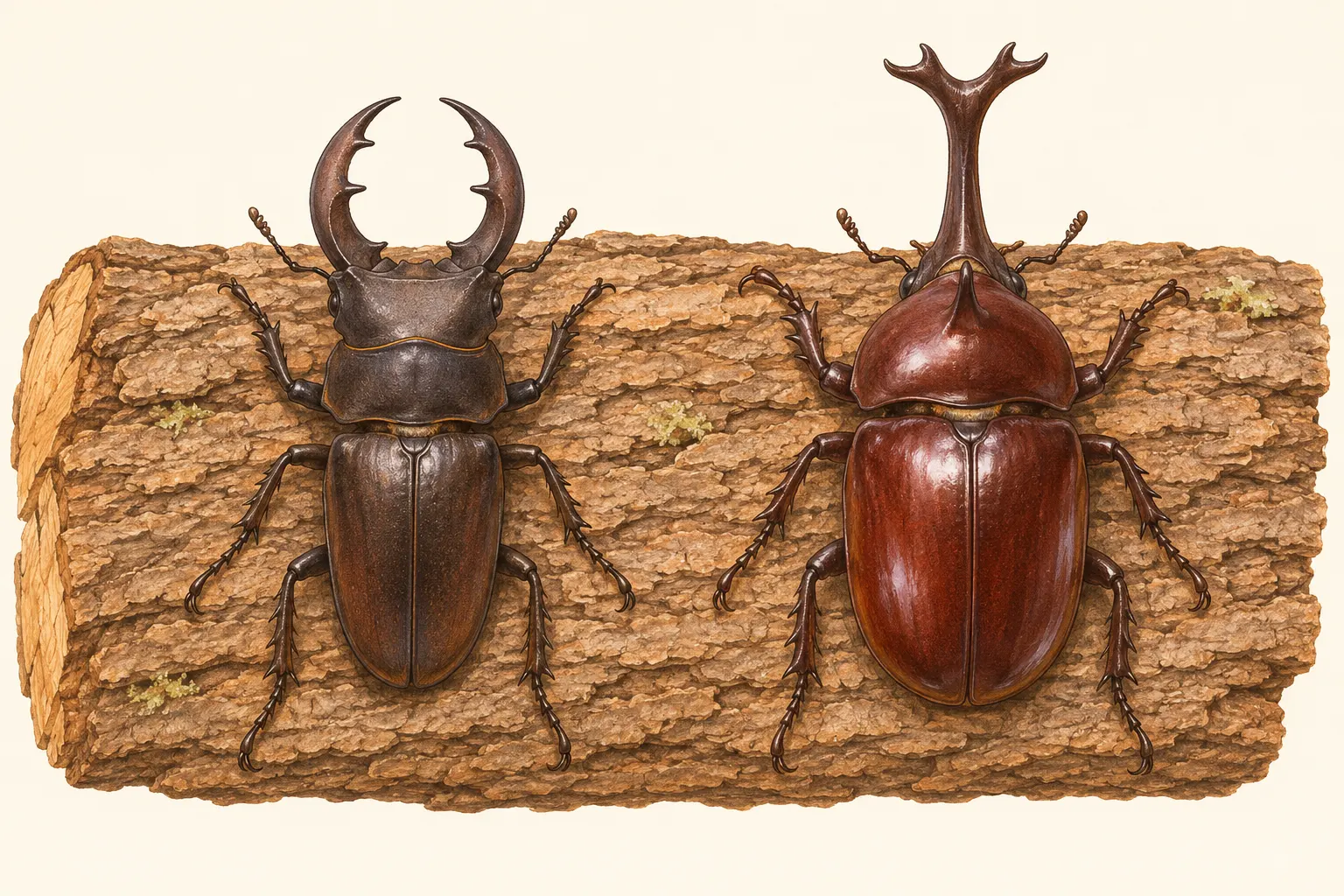
A stag beetle, with paired jaws, and a rhinoceros beetle, with a single horn: the kinds young Tajiri hunted in Machida.
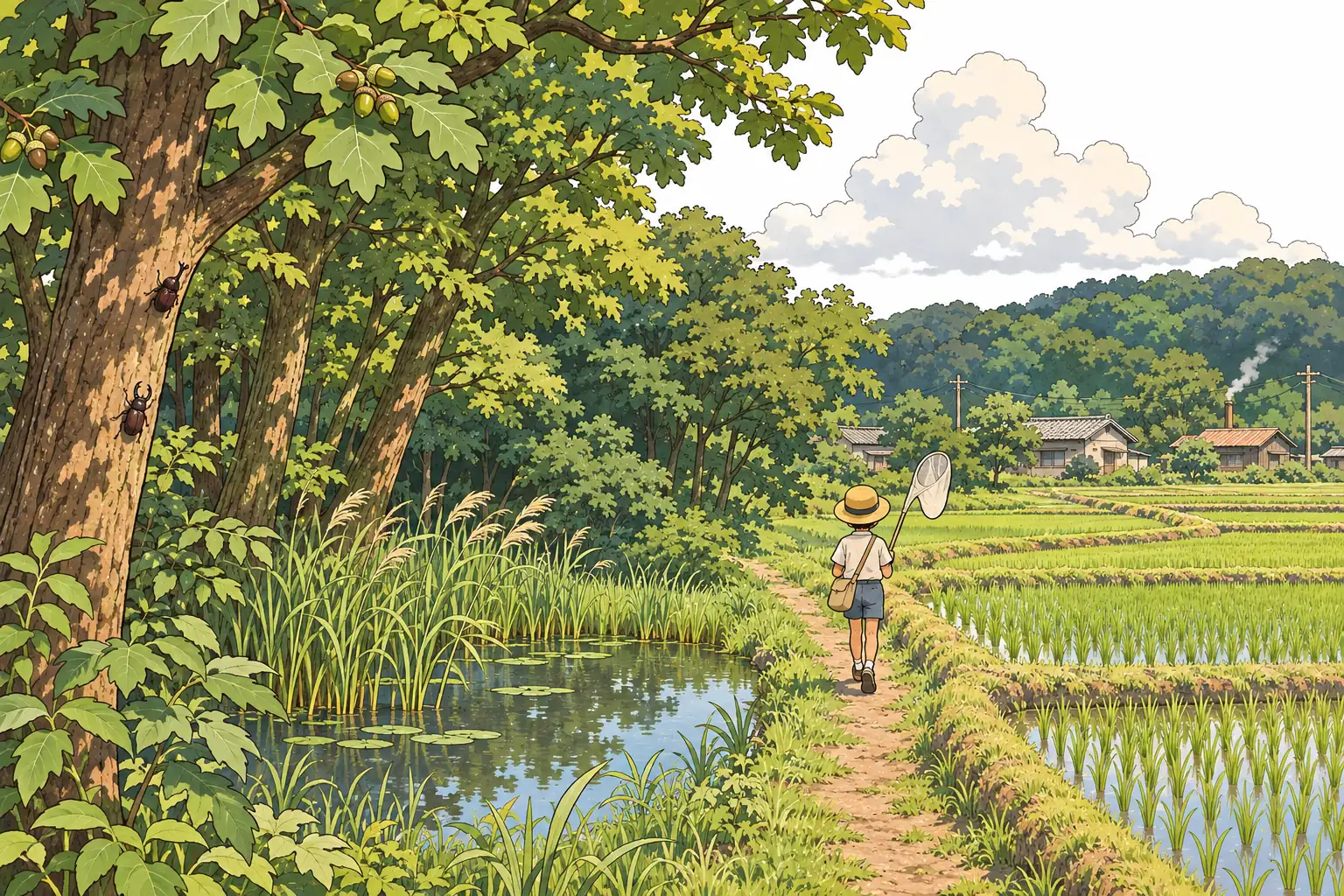
Satoyama in Machida on a summer afternoon: a boy with a bug net among woods, ponds and paddies (illustration).
He was also obsessed with video games. When Space Invaders swept Japan at the end of the 1970s, he practically lived in the arcades, and in 1983, while a student at a technical college in Tokyo, he began writing, photocopying and stapling his own fanzine about games, called Game Freak. A reader of the first issue, an artist named Sugimori Ken, drew for it from the second issue on. The two would work together for the rest of their careers. The fanzine’s circle made a Famicom puzzle game, Quinty (known in North America as Mendel Palace), which Namco published in 1989, and in April that year they used its royalties to found a development company, also called Game Freak.
That same year Nintendo launched the Game Boy. What caught Tajiri’s eye was the little port on the side and the link cable that let two machines talk to each other. He pictured an insect crawling along the cable from one Game Boy into the other. A living thing you could hand to a friend: that was the idea. He pitched it to Nintendo under the working title "Capsule Monsters," where it found supporters in Ishihara Tsunekazu, who would later run The Pokémon Company, and in Miyamoto Shigeru, the creator of Mario, who served as a producer and gave advice along the way.
Development dragged on for about six years. Game Freak was a small studio and repeatedly ran short of money; it took on other projects to stay afloat, among them Nintendo’s Yoshi’s Egg and Sega’s Pulseman, and some staff are said to have left during these years. Tajiri famously worked through the nights and slept by day. By the time the game was finished, the Game Boy looked like a platform near the end of its life.
02Red and Green: Two Versions and a Cable
Pocket Monsters Red and Pocket Monsters Green came out in Japan on February 27, 1996. In Japanese the name is shortened to Pokemon, pronounced "po-ke-mon," and that abbreviation became the brand worldwide. Overseas, the full name Pocket Monsters was dropped; the usual explanation is that it sat too close to an existing Western toy line called Monster in My Pocket, so the short form, with an accent added to guide English speakers’ pronunciation, became the official name everywhere outside Japan.
The player is a boy from Pallet Town who receives his first Pokémon from the local researcher, Professor Oak, choosing between Bulbasaur, Charmander and Squirtle. From there the route is clear: travel the towns of the Kanto region, beat the leaders of eight gyms, foil the criminal Team Rocket, and finally defeat the Elite Four and your rival to become champion. But the real goal was written on the Pokédex, the in-game encyclopedia: catch all 151 kinds of Pokémon.
Catching itself is a small drama. Wild Pokémon leap out of tall grass at random. You send out one of your own to fight, wear the wild one’s health down to a sliver, ideally put it to sleep or paralyze it, and then throw a Poké Ball. The ball wobbles once, twice, three times while you hold your breath; if it stays shut, the creature is yours. Hit too hard and the target faints, and the chance is gone. Each Pokémon you catch can be given a nickname, travels with you, learns new moves as it levels up, and at some point suddenly evolves into a new form with a new name. A caterpillar picked up in the first forest becomes a butterfly an hour later, and children remember that.
That goal could not be reached alone, and this was the genius of releasing two versions. The story, map and rules were the same in both cartridges; only the wild Pokémon differed. Ekans, Oddish, Mankey, Growlithe, Scyther and Electabuzz appeared only in Red. Sandshrew, Vulpix, Bellsprout, Meowth, Pinsir and Magmar appeared only in Green. On top of that, a handful of Pokémon, including Kadabra, Machoke, Graveler and Haunter, evolved into their final forms only when traded to another player. The game was designed so that you had to find someone else.
Only in Red
- Ekans
- Oddish
- Mankey
- Growlithe
- Scyther
- Electabuzz
Only in Green
- Sandshrew
- Vulpix
- Bellsprout
- Meowth
- Pinsir
- Magmar
Evolve only by trade
- Kadabra
- Machoke
- Graveler
- Haunter
Each version has its own Pokémon, and some evolve only when traded: the game was designed so that you had to find someone else.
The link cable became the center of the experience. In the late 1990s Japanese children went to each other’s houses after school with their Game Boys and cables, plugged in, and swapped what they were missing, or pitted their trained teams against each other. Who owned which version, and who had something rare, became part of the social economy of the classroom. Before Pokémon, video games were mostly a solitary activity, or something a few friends did crowded around one television. Pokémon turned a handheld game into a reason to talk to people, and it spread the way playground crazes spread: by word of mouth, because the game itself pushed players to tell each other about it.
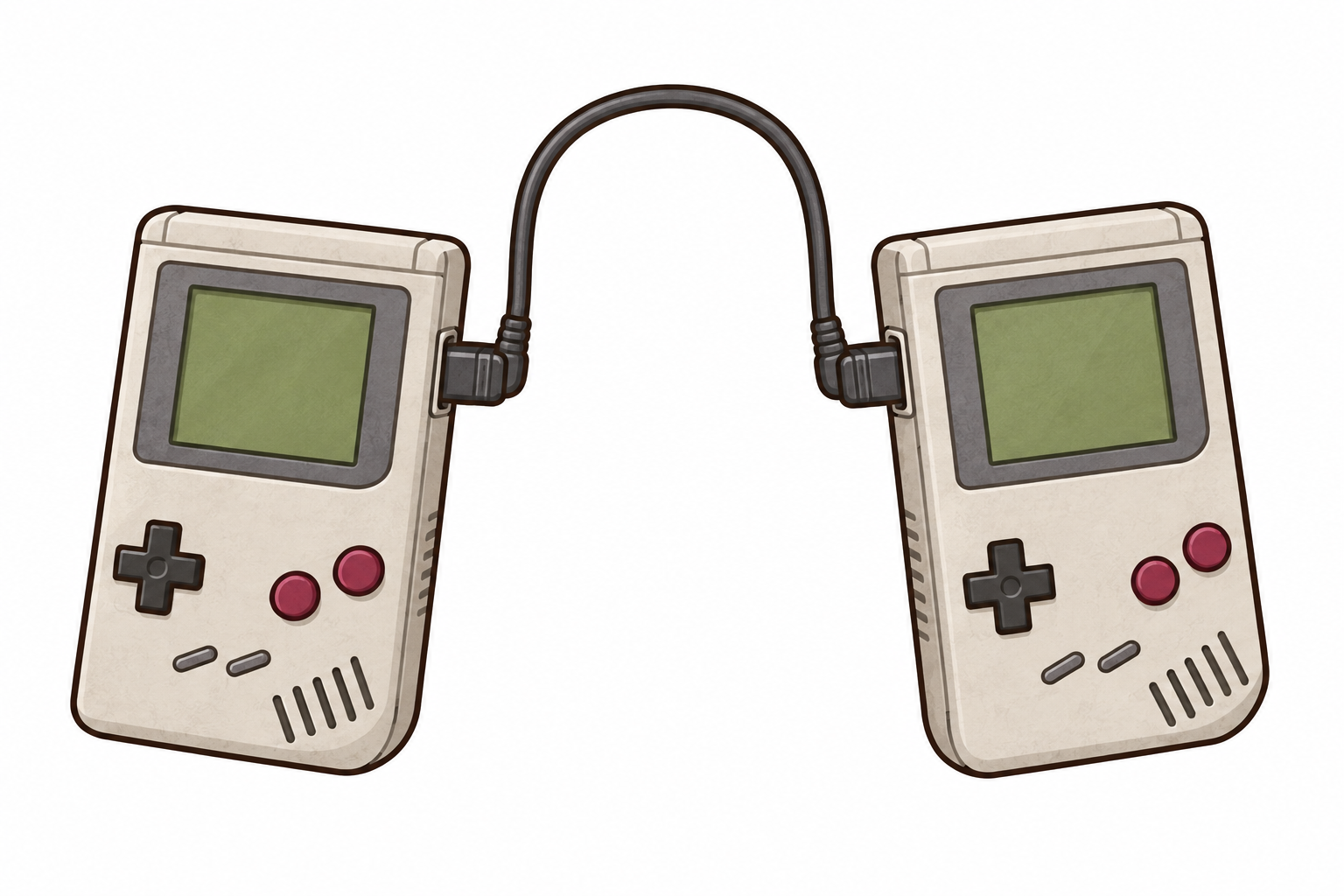
Two Game Boys joined by a link cable could trade Pokémon or battle.
Paired releases became the series’ signature. Gold and Silver, Ruby and Sapphire, Diamond and Pearl, Black and White, X and Y, Sun and Moon, Sword and Shield, Scarlet and Violet: every main generation has come in two editions with their own exclusive Pokémon. Commercially it meant some households bought both. In play, it guaranteed that trading always mattered.
Red and Green were not instant hits. Sales started modestly and built over months, helped enormously by CoroCoro Comic, the monthly manga magazine for boys published by Shogakukan, which promoted the game relentlessly and began running a Pokémon manga. In October 1996 a revised Blue version, with redrawn graphics and bug fixes, was offered by mail order through the magazine; it did not reach shops until 1999. In 1998 came Pikachu version, often called Yellow, in which Pikachu follows the player around in imitation of the anime. Outside Japan the first releases were Red and Blue, which arrived in North America in September 1998; most Western players never knew a Green existed, and the rival called Green in Japan became Blue in English.
03Number 151
The Pokédex in Red and Green officially ended at number 150, Mewtwo. But the cartridge hid one more: Mew. Near the end of development, after the debugging features were removed and a sliver of memory freed up, the programmer Morimoto Shigeki slipped it in without telling Nintendo, thinking it might be handed out later. Ordinary players could not meet it in the game. For a while it existed only as a rumor, the kind of secret children whispered about: there’s a 151st Pokémon.
In 1996 CoroCoro Comic turned that rumor into an event. It invited readers to apply to have Mew added to their games; winners would send in their cartridges and staff would write Mew into the save file. There were only twenty places, and around 78,000 postcards came in. That summer a second giveaway offered 100 places and drew more than 80,000 entries. Mew became something you could only get from the official source, at a particular time, and that pattern still defines the series’ "mythical" Pokémon, which are handed out through limited distributions, movie tie-ins and events.
The playground also ran on tall tales. Mew was supposedly hidden under a truck near the port in Vermilion City; it was not. Surfing up and down a certain island coast really did summon a glitched creature, called ketsuban in Japan and MissingNo. in English, which could scramble your save. In an age before online guides, a lot of the fun was testing what your friends swore was true.
Most of the original 151 were drawn by a small team under Sugimori Ken. Pikachu came from Nishida Atsuko, a young designer at the time; Sugimori later recalled that her first sketch looked like a daifuku rice cake with ears. Tajiri has explained the name as two Japanese sound words: pika, the crackle of an electric spark, and chū, the squeak of a mouse. Many Pokémon borrow from real animals, plants and objects, others from folklore, such as the nine-tailed fox behind Ninetales. They are mostly simple shapes, drawable in a few lines, which is part of why children copied them into the margins of their schoolbooks.
04Cards, Cartoons and a Global Craze
On October 20, 1996, the Pokémon Trading Card Game appeared, published in Japan by Media Factory and often described as the first serious Japanese-made trading card game. Its rules echo the games: each Pokémon card has hit points and attacks, attacks are powered by Energy cards attached to it, and evolution cards are laid on top of the basic Pokémon. Packs are random, and rare cards are printed in shiny holographic foil, which made the cards a game and a collectible at the same time. Plenty of children never learned the rules; what mattered was whether you owned a holographic Charizard. On April 1, 1997, the anime began on TV Tokyo. Its hero, Satoshi (Ash in English), is a ten-year-old who sets out with a Pikachu that refuses to go into its Poké Ball and rides on his shoulder instead. His rival Shigeru (Gary) was named after Miyamoto Shigeru, just as Satoshi was named after Tajiri. The anime turned the game’s silent protagonist into a boy with a temper, a big heart and a long record of losing, and it made Pikachu the face of the franchise. In the games Pikachu was one of many; on television it became the most recognizable yellow in the world.

How the cards stack, shown with blank cards: an evolution card laid on the basic one, Energy cards attached to power attacks.
On December 16, 1997, episode 38, "Dennō Senshi Porygon" ("Computer Warrior Porygon"), included a sequence of rapidly alternating red and blue flashes. Viewers, most of them children, suffered dizziness, nausea or seizures; a government survey counted 651 people taken to hospital in 30 prefectures. Japan calls it the "Pokémon Shock." The show went off the air for about four months, returning in April 1998, the same month NHK and the commercial broadcasters’ association issued guidelines on flashing images. The familiar caption at the start of Japanese cartoons, telling children to watch in a well-lit room and sit away from the screen, dates from this episode. Porygon, which had nothing to do with the flashing, has never again appeared in the main TV series.
The first film, Mewtwo Strikes Back, opened in Japan in July 1998 and was a major hit. The games reached North America that September and the cartoon began airing there the same month. The English adaptation changed more than names, cutting or reworking scenes and Japanese details it judged too foreign for American children, and gave the franchise a slogan, "Gotta catch 'em all," that summed up the whole idea in four words. Over the next year and a half the United States went through a full-blown Pokémania. In November 1999 Time gave Pokémon its cover, the first time a single video game had been so honored; Pikachu is usually described as the cover’s star. Trading cards caused so many arguments and thefts that some schools banned them. When Pokémon: The First Movie opened in American theaters in November 1999, it became the first Japanese film to open at number one at the American box office. Japanese animation and games had a Western following before, but Pokémon brought them into ordinary family living rooms.
05Thirty Years of Evolution
Gold and Silver (1999) are often called the most important sequel in the series. They added 100 new Pokémon, a real-time clock with day and night, and breeding with eggs. After clearing the new Johto region, modeled on the Kinki area around Kyoto and Ōsaka, where some characters speak Kansai dialect, players could cross back into Kanto from the first games, and at the very end, on the summit of Mt. Silver, they found a silent Red, the hero of the original, waiting to battle. For a generation of players it felt like their childhood had been carried forward.
New generations have followed every few years: Ruby and Sapphire on Game Boy Advance in 2002, Diamond and Pearl on the Nintendo DS in 2006, Black and White in 2010, X and Y in 2013 as the first worldwide simultaneous launch, Sun and Moon in 2016, Sword and Shield on Switch in 2019, and in 2022 the open-world Scarlet and Violet along with Pokémon Legends: Arceus, set in an ancient version of the Sinnoh region. Many regions are modeled on real places. Kanto and Johto mirror Japan’s Kantō and Kansai, and Hoenn and Sinnoh are generally taken to be Kyūshū and Hokkaidō; later the series traveled abroad, with Kalos based on France, Alola on Hawaii, Galar on Britain and Paldea on the Iberian Peninsula. As of 2026 the national Pokédex runs past a thousand species.
Battling has always been the other pillar. The type system, in which fire beats grass, water beats fire and grass beats water, is simple enough for a six-year-old, yet the stats, moves and team-building behind it support an annual World Championships. The same game serves a child filling a Pokédex and a competitive player running damage calculations, and neither gets in the other’s way.
In July 2016 (July 22 in Japan) the American company Niantic, working with The Pokémon Company, released Pokémon GO for smartphones. Players walked real streets and parks, found Pokémon on a map, and flicked Poké Balls at them with a finger. Within weeks it was a worldwide phenomenon. In Japan crowds gathered in parks and outside stations, heads down, and some popular spots had to deal with congestion; press reports at the time described Setagaya Park in Tokyo and the Minato Mirai waterfront in Yokohama as overrun, with knock-on traffic problems. It neatly reversed Tajiri’s starting point: he had put the bugs in the grass into a handheld; now the handheld sent Pokémon back into the grass.
Today the brand is managed by The Pokémon Company, jointly owned by Nintendo, Game Freak and Creatures, which oversees licensing, merchandise, the card game and the anime, while Game Freak continues to develop the main games. In 2023 the anime made its biggest change yet. In March, after twenty-six years and 1,240 episodes, Ash and Pikachu completed their journey; in an episode aired in November 2022 he had finally beaten Leon to become world champion. In April a new series began with two new protagonists, Liko and Roy.
06Why It Lasts
Collecting is the first reason. Japan has a deep habit of it: children catch insects, trade stickers and collect the cards that come with snacks; adults gather temple stamps and regional limited-edition goods. Pokémon turned that impulse into an encyclopedia that is always a few pages short, and told you that the missing pages were in someone else’s hands.
The second is that Pokémon has always been social. It needed two machines and two people from the very start. The card game carried that forward, and Pokémon GO had strangers in a park teaming up against the same gym. Many people remember not just a particular Pokémon but whom they traded it with, and where.
The third is the gentleness of the relationship between people and Pokémon. Pokémon fight, but they never die; they "faint," and a visit to a Pokémon Center restores them. They evolve through experience and change through friendship. Trainers are partners more than owners. That softness reassured parents and let the series cross cultural borders that more violent games might not have.
The fourth is cuteness. Round, brightly colored, simply expressive creatures like Pikachu, Eevee and Jigglypuff belong to the same family as Japan’s broader kawaii (cute) culture. Yet the roster also includes fierce or majestic designs like Charizard and Mewtwo, so almost any child can find a favorite.
The last is constancy. For three decades the core rules have barely changed: pick a starter, travel, challenge gyms, fill the Pokédex. A thirty-year-old parent and a seven-year-old can play the same game and argue about the same type matchups. Few video game series can put two generations on the same sofa.
07Pokémon in Japan Today
In Tokyo the obvious place to start is a Pokémon Center. Pokémon Center Mega Tokyo, opened in 2014 in the Sunshine City complex in Ikebukuro, is one of the largest. Pokémon Center Shibuya, inside the Shibuya PARCO building, greets visitors with a life-size animatronic Mewtwo sleeping in a glass tank, and the Nintendo Tokyo store is on the same floor. Nihonbashi, where the first Pokémon Center opened (usually dated to 1998, though some accounts say 1997), now has Pokémon Center Tokyo DX in the Takashimaya department store, beside the Pokémon Café, whose signature dish is an omelette rice shaped like Pikachu and where a costumed Pikachu comes out to greet diners. Each regional store has its own exclusive merchandise, such as the Kyoto store’s Pikachu dressed as a maiko (apprentice geisha), or the Pikachu released when the Okinawa store opened in 2022 in the costume of the local eisā drum dance (a version in an island-style aloha shirt is also said to exist), and those exclusives are the reason many fans make the rounds.
Outside the big cities, look down. Since December 2018, when the first one, featuring Eevee, went down in Ibusuki in Kagoshima Prefecture, local governments have installed Pokémon manhole covers, called Poké Lids (Pokefuta in Japanese), designed around local themes: a Pokémon linked to a regional specialty, landscape or legend. There are now hundreds across the country, fans hunt them the way stamp collectors fill albums, and many are registered as PokéStops in Pokémon GO.
Since 2014 Yokohama’s Minato Mirai district has repeatedly hosted a summer "Pikachu Outbreak," in which dozens of performers in Pikachu suits march and dance along the waterfront. ANA has flown jets painted with Pokémon since July 1998, and in 2023 a Pikachu-covered Boeing 787 joined its international routes. And on February 5, 2026, PokéPark Kanto opened inside the Yomiuriland amusement park in Inagi, on the outskirts of Tokyo, the franchise’s first permanent outdoor attraction.
Cards are a scene of their own. Akihabara, Ikebukuro and Nakano Broadway in Tokyo, and Nipponbashi in Ōsaka, are full of card shops whose windows display rare cards priced at tens of thousands or even millions of yen. Since the early 2020s the Japanese market has seen severe shortages and reselling, with secondhand prices soaring in 2022 and 2023; new booster sets vanish from convenience stores and bookshops on release morning, and many shops limit purchases or sell by lottery. Visitors hoping to buy should expect popular new packs to be sold out, and look instead for single cards in specialist shops.
If you just want to see Pokémon as part of daily life in Japan, you do not have to go anywhere special. Convenience stores sell Pokémon rice balls and snacks, hundred-yen shops sell Pokémon stationery, and on the train you will see office workers with Pikachu charms on their bags. For many Japanese adults, Pokémon is not a children’s thing they grew out of. It is something that has been with them the whole way.