
At a glance
How the ten-episode Japanese drama took shape, from trendy romances and star screenwriters to streaming, and where visitors can catch it in Japan.
- Japanese dramas run in seasons, with new shows starting around January, April, July and October.
- A typical drama airs one episode a week for 10 or 11 episodes and ends after about three months.
- Fuji TV’s Monday 9 p.m. getsuku slot and TBS’s Sunday 9 p.m. Nichiyō Gekijō are the best-known slots.
- NHK’s morning serial (since 1961) and taiga drama (since 1963) are rare long-form exceptions.
- Tokyo Love Story (1991) marked the peak of the bubble-era "trendy drama."
Japanese television drama, usually just called dorama, is one of the quieter pleasures of Japanese popular culture. It has none of the global reach of anime or the export machinery behind Korean drama, yet for decades it has shaped how audiences across East Asia imagine Tokyo life: the office romance, the stubborn doctor, the salaryman who refuses to bow. Most Japanese dramas run about ten episodes and then end for good. This introduction explains how that format works, where it came from, which shows mattered, what makes the genre feel distinctive, and how a visitor can run into it in Japan.
01The Shape of a Season
The basic unit of Japanese drama is the kur, a three-month broadcast season. Networks refresh their prime-time schedules four times a year, in January, April, July and October. A typical drama airs once a week in an hour-long slot, which leaves roughly 45 to 54 minutes of story once the commercials are taken out, and runs for ten or eleven episodes. Then it ends. A hit may earn a special, a sequel season years later, or a feature film, but the default expectation is a closed story with a real ending.
This is very different from American network television, where a successful series is renewed year after year until its ratings fade, and from Korean drama, which usually runs sixteen episodes or more and can air twice a week. A Japanese writer has about ten hours to set up characters, complicate them and resolve everything. That shapes the storytelling. The first episode has to establish the premise quickly. Many workplace dramas adopt a case-of-the-week structure, in which a surgeon saves one patient or a lawyer wins one trial per episode, while a longer arc about the hero’s career, a rival, or a buried secret builds toward the finale. Viewers can drop in at any point and still get a satisfying payoff.
Time slots themselves carry reputations. Fuji TV’s Monday 9 p.m. slot, known as getsuku (short for "Monday nine"), became the home of glossy romantic drama in the late 1980s and 1990s, and the word still suggests big-city love stories. TBS’s Sunday 9 p.m. Nichiyō Gekijō ("Sunday Theater") is associated with expensive, crowd-pleasing productions such as Hanzawa Naoki and Shitamachi Rocket. The public broadcaster NHK runs two long-form institutions that ignore the seasonal rule entirely: the morning serial, or asadora, which airs in short daily episodes for six months, and the taiga drama, a year-long historical epic broadcast on Sunday evenings at 8 p.m.
| Name | Network | When | Length |
|---|---|---|---|
| Seasonal drama | Networks | Once a week, hour-long slot | Ten or eleven episodes |
| Getsuku | Fuji TV | Monday 9 p.m. | — |
| Nichiyō Gekijō | TBS | Sunday 9 p.m. | — |
| Asadora | NHK | Short daily episodes | Six months |
| Taiga drama | NHK | Sunday 8 p.m. | A year-long historical epic |
Seasonal dramas change in January, April, July and October; NHK’s asadora and taiga drama ignore the seasonal rule.
The commercial networks are all based in Tokyo: Nippon TV, TBS, Fuji TV, TV Asahi and TV Tokyo. Because they live on advertising, household ratings measured by the research firm Video Research were for decades the yardstick of success. A drama’s first-episode rating, published the day after broadcast, could set the tone for its whole run.
02From Living Rooms to "Trendy Dramas"
Japanese television broadcasting began in 1953. Early dramas were often performed live in the studio, and the dominant forms through the 1960s and 1970s were home dramas about extended families, school dramas, and period pieces. NHK launched its morning serial in 1961 and its taiga drama in 1963; both still run today.
The 1970s produced some long-loved classics. Terauchi Kantarō Ikka on TBS followed a hot-tempered stonemason in old downtown Tokyo and his family’s noisy dinners. 3-nen B-gumi Kinpachi Sensei, which began in 1979, starred the singer Takeda Tetsuya as a middle-school homeroom teacher dealing with bullying, teenage pregnancy and exam pressure; it returned in new series for more than three decades. TBS also produced the melodramatic "Red Series," including Akai Giwaku (1975), in which the idol Yamaguchi Momoe played a girl dying of leukemia after a radiation accident.
The late 1980s changed the tone completely. Japan’s bubble economy turned Tokyo into a city of money, fashion and nightlife, and Fuji TV built a new kind of show around it. These were later called "trendy dramas": romances about young professionals with designer apartments, jobs in advertising or trading companies, and wardrobes taken straight from fashion magazines. The family was pushed offstage. The point was love, and the lifestyle that went with it.
The genre peaked in 1991 with Tokyo Love Story, adapted from Saimon Fumi’s manga. Oda Yūji played Nagao Kanji, a quiet young man from Ehime newly arrived in Tokyo, and Suzuki Honami played Akana Rika, a bold, affectionate coworker raised partly abroad. Rika’s habit of calling out "Kanchi!" and the train-station farewell near the end became cultural shorthand, and Oda Kazumasa’s theme song "Rabu Sutōrī wa Totsuzen ni" sold millions. The same year, 101-kaime no Puropōzu (The 101st Proposal) gave Takeda Tetsuya a role as a plain, middle-aged office worker courting a cellist; the scene in which he throws himself in front of a truck and shouts "I won’t die!" has been parodied endlessly ever since.
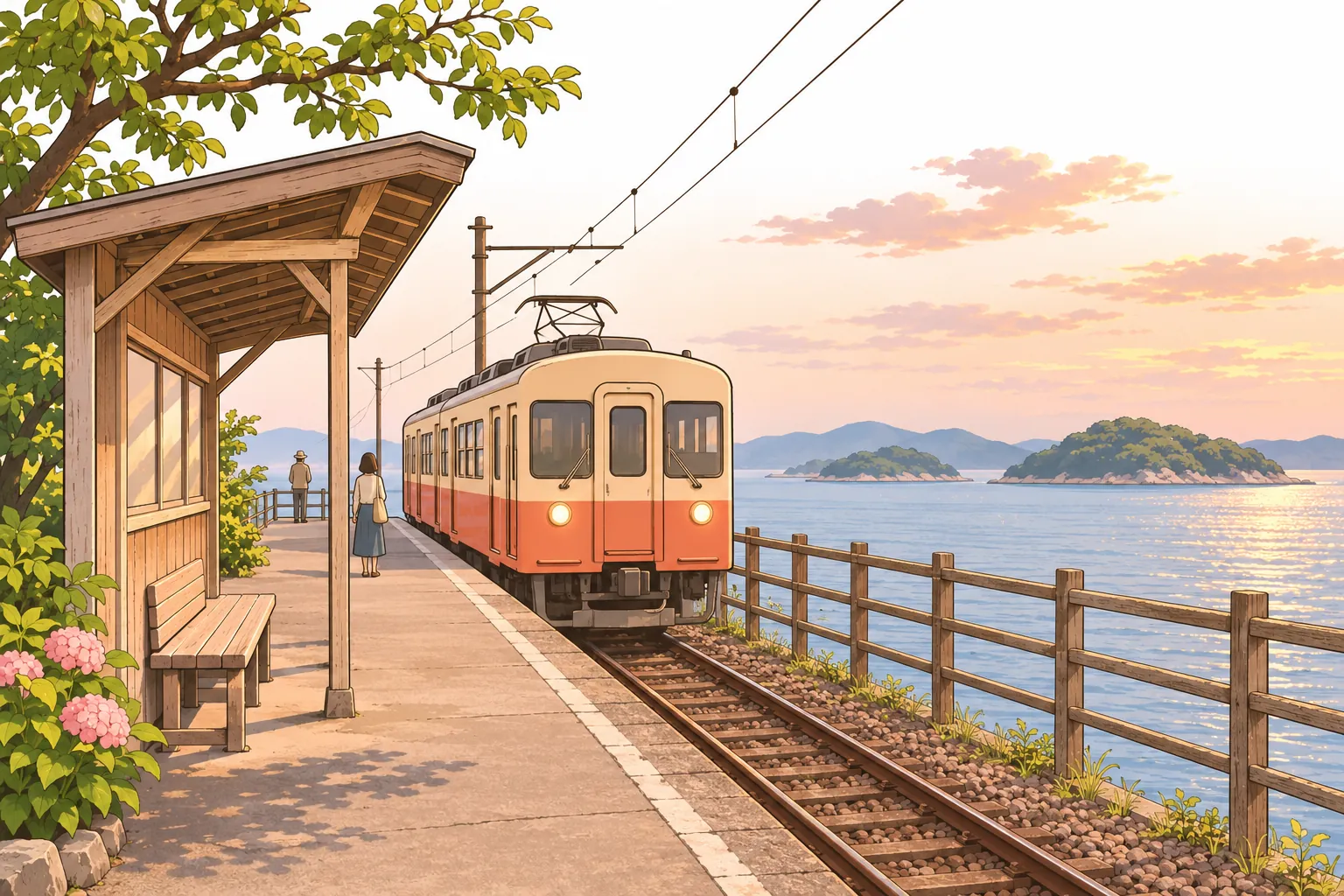
An unstaffed seaside station on the Seto Inland Sea, calm water beyond the platform rail as a short train arrives (illustration).
Through the 1990s, writers became stars in their own right. Nojima Shinji brought taboo subjects, including incest, abuse and suicide, into prime time with shows like Kōkō Kyōshi (High School Teacher, 1993). Kitagawa Eriko wrote Long Vacation (1996), in which Kimura Takuya and Yamaguchi Tomoko play two people stuck at a pause in their lives who end up sharing an apartment. Weekly magazines claimed that young office women disappeared from the streets on Monday nights while it aired. Kimura went on to headline hit after hit, including Love Generation and the prosecutor drama HERO, and became the face of Japanese drama for the next decade.
03Why Japanese Drama Looks the Way It Does
Several forces give dorama its particular texture.
The first is adaptation. A large share of Japanese dramas are based on manga or novels. Nodame Cantabile and Shinya Shokudō (Midnight Diner) came from manga; Shiroi Kyotō (The Great White Tower) from Yamasaki Toyoko’s novel about hospital politics; Hanzawa Naoki from Ikeido Jun’s banking novels. A manga has already tested its characters on an audience, so adapting one lowers the risk and delivers ready-made fans. The same story frequently passes through manga, anime, live-action drama and film, each version feeding the others.
The second is the writer. Japanese television treats the screenwriter, or kyakuhonka, as the main creative author, and audiences follow certain names. Sakamoto Yūji, who adapted Tokyo Love Story, later wrote Saikō no Rikon (The Best Divorce) and Quartet, dramas in which characters talk around their feelings over dinner or in a car until something true slips out. Kudō Kankurō’s morning serial Amachan (2013), about a teenage girl who becomes a free diver in a small town in Iwate and then a pop idol, turned regional life and the aftermath of the 2011 earthquake into warm, fast comedy. Kosawa Ryōta’s Legal High (2012) is built on machine-gun dialogue from Sakai Masato as an amoral, brilliant lawyer. Nogi Akiko, writer of Unnatural (2018) and MIU404, wraps social issues inside tightly plotted genre stories.
The third is casting. For decades male leads came overwhelmingly from Johnny & Associates, the talent agency behind boy bands such as SMAP and Arashi. Kimura Takuya, Matsumoto Jun and Ninomiya Kazunari all moved from pop stardom to acting. Networks got guaranteed viewers; the agency got exposure for its idols. That arrangement weakened sharply in 2023, when the agency admitted that its late founder, Johnny Kitagawa, had sexually abused young trainees over many years. The company renamed itself and split its businesses, and broadcasters and sponsors reconsidered their ties to it.
The fourth is the production system. Japanese dramas are made quickly and cheaply by international standards. Shooting often continues while early episodes are already on air, and scripts may still be in progress. Budgets rarely allow for spectacle, so most dramas live in apartments, offices, hospitals and Tokyo streets. The result leans on writing and performance, and on small physical details: a shared meal, a commute, a scene on a riverbank at dusk.
Genre preferences follow from all this. Japan has a deep appetite for shokugyō or "profession" dramas that take viewers inside a trade. Medical shows include The Great White Tower, Iryū (Team Medical Dragon) and Doctor-X, in which Yonekura Ryōko plays a freelance surgeon who refuses any duty that does not require a medical license. Police shows include Odoru Daisōsasen (Bayside Shakedown) and the long-running Aibō. There are dramas about chefs, editors, pilots, bankers and convenience-store managers. Audiences enjoy learning the rules of a profession and watching someone hold on to their principles inside a hierarchy. Romances and family dramas, meanwhile, often avoid big melodramatic swings and instead stay with small moments, letting a silence at the dinner table carry the weight.
Music completes the package. A drama’s theme song, sung by a major artist, has been a key promotional tool since the 1990s, and many million-selling singles of that decade were drama tie-ins. In 2016, Hoshino Gen’s song "Koi" for Nigeru wa Haji da ga Yaku ni Tatsu (We Married as a Job!), paired with an ending sequence in which the cast dances, set off a nationwide craze of people copying the "Koi Dance."
04Beyond Japan
Japanese drama reached Asian audiences long before streaming. In China, Akai Giwaku, the volleyball drama Moero Attack, and NHK’s Oshin were broadcast in the 1980s and watched by enormous audiences. Oshin (1983–84), the story of a girl from a poor farming family who rises through hardship from the Meiji era to the postwar years, reached an episode rating above 60 percent in Japan and was eventually shown in dozens of countries, from Iran to Thailand.
In the 1990s, Tokyo Love Story and other trendy dramas became huge in Taiwan, Hong Kong and mainland China, spreading through broadcast and videotape. Taiwan coined the word hari for young fans obsessed with Japanese pop culture. In the 2000s, fan subtitling groups put Chinese subtitles on new episodes within hours of their Japanese broadcast, and university dorms across China followed Nodame Cantabile, 1 Rittoru no Namida (One Liter of Tears) and Proposal Daisakusen.
In 2013 Hanzawa Naoki, about a bank employee fighting corrupt superiors, became a phenomenon. Sakai Masato’s catchphrase, "Baigaeshi da!" ("I’ll pay you back double!"), was named one of the year’s top buzzwords, and the final episode drew a rating of 42.2 percent in the Kantō region, among the highest for any drama this century. Korean drama overtook Japanese drama in international popularity from the 2000s on, helped by government support and aggressive export, but Japanese shows kept a loyal audience that values their brevity and restraint.
05Drama Today
Live television viewing has declined steadily in the twenty-first century, and the once-mighty Monday-nine slot has lost much of its pull. One response has been the late-night drama. Slots after 11 p.m. come with small budgets and fewer constraints, which has made room for odd, personal work. TV Tokyo’s Kodoku no Gurume (Solitary Gourmet), adapted from a manga written by Kusumi Masayuki and drawn by Taniguchi Jirō and launched in 2012, follows Inogashira Gorō, a self-employed importer played by Matsushige Yutaka, as he eats alone at real neighborhood restaurants, narrating his thoughts about each dish. Almost nothing happens, and it has run for more than a decade. Ossan’s Love (2018), a romantic comedy about male coworkers, began in a late-night slot and became a national talking point.
Streaming has also changed the business. The networks jointly operate TVer, a free service that streams recent episodes for a week or so after broadcast. Netflix and Amazon have commissioned Japanese series, including First Love (2022), a romance spanning two decades built around Utada Hikaru’s songs. Online views and social-media buzz now sit beside household ratings as measures of success.
The relationship between drama and its source material came under scrutiny in 2024, after the creator of a manga adapted for television died following a public dispute over changes to her story. The case led networks and publishers to revisit how they consult original authors.
NHK’s two long forms remain fixtures. As of 2026, the morning serial airs at 8 a.m. on weekdays in 15-minute episodes, and many households still watch it over breakfast; its lead actress, often a newcomer, can become famous overnight. The taiga drama, which began in 1963 with Hana no Shōgai, cycles through samurai warlords, late-Edo revolutionaries and, increasingly, less obvious figures. Each year the hometown of the protagonist sees a rush of visitors.
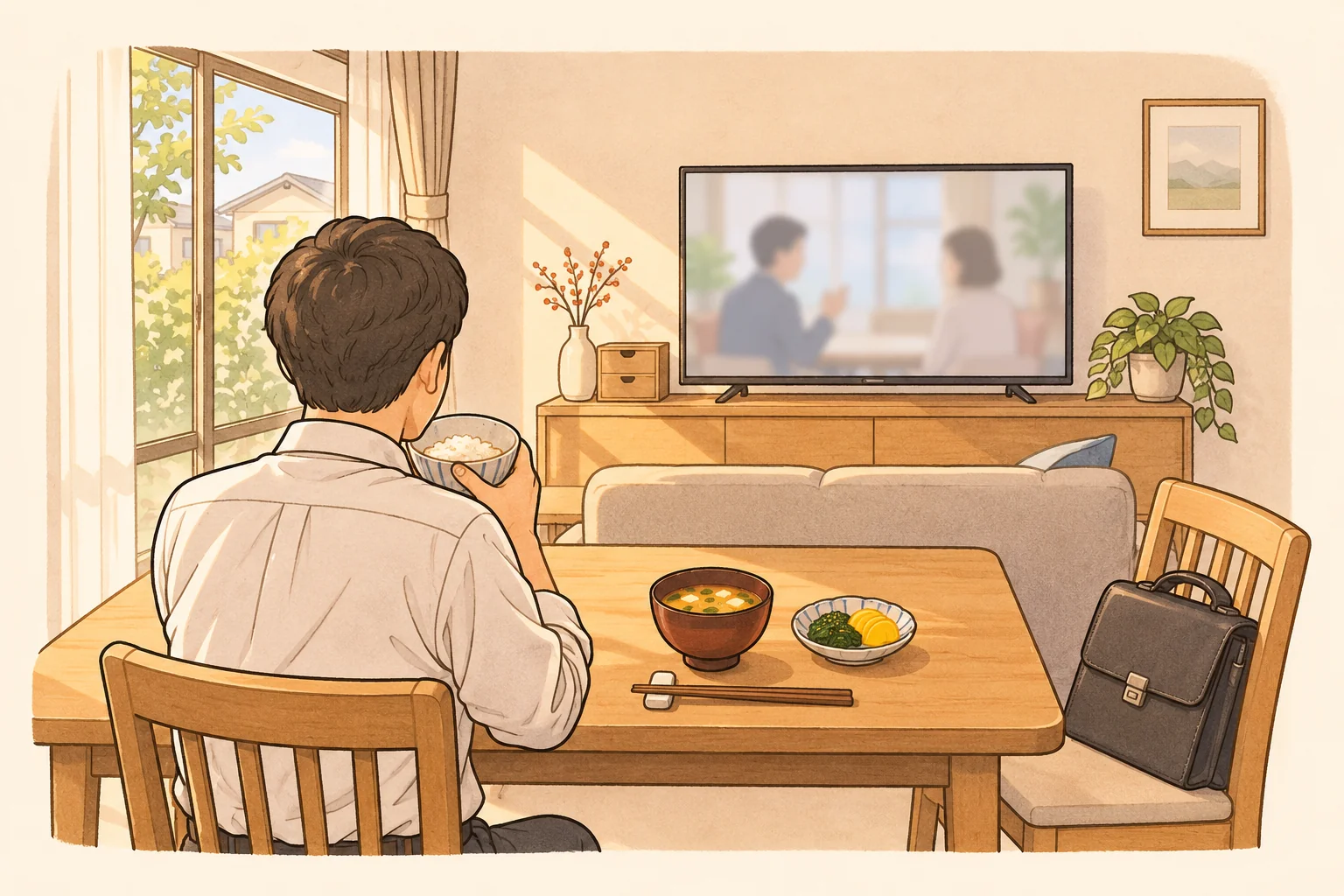
A weekday breakfast table with the television on. The morning serial runs in 15-minute episodes, and many households watch over breakfast.
06Finding Dorama in Japan
The easiest way to meet Japanese drama is in a hotel room. Prime-time dramas air mostly at 9 and 10 p.m. on weeknights, and flipping through the channels will turn one up. Without subtitles the dialogue can be hard to follow, but the visual grammar of Japanese drama is direct: faces, gestures and settings carry a great deal. TVer can be used on a phone while you are in Japan, though it generally blocks access from abroad.
Many dramas are filmed in real places, and fans visit them. Baishinji Station in Ehime, where Tokyo Love Story stages one of its farewells, still draws visitors decades later. The small restaurants in Solitary Gourmet are real businesses, and some fans work through them one by one. Towns that host a morning serial or taiga drama often open temporary exhibition halls with costumes and sets, and their stations and shopping streets hang posters of the cast.
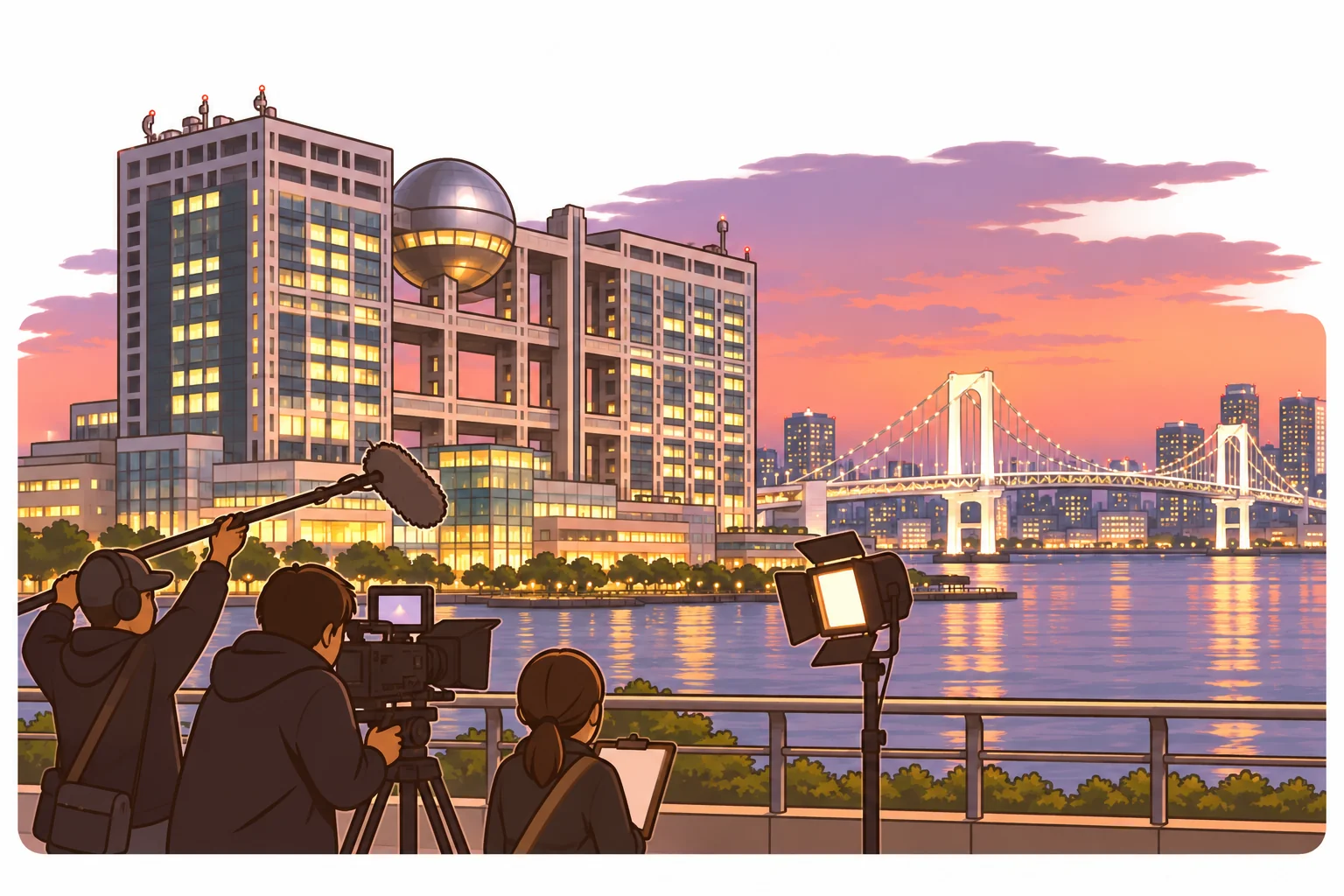
In Tokyo, Fuji TV’s headquarters at Odaiba, designed by Tange Kenzō, with its silver sphere suspended between two towers, has appeared in countless dramas since it opened in 1997. The observation deck inside the sphere remains open to the public as of 2026 and looks out over Tokyo Bay and the Rainbow Bridge, the backdrop of the city that the trendy dramas sold to a generation.
Finally, dramas are a practical way to learn how Japanese is actually spoken. Workplace shows are full of honorifics and office phrases; family dramas offer casual speech and regional dialects. Plenty of learners outside Japan began with a favorite show and a catchphrase, and worked their way toward understanding the rest.