
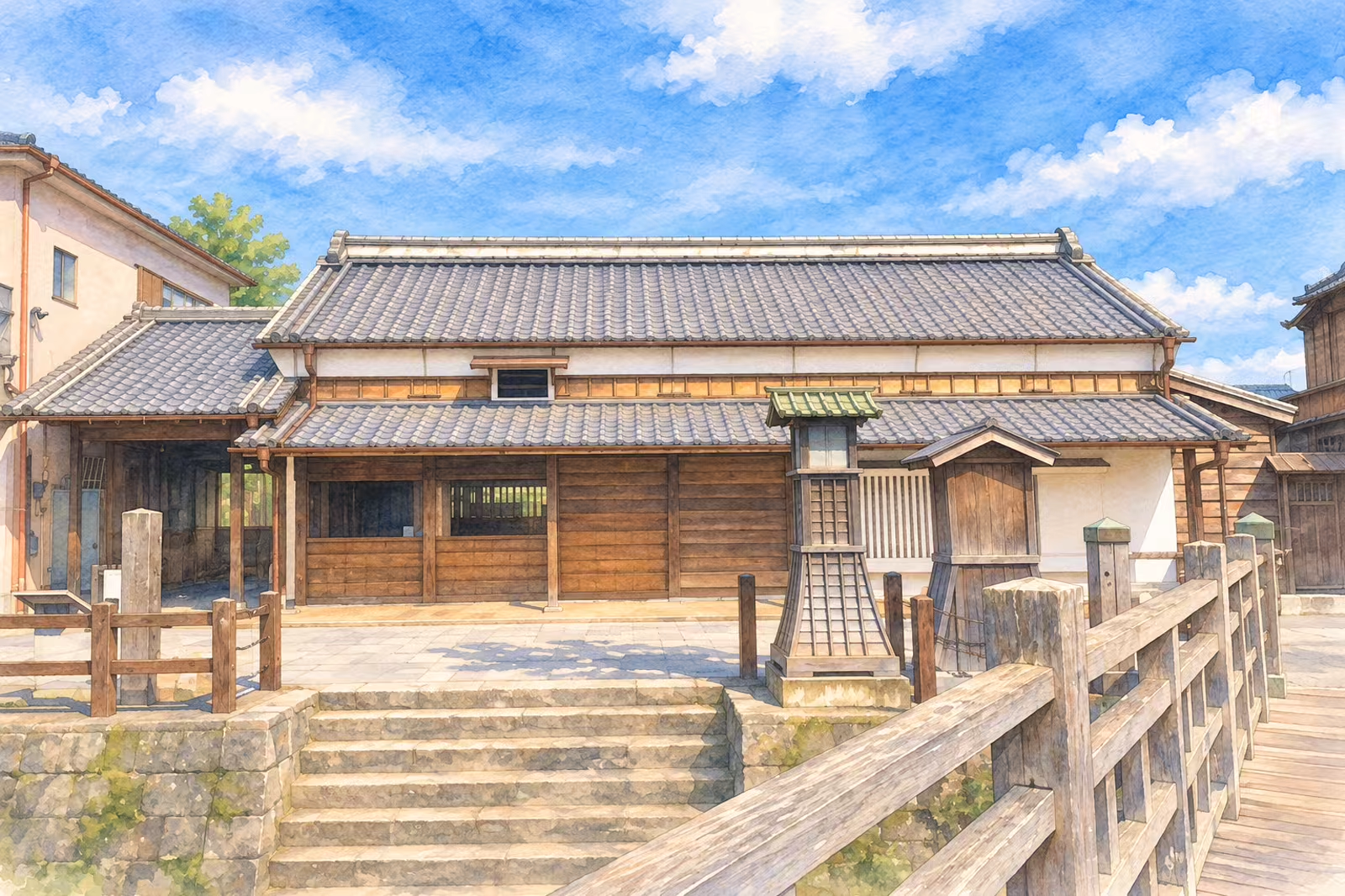
The Inō Tadataka Residence and the Inō Tadataka Memorial Museum face each other across the Onogawa River in Sawara, now part of Katori City, Chiba Prefecture. Inō Tadataka (1745–1818) spent about three decades here as a merchant and village leader. Only after retiring around the age of 50 did he go to Edo to study astronomy and calendar science, and in his later years he surveyed the coasts of Japan, producing the first maps of the whole country based on actual measurement. The residence preserves the merchant life of his first career; the museum holds the results of his second.
01A Merchant Head of House
Tadataka was born in the Kujūkuri coast area of Kazusa Province. In 1762, at 17, he married into the Inō family of Sawara as an adopted heir. Sawara was a river port on the Tone River system, and the Inō house dealt in sake brewing, rice trading, and river transport. Tadataka put the business in order and greatly increased the family’s wealth. He also served as village headman and distributed rice to local people during the Tenmei famine of the 1780s. In 1794 he handed the house to his eldest son, and the following year he moved to Edo to study under Takahashi Yoshitoki, a shogunal astronomer 19 years his junior.
02Surveying the Country
In 1800 Tadataka received shogunal permission to survey the southern part of Ezo, present-day Hokkaidō. Between then and 1816 he led ten survey expeditions along the coasts of Japan, and the later ones were carried out on direct orders from the shogunate. He fixed positions by pacing, measuring ropes, and astronomical observation, checking the results repeatedly. He died in Edo in 1818 at the age of 73. His students and the shogunal astronomers finished the work, and the Great Map of Japan’s Coastal Areas was presented to the shogunate in 1821.
03What You Can See Today
The residence stands on the riverbank and includes a shop front, kitchen, study wing, and storehouse. The study wing is said to have been designed by Tadataka himself and rebuilt around 1793. The residence is a National Historic Site. The memorial museum across the river opened in 1998 and displays survey instruments, maps, survey diaries, and letters; this collection was designated a National Treasure as a group in 2010. The surrounding Onogawa riverside and old main street keep merchant buildings from the Edo period to the early Shōwa era and form a nationally designated Preservation District for Groups of Traditional Buildings.