
At a glance
How the thirteen-string koto is tuned with movable bridges, how blind kengyō musicians made it an independent art, and how Miyagi Michio modernized it.
- A standard koto is about 180 cm long, with 13 strings each resting on a movable bridge that is shifted to tune it.
- The koto arrived with Tang court music in the Nara period; in the seventeenth century the blind musician Yatsuhashi Kengyō made it an independent art for ordinary listeners.
- From the mid-Edo period it divided into the Ikuta school, played at an angle with square picks, and the Yamada school, played facing the instrument with rounded picks.
- Miyagi Michio introduced the seventeen-string bass koto in 1921 and wrote Haru no Umi, a koto and shakuhachi duet, in 1929.
- Since 2002 Japanese junior high schools have had to teach traditional instruments, and many chose the koto.
If you are in Japan over the New Year holidays, you will hear the same piece of music again and again: in department stores, hotel lobbies, train stations and on television. It is Haru no Umi ("The Sea in Spring"), a duet for koto and shakuhachi flute written in 1929 by a blind composer named Miyagi Michio. The koto itself, a long zither laid flat on the floor, is the instrument most visitors picture when they think of traditional Japanese music. It began as one voice in the imperial court orchestra, became a solo art in the hands of blind professional musicians, turned into a respectable accomplishment for young women, and was finally pulled into the age of radio and records. This is an introduction to how the koto works, where its music comes from, and why it still sounds like Japan.
01What a Koto Is
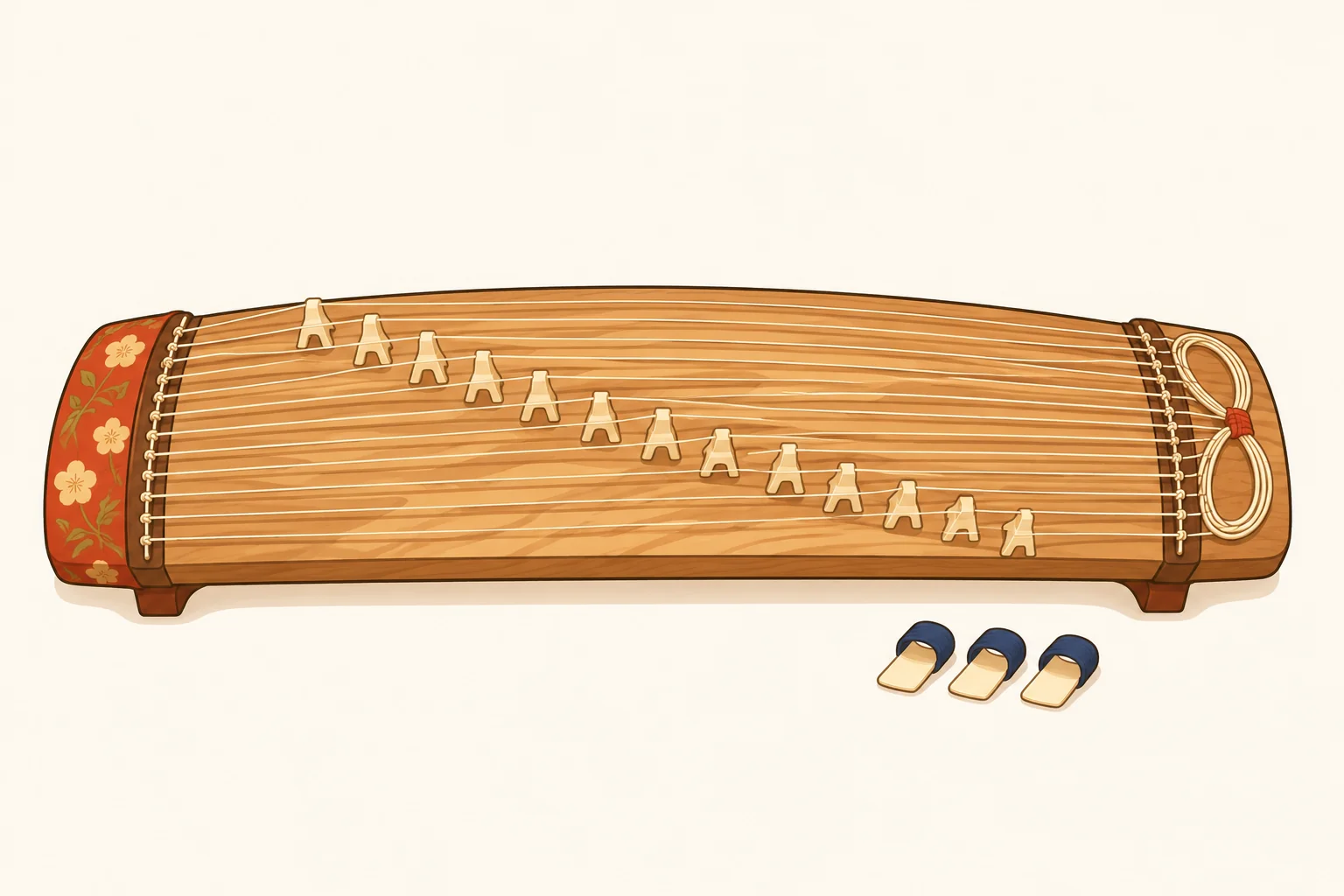
A standard koto is about 180 centimeters long, roughly the height of a tall man, and a little over 20 centimeters wide. The body is hollowed from a single piece of paulownia wood (kiri), a light, resonant timber also used for fine chests. The top is gently arched, and thirteen strings run along its full length. They were once silk; most players now use polyester or nylon, which lasts longer and holds its tuning better.
What makes the koto distinctive is the bridges. Under each string sits a movable bridge called a ji, shaped like a small inverted V. Sliding a bridge toward one end or the other shortens or lengthens the vibrating part of the string, and so sets its pitch. Nothing about the koto’s scale is fixed in the instrument itself. Before each piece, the player arranges the thirteen bridges into the pattern the music requires. A tuned koto shows them as a slanting line across the top, like a skein of wild geese in flight, and in Chinese and Japanese verse the bridges have long been called "goose bridges," and Japanese poems are said to liken them often to a line of geese.
- 1
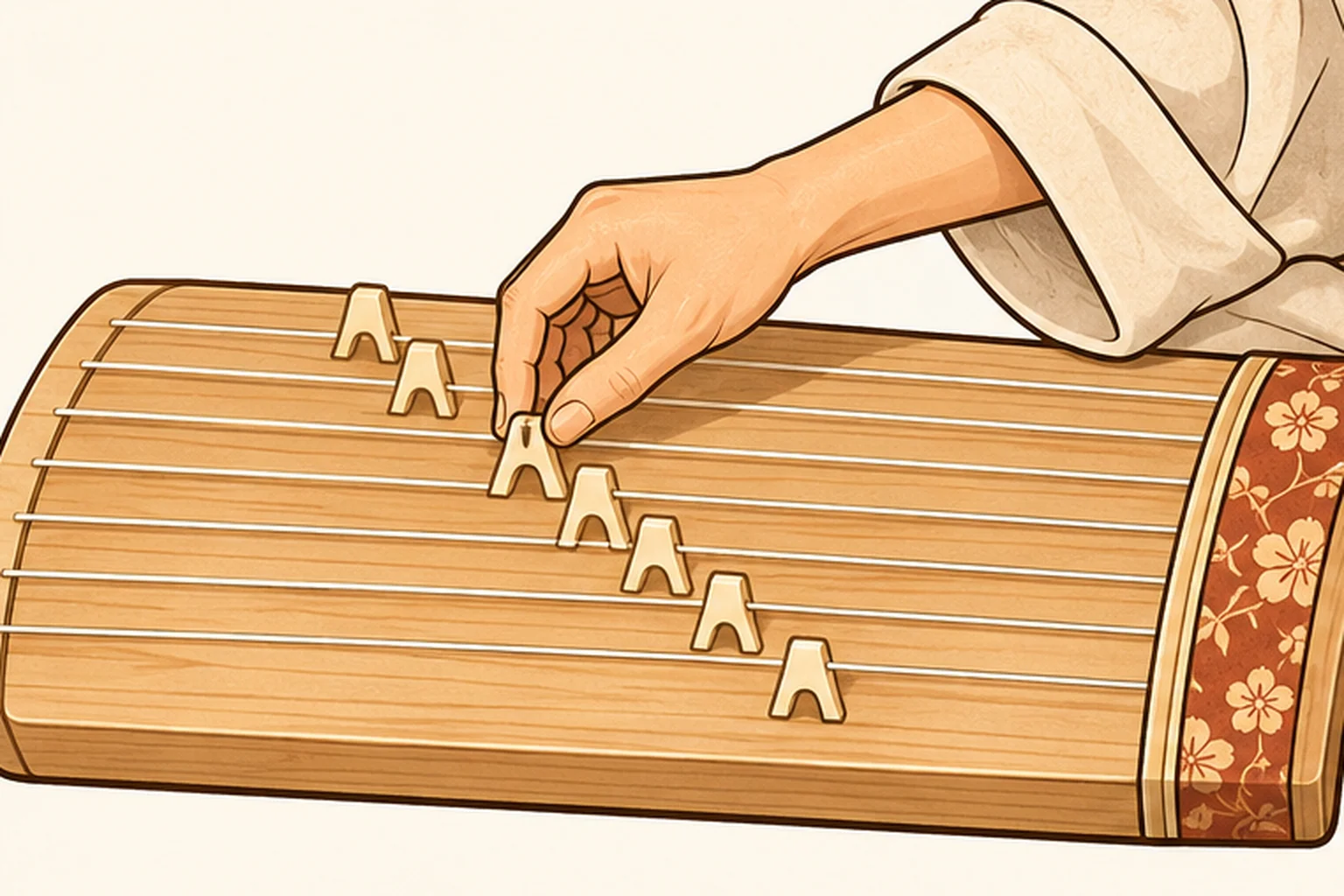 Before a piece, each movable bridge, or ji, is slid along its string to set the pitch.
- 2
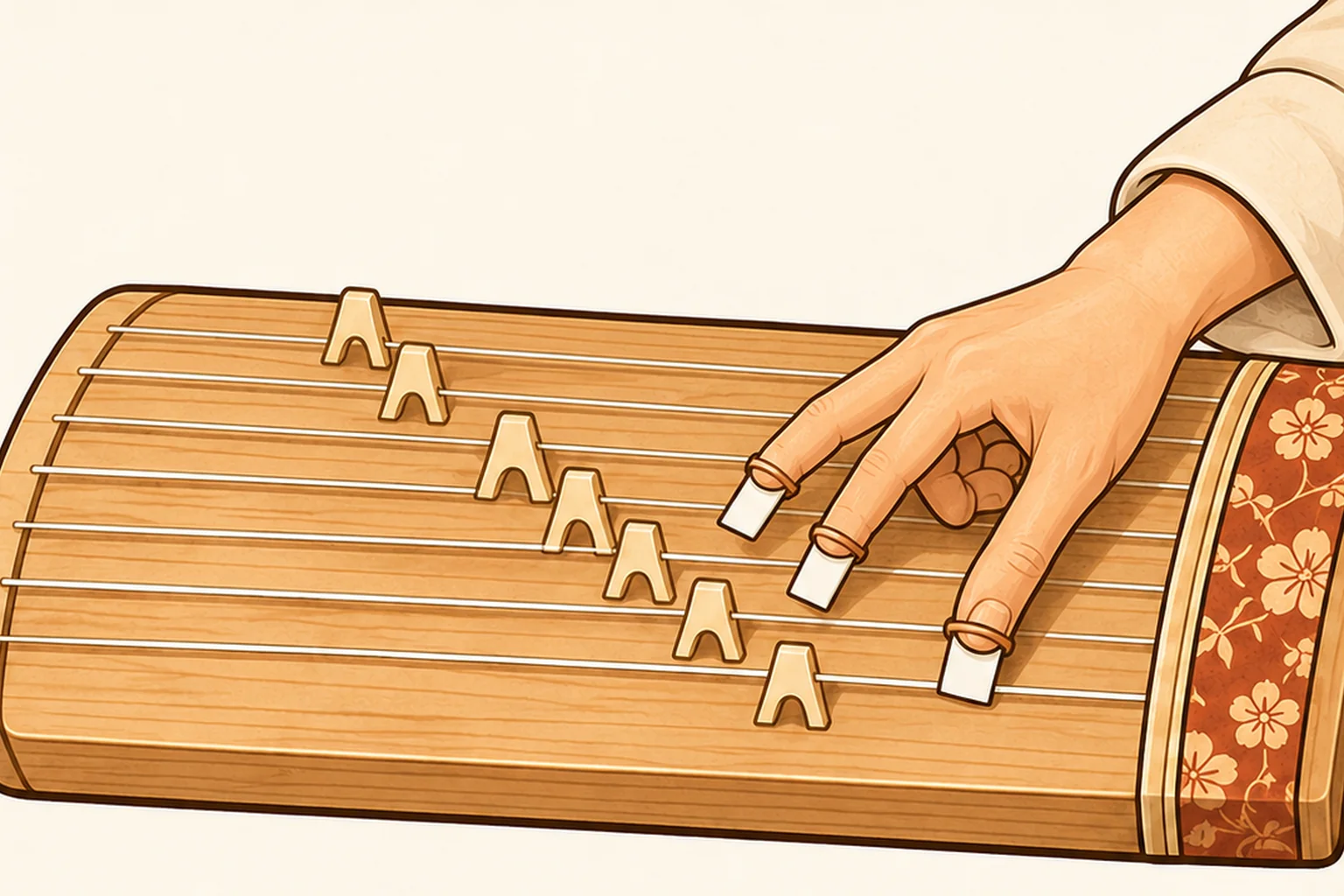 The right thumb, index and middle fingers each wear a pick called a tsume.
- 3
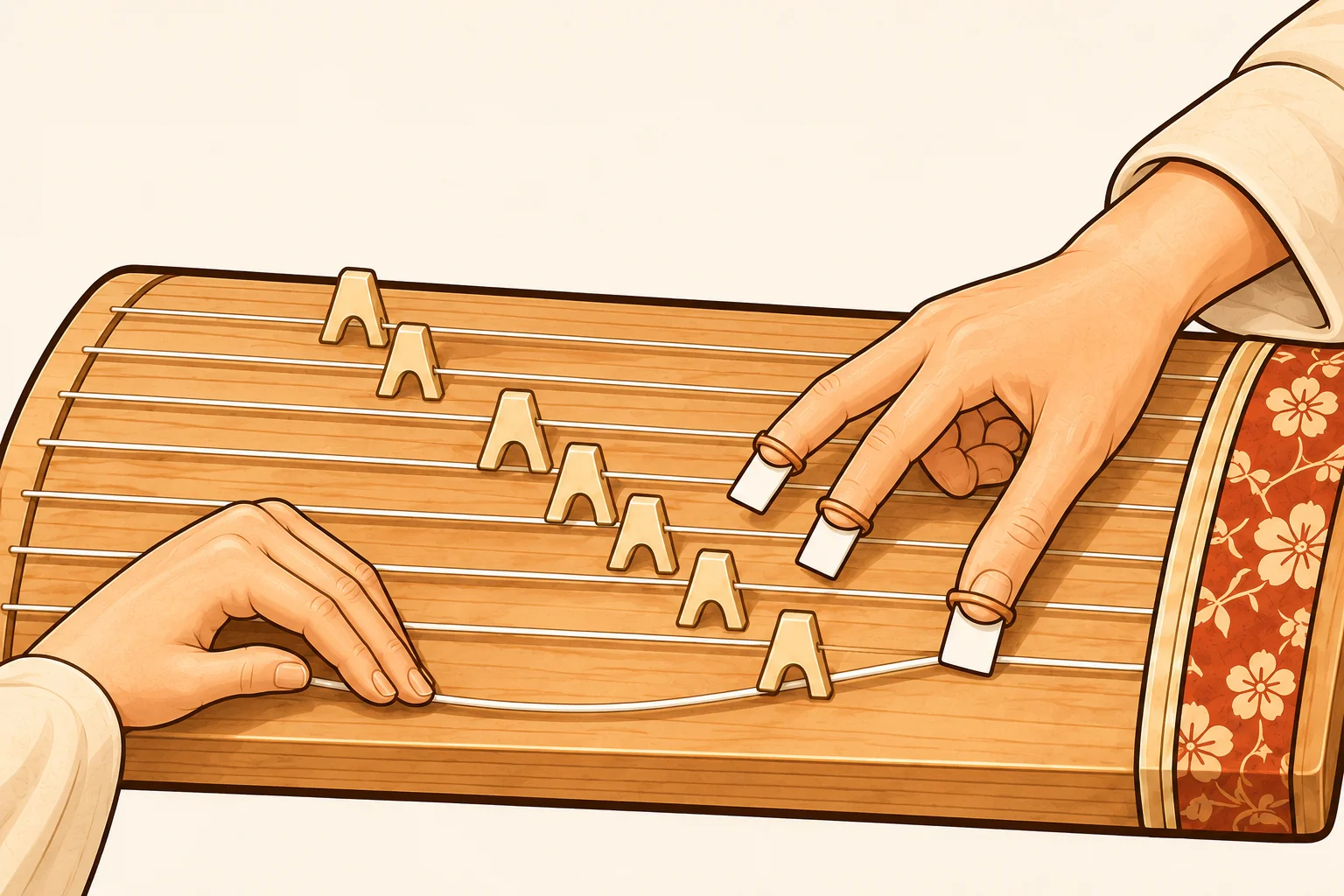 The bare left hand presses the string on the other side of the bridge, raising the pitch a half or whole step.
The player wears three picks, called tsume, on the thumb, index and middle fingers of the right hand. They are small sleeves of leather or plastic tipped with ivory or a substitute. The left hand stays bare. It works on the other side of the bridges, pressing strings down to raise their pitch by a half step or a whole step, or pressing and releasing after a note is struck so that the sound bends upward or wavers. Much of the koto’s character lives in this left hand. A note is plucked, the left hand leans on the string, and the tail of the sound lifts like a voice. A piano cannot do this.
- 1Bodyone piece of paulownia, about 180 cm long, a little over 20 cm wide
- 2Stringsthirteen; once silk, now mostly synthetic
- 3Bridges (ji)one under each string; sliding it sets the pitch
- 4Picks (tsume)right thumb, index and middle fingers
- 5Left handpresses on the other side of the bridges, a half or whole step
Nothing about the koto’s scale is fixed in the instrument; before each piece the player arranges the thirteen bridges.
The most common tuning is hirajōshi, a five-note scale containing two half steps. To most ears it sounds cool, slightly melancholy and unmistakably Japanese; it is the scale that film composers reach for when they want a few seconds of "Japan." Readers who know the Chinese guzheng will see the family resemblance, and the two do share an ancestor in the zithers of Tang-dynasty China. But they have spent well over a thousand years apart. The guzheng gained strings, settled into pentatonic scales without half steps and developed elaborate left-hand vibrato. The Japanese koto kept its thirteen strings and grew an entirely Japanese repertoire.
A note on names: Japanese people often write koto with the character 琴, but strictly speaking that character refers to a different, bridgeless zither related to the Chinese qin, which is rarely played in Japan today. The correct character for the instrument with bridges is 箏. In everyday speech nobody minds; "I’m learning koto" means this instrument.
02From the Court to the Blind Masters
The koto arrived in Japan in the Nara period, in the 700s, as part of the court music imported from Tang China. In gagaku, the imperial ensemble music, it is called the gakusō, and its job is modest: it plays set arpeggio patterns that mark the rhythm and support the melody carried by the winds. Heian aristocrats also played it privately. In The Tale of Genji, written around 1000, characters reveal their refinement, or lack of it, through how they play and listen to stringed instruments, and the koto appears again and again.
The koto became an independent art, with its own songs and solo pieces, in Kyūshū. In the sixteenth century a Buddhist priest named Kenjun, of the temple Zendō-ji in Kurume in northern Kyūshū, organized a body of songs accompanied by koto known as Tsukushi-goto, after the old name for the region. It was a closely guarded tradition, taught within temples and among samurai and scholars.
In the seventeenth century a blind musician known as Yatsuhashi Kengyō studied Tsukushi-goto in Edo with a teacher from Kenjun’s line, and remade it. He adopted the hirajōshi tuning, closer to the popular music of his day, and composed new works that ordinary listeners could enjoy. He is generally regarded as the founder of the modern koto tradition, and the most widely played classical piece, Rokudan no Shirabe ("Music in Six Sections"), is traditionally attributed to him. It has no singing. Each of its six sections has 52 beats (the first has 2 more), and each section starts slowly and gradually speeds up. Almost everyone who studies koto learns it. His grave is at Jōkō-in, a subtemple of Konkai Kōmyō-ji in the Kurodani area of Kyoto, where a memorial service is held every year on June 12, the anniversary of his death; koto players reportedly also go there around that date to perform in his memory. Kyoto also remembers him in a sweeter way: yatsuhashi, the city’s best-known souvenir confection, is a cinnamon cracker curved like a koto, and the shops that make it say it was named in his honor.
Kengyō was not a name but a rank. In the Edo period, blind men could join a guild called the Tōdōza, which held a legal monopoly over certain trades under shogunate protection: acupuncture, massage, moneylending and music. Kengyō was the highest of its many grades. For two centuries, the professional teaching of koto, shamisen and the bowed kokyū was largely in the hands of these blind musicians. They learned by ear and taught from memory, and notation came late. How a piece was played depended on who had taught it, which is one reason the schools of koto still differ so much in detail.
03Two Schools, Two Ways of Sitting
By the end of the eighteenth century the koto world had divided into the two schools that still dominate it.
The Ikuta school grew up in Kyoto and Ōsaka and traces itself to Ikuta Kengyō, active in the late seventeenth century. Musicians in the Kansai region were also masters of the three-stringed shamisen, and they joined the two instruments in a genre called jiuta-sōkyoku. The shamisen carries the melody and the singing, while the koto weaves around it, adding ornaments and answering phrases; long instrumental interludes show off technique. Ikuta players use square-tipped picks and sit at an angle to the instrument, which lets them use the corner of the pick to scrape and strike the strings for a crisp, textured sound.
The Yamada school came out of Edo, modern Tokyo, founded by Yamada Kengyō in the late eighteenth century. Edo audiences loved stories and singing, and Yamada drew on the narrative chanting styles popular in the city. In his music the lyrics matter, and the koto is the lead instrument rather than a partner. Yamada players use rounded picks and sit squarely facing the koto, producing a fuller, rounder tone.
Today the Ikuta school is far larger and is found all over Japan; the Yamada school is centered on Tokyo and the Kantō region. At a concert, the simplest way to tell them apart is posture. If the player sits at a slant, it is Ikuta. If she faces the instrument straight on, it is Yamada. The two schools also use different notation and different names for the same techniques, so a player switching from one to the other has a good deal to relearn.
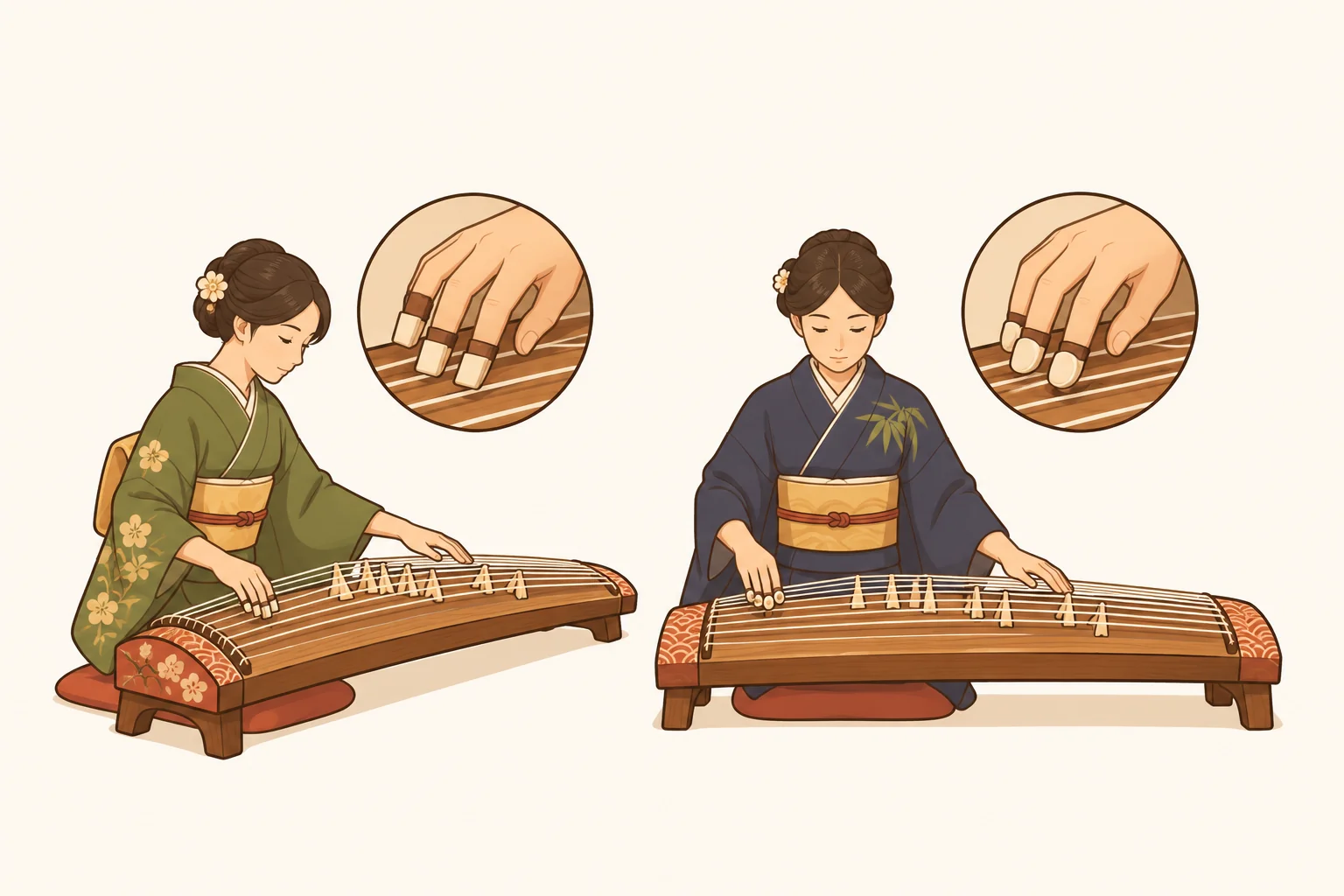
Ikuta players sit at an angle with square-tipped picks; Yamada players face the koto squarely with rounded picks.
04Miyagi Michio: The Bass Koto, the Ensemble and the Radio
The Meiji era upended the koto’s world. In 1871 the new government abolished the Tōdōza, and blind musicians lost both their organization and their privileges. At the same time Western music became the standard in schools, and native instruments were cast as relics. Yet the koto found another life. It was quiet and dignified, played kneeling in a graceful posture, and it became one of the okeikogoto, the cultivated accomplishments a middle-class or wealthy daughter was expected to acquire before marriage, alongside tea ceremony and flower arranging. Students multiplied, but the music retreated into parlors and teachers’ studios.
The man who opened the doors again was Miyagi Michio. Born in Kōbe in 1894, he developed an eye disease in infancy and was completely blind by about the age of eight, when he began formal study of Ikuta-school koto. As a teenager he moved with his family to Korea, then under Japanese rule, and supported them by teaching koto in Incheon and Seoul. He wrote his first composition, Mizu no Hentai ("Transformations of Water"), at fourteen. In Korea he heard a great deal of Western music, from military bands to church hymns, and when he settled in Tokyo around 1917 he came with a clear conviction: the koto should not be limited to old pieces. It should be able to play new music, in ensembles, with the expressive range of a Western instrument.
His first problem was range. The thirteen-string koto has little in the bass, so in ensemble music nothing anchors the bottom of the sound. In 1921 Miyagi introduced the jūshichigen, a seventeen-string bass koto with a larger body and heavy strings, designed to play the role a cello or double bass plays in an orchestra. It caught on and has become standard; almost every koto ensemble in Japan today includes one. He also experimented with an enormous eighty-string koto and with smaller instruments. The eighty-string koto proved too unwieldy to survive, but it shows what he was after: a whole family of kotos, in different sizes and registers, like the string section of an orchestra.
His second project was composition. Miyagi brought Western harmony, rhythm and form into koto writing. He wrote ensembles for koto, bass koto, shakuhachi and shamisen, and works pairing koto with Western orchestra. In 1920 he and the composer Motoori Nagayo gave a joint concert of their works at the Yūrakuza theater in Tokyo, and the shakuhachi player Yoshida Seifū named the event Shin Nihon Ongaku, "New Japanese Music." The name stuck and came to stand for the whole movement to modernize traditional instruments.
His third and most far-reaching move was to embrace new media. Japanese radio broadcasting began in 1925, and Miyagi soon became a regular presence on the air. Record companies recorded him extensively. For the first time, koto music reached people who had never set foot in a teacher’s studio or a concert hall.
Haru no Umi came out of this moment. Miyagi wrote it in 1929 on the theme set for the imperial New Year poetry gathering of 1930, "Rocks by the Sea." The duet pictures the Inland Sea in spring: the swell of waves, the creak of oars, the calls of seabirds. It is said to draw on his memory of a boat trip across the Inland Sea, and the harbor town of Tomonoura, near Fukuyama, is often named as the scene the piece evokes; by one account it draws on a boyhood visit to the Tomonoura area. A few years later the French violinist Renée Chemet, touring Japan, heard the piece, arranged the shakuhachi part for violin and recorded it with Miyagi. The record was released abroad, and Haru no Umi became one of the best-known pieces of Japanese music outside Japan. At home it has become the sound of the New Year itself. Many Japanese people could not tell you its title, but hearing the first bars, they know what season it is.
Miyagi was also a gifted essayist, and collections such as Ame no Nenbutsu are still read. In 1956 he fell from the door of an overnight train and was killed, at the age of 62. On the site of his home in Nakamachi, in Tokyo’s Shinjuku ward, the Miyagi Michio Memorial Hall opened in 1978, the first museum in Japan devoted to a musician. It holds his instruments, manuscripts and recordings, reportedly including an early seventeen-string bass koto.
05The Koto Today
Since the Second World War the koto has moved in two directions at once. The classical schools continue to teach, grant licenses and hold recitals, and the old pieces, Rokudan, Chidori no Kyoku and the great jiuta songs, pass from one generation to the next. Alongside them a contemporary repertoire has grown up. New instruments with twenty and then twenty-five strings appeared in the second half of the century, largely through the work of the performer Nosaka Keiko, and composers write specifically for them. Younger players arrange pop songs, anime themes and jazz for koto and find large audiences online.
The koto also entered the schools. Since 2002, Japanese junior high school music classes have been required to include traditional instruments, and many schools chose the koto. Once it is tuned, a beginner can pluck a string and get a beautiful sound right away. For many Japanese adults, the koto means a classroom full of instruments and a lesson spent on Sakura Sakura. New Year broadcasts, weddings and the background music of high-end Japanese restaurants keep the sound in daily life.
The koto as a bride’s accomplishment, however, has largely faded, and the number of students is much smaller than it was a few decades ago. Instrument makers and shops are fewer too. A fine paulownia koto can cost hundreds of thousands of yen or more, though practice instruments are far cheaper. The koto’s place today is a little like the violin’s in many Western households: everyone recognizes it, few keep playing it, and those who play it well are deeply respected.
06Hearing and Trying the Koto in Japan
The best way to hear the koto is at a recital. The various schools and associations hold regular concerts in civic halls across the country. Most programs feature Ikuta-school jiuta-sōkyoku, with koto and shamisen players seated side by side, the performers singing as they play. If it is your first time, watch for two things. Listen for the conversation between koto and shamisen, the way one instrument answers the other. And watch the player’s left hand, pressing and releasing the strings after each note to bend the sound into shape.
For Miyagi’s music, the New Year season is the obvious time. Haru no Umi is a fixture of New Year concerts. The Miyagi Michio Memorial Hall in Tokyo was closed for rebuilding as of 2026. The museum is modest in size, but when it is open, seeing the instruments he used up close makes his reforms easier to grasp; it has reportedly held small concerts and talks from time to time.
Kyoto, Tokyo and other tourist cities have short koto experience classes for visitors, usually about an hour. The teacher tunes the instrument in advance, then shows you how to put on the picks, how to sit and how to play a simple melody, often Sakura Sakura. Sitting down at a koto, you will notice how low it is. You kneel or perch on a low stool with your back straight, and the right hand sweeps through the string rather than hooking it upward. Most beginners play a recognizable tune within the hour, which is exactly why the koto became the classroom instrument of choice.
At some ryokan, the traditional inns, and at formal restaurants, a performer may be engaged to play a few pieces during dinner. There is no need to be stiff, but it is polite not to talk or take photos while the music is going on, and a light round of applause at the end is enough. If you have played yourself, the custom is to take off your picks, put them away in their little case, and thank your teacher.