
At a glance
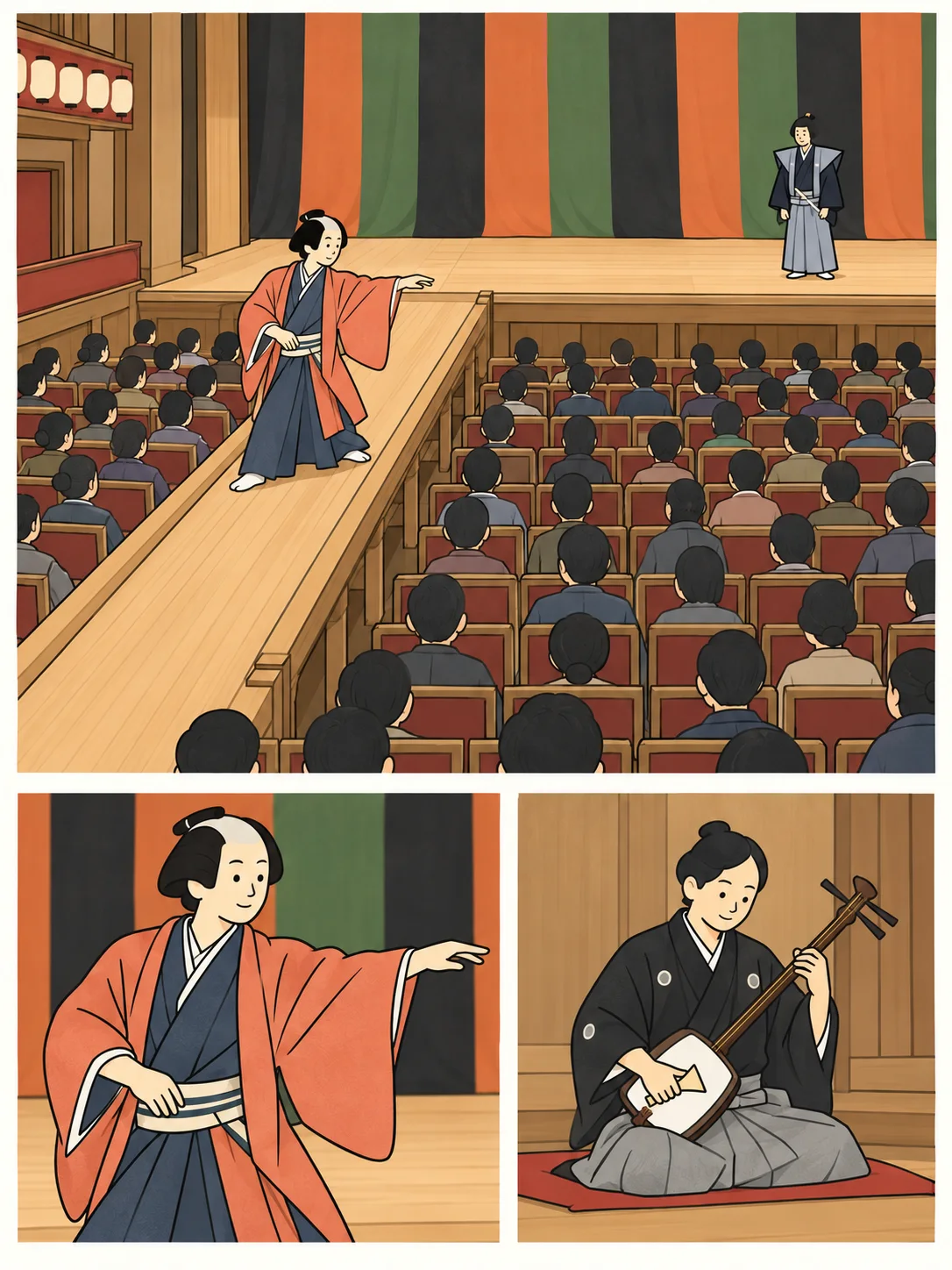
Why kabuki has painted faces, male actors in female roles, a runway through the audience and frozen poses, told through its history and the play Kanjinchō.
- Kabuki is usually dated from around 1603, when Okuni performed her "kabuki dance" in Kyoto.
- After women were banned from the stage in 1629 and boy troupes in 1652, only adult men performed, and the onnagata was born.
- In kumadori, red stands for justice and courage, indigo for coldness and evil, and brown for demons and spirits.
- The hanamichi runs from the stage through the audience to a curtain; actors often stop at the shichisan point to strike a pose.
- Today’s Kabukiza is the fifth building, opened in 2013, and almost exactly reproduces the look of the fourth.
Kabuki is Japan’s great popular theater: loud, colorful, all-male, and built for an audience that wanted spectacle as much as story. An actor in a costume weighing as much as a small child walks down a raised path through the seats, stops, snaps his head around and freezes with his eyes crossed, and someone in the top balcony bellows the name of his acting house. The form began as a scandalous dance on a Kyoto riverbank around 1603, grew into the favorite entertainment of the merchant towns of Edo-period Japan, and still plays nearly every month at the Kabukiza in Tokyo’s Ginza. This is a guide to where kabuki came from, why its strangest features exist, what happens in its best-loved play, and how to sit through an afternoon of it and enjoy yourself.
01A Dance Called "Leaning"
The three characters now used to write kabuki, meaning song, dance and skill, are a later and more respectable spelling. The word comes from the verb kabuku, "to lean" or "to tilt," which by the late sixteenth century meant to be off-kilter in the social sense: outlandish, flamboyant, defiant of convention. Kyoto’s streets at the end of the civil-war era had young men called kabukimono, "tilted ones," who wore loud clothes, carried absurdly long swords and picked fights. Kabuki first meant something done in their style: fashionable, a little dangerous, new.
The usual starting date is 1603, the year Tokugawa Ieyasu became shogun. Around then a woman named Okuni, who claimed to be a shrine maiden from the great shrine at Izumo, began performing on temporary stages near the Kitano shrine and on the dry riverbed of the Kamo River at Shijō in Kyoto. Her most famous number had her dressed as a dashing kabukimono, sword on hip, visiting a teahouse to flirt with a courtesan, all set to the popular songs of the day. Kyoto loved it. Almost nothing reliable is known about Okuni’s life, including whether she really came from Izumo or how she died, but she became the founding legend of kabuki, and a bronze statue of her stands by the river near the Minamiza theater today.
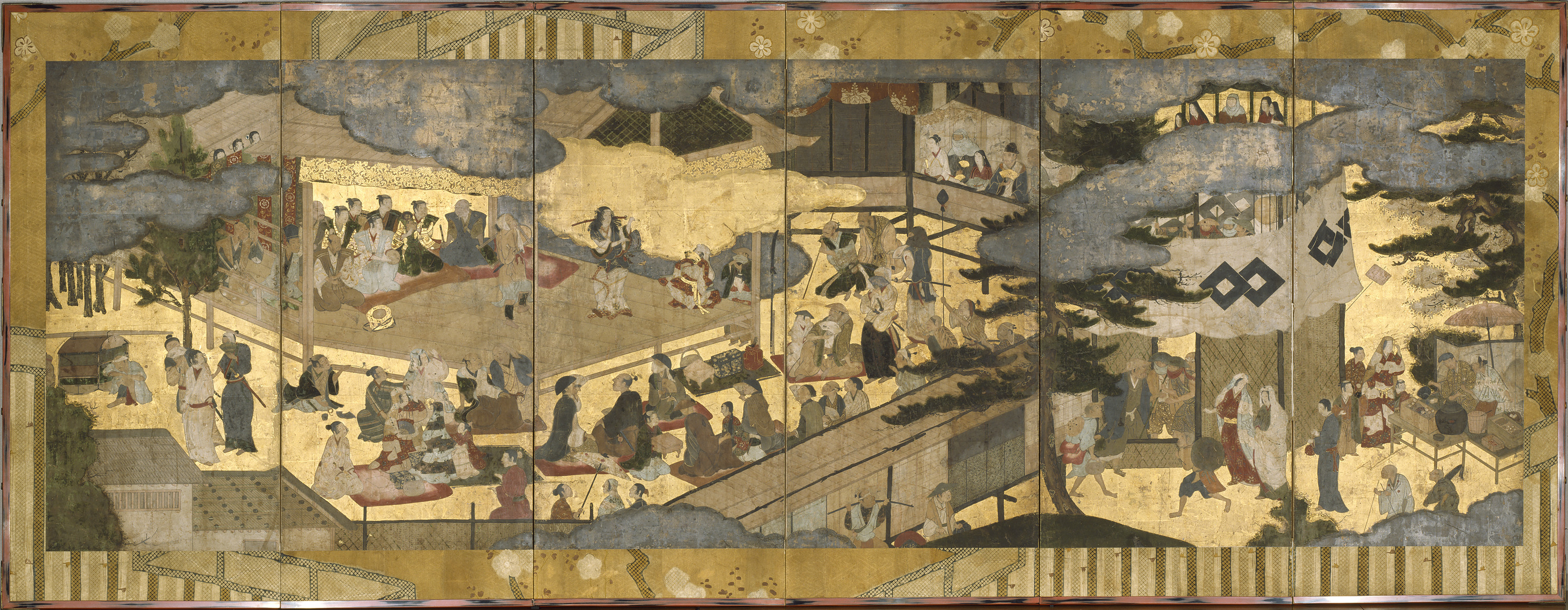
Okuni Kabuki screen, 17th century: a sword-carrying performer on stage, surrounded by spectators.Kyoto National Museum, Screen of Okuni Kabuki (artist unknown, 17th century)
Her act was copied almost at once, and brothels found that putting their women on stage was excellent advertising. This "women’s kabuki" blurred performance and prostitution, drew samurai into brawls over favorite performers, and worried a new shogunate that prized order. In 1629 women were banned from the stage. Troupes of adolescent boys took over, the same problems followed, and "young men’s kabuki" was banned in 1652. After that, the authorities allowed only adult men, with the front of their heads shaved in the ordinary male style, and required them to perform actual plays with plots rather than dances built on sex appeal.
Those two bans made kabuki what it is. With women gone, men had to play female roles, and the specialist female-role actor was born. With pretty youths gone, performers had to win audiences with skill, story and stagecraft. Over the second half of the seventeenth century a dance revue turned into drama, and professional kabuki has remained an all-male art ever since.
02Two Kinds of Hero: Edo and Kamigata
By the Genroku era around 1700, kabuki had developed two distinct personalities in Japan’s two main urban regions.
In Edo, the shogun’s capital and a raw, male-heavy boomtown of samurai, laborers and craftsmen, the star was Ichikawa Danjūrō I. He created aragoto, "rough business": superhuman heroes with boldly painted faces, booming voices, huge stamping movements and the habit of defeating dozens of enemies at once. It was theater as release, and Edo audiences adored it. The name Danjūrō became the most prestigious in kabuki and has been passed down through the Ichikawa family to the present.
In Kamigata, the older Kyoto–Ōsaka region with its wealthy merchant culture, the great actor was Sakata Tōjūrō I, master of wagoto, "soft business." His typical hero was a pampered young man from a rich family who has squandered everything on a courtesan: graceful, weak-willed, slightly comic, appealing in his helplessness. Tōjūrō worked closely with the playwright Chikamatsu Monzaemon, who later wrote mainly for the puppet theater, producing double-suicide tragedies such as The Love Suicides at Sonezaki.
Rough and soft remain the two poles of kabuki acting. A hero with red lines on his face who seems to be trying to stamp through the floorboards is in the aragoto line; a young man tottering about in a once-splendid robe now made of paper patches, speaking in a lovesick whine, is in the wagoto line.
The eighteenth century brought a flood of plays borrowed from the puppet theater, now known as bunraku, which was more popular than kabuki for a time. The three works usually called the masterpieces of the repertoire, Kanadehon Chūshingura (the story of the forty-seven loyal retainers), Yoshitsune Senbon Zakura (Yoshitsune and the Thousand Cherry Trees) and Sugawara Denju Tenarai Kagami, were all written for puppets and then taken over by actors, who perform while a chanter and shamisen player narrate from the side. In 1825 Tsuruya Nanboku IV wrote the ghost play Tōkaidō Yotsuya Kaidan, still the classic Japanese horror story, and in the late Edo and early Meiji years Kawatake Mokuami wrote plays about stylish thieves, such as Shiranami Gonin Otoko (Five Thieves), with dialogue in a seven-and-five-syllable rhythm that sounds almost sung.
Plays are commonly sorted into three types: jidaimono, history plays set among samurai and court nobles; sewamono, domestic plays about townspeople; and shosagoto, dance pieces. Kabuki dance is the parent of much of what is now called nihon buyō, classical Japanese dance, whose schools largely grew out of the families of kabuki choreographers.
03Kumadori: Character Written on the Face
The image most people associate with kabuki is a white face slashed with red or blue lines. This makeup is called kumadori. Kuma means shadow or shading, and the technique began as a way to exaggerate muscles and veins so that expressions could be read in the dim, candle- and daylight-lit theaters of Edo. Over time it hardened into a code.
Tradition credits Danjūrō I with inventing kumadori, and it belongs mainly to the aragoto style, so you see it most in Edo-style plays. Most roles do not use it at all. They have a plain white base with painted eyebrows, eyes and lips, and even that base carries meaning: the whiter the face, the younger, more refined or higher-ranking the character, while commoners and laborers have darker skin tones.
The colors follow broad rules. Red stands for courage, righteous anger and youthful vigor. The classic example is Kamakura Gongorō in Shibaraku ("Wait a Moment!"), whose sujiguma pattern sends thick red lines outward from the eyes and brows like bulging veins. With his enormous persimmon-colored robe and squared-off sleeves, he looks like a temple guardian statue that has decided to walk. Blue or indigo signals coldness, malice or the supernatural grudge of a ghost, and is used for villains such as the scheming nobles plotting to seize the throne, painted in a style called kugeare. Brown is for demons, spirits and other non-human beings, such as the spider monster in Tsuchigumo.
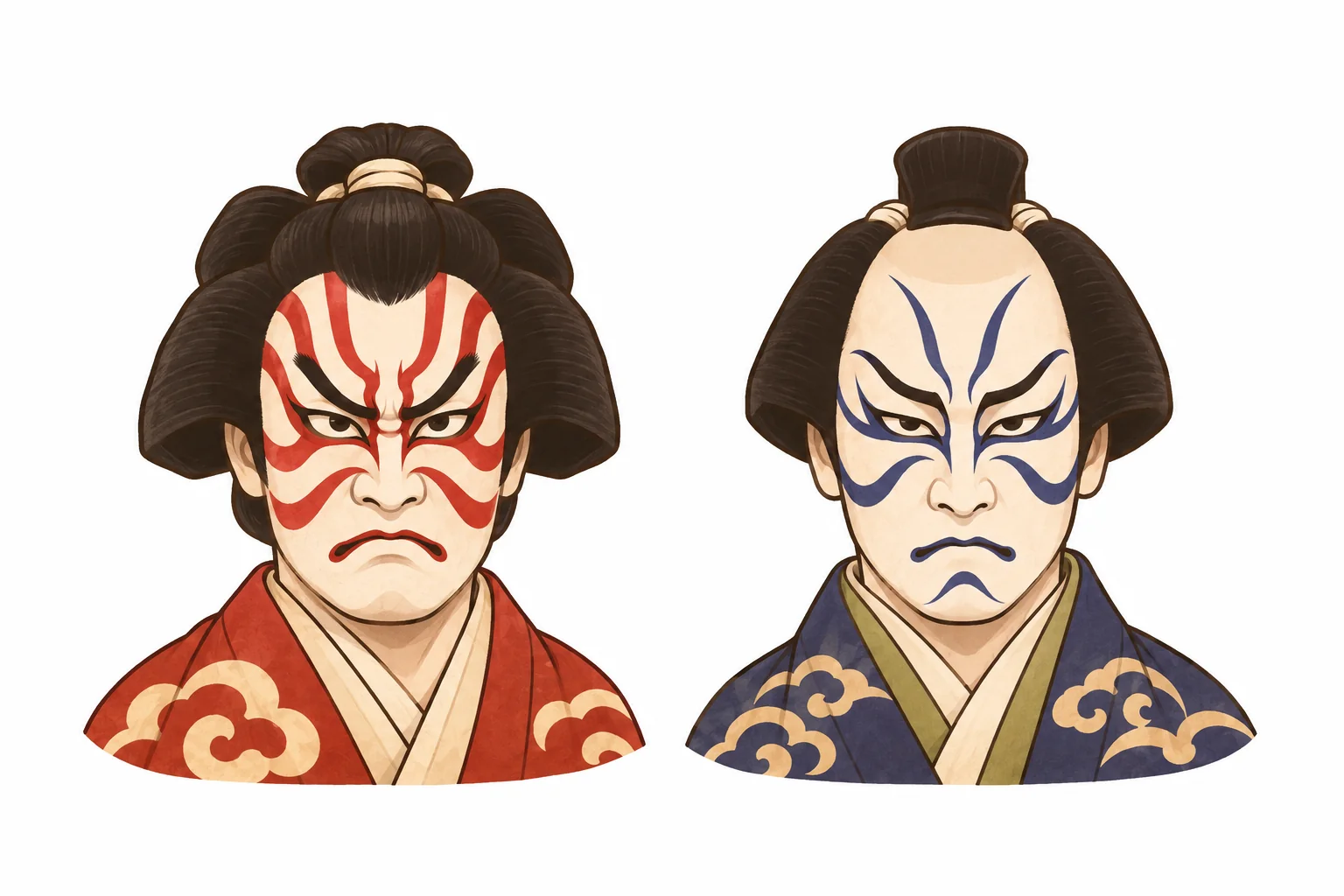
Two kumadori: the red sujiguma of the hero and the indigo kugeare of the scheming noble.
Actors paint their own kumadori. The lines are not simply drawn; color is laid on and then softened with the fingertips so that it fades into the white base, which is the "shading" the word describes. After a performance an actor may press a piece of silk to his face to take a print of the makeup, called an oshiguma. Each one is unique, and they were traditionally given to patrons as treasured keepsakes.
- 1
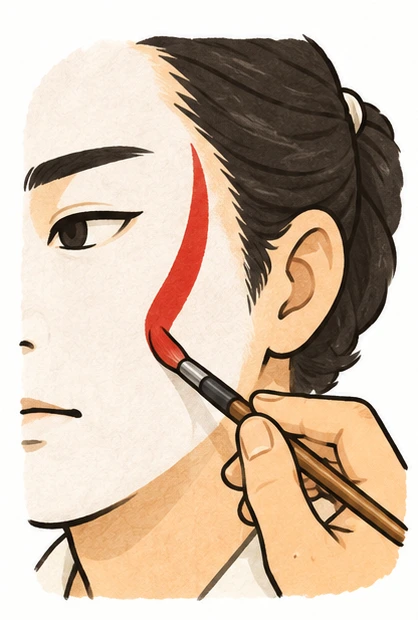 First the color line is applied to the face.
- 2
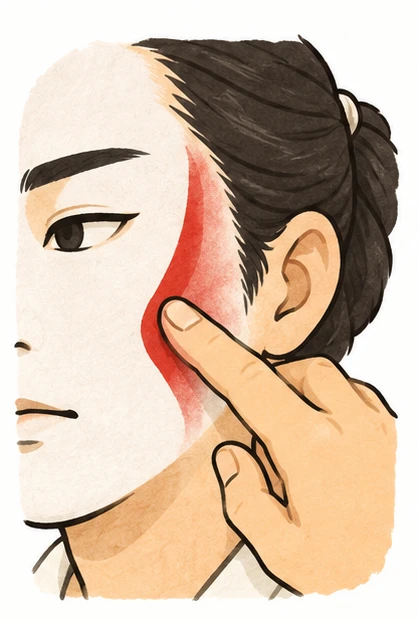 Then a finger blends the edge so the color fades into the white base.
- 3
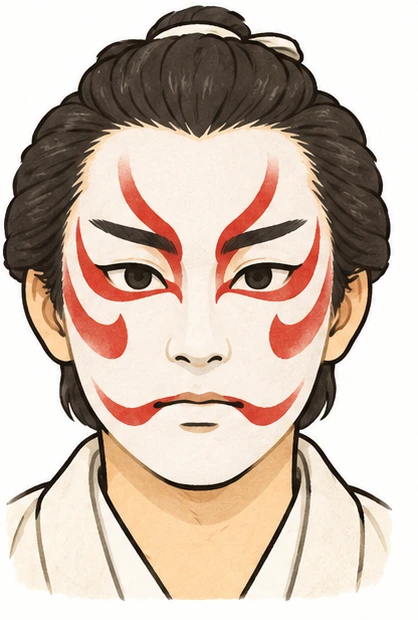 The finished kumadori: red lines spread from the eyes and brows toward the forehead and cheeks.
- 4
 After the performance, a silk cloth is pressed onto the face.
- 5
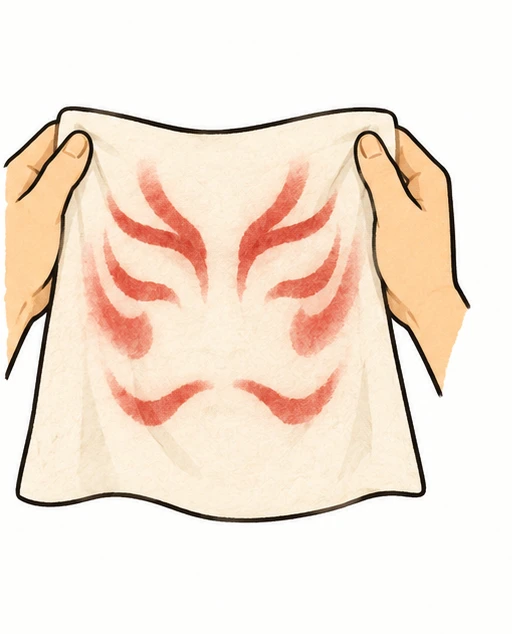 The cloth lifts off a print of the makeup, called an oshiguma.
The point of it all is speed of understanding. In a dark theater full of people eating, chatting and coming and going, an entering character’s face told you instantly whether to cheer him, hiss him, or be afraid.
04Onnagata: Men Playing Women
The onnagata is a male actor who specializes in female roles. The role began as a workaround for the 1629 ban, but over nearly four centuries it has become an art in its own right, and many kabuki lovers consider it the form’s highest achievement.
Yoshizawa Ayame I, the leading onnagata of the Genroku era, left teachings later collected as Ayamegusa. He argued that an onnagata should live as a woman offstage as well, eating, speaking and moving like one, so that femininity would be second nature on stage. That ideal shaped the profession for generations, and before the Meiji era many onnagata dressed as women in daily life.
The craft is a set of physical techniques for disguising a male body. The actor draws his shoulder blades back and down to make the shoulders look narrow and sloping, keeps his knees pressed together and slightly bent to reduce his height, and walks with toes turned in, taking small gliding steps that keep the kimono hem still. Fingers are held together and hands are often hidden in the sleeves. The voice is not a squeaky falsetto but a soft, slightly raised tone produced from the throat. The kimono collar is pulled back to show a long sweep of white-painted nape, the part of a woman’s body that Edo taste found most alluring.
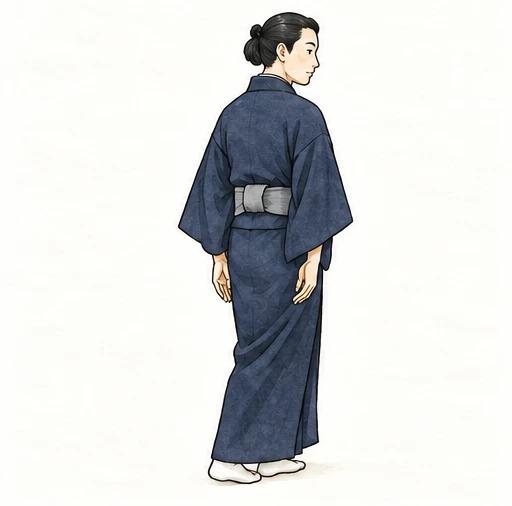
Onnagata posture (illustration): upper arms held close to the body, shoulders made to look narrow and round.
What the onnagata presents is not a realistic woman but a distilled image of femininity built up from conventions, every gesture shaped and deliberate. That is why connoisseurs say an onnagata can be more womanly than a woman. The roles range across many types: the princess in a red long-sleeved kimono, called akahime; the courtesan of the highest rank, tottering on tall black clogs; the merchant’s daughter; the loyal samurai wife; and the poisonous villainess. Three princess roles, Yaegaki-hime in Honchō Nijūshikō, Yuki-hime in Kinkakuji and Toki-hime in Kamakura Sandaiki, are known together as the "three princesses" and considered among the hardest parts to play.
The most celebrated onnagata of the twentieth century was Nakamura Utaemon VI. Today the great name is Bandō Tamasaburō V, still active on stage as of 2026, famous for his beauty and his haunting dances, who was designated a Living National Treasure in 2012. His performances of Sagi Musume (The Heron Maiden) and Kyōganoko Musume Dōjōji (The Maiden at Dōjō Temple) have drawn many people into kabuki for the first time.
05Hanamichi: The Flower Path
Walk into a kabuki theater and you will see a narrow walkway, level with the stage, running from the stage’s left side (as you face it) straight through the audience to the back wall of the auditorium. This is the hanamichi, literally "flower path." Its origin is uncertain; one popular explanation is that it began as the route fans used to bring gifts, or "flowers," to their favorite actors. By the eighteenth century it was a fixed part of theater architecture, and some theaters also install a second, temporary walkway on the right for certain plays.
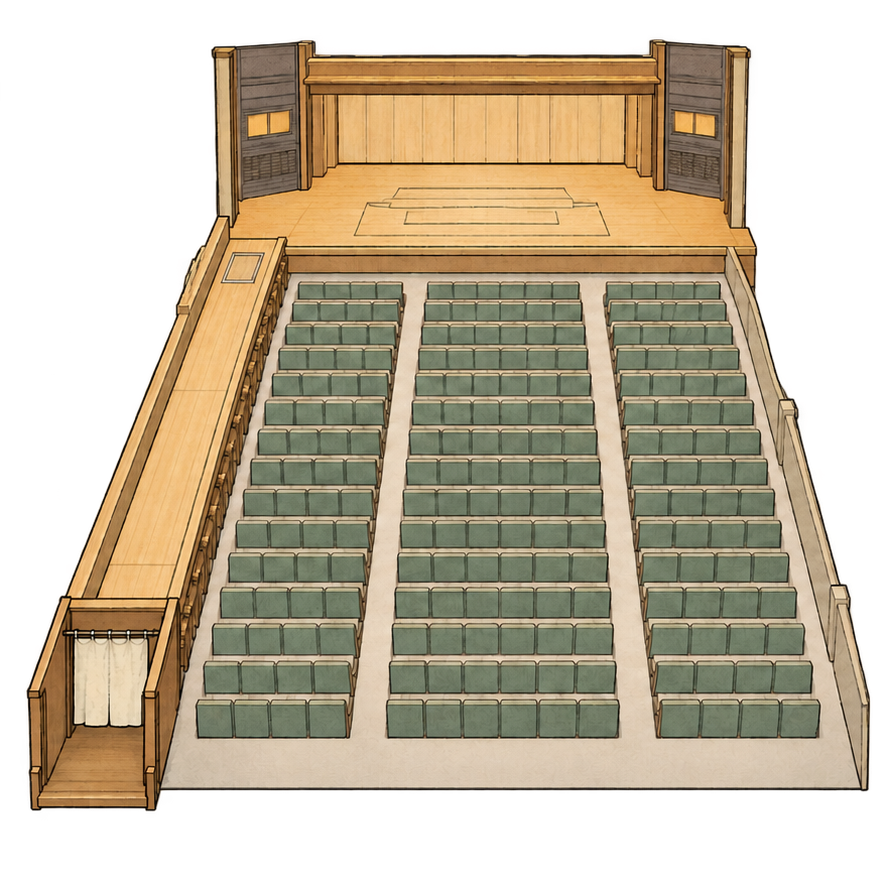
Seen from behind the audience: the hanamichi on the left, running from the stage to the curtain.
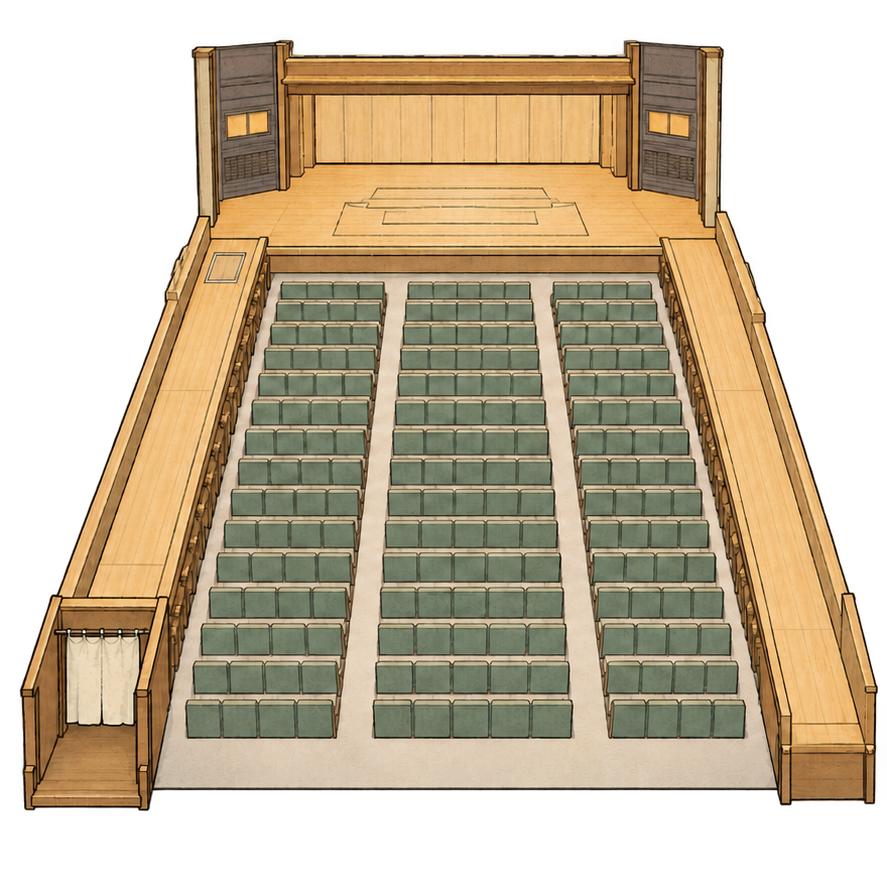
For certain plays, a second runway is added on the right.
At the far end of the hanamichi hangs a curtain printed with the theater’s crest, the agemaku. Behind it is a small room where actors wait to enter. When the curtain’s metal rings rattle along their rod, heads in the audience turn: someone important is coming.
The most important spot on the walkway is the shichisan, "seven-three," roughly seven-tenths of the way from the curtain to the stage. Here actors stop to strike a pose, deliver a speech or look back at the characters on stage. Set into the floor at this point is a small trap lift called the suppon, "snapping turtle," reserved for ghosts, demons, fox spirits and magicians, who rise eerily from below. Ordinary characters use the larger lifts on the main stage. Once again the architecture itself tells you what kind of being you are looking at.
- 1Waiting roomwhere actors wait to enter
- 2Agemakucurtain with the theater’s crest, at the far end
- 3Shichisan and supponabout seven-tenths of the way; the trap for ghosts and demons
- 4Main stageordinary characters use the larger lifts
Actors enter through the agemaku and stop at the shichisan; only supernatural beings rise through the suppon there.
The hanamichi’s genius is that it puts the drama among the audience. If you sit beside it you can see the sweat under an actor’s makeup, the embroidery on his robe, the way his eyes move. On a Western proscenium stage the action happens over there, behind a frame; on the hanamichi a hero walks out of the crowd into the story and walks back out through it. Some of kabuki’s most thrilling moments happen here, above all the great exits in roppō, a swaggering, arm-swinging, stamping gait that carries a hero down the path and through the curtain.
06Freeze-Frames, Clappers and Shouts from the Gallery
The signature move of kabuki acting is the mie. At the climax of an emotion the actor stops dead, strikes an exaggerated pose, whips his head around and glares, sometimes crossing one eye toward his nose in a move called nirami. It works like a freeze-frame close-up in film. The audience holds its breath and then breaks into applause.
The mie is punctuated by sharp cracking sounds from the side of the stage. A stagehand kneels there with two wooden clappers and beats them on a board in time with the actor’s movements, a technique called tsuke, multiplying the force of every stamp and turn. A different wooden sound, the ki or hyōshigi, two hardwood blocks struck together, marks the opening and closing of the curtain, starting slow and accelerating as the moment approaches.
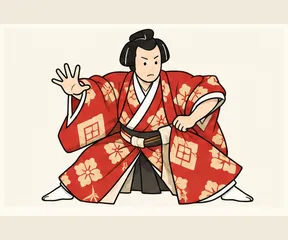
A mie: at the emotional peak the actor freezes and glares.
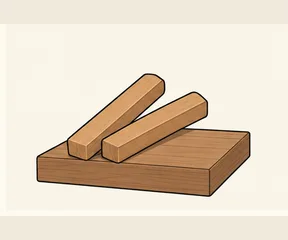
Tsuke: two wooden clappers struck on a board to amplify the movement.

Ki: two hardwood blocks struck together to signal curtain and scene changes.
On stage you will also see figures dressed entirely in black with gauze hoods over their faces. These are kurogo, stage assistants who hand actors props, adjust their costumes and slip stools behind them. By convention black means invisible, and the audience agrees not to see them. In snow scenes they switch to white, in sea scenes to blue.
Kabuki loves transformation. In hayagawari, quick-change, one actor may play several characters in a single piece, switching from princess to old woman to fox in a matter of seconds. In hikinuki, a costume is tacked together with loose threads; an assistant yanks them out and the outer layer falls away to reveal a completely different color beneath, often the moment when a character’s true nature is exposed. The stagecraft is old and ingenious. Edo-period theaters already had a revolving stage, the mawari butai, generally considered one of the earliest in the world, and lifts called seri that could raise an entire palace from below.
What startles first-time visitors most is the shouting. At a key entrance or mie, voices from the top gallery call out the actor’s house name: "Naritaya!" "Otowaya!" "Harimaya!" These are the ōmukō, longtime devotees whose timing must be exact; a shout half a beat early or late marks an amateur. They have their own clubs, whose members have traditionally been allowed in free. Ordinary audience members should leave this to them and simply applaud.
The house name, or yagō, is a sort of trade name for an acting family, traditionally explained as dating from a time when commoners, and actors of low status above all, could not openly use surnames, so actors took house names as merchants did. The Ichikawa Danjūrō line is Naritaya, the Onoe Kikugorō line is Otowaya, Nakamura Kichiemon’s line is Harimaya, the Nakamura Utaemon line is Narikomaya, and the Matsumoto Kōshirō line is Kōraiya.
07Kanjinchō: Getting the Master Through the Barrier
If you see only one kabuki play, many fans will tell you to make it Kanjinchō, "The Subscription List." The plot is simple, the characters are vivid, and it packs in almost everything kabuki does well. It is also among the most frequently performed plays in the repertoire.
The story is set after the Genpei War of the late twelfth century. Minamoto no Yoshitsune, the brilliant general who won the war for his elder brother Yoritomo, has fallen under Yoritomo’s suspicion and is now a hunted man. With a few loyal retainers led by the giant warrior monk Musashibō Benkei, he is fleeing north to the protection of the Fujiwara lords of Ōshū. To get through the barrier checkpoints Yoritomo has set up, the party has disguised itself as yamabushi, wandering mountain ascetics, with Yoshitsune dressed as their lowly porter. At the Ataka barrier in Kaga province, the commander Togashi no Saemon has orders to stop all yamabushi.
When Togashi blocks their way, Benkei explains that they are monks collecting donations to rebuild the great Tōdai-ji temple in Nara, burned in the war. Then, says Togashi, you must carry a subscription list, the document setting out the purpose of the appeal; read it to me. Benkei has no such document. He takes out a blank scroll, unrolls it, and improvises a solemn, elaborate appeal on the spot, "reading" it aloud word by word. When Togashi edges closer to look, Benkei snaps the scroll shut and fixes him with a glare. Togashi then fires question after question about yamabushi dress, ritual objects and doctrine, and Benkei answers each one without hesitation. This exchange, the yamabushi mondō, accelerates into the play’s most gripping passage.
Togashi lets them go. But one of his men thinks the porter looks like Yoshitsune, and Togashi calls the party back. With discovery a breath away, Benkei seizes his staff and beats his master, cursing him for looking like a wanted man and bringing suspicion on them all. For a retainer to strike his lord was an unthinkable crime. Togashi sees, understands everything, and understands too the loyalty that would drive a man to commit such an offense to save his lord. He lets them pass.
Safely beyond the barrier, Yoshitsune offers his hand to Benkei in thanks, and the huge man who has never wept breaks down. Togashi follows with sake as an apology; Benkei drinks deep and performs a vigorous dance, all the while signaling his companions to go on ahead. At last he is alone. He bows toward the departing Togashi and makes his exit down the hanamichi in the tobi-roppō, a leaping, one-legged, arm-swinging run, staff in hand, that propels him to the curtain like a gust of wind. The applause usually lasts until he has vanished.
- 1
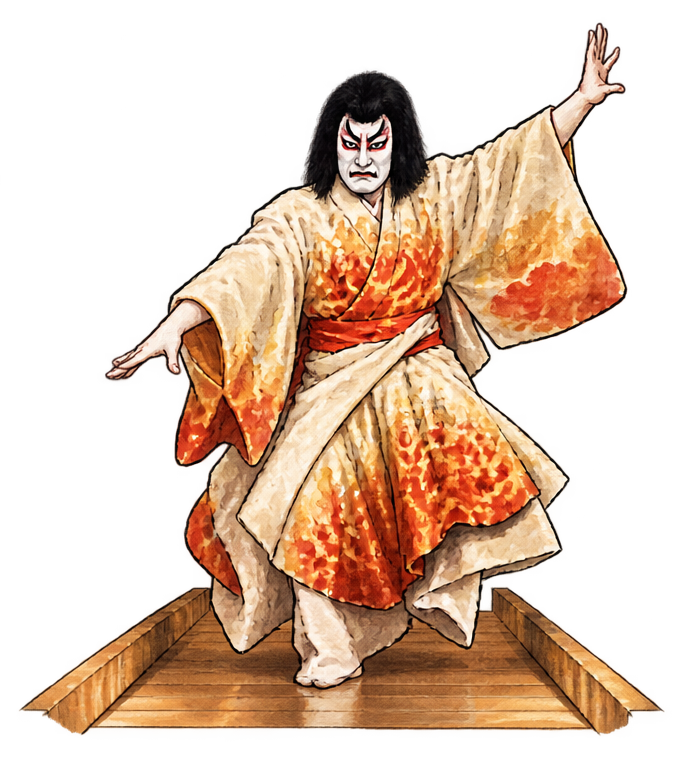 One arm raised high, the other stretched out (illustration, not Kanjinchō costume).
- 2
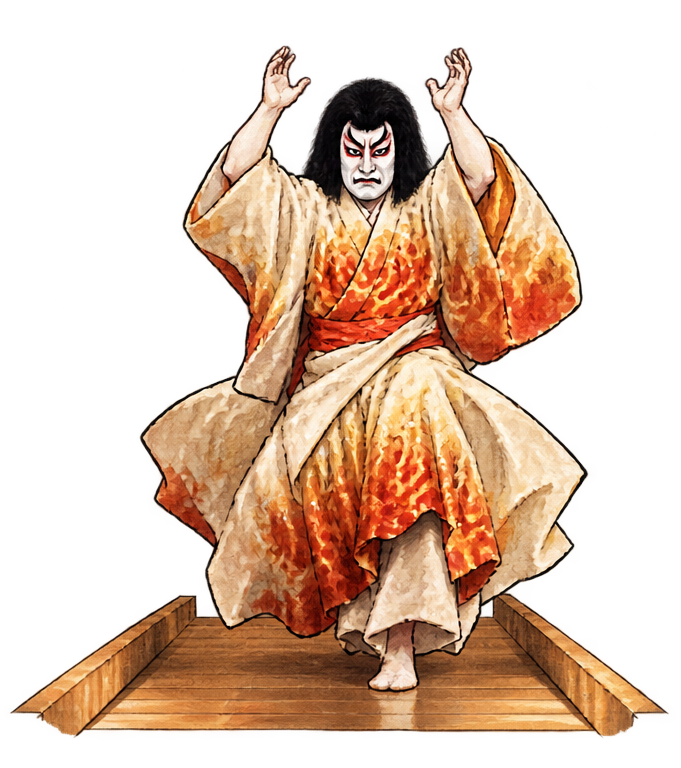 Both arms swing up beside the head.
- 3
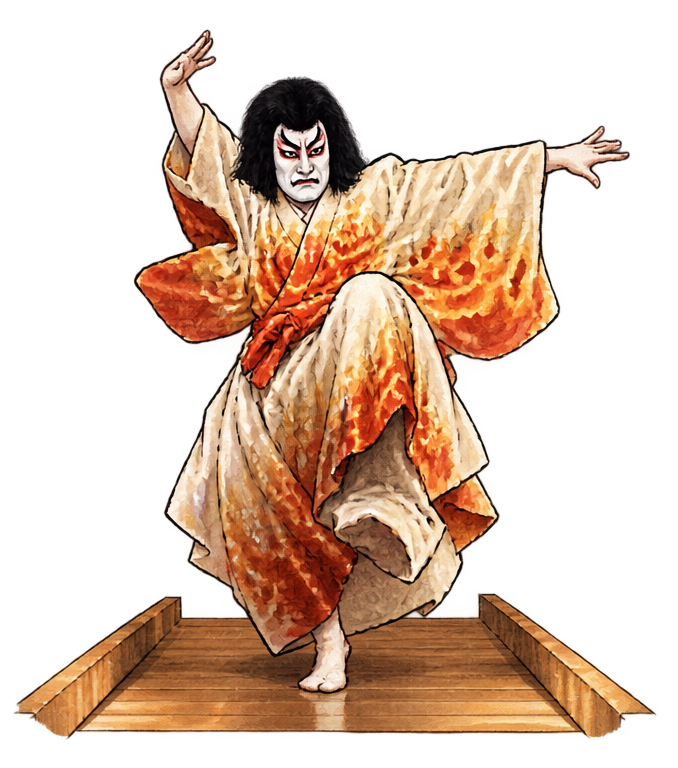 A raised knee and spread arms as the actor stamps toward the curtain.
Kanjinchō was first staged in 1840 at the Kawarazaki-za in Edo, with Ichikawa Danjūrō VII as Benkei (he had already passed the Danjūrō name to his son and was then performing as Ichikawa Ebizō V), based on the noh play Ataka. In tribute to its source, the set imitates a noh stage, with a great pine tree painted on the back wall; plays of this kind are called matsubame-mono, "pine-board pieces." The music is nagauta, with rows of singers and shamisen players seated across the back of the stage. Danjūrō VII placed the play in the Kabuki Jūhachiban, the Eighteen Great Plays of the Ichikawa family, which also include Shibaraku and Sukeroku. The Japanese expression ohako, meaning one’s specialty or party piece, is usually written with the characters for "eighteen," and is traditionally linked to this collection.
What makes the play work is that all three men do what they must and more. Benkei commits disloyalty in the name of loyalty; Togashi fails in his duty to serve a higher code of honor; Yoshitsune, the lord, silently accepts a beating. The audience knows how it ends. The pleasure lies in watching how each of them gets through that gate.
08Names That Outlive Their Bearers
Kabuki is a hereditary art. Nearly all leading actors come from a few dozen acting families and begin learning as small children, often making a formal stage debut at three or four. As they mature they take on progressively greater names within their lineage, a process called shūmei, name succession. An actor may hold three or four names in a lifetime. Ichikawa Ebizō, for example, is the name traditionally held just before Danjūrō.
A succession is a major event, celebrated with a month or more of special performances that include a kōjō, a ceremony in which the company kneels in formal dress across the stage and senior actors introduce the new name-holder to the audience one by one. In autumn 2022, Ichikawa Ebizō XI took the name Ichikawa Danjūrō XIII Hakuen, celebrated with two months of succession performances at the Kabukiza that November and December, filling the most famous name in kabuki for the first time since the death of his father in 2013. It was national news.
The system keeps technique inside the family. Every gesture, where the eyes go at this line, how long this step is, is learned directly from predecessors as a kata, a set form. The audience watches not just today’s actor but the line of actors behind the name; veteran fans will say this Danjūrō’s Benkei has something of his grandfather in it. There are actors from outside the families too. Since 1970 the National Theatre has run a training program for young people with no kabuki background, most of whom go on to supporting roles.
Almost all major kabuki today is produced by Shōchiku, an entertainment company founded in Kyoto in 1895 by the twin brothers Shirai Matsujirō and Ōtani Takejirō, which also became one of Japan’s largest film studios. UNESCO proclaimed kabuki a Masterpiece of the Oral and Intangible Heritage of Humanity in 2005 and inscribed it on the Representative List of the Intangible Cultural Heritage in 2008.
09The Kabukiza: Five Buildings, One Familiar Face
In Tokyo, kabuki’s home is the Kabukiza in Higashi-Ginza, at the eastern end of Ginza. Exits from Higashi-Ginza station on the Hibiya and Toei Asakusa subway lines lead straight into its underground plaza. Approaching along Harumi-dōri, you see a white-walled building with vermilion railings and sweeping, curved temple-style gables, its façade hung with huge painted signboards for the month’s program, sitting among office towers like a visitor from another century.
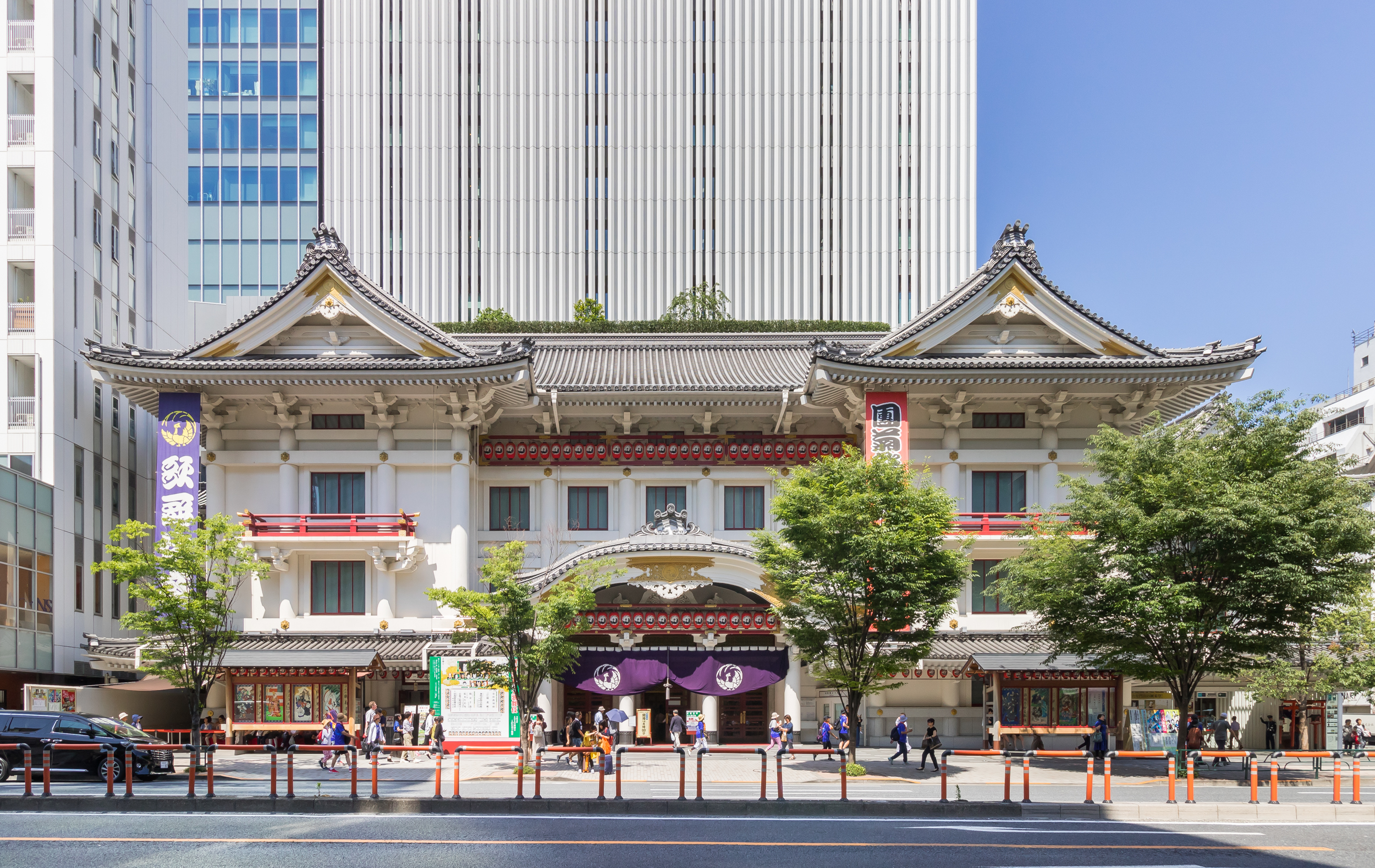
The fifth Kabukiza: white walls, vermilion railings and upswept roofs, with the office tower behind.
The present building is the fifth. The first Kabukiza opened in 1889, founded by the journalist Fukuchi Ōchi and others as part of the Meiji-era movement to "reform" kabuki into a respectable theater worthy of a modern nation, and its exterior was Western in style. A second building with a Japanese façade followed in 1911 and was destroyed by an electrical fire in 1921. The third, designed by the architect Okada Shin’ichirō in reinforced concrete in a Momoyama-inspired style with great gabled roofs (some accounts say it also drew on Nara-period temple architecture), opened in January 1925 after construction was interrupted by the Great Kantō Earthquake. In an air raid in May 1945 its great roof collapsed and the interior burned out. In 1951 the architect Yoshida Isoya rebuilt it as the fourth Kabukiza, closely following Okada’s exterior, and that building served for nearly sixty years.
When the fourth Kabukiza closed in April 2010, many longtime theatergoers grieved; according to reports at the time, some came every day to take photographs, and crowds lingered after the last performance. The new building, designed by Kuma Kengo, opened in April 2013. Kuma did not start from scratch. He recreated the old façade, with its curved karahafu gable and vermilion railings, almost exactly, and kept the stage width, hanamichi length and auditorium layout as close to the old proportions as he could, placing a 29-story office tower, the Kabukiza Tower, behind it.
Why not build something new? Because in kabuki the performance and the building grew up together. How many steps it takes to reach the shichisan, where an actor turns, how wide the stage is, how long it takes a shout from the third balcony to reach the stage: these are built into the kata themselves. A different-sized stage means retraining the body. The same goes for the audience. For many Tokyoites the roofline is kabuki. So each rebuilding of the Kabukiza after the first has worked to keep it looking the same.
Today’s Kabukiza also has a rooftop garden, a gallery of costumes and props beside it, plus a basement plaza called Kobikichō Hiroba with shops selling bento, sweets and kabuki souvenirs. Kobikichō was the old name of the district, which had theaters in the Edo period, so the area’s ties to kabuki run deep.
Beyond Tokyo, the Minamiza in Kyoto, at the eastern end of the Shijō bridge, stands on one of the oldest theater sites in Japan. Its December kaomise ("face-showing") performances, when the façade is lined with wooden boards bearing the actors’ names in a thick, rounded script, mark the start of winter in the city. Ōsaka has the Ōsaka Shōchikuza and Fukuoka the Hakataza. In Kotohira, on the island of Shikoku, the Kanamaru-za (the former Konpira Grand Theater), built in 1835, is the oldest surviving kabuki theater in Japan. As of 2026 a spring kabuki season is still held there; the audience sits on tatami in boxed squares, and the revolving stage and trap lifts are turned by hand from below. In villages in Saitama, Gifu, Fukushima and elsewhere, local people still perform ji-kabuki, amateur village kabuki, at shrine festivals.
10Going to the Theater
The Kabukiza runs a program almost every month, divided into a matinee and an evening show, sometimes three parts a day. Each part runs about four hours and includes two or three pieces: typically a history play or puppet-derived drama, a dance piece, and a domestic or lighter play. Long plays are usually presented as their best one or two acts, a practice called midori, so you will not need to follow a whole sprawling story from the start.
Seats range in several grades from first-class on the ground floor to the third balcony. To sample kabuki, there are also hitomakumi or single-act seats in the fourth-floor top gallery, which let you watch just one piece. The view of the hanamichi from up there is partial, but you can clearly hear the ōmukō shouts.
For non-Japanese speakers, the theater rents tablets that display English subtitles in time with the performance; Japanese audiences often rent earphone guides that explain plot, characters and actors in Japanese as the play unfolds. You can also buy a program, the sujigaki, with synopses and photographs. Kabuki dialogue is old Japanese delivered in a stylized chant, and many younger Japanese use the guides too.
The main interval, often about thirty minutes long, is part of the fun. People open bento boxes at their seats or go to the restaurants inside the theater. The makunouchi bentō, a classic boxed meal of rice and assorted side dishes, is generally said to take its name from food eaten maku no uchi, between the acts.
Dress is casual; everyday clothes are fine, though you will see many Japanese women in kimono for the occasion. Photography and recording during performances are forbidden, and phones should be off. Do not try shouting house names. If you are lucky enough to sit beside the hanamichi, an actor will pass within arm’s reach, his costume brushing the air by your face. Keep your feet out of his path and watch his eyes.
If you have only one chance, look for a month with Kanjinchō, Shibaraku or the dance Sagi Musume, or a program featuring Tamasaburō. Kabuki also keeps reinventing itself. In the 1980s Ichikawa Ennosuke III created "Super Kabuki," with modern lighting and actors flying over the audience; a later Super Kabuki production adapted the manga One Piece. Since 2016, "Chō Kabuki" has paired live actors with the virtual singer Hatsune Miku. And the Heisei Nakamuraza, founded by the late Nakamura Kanzaburō XVIII, tours with a temporary wooden playhouse modeled on those of the Edo period, where the audience sits closer to the actors than anywhere else, and comes about as near as anyone can to how Edo townspeople once watched a play.