
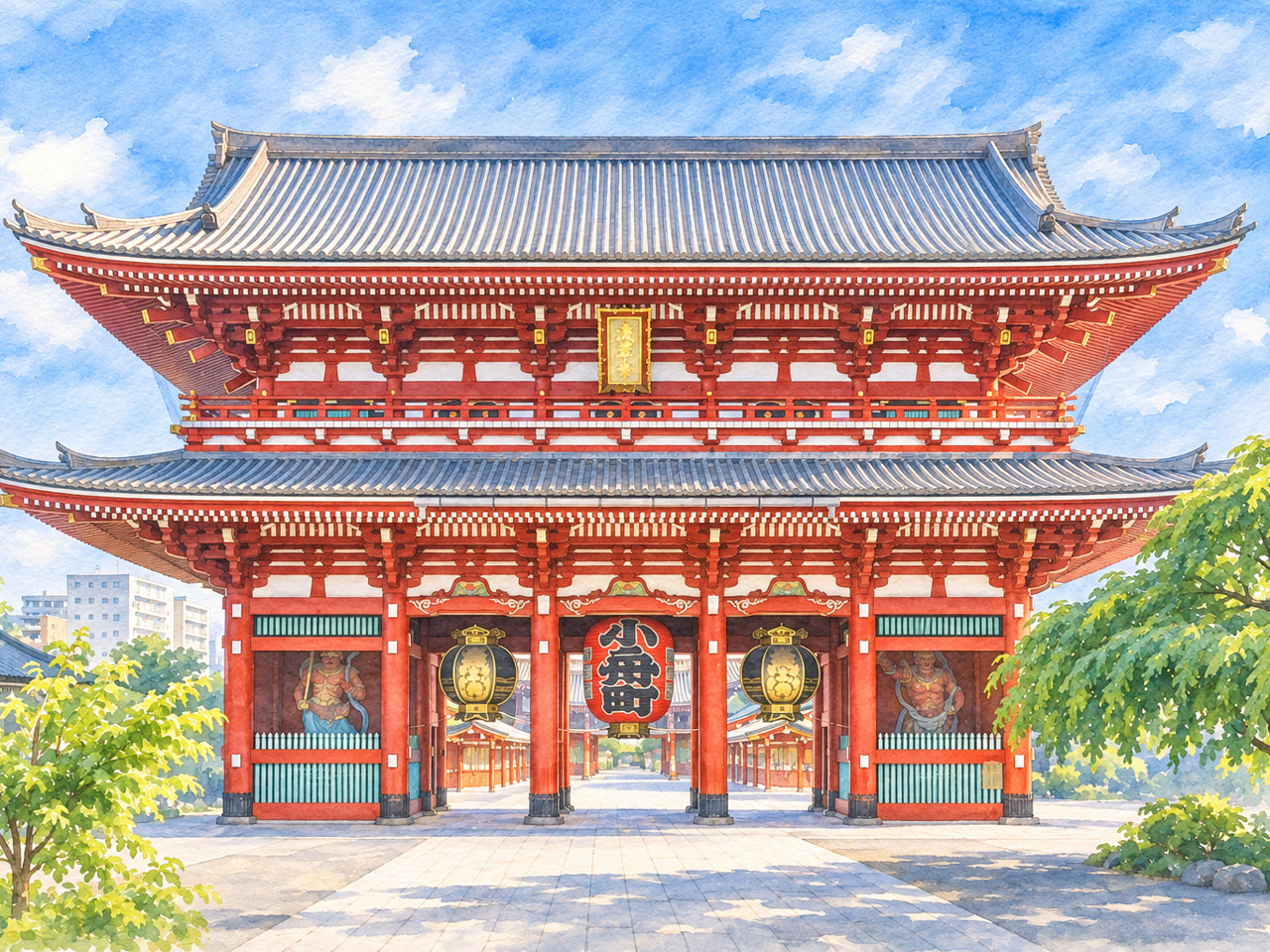
Sensō-ji, in the Asakusa district of Taitō Ward, is Tokyo’s oldest temple and one of its busiest. Dedicated to Kannon, the bodhisattva of compassion, it is approached through the Kaminarimon ("Thunder Gate") with its enormous red lantern, then along Nakamise-dōri, a lane of small shops, to the Hōzōmon gate and the main hall. For more than three centuries this route has been where ordinary Edo and Tokyo people came to pray, shop and be entertained.
01A Kannon from a fishing net
The temple’s founding story is set in 628. Two fishermen, the brothers Hinokuma no Hamanari and Hinokuma no Takenari, pulled a small image of Kannon from the Sumida River in their net. A local man, Haji no Nakatomo, recognized it, took holy orders and turned his house into a temple to enshrine it. Later the monk Shōkai is said to have built a hall for the image and declared it a hidden Buddha, never to be shown. In 857, according to the temple, the Tendai monk Ennin visited and carved a second image for public worship, and the temple counts him as its restorer. The three founders are honored at Asakusa Jinja, the shrine beside the main hall, whose Sanja Matsuri festival fills the neighborhood every May.
None of this can be confirmed from contemporary records, but the temple is generally thought to have existed by the Heian period.
02Warriors, shoguns and the pleasures of Edo
According to tradition, in 942 Taira no Kinmasa built a complex of halls in thanks for his appointment as governor of Musashi; the Kaminarimon is traced back to him. The temple’s records say Minamoto no Yoritomo prayed here for victory in 1180. After Tokugawa Ieyasu took over Edo in 1590, he made Sensō-ji a temple for official prayers and granted it lands. After a fire in 1642, the third shogun, Tokugawa Iemitsu, rebuilt the main hall in 1649, and that building stood until the twentieth century.
In the Edo period the temple grounds became the heart of a lively pleasure district. Shops lined the approach, and the area behind the main hall, known as Okuyama, filled with acrobats, sideshows and storytellers. The relocated Yoshiwara licensed quarter and, from the 1840s, the kabuki theaters of Saruwaka-machi lay close by. In the Meiji era the precinct was made Asakusa Park, and its sixth district, Rokku, grew into Tokyo’s theater and cinema street.
03What survives today
The air raid of March 10, 1945, destroyed the main hall, the five-story pagoda and the Hōzōmon, then called the Niōmon. The present main hall is a reinforced-concrete reconstruction completed in 1958. The Kaminarimon was rebuilt in 1960 with a donation from Matsushita Kōnosuke, founder of Panasonic, the Hōzōmon in 1964, and the pagoda in 1973 on a new site southwest of the main hall.
The chief Edo-period survivors are the Nitenmon gate and the main building of Asakusa Jinja, both Important Cultural Properties. The Edo-period garden of Denbō-in, the abbot’s residence, a national Place of Scenic Beauty since 2011, is generally closed to the public. Sensō-ji belonged to the Tendai school until 1950, when it became independent as head temple of the Shō Kannon sect.
Sensō-ji
01Three Men and a Net
Every visitor to Sensō-ji walks into a story that begins on the river a few hundred meters to the east. According to the temple’s own founding account, on the eighteenth day of the third month of 628, two brothers named Hinokuma no Hamanari and Hinokuma no Takenari were fishing in the lower reaches of the Sumida River. They caught nothing but a small figure tangled in their net. They threw it back and cast again somewhere else, and the same figure came up. After this had happened several times, they took it ashore and showed it to Haji no Nakatomo, the most learned man in the village. He recognized it as an image of Shō Kannon, the bodhisattva of compassion in her standard form. Moved, he became a monk and converted his own house into a temple to house the image.
The legend adds that on the night the image appeared, a thousand pine trees sprang up overnight nearby, and that a golden dragon later descended from the sky. That dragon gives the temple its mountain name, and the Golden Dragon Dance performed every March 18 and October 18 (created in 1958 to mark the rebuilding of the main hall) recalls it. The name is Kinryūzan, "Golden Dragon Mountain," which you will see written on the plaque of the Kaminarimon. The image itself is said to be tiny, about 5.5 centimeters tall. No one alive can confirm this, because no one is allowed to see it.
Historians cannot verify any of this. No contemporary document records a temple at Asakusa in the seventh century. What can be said is that the mouth of the Sumida was settled early, and that a Kannon temple here is generally thought to have existed by the Heian period (794–1185). The founding story belongs to the temple’s faith rather than to documented history, but it shapes the whole site, down to the shrine standing next to the main hall.
02The Hidden Buddha
The temple’s account continues in 645, when a monk named Shōkai is said to have arrived, built a proper Kannon hall and, after a dream, ruled that the image must be hidden from view. Sensō-ji has kept that rule ever since. Its principal image is an absolute hidden Buddha (zettai hibutsu): it is never displayed, not even on special occasions.
Worshippers needed something to face, and the temple credits the Tendai monk Ennin with providing it. Ennin, honored as Jikaku Daishi, is famous for his long journey in Tang China, recorded in his diary Nittō guhō junrei kōki. After his return he is said to have traveled in eastern Japan, and the temple holds that he visited Asakusa in 857 and carved a second image to stand before the hidden one, the maedachi honzon. Sensō-ji counts him as its restorer. Even this second image is normally kept closed and is shown only in certain years.
So the temple names three foundational moments: the netting of the image in 628, Shōkai’s hall in 645, and Ennin’s restoration. All three are known only from later temple records.
03The Shrine of the Three Founders
Stand in front of the main hall and look right. The vermilion building there is Asakusa Jinja, and it honors the three men of the founding legend: the two fishing brothers and Haji no Nakatomo. In the Edo period it was called Sanja Gongen, "the avatars of the three shrines," and only after the Meiji Restoration did it take its present name.
For most of Japanese history, shrines and temples were not separate institutions. The shrine was simply part of Sensō-ji, its deities understood as protectors of Kannon. In 1868 the new government ordered Buddhism and Shinto separated, and the shrine became administratively independent, yet the two still share the same grounds.
The shrine’s great annual festival is the Sanja Matsuri, held each May. Dozens of portable shrines (mikoshi) from the neighborhoods of Asakusa are carried through the streets, and on the last day the shrine’s own three main mikoshi come out. Tradition holds that the festival was once performed partly by boat on the Sumida, re-enacting the image’s arrival from the water.
The present shrine building was donated by the third Tokugawa shogun, Tokugawa Iemitsu, and completed in 1649. It is built in the gongen-zukuri style, with the main sanctuary and worship hall joined by a connecting chamber. It survived both the 1923 earthquake and the 1945 air raids and is an Important Cultural Property, one of the few genuine early Edo buildings in the area.
04A Warrior Patron and the Thunder Gate
The Kaminarimon is the image everyone takes home from Asakusa, and its formal name is Fūraijinmon, "Gate of the Wind and Thunder Gods," after the two guardian figures in its niches. The temple traces the gate back to 942, when Taira no Kinmasa is said to have prayed at Sensō-ji to be made governor of Musashi Province and, once appointed, built a full set of halls and a main gate in thanks.
The date matters. Only two years earlier, Taira no Masakado had been killed after his rebellion in the Kantō, in which he had proclaimed himself "new emperor." Kinmasa, a son of Taira no Yoshikane and recorded as having served as governor of both Awa and Musashi, belonged to the same warrior clan, and the story places Sensō-ji within the world of the eastern warrior houses as early as the tenth century. Like the founding legend, though, it rests on the temple’s tradition. The tradition also says the first gate stood elsewhere, near Komagata on the river, and was moved to its present spot sometime after the Kamakura period, when the wind and thunder gods were probably installed.
The gate burned and was rebuilt several times in the Edo period: it burned in 1642 and was rebuilt by Iemitsu in 1649, burned again in 1767 and was rebuilt in 1795. After a fire on the twelfth day of the twelfth month of Keiō 1 (January 28, 1866) it was not rebuilt at all, and for 95 years Sensō-ji had no Thunder Gate.
05The Warrior Age
According to the temple’s history, in 1180 Minamoto no Yoritomo, leading his army from Shimōsa into Musashi Province during the Genpei War, prayed at Sensō-ji for victory and donated 36 chō of rice land. The Azuma kagami, the official history of the Kamakura shogunate, records that the following year carpenters were summoned from Asakusa to build Tsurugaoka Hachimangū in Kamakura.
Sensō-ji became the thirteenth stop on the Bandō pilgrimage, a circuit of thirty-three Kannon temples across eastern Japan modeled on the older western pilgrimage. Sitting on the route into Musashi, it was a natural stage for pilgrims. Through the Muromachi and Warring States periods it remained a major temple of the Kantō, protected in turn by the regional powers, last of all the Later Hōjō of Odawara, though records from these centuries are thin.
06The Tokugawa Temple
Everything changed in 1590. Toyotomi Hideyoshi destroyed the Hōjō and assigned the Kantō to Tokugawa Ieyasu, who moved into Edo. Ieyasu designated Sensō-ji as a temple where prayers would be offered for the Tokugawa house and granted it lands, usually given as 500 koku.
After Ieyasu’s death, shrines to him as the deity Tōshō Daigongen went up around Edo, and one was built in the grounds of Sensō-ji in 1618. It burned in 1631 and again in 1642, a fire that also took the main hall, and the Asakusa Tōshōgū was then moved to the Momijiyama enclosure inside Edo Castle. The Nitenmon, the gate on the east side of the grounds, is generally thought to have begun as the attendant-figure gate of this shrine; one view dates the present structure to 1618, while the temple says it was built in 1649 as its east gate. In 1884 the attendant figures went to Asakusa Jinja and statues of two of the Four Heavenly Kings came from Tsurugaoka Hachimangū, giving the gate its name, "Gate of the Two Devas." Those burned in 1945; the present pair, Edo-period figures, came in 1957 from the mausoleum of the fourth shogun, Tokugawa Ietsuna, at Kan’ei-ji. It is an Important Cultural Property and one of the temple’s few early Edo survivors.
Sensō-ji’s place within the Tendai school also changed. Once Tenkai founded Kan’ei-ji at Ueno, that temple became the center of Tendai in eastern Japan, and Sensō-ji was placed under its authority, with its chief administrator usually sent from Ueno.
07Iemitsu’s Main Hall
Iemitsu rebuilt the main hall after the 1642 fire, and it was finished in 1649, the same year as the shrine. It was a massive building with a broad hipped-and-gabled roof, typical of the confident architecture of the early Tokugawa period. It survived the many fires that swept Edo over the next two centuries and was designated a National Treasure under the prewar system in 1907.
Its most celebrated escape came on September 1, 1923. The Great Kantō Earthquake set off fires that destroyed nearly all of Asakusa, but the flames stopped short of the main hall, and many people who had fled into the grounds survived. The episode added to Asakusa Kannon’s reputation for protecting its worshippers. Twenty-two years later, the hall’s luck ran out.
08Shops, Sideshows and the Pleasure Quarter
In the Edo period Sensō-ji was not only a place of prayer. It was the city’s favorite day out.
The shopping street between the Kaminarimon and the inner gate, Nakamise-dōri, is generally said to have begun in the late seventeenth or early eighteenth century, when local residents were allowed to set up stalls on the approach in return for sweeping the temple grounds. The name means "the shops in between," that is, between the two gates. They sold toys, sweets, souvenirs and woodblock prints.
Northwest of the main hall lay Okuyama, "the back hills," a crowded fairground of acrobats, jugglers, storytellers, performing monkeys, peep shows, archery booths and teahouses. In the late Edo period its displays of lifelike dolls drew huge crowds.
Two other attractions lay nearby. After the Meireki fire of 1657, the shogunate moved the licensed quarter of Yoshiwara from central Edo to the rice fields north of Asakusa, and visitors to the "New Yoshiwara" often passed through Asakusa on the way. Then, during the Tenpō reforms, after a fire in 1841 destroyed the Nakamura-za and Ichimura-za, the authorities moved Edo’s licensed kabuki theaters to Saruwaka-machi, just northeast of the temple: from 1842 the Nakamura-za, the Ichimura-za and the Kawarazaki-za, standing in for the Morita-za, reopened there. Until the early Meiji years, Asakusa was the home of kabuki.
To the south stood the shogunate’s rice granaries, the Asakusa Okura, where the stipends of the shogun’s retainers were paid out in rice. The brokers who handled these stipends, the fudasashi of Kuramae, grew rich lending money against them, and their spending in the theaters and in Yoshiwara helped fuel Asakusa’s late Edo prosperity.
09A Bell in a Poem, a Gate in the Snow
The haiku poet Matsuo Bashō wrote a famous verse that may be rendered: "A cloud of blossoms. Is that bell from Ueno, or from Asakusa?" The Asakusa bell is the time bell on Bentenyama, a small mound in the temple grounds, one of the bells that told the hours to Edo’s townspeople. The present bell was recast in 1692, under the fifth shogun, Tokugawa Tsunayoshi, a few years after Bashō wrote the poem in 1687. It survived the war and is still rung at six each morning and on New Year’s Eve.
Asakusa was also a favorite subject for woodblock artists. In Utagawa Hiroshige’s One Hundred Famous Views of Edo, a snow scene frames the pagoda behind the great lantern of the Kaminarimon, one of the best-known prints in the series.
Several Edo festivals still run on the temple calendar. On Shiman rokusen nichi, the "46,000 days" in July, a single visit is said to earn the merit of 46,000 days of worship, and a market sells potted ground cherries. In December the battledore market sells decorated hagoita paddles, many showing kabuki actors.
10Asakusa Park and Rokku
After the Meiji Restoration the temple lost its lands. In 1873 the government designated the precinct as Asakusa Park, one of Japan’s first public parks, later divided into seven districts. The old Okuyama area and filled-in land to the west became the sixth district, Rokku.
Rokku turned into Tokyo’s entertainment street. Sideshow booths gave way to variety halls, theaters and cinemas, among them the Denkikan of 1903, one of Japan’s first permanent movie theaters. In the 1910s and 1920s, "Asakusa opera" brought light opera to mass audiences.
In 1890 the Ryōunkaku, a twelve-story tower known as the Asakusa Jūnikai, opened north of Rokku. It was the tallest building in Japan at the time and had one of the country’s first electric elevators. It snapped in the 1923 earthquake and was demolished.
Nakamise changed too. In 1885 the old stalls were replaced by rows of brick shops in Western style. These collapsed in 1923 and were rebuilt in reinforced concrete, the basis of the shops you see today.
11Fire from the Sky and Rebuilding
In the early hours of March 10, 1945, American bombers dropped incendiaries on the low-lying eastern districts of Tokyo. Around 100,000 people died in a single night. Asakusa burned, and with it the main hall of 1649, the five-story pagoda and the Niōmon. The temple says the hidden image had been placed in a bronze water basin buried about 3 meters beneath the main hall and survived.
Rebuilding took decades. In 1950 Sensō-ji left the Tendai school and became head temple of a new denomination, the Shō Kannon sect. Work on a new main hall began in 1951, and the present hall, a reinforced-concrete building closely following the old design, was completed in 1958.
The Kaminarimon returned in 1960, paid for personally by Matsushita Kōnosuke, founder of the company now known as Panasonic; the temple says he gave it in thanks for recovering from a joint ailment. The great red lantern also came from the Matsushita side and has been replaced periodically, most recently in 2020 (as of 2026); it stands 3.9 meters tall and weighs about 700 kilograms. The donor’s name, Matsushita Denki, is inscribed on the base, and reportedly was kept even after the company renamed itself Panasonic in 2008. The inner gate was rebuilt in 1964 with funds from the industrialist Ōtani Yonetarō and his wife. Because its upper floor stores the temple’s treasures and sutras, it was renamed the Hōzōmon, "Treasure House Gate." The giant straw sandals hanging on its rear side are made and presented by a support association in Murayama, Yamagata Prefecture, and replaced about every ten years.
The pagoda followed in 1973, but not where it had stood. The prewar pagoda was east of the approach; the new one stands to the southwest of the main hall, on the left as you pass through the Hōzōmon. Its top level holds relics of the Buddha brought from Isurumuniya temple at Anuradhapura in Sri Lanka.
12Walking the Approach
Begin at the Kaminarimon. The wind god and thunder god face the street; on the back are figures of a heavenly dragon and a golden dragon, carved by Hirakushi Denchū and Sugawara Yasuo and donated in 1978, nodding to the temple’s mountain name. The gate and lantern are postwar, but the heads of the two gods were saved from the 1866 fire; their bodies were recarved in 1874 and restored in 1960.
Nakamise-dōri runs about 250 meters to the Hōzōmon. The buildings are modern, but the street itself is the direct descendant of the Edo stalls, and shops still sell ningyō-yaki cakes and rice crackers alongside souvenirs.
Pass through the Hōzōmon between its guardian kings and look back to see the sandals. Ahead is the incense burner, where people waft smoke over themselves for health, with the pagoda on your left and the main hall beyond. Inside, worshippers stay in the outer sanctuary; the hidden Buddha’s shrine stays shut. Look up at the ceiling paintings of a dragon and heavenly maidens by the postwar artists Kawabata Ryūshi and Dōmoto Inshō.
Walk to the right of the main hall to see Asakusa Jinja and, beyond it, the Nitenmon. These are the real early Edo buildings, and comparing them with the rebuilt hall and gates tells you much about what was lost in 1945. To the southwest lies Denbō-in, the abbot’s residence, with an Edo-period strolling garden, designated a national Place of Scenic Beauty in 2011, that is usually closed to the public.
Then walk a few minutes east to the Sumida. This is the river where the brothers of the legend are said to have cast their net nearly fourteen centuries ago; the Tokyo Skytree now rises on the far bank.