
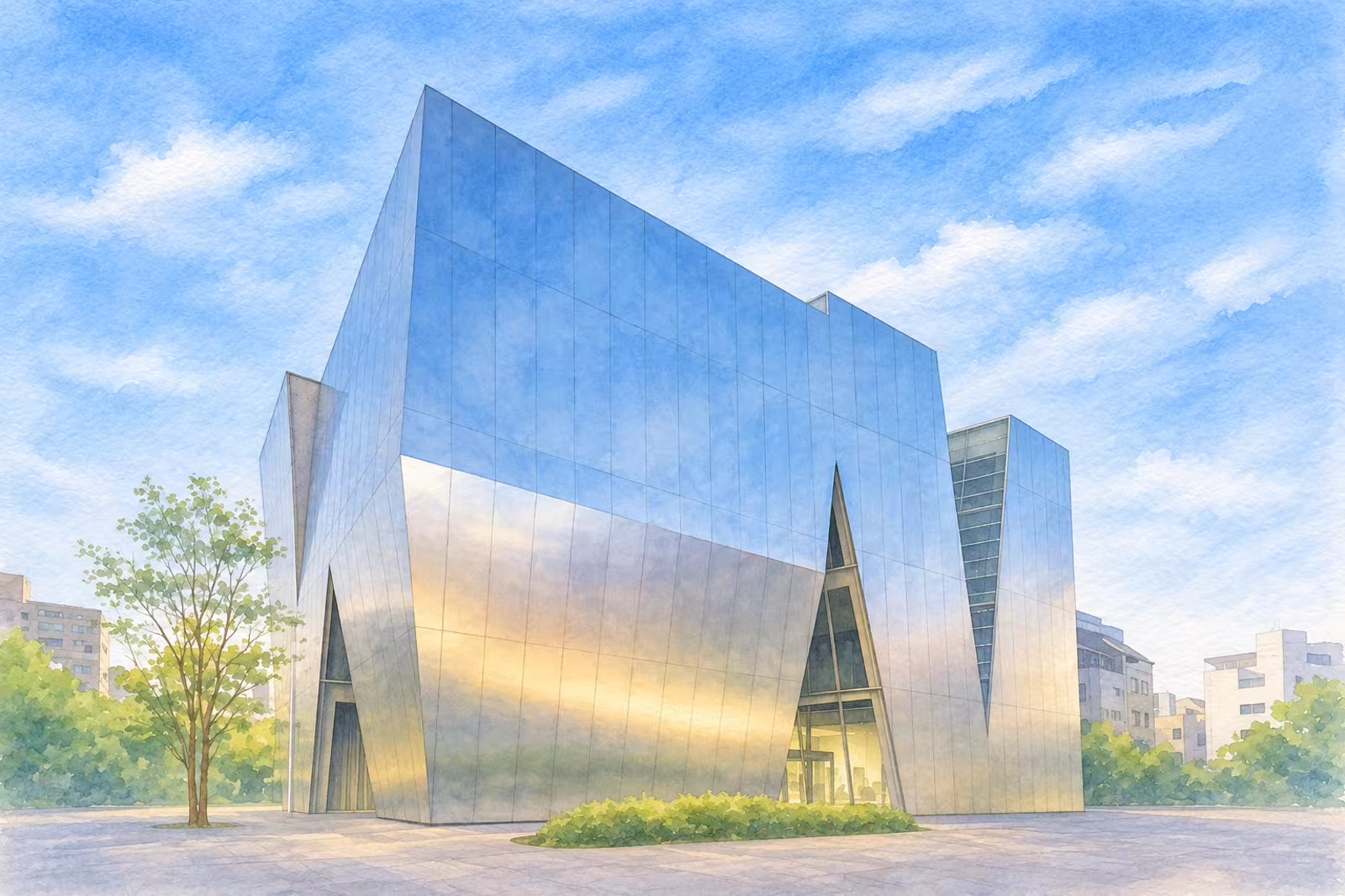
The Sumida Hokusai Historic Area is a group of places in Sumida Ward, Tokyo, connected with the ukiyo-e artist Katsushika Hokusai. They cluster around Ryōgoku, Kamezawa and Midori, the district known in the Edo period as Honjo. Hokusai was born here, spent most of his life on the east bank of the Sumida River, and drew many of his subjects from this neighborhood of canals and riverbanks. No house of his survives, but the area has the Sumida Hokusai Museum, Hokusai-dōri street and interpretive boards across the district.
01Hokusai and Honjo
Hokusai was born in 1760 near the Wari-gesui, a drainage canal in Honjo. He changed his art name more than thirty times and, by tradition, moved house 93 times, yet he rarely strayed far from Honjo and Asakusa. Prints from Thirty-six Views of Mount Fuji such as "Honjo Tatekawa" and "Sunset across Ryōgoku Bridge from the Bank of the Sumida River at Onmayagashi" show the waterfronts of the Sumida and Honjo, and his illustrated book of both banks of the Sumida River takes the same district as its subject. He also painted a large votive panel of Susanoo subduing the demons of pestilence for the nearby Ushijima Shrine; the original was destroyed in the 1923 Great Kantō Earthquake. Hokusai died in Asakusa in 1849 at the age of 88 (90 by traditional count), and his grave is at Seikyō-ji in today’s Taitō Ward.
02What can be seen today
None of the buildings where Hokusai was born or lived survives, and their exact locations are hard to fix. The Wari-gesui was filled in during reconstruction after the 1923 earthquake, and the road built over it was later named Hokusai-dōri, with interpretive signs along the way. Sumida Ward has placed a series of boards at sites linked to Hokusai’s life and work, where his pictures can be compared with the present streetscape. The Sumida Hokusai Museum opened in 2016 in Midori-chō Park. Designed by Sejima Kazuyo, it is clad in aluminum panels and broken into angular, split volumes. In the Edo period the site belonged to a residence of the Tsugaru family, lords of the Hirosaki domain. The permanent gallery tells Hokusai’s life through high-quality reproductions, special exhibitions show original works in rotation, and the lost Ushijima Shrine panel is displayed in a reconstruction based on a black-and-white photograph.
Hokusai’s Sumida (Tokyo)
01Where You Are Standing
Walk east from Ryōgoku Station, past the sumo stables and the small workshops that still fill the side streets, and you reach a low, angular building clad in pale aluminum panels, split by sharp diagonal cuts. This is the Sumida Hokusai Museum, set at the edge of Midori-chō Park in the Kamezawa district of Sumida Ward. In the Edo period (1603–1868) this whole area east of the Sumida River was called Honjo.
Katsushika Hokusai, the artist behind The Great Wave off Kanagawa, was born a short walk from here. He is said to have moved house more than ninety times and used more than thirty art names, and he traveled to Nagoya, the Kansai region and the mountain town of Obuse. But for almost his entire life he kept returning to this flat, canal-cut district across the river from central Edo. Even his surname was local: Katsushika was the old name of the county that included Honjo.
There is no Hokusai house to visit and no building he touched. What you can see here is the street plan of old Honjo, the river and canals he drew, and a museum built by his home ward to bring his work back to where he started. This guide follows his life in order and points out where each part of it touches the ground you are standing on.
02Honjo: Edo’s New Town Across the River
For the first half century of Tokugawa rule, the east bank of the Sumida was marshland outside the city. That changed after the Meireki Fire of 1657, which destroyed much of Edo. To give the crowded city room and a fire break, the shogunate built a bridge across the river and opened the east bank to planned development. The bridge linked two provinces, Musashi and Shimōsa, and so became Ryōgoku-bashi, the "Bridge of Two Provinces."
Surveyors laid out Honjo on a grid. Canals were dug, most importantly the Tatekawa, which runs east–west, and the Ōyokogawa, which runs north–south, and the spoil raised the ground. Lumber yards and rice warehouses lined the water. Inland, the land was parceled out to low-ranking retainers of the shogun and to the secondary residences of feudal lords. At the eastern foot of Ryōgoku Bridge grew one of Edo’s great entertainment districts, full of teahouses, street performers and sideshows.
Hokusai was born near the Warigesui, a drainage channel running through central Honjo, lined with the modest homes of minor samurai families. The street now called Hokusai-dōri roughly follows its line.
03A Mirror-Maker’s Boy
Hokusai was born on the twenty-third day of the ninth month of 1760 (October 31 in the Western calendar). His childhood name was Tokitarō; later he was called Tetsuzō. The usual account says he was adopted into the household of Nakajima Ise, a mirror-maker who polished bronze mirrors for the shogun’s household. Some writers have suggested he was in fact Nakajima’s son by a concubine, which would explain why he did not inherit the business. Neither version is firmly documented.
In later life Hokusai wrote that he had loved copying the shapes of things since the age of six. As a teenager he worked for a lending library and trained as a woodblock carver, the craftsman who cuts an artist’s drawing into the cherrywood block. That gave him a practical knowledge of how prints were actually made, which would show in everything he later designed.
At about nineteen he entered the studio of Katsukawa Shunshō, the leading painter of kabuki actor prints, and in 1779 he published his first actor portraits under the name Katsukawa Shunrō. For the next fifteen years he was a working member of the Katsukawa school, producing actor prints and illustrations for cheap illustrated fiction. Nothing in this period marked him out as unusual.
04Taking the Name Hokusai
Around 1794 he left the Katsukawa school. Later stories say he quarreled with a senior pupil or was caught studying the techniques of the rival Kanō school; whatever the cause, he went his own way and, according to anecdote, was poor enough at one point to peddle red pepper and calendars on the street.
He then took over the name Sōri, associated with the Rinpa-style artist Tawaraya Sōri, and became known for surimono, small privately commissioned prints of extremely high quality, often New Year greetings for poetry circles. Around 1798 he handed the Sōri name to a pupil and began calling himself Hokusai.
The new name had a local source. Hokusai was a devotee of Myōken, the Buddhist deity of the Pole Star and the Big Dipper. A short way north of Honjo, at Yanagishima, the Nichiren temple Hosshō-ji had a Myōken hall that was popular across Edo, and Hokusai worshipped there. "Hokusai" means something like "North Studio," a reference to the northern star; he also signed as Hokusai Tokimasa, another star reference. He later made a print of the Yanagishima Myōken hall, and the temple still points visitors to the connection.
Hokusai went on changing names throughout his career: Taito, Iitsu, and finally Gakyō Rōjin Manji, "the Old Man Mad About Painting." Passing a name, with its reputation, to a pupil for a fee was ordinary practice in Edo’s art world, and it helped him through lean years.
05The River Itself
In the first decade of the 1800s Hokusai was best known as an illustrator of yomihon, long historical novels. His collaboration with the novelist Kyokutei Bakin on Chinsetsu Yumiharizuki (Strange Tales of the Crescent Moon) produced pictures so dramatic that, the story goes, author and artist argued over who was in charge.
In roughly the same years he produced a picture book that is the best introduction to his relationship with this place: Ehon Sumidagawa Ryōgan Ichiran (Picture Book of Both Banks of the Sumida River at a Glance). It follows the river upstream toward Asakusa and Mukōjima, with boats, bridges, crowds and the changing seasons running as one continuous view. Hokusai was not picturing a distant scenic spot. He was drawing his own riverbank.
He also made himself famous through public performances. In 1804, at Gokoku-ji temple in Edo, he painted a half-length portrait of the Zen patriarch Daruma on a sheet the size of about 120 tatami mats, using a brush like a broom; spectators had to climb to a height to see the whole face. He repeated stunts like this in Nagoya and elsewhere.
06Hokusai Manga
In 1812 Hokusai traveled west and stayed in Nagoya, where pupils and local publishers helped him assemble a book of model drawings for students. The first volume of Hokusai Manga appeared in 1814. It is a crowded catalog of the visible world: people at work, animals, plants, tools, ghosts, gods, gestures, weather. It sold so well that new volumes kept appearing for decades, fifteen in all, the last after his death.
Manga here means "random sketches," not comics in the modern sense. In the second half of the nineteenth century the books reached Europe, where French artists and designers studied them closely, and they were among the main routes by which Hokusai’s name became known in the West.
07Mount Fuji from the Canals
Around 1830–31, when Hokusai was about seventy, the Edo publisher Nishimuraya Yohachi (Eijudō) began issuing Thirty-Six Views of Mount Fuji. It was so successful that ten more designs were added, for a total of forty-six, completed by about 1834. The series made bold use of Prussian blue, a synthetic pigment recently imported via Dutch traders, and its strong, stable blue gave the landscapes a freshness buyers had not seen before.
The best-known design is The Great Wave off Kanagawa: a clawed wave towering over three fast boats carrying fish to market, with a tiny Fuji in the trough. Another, Fine Wind, Clear Morning, shows the mountain glowing red at dawn and is known as "Red Fuji."
Several designs in the series show this neighborhood. Honjo Tatekawa shows the lumber yards along the Tatekawa canal, timber stacked high and a glimpse of Fuji between the piles, with workers tossing lumber up to one another. Sunset across Ryōgoku Bridge from the Bank of the Sumida River at Onmayagashi shows a ferry pulling away from the Onmaya landing on the west bank, with Ryōgoku Bridge downstream and Fuji silhouetted beyond. The river frontage has changed with embankments and expressways, but you can still line up the bridge and the water with the print.
In 1834 Hokusai followed the series with the picture book One Hundred Views of Mount Fuji. Its afterword contains his most quoted words. He says he had been drawing since six, and had published a great deal by fifty, but nothing he drew before seventy was worth much. At seventy-three he had begun to grasp the structure of birds and animals, insects and fish, and the way plants grow. If he kept at it, by eighty he would improve further, at ninety he would penetrate the secrets of things, at one hundred he would reach the divine, and at one hundred and ten every dot and line would be alive. He signed it Gakyō Rōjin Manji.
08Hard Years and Oei
His last decades were not comfortable. From about 1834 to 1836 he left Edo and lived under another name at Uraga on the Miura Peninsula. The reason is not documented; the usual explanation is that a grandson’s debts and misbehavior had drawn him in. The Tenpō famine and the shogunate’s Tenpō Reforms of the early 1840s, which restricted luxury publishing, shrank the print market, and Hokusai turned increasingly to paintings done by hand on silk and paper.
His companion in these years was his third daughter, Oei, who painted under the name Katsushika Ōi. One explanation of the name is that her father always called to her with "Oi!" ("Hey!"). She had married the painter Minamizawa Tōmei, divorced, and returned to live with Hokusai, painting alongside him and assisting on some of his works. Her own Night View of the Yoshiwara (Yoshiwara Kōshisaki no Zu) is admired for its handling of light and shadow.
A pupil, Tsuyuki Iitsu, left a sketch of the pair at home: Hokusai, wrapped in a quilt, hunched over his drawing; Oei watching; the room littered with brushes and food wrappers. Neither father nor daughter cared about housekeeping, and the story goes that when a place became too filthy they simply moved, which is one explanation for all those changes of address. The Sumida Hokusai Museum has rebuilt this scene, with life-size figures, in its permanent gallery.
From 1844 Hokusai, by then in his eighties, made several trips to Obuse in the Shinano mountains as the guest of the wealthy merchant Takai Kōzan, where he painted the ceilings of festival floats.
09The Lost Votive Painting at Ushijima Shrine
One late work tied Hokusai directly to his home district. In 1845, at eighty-six by Japanese reckoning, he painted a large ema, a votive panel, for Ushijima Shrine on the Sumida riverbank. It showed the god Susanoo subduing the spirits of plague and making them swear to do no more harm, and it was one of the largest color paintings of his late years.
The panel was destroyed in the fires that followed the Great Kantō Earthquake of 1923. For most of the twentieth century it was known only from a single black-and-white photograph. The Sumida Hokusai Museum used that photograph, together with the colors of Hokusai’s paintings from the same period, to produce a full-size estimated reconstruction, now one of the museum’s centerpieces. The shrine buildings burned in the same disaster. When Sumida Park was laid out afterward, the shrine was moved to its present site in Mukōjima beside the park, with new buildings completed in 1932, so it no longer stands where Hokusai’s panel hung.
10Death and Afterlife
Hokusai died on May 10, 1849 (the eighteenth day of the fourth month of Kaei 2), at lodgings within the grounds of the temple Henshō-in in Asakusa, across the river. He was ninety by the traditional count in which a child is one at birth. According to his pupils’ accounts he lamented on his deathbed that if heaven gave him ten more years, or even five, he could become a true painter. His farewell poem pictures himself as a wandering soul, strolling out over the summer fields.
He is buried at Seikyō-ji, a small temple in Moto-Asakusa in Taitō Ward. The gravestone reads "Grave of Gakyō Rōjin Manji."
After his death his work traveled. Hokusai Manga and his prints were collected and studied in Paris; artists such as Claude Monet, Edgar Degas and Vincent van Gogh absorbed lessons from him, and his waves and plants passed into Art Nouveau design. The first edition of Claude Debussy’s orchestral work La Mer used The Great Wave on its cover. In the late 1990s Life magazine’s list of the hundred most important people of the past thousand years included one Japanese person: Hokusai.
11The Museum
Sumida Ward began planning a museum for Hokusai decades before it opened, but the project stalled for years over money. Meanwhile the ward acquired two major collections. After the American Hokusai scholar and collector Peter Morse died in 1993, his family agreed to sell the ward close to six hundred works and research materials in one lot. The second came from the Japanese ukiyo-e scholar Narasaki Muneshige. Together with works the ward bought itself, these form the core of the holdings.
The museum finally opened on November 22, 2016. Its architect, Sejima Kazuyo, one of the partners of the firm SANAA, broke the volume into connected blocks separated by slits, so that the building does not loom over the low houses around it and the park and surrounding streets can flow through it. The aluminum cladding picks up and softens the colors of the neighborhood and the sky.
The museum and the neighboring Midori-chō Park occupy part of the former main Edo residence of the Tsugaru family, lords of Hirosaki domain in northern Japan, one of the few daimyo compounds in Honjo that survived until the end of the shogunate.
Original prints and paintings are fragile and can only be shown for limited periods, so the permanent gallery uses high-resolution reproductions with touch-screen guides that let you zoom in on detail; originals rotate through special exhibitions. The reconstructed studio scene with Hokusai and Oei and the reconstructed Ushijima Shrine votive panel are both in the permanent gallery.
12A Walk Through Hokusai’s Honjo
Start at the Sumida River by Ryōgoku Bridge. The present bridge is a steel span from the early Shōwa period (1926–1989), on a slightly different line from the Edo-period bridge. Look upstream: the next bridge is Umayabashi, near the old Onmaya landing, and the stretch of water between the two is the one Hokusai showed at sunset.
Head east along Keiyō Road or Hokusai-dōri into old Honjo. The street is ordinary, but its lamps and pavement are decorated with Hokusai motifs. At Midori-chō Park you can take in the museum from several sides, and notice the scale of the surrounding blocks: the small plots laid out for minor samurai in the seventeenth century still shape the neighborhood.
Near the museum, in Kamezawa, a sign marks the vicinity of Hokusai’s birthplace. A short walk south brings you to the Tatekawa canal, the waterway of the Honjo Tatekawa print, now roofed over by the elevated Shuto Expressway.
With more time, go north to Mukōjima for Ushijima Shrine beside Sumida Park, and on to Hosshō-ji and its Yanagishima Myōken hall, where the name Hokusai began. Then cross the river to Asakusa and Moto-Asakusa, near where he died and where he is buried at Seikyō-ji. Almost all of his ninety years were lived within a few kilometers of these points.