
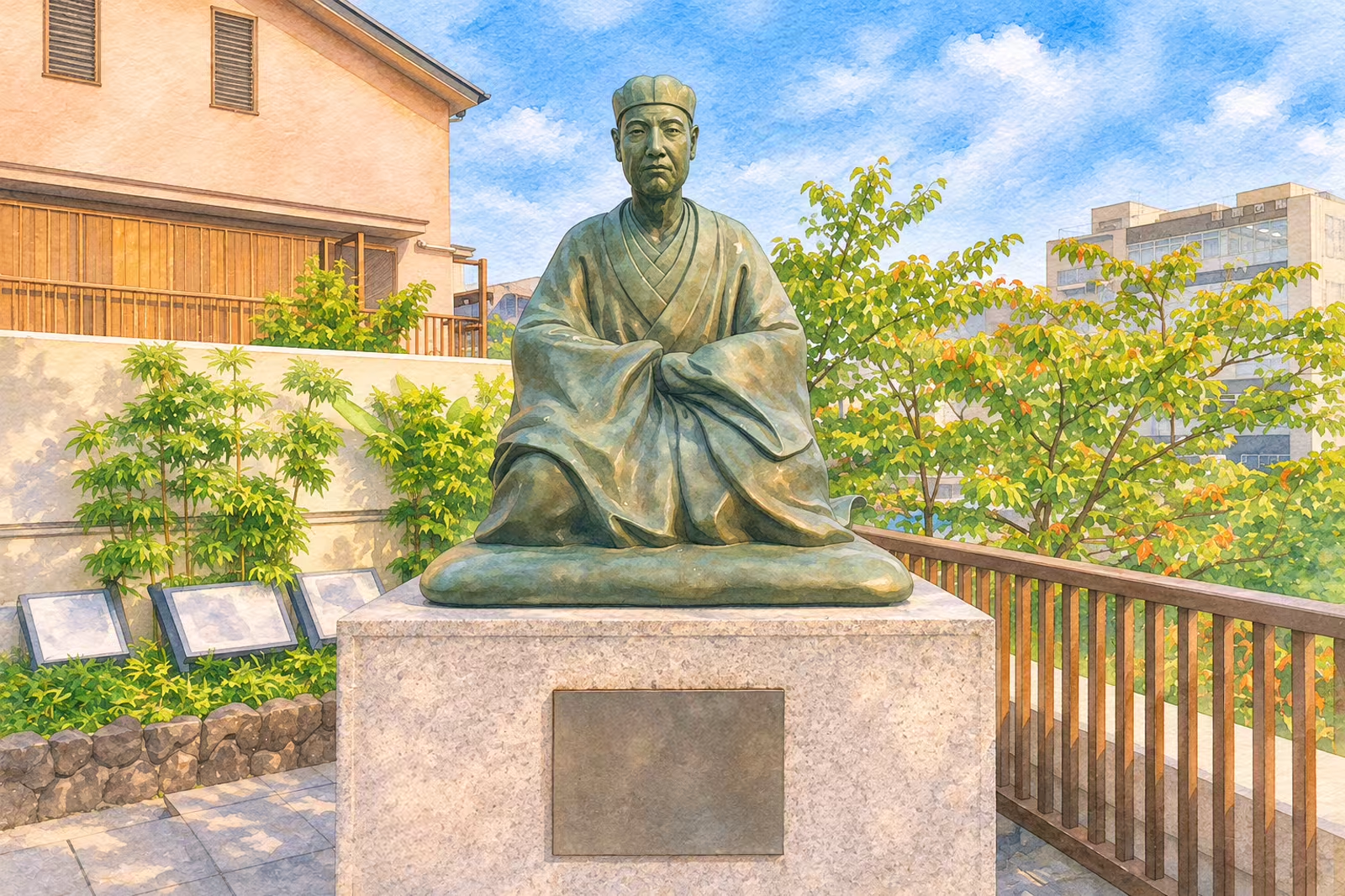
The site of Bashō’s Fukagawa hermitage and the Bashō Memorial Museum lie in the Tokiwa area of Kōtō City, Tokyo, near the point where the Onagi River meets the Sumida. The haiku poet Matsuo Bashō lived in a small hut here on and off for more than ten years. Here he wrote his best-known verse, about a frog jumping into an old pond, and from here he set out on the journey he later turned into Oku no Hosomichi (The Narrow Road to the Deep North). The hut itself is long gone. What remains is a commemorated site, the small Bashō Inari Shrine, and a museum run by Kōtō City.
01Bashō in Fukagawa
In the winter of 1680 Bashō left the Nihonbashi area for Fukagawa, then on the edge of Edo. His new home is generally thought to have been a hut provided by his disciple Sugiyama Sanpū, a fish merchant. Another follower, Rika, gave him a banana plant (bashō), which grew well beside the hut. Visitors began calling the place Bashō-an, "banana-plant hermitage," and the poet took Bashō as his name.
A great fire in the twelfth month of Tenna 2 (January 1683) destroyed the hut. Bashō spent some time in Kai Province and returned the next year, when his followers raised money to rebuild near the old spot. The mature style of his school took shape in these years, and the frog poem is usually dated to around 1686. In 1689 he gave up the hut, and with his disciple Kawai Sora went up the Sumida by boat, landing at Senju to begin the long walk north. After returning he lived in another hut his followers built nearby. He died in 1694 while traveling in Ōsaka.
02Finding the site again
After Bashō’s death the land was absorbed into a samurai estate, and the exact location was forgotten. According to local tradition, a stone frog was found after a storm surge in 1917 and identified as an object Bashō had loved, and the Bashō Inari Shrine was set up where it turned up. In 1921 Tokyo Prefecture marked the area as the site of "Bashō’s old pond." Both the frog’s history and the claim that the shrine stands on the hut site rest on tradition.
03What can be seen today
Kōtō City opened the Bashō Memorial Museum nearby in 1981. It holds calligraphy, haiku books and other materials connected with Bashō and his circle, and its garden has banana plants, poem stones and a small hut in the old style. In 1995 an annex and a viewing garden were added near the shrine, overlooking the meeting of the two rivers, with a seated statue of the poet. The stone frog is generally said to be kept at the museum. All of these are modern memorials; nothing from the seventeenth-century hut has been identified on the ground.