
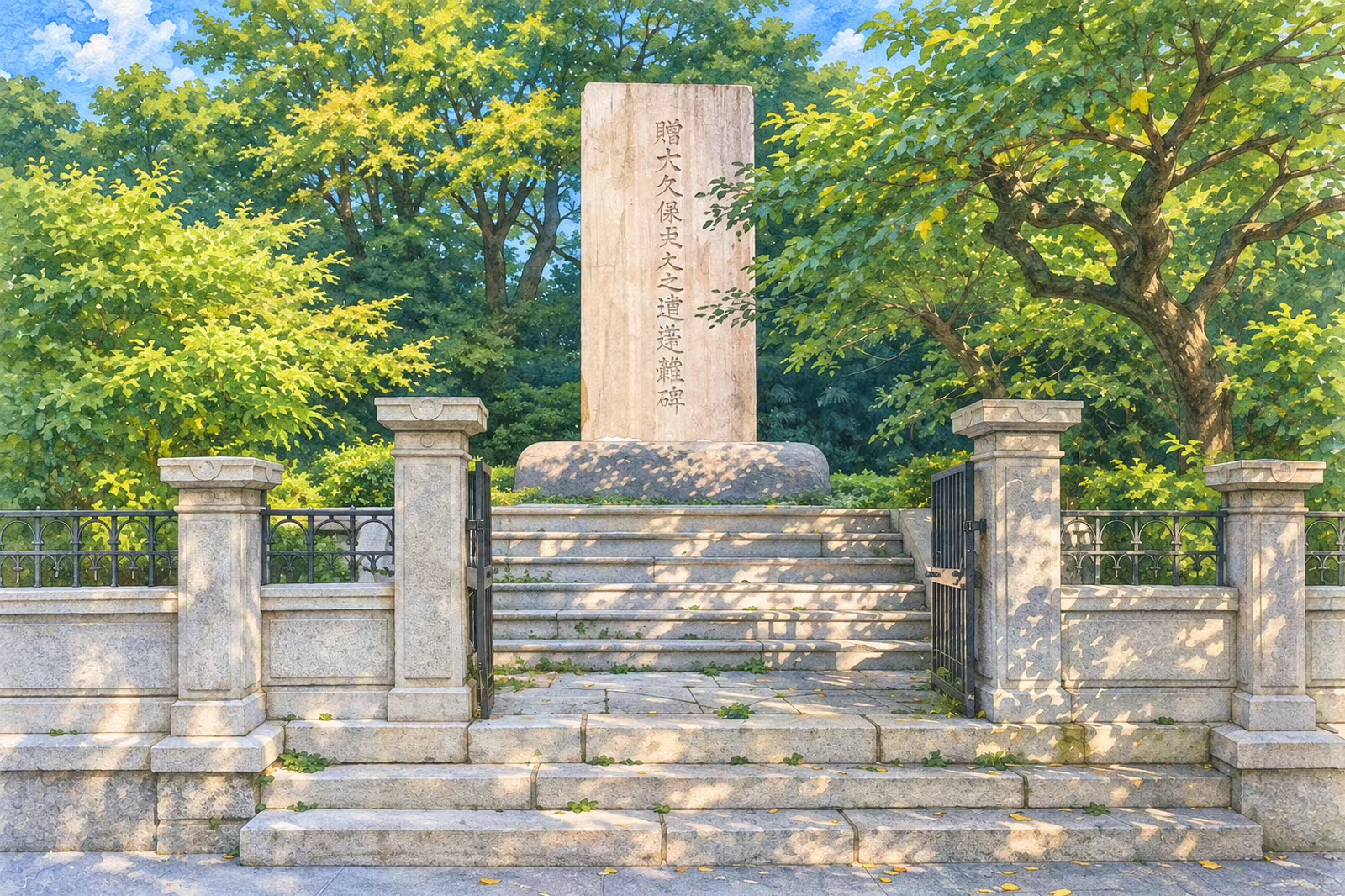
The site of Ōkubo Toshimichi’s assassination lies in the Kioichō area of Chiyoda City, Tokyo, where a large memorial stone now stands in Shimizudani Park. On May 14, 1878, Ōkubo, the Home Minister and the most powerful figure in the Meiji government, was attacked and killed here on his way to the imperial palace. The killing, known as the Kioizaka Incident, came less than a year after the end of the Satsuma Rebellion and is the best-known act of political violence of the early Meiji years.
01May 14, 1878
That morning Ōkubo left his residence near Kasumigaseki by carriage for the temporary imperial palace in Akasaka. As the carriage passed near Shimizudani, six men led by Shimada Ichirō, a former samurai from Ishikawa Prefecture, stopped it with swords. Ōkubo was killed on the spot, and his driver was also killed. Ōkubo was 47 (49 by traditional count). The attackers gave themselves up. A statement they carried accused him of monopolizing power, silencing public opinion and wasting state funds, and blamed him for the death of Saigō Takamori. All six were executed that July.
The name Kioi combines one character each from the three houses that had residences here in the Edo period: the Kii and Owari branches of the Tokugawa and the Ii family of Hikone. The incident is named after the Kioizaka slope, but the attack is generally thought to have taken place on the road in the Shimizudani valley below rather than on the slope itself.
02Background
Ōkubo, from Satsuma, was one of the leaders of the Meiji Restoration. He drove the centralization that followed the abolition of the domains in 1871 and the government’s push for industry. In 1873 he broke with Saigō Takamori over the proposal to send a mission to Korea. When government forces defeated Saigō in the Satsuma Rebellion of 1877, former samurai unhappy with the new order turned their anger on Ōkubo. After his death leadership passed to Itō Hirobumi and others, while the Freedom and People’s Rights Movement kept pressing for an elected assembly.
03What can be seen today
In 1888, ten years after the attack, leading officials put up a large memorial stone nearby, its inscription praising Ōkubo’s service to the state. The ground became part of Shimizudani Park, opened in 1890 and now managed by Chiyoda City, and the stone is designated a city cultural property. The slopes and the valley can still be traced, but the estates, streets and roads of 1878 have given way to high-rise buildings and modern roads. Ōkubo’s grave is in Aoyama Cemetery.