
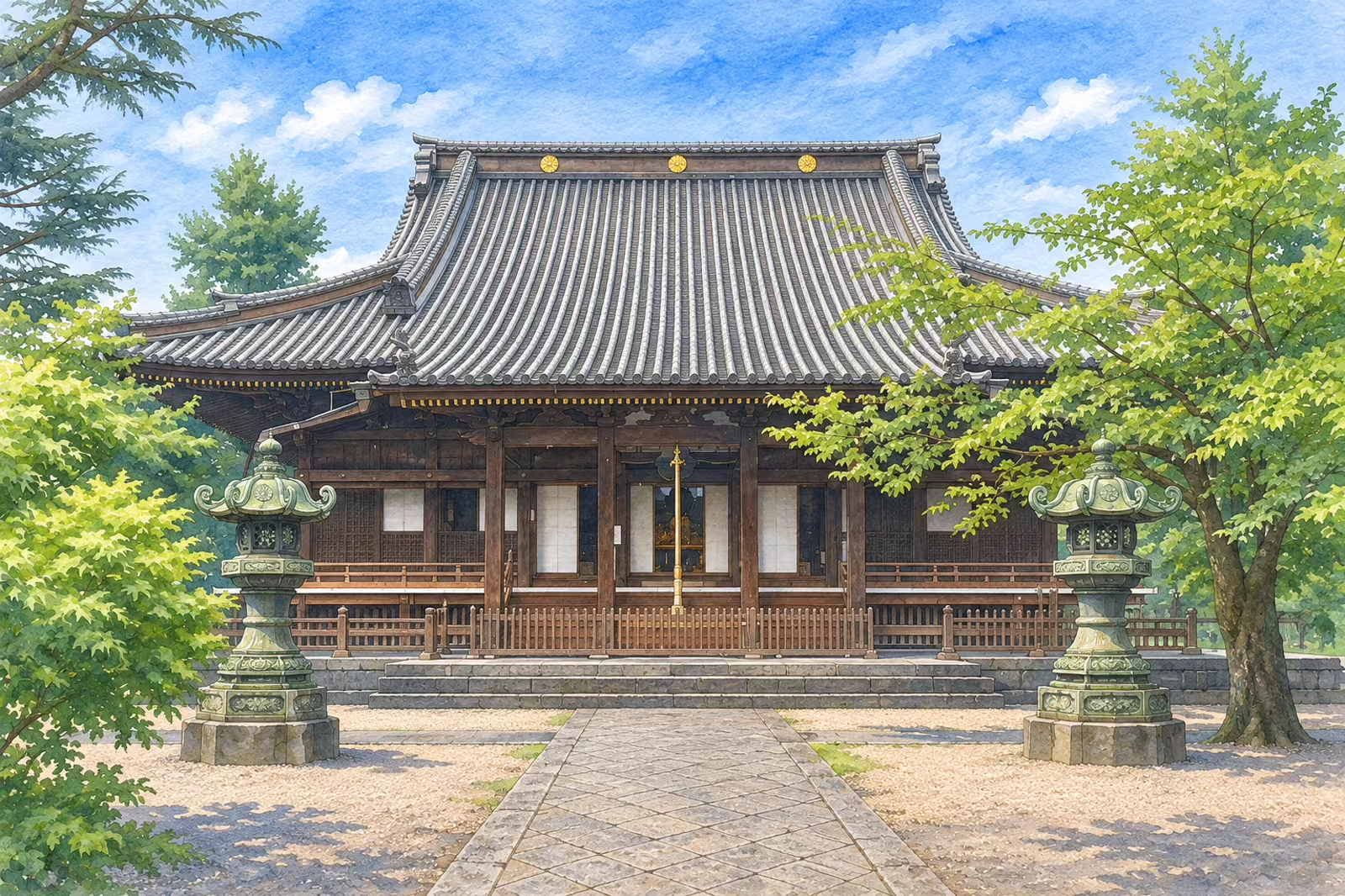
Kan’ei-ji is a Tendai Buddhist temple in Ueno, Taitō City, Tokyo. In the Edo period it covered most of what is now Ueno Park and was one of the two family temples of the Tokugawa shoguns, alongside Zōjō-ji in Shiba. The Battle of Ueno in 1868 destroyed its core, and the temple grounds were turned into a public park that now holds national museums, galleries and a zoo. Halls, gates and tombs scattered across the park still show how large the temple once was.
01Mount Hiei of the East
The monk Tenkai founded the temple in 1625 with the backing of the third shogun, Tokugawa Iemitsu. It took its name from the Kan’ei era, and its mountain name, Tōeizan, means "Mount Hiei of the East." Standing northeast of Edo Castle, it is generally thought to have copied the way Enryaku-ji on Mount Hiei guarded Kyoto’s unlucky northeast quarter. Over the following decades the temple added a head residence, many halls and dozens of sub-temples. The main hall, the Konponchūdō, was completed in 1698.
From the mid-seventeenth century the abbots were imperial princes, beginning with a son of Emperor Go-Mizunoo. Known as the Rinnōji-no-miya, they also oversaw Nikkō, which gave Kan’ei-ji great standing in the Buddhist world. Six shoguns are buried here: Ietsuna, Tsunayoshi, Yoshimune, Ieharu, Ienari and Iesada.
02War and the park
On the fifteenth day of the fifth month of 1868 (July 4), the Shōgitai, a force loyal to the old shogunate, held the temple against the new government’s army. The fighting ended within a day, and the main hall, the head residence and most other buildings burned. The Meiji government then took most of the land, and in 1873 Ueno became one of Japan’s first public parks. In 1879 a hall from Kita-in in Kawagoe was moved onto the site of a former sub-temple to serve as the present Konponchūdō.
03What can be seen today
Only a few early buildings survive. The Kiyomizu Kannon-dō, built in 1631 and later moved to its present spot, is an Important Cultural Property. So is the five-story pagoda, rebuilt in 1639, which now stands inside Ueno Zoo. The front gate of the old head residence survived the battle and still carries bullet marks; it now serves as the gate of Rinnō-ji. The Benten-dō on the island in Shinobazu Pond burned in the 1945 air raids and was rebuilt in 1958. Some gates and tombs of the Tokugawa mausoleums remain, though the cemetery is normally closed. A gravestone for the Shōgitai dead stands in the park. Ueno Tōshōgū, also run by Kan’ei-ji in the Edo period, has shrine buildings designated Important Cultural Properties.
Kan’ei-ji and Ueno
01A Park on Top of a Temple
Ueno Park is the place where Tokyo goes to look at things: cherry blossoms in spring, pandas at the zoo, Buddhist sculpture at the Tokyo National Museum, Rodin at the National Museum of Western Art. It feels like a planned civic space, and in a sense it is. But almost everything on this low plateau north of the old city stands on ground that, for nearly 250 years, belonged to a single Buddhist temple: Kan’ei-ji, one of the two family temples of the Tokugawa shoguns.
The temple still exists. It sits quietly at the northern edge of the park, in a district called Ueno-Sakuragi, reduced to a fraction of its old size. How it shrank, and how a sacred precinct of the shoguns turned into Japan’s first great public park, is a story of one man’s grand design, two and a half centuries of dynastic ritual, and a single day of fighting in the rain in 1868.
02Tenkai and the "Hiei of the East"
Kan’ei-ji was founded in 1625, with the backing of the shogunate, by Tenkai, a monk of the Tendai school of Buddhism, the tradition whose headquarters is Enryaku-ji on Mount Hiei, above Kyoto. Tenkai had become a close religious adviser to Tokugawa Ieyasu, the founder of the shogunate, in Ieyasu’s last years. After Ieyasu’s death in 1616 Tenkai shaped the way he was enshrined as a god, the Tōshō Daigongen ("Great Avatar Illuminating the East"), and he went on to serve the second and third shoguns, Hidetada and Iemitsu. Tenkai’s origins are obscure and he was said to have lived past a hundred, which has made him a magnet for legend; the popular theory that he was the warlord Akechi Mitsuhide in disguise has no basis.
The names Tenkai gave his new temple announced its ambitions. Its mountain name, Tōeizan, means "Mount Hiei of the East." Its temple name, Kan’ei-ji, came from the reigning era name, Kan’ei, just as Enryaku-ji had taken its name from the Enryaku era in the eighth century. Mount Hiei lies northeast of Kyoto, the direction from which, in traditional geomancy, misfortune enters, and the monastery there was regarded as the capital’s spiritual guard. Ueno lies northeast of Edo Castle. Kan’ei-ji was meant to play the same protective role for the shogun’s capital.
Tenkai carried the parallel further by recreating the landscape around Kyoto in miniature. He built a Kiyomizu Kannon Hall on the edge of the plateau, modeled on Kyoto’s famous Kiyomizu-dera with its projecting stage. The pond at the foot of the hill, Shinobazu, was cast as Lake Biwa, and on an island in it he placed a hall to the goddess Benzaiten, echoing the shrine on Chikubushima in the real lake. The land itself had been occupied by the Edo mansions of several daimyo (feudal lords), among them Tōdō Takatora; the shogunate took it over and granted it to Tenkai.
03A Prince in Edo
The temple grew through the seventeenth century and reached its peak under the fifth shogun, Tsunayoshi. In 1698 a vast main hall, the Konpon Chūdō, was completed near where the park’s central fountain now plays. At its height the temple compound is said to have covered more than 300,000 tsubo, about a square kilometer, with thirty-six sub-temples.
What set Kan’ei-ji apart was its abbot. From the mid-seventeenth century the post was held by an imperial prince, beginning with Prince Morizumi, a son of Emperor Go-Mizunoo, who became the third abbot in 1654 and received the title Rinnōji-no-miya the following year. The title passed to his successors and carried charge of the great shrine-temple complex at Nikkō, and the abbot was frequently head of the entire Tendai school as well. Placing a member of the imperial family permanently in Edo gave the shogunate’s temple unmatched prestige. It has often been suggested that it also gave the shogunate a useful card: should the court in Kyoto ever turn against it, the Tokugawa would have a prince of their own to put forward. Whether or not that was the original intention, it is exactly how events played out in 1868.
04Graves of the Shoguns
Kan’ei-ji became a burial place for shoguns with the fourth, Ietsuna, who died in 1680. Before him, Ieyasu and Iemitsu had been entombed at Nikkō and Hidetada at Zōjō-ji, the Pure Land temple at Shiba in the south of the city. From Ietsuna on, the shoguns were divided between Kan’ei-ji and Zōjō-ji. Six lie at Kan’ei-ji: Ietsuna (4th), Tsunayoshi (5th), Yoshimune (8th), Ieharu (10th), Ienari (11th), and Iesada (13th). Tenshōin, better known as Atsuhime, the wife of Iesada, is buried beside her husband.
Each mausoleum once had its own lavishly decorated worship halls and gates in the style of Nikkō. Most of the mausoleum buildings came through 1868 only to burn in the air raids of 1945, and the cemetery is not generally open. But several of the gates survive, including the Chokugakumon ("imperial-plaque gates") and water-basin pavilions of the mausolea of Ietsuna and Tsunayoshi, Important Cultural Properties that can be seen from outside.
05Ueno Tōshōgū
On the western side of the park stands the Ueno Tōshōgū, a shrine to the deified Ieyasu. Its origins go back to 1627, when Tōdō Takatora built a shrine to Ieyasu next to his residence here. The shrine likes to tell the story that the dying Ieyasu, Tenkai, and Takatora wished to remain together in spirit in one place; this is a tradition rather than a documented event.
The buildings you see today were rebuilt in 1651 by the third shogun, Iemitsu, whose devotion to his grandfather also produced the extravagant rebuilding of Nikkō Tōshōgū. Worship hall, offering hall, and main sanctuary are joined under one roof in the gongen style and covered in gold leaf, which is why the complex is nicknamed the Konjikiden, the "Golden Hall." The Karamon, the ornate Chinese-style gate before it, carries carvings of dragons attributed by tradition to the legendary carpenter Hidari Jingorō; another story says the dragons slip out at night to drink from Shinobazu Pond.
The approach is lined with stone lanterns and some fifty bronze lanterns presented by daimyo, many with their donors’ names still legible, and the great stone torii at the entrance was given in 1633 by the senior councillor Sakai Tadayo. Remarkably, the shrine survived the battle of 1868, the Great Kantō Earthquake of 1923, and the bombing of 1945. It is the most complete group of early Edo-period buildings on the hill, and its main buildings, the Karamon, the openwork fence, the stone torii, and the bronze lanterns are designated Important Cultural Properties. A recent restoration renewed the gold leaf, so the shrine looks startlingly bright.
The five-storied pagoda that rises behind the zoo fence nearby was originally part of the shrine. Built in 1631 and rebuilt after a fire in 1639, it was transferred to Kan’ei-ji when Shinto and Buddhist institutions were separated in the early Meiji period and given to the city of Tokyo in 1958. It is an Important Cultural Property and now stands inside Ueno Zoo.
06Blossoms and Bells
For ordinary people in Edo, Ueno meant cherry blossoms. Tenkai is said to have brought trees from Yoshino, and by the eighteenth century Ueno was the city’s most celebrated viewing spot. But this was the shogun’s temple, and its rules were strict: gates closed at dusk, and drunken carousing was frowned upon. The rowdier parties moved over time to places like Asukayama and the Sumida River embankment, which the eighth shogun, Yoshimune, planted with cherries partly so that commoners could enjoy themselves.
Ueno also kept one of Edo’s time bells. The poet Matsuo Bashō wrote a famous haiku in which, amid a cloud of blossoms, he hears a bell and cannot tell whether it is Ueno’s or Asakusa’s. The bell still hangs on a small mound in the park and is still rung.
07The Last Shogun in Retreat
In January 1868 forces loyal to the shogunate were defeated at Toba-Fushimi near Kyoto, and the last shogun, Tokugawa Yoshinobu, fled by ship to Edo. As the new imperial government’s army marched east, Yoshinobu chose submission. In the second month of the lunar calendar he left Edo Castle and shut himself up in Daiji-in, one of Kan’ei-ji’s sub-temples, in a gesture of contrite seclusion. The abbot of the day, Prince Kōgen, carried a plea for leniency to the imperial commanders.
After the famous negotiations between Katsu Kaishū for the Tokugawa and Saigō Takamori for the imperial side, Edo Castle was handed over without a fight on the eleventh day of the fourth month. That same day Yoshinobu left Ueno for further confinement in Mito. The site of Daiji-in is now the heart of present-day Kan’ei-ji, which preserves the room he used.
08The Shōgitai
Not every Tokugawa retainer accepted defeat. Around the time Yoshinobu moved to Ueno, a group of shogunal vassals formed the Shōgitai, the "League to Demonstrate Righteousness," nominally to protect him. Its leaders included Shibusawa Seiichirō, a cousin of the future industrialist Shibusawa Eiichi, and Amano Hachirō. When Yoshinobu left for Mito, the Shōgitai stayed, claiming now to guard the prince-abbot and the Tokugawa tombs. Disaffected men flocked to them, and their numbers are said to have reached two to three thousand at their height. Shibusawa, who disagreed with Amano, eventually left with his own followers.
For the new government, an armed band holding the high ground in the middle of the capital, with an imperial prince in its midst, could not be tolerated. Ōmura Masujirō, the Chōshū military planner who was effectively directing operations in Edo, resolved to destroy it in one blow.
09The Battle of Ueno
The attack came on the fifteenth day of the fifth month, July 4, 1868, in heavy rain. Ōmura’s plan surrounded the hill on three sides but left the north open, toward Negishi and Mikawashima, so that the defenders could flee rather than fight to the last man. Satsuma troops under Saigō Takamori attacked the main entrance, the Kuromon or Black Gate, at the south end of the hill, close to where the Saigō statue now stands; the fighting there was the fiercest. Chōshū and other units came in from Dangozaka and the Yanaka side to the northwest. Across Shinobazu Pond, Armstrong guns belonging to the Saga domain fired onto the hill from the grounds of the Kaga domain’s mansion at Hongō, now the University of Tokyo.
By late afternoon the Shōgitai had collapsed. Fires set by the shelling and the fighting swept through the temple. The Konpon Chūdō, the abbot’s palace, and most of the other halls were destroyed; the Tōshōgū, the Kiyomizu Kannon Hall, and the pagoda were among the few survivors. Shōgitai dead are generally put at over two hundred. The prince-abbot Kōgen was smuggled out and eventually reached the northeast, where the alliance of northern domains resisting the new government made him their figurehead. Later pardoned, he returned to lay life as Prince Kitashirakawa Yoshihisa and died in Taiwan in 1895 while commanding troops there.
The bodies of the Shōgitai dead were left on the hill for days. The priest of Entsū-ji in Minowa eventually had them cremated on the hill, at a spot called Sannōdai, and buried their ashes at his temple. In 1907 Entsū-ji also received the Kuromon itself, still pocked with bullet holes. A survivor, Ogawa Okisato, was later allowed to raise a grave at Sannōdai; it was completed in 1881. Out of caution toward the government, the great stone does not name the Shōgitai at all, reading only "Grave of Those Who Died in Battle," in calligraphy attributed to Yamaoka Tesshū. That is the Shōgitai grave that stands today a short walk behind the Saigō statue.
10From Hospital Site to Public Park
After the battle the hill was a burned-out ruin in government hands. The new authorities planned to build a medical school and hospital there. According to the story told in Ueno for well over a century, the Dutch army doctor Antonius Bauduin, invited to inspect the site, argued that such a fine wooded height should be kept as a park instead. A bust of Bauduin stands in the park in gratitude. The first bust, put up in 1973, actually showed his younger brother, because of a mistaken photograph supplied from the Netherlands; it was replaced with a correct likeness in 2006.
In 1873 the government issued an order establishing public parks, and Ueno was among Tokyo’s first, along with Asakusa, Shiba, Fukagawa, and Asukayama. Ueno Park formally opened in 1876. It quickly became the stage on which Meiji Japan displayed modernity to itself. The First National Industrial Exhibition was held here in 1877. In 1882 a museum designed by the British architect Josiah Conder opened on the site of the abbot’s palace, and in the same year Japan’s first zoo opened beside it. Art and music schools, a library, and later concert halls and more museums followed, making Ueno the country’s cultural showcase.
In 1890 the park became imperial property. In 1924, to mark the wedding of the Crown Prince, the future Emperor Shōwa, the Imperial Household gave it to the city of Tokyo, which is why its formal name is Ueno Onshi Kōen, "Ueno Imperial Gift Park."
11Saigō Takamori and His Dog
The best-known monument in the park is the bronze statue of Saigō Takamori at its southern tip. Saigō, a samurai of Satsuma, was one of the chief architects of the Meiji Restoration and the imperial negotiator at the surrender of Edo Castle. Less than ten years later, in 1877, he led the Satsuma Rebellion against the government he had helped create, and died at its end. He was officially a rebel until 1889, when he was pardoned and posthumously restored to court rank on the promulgation of the Meiji Constitution. His friends then raised money for a statue, eventually from more than 25,000 donors, with a contribution from the Imperial Household Ministry.
It was unveiled in December 1898. The sculptor Takamura Kōun made the figure; the dog, said in the end to have been modeled on a Satsuma breed, was the work of Gotō Sadayuki. Saigō is shown not in uniform but in a simple kimono, with his hunting dog on a leash, as if setting out into the hills. The informal pose is usually explained by his status as a former rebel. At the unveiling his widow Ito is said to have exclaimed that her husband did not look like that; whether she meant the face or the casual dress has been argued ever since.
The statue stands almost exactly where Satsuma troops stormed the Black Gate in 1868, and the grave of the men they killed lies a few dozen steps behind it.
12Earthquake, War, and the Temple Today
During the Great Kantō Earthquake of 1923, Ueno Park sheltered hundreds of thousands of refugees, and the Saigō statue was covered with notices from people searching for missing family. The head of the Ueno Great Buddha fell in the quake; the rest of the statue was later surrendered for its metal during the Second World War. Only the face survives, mounted on a wall on its old hill, and students visit it to pray for exam success because it "will not fall again." In 1945 air raids destroyed the Benten Hall on Shinobazu Pond, which was rebuilt after the war. At the zoo, elephants and other large animals were killed on official orders during the war, a story later retold in a well-known children’s book.
Kan’ei-ji itself was left with a small part of its former grounds. In 1879 a hall built in 1638 at Kita-in, a Tendai temple in Kawagoe with old ties to Tenkai, was dismantled, shipped to Ueno, and re-erected on the site of Daiji-in as the new Konpon Chūdō. It is the main hall today. The National Museum of Western Art, designed by Le Corbusier and opened in 1959, became part of a World Heritage listing of his works in 2016.
13A Walk Across the Hill
Begin at the south end, climbing the steps from the Keisei Ueno station side. The Saigō statue is the first thing you meet, and the Shōgitai grave is just behind it. A little further along the edge of the plateau is the Kiyomizu Kannon Hall, built in 1631 and moved to this spot in 1694 to make room for the main hall, a survivor of the battle and an Important Cultural Property. In front of it, a pine trained into a loop, the "Moon Pine," recreates a scene from Utagawa Hiroshige’s One Hundred Famous Views of Edo. From the hall’s stage you look down on Shinobazu Pond and the Benten Hall, which is Tenkai’s Kyoto-in-Edo laid out before you.
Continue north past the time bell and the Great Buddha’s face to the Tōshōgū, with its avenue of lanterns, the Karamon, and the Golden Hall. Look over the zoo fence for the pagoda. The central fountain marks roughly where the Konpon Chūdō stood. Beyond it the Tokyo National Museum occupies the site of the abbot’s palace; the palace’s front gate, which also survived 1868 and also bears bullet scars, served for a time as the museum’s main entrance and has stood since 1937 just west of the museum, in front of the Rinnōden hall. It is an Important Cultural Property.
Cross the road behind the museum to reach today’s Kan’ei-ji, with its main hall brought from Kawagoe and its founder’s hall, popularly called the Ryōdaishi ("Two Great Teachers"), dedicated to Tenkai and the Heian-period Tendai master Ryōgen. Nearby, behind walls, lie the shoguns. Standing there, it is easy to read the whole park as a map of the vanished temple: the gardens were its precincts, the museum its abbot’s residence, the zoo holds its pagoda, and the fountain marks its main hall.