
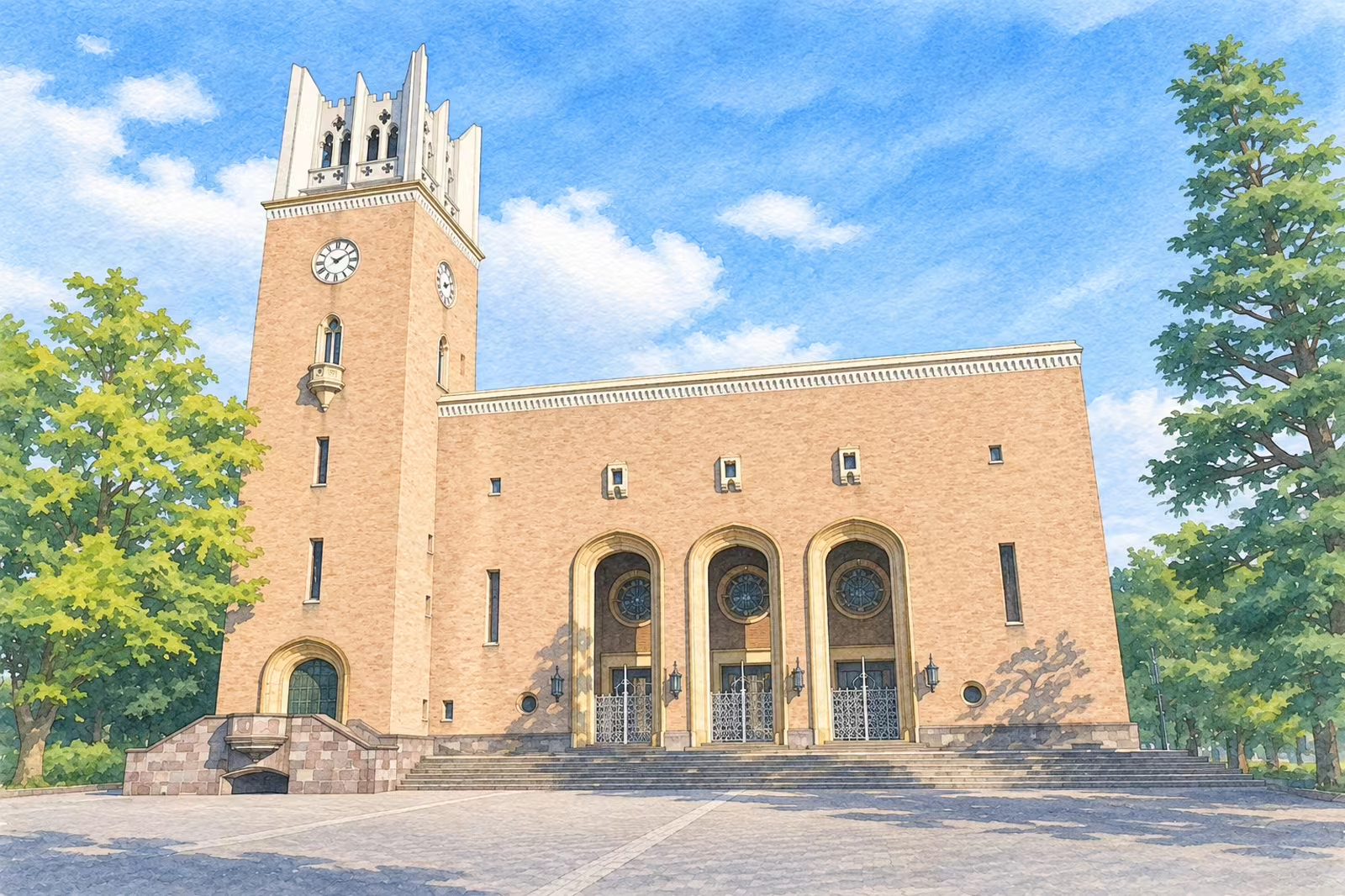
Waseda University’s main Waseda Campus, in Shinjuku Ward, Tokyo, grew out of Tokyo Senmon Gakkō, a school founded in 1882 by the statesman Ōkuma Shigenobu. Ōkuma Auditorium, the Ōkuma Garden, the Ōkuma statue and the former library trace how this private institution developed from a small specialist school into a major university, and they show a path in Meiji education that ran outside the government establishment.
01Ōkuma Shigenobu and Tokyo Senmon Gakkō
Ōkuma, from the Saga domain, oversaw finance in the early Meiji government. In 1881 he clashed with Itō Hirobumi and others, chiefly over his call for an early national assembly, and was forced out of government in what is known as the Political Crisis of 1881. The following year he organized the Rikken Kaishintō (Constitutional Reform Party), and in October 1882 he opened Tokyo Senmon Gakkō near the village of Waseda on the outskirts of Tokyo, with Ono Azusa among the founders. The school proclaimed "the independence of learning" and taught politics, law and related subjects to train people who would not depend on official patronage. Ōkuma’s own residence stood next to the school, and he later served twice as prime minister. The school took the name Waseda University in 1902 and gained formal university status under the University Ordinance in 1920. Ōkuma died in 1922 at the age of 83 (85 by traditional count).
02What Can Be Seen Today
Ōkuma Auditorium, completed in 1927, with its clock tower and brick-toned facade, is the university’s emblem; it was designated an Important Cultural Property in 2007. The Ōkuma Garden was originally the garden of his residence. His family donated it to the university after his death; it was damaged in the 1945 air raids and restored after the war. A small gatehouse beside the garden is described by the university as the oldest surviving building on campus. The statue of Ōkuma inside the main gate is recorded as having been erected in 1932 for the school’s 50th anniversary. The former library, completed in 1925, now houses the Aizu Yaichi Memorial Museum. The campus also has the Theatre Museum, named after Tsubouchi Shōyō, and the Waseda University History Museum, which presents the institution’s own story. The whole area remains a working campus, and the original Meiji school buildings have not survived as a group.