
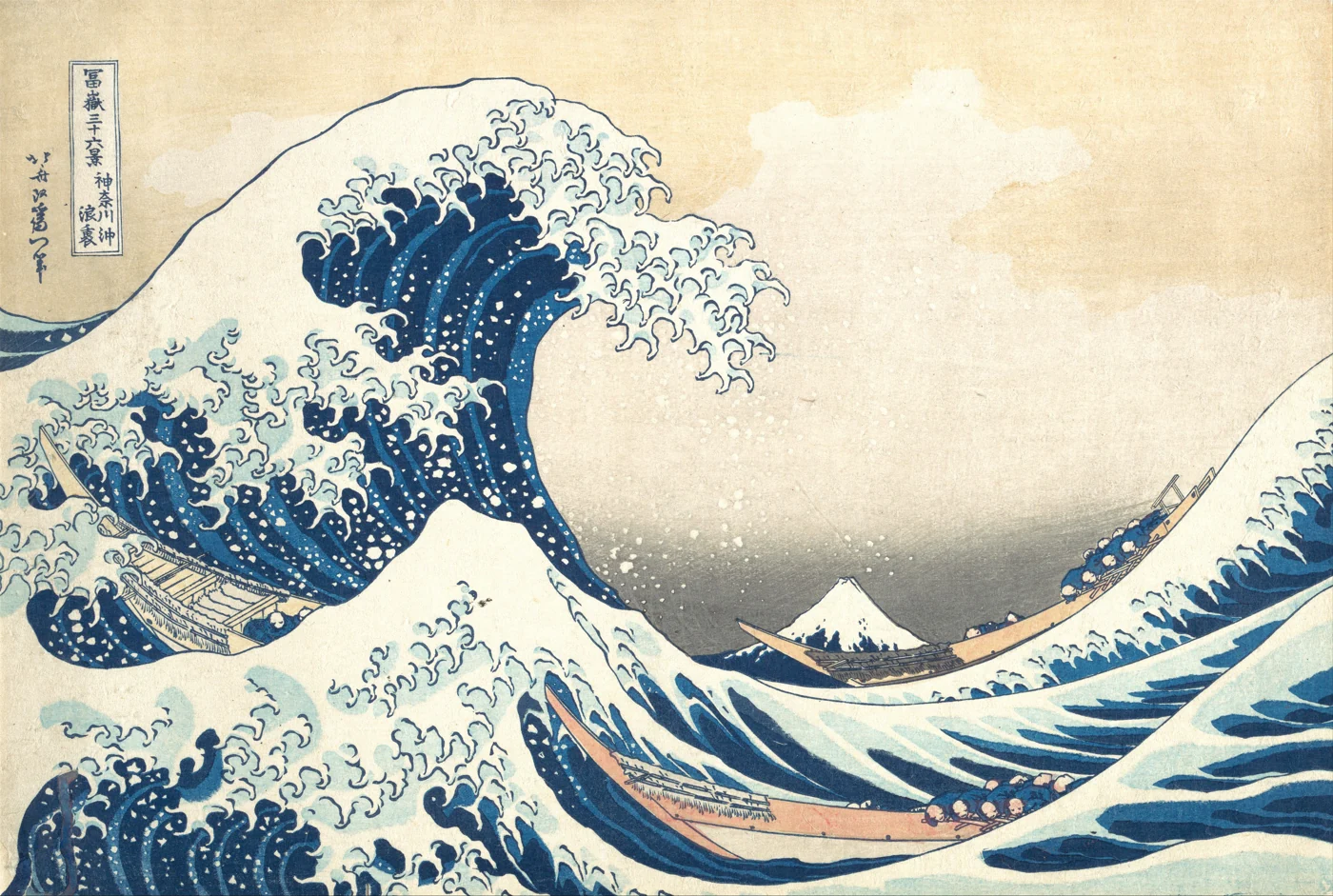
At a glance
How cheap Edo color prints were made by four craftsmen, what they showed, why no two Great Waves match, and where to see them in Japan.
- Ukiyo-e pictured the 'floating world' of theaters, pleasure quarters and fashion, mostly as cheap woodblock prints.
- The 1765 vogue for exchanging picture calendars produced multi-block 'brocade pictures’, kept in register by the kentō.
- Each print was the work of four parties: publisher, designer, carver and printer; a first printing ran to about 200 sheets.
- A late-Edo print is usually quoted at around 20 mon, against about 16 for a bowl of soba.
- Thirty-six Views of Mount Fuji has 46 prints; somewhat over 100 impressions of the Great Wave survive, no two identical.
Hokusai’s Great Wave is probably the most reproduced image in Asian art. It appears on tote bags, phone cases, emoji keyboards and the pages of Japanese passports. Yet when it was new, around 1831, it was a cheap color print sold over the counter in Edo, the city now called Tokyo, for roughly the price of a bowl of noodles. That gap between humble origin and global fame is the story of ukiyo-e, "pictures of the floating world." This introduction explains what the prints showed and who bought them, how a single sheet was made by four different craftsmen, why Hokusai’s Thirty-six Views of Mount Fuji contains forty-six pictures, why no two copies of the Great Wave are quite the same, and where you can see the real thing in Japan.
01The floating world
The word ukiyo began as a Buddhist lament. Written with characters meaning "sorrowful world," it described the transience of life and the futility of attachment. In the seventeenth century, after the Tokugawa shoguns brought a long peace to Japan, the same sound came to be written with a different character, the one for "floating." The sorrow turned into an invitation. If life drifts past like a gourd on a stream, why not enjoy it? The floating world became the world of pleasure and fashion: the kabuki theater, the licensed brothel district of the Yoshiwara, teahouses, restaurants, cherry-blossom outings and the newest kimono patterns.
Edo had grown by the eighteenth century into a city of perhaps a million people, among the largest anywhere. A great many of them were merchants, artisans, servants and samurai retainers posted from the provinces. These were not the patrons who commissioned folding screens from the Kanō painters who served the shogun and the great lords. But they wanted pictures too: pictures of celebrated courtesans, of their favorite actors, of something bright to paste on the wall. Woodblock printing answered that demand. A single set of carved blocks could produce hundreds of copies, which kept the price low enough for ordinary townspeople.
Hishikawa Moronobu, active in the later seventeenth century, is usually named as the founder of ukiyo-e. He started as an illustrator of popular books and began issuing his pictures as single sheets, independent of any text. His most famous work, ironically, is a painting rather than a print: Beauty Looking Back, a hanging scroll of a young woman glancing over her shoulder, her sash rendered in careful detail. Ukiyo-e artists painted as well as designed prints throughout the period, but it was the print that made the genre a mass phenomenon.
02From black and white to "brocade pictures"
The earliest prints were in black ink only. Color, if a buyer wanted it, was brushed on by hand. Collectors today distinguish several stages by the colors used: orange-red lead pigment, a pink derived from safflower, and black ink thickened with glue to look like lacquer. All of this was hand work, slow and inconsistent.
By the 1740s, publishers were printing a few colors from separate blocks, usually a pink and a green. The decisive leap came in 1765. Wealthy amateurs in Edo had taken up a fashion for exchanging picture calendars, puzzle prints in which the long and short months of the coming year were hidden in the design. Since money was no object, the artist Suzuki Harunobu and his carvers and printers pushed the number of color blocks from the two or three of earlier prints to several, sometimes more than ten. The results were so rich that publishers soon acquired the blocks, removed the calendar markings and the patrons’ names, and sold the prints commercially under the name Azuma nishiki-e, "brocade pictures of the East," that is, of Edo. Full-color woodblock prints have been called nishiki-e ever since.
- 1Black ink only
- 2Colour brushed on by handlead red, safflower pink, lacquer-like black
- 3A few colour blocksby the 1740s; two or three blocks, usually pink and green
- 4Nishiki-e1765; several blocks, sometimes more than ten
Colour moved from hand painting to separate blocks; in 1765 the blocks grew to several or more than ten, and nishiki-e was born.
What made multi-block printing reliable was a simple device called the kentō, a pair of registration marks cut into the edge of every block: an L-shaped notch at the lower right corner and a straight notch along the bottom edge. The printer lays the paper’s corner and edge into these notches for each block in turn, so every color lands exactly where it should. When you see a nishiki-e in which outlines and color areas meet without a gap, you are looking at those two small notches and a printer’s practiced hands.
Harunobu’s own pictures are easy to recognize. His figures are slender and almost weightless, young men and women so alike that it is sometimes hard to tell which is which. They sit on verandas or walk through snow, absorbed in some small task. He favored thick paper and soft colors, sometimes filled the whole background with a flat tone, and liked to press uninked patterns into snow and fabric. Those luxuries were a legacy of the private calendar commissions where his style was born.
03How a print was made
A ukiyo-e print was a team product. The publisher, or hanmoto, put up the money, chose the subject, hired the artist and took the risk. He usually ran a shop as well, and functioned as something between a book publisher and a film producer. The most celebrated of them, Tsutaya Jūzaburō, launched the career of Kitagawa Utamaro in the 1780s and introduced the mysterious Sharaku in 1794. The artist supplied the design. The carver turned it into wood. The printer turned the wood into color on paper. Only the artist’s signature normally appears on the sheet, next to the publisher’s trademark. Carvers and printers were almost never named.
The artist drew the outlines in ink on thin paper. The carver pasted this drawing face down on a block of cherry wood, so that the lines showed through, and cut away everything except the lines, leaving them standing in relief. This was the key block. The hardest part was the hairline of a woman’s coiffure, where several separate strands might have to fit into a millimeter, and that job went to the most senior carver. Since the drawing was destroyed in the cutting, almost no original designs for prints survive.
From the key block, proofs were pulled in black. The artist marked on each proof which areas were to be red, which blue, which yellow, and a separate block was carved for each color, often on both faces of the wood to save timber. An ordinary print might need anywhere from a handful of color blocks to more than a dozen.
- 1Ink drawingthe artist draws outlines on thin paper
- 2Key blockthe carver cuts the lines in cherry wood; the drawing is destroyed
- 3Proofs in blackpulled from the key block
- 4Colours markedthe artist marks red, blue, yellow
- 5Colour blocksone per colour, often both faces
- 6Printingpaper laid into the kentō, one colour at a time
The drawing is destroyed when the key block is cut, so almost no original designs survive; colour blocks range from a handful to more than a dozen.
Then came the printer. The paper was a strong, thick sheet made from the inner bark of the paper mulberry. It had to be dampened to exactly the right degree: too dry and it would not take the color, too wet and the color would bleed. The printer brushed pigment mixed with a little rice paste onto the block, laid the paper into the kentō, and rubbed the back of the sheet with a baren, a flat disc made of a coiled cord of twisted bamboo sheath wrapped in a further layer of bamboo sheath. All the pressure came from the printer’s arm and wrist. A first printing is generally said to have run to about two hundred sheets, and the printer would take each color through the whole stack before moving to the next block.
- 1
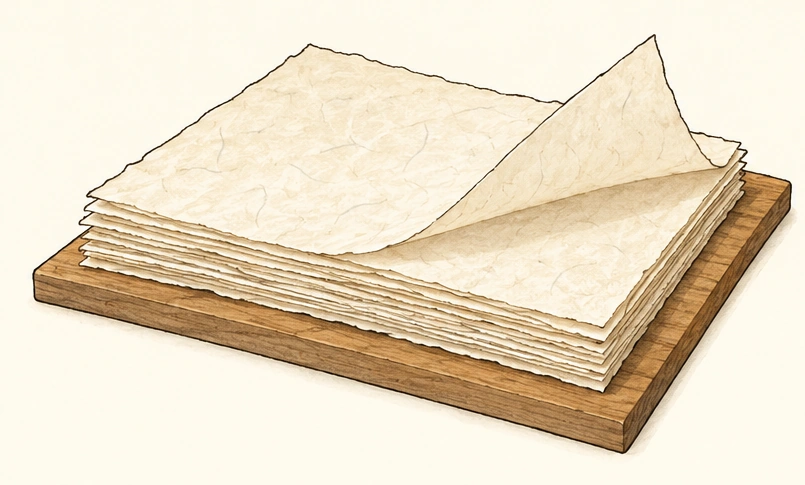 Thick washi made from mulberry bark, dampened to just the right degree.
- 2
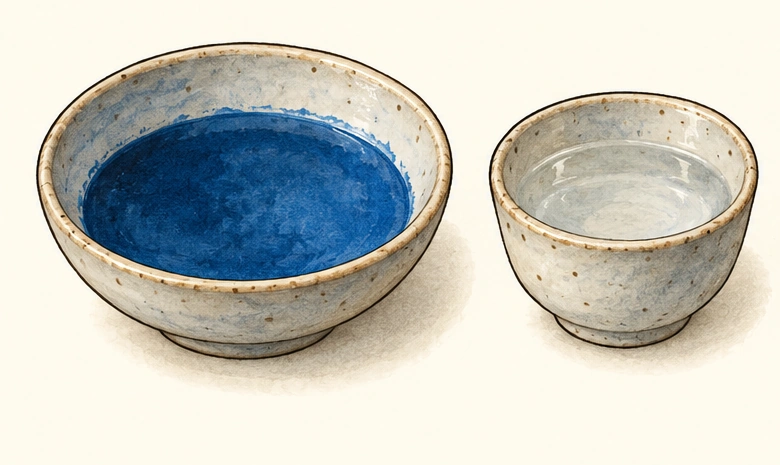 Pigment and water are made ready.
- 3
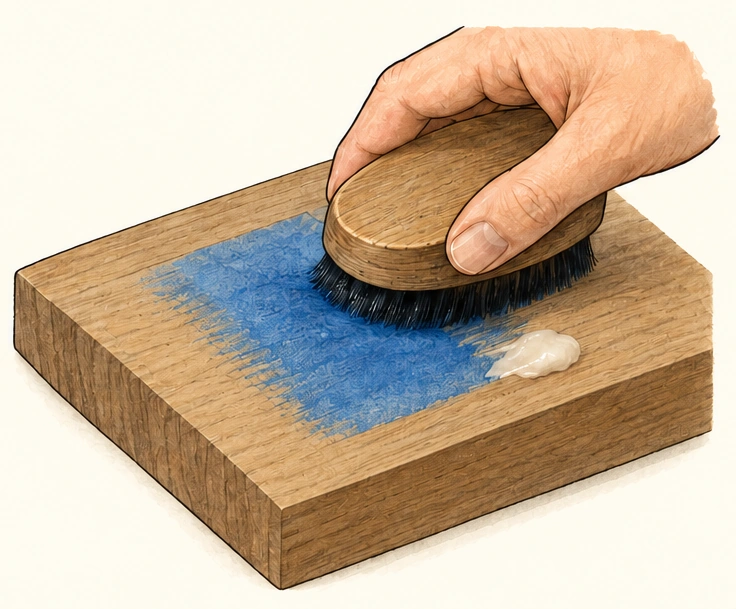 Pigment and rice paste are brushed onto the block.
- 4
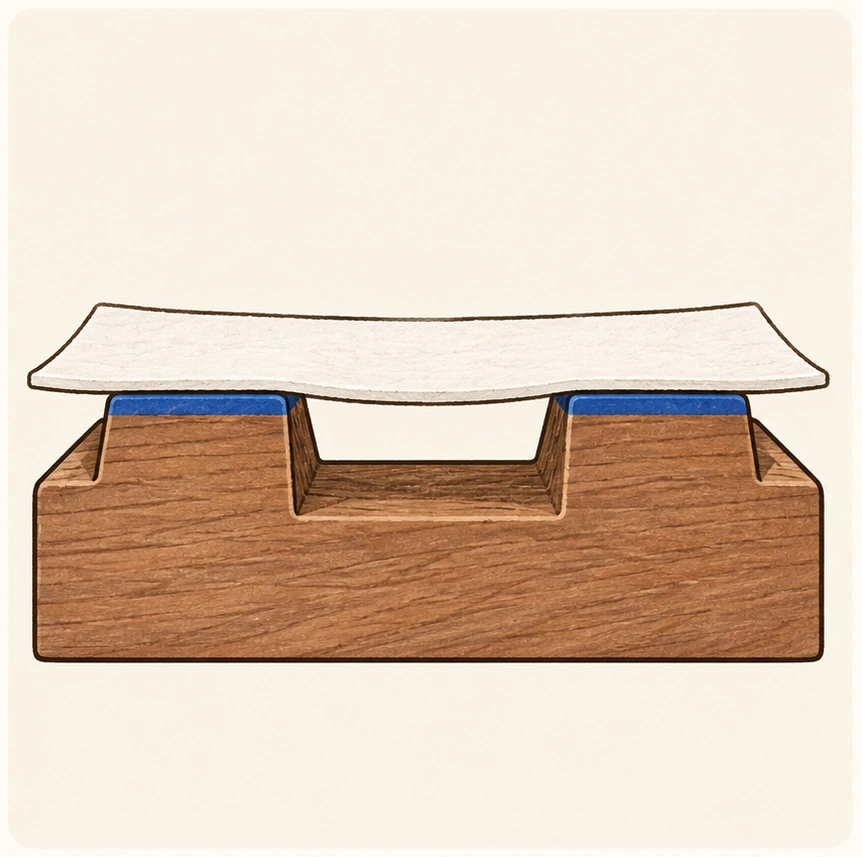 Paper laid in the kentō is rubbed from behind; the inked raised areas press color into it (schematic, not to scale).
- 5
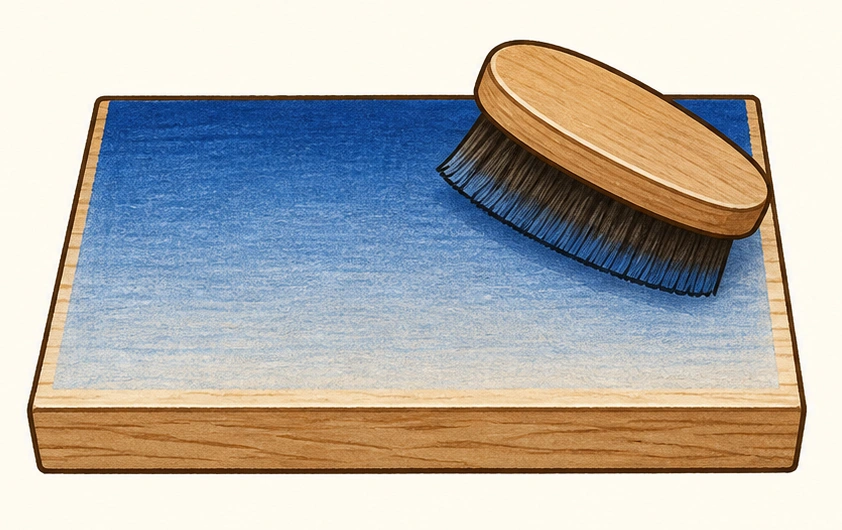 Bokashi: the color is first graded from dark to light on the block.
- 6
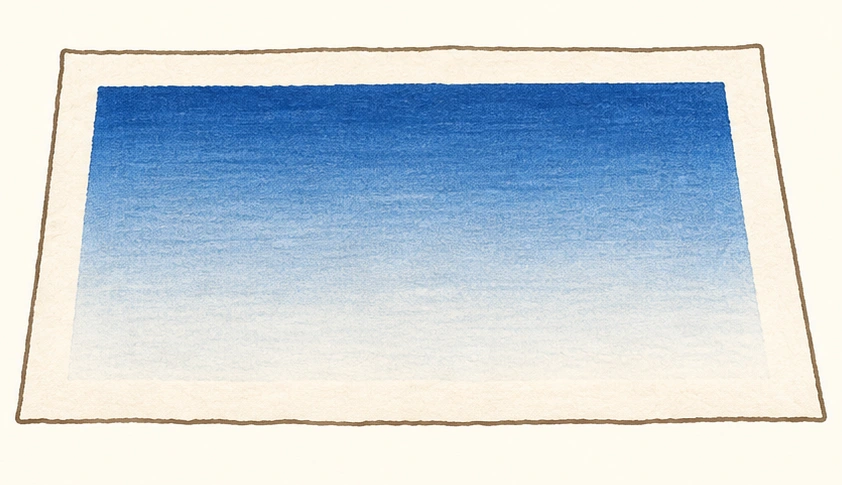 Printed, it becomes the band of sky fading from deep blue to white.
Many of the effects that make nishiki-e memorable are printers’ techniques. Bokashi is graded color, made by wiping the inked block with a damp cloth so that the tone fades from dark to light. The deep blue bands of sky at the top of Hokusai’s and Hiroshige’s landscapes are bokashi. Karazuri, "empty printing," uses an uninked block pressed hard to raise an embossed pattern, used for snow, for the weave of a kimono or the feathers of a bird. It is almost invisible in photographs and only appears when you look at an original in raking light. Mica dust brushed onto a glued background gave a soft silver shimmer to the portraits of Utamaro and Sharaku. Burnishing black areas gave them the sheen of satin.
A standard full-size print, the ōban, measures about 39 by 26.5 centimeters, noticeably larger than a sheet of A4 or US letter paper. A common rule of thumb is that a print cost about as much as a bowl of soba from a street stall; the figures usually quoted are around twenty mon for a print and about sixteen for the soba. It was cheap because it was a mass-produced commodity. It was beautiful because a whole industry of specialists made it.
Prints were also censored. From the 1790s, every design had to be inspected and stamped with a seal of approval before sale, and later with date seals as well. These tiny seals are among the main tools scholars now use to date individual prints.
04Beauties and actors
The two largest genres of ukiyo-e were pictures of beautiful women, bijinga, and pictures of kabuki actors, yakusha-e.
The beauties were mostly courtesans of the Yoshiwara and the geisha of the pleasure quarters, along with the occasional teahouse waitress whose looks had made her famous. In the 1780s Torii Kiyonaga drew tall, statuesque women strolling in groups through recognizable Edo streets and along the shore, rather like a fashion shoot on location. In the 1790s Utamaro moved the camera in. His ōkubi-e, "large head pictures," show women from the chest up, and he cataloged their gestures: a woman reading a letter, adjusting her hair in a mirror, blowing into a poppin, a thin glass toy that clicks when you blow into it. The girl with the poppin, her checked kimono and pursed lips, has become a kind of shorthand for the ukiyo-e beauty. These prints were also fashion plates. The patterns of a courtesan’s robes, her hairstyle and her hairpins were what the women of Edo copied.
Actor prints were the celebrity photographs and production stills of their day. After a performance, a fan could buy a picture of a favorite star in the role he was playing that season. The Torii family of artists had designed theater signboards and posters since the late seventeenth century; Katsukawa Shunshō, in the later eighteenth century, began to give each actor an individual face rather than a stock type.
The great puzzle of ukiyo-e is Tōshūsai Sharaku. He appeared out of nowhere in the fifth month of 1794, published by Tsutaya, with 28 large-head portraits of actors on dark mica backgrounds. The faces are exaggerated almost to caricature: arched eyebrows, clamped mouths, clawing fingers. Over about ten months he produced some 140 prints, then vanished for good. His identity has been argued over for more than a century. The most widely accepted candidate today is Saitō Jūrōbei, a noh actor in the service of the lord of Awa, though not everyone is convinced. Sharaku’s prints may not have sold well; one story has it that they were too truthful and showed the actors’ flaws. Western collectors later prized them as some of the most individual portraits in Japanese art.
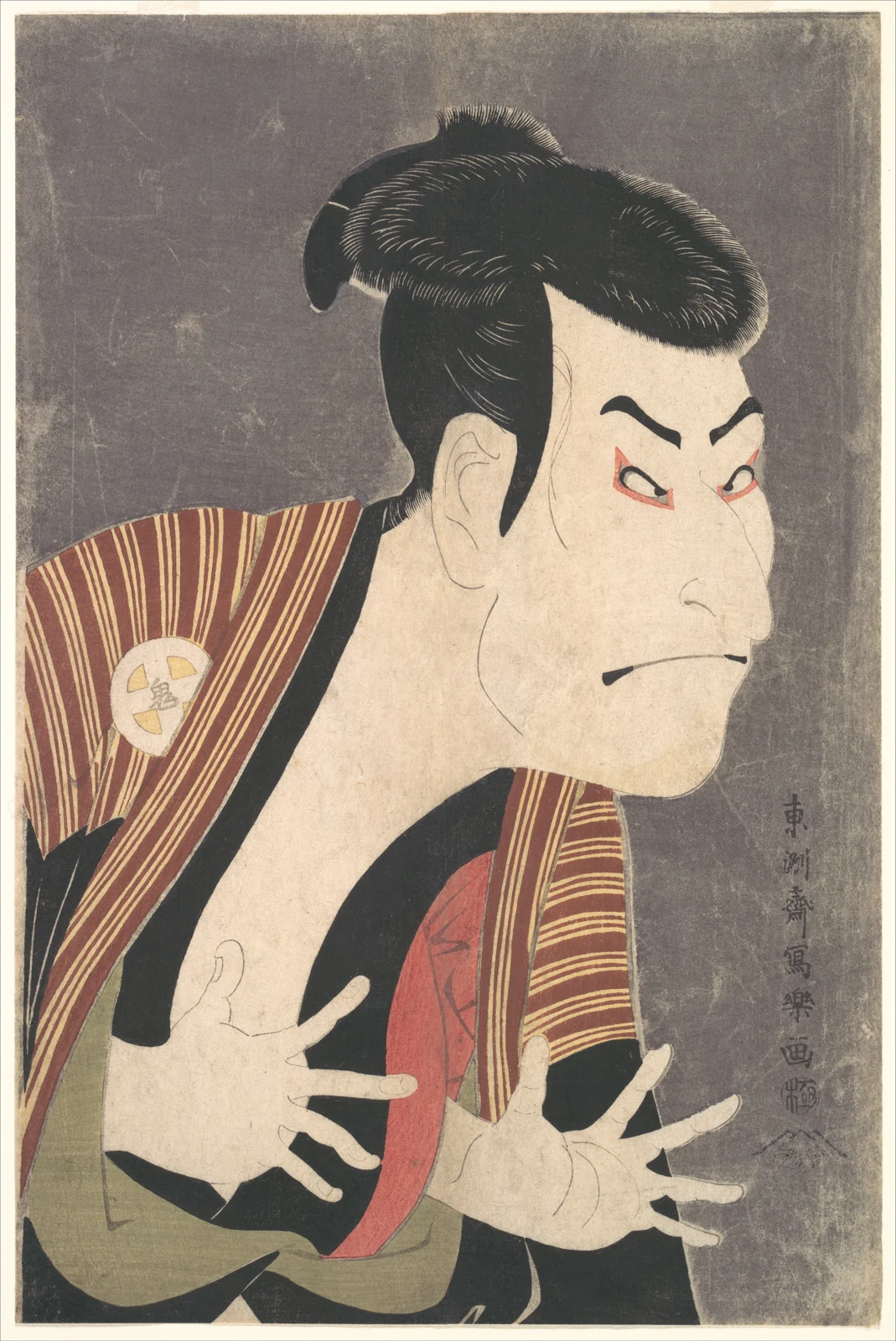
Sharaku, Ōtani Oniji III as Yakko Edobei, 1794: raised brows, clamped mouth, splayed fingers on a dark mica ground.
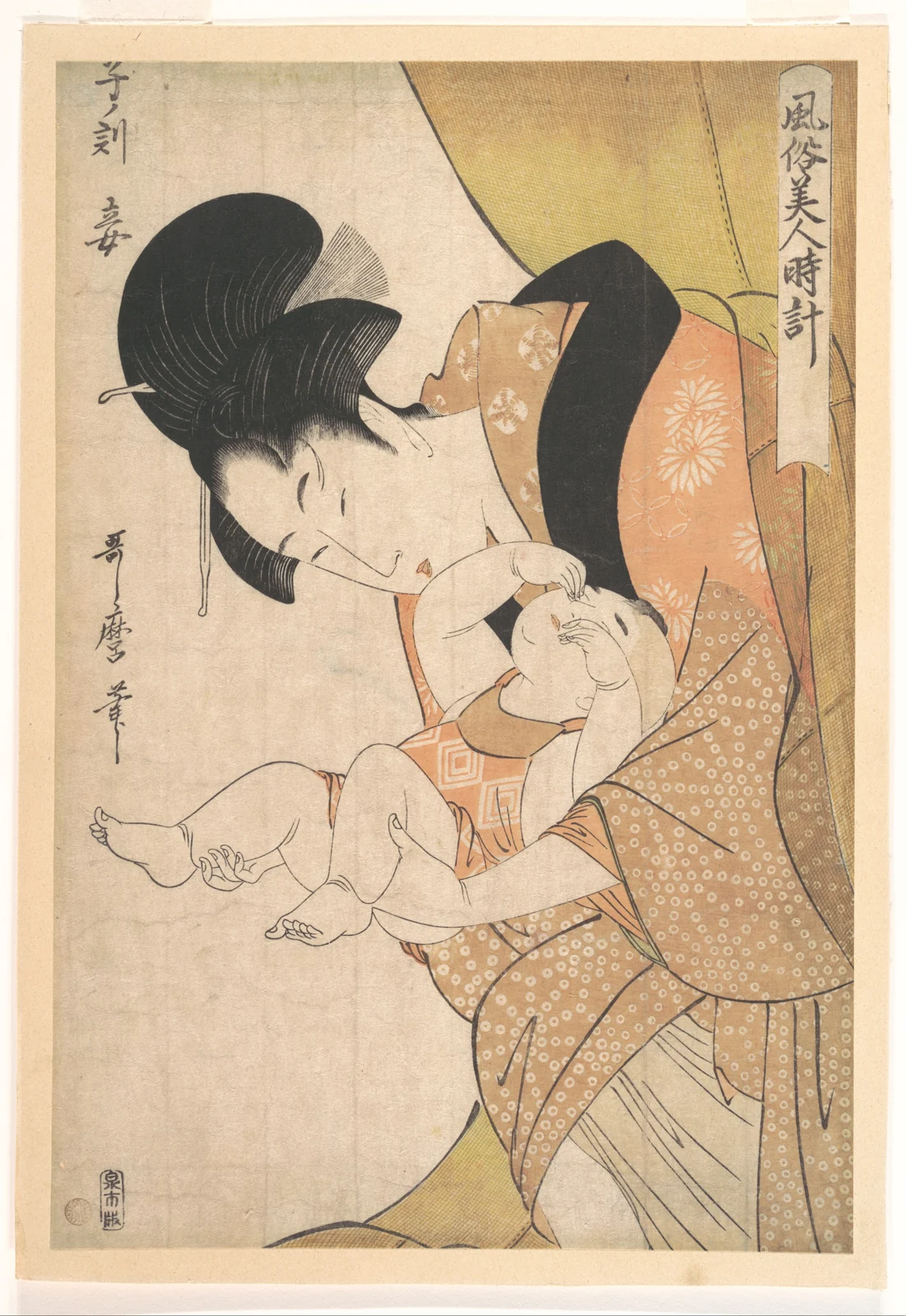
Utamaro, Hour of the Rat, 1790: a beauty seen close up, from the waist up.
The Metropolitan Museum of Art (Open Access): Tōshūsai Sharaku, Ōtani Oniji III as Edobei (1794); Kitagawa Utamaro, Hour of the Rat: A Mistress, from Customs of Beauties Around the Clock (1790)
The 1790s were the high point of beauties and actors, and also a period of tight control. The Kansei Reforms restricted luxury, color and subject matter. Half a century later, during the Tenpō Reforms of the early 1840s, prints of actors and courtesans were banned outright for several years. Utamaro himself was punished in 1804 for prints on the life of the warlord Toyotomi Hideyoshi, reportedly sentenced to fifty days in manacles, and he died two years later. Ukiyo-e always had to find its way between fashion and the censor, and the later rise of landscape and warrior prints had something to do with that.
05Prints not for sale, and books with pictures
Alongside the commercial prints sold in shops there was a category that never went on sale at all: surimono, "printed things." These were private commissions, usually paid for by members of a poetry circle devoted to kyōka, comic verse in the classical thirty-one-syllable form. Members would contribute poems, hire an artist to design an image, and print the poems on the picture to exchange with friends, most often at New Year. Think of them as extraordinarily refined greeting cards.
Because cost was secondary, surimono used the best paper and the most extravagant techniques: heavy embossing, metallic powders of gold, silver and copper, and mica. Most are roughly square, smaller than a commercial print. Their designs tend toward still life: a fan, a dish of shells, a suit of armor, a sea bream for New Year, each object chosen to echo a pun or allusion in the verses. Hokusai and his pupils designed a great many, and Yashima Gakutei and Totoya Hokkei specialized in them. If you see in a museum a small print glittering with gold, showing a few objects and covered in fine calligraphy, it is almost certainly a surimono. The jokes were meant for insiders, but the craft is plain to anyone.
The other half of an ukiyo-e artist’s working life was books. Edo’s popular fiction, known collectively as kusazōshi, was classified by the color of its covers: red, black, blue-green. In 1775 the writer and artist Koikawa Harumachi published Kinkin sensei eiga no yume, "Master Flashgold’s Dream of Glory," and invented a new kind of book, the kibyōshi, or "yellow cover."
A kibyōshi came in slim fascicles of five folded leaves, usually two or three to a story, with pictures filling every page and text squeezed into the spaces around the figures, the characters’ speech written next to them. It reads remarkably like a comic. It was also written for adults. Kibyōshi satirized current affairs, poked fun at the pretensions of the Yoshiwara, the nouveaux riches and the stiff-necked samurai, and were full of wordplay. Harumachi’s story follows a country youth who comes to Edo, dozes off in a shop selling millet cakes, and dreams that he is adopted by a rich merchant, lives in splendor, squanders it all and is thrown out, only to wake up and find his cake still steaming. The plot borrows, by way of the noh play Kantan, a famous Chinese tale of a whole life lived in a dream while a pot of millet cooks.
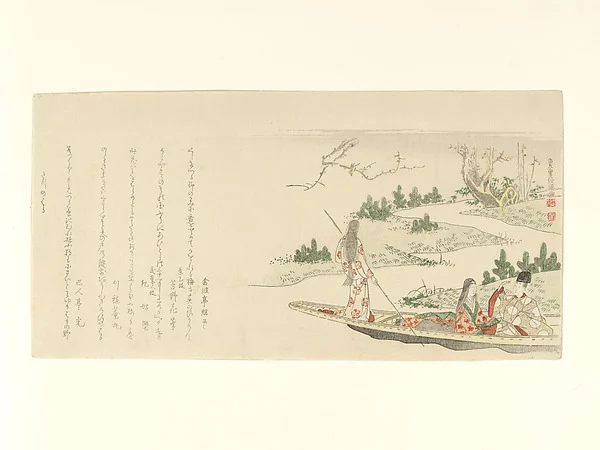
A surimono by Kubo Shunman, 1796: picture and New Year poems share one sheet.The Metropolitan Museum of Art (Open Access): Kubo Shunman, surimono of a woman poling a boat with a nobleman and lady (1796)
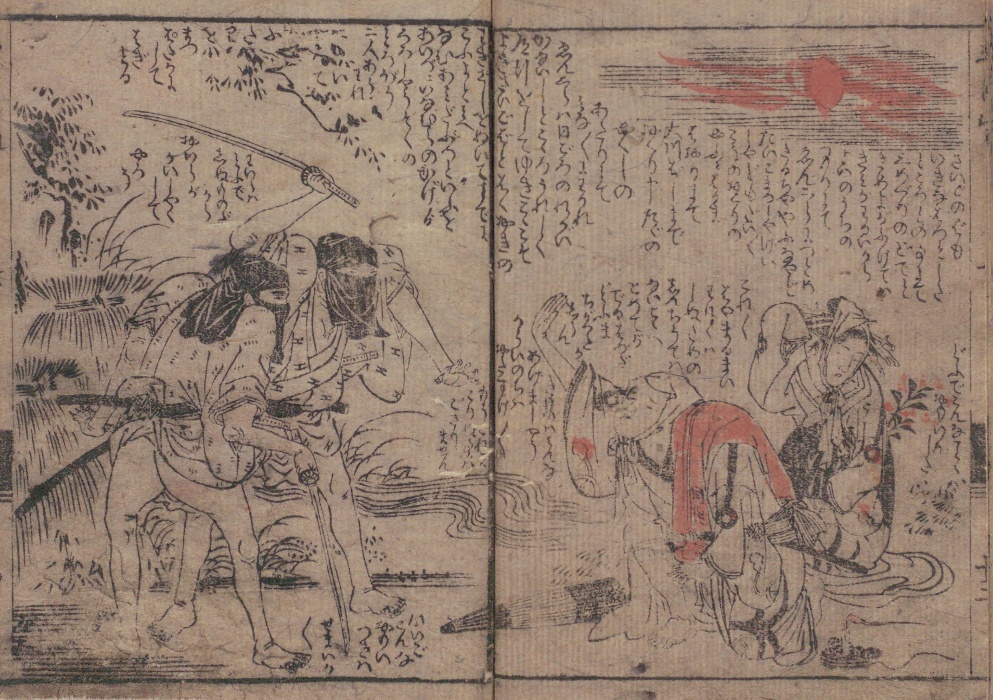
Santō Kyōden’s kibyōshi Edo umare uwaki no kabayaki, 1785: every page a picture, with text packed into the gaps.National Diet Library: Santō Kyōden, Edo umare uwaki no kabayaki (1785)
The Metropolitan Museum of Art (Open Access); National Diet Library
Kibyōshi were at their peak in the 1780s. The best-known author, Santō Kyōden, was also a print designer and ran a tobacco-pouch shop. When the Kansei Reforms arrived, political satire was an obvious target. Harumachi, a samurai, was summoned by the authorities over a kibyōshi mocking the reforms, pleaded illness, and died later in 1789, very probably by suicide; Kyōden was sentenced in 1791 to fifty days in manacles for novels about the pleasure quarters. Kibyōshi turned to moral tales and revenge stories, grew longer, and within a couple of decades had evolved into the thick bound volumes called gōkan. Calling kibyōshi the ancestor of manga is a stretch, but the habit of reading pictures and words together on one page, with dialogue floating beside the speaker, was clearly already there.
06Hokusai and the forty-six views of Fuji
Katsushika Hokusai was born in 1760 and died in 1849 at 88 (90 by the traditional count). He used more than thirty art names and is said to have moved house over ninety times. He began with actor prints and went on to surimono, novel illustrations, paintings and the Hokusai manga, a series of sketchbooks published from 1814 that eventually filled fifteen volumes with thousands of people, animals, ghosts and gestures and became a textbook for other artists. He signed some late works "old man mad about painting." At seventy-five by the traditional count, in the afterword to One Hundred Views of Mount Fuji, he wrote, counting age the same way, that nothing he had made before the age of seventy was worth noticing, that at seventy-three he had begun to understand the structure of animals and plants, and that if he lived to a hundred he might finally achieve something divine.
Around 1830, when he was about seventy by the traditional count, he designed Thirty-six Views of Mount Fuji for the publisher Nishimuraya Yohachi, whose shop was called Eijudō. It is generally credited with establishing landscape as a genre of its own in ukiyo-e. Before that, scenery had mostly served as a backdrop for beauties and actors, or as illustration in travel guides.
Two things about the series were new. The first was color. Many of the prints use a new pigment, Prussian blue, known in Japan as bero-ai, "Berlin indigo." It was a synthetic pigment from Europe, reaching Japan through Dutch and Chinese trade. Compared with the vegetable blues used before, it was brighter, more stable in light and could be graded into deep, transparent bands. The publisher is said to have promoted the series precisely as blue printing. The second was composition. Fuji appears in every picture but is often not the subject. It might be a small triangle seen through the hoop of a giant barrel, a peak in the trough of a wave, or a point above the rooftops of Edo. The foreground is daily life: a cooper at work, travelers resting at a teahouse, people whose hats and papers are being whipped away by the wind, men hauling boats. Hokusai’s subject was Fuji as seen from here, from wherever ordinary people happened to be.
The three most famous designs are the Great Wave; Fine Wind, Clear Morning, known as Red Fuji; and Thunderstorm Beneath the Summit. Red Fuji shows the mountain at dawn in late summer or early autumn, glowing rust-red above a band of green forest under rows of white cloud, almost nothing else in the picture. Thunderstorm uses nearly the same silhouette, but the lower slopes are black with storm and a zigzag of lightning cuts across them. Side by side they are one mountain in two kinds of weather.
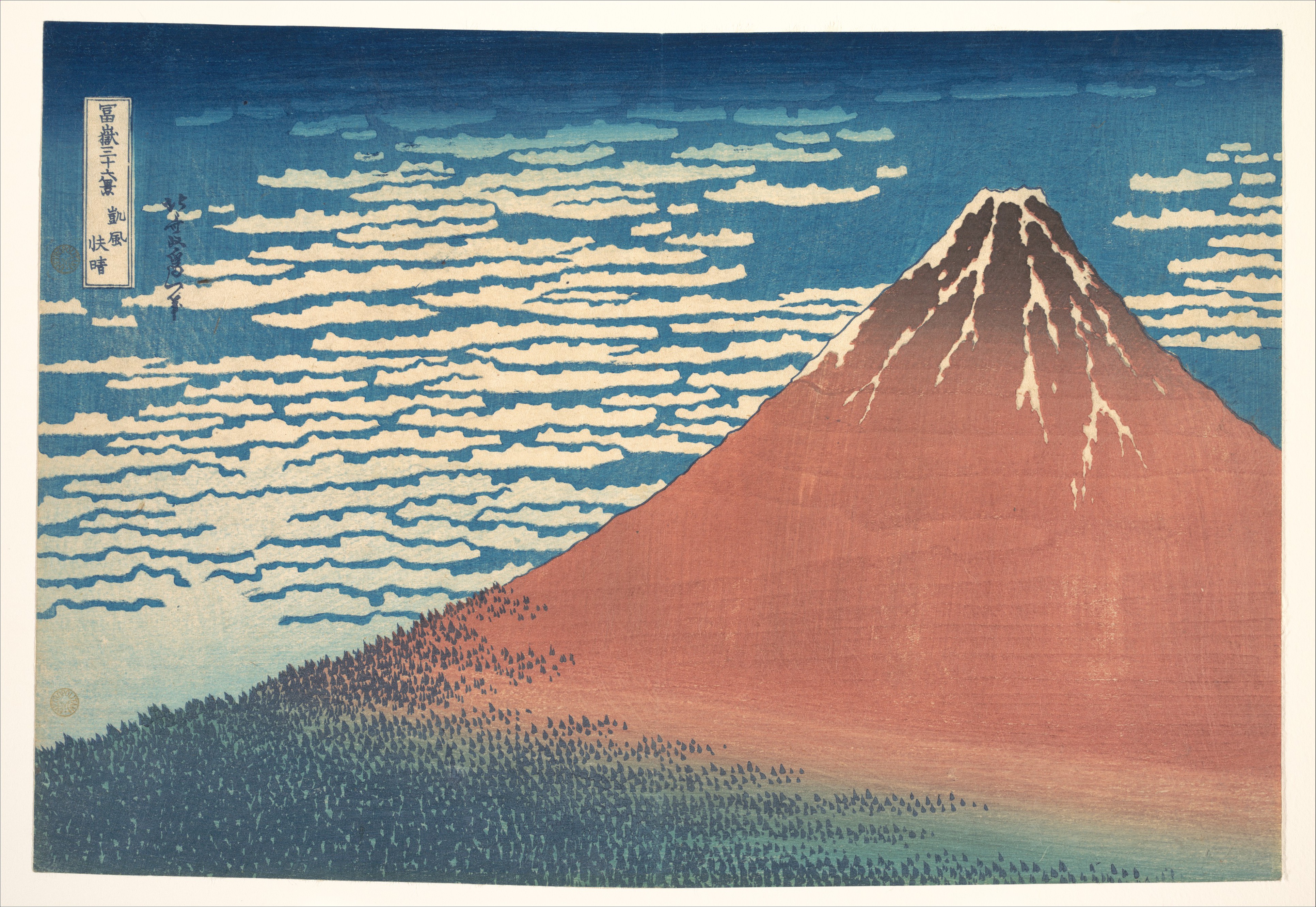
Fine Wind, Clear Morning (Red Fuji): the picture is almost all mountain.
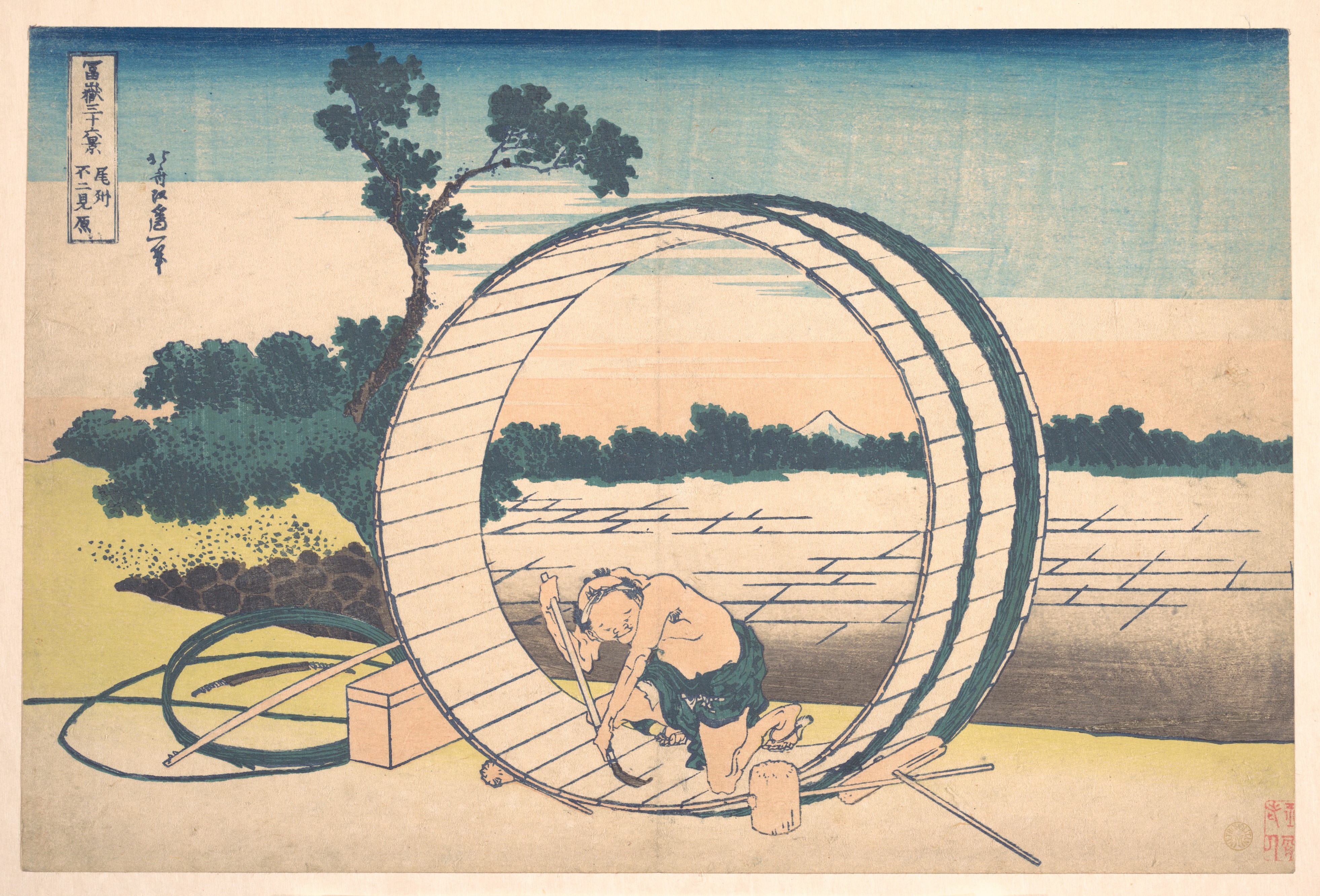
Fujimigahara in Owari: Fuji framed inside a cooper’s barrel.
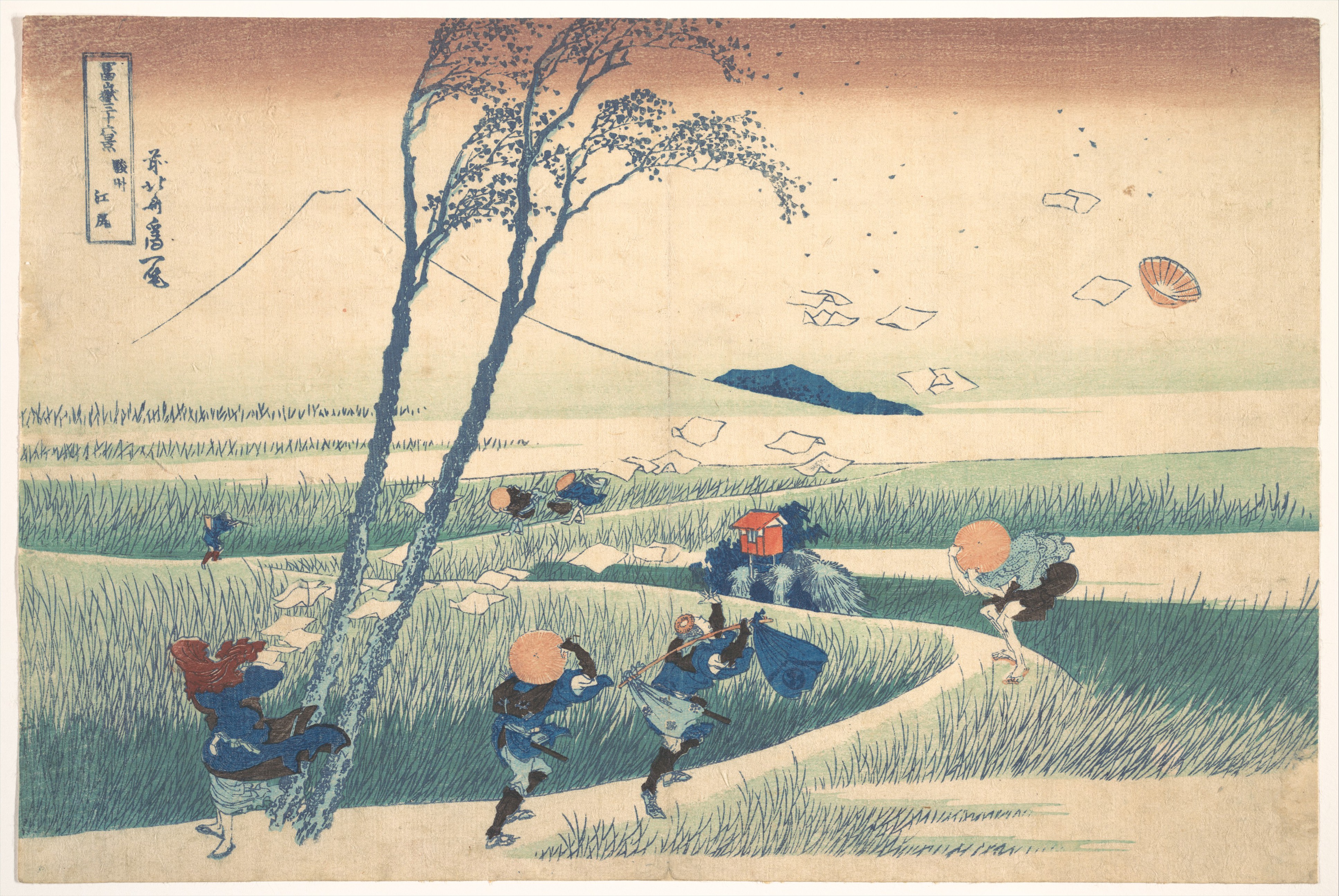
Ejiri in Suruga: a gust sends travelers’ hats and papers flying.
The Metropolitan Museum of Art (Open Access): Katsushika Hokusai, Thirty-six Views of Mount Fuji: Fine Wind, Clear Morning; Fujimigahara in Owari Province (JP19); Ejiri in Suruga Province (JP2953), c. 1830–1832
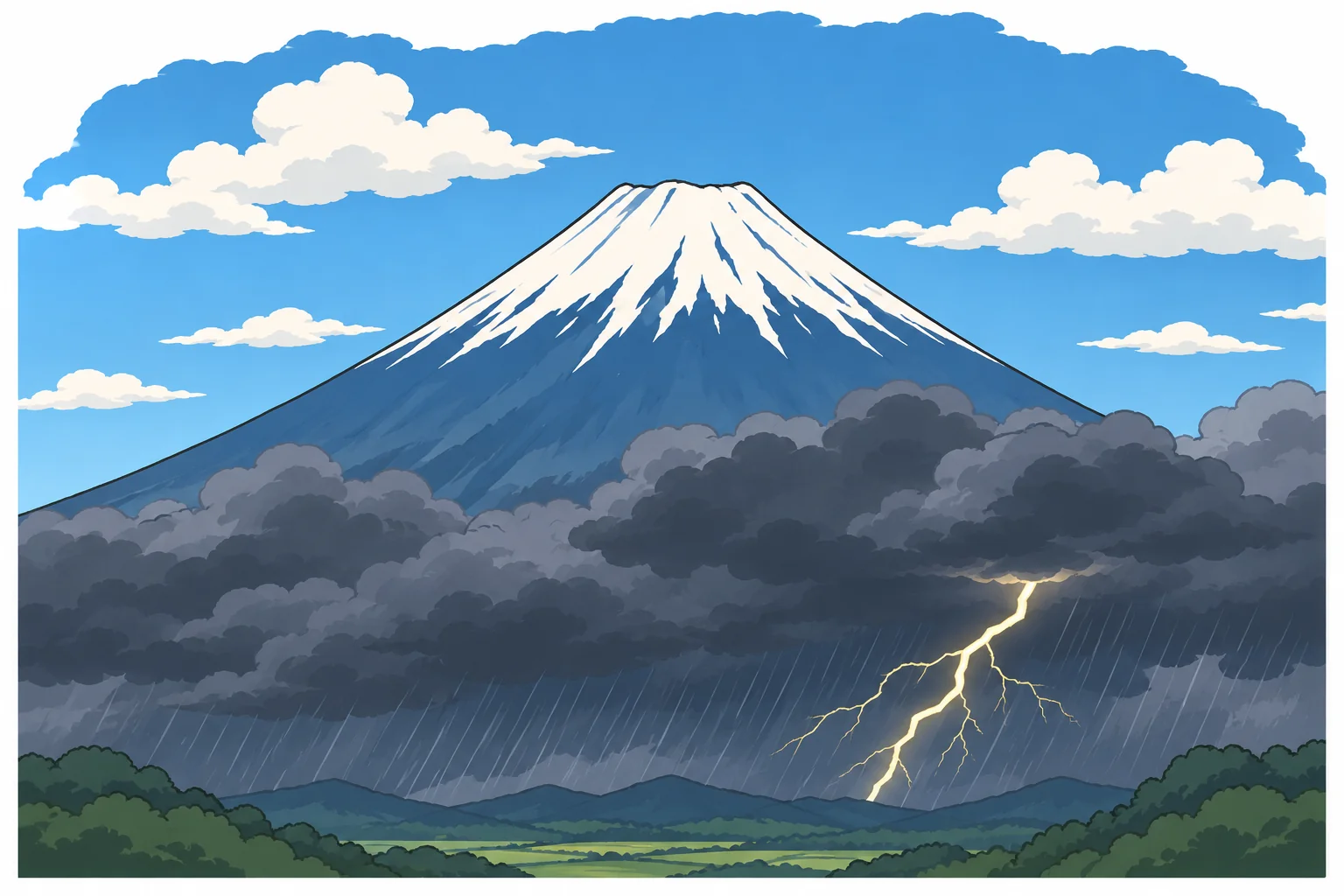
Mount Fuji in summer: clear at the summit, its foot shrouded in dark storm clouds split by lightning (illustration).
Why forty-six views in a series of thirty-six? The prints sold so well that the publisher added ten more. In the first thirty-six, the outlines are printed in Prussian blue; in the ten additions, the outlines are in black ink, and later collectors called these the ura Fuji, the "back" or "other" Fuji. "Thirty-six" is generally thought to have been a conventional number borrowed from the Thirty-six Immortal Poets of classical Japanese verse, not a strict count (some say it was also chosen as an auspicious number), so the title was never changed. From 1834 Hokusai also published One Hundred Views of Mount Fuji, a three-volume picture book in black and gray that explores the mountain from every angle and through every kind of visual joke.
07The Great Wave: one design, many impressions
The full title is Under the Wave off Kanagawa. Kanagawa was a post town on what is now the waterfront of Yokohama. Three long, narrow boats are being tossed in a heavy sea, their oarsmen bent low and gripping the sides. These were oshiokuri-bune, fast boats that rushed fresh fish from the Bōsō and Izu peninsulas to the Edo fish market. The wave rears up from the left, its crest breaking into claw-like fingers of foam, a moment before it falls. Far off, Mount Fuji, capped with snow, is no bigger than one of the smaller waves in the foreground. The drama lies in that contrast of near and far, huge and tiny, and in the instant before the crash.
A Japanese viewer tends to read the image from right to left, starting at the open space and the boats and moving toward the oncoming wave. A Western viewer, reading left to right, meets the wave first and feels it bearing down. Both readings work, which may be part of why the picture has traveled so well. Hokusai had been working on this theme for decades; earlier wave studies by him show the same motif in clumsier form.
The essential point about the Great Wave is that it is not a single picture. It is a design that exists as many impressions. No publisher’s records survive to say how many were printed, and scholarly estimates range from several thousand up to around eight thousand. Blocks wear out. Lines break, edges thicken, and publishers sometimes simplified the colors as an edition went on. Early impressions have crisp, unbroken lines, delicate gradation in the sky and a brilliant blue. In later impressions the key block lines show breaks, especially around the title cartouche, and the blue is flatter. The large cloud was once tinted pale pink, a pigment so sensitive to light that in most surviving impressions it has faded almost to nothing. Add two centuries of light and damp, and the differences grow: some surviving sheets have faded to a grayish green, while others still look almost new. Somewhat over a hundred impressions are thought to survive in museums and private collections, and no two are identical.
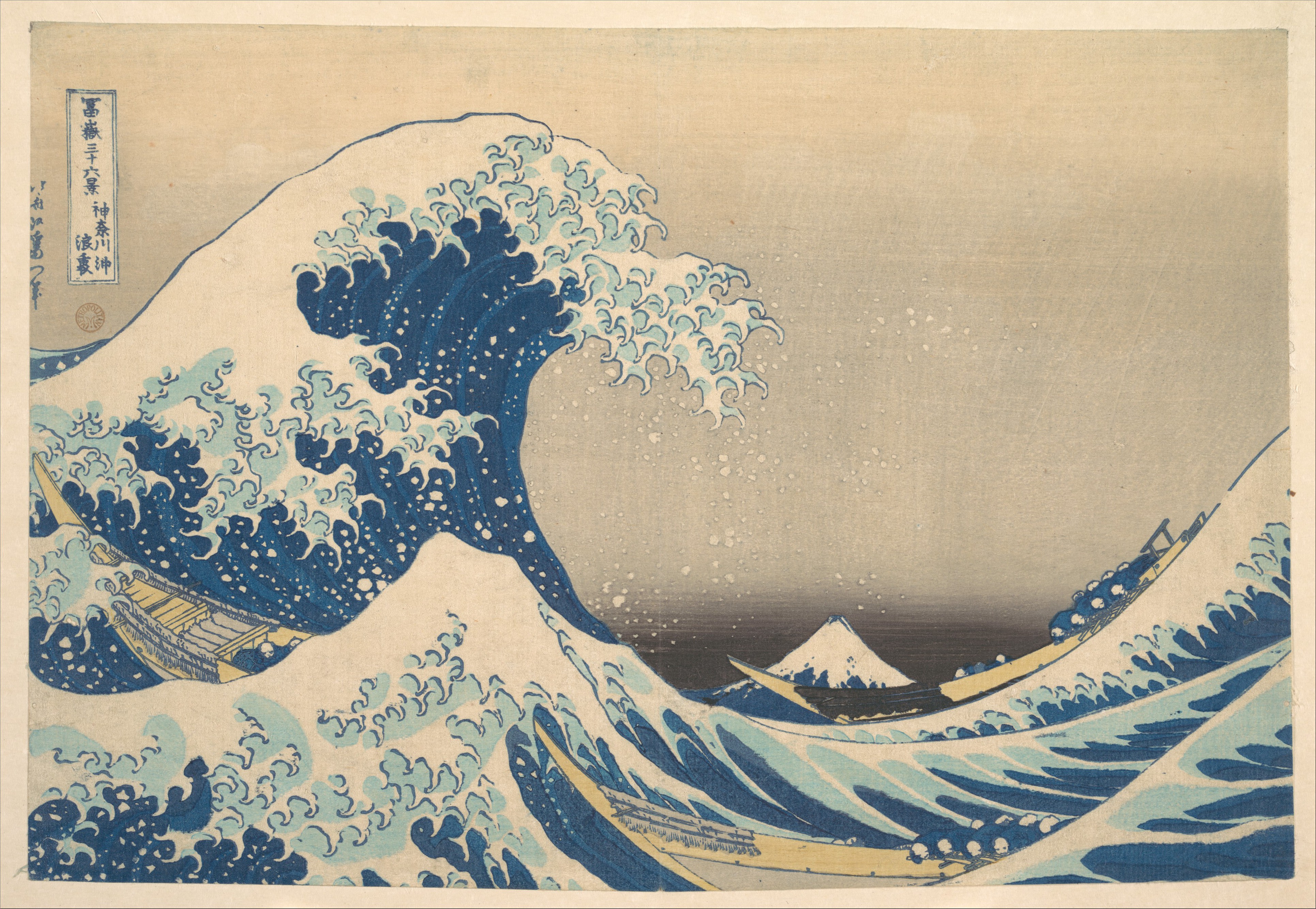
The Met’s impression JP10.The Metropolitan Museum of Art (Open Access): Katsushika Hokusai, Under the Wave off Kanagawa (JP10)
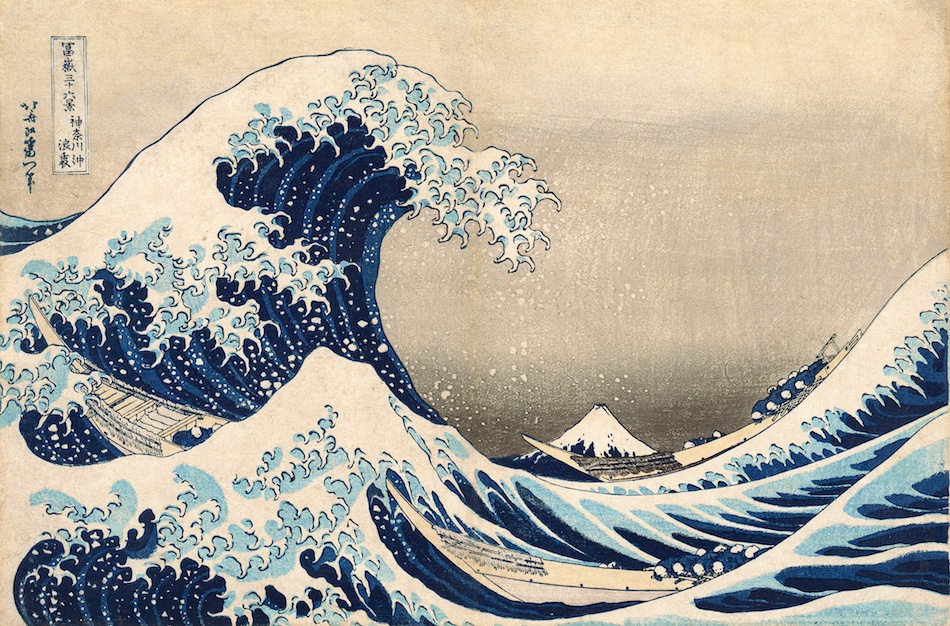
The Tokyo Fuji Art Museum impression: the sky and the depth of blue differ.Tokyo Fuji Art Museum (CC0): Katsushika Hokusai, Under the Wave off Kanagawa
The Metropolitan Museum of Art; Tokyo Fuji Art Museum
The impression in the Metropolitan Museum of Art in New York, accession number JP1847, is one such specific sheet. It came from the collection of the sugar magnate Henry Osborne Havemeyer and his wife Louisine, and entered the museum with Louisine Havemeyer’s bequest in 1929. The Met publishes a high-resolution image of it online, where anyone can zoom in far enough to see the cuts of the carver’s knife; it has been reported to be among the most viewed images in the Met’s online collection. Put it next to the impressions in the Tokyo National Museum, the British Museum or the Museum of Fine Arts in Boston, and you can see differences in the clouds, the depth of blue and the places where the key block lines have broken. When collectors and curators discuss a Great Wave, these are the things they care about: how early it was printed, how much color remains, whether the margins have been trimmed. It changes how you look. Standing before a ukiyo-e print, you are seeing one version of a design, printed on one particular day by one printer, a sibling of the sheet in another museum rather than the same object.
08Hiroshige, Kuniyoshi and the end of an era
The success of the Fuji series opened a market for landscape prints. Utagawa Hiroshige, nearly forty years younger than Hokusai, published The Fifty-three Stations of the Tōkaidō with the publisher Hōeidō around 1833 to 1834. It depicts the post stations on the great highway between Nihonbashi in Edo and Sanjō Bridge in Kyoto, fifty-five prints in all counting the start and end.
Where Hokusai’s pictures are bold designs, Hiroshige’s are lyric poems. He painted weather: rain, snow, mist and dusk. In Shōno, travelers scramble up a slope through slanting rain; in Kanbara, snow falls silently on a sleeping village at night. The Tōkaidō was the busiest travel route in Japan, and the series served as both art and souvenir. People who had never made the journey could travel it on paper.
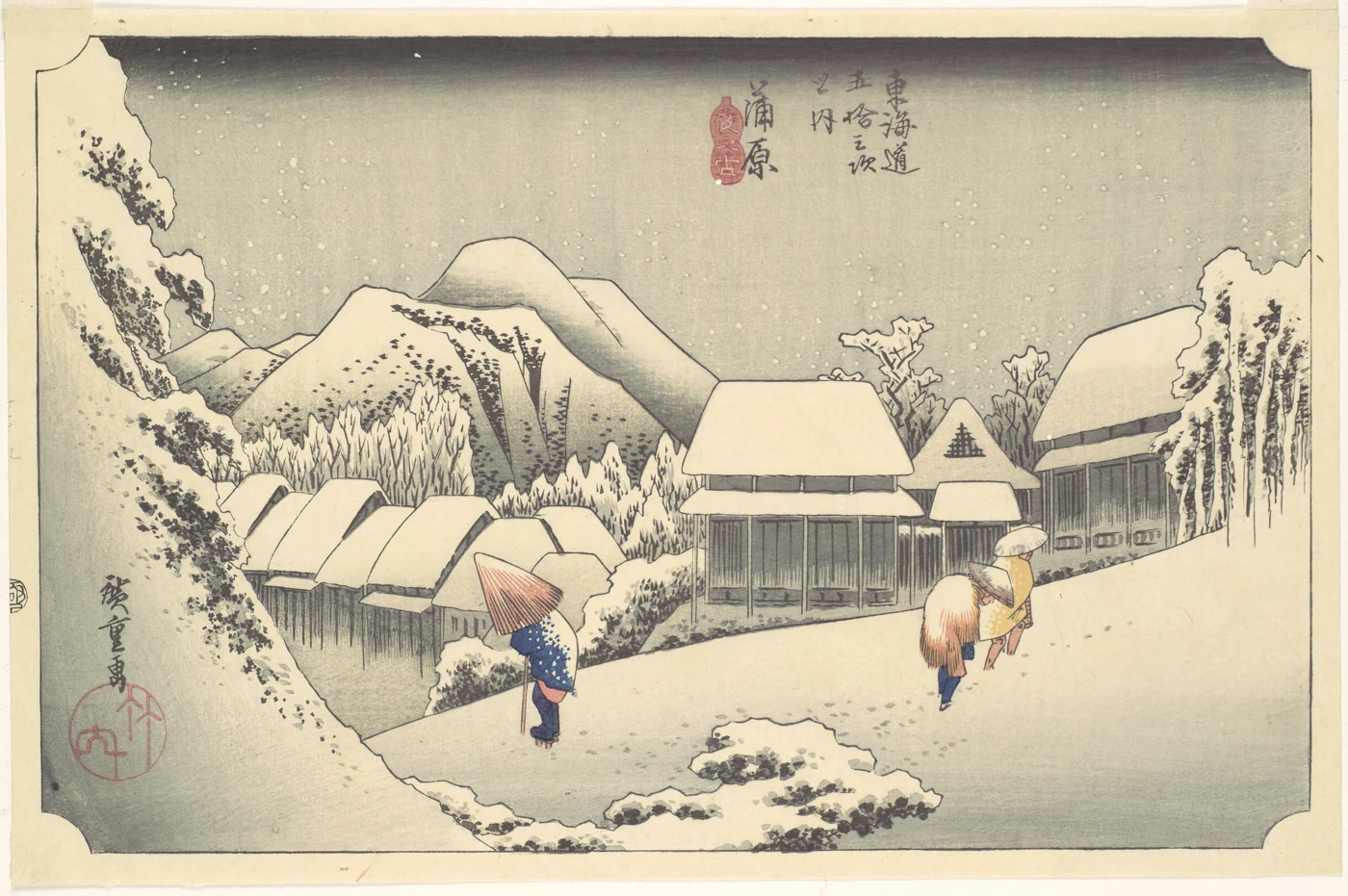
Hiroshige, Kanbara from the Fifty-three Stations of the Tōkaidō, c. 1833–1834: silent night snow.The Metropolitan Museum of Art (Open Access): Utagawa Hiroshige, The Fifty-three Stations of the Tōkaidō: Kanbara (c. 1833–1834)
Hiroshige’s last great work, One Hundred Famous Views of Edo, came out between 1856 and 1858: 118 views by Hiroshige, one added after his death by his pupil Hiroshige II, and a contents sheet, 120 sheets in all. It is the final portrait of Edo before the city was renamed Tokyo in 1868. In many of these vertical designs he thrusts a branch, a hawk or a lantern into the extreme foreground, cropped by the frame, with the view small behind it. That daring cropping went straight into European painting.
His contemporary Utagawa Kuniyoshi made his name with warrior prints. His series of heroes from the Chinese novel Water Margin, shown with elaborate full-body tattoos, set off a fashion for tattooing in Edo. He also loved cats, which appear all over his work, sometimes arranged to form written characters, sometimes dressed as people. During the Tenpō ban on actor prints he used cats, frogs and ghosts to portray forbidden actors in disguise, and his audience got the joke. Another Utagawa artist, Kunisada, later known as Toyokuni III, was the most prolific of all, with output in the tens of thousands, mostly actor prints.
After Japan opened its ports in the 1850s, cheap imported aniline dyes flooded in, and many Meiji-era prints glare with harsh reds and purples. Photography and modern printing took over the jobs ukiyo-e had done. Tsukioka Yoshitoshi, working in the Meiji era, produced violent, powerful warrior prints and the moody series One Hundred Aspects of the Moon, and is often called the last great master of ukiyo-e. In the 1910s the publisher Watanabe Shōzaburō launched the shin-hanga, "new prints," movement, keeping the old division of labor among publisher, artist, carver and printer. Kawase Hasui’s snowy temples and twilight streets found an especially eager market abroad, reportedly above all among American collectors. A parallel sōsaku-hanga, "creative print," movement insisted that the artist should design, carve and print alone. One way or another, the craft has survived to the present.
09Japonisme
A much repeated story says that around 1856 the French printmaker Félix Bracquemond found a volume of Hokusai manga used as packing material in a shipment of porcelain. The tale has probably been polished in the retelling, but it captures something real: in Japan these prints were ordinary enough to wrap things in.
Japan took part officially in the Paris Exposition Universelle of 1867, and over the following decades dealers in Paris, notably Hayashi Tadamasa and Siegfried Bing, sold vast numbers of prints to European collectors. The French called the craze japonisme. Claude Monet covered the walls of his house at Giverny with Japanese prints, and they hang there still; he painted his wife in a kimono and built a Japanese footbridge over his lily pond. Vincent van Gogh collected hundreds of prints in Paris and copied two of Hiroshige’s Edo views in oil, the plum garden at Kameido and the sudden shower over Ōhashi bridge, adding borders filled with Japanese characters borrowed from other prints. The cover of the first edition of Debussy’s La Mer, in 1905, was adapted from the Great Wave.
What Western artists took from ukiyo-e was flat color, bold outline, cropping that ignored single-point perspective, compositions that pushed the subject to the edge or cut it in half, and an interest in ordinary life. Much of what looks modern in late nineteenth-century European painting was standard practice in Edo prints. The traffic ran the other way too: ukiyo-e was taken more seriously in Japan after Westerners started paying for it. So many fine prints left the country in the Meiji era that the holdings of the Museum of Fine Arts, Boston, and the British Museum rival any collection in Japan, which is why any account of ukiyo-e ends up mentioning New York, Boston and London.
Ukiyo-e ran in parallel with the other traditions of Japanese painting, the Kanō school, the decorative Rinpa style and narrative handscrolls, and borrowed freely from all of them. Its flat, poster-like color later became one of the roots of modern Japanese graphic design.
10Seeing ukiyo-e in Japan
Ukiyo-e prints are sensitive to light. Many of their pigments are vegetable dyes that fade within months under strong illumination, so Japanese museums usually show a given print for only a few weeks before rotating it out, in dim galleries. For a visitor that has two consequences. If you want to see a particular masterpiece, check the exhibition schedule before you travel. And because the displays change all the time, there is always something good on, so it is better not to fixate on one famous sheet.
In Tokyo, the most rewarding place to start is the Ōta Memorial Museum of Art, tucked into a lane just off Omotesandō in Harajuku. It is a small, quiet building whose exhibitions change roughly every month or so. The galleries are intimate and the prints hang close behind the glass, so you can look slowly. The Sumida Hokusai Museum in Ryōgoku, opened in 2016 in a striking building by the architect Sejima Kazuyo, reportedly clad in aluminum panels, has a permanent display of high-quality facsimiles with touch screens for zooming in, while originals appear in rotating special exhibitions. The Tokyo National Museum in Ueno devotes Room 10 on the second floor of its main building to ukiyo-e and Edo dress, with regular rotations, which the museum scheduled roughly once a month as of 2025; with luck you may find a Great Wave or a Sharaku. Outside Tokyo, the small town of Obuse in Nagano, which Hokusai visited four times from the age of eighty-three by the traditional count, has the Hokusai-kan, where you can see the surging waves he painted in his mid-eighties for the ceiling of a festival float.
When you stand in front of a print, try looking in stages. First find the text and seals: the series title, the picture title, the artist’s signature, the publisher’s mark, the censor’s seal. Then look at the registration and the gradation in the sky. Then tilt your head and look across the surface in raking light, because embossing and mica only show up that way. If an exhibition happens to include two impressions of the same design, compare them, and the idea of early and late impressions will suddenly make sense.
To see how prints are made, the Adachi Institute of Woodblock Prints, near Mejiro Station in Tokyo, has a showroom and holds regular printing demonstrations, and several studios in Tokyo and Kyoto run short workshops where you can print a small three- or four-color design with a baren yourself. Adachi’s reproductions are recarved and hand-printed in the traditional way and make far better souvenirs than posters. For antique prints, the old bookshops of Jinbōchō in Tokyo include dealers specializing in ukiyo-e, where, as of 2026, a Meiji-era sheet might cost a few thousand yen while a fine early impression by a major artist runs to millions. Always ask whether you are buying an original edition, a later printing from the old blocks, or a modern recut, because the prices are worlds apart.
And the prints are not confined to museums. Nihonbashi, Ryōgoku and Asakusa still bear the names Hiroshige and Hokusai wrote on their prints. The Sumida River still flows past them. On a clear winter morning, from a high enough point in Tokyo, you can still see Fuji to the west, a small white triangle on the horizon, much as it sits in the corner of so many Edo prints.