
At a glance
How kimono patterns are dyed or woven, from yūzen paste lines and Arimatsu shibori to Nishijin looms, Ōshima tsumugi and Okinawan bashōfu.
- Kimono patterns take two routes: dye white woven silk afterwards, or dye the yarn first and weave the pattern in.
- Yūzen is named after Miyazaki Yūzensai, a Genroku-era Kyoto fan painter; a line of rice paste keeps its colors apart.
- An all-over kanoko shibori furisode can carry over a hundred thousand ties; an edict of 1683 banned it outright.
- Nishijin takes its name from the Ōnin War that began in 1467; in 1872 Kyoto sent three weavers to Lyon to learn the Jacquard loom.
- Kijoka bashōfu became an Important Intangible Cultural Property in 1974; one bolt takes around 200 plants.
Every pattern on a kimono got there in one of two ways. Either it was painted, bound or stenciled onto a finished length of white silk, or it was built into the threads before the cloth was ever woven. Japanese makers and wearers treat these two routes very differently, and the difference shapes what people wear to a wedding, what they wear to the shops, and what they will pay. This guide follows the main techniques: yūzen paste-resist dyeing from Kyoto, shibori tie-dye, embroidery and gold couching, the looms of Nishijin, kasuri ikat and Ōshima tsumugi from the southern islands, and the banana-fiber cloth of Okinawa.
01Dyed Kimono and Woven Kimono
The trade has an old saying: some no kimono ni ori no obi, "a dyed kimono with a woven obi." It sums up the classic formal outfit. The robe itself starts as a bolt of plain white silk, called shiraki, and is dyed with its pattern afterward. The obi, the wide sash tied at the waist, is a woven brocade whose design comes from colored and metallic threads on the loom.
Japanese uses two words for this. Atozome, "after-dyeing," means weaving first and coloring later. Nearly all formal kimono are made this way: the long-sleeved furisode worn by young women at Coming of Age Day, the black tomesode worn by mothers of the bride, the hōmongi visiting kimono worn to tea ceremonies and receptions. Because the dyer works on the whole cloth, a pattern can sweep across the seams from hem to shoulder like a single painting. Sakizome, "first-dyeing," means coloring the yarn before it goes on the loom. Tsumugi pongee, kasuri ikat and the crisp silk crepe called omeshi all belong here.
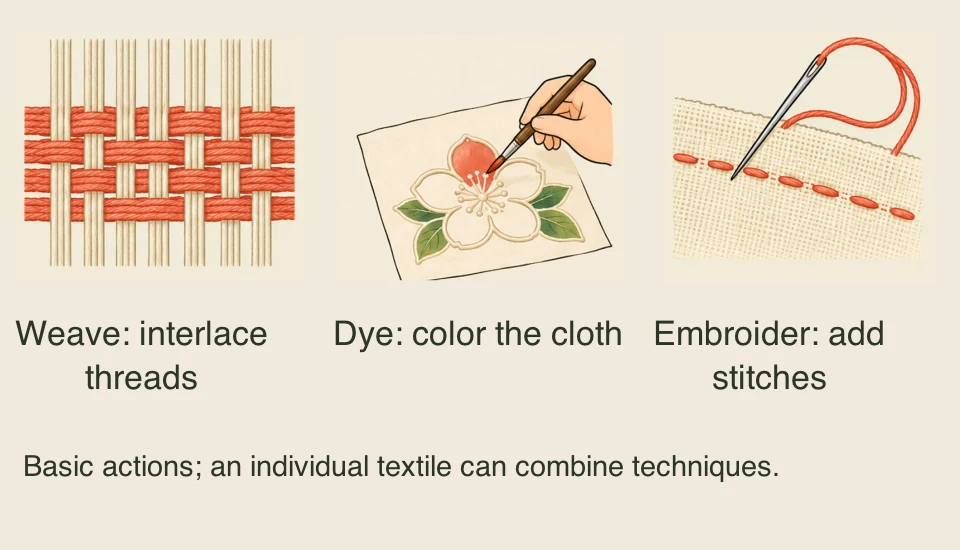
Weaving interlaces warp and weft, dyeing colors the cloth, embroidery adds stitches on top.
In the formal hierarchy, dyed beats woven. A tsumugi robe can cost as much as a small car and still be considered too casual for a wedding banquet. The reason is history: tsumugi began as farmhouse cloth, spun from broken or flawed cocoons that could not be reeled into fine silk, and woven at home to wear in the fields. Its status as everyday wear survived its rise in price. The obi works the other way round, where the heaviest woven brocade is the most formal. So a mother in black tomesode at her daughter’s wedding is often wearing a Kyoto dyer’s work on her body and a Nishijin weaver’s work around her waist.
02Yūzen: A Line of Paste That Holds the Color
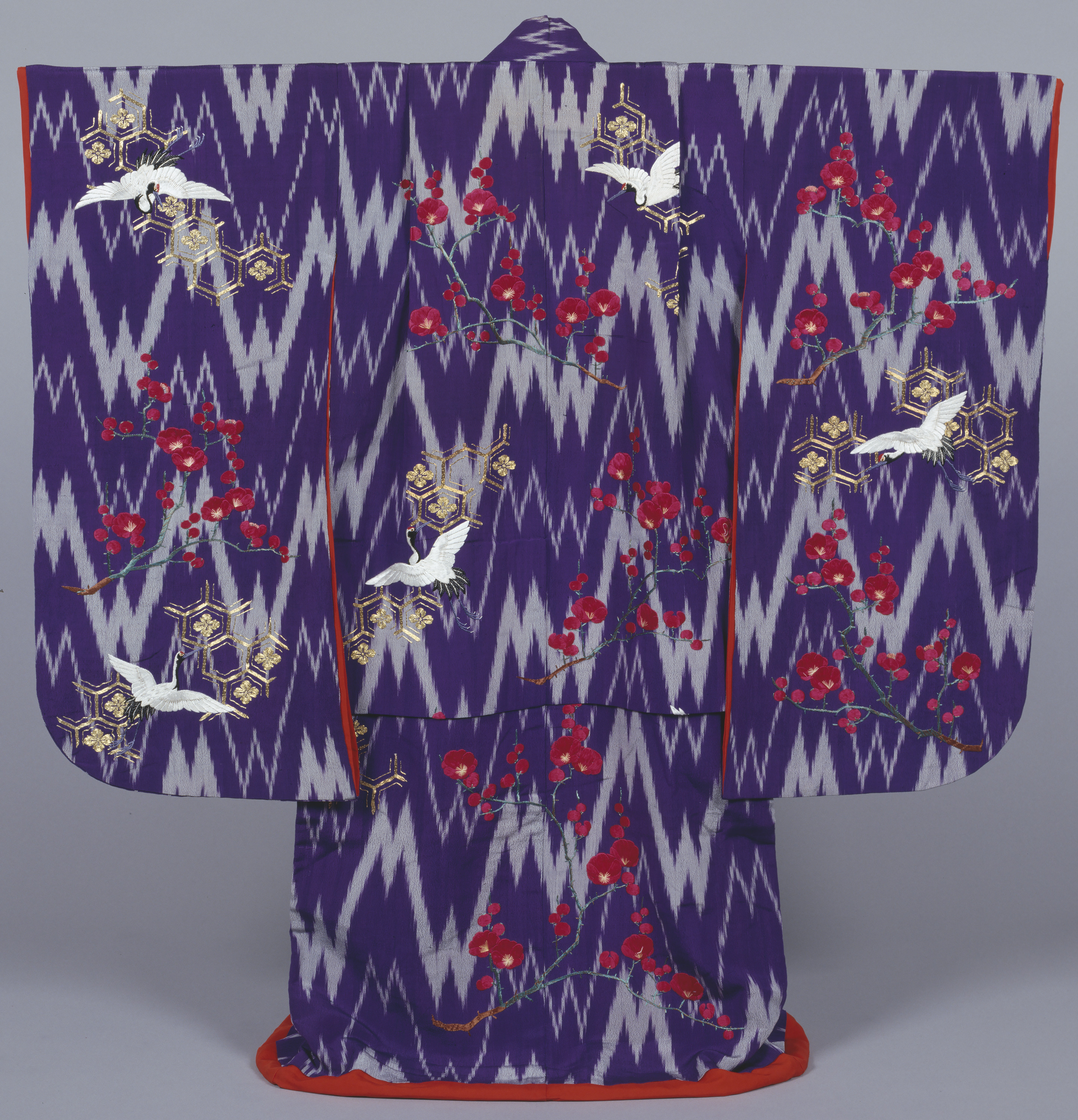
Yūzen is the signature technique of the dyed kimono. The name comes from Miyazaki Yūzensai, a fan painter working in Kyoto in the late 17th century, during the Genroku era. His designs on fans became fashionable, and kimono patterns in the same style came to be called yūzen. Yūzensai was a painter, not a dyer, and resist techniques were already in use before him; what Kyoto’s dye houses did was marry his pictorial style to a refined method of paste resist.
The problem yūzen solves is bleeding. Silk drinks up dye, and color brushed straight onto it spreads along the fibers. The dyer’s answer is a paste made from glutinous rice, squeezed through a small cone with a metal tip to trace every outline of the design in a thread-thin line called itome. Once the paste dries, each area of the design is a sealed compartment, and colors brushed inside it cannot creep into their neighbors. When the paste is finally washed out, the silk under it is left undyed, which is why hand-painted yūzen has those fine white outlines around every petal and leaf.
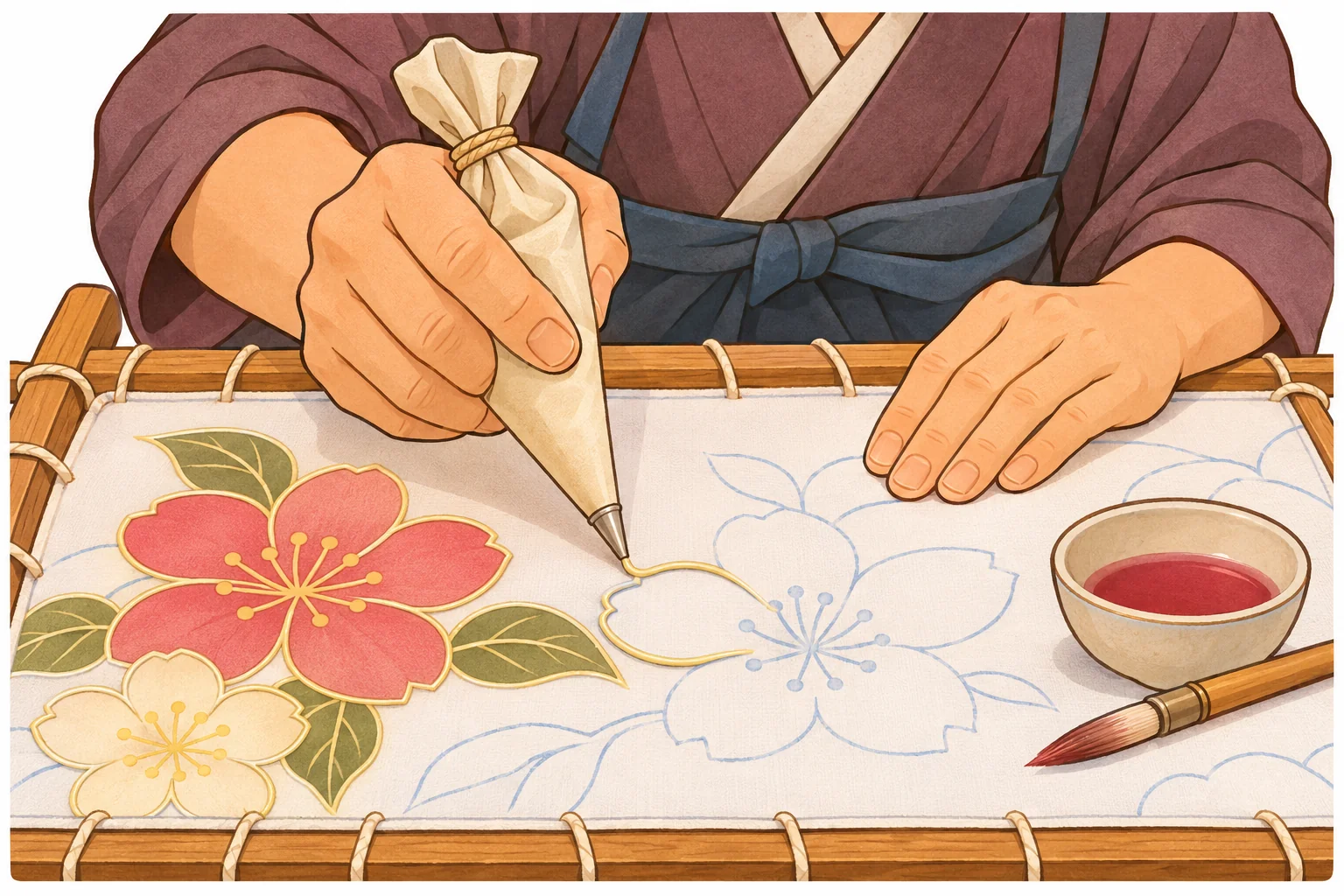
A dyer squeezes a fine line of rice-paste resist (itome) from a paste cone along the design on white silk (illustration).
The process runs to well over a dozen steps, each traditionally done by a different specialist. A designer sketches the pattern on the white silk in aobana, a blue juice from the dayflower that vanishes in water. The paste artist lays the itome lines. The colorist fills each compartment with brushes, shading petals from dark to light, in a step called sashi-yūzen. Then the finished motifs are covered completely with more paste, and the background is brushed in with wide brushes. Steaming fixes the dyes, and washing removes the paste. Kyoto workshops once rinsed their silk in the Kamo and Hori rivers, long lengths streaming in the current; this yūzen nagashi was stopped decades ago because the dye polluted the rivers and now appears only as an occasional demonstration.
- 1
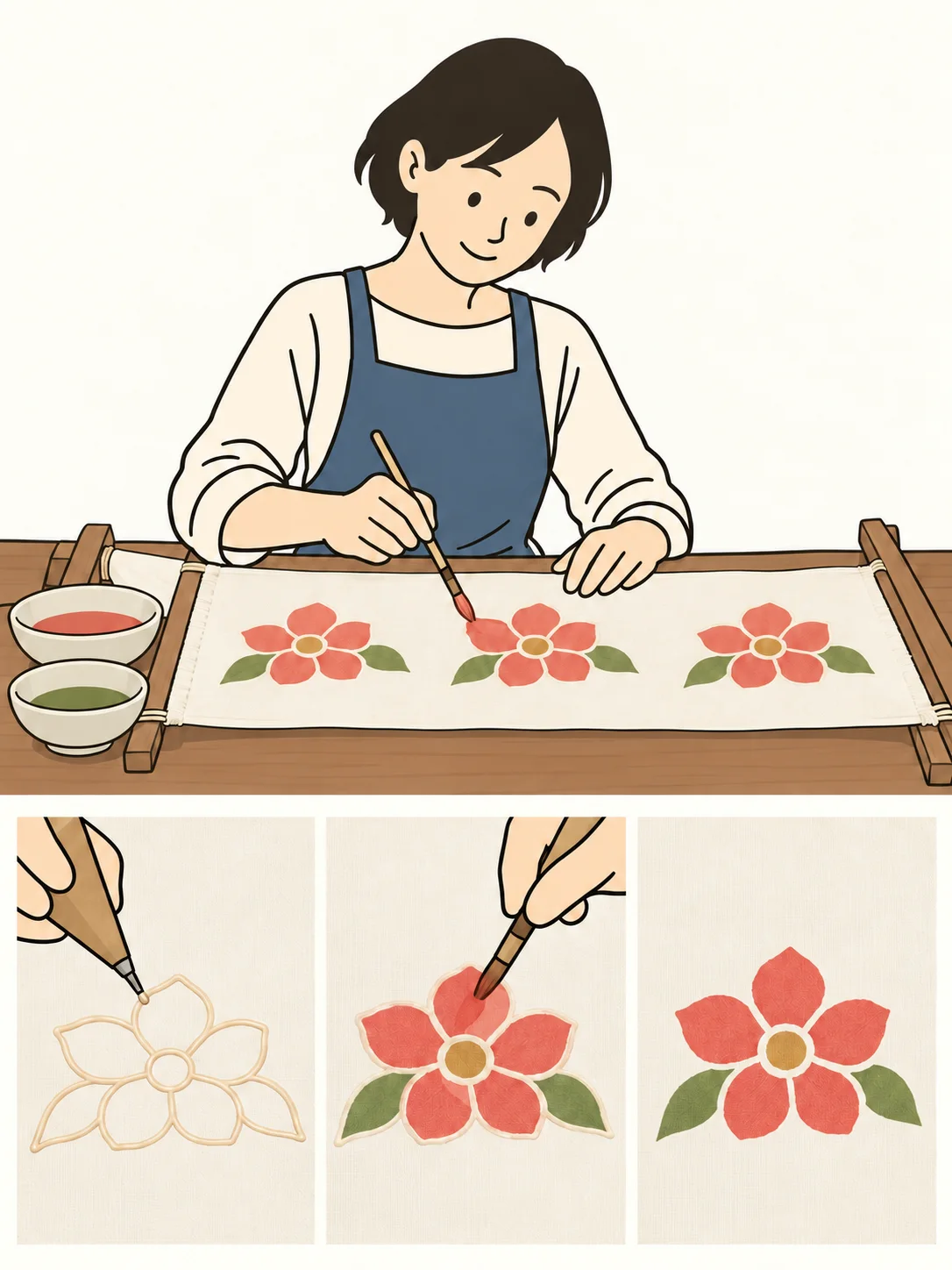 Paste is piped along the outlines, color is brushed inside them, and rinsing leaves fine white outlines.
- 2
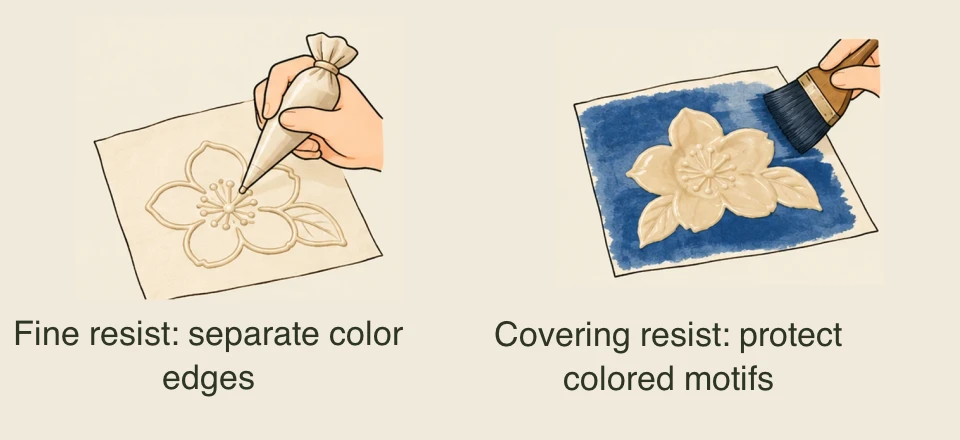 Left, the fine paste line that separates colors; right, cover paste protects the finished motif while the ground is brushed in.
- 3
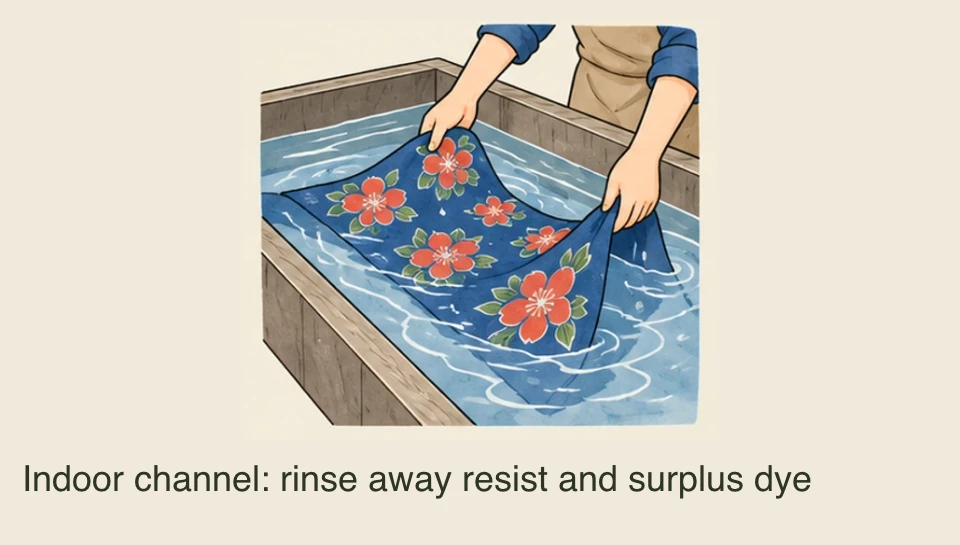 After steaming, the paste and excess dye are rinsed away; Kyoto once did this in the Kamo and Hori rivers.
Three regions are known for yūzen. Kyō-yūzen, from Kyoto, is the most opulent, often finished with gold leaf and embroidery, and by the usual account its shading fades from the center of a motif outward, the reverse of Kaga. Kaga-yūzen, from Kanazawa, is linked by legend to Yūzensai himself spending his later years in the Kaga domain. It favors a set palette known as the five Kaga colors, crimson, indigo, ocher, grass green and an antique purple, uses little gold, and aims at realism, sometimes painting tiny wormholes into leaves; its shading typically fades from the outer edge of a motif inward. Tokyo yūzen tends toward subdued grays, blues and urban understatement.
The same paste can be pushed through a cut-paper stencil instead of a cone. That is katazome, stencil dyeing, which lets a pattern repeat identically along a bolt. Indigo yukata cotton and Okinawa’s brilliantly colored bingata are both made this way. From the Meiji period on, dyers also mixed dye directly into the paste and printed it through stencils, a method called kata-yūzen. It made yūzen designs affordable, and most moderately priced yūzen kimono today are made this way rather than painted by hand.
03Shibori: Change the Shape of the Cloth, Then Dye It
Shibori is older and simpler in principle. Bind, stitch, fold or clamp part of the cloth so tightly that dye cannot reach it, put it in the vat, then open it up. Instead of drawing on the surface, the dyer reshapes the cloth in three dimensions first.
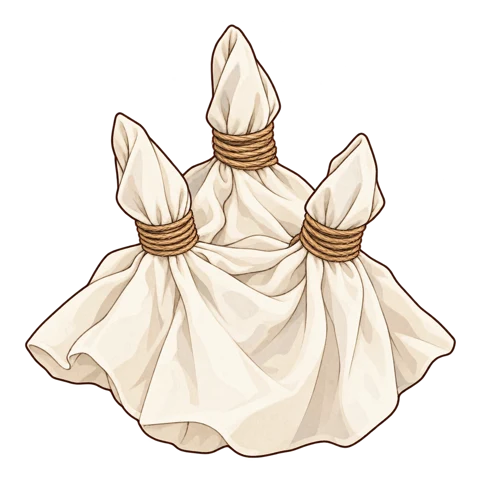
Binding: thread wrapped tightly around small tufts of cloth.
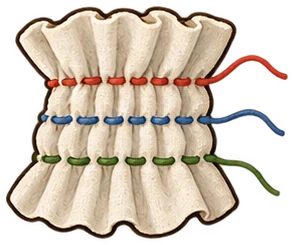
Stitching: running stitches pulled tight gather the cloth.
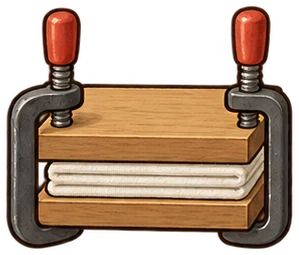
Clamping: folded cloth pressed between two boards.
The most prized Japanese form is kanoko shibori, "fawn spot." The binder pinches up a tiny peak of silk with a fingertip and wraps it several times with thread. Dyed and unwrapped, each tie leaves a small pale ring with a dot of color at its center, like the spots on a young deer. A furisode covered entirely in kanoko, called sō-shibori, can carry well over a hundred thousand ties made one by one, which is why it costs so much. The Tokugawa shogunate issued sumptuary laws again and again, and its edict of 1683 banned all-over kanoko outright.
Kyoto is known for the finest kanoko. The other great center is Arimatsu, with neighboring Narumi, now on the southeastern edge of Nagoya. Arimatsu was founded in 1608, at the Owari domain’s urging, as a new village on the Tōkaidō, the main road between Edo and Kyoto. The land was poor, and according to local tradition a villager named Takeda Shōkurō learned binding techniques from workers who had come to build Nagoya Castle, then sold dyed towels to travelers on the highway. The Owari domain later protected it as a domain specialty, and Arimatsu shibori grew into a regional industry known for sheer variety, with some seventy binding techniques (by one account there were once more than a hundred), among them spiderweb, willow and the diagonal pole-wrapped arashi ("storm") patterns. The old merchant houses still line the street, and the town holds a shibori festival in early June.
Earlier still, from the late Muromachi to the Momoyama period, a technique called tsujigahana combined shibori with painted ink lines and gold leaf. Few pieces survive, nearly all in museums, and the way it disappeared in the early Edo period has given it an air of mystery.
04Embroidery and Gold: Adding a Layer on Top
A third way to make a pattern is to sew it. Japanese embroidery, nihon shishū, mostly uses silk floss with no twist, called hiraito. A single strand can be split into finer ones, and laid down in long, parallel satin stitches it forms a smooth, glossy surface. The direction of the stitches does the shading: a petal stitched at two angles shows two tones of the same color as the light changes.
Gold thread is handled differently. Traditionally it is made by applying gold leaf to paper, cutting it into fine strips and wrapping them around a silk core. That makes it stiff, and it would wear out quickly if pulled through the cloth over and over. So the embroiderer lays it on the surface, usually two threads side by side, and tacks it down at short intervals with a fine silk thread crossing over it. This is couching, known in Japanese as komazukai-nui. The gold stays on top where it catches the light, and the thin thread does the holding.
- 1
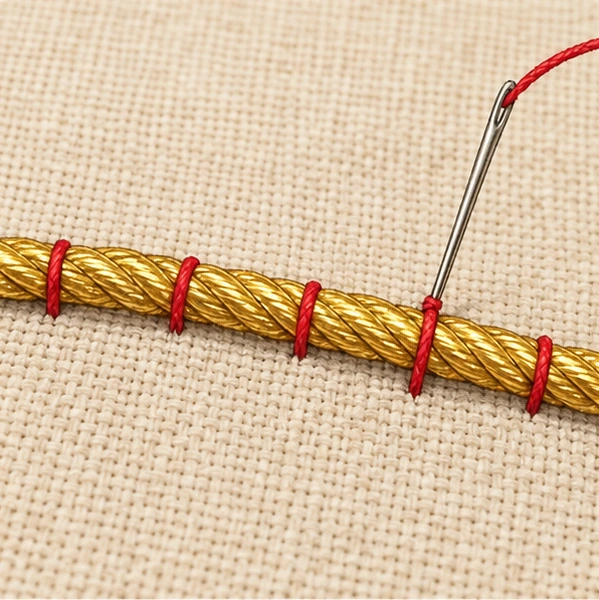 The gold thread lies on the surface; a fine silk thread crosses it at short intervals.
- 2
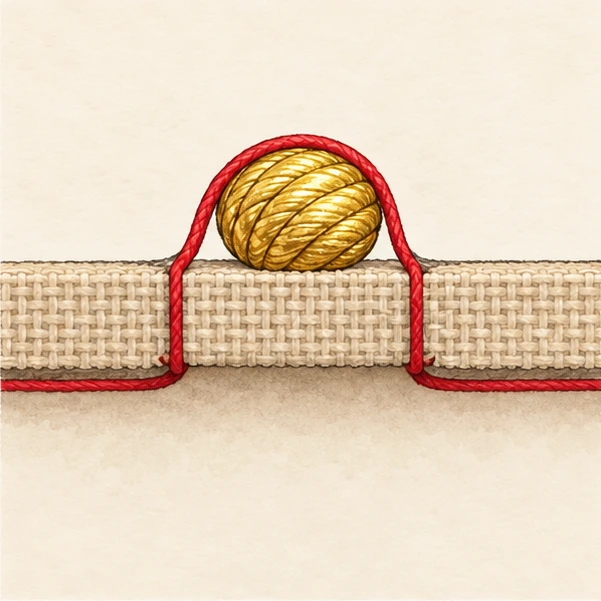 Cross-section: the gold never passes through the cloth; only the tying thread does.
- 3
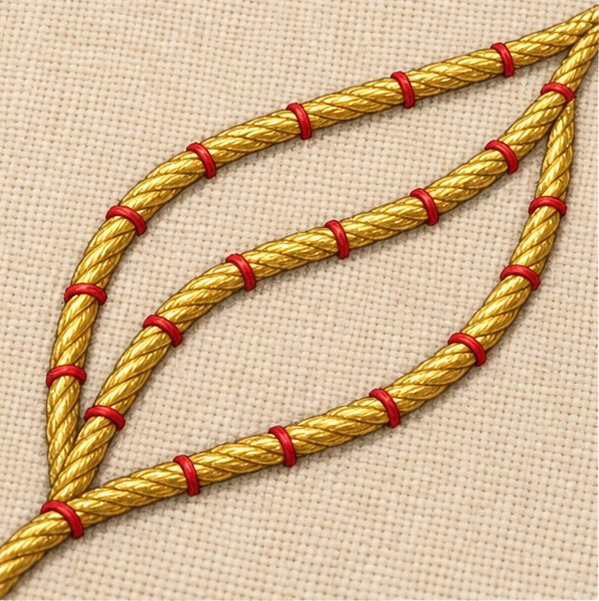 Couched along the design, the gold keeps its full shine on the surface.
Embroidery and gold are at their most lavish on Noh costumes and wedding robes. The Noh garment called nuihaku combines embroidery with applied gold or silver leaf, and a bride’s colored uchikake overrobe may be so densely embroidered with cranes, pines and court carriages that the ground silk barely shows. On an ordinary furisode or hōmongi, embroidery tends to be an accent, picking out the center of a flower or a family crest on top of the dyed design. Kyoto embroidery, kyō-nui, is a designated traditional craft, and Kanazawa has its own Kaga embroidery, said to have arrived there along with Buddhism and to have first decorated temple banners and priests’ robes.
05Nishijin: One District, Many Kinds of Cloth
Nishijin, "Western Camp," is a neighborhood in northern Kyoto. It takes its name from the Ōnin War, which began in 1467 and wrecked the city over a decade; the Western Army under Yamana Sōzen camped here. When the fighting ended, weavers who had fled returned to the area and set up their looms again, carrying on techniques that went back to the court workshops of the Heian period. Through the Edo period Nishijin was Japan’s center for luxury silk, weaving for the court, the samurai elite and rich merchants.
Nishijin-ori is not a single fabric but the name for all the yarn-dyed silks woven in the district, and the official designation covers twelve categories. Three matter most to a visitor. Nishiki is brocade, woven with many colors and metallic threads into large figured designs, and it supplies most formal obi. Tsuzure is tapestry weave, built up patch by patch with the weft, and its weavers file their fingernails into a saw-tooth edge to comb each weft thread tight; a skilled weaver may complete only a few centimeters a day. Omeshi is a high-twist silk crepe with a faint pebbled surface, a yarn-dyed fabric fine enough for the body of a kimono; tradition says its name, an honorific for "worn by," comes from the shogun Tokugawa Ienari’s fondness for it.
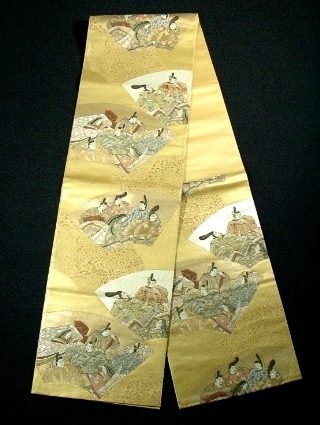
A Nishijin fukuro obi: fans and figures woven in many colors on a gold ground.
When the emperor and court moved to Tokyo after the Meiji Restoration, Nishijin lost its best customers. In 1872 Kyoto sent three weavers to Lyon in France, and they brought back the Jacquard loom, which uses punched cards to control which warp threads lift. Complex patterns could now be repeated quickly and exactly, and the district recovered. Today most Nishijin looms are powered, but the work is still divided among separate workshops for design, pattern cards, yarn dyeing, warping and weaving, and a single obi passes through a couple of dozen hands. The Nishijin Textile Center, on Horikawa-dōri just south of Imadegawa, has demonstrations of hand-loom and tsuzure weaving; it used to stage kimono shows every day, though these were suspended during the pandemic and, as of 2026, had not been announced as resumed.
06Kasuri and Ōshima Tsumugi: Patterns Planned in the Thread
Kasuri is the most mentally demanding of the yarn-dyed techniques. Before weaving, the maker works out exactly where each part of the pattern will fall on the warp or weft threads, binds those sections tightly and dyes the bundle. The bound sections stay white. When the threads go on the loom, the white segments line up to form the design. Since threads always shift a little during weaving, the edges blur and flicker, and the word kasuri itself suggests a brushstroke where the ink runs dry. Elsewhere the technique is known as ikat, and versions exist across Southeast and Central Asia.
In Japan, kasuri became the everyday cloth of ordinary people in the late Edo period, most often as white patterns on indigo cotton. Kurume kasuri from Fukuoka, Iyo kasuri from Ehime and Bingo kasuri from Hiroshima are often called the three great kasuri. Kurume kasuri is traditionally credited to Inoue Den, a girl of twelve or thirteen by the traditional count who around 1800 studied the white flecks on a faded old garment and worked out how to reproduce them. In snowy Niigata, Echigo jōfu and Ojiya chijimi are ramie kasuri, bleached by laying the cloth on snowfields, and remain luxury summer fabrics.
Ōshima tsumugi takes kasuri to an extreme. It comes from Amami Ōshima, an island south of Kyūshū in Kagoshima Prefecture, and is also produced in the city of Kagoshima. Its best-known form is mud-dyed. The silk is first dyed again and again in a brew made by boiling chips of a local tree, sharinbai (known on the island as tēchigi), then kneaded in iron-rich mud paddies. Tannin from the tree reacts with iron in the mud and turns the silk a deep, soft, lustrous black-brown. The two steps alternate many times.
Its patterns are extraordinarily fine thanks to a special loom called shime-bata. Silk threads destined to carry the pattern are first woven with cotton thread into a tight mat, kasuri-mushiro, so that the cotton compresses and protects the sections meant to stay pale. The mat is dyed, the cotton is picked out, and the silk now carries precisely placed undyed dots. Only then is it woven into the actual cloth. In effect each bolt is woven twice. Up close the design is a field of tiny crosses; at arm’s length they resolve into motifs such as the traditional Tatsugō pattern. Ōshima tsumugi is light, smooth and resists creasing, and it is said to last three generations. As of 2026, top pieces sell for over a million yen and are still, by the rules above, casual wear.
- 1
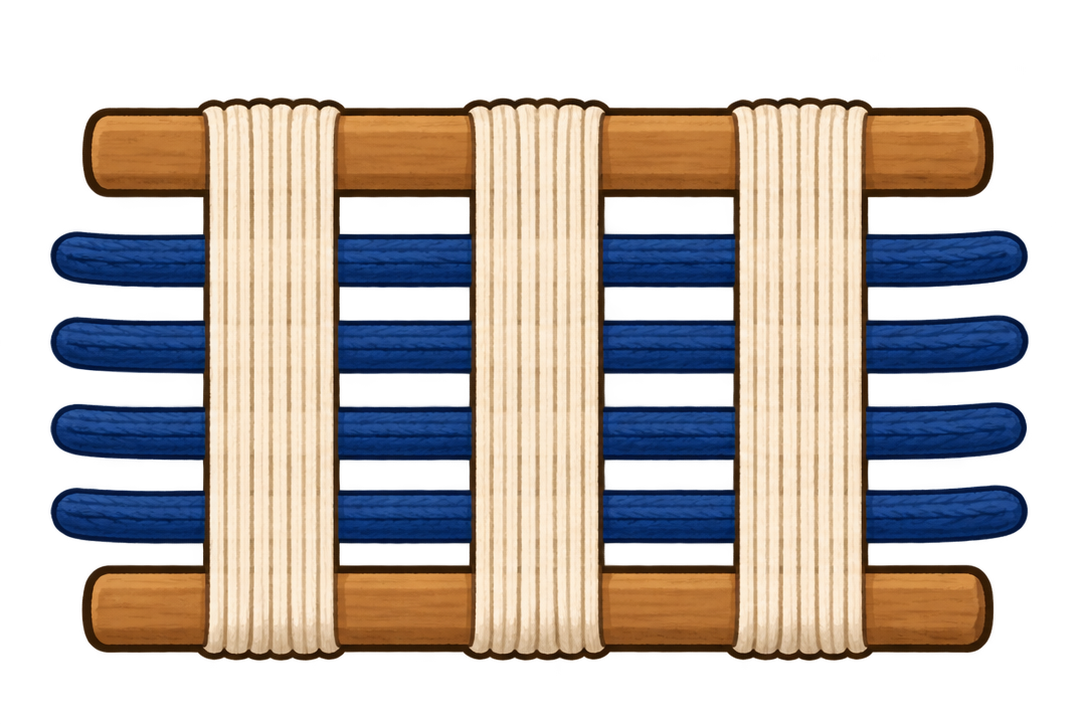 On the shime-bata loom, cotton threads bind the silk into a tight mat; the covered sections resist the dye.
- 2
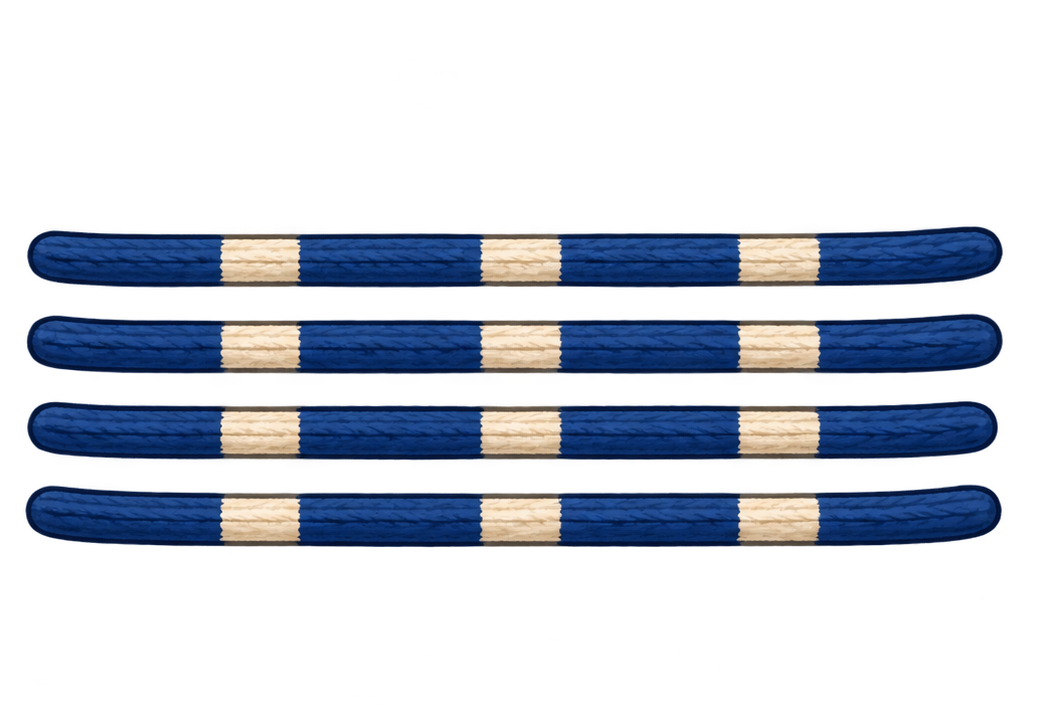 After dyeing, the cotton is removed, leaving precise white flecks on the silk.
- 3
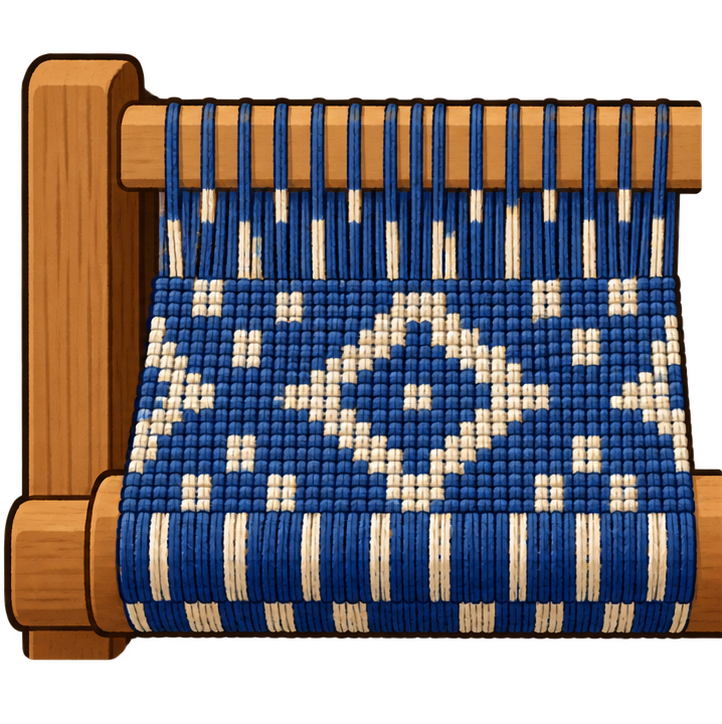 The real cloth is then woven from this yarn, and the flecks line up into the pattern.
07Bashōfu: Cloth from the Banana Plant
In Okinawa, the old Ryūkyū Kingdom, the traditional fiber was neither silk nor cotton but the fiber banana, itobashō, a relative of the edible banana grown for its stalk rather than its fruit. Cloth woven from its fibers is bashōfu. Under the Ryūkyū kings everyone from royalty to farmers wore it, because it is stiff, airy and stands away from the skin in a hot, humid summer.
Making it is laborious. The plants grow for about three years before harvest. The stalk layers are peeled apart, boiled in wood-ash lye and scraped to free the fiber. Then comes the slowest stage, splitting the fiber into fine strands and knotting them end to end by hand into continuous yarn. A single bolt reportedly takes around two hundred plants. After weaving, the cloth is boiled in lye again and then soaked in yunaji, a fermented rice-gruel liquid that neutralizes the lye. The result is thin, slightly translucent and a natural pale gold, often patterned with simple kasuri in brown from sharinbai and blue from Ryūkyū indigo.
- 1
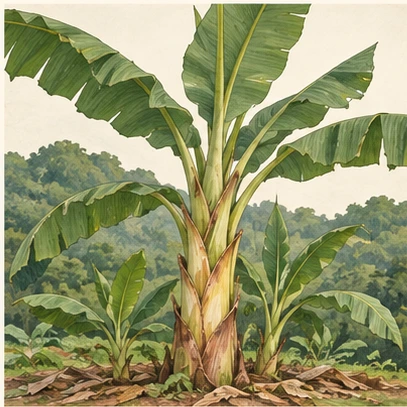 Thread banana grows for about three years before harvest.
- 2
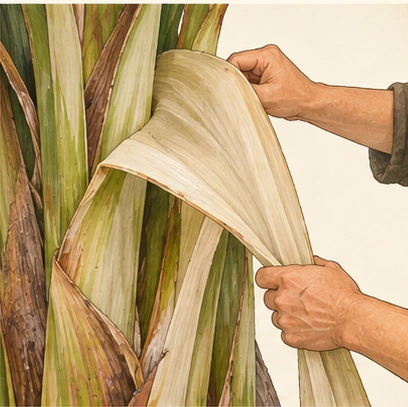 The pseudostem is peeled apart.
- 3
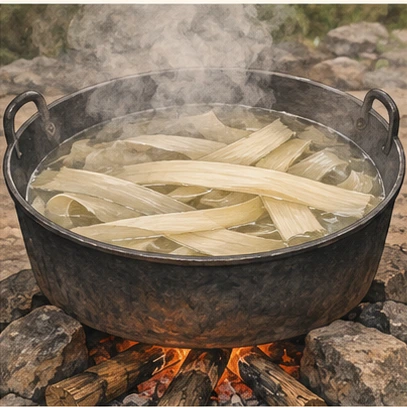 The strips are boiled in wood-ash lye, then scraped clean.
- 4
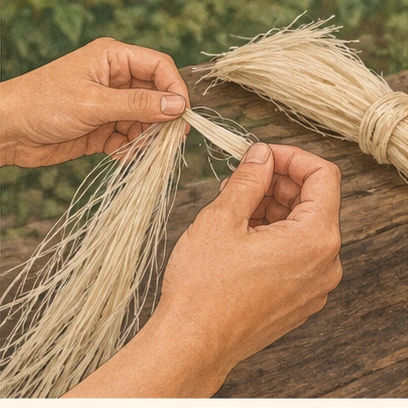 Fibers are split fine and joined by hand into continuous yarn.
- 5
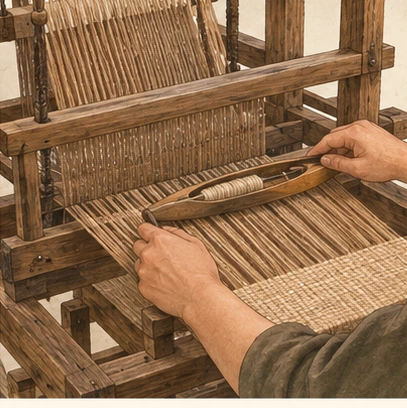 The yarn is woven into thin, slightly translucent cloth.
After the Second World War, bashōfu nearly died out. In the village of Kijoka in Ōgimi, northern Okinawa, Taira Toshiko led its revival from the postwar years on. Kijoka bashōfu was designated an Important Intangible Cultural Property in 1974, and in 2000 Taira herself was named a Living National Treasure. The Bashōfu Hall in Kijoka shows the whole process from stalk to loom. Bashōfu kimono are now expensive and worn mostly by connoisseurs; a woman in bashōfu on a Kyoto summer street is dressed with real expertise.
08Seeing and Wearing Kimono Textiles in Japan
Kyoto is the easiest place to start. The Nishijin Textile Center has working hand looms, and several yūzen studios offer short stencil-dyeing sessions where you brush color onto a handkerchief or tote bag in an hour or two. The textile galleries of the Kyoto and Tokyo National Museums rotate kosode robes and Noh costumes, often including Edo-period yūzen and nuihaku, the best chance to see embroidery and couched gold up close. In Kanazawa, the Kaga Yūzen Kimono Center lets you watch colorists at work and try on Kaga yūzen.
Arimatsu’s old street is a short walk from Arimatsu Station on the Meitetsu line from Nagoya, with shibori shops and workshops open year-round and the busiest days at the June festival. On Amami Ōshima, the Ōshima Tsumugi Village shows the mud paddies and the shime-bata loom. Kijoka is an easy detour on a drive through northern Okinawa.
A few clues help you read kimono on the street. A design that flows like a painting across the seams, with crisp white outlines, is usually yūzen. A surface of tiny puckered dots means shibori. Patterns with soft, jittery edges are kasuri. An obi with raised, heavy gold motifs most likely came from Nishijin. The rental kimono worn by visitors around Kiyomizu and Gion are mostly printed polyester, slick and light compared with real silk, but fine for feeling how a kimono moves. If you want the real thing, secondhand kimono shops in Kyoto and Tokyo sell silk tsumugi and small-pattern komon for a few thousand yen as of 2026; check inside the collar for stains and along the back seam for wear.
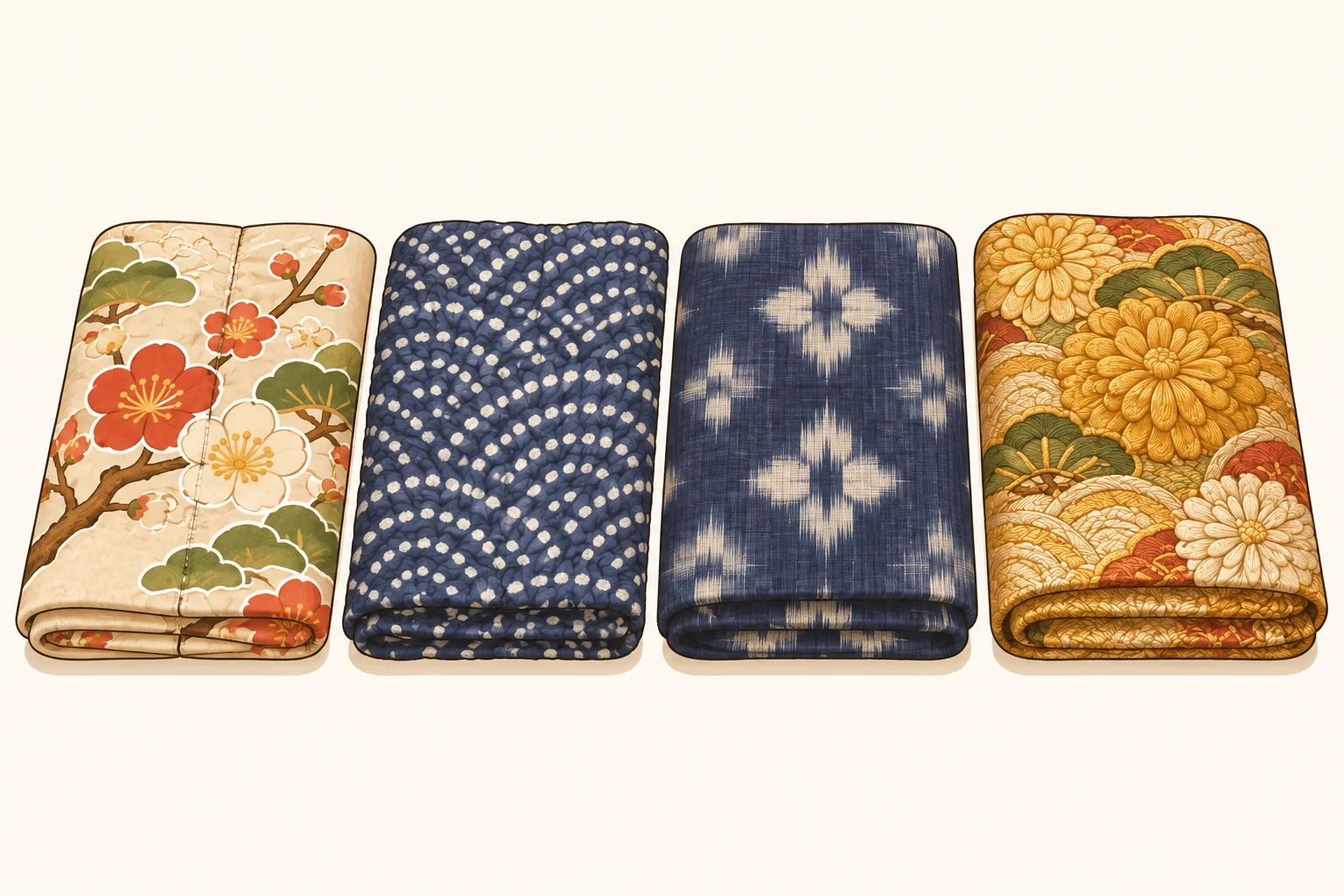
Four textiles: yūzen, shibori, kasuri and a Nishijin obi.