
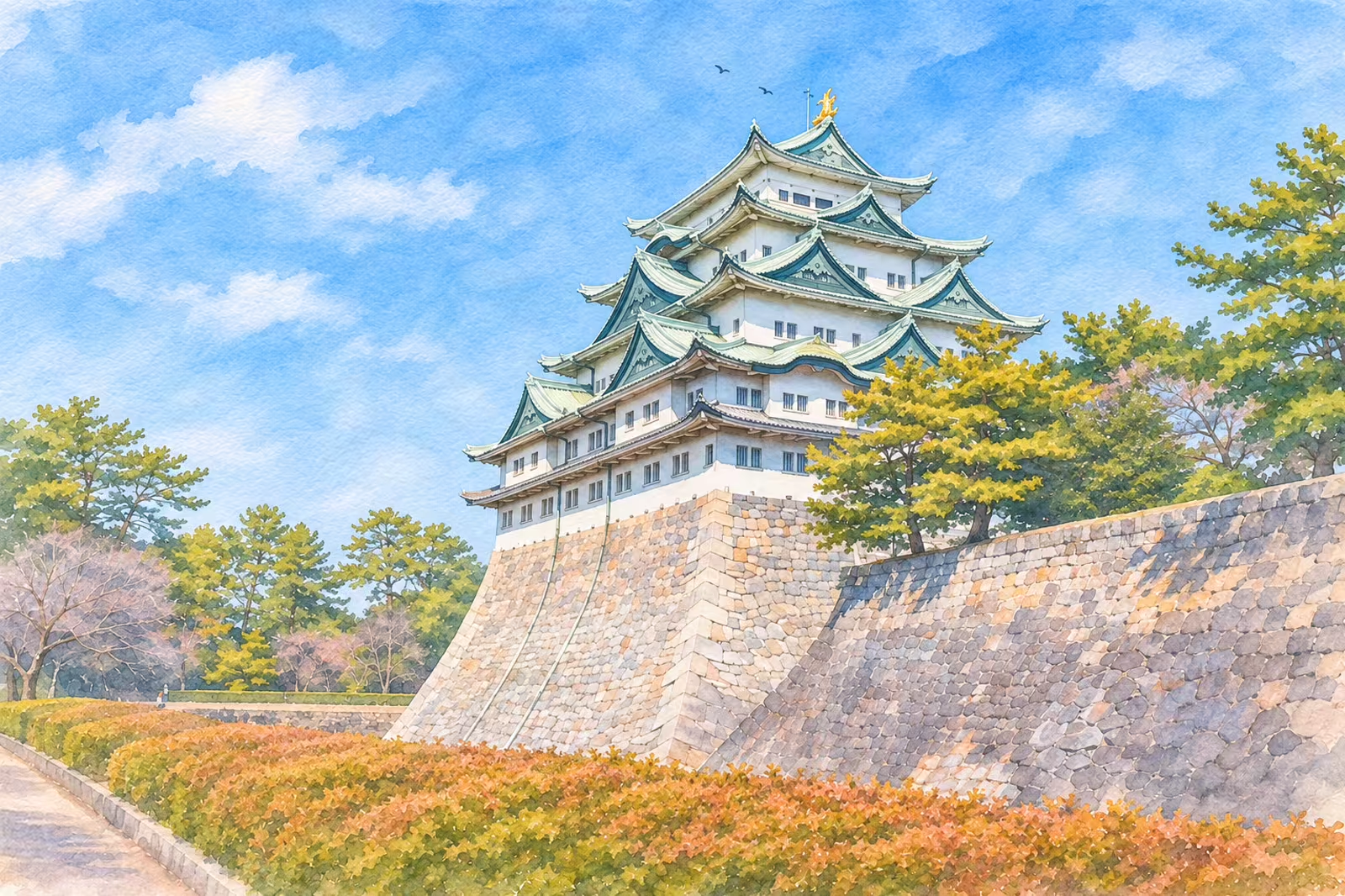
Nagoya Castle, in Nagoya, Aichi Prefecture, was built in the first years of the Tokugawa shogunate by Tokugawa Ieyasu for his ninth son, Tokugawa Yoshinao. For more than two and a half centuries it was the seat of the Owari Tokugawa, the senior of the three Tokugawa branch houses (gosanke), and it guarded the Tōkaidō road against the lords of western Japan. The pair of golden shachihoko (dolphin-like roof ornaments) on its keep remain the best-known symbol of the city.
01Building the castle and the city
Ieyasu ordered construction in 1610 as a tenka-bushin, a project whose costs and labor were imposed on other lords. Western daimyo such as Katō Kiyomasa and Fukushima Masanori took charge of sections of the stone walls, and the marks their crews carved into the blocks can still be found. The keep was finished around 1612 and the Honmaru Palace in 1615. At the same time the samurai, merchants and temples of nearby Kiyosu, the old center of Owari, were moved wholesale to the new castle town. This relocation, remembered as the Kiyosu-goshi, laid out the core of modern Nagoya. In 1634 the third shogun, Tokugawa Iemitsu, stayed here on his way to Kyoto, and a new wing, the Jōrakuden, was added to the palace for the visit.
02Modern changes and wartime loss
After the Meiji Restoration the army occupied the castle. In 1893 it became an imperial detached palace, and in 1930 it was given to the city of Nagoya. That same year the keep and the palace were designated National Treasures, among the first castle buildings to receive the status. In May 1945 an air raid burned the keep, the palace and the golden shachihoko. Most of the palace’s painted sliding doors and wall panels had been removed beforehand, and more than a thousand of them survive today as Important Cultural Properties.
03What can be seen today
Original early-Edo structures include three corner turrets (southwest, southeast and northwest) and several gates, such as the second gate of the Ninomaru main entrance, all Important Cultural Properties. The northwest turret is often said to reuse timber from Kiyosu Castle, though this is debated. The present keep is a ferroconcrete reconstruction of 1959 that reproduces the old exterior and housed a museum. Because of aging and earthquake concerns it has been closed to visitors since 2018, and the city plans to replace it with a wooden keep; as of 2026 no completion date has been fixed. The Honmaru Palace was rebuilt in wood on its original site, based on prewar survey drawings, photographs and the surviving paintings, and fully reopened in 2018. The whole castle site is a Special Historic Site.
Nagoya Castle
01The Fish on the Roof
Look up at the main keep and the first things you see are the two golden creatures at either end of the ridge. They are shachihoko, or shachi for short: mythical sea beasts with the head of a tiger and the body of a fish, their tails flung skyward. Japanese builders placed them on roofs as charms against fire, since a creature of the sea was supposed to summon water when flames threatened. Most castles had shachi of fired clay or copper. Nagoya’s were sheathed in gold, and they made the castle famous. An old saying ran "Owari’s Nagoya stands on its castle," and the castle, in the popular mind, stood on its golden shachi.
What you are looking at, however, is not the seventeenth-century keep. The original keep, the palace beside it and the original golden shachi were destroyed by American incendiary bombs in May 1945. The keep you see was rebuilt in reinforced concrete in 1959; the shachi on its roof were cast that same year. The palace next door is newer still, a timber reconstruction completed in 2018. Nagoya Castle is best understood as a site with three layers: a modest sixteenth-century fort where the young Oda Nobunaga lived, the great Tokugawa castle that stood here for more than two and a half centuries, and the postwar city’s long effort to bring it back.
02Before the Tokugawa: Nobunaga’s Boyhood Castle
The plateau on which the castle stands was fortified long before the Tokugawa arrived. In the early sixteenth century the Imagawa family, warlords based in Suruga to the east, pushed into Owari province and built a fort here, written with different characters as Nagoya (那古野). It is usually attributed to Imagawa Ujichika in the 1520s and was held by a member of his family, Imagawa Ujitoyo.
In the 1530s the fort was seized by Oda Nobuhide, an ambitious Owari warlord. Accounts differ on the exact year, with 1532 and 1538 both proposed; the castle’s own account favors about 1538. Nobuhide later placed his heir here, a boy called Kippōshi who would grow up to be Oda Nobunaga, the first of the three great unifiers of Japan. Whether Nobunaga was born here or at his father’s earlier castle of Shobata is debated, with recent scholarship leaning toward Shobata, but he spent his youth at Nagoya. This is where the teenager whom contemporaries called "the great fool of Owari," strolling about with gourds hanging from his belt, began his career.
In 1555 Nobunaga took Kiyosu Castle and moved his base there. The Nagoya fort passed to his uncle Oda Nobumitsu and then to the retainer Hayashi Hidesada, declined, and was abandoned around 1582. A stone marker in the Ninomaru, the second enclosure, now indicates the approximate site.
03Why Ieyasu Built Here
After his victory at Sekigahara in 1600, Tokugawa Ieyasu was the most powerful man in Japan, and in 1603 he became shogun. But Toyotomi Hideyori, the son of his late overlord Toyotomi Hideyoshi, still sat in Ōsaka Castle with a large fortune and the loyalty of many western lords. Owari lay on the Tōkaidō, the great highway between Edo and the Kyoto–Ōsaka region. If war came with Ōsaka, it would be the Tokugawa’s forward bastion.
The provincial center at the time was Kiyosu, where Ieyasu installed first his fourth son, Matsudaira Tadayoshi, and after Tadayoshi’s death in 1607 his ninth son, Tokugawa Yoshinao. Kiyosu, however, sat on low ground prone to flooding and was too cramped for a major military base. In 1609 Ieyasu decided to build a new castle a few kilometers to the southeast on the Nagoya plateau. Marshes to the north and west gave natural protection, while the ground to the south offered room for a castle town.
The move that followed is known as the Kiyosu-goshi, the "Kiyosu transfer." Samurai residences, merchant houses, temples and shrines were relocated wholesale, often keeping their old neighborhood names. Tradition puts the number of people in the tens of thousands, along with some 110 temples and three shrines. A popular ditty lamented that Nagoya had become a castle while Kiyosu had become a field. Several neighborhood names and temples in central Nagoya still trace their origins to Kiyosu.
04Built by Rivals: The Stone Walls
Nagoya Castle was a tenka-bushin, a "national construction project," in which the shogunate ordered daimyo (regional lords) to supply labor and money. In 1610 twenty lords were assigned sections of the stone walls. Most were western lords who had served the Toyotomi, among them Katō Kiyomasa, Fukushima Masanori, Kuroda Nagamasa, Ikeda Terumasa, Asano Yoshinaga and Maeda Toshitsune. Making former Toyotomi allies pay for a Tokugawa fortress had an obvious second purpose: it drained their treasuries.
A later anecdote has Fukushima Masanori grumbling about having to build castles even for Ieyasu’s sons, and Katō Kiyomasa replying that if he disliked it, he should go home and raise an army. The story comes from later sources and cannot be verified, but it captures the mood of the outside lords.
The most prestigious assignment, the base of the main keep, went to Katō Kiyomasa, renowned as a builder of stone walls, who volunteered for it and is said to have finished it in under three months. Legends grew up around him: that he stood atop a giant stone as it was hauled in, urging on the laborers with songs and drums. A bronze statue of this scene stands just outside the main gate. Inside the castle, just through the East Second Gate of the Honmaru (the main enclosure), is the largest stone in the walls, known as the Kiyomasa Stone. Despite the name, that stretch of wall is believed to have been the work of Kuroda Nagamasa; Kiyomasa’s fame simply attracted the legend.
As you walk, look closely at the wall surfaces. Many stones bear carved marks: circles, triangles, fans, family crests. These were made by the different lords’ crews to identify their own stones, and Nagoya preserves an unusually large number of them.
05The Keep and the Palace
Once the walls were done, the shogunate itself took charge of the buildings. The nine construction commissioners included Kobori Masakazu, better known as the tea master and garden designer Kobori Enshū, and the master carpenter was Nakai Masakiyo. The main keep was essentially complete in 1612. It had five roofs outside and five floors inside plus a basement, and it was linked to a smaller keep by a walled stone causeway. The keep stood about 36 meters tall, and with its stone base about 55 meters. In floor area it was among the largest keeps ever built in Japan.
In the mid-eighteenth century the keep began to tilt as its base settled. From 1752 the domain spent about three years on a major repair, dismantling and rebuilding the stone base and straightening the keep: the Hōreki Repair. At the same time the clay tiles on the second to fourth roofs were replaced with copper ones to lighten the load.
The Honmaru Palace, begun in 1612, was completed in 1615 as the residence of Yoshinao. It was a showpiece of shoin-zukuri, the formal reception architecture of the samurai elite, a chain of halls whose sliding doors and walls were covered in paintings by artists of the Kanō school, the official painters to the shogunate. The tigers and leopards among bamboo in the entrance hall are especially famous. The Ninomaru Palace was finished in 1617, Yoshinao moved his everyday residence there in 1620, and the Honmaru Palace was kept for the shogun’s visits. In 1634, for the third shogun Tokugawa Iemitsu’s journey to Kyoto, a new wing called the Jōrakuden was added, with sliding-door paintings by Kanō Tan’yū and the most lavish carved transoms and metal fittings in the palace. Iemitsu stayed there for two nights on that single journey, and no shogun ever stayed there again.
As for the golden shachi, installed when the keep was finished in 1612, the pair is generally said to have used gold equal to 1,940 Keichō ōban coins, about 215 kilograms of pure gold, and each stood about 2.7 meters tall. As the domain’s finances worsened, the shachi were recast three times, in 1730, 1827 and 1846, each time with lower gold content. At the first recasting, wire netting was put around them, officially to keep birds off and, people said, also to keep thieves away.
06The Owari Tokugawa
The castle’s lords were the Owari branch of the Tokugawa. The first, Tokugawa Yoshinao, was the man the castle had been built for; he formally entered it in 1616, after Ieyasu’s death, at the age of seventeen by the traditional count. His domain covered Owari province plus parts of Mino and the Kiso valley in Shinano, with an official assessment of about 619,500 koku of rice. With the Kii and Mito branches, the Owari house formed the Gosanke, the "three houses" eligible to supply a shogun if the main line failed.
Yoshinao was a serious scholar of Confucian learning who collected a great library; it forms the core of the Hōsa Library in Nagoya today. The seventh lord, Tokugawa Muneharu, was a contemporary of the eighth shogun, Tokugawa Yoshimune, whose reforms preached thrift. Muneharu defied him, relaxing restrictions on theaters and entertainment, and Nagoya boomed. The shogunate eventually forced him into retirement and confinement. The Owari house was the senior of the three branches, yet it never produced a shogun, a point that has fed many historical debates.
At the end of the Edo period the fourteenth lord, Tokugawa Yoshikatsu, sided with reformers and often clashed with the shogunate’s leadership. Early in 1868, as civil war broke out, the domain executed a group of retainers accused of pro-shogunate sympathies, in what is called the Aomatsuba Incident. Owari then joined the new imperial government, and the great Tokugawa castle passed into the Meiji era without a fight.
07Army Base, Imperial Villa, National Treasure
After the Meiji Restoration many castles were demolished, and Nagoya might have been one of them. In 1871 a branch of the army’s Tokyo garrison was stationed in the castle, which came under the Army Ministry; in 1873 the unit became the Nagoya garrison, and the Ninomaru Palace and other buildings were torn down for barracks. Demolition of the castle was discussed, but in 1879, after appeals from the German minister Max von Brandt and the army engineer Colonel Nakamura Shigetō, the government decided to preserve it permanently, ranking it with Himeji among the castles to be kept.
The golden shachi went traveling. Removed from the roof in 1871 and presented to the Imperial Household Ministry, the male was shown at an 1872 exhibition at Yushima in Tokyo and the female at the 1873 Vienna World’s Fair, and both then toured domestic expositions. In 1879, after petitions from Nagoya, both were returned to the keep.
The Nōbi Earthquake of 1891 damaged many buildings. In 1893 the main and western enclosures were transferred to the Imperial Household Ministry and became the Nagoya Detached Palace. In 1930 the ministry gave the castle to the city of Nagoya, and in the same year the keep, the Honmaru Palace and other structures, twenty-four in all, were designated National Treasures under the law of the time. Nagoya was the first castle to receive that designation. In January 1937 a thief climbed the keep and pried fifty-eight golden scales off the male shachi, a crime that made national headlines.
08May 14, 1945
Nagoya, a center of aircraft production, was bombed repeatedly in the last year of the Pacific War. As a precaution, the movable paintings were evacuated from the Honmaru Palace, and scaffolding was put up around the keep’s roof so the golden shachi could be taken down.
On May 14, 1945, during a major American air raid, incendiaries struck the castle; the usual account is that they lodged in the scaffolding and the fire spread into the keep. The main and small keeps, the Honmaru Palace and most gates and turrets burned, and the golden shachi, still on the roof, melted in the fire. Some of the gold was reportedly recovered from the ruins after the war.
What survived were three corner turrets, the Southwest, Southeast and Northwest turrets, and three gates: the Omote Ni-no-mon, the Ninomaru Ōte Ni-no-mon and the former Ninomaru East Ni-no-mon. All are now Important Cultural Properties. More than a thousand of the palace’s paintings survived thanks to their evacuation, and 1,047 of them are Important Cultural Properties; about 140 paintings fixed to the walls burned with the building. They proved indispensable when the palace was rebuilt.
09Concrete Keep, Timber Palace
After the war, residents pressed to see the keep restored. As a project marking the city’s seventieth anniversary, construction began in 1957, and in October 1959 the main and small keeps and the main gate were completed in reinforced concrete, with exteriors based on prewar surveys and photographs and interiors fitted out as a museum with elevators. A new pair of golden shachi was made by the Japan Mint in Ōsaka, covered in 18-karat gold plates totaling about 88 kilograms. Donations from residents and from across Japan helped pay for the work.
In the 2000s the city began reconstructing the Honmaru Palace in timber using traditional methods. The work relied on detailed prewar measured drawings, hundreds of photographs, and the surviving paintings. Construction started in 2009 and the palace opened in stages, with the whole complex completed in 2018. The paintings inside are faithful reproductions; the originals are displayed in rotation at the Nishinomaru Okura Treasure Museum on the grounds.
The concrete keep, meanwhile, has aged and does not meet modern earthquake standards. The city decided to replace it with a timber reconstruction faithful to the original, and the keep has been closed to visitors in recent years. The plan has been controversial, especially over whether a wooden replica should include elevators for wheelchair users, and it is still in progress.
10A Walk Through the Castle
Entering through the main gate, you come first to the Nishinomaru, the western enclosure, where the Nishinomaru Okura Treasure Museum tells the castle’s story and shows the original palace paintings in rotation. Across the moat stands the Southwest Turret, an original structure from the early 1600s. It collapsed with its stone base in 1921 and was rebuilt by the Imperial Household Ministry in 1923, which is why some of its roof tiles bear the imperial chrysanthemum rather than the Tokugawa hollyhock.
Through the Omote Ni-no-mon gate you enter the Honmaru and the reconstructed palace. Moving from the entrance hall with its tigers, through the formal reception rooms, to the Jōrakuden at the back, you can watch the decoration grow richer as the rooms rise in rank, from spaces for the lord’s guests to quarters meant for a shogun.
North of the palace rise the main and small keeps. Even when the interior is closed, you can study the stone base built under Katō Kiyomasa’s direction and the causeway linking the two keeps. On the west side, in the Ofukemaru enclosure, the Northwest Turret is the largest of the three surviving turrets. It is traditionally called the Kiyosu Turret because it is said to have been built by moving the keep of Kiyosu Castle, and repairs have found traces of reused timber. On the east side of the Honmaru, near the East Second Gate, you can find the Kiyomasa Stone, and the Southeast Turret looks out over the Ninomaru.
The Ninomaru Garden, once attached to the lords’ residence, has been excavated and partly restored. Nearby, the marker for the old Nagoya fort is a reminder that before the Tokugawa built their golden castle, a boy named Kippōshi lived on this ground.