
At a glance
What Japan’s Living National Treasure title actually recognizes, why it began after the war, how bamboo masters work, and where to see their pieces.
- "Living National Treasure" is a nickname; the legal title is Holder of Important Intangible Cultural Property.
- The state designates a technique first, then recognizes a person as a holder of that technique.
- A 1949 fire at Hōryū-ji led to the 1950 cultural properties law; the first holders were named in 1955.
- Individual holders were long capped at 116; the ceiling rises to 126 from fiscal 2026.
- The Japan Traditional Kōgei Exhibition each autumn gathers work by Living National Treasures in one place.
Walk through a department-store gallery in Tokyo in September and you may find a tea bowl, a bolt of kimono silk, or a bamboo flower basket with a small card beside it naming the maker as a "Holder of Important Intangible Cultural Property." In everyday Japanese these people are called ningen kokuhō, "human national treasures," usually rendered in English as Living National Treasures. Since the 1950s, Japan has treated certain skills as cultural property in the same legal sense as temples and paintings, and has recognized the individuals who carry those skills at the highest level. This piece explains what the title actually means, why Japan created it, which crafts it covers, what one of those crafts, bamboo basketry, looks like from the inside, and where a visitor can see the work.
01A Nickname for a Legal Category
"Living National Treasure" is not a legal term. Japan’s Law for the Protection of Cultural Properties divides cultural property into the tangible and the intangible. Tangible properties are buildings, sculptures, paintings, swords, and documents; the most important of them are designated kokuhō, National Treasures. Intangible properties are things that exist only in human skill: theater, music, dance, and craft techniques. The state designates the most significant of these as Important Intangible Cultural Properties and, alongside each designation, recognizes the people who embody the technique as its "holders." Journalists found the official phrase unwieldy and borrowed the word kokuhō, and the nickname stuck; the Agency for Cultural Affairs itself now writes "so-called Living National Treasures" in its own explanations.
The order matters. What the government designates first is a technique, such as Bizen stoneware, maki-e lacquer decoration, or yūzen dyeing. A person is then recognized as a holder of that technique. A potter is never simply a Living National Treasure; he or she is a Living National Treasure for a named craft.
There are three forms of recognition. Individual recognition, the one people mean by the nickname, honors a single artist. Collective recognition applies to performing arts that only exist as ensembles, such as kabuki, Noh, and the puppet theater bunraku. Group recognition applies to a craft kept alive by a whole community, such as the silk pongee of Yūki or the ramie cloth of Ojiya, where a preservation society rather than a single master holds the technique.
The number of individual holders is capped, with a long-standing ceiling of 116 across crafts and performing arts combined. A 2025 revision added a third field, "lifestyle culture," and raised the ceiling to 126 from fiscal 2026. As of 2026, each receives an annual special grant of two million yen, intended for refining the skill and training successors. That is modest by the standards of a top potter’s prices or a leading actor’s income. The real value of the title is recognition: once a craftsperson is named, demand for their work and interest from would-be apprentices tend to rise sharply.
02A Fire, a Law, and the Problem of Skills That Die With Their Owners
The system grew out of a disaster. In January 1949, a fire broke out in the Golden Hall of Hōryū-ji in Nara during restoration work, destroying most of the celebrated seventh-century wall paintings. The loss shocked the country, and in 1950 Japan passed the Law for the Protection of Cultural Properties, consolidating older statutes on temples, shrines, and national treasures. For the first time, the law included intangible cultural property.
The reason was the state of postwar Japan. The war and its aftermath had nearly severed many traditions. Lacquer, silk, and gold leaf were scarce; workshops that made luxury goods closed; Noh and bunraku had lost the patronage of the samurai households and merchant families that once supported them. Daily life was moving off the tatami and into Western-style rooms. A burned temple can be rebuilt from measured drawings. A weaving technique cannot be reconstructed once the last woman who knows how to prepare and tension the threads has died without anyone watching her work.
The 1950 law originally protected only skills judged to be in danger of disappearing. A 1954 amendment changed the logic: the state would designate techniques for their importance, whether or not they were endangered, and would recognize holders. The first individual recognitions followed in 1955. Among the craftspeople in that first group were the potter Hamada Shōji of Mashiko, the porcelain painter Tomimoto Kenkichi, Arakawa Toyozō, who had revived the Shino ware of the Momoyama period, the potter Ishiguro Munemaro, and the lacquer artist Matsuda Gonroku.
The idea traveled. South Korea set up a comparable system in the 1960s, and in the 1990s UNESCO encouraged member states to establish "Living Human Treasures" programs, a line of thinking that fed into the 2003 Convention for the Safeguarding of the Intangible Cultural Heritage.
03The Crafts and the Craftspeople
Crafts recognized under the system fall into a handful of fields: ceramics, textiles, lacquer, metalwork, wood and bamboo, dolls, handmade paper, and miscellaneous crafts. The performing arts side covers gagaku court music, Noh and kyōgen, bunraku, kabuki, Okinawan kumiodori, music, dance, and storytelling arts. The new lifestyle-culture field brings in skills such as cooking, sake brewing, and flower arrangement; in October 2026 the Council for Cultural Affairs recommended its first three holders (formal recognition had yet to be announced as of November 2026): Takahashi Eiichi of the Kyoto restaurant Hyōtei for Kyoto kaiseki cuisine, the master brewer Noguchi Naohiko for ginjō sake brewing, and the Ikenobō headmaster Ikenobō Sen’ei for the rikka style of arrangement.
Ceramics attracts the most attention. Hamada Shōji, a central figure in the mingei folk-craft movement, made robust stoneware in Mashiko, north of Tokyo, using local clay and glazes poured with a few quick gestures. His house, kilns, and collection are now the Mashiko Sankōkan museum. Tomimoto Kenkichi, who had studied in London, insisted on never copying an existing pattern and drew his porcelain designs from his own sketches of plants and landscapes. Arakawa Toyozō’s story is the most dramatic. In 1930, digging in the hills of Mino, he found shards of a Momoyama-era Shino tea bowl, proving that Shino had been fired in Mino rather than Seto as long assumed. He built his own kiln and spent years recovering Shino’s thick, milky glaze with its flush of fire-red. Kaneshige Tōyō did something similar for Bizen, the unglazed stoneware of Okayama, returning it to favor with tea practitioners. What these figures share is that they did not reproduce old objects; they found inside old methods a language they could keep using.
In textiles, the Kyoto yūzen dyer Moriguchi Kakō, the Kaga yūzen dyer Kimura Uzan of Kanazawa, and the weaver and dyer Shimura Fukumi are among the best known. Shimura’s plant-dyed pongee, its colors shading from one tone to the next, has a large following, as do her essays. In lacquer, Matsuda Gonroku moved maki-e, the technique of sprinkling gold and silver powder into wet lacquer, from decorative trade into personal art. Metalwork includes casting, hammering, and chasing, and also swordsmithing; smiths such as Miyairi Yukihira, Sumitani Masamine, and Amada Akitsugu have been recognized.
On the performing side, the names are more familiar to the Japanese public because they appear on stage and television: the kabuki onnagata Bandō Tamasaburō, the kyōgen actor Nomura Mansaku, and the chanters and shamisen players of bunraku. For a theatergoer, seeing "Living National Treasure" printed beside a performer’s name signals the highest level of that art available today.
A separate and often confused label is dentōteki kōgeihin, "traditional craft products," designated by the Ministry of Economy, Trade and Industry under a 1974 law. That system supports regional industries such as Wajima lacquer, Nishijin weaving, and Beppu bamboo ware, and is concerned with production and local economies. The Living National Treasure system is run by the Agency for Cultural Affairs and is concerned with the highest level of a skill.
04Bamboo Basketry: From Strips to Sculpture
Bamboo shows more clearly than any other craft what "technique" means in this system, because most of the work happens before any weaving begins.
Makers usually use madake, Japanese timber bamboo, along with black bamboo, spotted "tiger" bamboo, and susudake, smoked bamboo taken from the roofs of old farmhouses, where a century or more of hearth smoke turned it a deep brown. That smoked bamboo is increasingly rare as old houses are demolished. Fresh bamboo is cut in autumn or winter, when it holds less water and is less attractive to insects. It must then have its oils removed, either by boiling in an alkaline solution (caustic soda, by some accounts) or by heating over a flame and wiping off the oil that rises to the surface. This stabilizes the color to a pale gold and protects against mold. The culms then dry for months.
Next come the strips, called higo. The maker drives a blade into the end of a culm and splits it in half, then in quarters, then eighths, and on down. Each piece is separated into layers, keeping the tough, flexible layer just beneath the skin. The strips are drawn through fixed blades to make their thickness and width uniform, and finally their edges are beveled. A fine flower basket may need hundreds of fine strips, all identical in width and thickness; the finest are said to be under two millimeters wide. If the strips vary, the basket will lean or gap. Many makers say strip preparation takes the greater part of their working time.
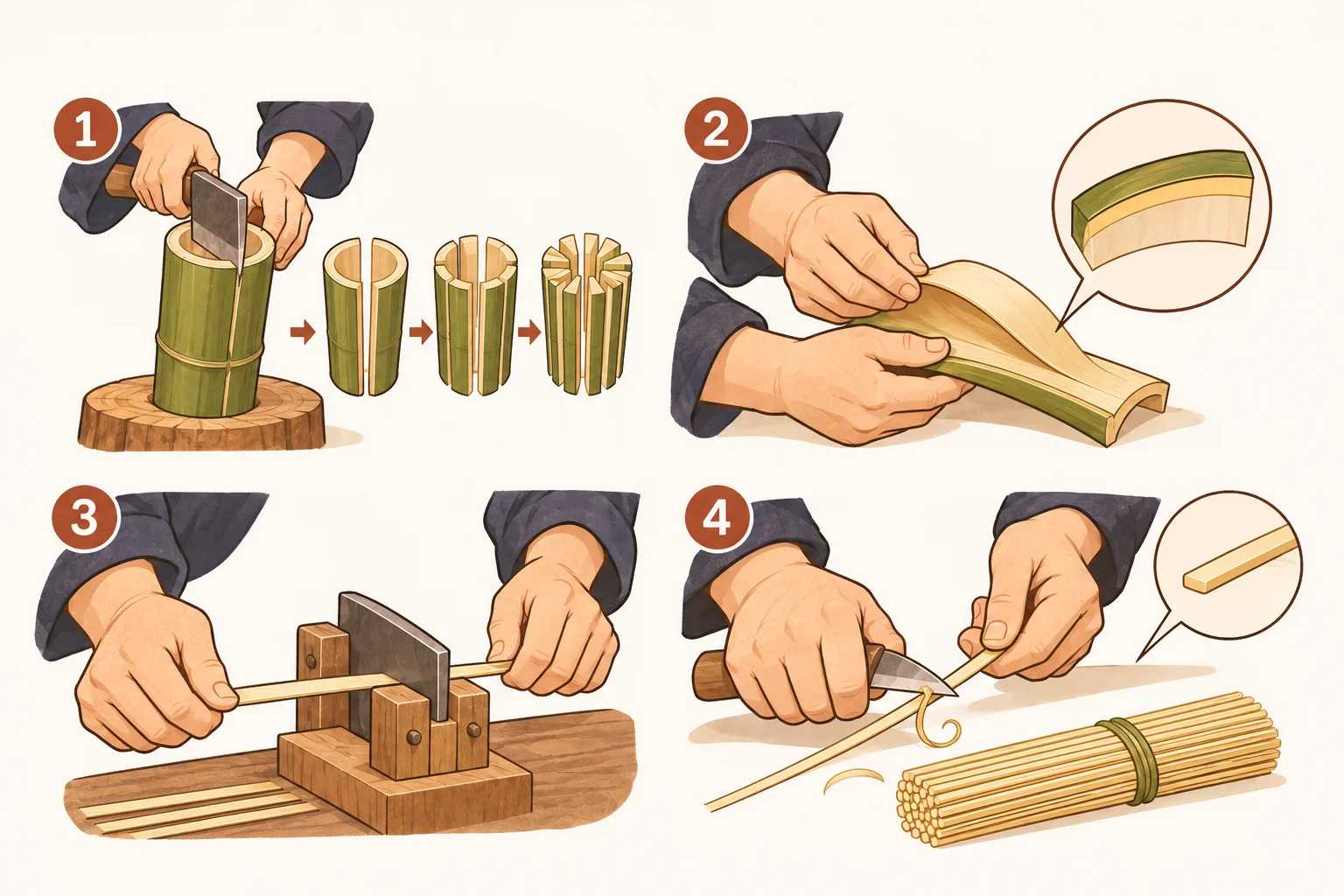
Making higo: splitting the culm, keeping the layer beneath the skin, drawing strips through blades, beveling the edges.
Weaving is the visible part. Yotsume-ami produces an open square grid; mutsume-ami produces the hexagonal mesh familiar from Japanese baskets. Ajiro-ami interlaces strips over two and under two, or over three and under three, giving a dense twill-like surface. Tabane-ami bundles several strips together and weaves them as one, producing bold, ropy lines; midare-ami, "random weave," lets strips cross in what looks like free movement. The hardest moment is the turn from flat to three-dimensional. Once the base is woven, the strips are raised and the walls built up, swelling or narrowing as the maker controls tension with the fingers at every turn. Rims are bound with rattan, handles added, and the piece finished with lacquer or stain.
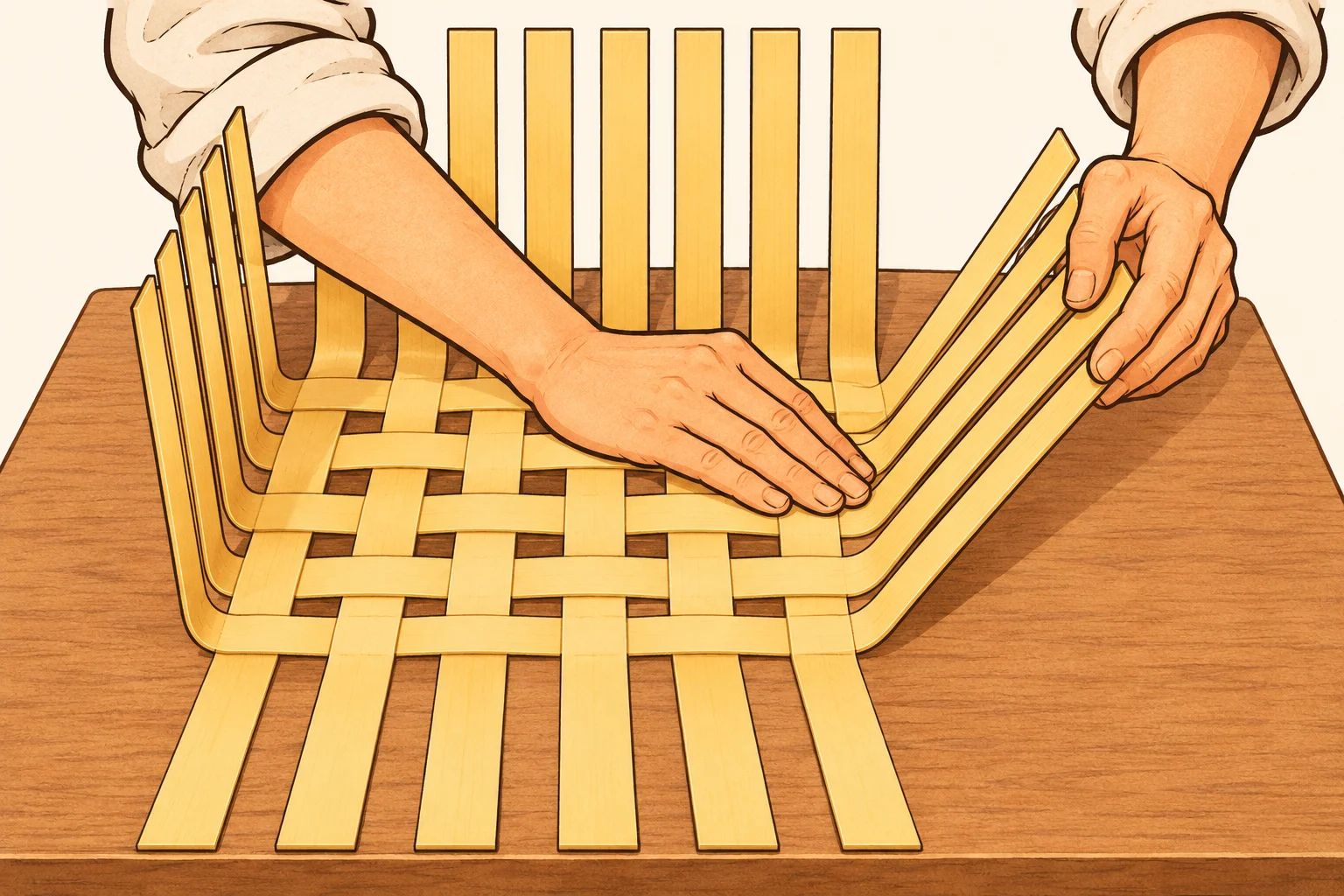
The hardest moment in bamboo weaving: once the base is woven, the strips are raised and flat turns three-dimensional.
- 1Cuttingautumn or winter
- 2Removing the oilsboiling in alkali or heating over a flame
- 3Dryingfor months
- 4Making strips (higo)split, keep the layer beneath the skin, make uniform, bevel
- 5Weavingyotsume, mutsume, ajiro and others
- 6Flat to three-dimensionalstrips raised, tension controlled by the fingers
- 7Finishingrattan rim, handles, lacquer or stain
Weaving is the visible part, but strip preparation takes the greater part of the work.
Japanese bamboo art grew up alongside flower arrangement. From the Muromachi period, finely made baskets imported from China, known as karamono, held flowers in tea rooms. In the late Edo and Meiji periods, the vogue for sencha steeped tea created demand for baskets in that Chinese manner, and specialist masters appeared in Ōsaka, Sakai, and Kyoto. The Tanabe Chikuunsai line of Sakai, now in its fourth generation, comes from this world. In Tokyo, Iizuka Rōkansai pushed bamboo beyond imitation of Chinese models toward individual expression in the early twentieth century; his son Iizuka Shōkansai was later named a Living National Treasure.
The first bamboo artist so recognized was Shōno Shōunsai of Beppu in Ōita Prefecture, in 1967. Beppu remains the center of the craft. Peddlers’ baskets were made here by the Muromachi period, and in the Edo period rice baskets, strainers, and other kitchen ware for hot-spring visitors cooking their own meals made bamboo a local industry (some accounts add baskets for carrying visitors’ luggage). A vocational training center for wounded soldiers, founded in 1939, moved to its present site in 1963 as the prefectural bamboo craft training school and continues today as the Ōita Prefectural Bamboo Craft Training Support Center, which still trains young makers. Later bamboo holders include Maeda Chikubōsai II, Katsushiro Sōhō, and Fujinuma Noboru, and in 2024 Kibe Shōhō of Kokonoe became the second bamboo holder from Ōita. In recent decades, museums and collectors in the United States and Europe have taken Japanese bamboo seriously as sculpture; the Metropolitan Museum of Art in New York staged a major exhibition in 2017–18, for which the fourth Chikuunsai built a room-sized bamboo installation, The Gate, at its entrance.
05Keeping It Going
The system asks holders to train successors, which is harder than handing out a grant.
The first problem is materials and tools. Japanese lacquer comes from tapping lacquer trees, and domestic production is now tiny, with most lacquer imported from China. Swordsmiths need tamahagane steel smelted in a traditional tatara furnace, and nearly all of it comes from a single furnace in Okuizumo, Shimane Prefecture, fired only a few times a year. It is usually described as the only tatara in Japan still operating regularly, and its firings are said to take place mostly in winter. Smoked bamboo is disappearing with old farmhouses. Paper mulberry, special animal hair for lacquer brushes, and the paper used to beat gold leaf each face their own shortages. To address this, the law also protects "selected conservation techniques," the skills needed to make the materials and tools on which crafts and restoration depend, such as making lacquer brushes or producing sukumo, the fermented indigo used in traditional dyeing. A dyer’s mastery means little if no one can make her brushes or her dye.
The second problem is age. Holders are usually recognized in their sixties or seventies, so names leave the list every year and some fields go long periods without a new recognition. The third is the market. A bamboo basket that took three months to make is priced beyond ordinary households, while everyday bamboo goods have long since been replaced by plastic and imports. Many younger makers support themselves through teaching, exhibitions, and overseas collectors.
The title also has critics. It is held for life and raises prices, and some worry that it pushes craft toward the luxury art market and away from everyday use. Some admired artists kept their distance from state honors: Kawai Kanjirō, a founder of the mingei movement, declined both the Order of Culture and Living National Treasure status, and Kitaōji Rosanjin turned down recognition for his Oribe ware.
06Where to See the Work
The best single opportunity is the annual Japan Traditional Kōgei Exhibition, organized by the Japan Kōgei Association with the Agency for Cultural Affairs, the Tokyo Metropolitan Board of Education, NHK, and the Asahi Shimbun, and held since 1954. Living National Treasures show alongside younger artists selected by jury, across seven divisions: ceramics, textiles, lacquer, metalwork, wood and bamboo, dolls, and miscellaneous crafts. It usually opens in September at the Mitsukoshi flagship store in Nihonbashi, Tokyo, then tours to cities including Kyoto, Nagoya, Sendai, Kanazawa, and Okayama. Many works are reportedly available for purchase on inquiry, and in one afternoon you see the current state of Japanese craft.
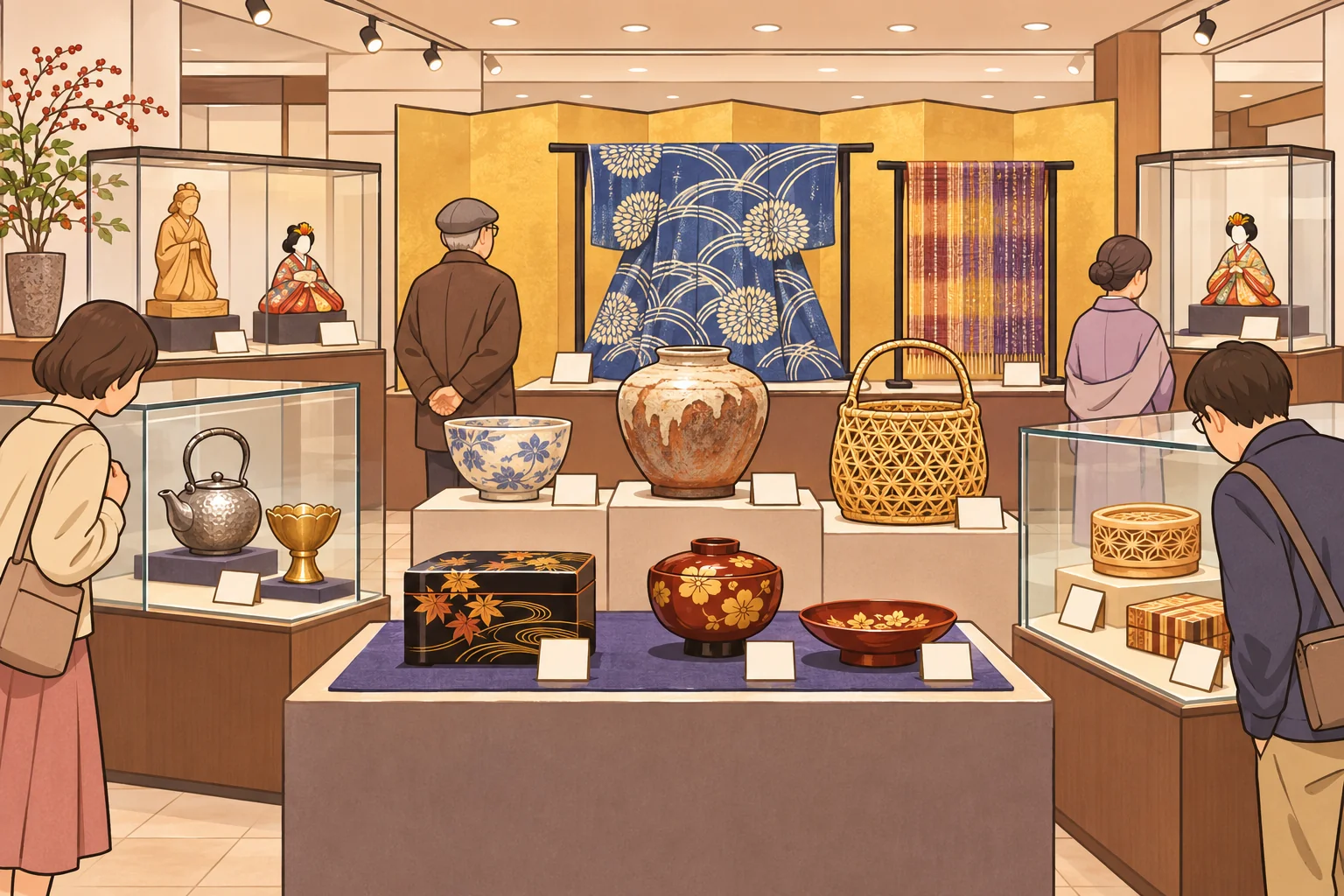
A traditional crafts exhibition in a department store gallery: ceramics, lacquer, textiles and bamboo on display (illustration).
For permanent collections, the National Crafts Museum, which moved from Tokyo to Kanazawa in 2020, focuses on modern and contemporary craft and holds many works by holders. The national museums of modern art in Tokyo and Kyoto also mount craft exhibitions regularly. For individual makers, visit the Mashiko Sankōkan to see Hamada’s kilns and house; walk the kiln district of Imbe in Bizen, where signs mark the workshops of past and present holders; or go to Beppu’s Bamboo Crafts Traditional Industry Center, which displays the main weaves alongside pieces by the town’s masters, with workshops nearby where you can weave a small basket yourself.
When you look, get close. With a basket, check whether the strips are even in width and whether the rim closes smoothly. With a tea bowl, watch the glaze change as you move and look at how the foot was trimmed. With yūzen, look at the edges of the lines and the way one color fades into the next. What you are seeing is the result of a single person repeating the same set of movements for decades.