At a glance
How a kimono is cut from one bolt of cloth, how it grew from an undergarment, which kinds suit which occasions, and what to know before renting one.
- A kimono uses one tan of cloth, about 36 cm wide and 12 m long, cut straight into eight pieces with almost no waste.
- Its direct ancestor is the kosode, which in the Heian period was a white undergarment worn innermost by aristocrats.
- Kimono are ranked from formal to casual by where the pattern falls, how many crests they bear and what type they are, not by price.
- Kimono change with the seasons: lined awase from October to May, unlined hitoe in June and September, sheer usumono at the height of summer.
- Everyone wraps right side first, with the left panel on top; the reverse is how the dead are dressed.
A kimono, unpicked and laid flat, is a handful of rectangles. There are no curves, no darts, almost no offcuts. Out of that simple geometry Japan built a garment that can tell an informed onlooker whether the wearer is married, how close she is to the bride, what month it is, and which family she belongs to. Most Japanese people now wear kimono only a few times in their lives, yet on those days the rules still matter. This is an introduction to what a kimono is, why it is shaped the way it is, how it grew out of an undergarment called the kosode, which kimono are worn where, what all the sashes, cords and jackets are for, who still wears kimono every day, and what you should know before you rent one in Kyoto or Asakusa.
01A Garment Cut from a Single Bolt
Every kimono begins as a tan, a bolt of cloth about 36 centimeters wide and around 12 meters long, enough for one adult garment. The tailor cuts it straight across into eight pieces: two long body panels that run from the front hem over the shoulder and down to the back hem, two sleeves, two narrow front overlap panels called okumi, a collar, and a collar cover. Every cut is a straight line, and almost nothing is thrown away.
- 1Body panels ×2Run from the front hem over the shoulder to the back hem
- 2Sleeves ×2
- 3Okumi ×2Narrow front overlap panels
- 4Collar ×1
- 5Collar cover ×1
A tan about 36 centimeters wide and around 12 meters long is cut straight across into these eight pieces, with almost nothing thrown away.
That way of cutting explains most of what is distinctive about the kimono. Western tailoring shapes cloth around the body, so a jacket has a form even on a hanger. A kimono on a hanger is a flat T. It takes its shape only when it is put on, folded, wrapped and tied in place. Because nothing is cut to an individual’s curves, one kimono can fit many bodies. A woman’s kimono is made longer than she is tall, and the extra length is folded up at the waist into a tuck called the ohashori; adjusting that fold is how the same garment fits a taller mother and a shorter daughter. Handing kimono down is ordinary. Plenty of young women wear their mother’s furisode to their coming-of-age ceremony.
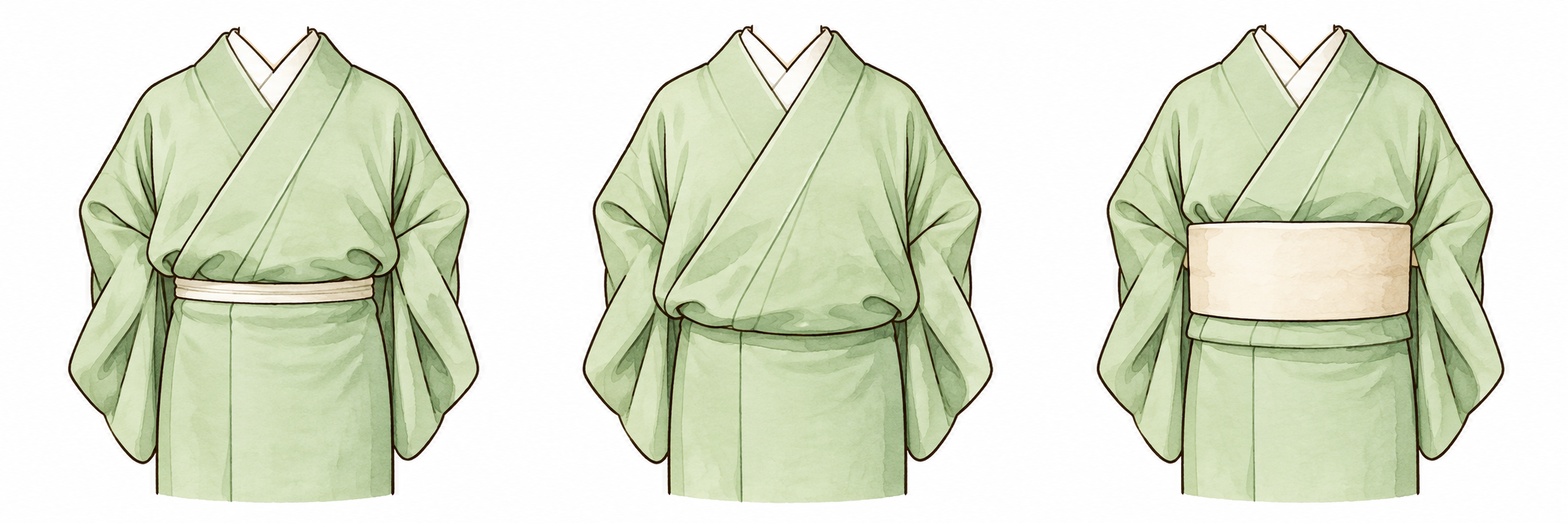
From left: a waist cord holds the robe; the extra length folds down over it as the ohashori; once the wide obi is tied, the fold still shows below it.
Straight seams also mean the garment can be taken apart. A good silk kimono was never thrown in a tub. Instead it was unpicked back into its strips, washed, starched and stretched flat on boards to dry, then sewn up again. The process is called araihari, "washing and stretching." Some faded panels could be turned inside out, a worn sleeve swapped with a less visible piece, and when the garment finally gave out it became a child’s kimono, then cushion covers, then rags. A kimono was a store of cloth as much as a piece of clothing.
The word itself is plain. Kimono means "a thing to wear." The older trade term gofuku, literally "Wu clothing," originally referred to silks associated with China and came to mean kimono fabric in general, which is why old kimono shops are called gofukuten.
02From Undergarment to Outerwear: The Kosode
The direct ancestor of the modern kimono is the kosode, "small sleeves." The name refers not to short sleeves but to a small wrist opening: the sleeve is sewn closed below, leaving a gap just large enough for the hand. Its opposite was the ōsode, the "large sleeve," open all the way down.
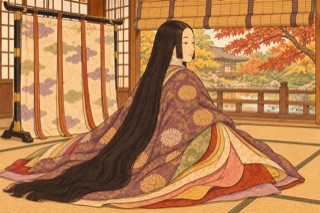
In the Heian period (794–1185), aristocratic women at court wore the layered robes later nicknamed jūnihitoe, "twelve layers," with wide-sleeved robes stacked so that their colors showed in graded bands at the collar and cuffs. The kosode was the white garment worn closest to the skin, invisible to anyone else. Commoners, meanwhile, worked in narrow-sleeved garments of hemp as their everyday outer clothes.
As warriors took power from the twelfth century onward, the court’s heavy layers were gradually dropped, and the kosode, once hidden, became the visible outer garment. By the late sixteenth century, the age of Oda Nobunaga and Toyotomi Hideyoshi, women of samurai families and wealthy townspeople alike wore kosode decorated with bold patterns. The technique called tsujigahana, which combined tie-dye with ink painting and sometimes embroidery, belongs to this period, and surviving pieces are some of the most prized textiles in Japanese museums.
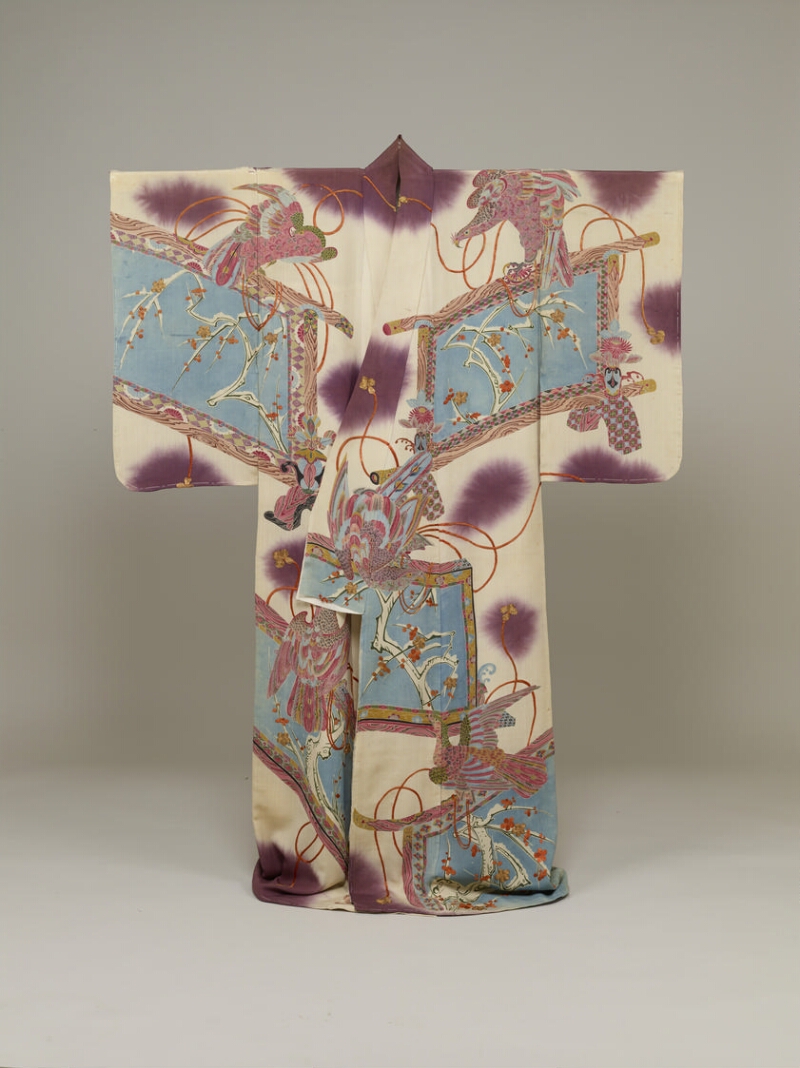
The Edo period (1603–1868) was the kosode’s great age. Two and a half centuries of peace made merchants rich, and many of them spent conspicuously on clothes. In the 1660s the so-called Kanbun style placed a single huge motif sweeping diagonally from one shoulder to the hem, leaving large areas of the ground empty. Publishers produced pattern books, hinagatabon, so customers could choose designs to order. The shogunate repeatedly issued sumptuary laws forbidding townspeople gold embroidery and all-over fine tie-dye, and fashionable merchants answered by putting their money where it was harder to police: in linings, in fine but understated fabrics, in details only another connoisseur would notice. That taste for restraint on the surface and luxury underneath became part of the Edo ideal of iki, chic. Around the Genroku era (1688–1704), the name of a Kyoto fan painter famous for his designs, Miyazaki Yūzensai, attached itself to a paste-resist dyeing technique, yūzen, that could put painterly, multicolored designs onto silk; the technique itself grew out of the work of many dyers in the later seventeenth century. (Yūzen and the other textile crafts have their own entries.)
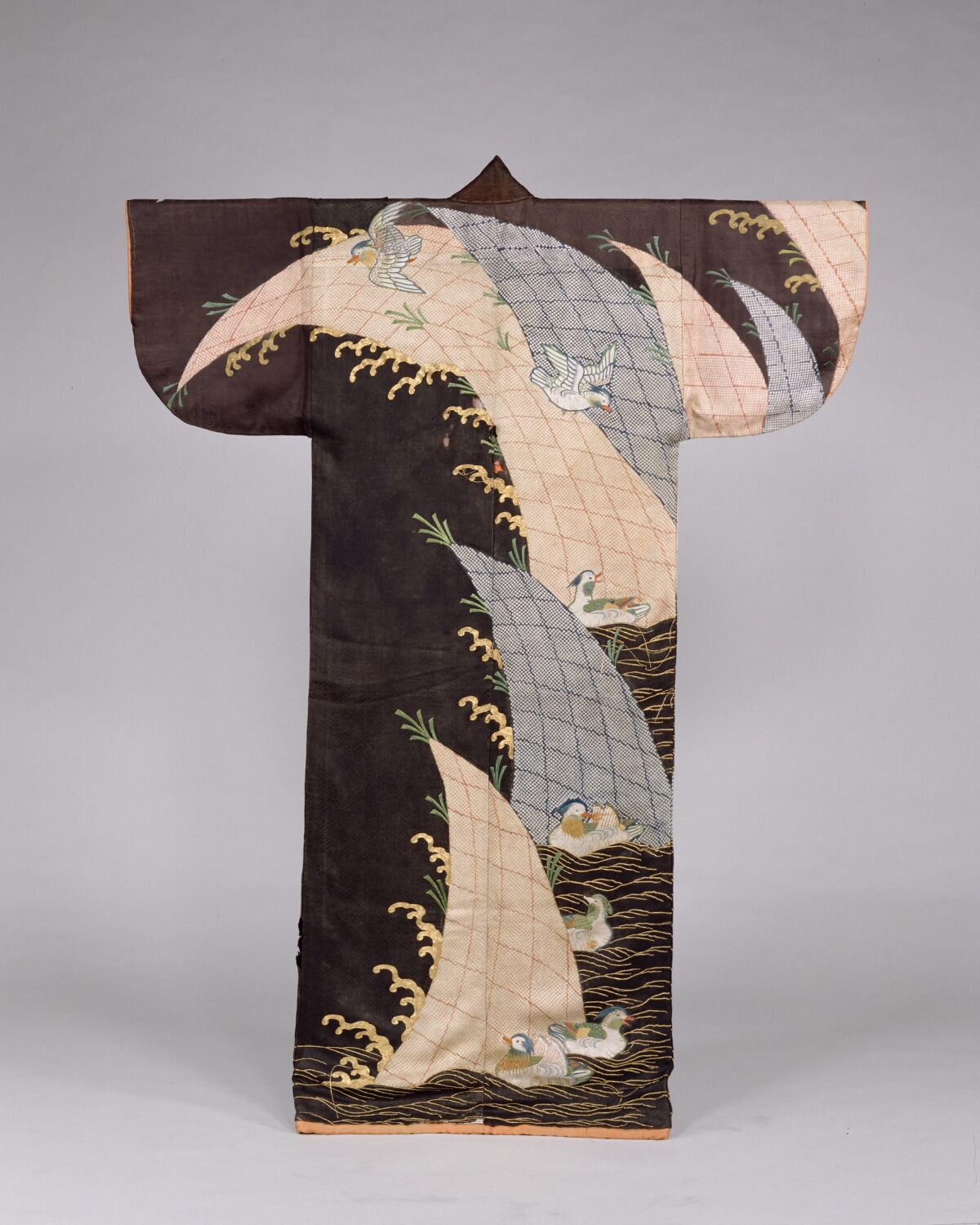
A 17th-century Kanbun-style kosode, seen from the back: a huge design sweeps diagonally from the shoulder to the hem, leaving wide areas plain.Tokyo National Museum, kosode with waves and mandarin ducks on black figured satin (17th century)
The sash changed at the same time. Early Edo obi were narrow cords and ribbons. From the later seventeenth century they grew wider and longer, and the knot migrated to the back. By the end of the period the visual weight of a woman’s outfit had moved from the robe itself to the broad band at her waist.
After the Meiji Restoration of 1868, officials, soldiers and students switched to Western clothes. Only once there was yōfuku, "Western clothing," did people need a word for what they had been wearing all along, and wafuku, "Japanese clothing," came into common use alongside kimono. Men often wore suits to work and changed into kimono at home; most women went on wearing kimono into the early Shōwa years of the late 1920s and 1930s. The decisive break came after the Second World War, when offices, trains and apartments were all organized around Western dress. Kimono faded from daily life over several decades; inexpensive wool kimono enjoyed a last burst of everyday popularity in the 1960s and early 1970s. As fewer people learned to wear kimono at home, dressing became a skill taught in kimono-dressing schools, kitsuke kyōshitsu. Those schools, along with a kimono trade eager to sell the right garment for every occasion, standardized a great deal, and many of the "rules" people now treat as timeless were codified in the postwar decades.
03Reading the Occasion: A Hierarchy of Kimono
Kimono have a ranking of formality, called kaku, comparable to the difference between white tie, a lounge suit and jeans. Three things set the rank: how the pattern is placed, how many family crests appear, and what kind of kimono it is.
At the top of women’s formal wear is the kurotomesode, the black tomesode. The ground is black, the upper body is plain, and all the decoration is concentrated below the waist. It always carries five white family crests. It is worn by married women, and the classic place to see it is a wedding: the mothers of the bride and groom, along with close female relatives, stand in the front row in black tomesode. The name comes from an Edo custom. When a young woman came of age or married, the long sleeves of her furisode were shortened and their swinging portion sewn to the body, "stopped." Tomesode means "stopped sleeves."
The irotomesode has the same layout on a colored ground, perhaps a pale pink, lavender or gray-green, and can be worn by unmarried women too. With five crests it is as formal as the black version; with three or one, it drops a step and suits formal parties and ceremonies.
The furisode, "swinging sleeves," is the most formal kimono for an unmarried woman, and the most spectacular. Its sleeves can reach well over a meter; those of the longest, the ōfurisode, measure around 110 centimeters and nearly brush the ankles. Patterns cover the whole garment in bright color, and the obi is tied into an elaborate sculpted bow at the back. For most Japanese the furisode means one day in particular: Coming of Age Day, held in January, when cities and towns invite their new adults to a ceremony and the streets fill with young women in furisode and fur stoles. Families often book a furisode a year or two ahead. Furisode also appear at university graduations, weddings and as the bride’s change of dress at the reception. A famous legend attaches to them. The Great Fire of Meireki in 1657, which destroyed much of Edo, is popularly called the "Furisode Fire," because, the story goes, it started when a temple tried to burn a cursed furisode and the wind carried the flames into the city. The story is legend; the fire was real and killed tens of thousands.
Below these come the semi-formal kimono. The hōmongi, literally "visiting wear," can be worn by married and unmarried women. Its design is laid out as a single picture that flows across seams from the hem up to the shoulder and over the sleeves. To achieve this, the white cloth is first basted into the shape of a kimono, the design is sketched on, and then it is taken apart to be dyed panel by panel, so that the image lines up when sewn back together. That technique is called eba. A hōmongi is what you would wear to a friend’s wedding, a formal tea gathering or a celebratory dinner. The tsukesage is a slightly simpler cousin, with motifs that all point upward but do not necessarily cross the seams. The iromuji is a kimono in one solid color; with a single crest it is acceptable at tea ceremonies and celebrations, and many women who study tea own one.
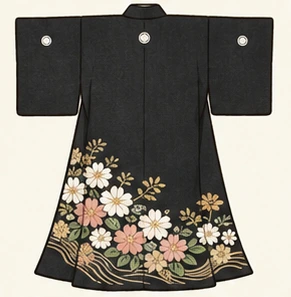
Kurotomesode: black ground, pattern only at the hem, crests on the back and sleeves.
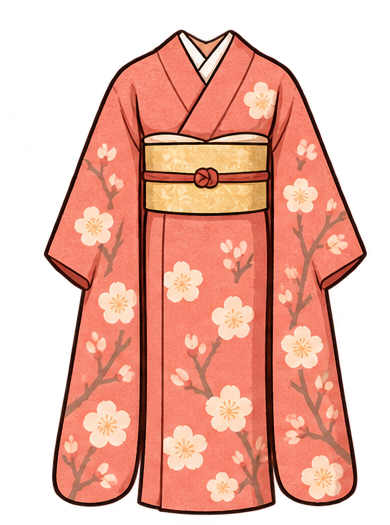
Furisode: long hanging sleeves, with bright pattern spread over the whole robe.
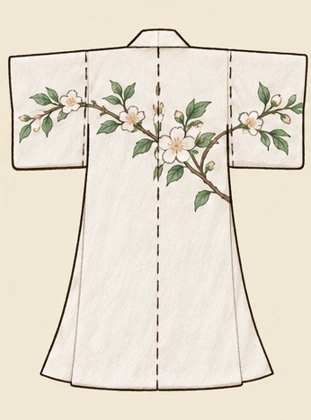
Eba on a hōmongi: the flowering branch runs across the seams from body to sleeve.
Then come everyday kimono. The komon, "small pattern," is covered in a repeating motif, like printed fabric, with no particular top or bottom. It is the kimono for shopping, the theater, or lunch with friends. Tsumugi is woven from hand-spun silk made from broken or waste cocoons, giving a sturdy fabric with a soft, slightly nubbly sheen. As of the 2020s, famous regional tsumugi such as Yūki and Ōshima often cost several hundred thousand yen for a single bolt of top grade, and the finest are said to reach a million yen or more, and yet by convention they remain casual wear and should not be worn to a wedding. Visitors find this confusing, but kimono formality depends on the kind of garment and its decoration, not on its price.
Mourning dress, mofuku, is plain black with five crests, worn with a black obi and black accessories, mainly by close family of the deceased.
Men’s kimono have far fewer categories. The most formal outfit is the montsuki haori hakama: a black habutae silk kimono and black haori jacket, each with five crests, worn with striped hakama trousers, white haori ties and white tabi socks. A groom at a Shinto wedding wears exactly this. Below that comes a colored kimono with fewer crests and hakama, and below that kinagashi, a kimono and sash without hakama, which is how men wear kimono casually. Men’s colors are restrained: navy, gray, brown, black. The fun is in the fabric and the linings.
04Dressing for the Season
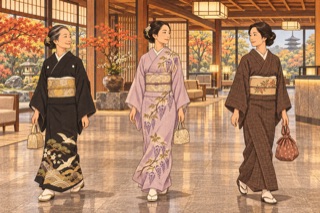
A kimono also has to suit the month, and the basic division is whether it is lined.
From October through May, the standard is awase, a lined kimono, two layers of cloth that hang heavily and keep the wearer warm. In June and September one wears hitoe, unlined kimono. In the hottest months, July and August, one wears usumono, "thin things," made of gauze weaves such as ro and sha, so sheer that the color of the underkimono shows faintly through. The seasonal change of clothes is called koromogae. In the Edo period it fell on the first day of the fourth month and the first of the tenth by the old lunar calendar; today the customary dates are June 1 and October 1, and Japanese schools and many workplaces still switch their uniforms on those days.
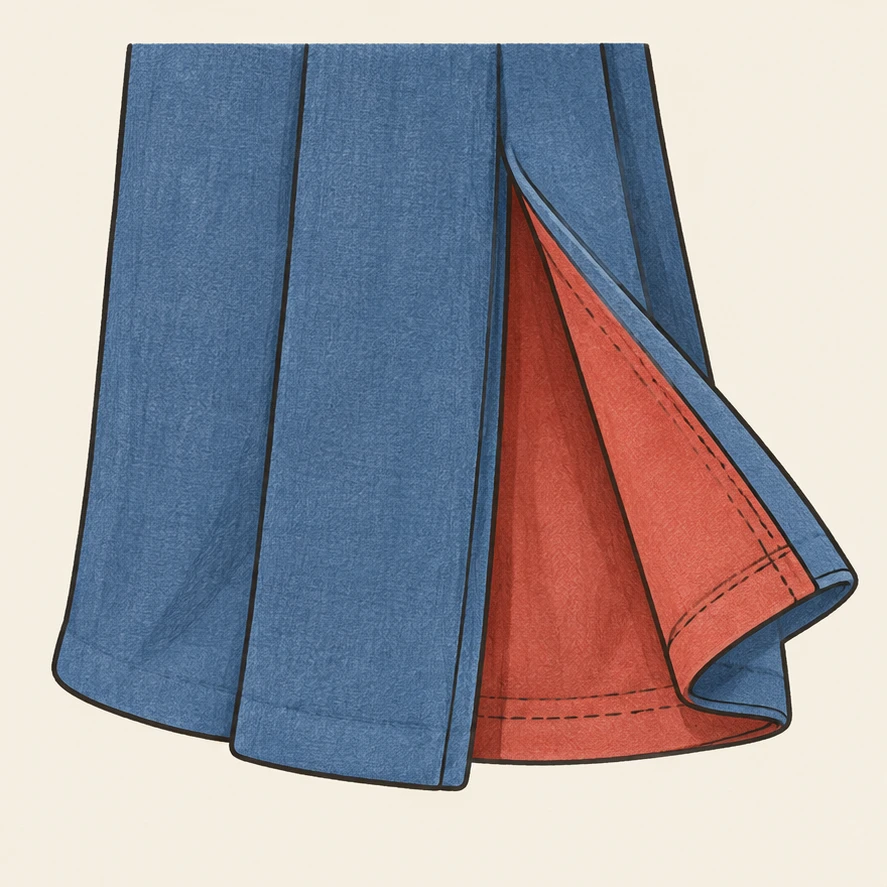
Awase: turn back the hem and a lining shows inside the outer cloth.
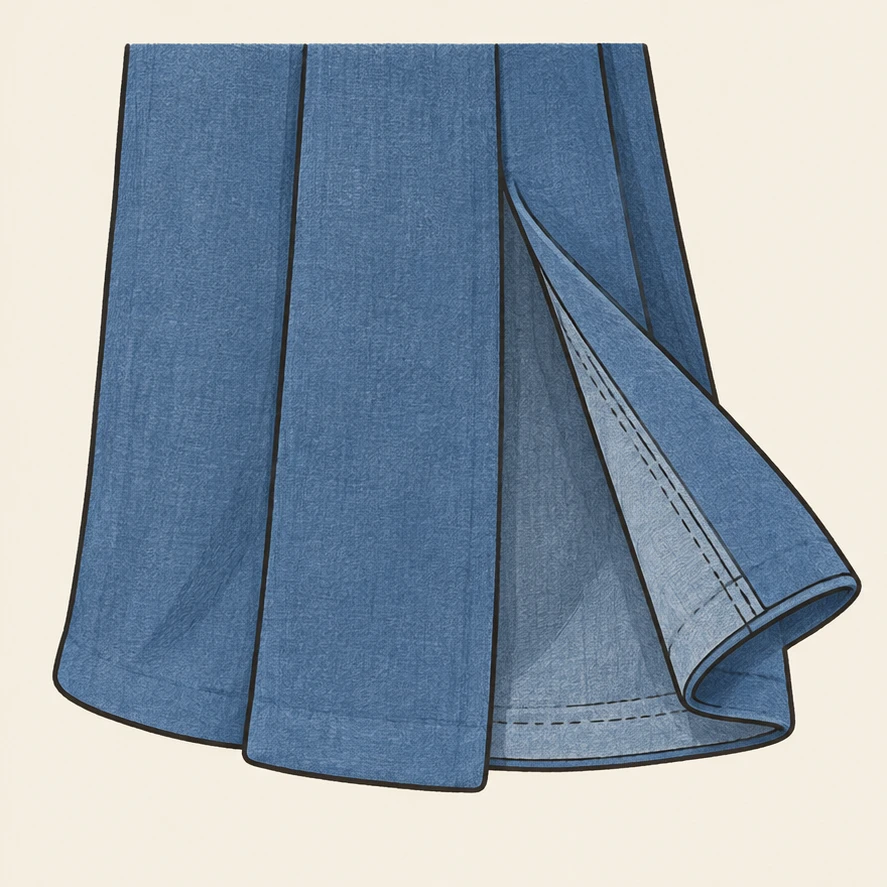
Hitoe: a single layer; turned back, it shows only the reverse of the same cloth.
Patterns follow the seasons too. Cherry blossoms in spring and maple leaves in autumn are obvious; the refined approach is to wear a motif slightly ahead of its season and put it away once the real blossoms are out, since there is no point competing with the trees. In summer people wear motifs that look cool, such as flowing water, dragonflies and autumn grasses. Obi, collars and the small accessories change texture with the season as well. With Japanese summers growing hotter, many people now wear unlined kimono from May and well into late September, and outside the tea world the calendar has loosened.
Summer is also the season of the yukata, which began as the hemp yukatabira worn in the bath by Heian aristocrats and, once cotton and public bathhouses spread in the Edo period, became a cotton robe for after the bath and for summer. It is cotton or linen, worn without an underkimono, tied with a narrow obi and worn with bare feet in wooden geta. It belongs to fireworks, summer festivals and hot-spring inns. See also: Yukata and Jinbei: Japan’s Summer Cotton, from Bathhouse to Fireworks.
05The Obi and Its Accessories
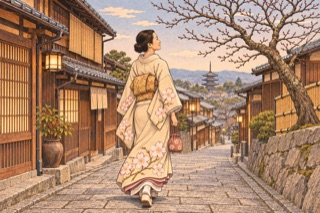
Since the kimono itself is a straight column, the obi gives an outfit its silhouette. From behind, half of what you see is the knot.
The fukuro obi is the most widely worn formal women’s obi today, second in rank only to the maru obi, which is now rarely worn. It is about 30 centimeters wide and a little over four meters long. The name, "bag obi," comes from its original construction as a tube woven double; today most are two separately woven layers sewn together. After the war it displaced the heavier maru obi as the standard formal sash. Woven with gold and silver thread, it is worn with tomesode, furisode and hōmongi, usually tied in the nijū daiko, the "double drum," a padded rectangular box at the back made from two thicknesses of obi. With a furisode, it is tied into showier bows with names like tateya, "standing arrow."
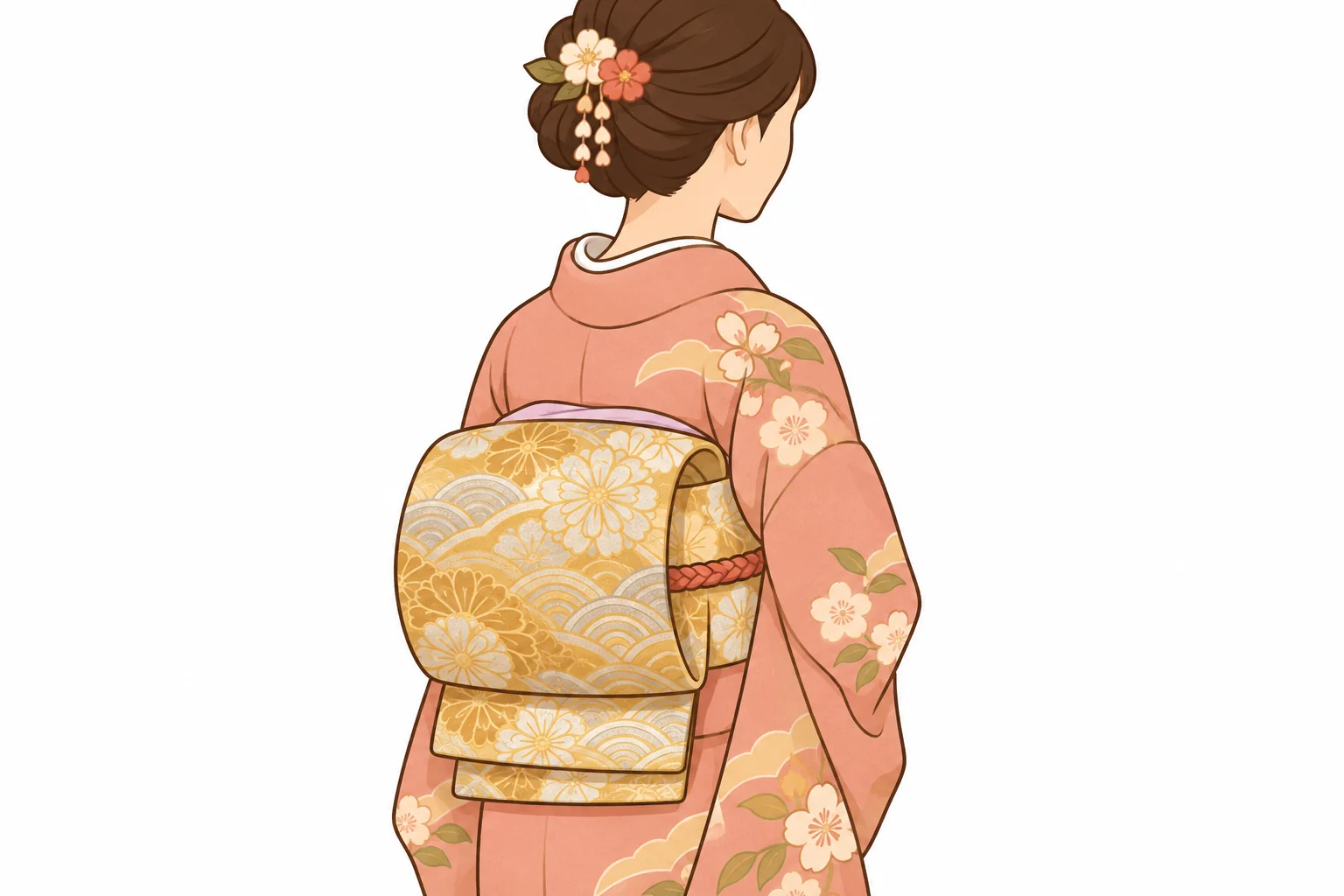
A woman in hōmongi from behind, her fukuro obi tied in a double taiko knot with obijime and obiage visible (illustration).
The Nagoya obi is shorter, around 3.6 to 3.7 meters, and can only be tied into a single drum. Its section that wraps around the body is folded in half lengthwise and sewn, making it much quicker to tie. It is generally credited to Koshihara Haruko, founder of a girls’ school in Nagoya, in the Taishō period (1912–1926), and a Nagoya kimono shop brought it to market. It goes with komon, tsumugi and tsukesage, and it is the workhorse obi of everyday kimono today.
The hanhaba obi, "half-width obi," is about 15 centimeters wide, light and easy to tie in many ways. It is the obi for yukata, usually tied in the bow-like bunko knot, and it is also popular with casual komon. Men’s obi are a separate family: the stiff kaku obi, about ten centimeters wide, tied in a flat kai no kuchi knot at the back for most occasions, and the soft, scarf-like heko obi for home and yukata.
An obi knot needs help to stay up. The obijime is a braided silk cord that passes through the knot and ties at the front, holding the drum in place and drawing a line of contrasting color across the waist. The obiage is a silk scarf that wraps the pad supporting the drum and peeks out along the top edge of the obi. Choosing these is where much of the pleasure of dressing lies: change the obijime on a plain kimono and the whole outfit changes mood. The obidome is a decorative clasp threaded onto the obijime, something like a brooch, made of coral, carved metal, cloisonné or lacquer. A common account holds that after the sword ban of 1876, metalworkers who had made sword fittings turned to obidome, and the small objects flourished.
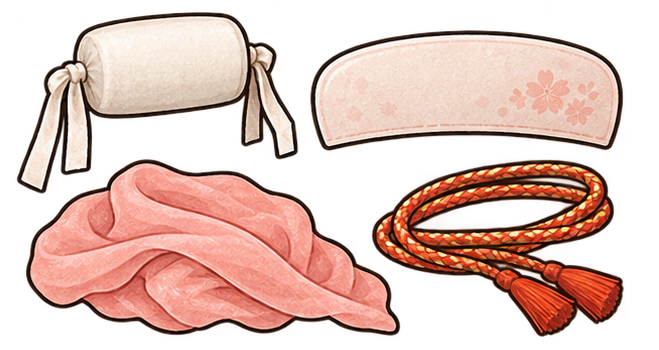
Top left: the obimakura pad that props up the knot. Top right: the obi-ita board that keeps the front flat. Bottom left: the obiage cloth that wraps the pad and shows along the obi’s upper edge. Bottom right: the obijime cord that passes through the knot and ties in front.
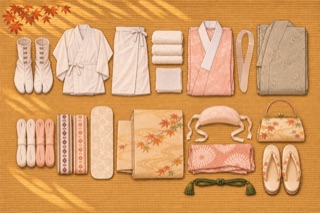
Beneath all this is a world of things no one sees: a cotton undershirt, the full-length nagajuban underkimono whose white han’eri collar shows at the neck, several waist ties, a stiff datejime band to flatten the front, and an obi-ita board slipped into the obi to keep it smooth. A woman’s formal outfit can involve a dozen or more items, which is why many people pay a professional dresser.
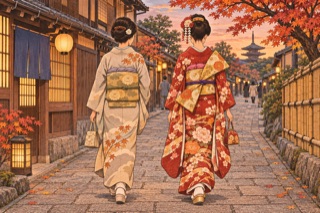
06Haori, Hakama and Happi: Layers on Top
Three garments are worn over the kimono.
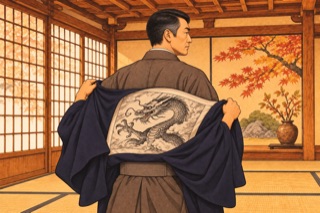
The haori is a jacket that reaches the hip or knee. Its front panels do not overlap; they hang open and are joined by a pair of cords, the haori-himo. It began as a samurai garment, spread to townsmen in the Edo period and became part of men’s formal dress. In Edo, the geisha of the Fukagawa district were known for wearing haori, then a man’s garment, and were nicknamed haori geisha; haori for women became general only later. The lining, haura, is where Edo men showed off: plain black outside, and inside a hand-painted dragon or landscape, glimpsed only when the jacket came off.
Hakama are wide pleated trousers or skirts worn over the kimono, with deep pleats in front and a stiff board at the back of the waist. The divided type, umanori bakama, "riding hakama," was designed for horseback; the undivided andon bakama, named after a cylindrical paper lantern, is closer to a skirt. Men wear hakama at weddings, Coming of Age Day and formal ceremonies, and practitioners of kendo, kyudo and aikido train in them. Women’s hakama were a Meiji innovation. When girls’ schools opened, long kimono sleeves and a tight wrap were impractical for classes and exercise, so schoolgirls began wearing hakama over a kimono, often with laced leather boots. The look became the emblem of the late Meiji and Taishō schoolgirl, and from the 1980s it revived to become the standard outfit for Japanese women at university graduation: a kimono with moderately long sleeves, a dark hakama and often boots. Walk past a campus in late March and you will see hundreds of them.
The hanten is a short working jacket, shorter than a haori, without ties and with narrow sleeves, the uniform of Edo craftsmen, shop hands and the town firefighters. A shirushi-banten has a shop name or guild emblem dyed large across the back, so anyone could tell at a glance whom the wearer worked for. The matching jackets worn by people carrying portable shrines at a festival belong to this family and are usually called happi today; the words are used loosely. A quilted hanten is also a cozy winter jacket worn at home.
07From Feet to Hair: Tabi, Zōri, Geta and Kanzashi
With kimono you wear tabi, cloth socks with the big toe separated from the others, fastened at the back of the ankle with small metal hooks called kohaze. White tabi go with all formal wear; colored and patterned ones are for casual outfits. They should fit snugly, because wrinkles at the ankle are surprisingly conspicuous.
Footwear comes in two kinds. Zōri are flat thonged sandals faced with fabric or leather, worn with kimono; the more formal the occasion, the higher the heel, and for formal wear they may come in a matching set with a handbag. Geta have a wooden base, usually raised on two wooden teeth, and clack on the pavement. They go with yukata and casual kimono and are not worn with formal dress. Both are held by a thong between the big toe and second toe, and the correct way to wear them is with the heel slightly overhanging the back, not with the whole foot planted like a flip-flop.
Hair ornaments are collectively kanzashi. Edo-period women wore elaborate nihongami hairstyles such as the shimada, held and decorated with combs, a long bar called a kōgai, and hairpins of many kinds: flat silver pins, pins topped with a single bead, dangling bira-bira ornaments, and tsumami kanzashi, flowers built up from tiny folded squares of silk. A woman in kimono today usually puts her hair up and adds a single pin. The most complete living tradition belongs to the maiko, the apprentice geisha of Kyoto, whose flower kanzashi change every month: a combination of auspicious motifs such as pine, bamboo, plum and winter chrysanthemum in January, plum in February, rape blossom or narcissus in March, cherry in April, wisteria or iris in May, willow in June, paper fans in July, pampas grass in August, bellflower in September, chrysanthemum in October, maple leaves in November, and in December the maneki, small plaques bearing the names of kabuki actors. Accounts differ on which flower belongs to March and May. You can tell the month from a maiko’s hair.
08Family Crests
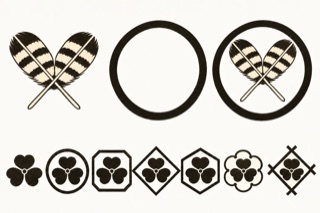
The small white circles on a formal kimono are kamon, family crests. They are hereditary like European heraldry but far more austere: typically a plant, object or geometric figure inside a circle, such as a bellflower, wisteria, oak leaves, paulownia or crossed hawk feathers. There are thousands of designs and many more variants.
Crests began as identifying marks used by aristocrats on oxcarts and by samurai on banners and curtains. In the Edo period they spread to townspeople and farmers until nearly every family had one, used on kimono, lanterns and gravestones. On a kimono, the number of crests sets the formality. Five is the most formal: one at the center of the back below the collar, one on the back of each sleeve, and one on each side of the chest. Three crests means the back and the two sleeves; one crest, the back alone. The technique matters as well. A crest dyed by reserving the white shape, somenuki, is the most formal; an embroidered outline crest, nuimon, is more casual.
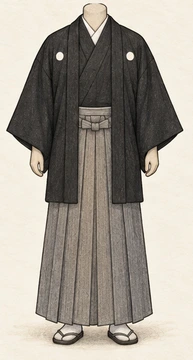
Front: one crest on each side of the chest (shown on a man’s crested haori and hakama).
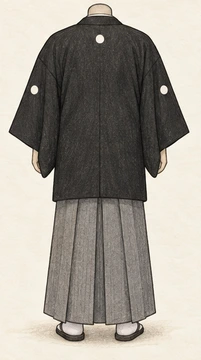
Back: one crest at the center of the back and one on the back of each sleeve.
Many Japanese no longer know their family crest offhand and have to check a gravestone or ask a grandparent. Rental shops and makers of off-the-peg formal wear use a neutral "general-purpose" crest such as the gosan no kiri, a paulownia design that offends no one. In parts of western Japan there is a custom of onna mon, women’s crests passed from mother to daughter, so a bride may take her mother’s line crest rather than her husband’s family crest into marriage.
09Who Wears Kimono Now
For most Japanese, kimono marks the milestones. A newborn is carried to the local shrine wrapped in a bright festive robe; children of three, five and seven (traditionally by the old count, in which a baby is one at birth, though many families now use actual age) dress up for Shichi-Go-San in November; young people wear furisode or crested hakama at around twenty; women wear hakama at university graduation; a bride wears pure white shiromuku or a colorful irouchikake at a Shinto wedding while her mother wears black tomesode; and at the end, the family wears mourning kimono at a funeral. In between, most people never touch one.
The industry has shrunk accordingly. Kimono retail sales peaked around 1980 at a figure usually given as about 1.8 trillion yen a year and have fallen for decades since; by 2019 the market was estimated at about 260 billion yen. As of the 2020s, a new hand-painted yūzen hōmongi can cost hundreds of thousands of yen or more, while countless households keep chests of a grandmother’s kimono that nobody wears and nobody wants to throw away.
Some people still wear kimono constantly. By long-standing custom in the sumo world, wrestlers wear kimono or yukata in public (some press reports describe it as a Japan Sumo Association requirement), which is why the very large men around Ryōgoku Station are usually in cotton robes and geta or setta sandals. Rakugo storytellers perform in kimono, and for kabuki actors, noh performers and teachers of classical dance and shamisen, kimono is work clothing. The geiko (as geisha are called in Kyoto) and maiko of Kyoto’s five geisha districts, Gion Kōbu, Miyagawachō, Pontochō, Kamishichiken and Gion Higashi, wear it every working day, as do the proprietresses, okami, of traditional inns and many teachers of tea ceremony and flower arranging.
Over the last couple of decades another group has appeared: younger people who treat kimono as ordinary clothes. They buy a secondhand komon for a few thousand yen, pair it with a lace collar, boots or a beret, and ignore the old rules. Secondhand kimono shops are common in Tokyo and Kyoto, and at Kyoto’s monthly markets, Kōbō-san at Tō-ji on the 21st and Tenjin-san at Kitano Tenmangū on the 25th, heaps of old kimono and obi are sold off tables and tarps for very little. Some Kyoto temples and shops give discounts to visitors in kimono, and during events such as the city’s Day of Traditional Industries, Kyoto has in the past let people in kimono ride its city buses and subway free.
10Wearing One Yourself
Kimono rental shops cluster wherever visitors walk: around Gion and Kiyomizu-dera in Kyoto, in Asakusa in Tokyo, in Kanazawa’s Higashi Chaya district. You choose a kimono from a rack of dozens, then an obi and accessories, and a staff member dresses you; for women it takes around half an hour, and men are done much faster. In summer most shops switch to yukata.
One rule matters above all: the left side goes over the right. Looking down at yourself, the right-hand panel is wrapped across your body first, and the left-hand panel goes over it, so the outer edge of the collar runs from the left side of your neck down toward your right hip. A simple check is that you could slip your right hand into the front of the kimono. The reverse, right over left, is how the dead are dressed for burial and looks deeply wrong to Japanese eyes. The rule is the same for men and women and for yukata, and it goes back at least to 719, when, according to the court chronicle Shoku Nihongi, the government ordered the whole population to wrap their robes right-side first. Rental staff will get it right, but if you put on a yukata at a hot-spring inn yourself, remember it.
Wearing kimono changes how you move. Take small steps with your knees and toes turned slightly in; long strides pull the front open. On stairs, lift the front of the skirt a little with one hand. Before sitting, smooth the kimono under you, sit upright and keep away from the chair back so you do not crush the obi knot. Mind the sleeves: when you reach for something, hold the sleeve with your other hand or it will trail through your food. The toilet is the hardest part, since you need to tuck or tie up the sleeves and then lift several layers of skirt, and many people simply drink less. If rain is forecast, consider another day; rental kimono are often polyester, but zōri in puddles are miserable.
Finally, a matter of courtesy. On the streets of Gion, a real geiko or maiko is usually on her way to an appointment. She is at work; do not block her path for a photo or touch her sleeves. Gion has posted notices banning photography on its private lanes. Locals generally enjoy seeing visitors in rented kimono, but avoid dressing up to pass as a maiko, which is a profession with strict rules of its own. Then walk up from Yasaka Shrine by the stone steps of Sannenzaka toward Kiyomizu-dera, in small steps, and stop for a bowl of matcha somewhere with a garden.