
Stand on a street corner in Kyoto’s Gion and watch two women in kimono walk away from you. One carries a flat, squarish box on her back, a neat panel of brocade with a short tail hanging beneath it. The other has two broad wings of fabric angled across her shoulder blades, like the fletching of an arrow. Without seeing either face, someone who knows kimono could tell you that the first is a grown woman heading to a tea gathering or a wedding, and the second is probably twenty and on her way to her coming-of-age photographs. The knot at the back of the obi, the long sash that holds a kimono closed, is one of the most legible things in Japanese dress. It announces age, occasion and mood, and it has a history full of fashion crazes, geisha, samurai households and stage actors. This piece is not a tying tutorial. It is a field guide to what the main knots look like, which obi can make them, what they are worn with, and where they came from.
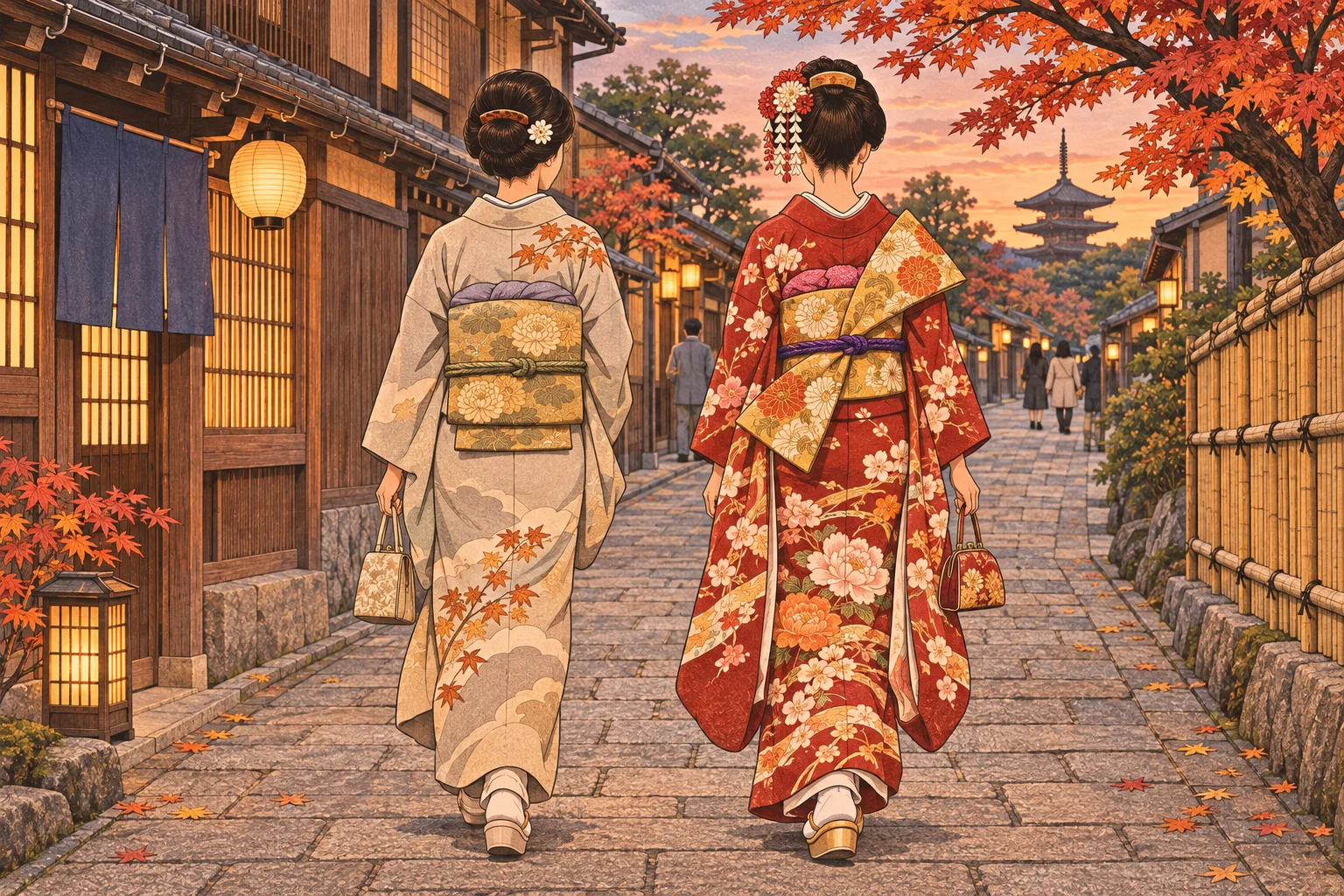
Two women seen from behind. Left: a hōmongi with the square box of a drum knot. Right: a furisode with the diagonal loops of a tateya.
01How the Knot Moved Round to the Back
The idea that a kimono knot belongs at the back is younger than most visitors assume. The kosode, the small-sleeved robe that became the kimono, was tied in the fifteenth and sixteenth centuries with a narrow sash, sometimes not much more than a braided cord. Women knotted it at the front or at the hip, much as you would tie a bathrobe. Screen paintings of late sixteenth-century streets show townswomen with a slim band at the waist and a small bow whose ends dangle loosely.
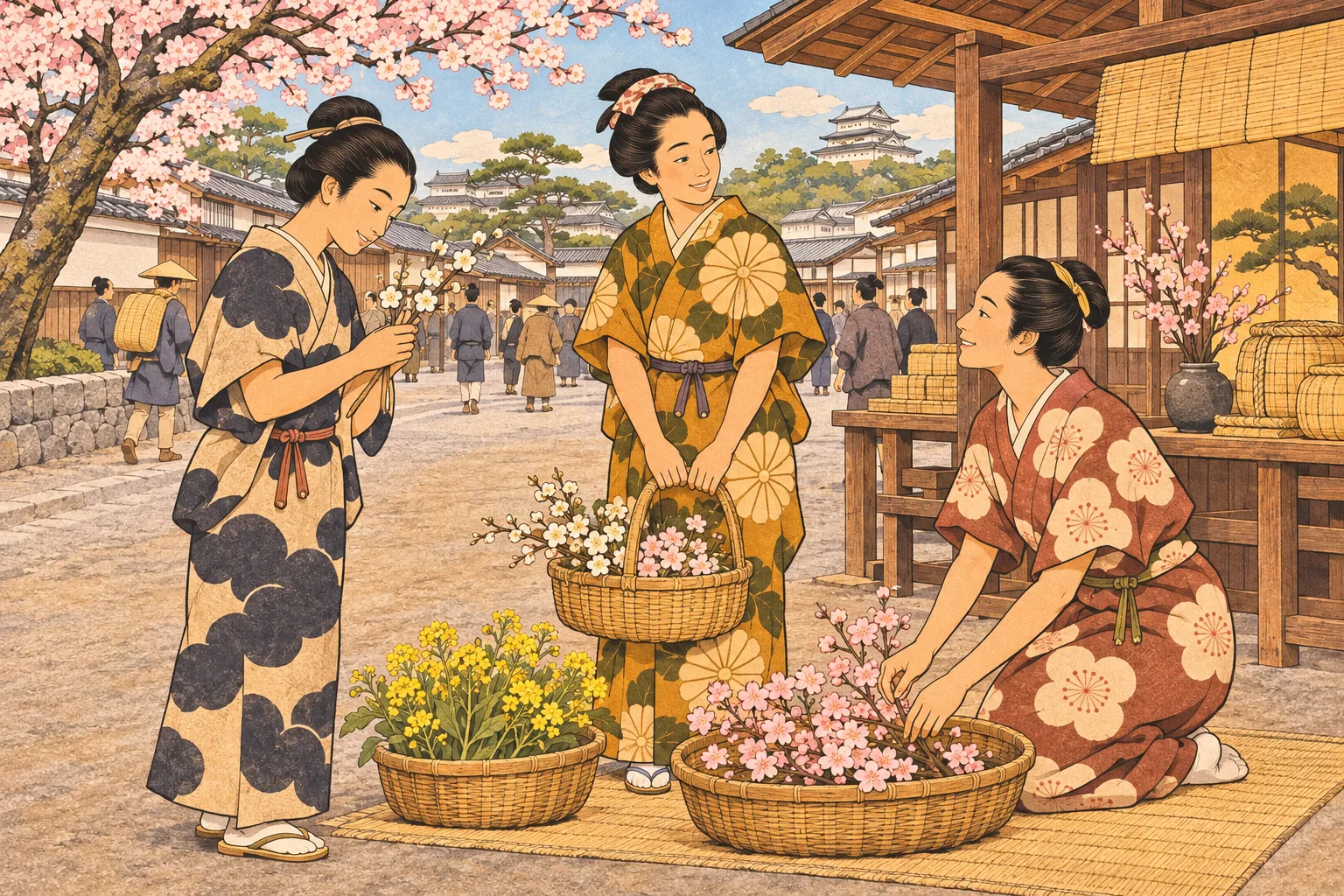
A street in the kosode era: the sash is a narrow band, knotted at the front with its ends hanging loose (artist’s impression)
During the seventeenth century the sash grew. Sleeves were lengthening, kimono designs were becoming bold single pictures spread across the whole robe, and a wider band was needed to frame the composition. Taste in the big cities also pushed things along. In the Genroku era, around 1700, merchant families in Kyoto, Osaka and Edo (now Tokyo) had money to spend, and fashions spread from the kabuki stage. A knot worn by a popular onnagata, a male actor of female roles, could be copied in town within days. One famous example is the Kichiya knot, said to have been started by Uemura Kichiya I, an onnagata who was a star in the 1670s, in which the two ends hung down with lead weights sewn in so that they swung in a pleasing line; by the Genroku years it had spread to townswomen. Between the early seventeenth century and about 1700 the obi widened from roughly 6 centimetres to nearly 30, and lengthened to three or four metres.
A big bundle of fabric at the front is awkward for work, bowing and sitting, so the knot migrated to the side and then to the back. This happened gradually. In the later seventeenth century front, side and back knots coexisted, and a loose code grew up: a back knot marked a girl not yet of age, a front or side knot a married woman. It was a tendency rather than a fixed law, and practice varied by place and decade. By the late Edo period, in the early nineteenth century, ordinary women had largely settled on the back.
The front knot survived in one memorable place: the pleasure quarters. High-ranking courtesans in Yoshiwara wore a huge, showy knot hanging in front, the mae-obi, and it became their visual signature on stage and in later films. In some regions widows also tied a front knot for a period after a husband’s death. Partly because of the courtesan association, respectable women after the Meiji period (1868–1912) tied at the back without exception. Even today, a large decorative bow at the front reads as a costume, usually an oiran (courtesan) parade.
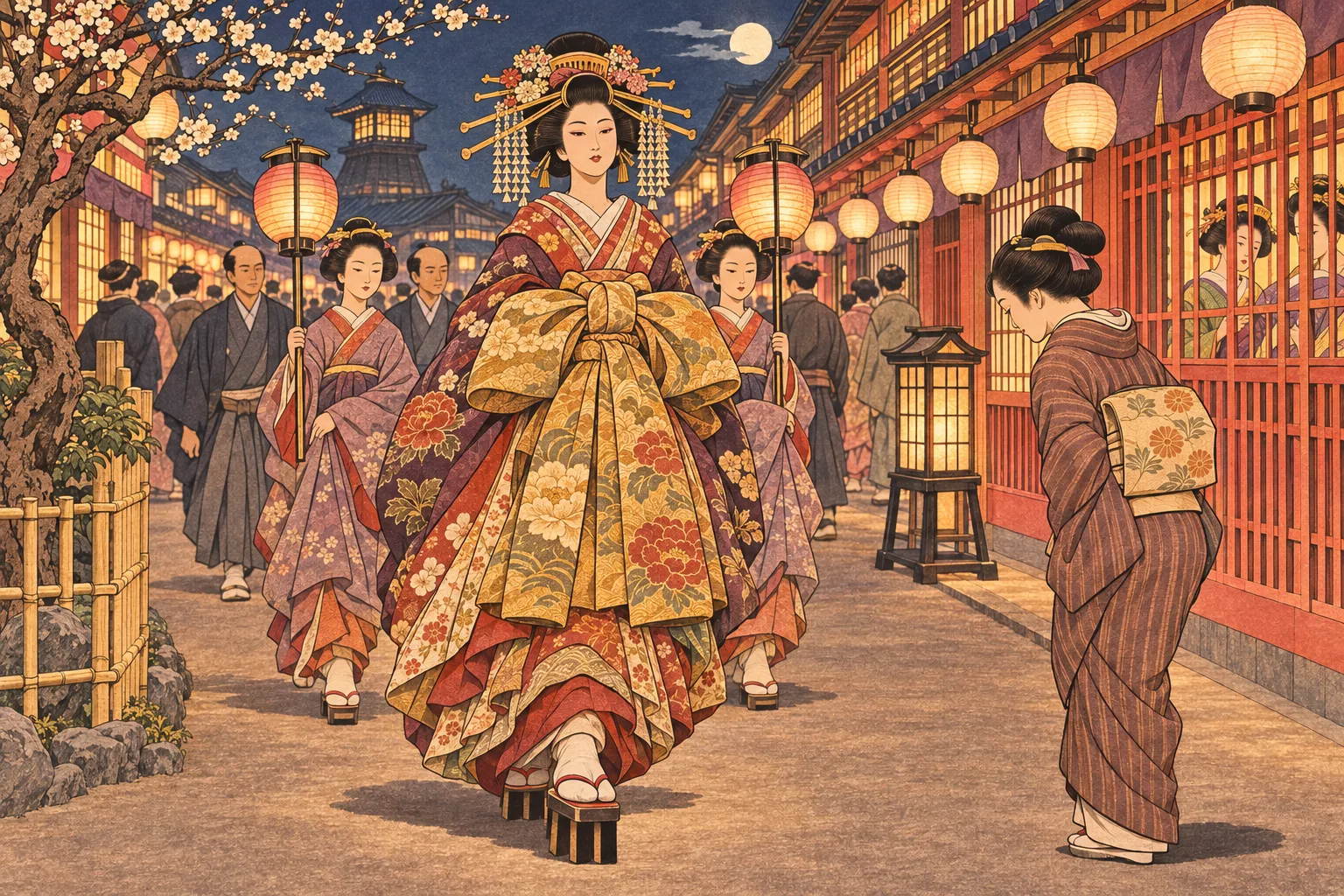
An oiran procession: the courtesan’s huge mae-obi hangs in front, while the townswoman stepping aside on the right wears her knot at the back (artist’s impression)
Men’s obi never went through this inflation. They stayed narrow, the knot stayed small and sat at the back slightly off-centre, and it has changed little since Edo. Most of the elaborate knots below are women’s.
02Seven Kinds of Obi, and What Each Can Do
The fabric decides the knot. A stiff, heavy brocade and a soft, unlined cotton scarf will not make the same shapes.
The maru obi is the highest-ranking and most formal women’s sash: woven at twice the finished width, then folded and sewn, about 30-odd centimetres wide, patterned on both sides and very heavy. It was the formal obi of brides and wealthy women in the Meiji and Taishō eras. Today it is rarely worn, and you see it mostly in bridal outfits and on maiko, the apprentice geisha of Kyoto, whose dangling darari obi is a maru obi.
The fukuro obi is the lighter successor, first made in the Taishō era, woven with a pattern on the front face only and a little over four metres long. After the war it displaced the maru obi; it ranks just below it but is in practice the workhorse of formal dress, worn with married women’s tomesode, with furisode (the long-sleeved kimono of young unmarried women) and with hōmongi visiting kimono. It is long enough to form two layers, so the double drum and the big furisode knots require it.
The Nagoya obi was invented in Nagoya in the Taishō era (1912–1926). One end is pre-folded and stitched narrow, and at 3.6 to 3.7 metres it is half a metre or more shorter than a fukuro obi. It makes a single drum and the tsunodashi knot, and it is the usual partner for everyday and semi-formal kimono such as komon (small all-over patterns) and tsumugi (pongee silk).
The fukuro Nagoya obi, also called the hassun Nagoya obi, is a postwar type made of a stiffer, thicker weave with no interlining; only the edges of the drum section are overcast. It serves the same purposes as the Nagoya obi, a little more casual and crisp.
The hanhaba obi is half width, around 15 centimetres. It is the obi of yukata, the cotton summer kimono, and of everyday wear. It needs no padding and makes flat knots such as the bunko bow, the kai-no-kuchi and the katabasami.
The kaku obi is the standard men’s obi, about 9 to 10 centimetres wide and stiff, often Hakata weave from Fukuoka. Men tie the kai-no-kuchi, rōnin and katabasami with it.
The heko obi is a length of soft, unlined cloth that can be scrunched and knotted freely. Originally for men and children at home, it is now everywhere on summer yukata for women and kids.
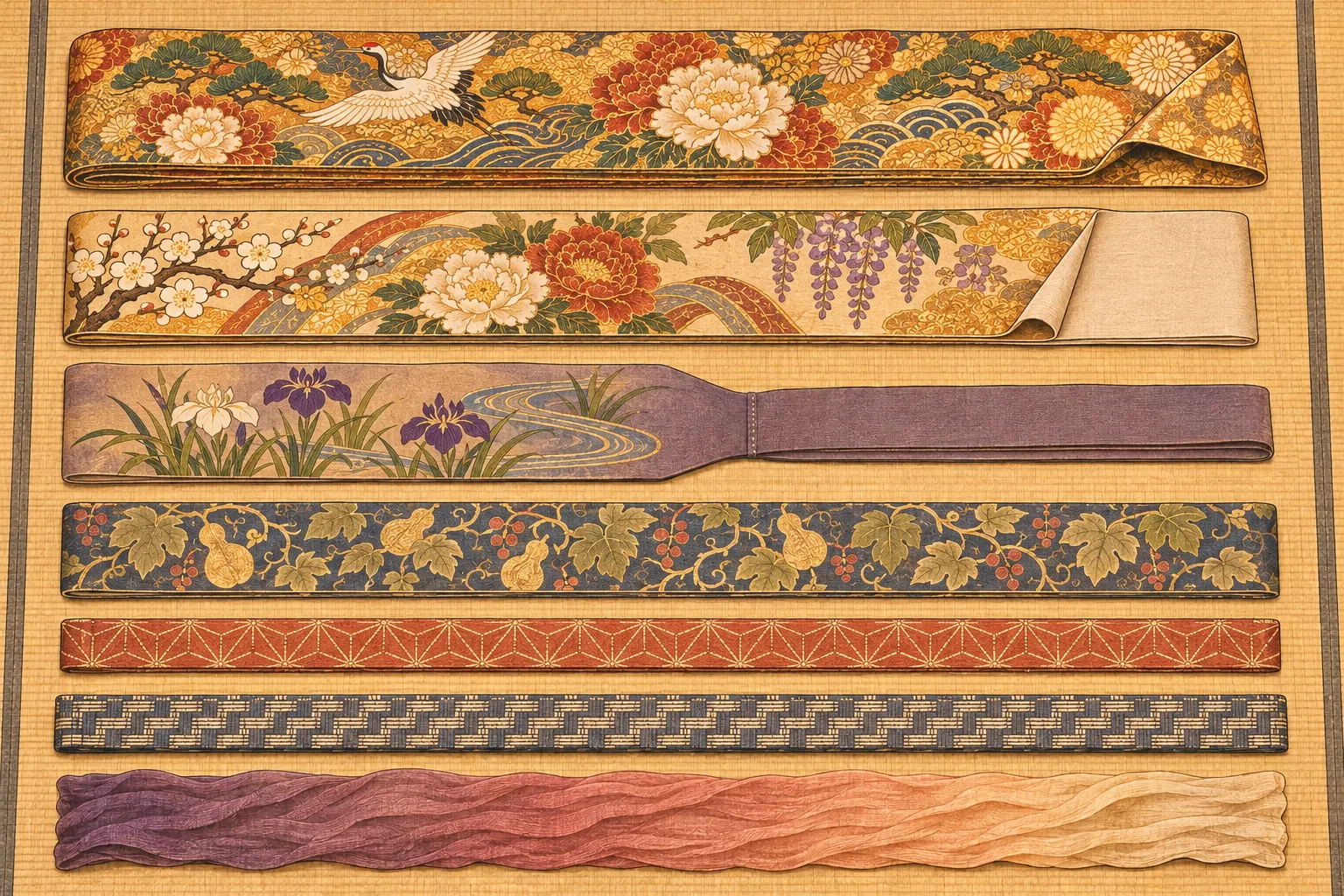
Seven obi, from top to bottom: maru obi; fukuro obi, its plain reverse showing at the turned corner; Nagoya obi, one end sewn narrow; fukuro Nagoya obi; hanhaba obi; kaku obi; heko obi.
03The Taiko: the Standard Silhouette
If you remember only one knot, make it the taiko musubi, the drum knot. It is the square, slightly puffed box on the back of almost every adult woman at a tea ceremony, wedding or theatre in Japan. It is about 30 centimetres wide and 25 tall, its top edge a clean fold given a gentle curve by a hidden pad. Below the box hangs a short tail, the tare, about the length of an index finger. At each side, a tiny bit of the obi’s other end, the te-saki, peeks out by a centimetre or two. In profile it does resemble the side of a drum.
The best-known origin story involves a bridge. According to tradition, in 1813 the arched taikobashi, or "drum bridge", at Kameido Tenjin shrine in Edo was rebuilt, and geisha of the nearby Fukagawa district celebrated by tying their obi in the shape of the bridge (some versions put the date at 1817). The bridge still stands over the shrine pond and is crowded in wisteria season. The story is charming, but it is a later telling, and its date and protagonists cannot be confirmed. What can be said more safely is that the drum knot spread in the late Edo period from the geisha quarters of Fukagawa and Yanagibashi to townswomen. Fukagawa geisha were known for brisk, unfussy style, and the taiko uses less fabric and has cleaner lines than the layered knots before it.
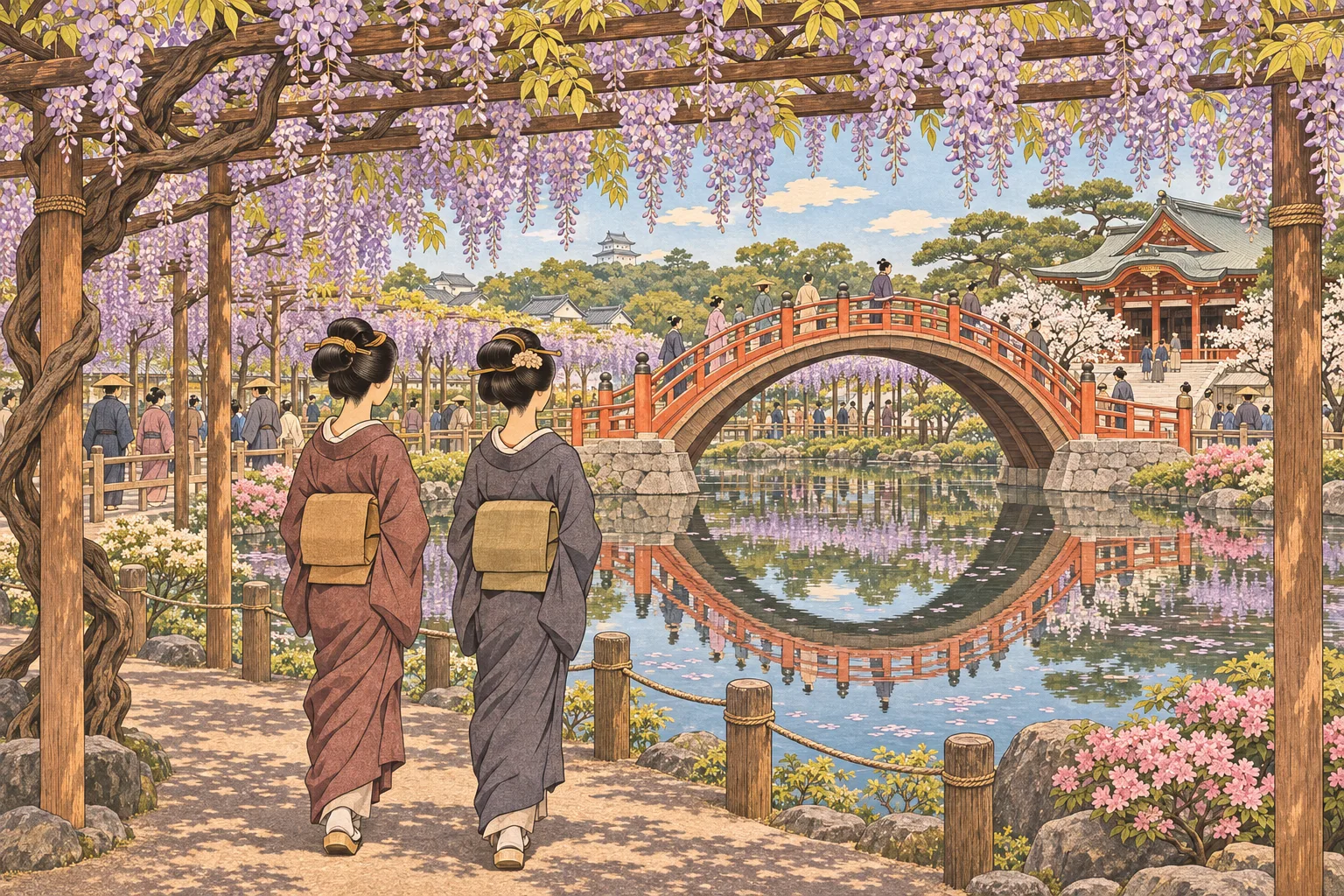
The drum bridge at Kameido Tenjin in wisteria season. Tradition says Fukagawa geisha tied their obi in the shape of the bridge, giving the drum knot its name (artist’s impression)
The taiko became the default for all adult women after the Meiji period. It was flat enough to survive rickshaws and train seats, quicker than the elaborate Edo bows, and fitted neatly with a system of accessories that fixed the rules of formal dress. By the Shōwa era it was simply what a grown woman wore.
There are two versions. The ichijū daiko, single drum, has one layer of fabric forming the box, so its lower edge shows a single line. It is tied with Nagoya obi and goes with everyday and semi-formal kimono. It is also the knot of mourning: with black funeral kimono, a black Nagoya obi is tied as a single drum, interpreted as wishing that misfortune not be doubled. This is a later symbolic reading, but it is widely observed, and a double drum at a funeral would look wrong.
The nijū daiko, double drum, is tied with a fukuro obi, and its box has two layers of fabric. Look closely at the lower edge and you can see two slightly offset lines; the whole knot is thicker. It is the standard for formal wear: black and coloured tomesode, hōmongi, weddings, parties, school ceremonies, the New Year’s first tea. "Double" is read as "joy upon joy." In Japanese wedding photos, the mothers of the couple in black tomesode almost always wear a gold-and-silver brocade fukuro obi in a double drum.
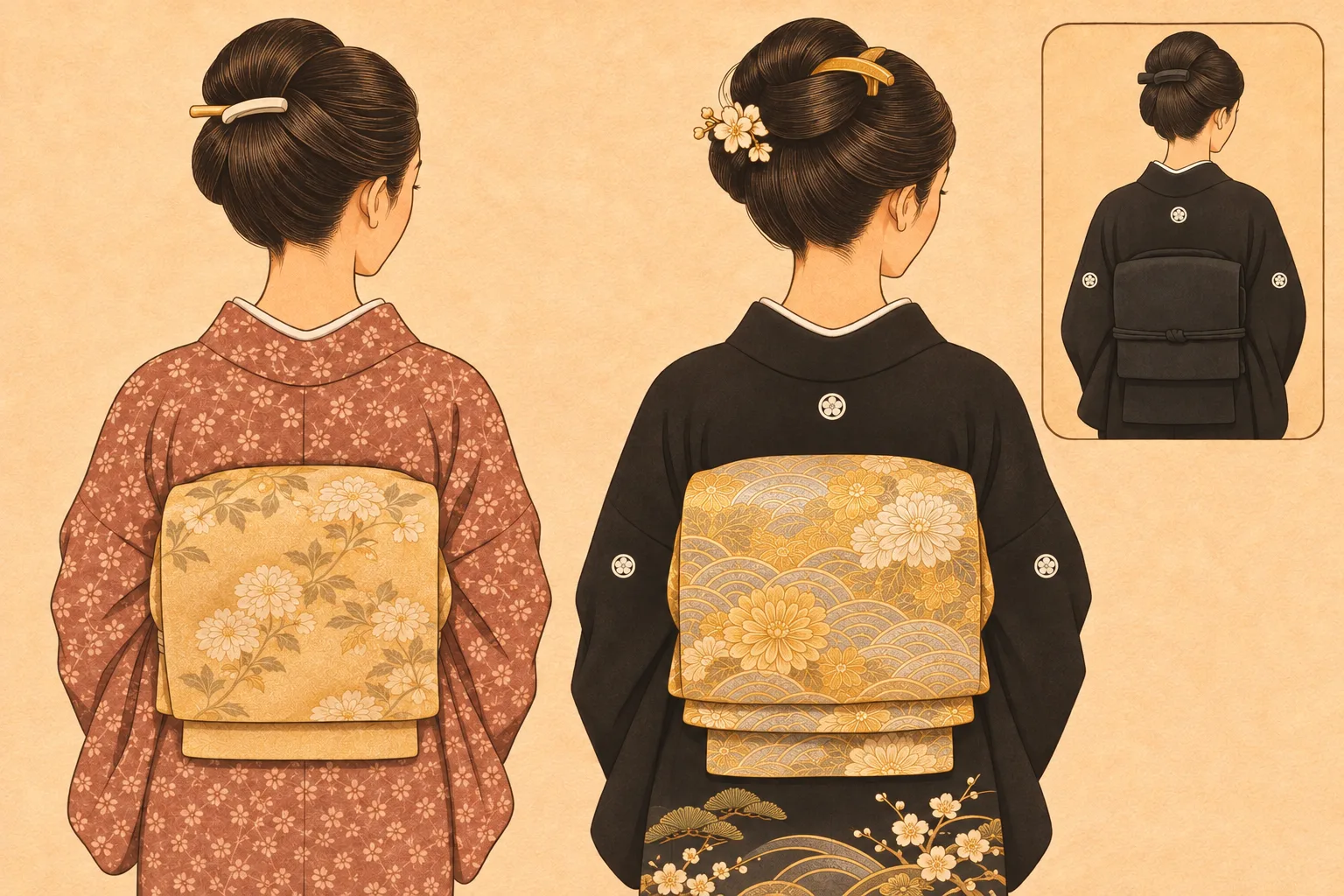
Left: the single drum, with one edge along the bottom. Right: the double drum on a kurotomesode, two layers showing at the bottom. Inset: the single drum in black, worn with mourning dress.
The drum also carries an age message. It belongs to grown women. A twenty-year-old in furisode rarely ties one because it looks too mature, and a woman in her fifties wearing a youthful winged knot would draw comment.
04Wings and Sparrows: the Furisode Knots
The knots worn with furisode are the showiest part of kimono culture. They are three-dimensional, broad, and use a lot of fabric, so they need a fukuro or maru obi. Coming-of-age ceremonies in January, graduations, weddings and New Year shrine visits are full of them.
The tateya musubi, "standing arrow" knot, is the classic. Two wide loops run diagonally across the back, one rising above a shoulder blade, the other dropping below the waist on the opposite side, like the feathers at the end of an arrow stuck upright in a quiver. The diagonal makes the wearer look tall and poised. It belongs to the family of the ya-no-ji, a diagonal knot said to have been in fashion by the 1790s; set more upright, it becomes the tateya. Tradition traces it to the ladies-in-waiting who served in the inner quarters of the shogun’s and daimyō’s residences. It was considered dignified, and it later became the knot of young women’s formal dress.
The bunko musubi is a large, symmetrical horizontal bow: a narrow centre with a flat wing on each side and a tail hanging below. Bunko means a box for letters and documents, and the name is generally explained by the bow-shaped cord tied around such a box. The knot is said to date from the mid-eighteenth century, and in the Edo period it is generally described as the basic knot of samurai-family women. Today it has two faces. In a fukuro obi on furisode it is wide and pleated and grand. In a hanhaba obi on a yukata it is small and flat, and it is the commonest knot at summer fireworks festivals. The same name covers the most formal and the most casual ends of the range, so read the bunko together with the obi it is tied in.
The fukura suzume, "puffed-up sparrow," is named after the way sparrows fluff out their feathers in winter and sit round as balls on a branch. Japanese have long found that image endearing, and fukura can be written with characters meaning "good fortune," which made the sparrow an auspicious motif. The knot shows the bird: a plump central body, two rounded wings spread to either side, and a pleated tail below. It is softer than the tateya and fuller than the bunko. It spread as a furisode knot after the Second World War, and it is now almost exclusive to furisode and one of the most popular choices at coming-of-age ceremonies.
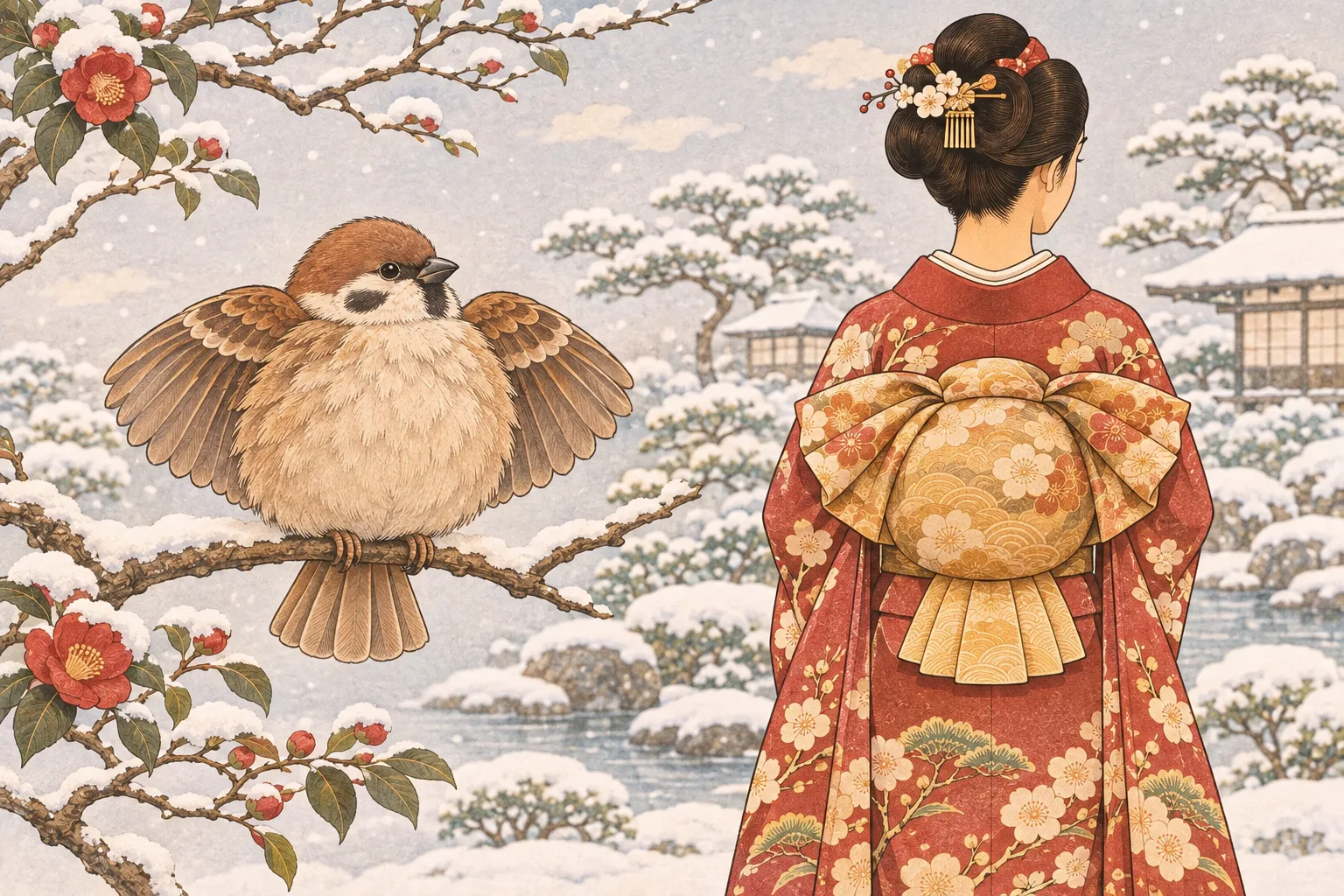
A sparrow fluffed up against the cold beside the fukura suzume knot on a furisode: plump centre, two rounded wings and a pleated tail.
Around these three cluster countless kawari musubi, "variation knots," also called flower knots. Dressers fold the fukuro obi into tiers of pleats forming flowers, fans, butterflies or feathers, often with names invented by a particular shop. Over the past few decades, as coming-of-age outfits grew more elaborate, these have reached five or six layers. Most are elaborations of the tateya, bunko or fukura suzume; look at the position of the centre and the direction of the wings and you can usually tell which.
These knots are almost never self-tied. On the morning of coming-of-age day, salons and photo studios open before dawn, and professional dressers work through queues of young women, building each knot with a hidden frame of elastic cords, clips and an oversized pad. A tateya or sparrow can stand out 15 centimetres or more from the back, which is why a woman in furisode sits on the front edge of a chair, never leaning back, and why taxis and train seats are a small ordeal that day. The knot is also built to be photographed: dressers fan the pleats and arrange the obi-age and obi-jime so that the back looks as finished as the front in the family portrait.
All of these speak of youth. The furisode is the most formal garment for an unmarried woman, and its knots became the visual shorthand for being twenty. After marriage, the long sleeves are put away and the knot becomes a drum.
05Chic, Masculine and Casual: the Other Knots
The tsunodashi, "horns sticking out," is an Edo knot with a reputation for iki, the understated urban chic of old Tokyo. It looks like a smaller, flatter drum with no pad inside, and the obi ends stick out much further on both sides, like two horns. It is relaxed and low-key. Said to have been popular among townswomen and in the geisha quarters of late Edo, it is now worn mainly by mature women in komon or tsumugi, with a Nagoya or half-width obi. In Tokyo’s old downtown and among kimono connoisseurs it signals someone who knows what she is doing. It is too casual for a wedding.
The kai-no-kuchi, "shell mouth," is the standard men’s knot in a kaku obi. A small knot sits at the back, slightly to one side, with one end angled up and the other angled down, like the open mouth of a clam. It is only a little wider than a hand, and lies flat enough to sit against a chair back. Edo merchants wore it, and so do rakugo storytellers, male tea hosts and men in yukata at fireworks displays. Women tie it too in hanhaba obi, and it has become fashionable with young women who want something neat rather than sweet.
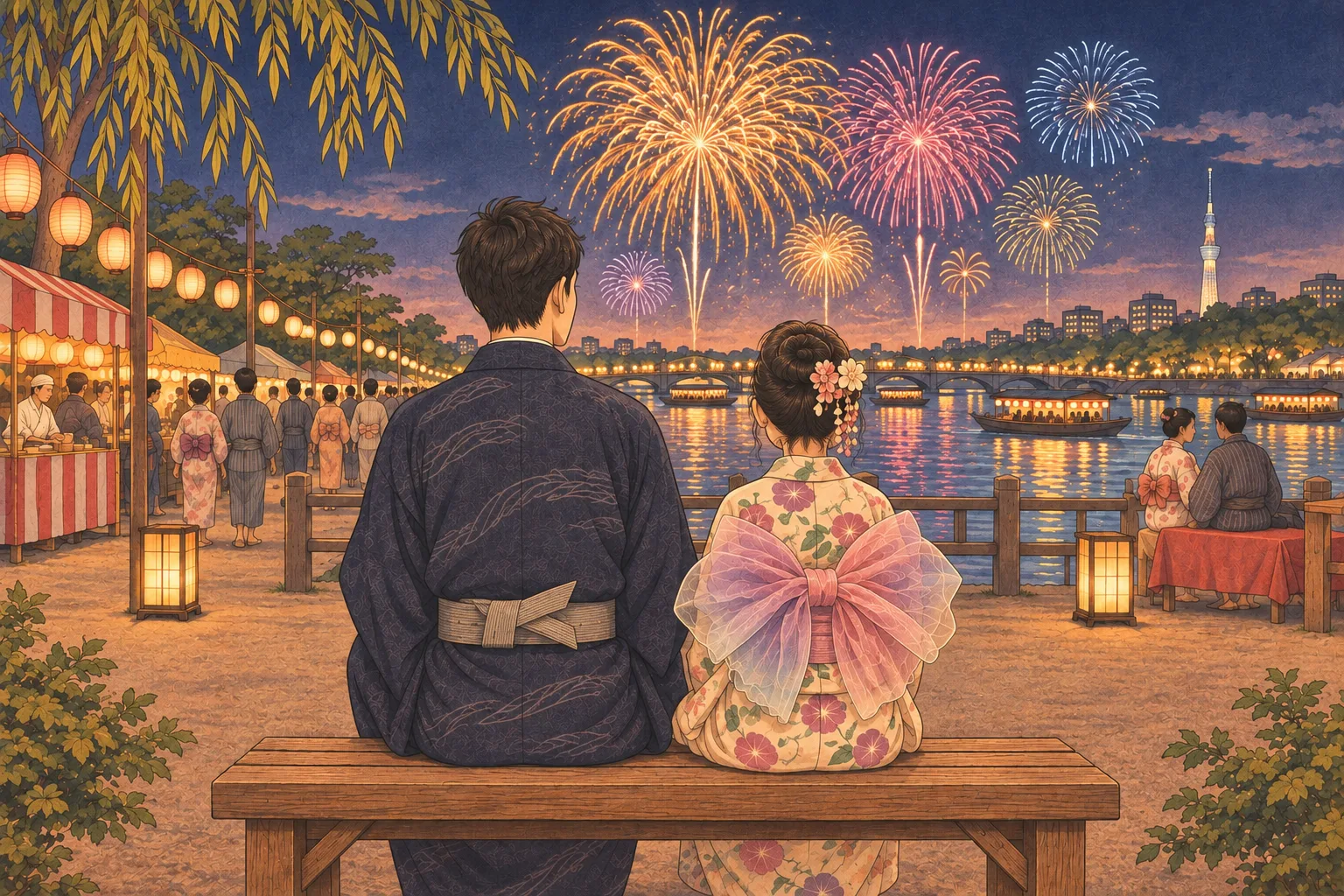
A summer fireworks night. Left: the small flat kai-no-kuchi in a kaku obi on a man’s yukata. Right: a big fluffy heko obi bow in sheer gradient cloth.
The rōnin musubi is tied loosely, its ends angled out of the knot, giving a careless, swaggering look that suits its name, the masterless samurai. It is used with yukata and casual wear. The katabasami is even simpler: after wrapping, one end is folded and tucked straight into the band, so all you see is a flat folded block. It is a traditional tie for home and for work. Samurai wore swords thrust through their obi, which is one reason men’s knots stayed small and out of the way.
The heko obi follows almost no rules. Heko was a Satsuma (southern Kyushu) word for young men aged about fifteen to twenty-five, who wore a soft cloth sash. After the Meiji Restoration, when Satsuma men flooded into Tokyo, the sash went with them and became the casual obi of men and boys. Being soft, it ties into a loose bow or is simply wrapped twice and knotted. Today, children at summer festivals wear big fluffy heko obi bows, often in sheer gradient-dyed cloth that sways as they walk, and young women use it for soft flower shapes. It belongs to summer and ease, never to formal occasions.
06The Hidden Scaffolding
A drum or a tateya that holds its shape is not the obi’s work alone. Beneath and around it is a set of accessories, some invisible, some showing only a strip of colour.
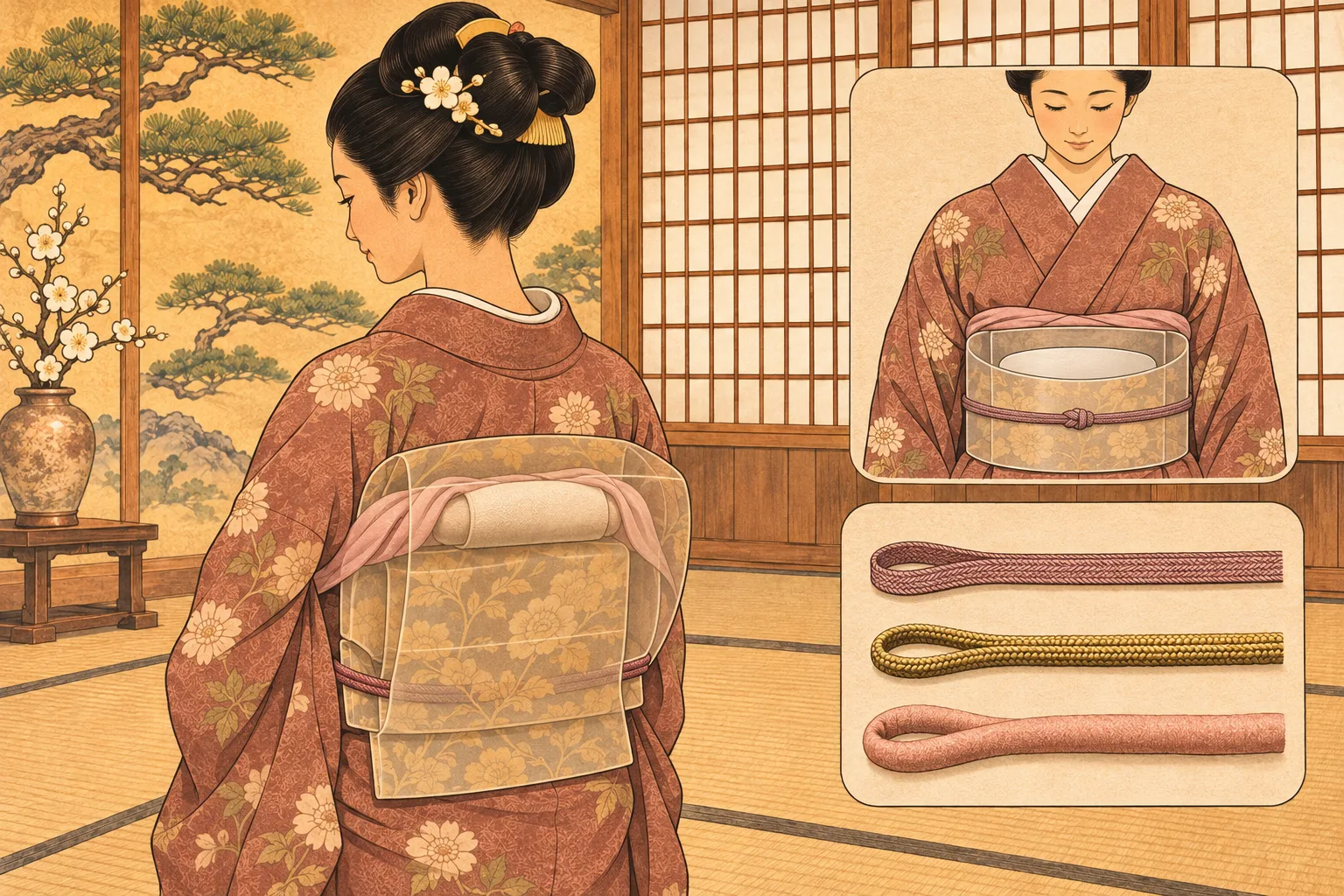
A drum knot drawn see-through: the obi-makura props up the top edge, the obi-age wraps it and runs to the front, the obi-jime passes through the middle. Top right: the stiffening board at the front. Bottom right: three obi-jime, a flat braid, a round braid and a padded fabric cord.
The obi-makura, "obi pillow," is a small pad about 20-odd centimetres long, set inside the top of the drum to give its fold a full curve. Once paper or cotton, it is now usually foam or plastic. Without it the drum collapses into a flat panel. Furisode knots use larger pads or elastic bands with three cords to hold up their wings.
The obi-age is a scarf of crepe or tie-dyed silk that wraps the pad and is tucked along the top edge of the obi at the front. How much of it shows is telling. Young women in furisode let a generous puff of shibori in red, pink or pale yellow spill over; adult women show a thin, muted line; at funerals it is plain black.
The obi-jime is a cord tied round the middle of the obi and knotted at the front to lock the drum in place. It arrived more or less with the drum knot, and tradition credits Fukagawa geisha with first binding their drum with a cord; padded fabric cords were in use by the end of the Edo period. The usual account is that after the 1876 edict banning swords, the braiders who had made silk cords for sword hilts turned to obi-jime, which is part of why the craft of kumihimo survived. Iga in Mie Prefecture and Kyoto remain the main centres. Flat braids, hirauchi, about a centimetre wide with crisp patterns, are the most common, and formal ones carry gold and silver thread. Round braids, maruuchi, are thinner and softer, suiting everyday wear. There are also square braids and the maru-guke, a stuffed fabric tube, plump and once typical of brides and furisode.
The obi-dome, a brooch-like ornament threaded onto a thin obi-jime at the centre front, and the obi-ita, a hidden board that keeps the front of the obi smooth, are covered in the main kimono article. Worth adding is that waist ornaments existed in Edo before the sword-fitting makers took up obi-dome, and that today the obi-dome belongs to semi-formal and casual dress more than to formal wear.
Finally, the tsukuri obi, "ready-made obi," has the knot pre-sewn. The waistband and the knot are separate, and the knot hooks or slots on in seconds. Yukata versions are sold in department stores; two-piece Nagoya obi are common among restaurant proprietresses, kimono shop staff and inn attendants. They were devised in the 1920s for convenience and spread after the war, as fewer people learned to tie their own. Purists do not count them as formal, but they keep many people in kimono. A tsukuri drum seen from behind is often too regular, its corners as sharp as a cardboard box.
07Eight Backs Side by Side
To tell the knots apart, look at three things: whether the outline is square, round or diagonal; whether a pad makes it puff out; and how high it sits.
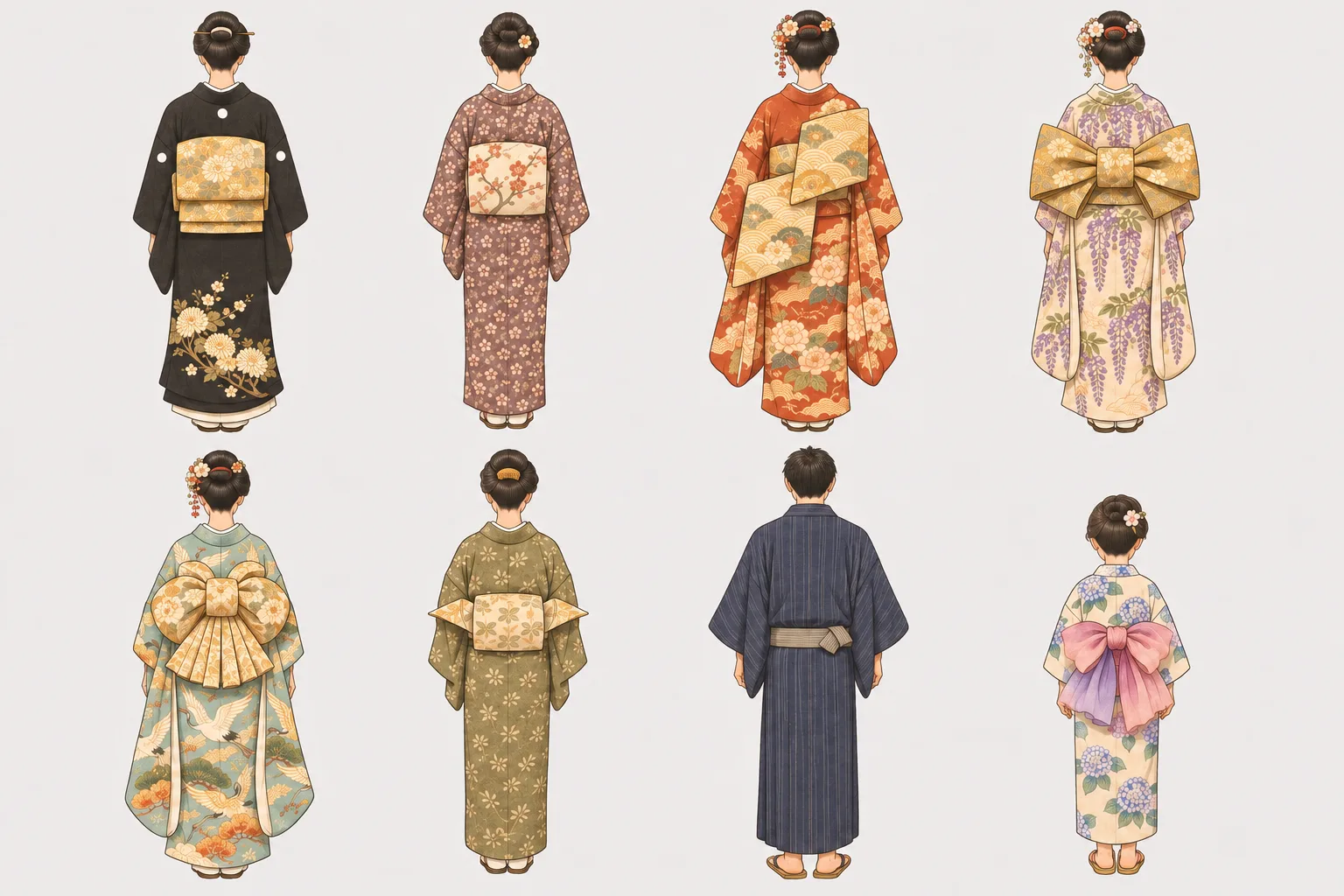
Eight backs. Top row, from left: double drum, single drum, tateya, bunko. Bottom row: fukura suzume, tsunodashi, kai-no-kuchi, heko obi bow.
Double drum: a square box at centre back, top edge gently curved by a pad, two layers visible at the lower edge, short tail below. Square, thick, symmetrical. Formal wear for adult women at happy occasions.
Single drum: the same box with one layer and one line at the bottom, a little thinner. Everyday kimono for adult women, and black mourning dress.
Tateya: two broad loops on a diagonal from above one shoulder blade to below the opposite hip. Tall and sharp. Furisode.
Bunko: a wide symmetrical horizontal bow with a narrow centre and a hanging tail. Grand in a fukuro obi on furisode; small and flat in a hanhaba obi on yukata.
Fukura suzume: a high plump centre, two rounded wings and a pleated tail, like a round little bird. Full, symmetrical, softer than the tateya. Furisode, coming-of-age day, wedding guests.
Tsunodashi: a small flat block with long horns sticking out either side, no puff. Komon and tsumugi on mature women.
Kai-no-kuchi: a small knot off-centre at the waist, ends angled up and down like an open shell. Flat and compact. Men’s standard; women in half-width obi.
Heko obi bow: a soft, fluffy bow with no corners, ends drooping, often sheer and gradient-dyed. Yukata, children, summer.
A rough rule of thumb: the squarer, the older; the more sculptural, the younger; the flatter, the more casual.
One more back stands out in Kyoto but belongs to none of these. Maiko in Gion and Pontochō wear a maru obi with its two ends hanging almost to their ankles, the darari obi, woven at the tip with the crest of their geisha house. It is covered in our geisha article; here it is enough to say that it is not a knot style open to anyone, and is generally seen as a survival of the long dangling sashes of Edo girls, reserved today for the apprentice.
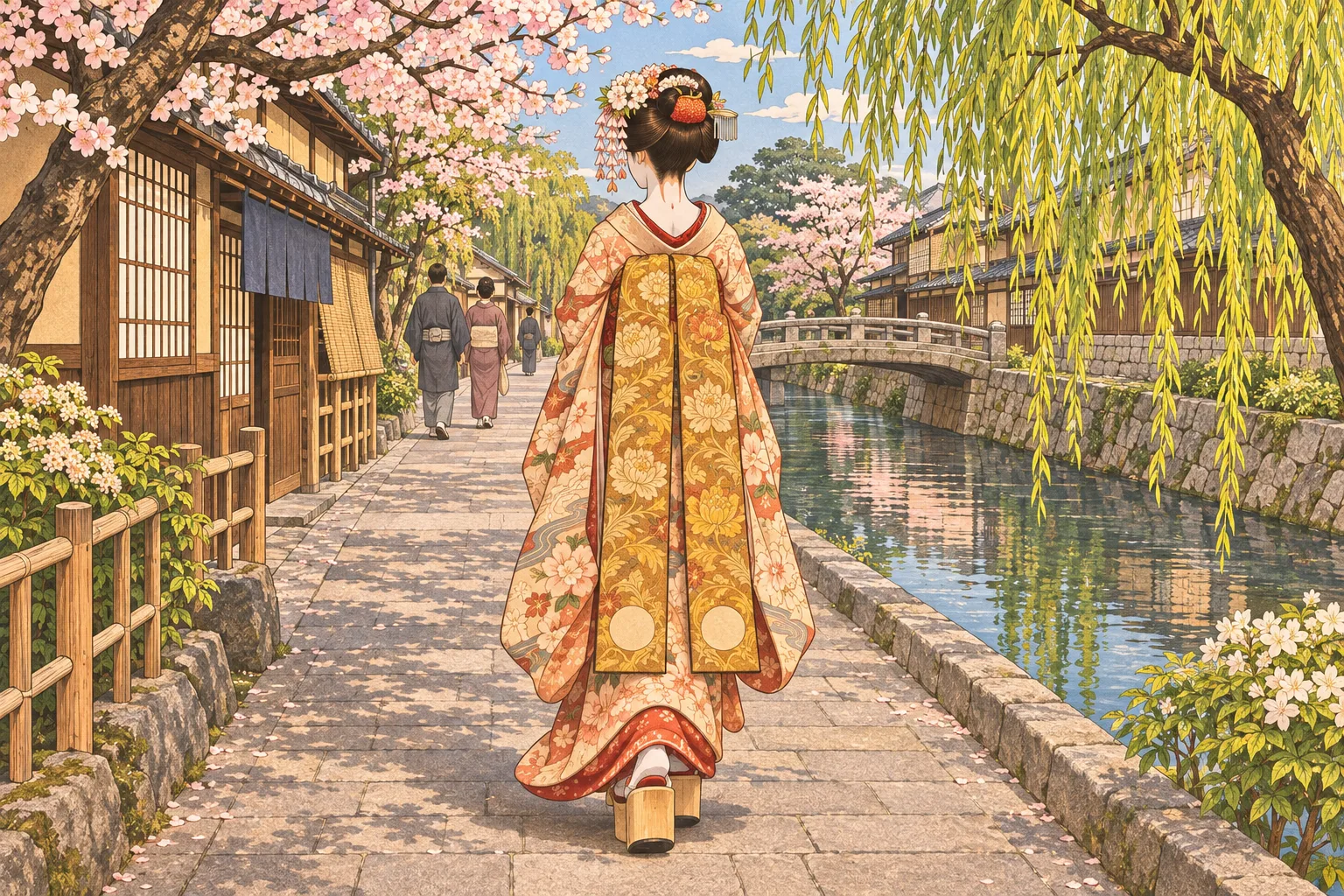
A maiko’s darari obi: the maru obi is not shaped into a knot at all, its two ends hanging almost to her ankles.
08Why the Back Matters
Kimono put their drama on the back for a practical reason. The front is a flat expanse of overlapping panels and a smooth band, while the back offers a broad, uninterrupted field. People see your back as you walk ahead of them, bow and leave, and Edo taste developed a real appreciation for ushiro-sugata, the figure seen from behind.
The knot is also a social signal that needs no words. In Edo it hinted at whether a woman was a girl, a wife or from the pleasure quarters. Today it says age and occasion: tateya or sparrow means twenty, unmarried and celebrating; double drum means adult and festive; single drum means daily life or mourning; tsunodashi means connoisseur; heko obi means summer and ease. A practised eye scanning the backs at a wedding reception can pick out the groom’s mother, the young cousin and the women helping out.
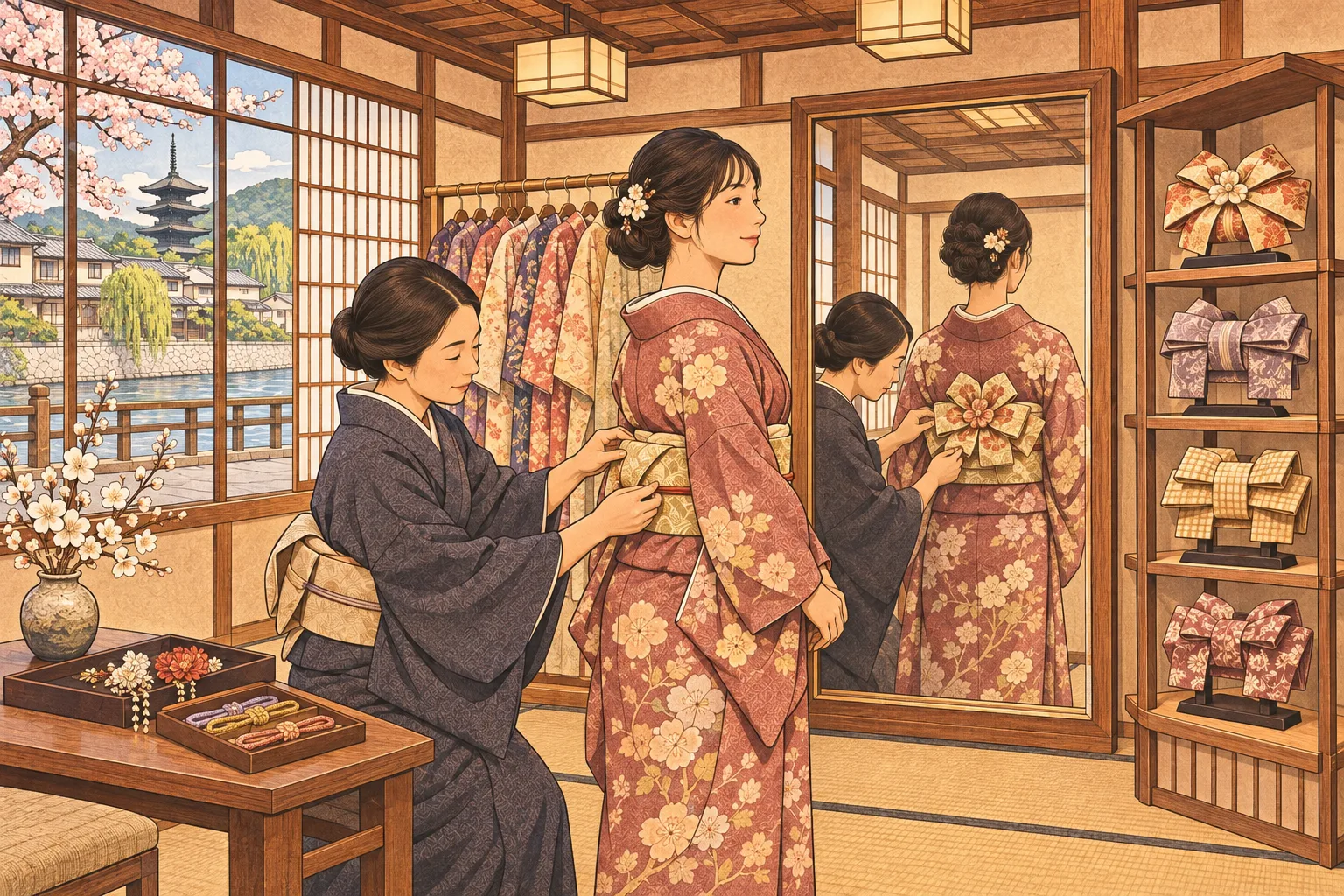
In a rental shop, a dresser ties a visitor’s obi, the bow reflected in the mirror; the shelves on the right hold tsukuri obi with their knots already sewn.
That language is changing. Few people can tie their own double drum, and many hire a dresser twice in their lives, for coming-of-age day and a wedding. Ready-made and two-piece obi multiply. Young people mix men’s shell knots and women’s flower bows on yukata. Rental shops in Kyoto and Asakusa tie visitors’ obi into package bows. Some worry that the rules are fading; others point out that obi knots were always fashions, spread by geisha and kabuki actors, and that new shapes simply continue the habit. Either way, next time a kimono passes you on a Kyoto lane, look at the back. Square, diagonal or round, it will tell you roughly where she is going.
More deep dives on this topic
 Kimono Types and Their RankSpend a Saturday afternoon in the lobby of a big hotel in Tokyo or Kyoto and you will see kimono that look, to an outsider, like variations on a single garment.
 The Obi and Its KnotsStand on a street corner in Kyoto’s Gion and watch two women in kimono walk away from you.
 Kimono Motifs and the SeasonsWalk through Kyoto in early March and you will see cherry blossoms on kimono sleeves weeks before a single tree has opened.
 Japanese Hairstyles and KanzashiLook closely at a woodblock print of a street in late Edo or Meiji Japan and you can read the women in it like name tags.
 Men’s KimonoMost visitors to Japan see far more women in kimono than men, and when a man does walk past in kimono, he can look oddly uniform: dark colours, a short jacket, a narrow belt, flat…
 Putting On a Kimono, Layer by LayerWhen you rent a kimono in Kyoto or Asakusa, you stand in front of a mirror for fifteen or twenty minutes while someone wraps, pulls, tucks and ties, mostly out of your sight.
 KamonWalk through any old Japanese town and you will start to notice the same kind of image again and again: a small black-and-white emblem, perfectly symmetrical, usually inside a…
 The Life of a KimonoMost clothes are finished the day they are sewn.
- Back to the main article: Kimono →