
Look closely at a woodblock print of a street in late Edo or Meiji Japan and you can read the women in it like name tags. The girl with a split, red-lined knot at the back of her head is in her mid-teens. The young woman with a long, waisted chignon is unmarried. The woman with a smooth, flat bun and a strip of crimson silk beneath it has just become a wife, and the one with a smaller bun over brown or navy silk has been married for decades. The figure whose hair spreads sideways like wings, bristling with a dozen tortoiseshell pins, is a top-ranking courtesan. For about 250 years, Japanese women’s hair worked as a public code, and the combs and hairpins pushed into it, known collectively as kanzashi, were part of the message.
That code collapsed within a few decades of the Meiji Restoration in 1868. Yet pieces of it are still easy to find: on maiko in Kyoto, on brides at shrine weddings, on twenty-year-olds at Coming of Age Day, in every samurai drama on television, and in small shops in Asakusa selling silk-flower hairpins. This guide walks through the main styles and ornaments, how to recognise each, who wore them, and why they disappeared.
01Before the Topknot: A Thousand Years of Hair Worn Down
For most of Japanese history, women did not put their hair up at all. Aristocratic women of the Heian court (794–1185) wore their hair loose and straight, parted in the centre and falling down the back. This style is called taregami or suihatsu, "hanging hair." The ideal was hair longer than the woman was tall, so that when she sat, it pooled on the floor behind her. In The Tale of Genji and Sei Shōnagon’s Pillow Book, a woman’s hair is often the first thing described: black, glossy, straight, and long enough to trail.
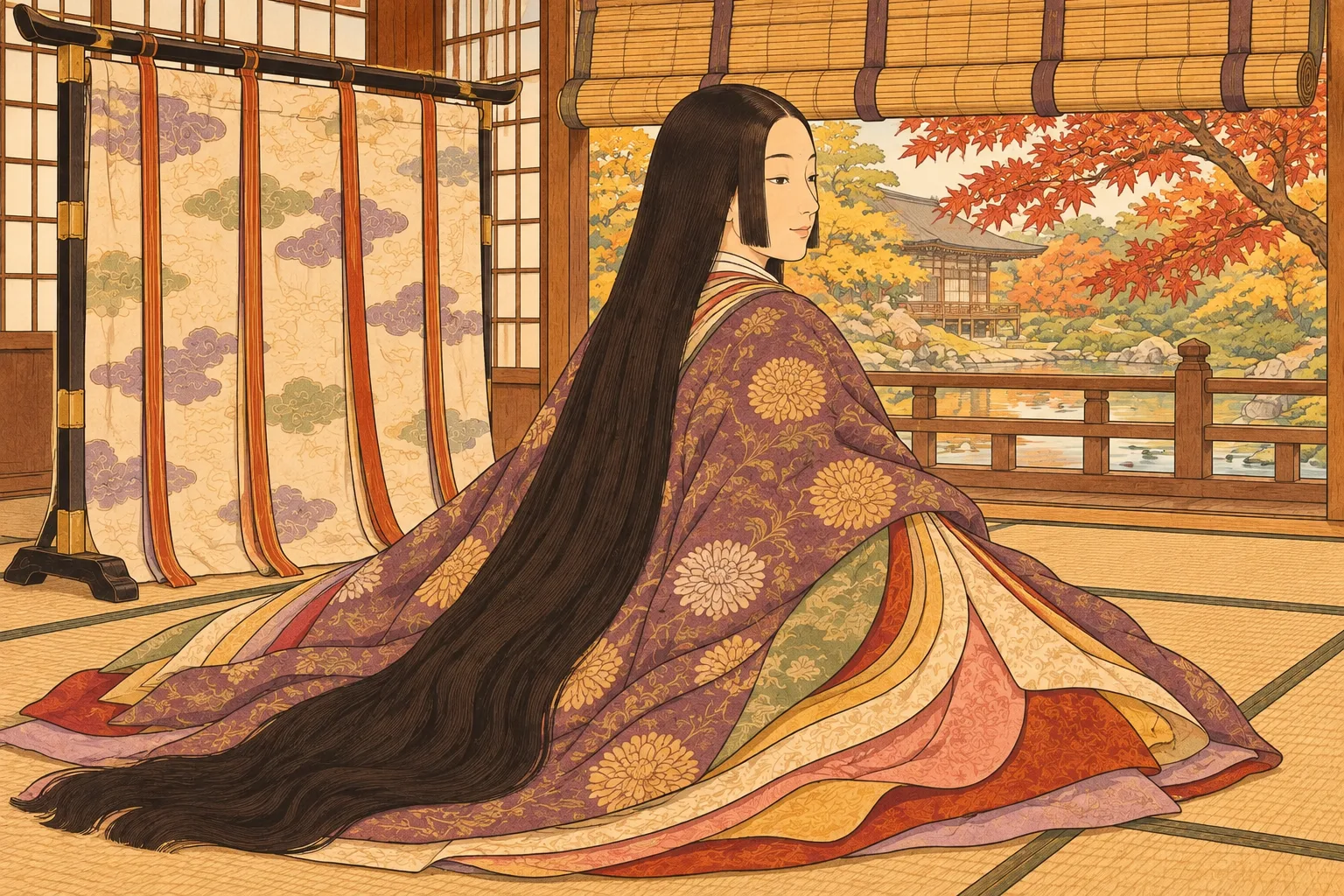
A Heian court lady with her hair worn down, falling the length of her back and pooling on the floor behind her (artist’s impression)
Keeping hair like that took effort. Washing was a half-day affair, done with rice water or similar preparations and timed for auspicious days. At the sides of the face, a shorter lock was cut to around the chin or chest. This cutting, binsogi, marked a girl’s coming of age in her mid-teens. At the coming-of-age ceremony called mogi, when a girl first tied on the trailing skirt of adult court dress, she usually also went through kamiage, "putting up the hair." Girls had once marked adulthood by literally tying their hair up, but once Heian adults wore their hair down, the rite became a formality; dictionaries differ on what was done, some describing the childhood hair gathered to hang down the back, others a ceremonial tying-up. Afterward she went on wearing it down. In daily life there was almost no ornament but the hair itself.
A formal version survives today. When women of the imperial family wear the twelve-layer jūnihitoe robes at an enthronement or wedding, their hair is puffed out at the sides of the head and gathered into a long tail down the back, tied at intervals with paper or white cloth. That is the descendant of Heian court hair, and it is the only place it survives as real formal dress.
As warrior government took over from the twelfth century, women who worked, walked and travelled found long loose hair impractical. Through the Kamakura and Muromachi periods, ordinary women tied it back at the nape or between the shoulders, still letting it hang. Hair did not move upward onto the head until the late sixteenth century.
02The First Topknots: Karawa, Hyōgo and Katsuyama
The fashion for putting hair up began among courtesans and the early kabuki stage, during the Momoyama period and the first decades of Edo rule (around 1580–1650).
The earliest widely depicted style is karawa, "Chinese rings." The hair was gathered at the crown and wound into two to four upright loops, with the remaining hair wrapped around their base. A style of the same name had been worn since the Kamakura period by young samurai retainers and temple acolytes; women took it up because loose hair got in the way of work. Why the name uses the character for "Tang" or "Chinese" is not settled. Today you will see karawa mainly in old paintings and in historical processions.
Next came hyōgo-mage, which appeared around the 1620s–1640s. Tradition links its name to courtesans of Hyōgo, the port that is now part of Kōbe; another explanation compares its shape to a Hyōgo sake barrel. The hair was gathered behind the head and tied high in a loop, with the root twisted so that it jutted up at the top. For a time ordinary middle-aged women wore it too, but by the late Edo period it was again a courtesans’ style, and one variant became the signature of the oiran, the highest-ranking courtesans of Edo’s Yoshiwara district. The yoko-hyōgo, "sideways hyōgo," began as a hyōgo knot tipped to one side and later grew loops on both sides that spread out like a pair of open wings; the tate-hyōgo stood upright. When you see an ukiyo-e print of an oiran with hairpins fanning out from her head like a halo, she is usually wearing yoko-hyōgo.
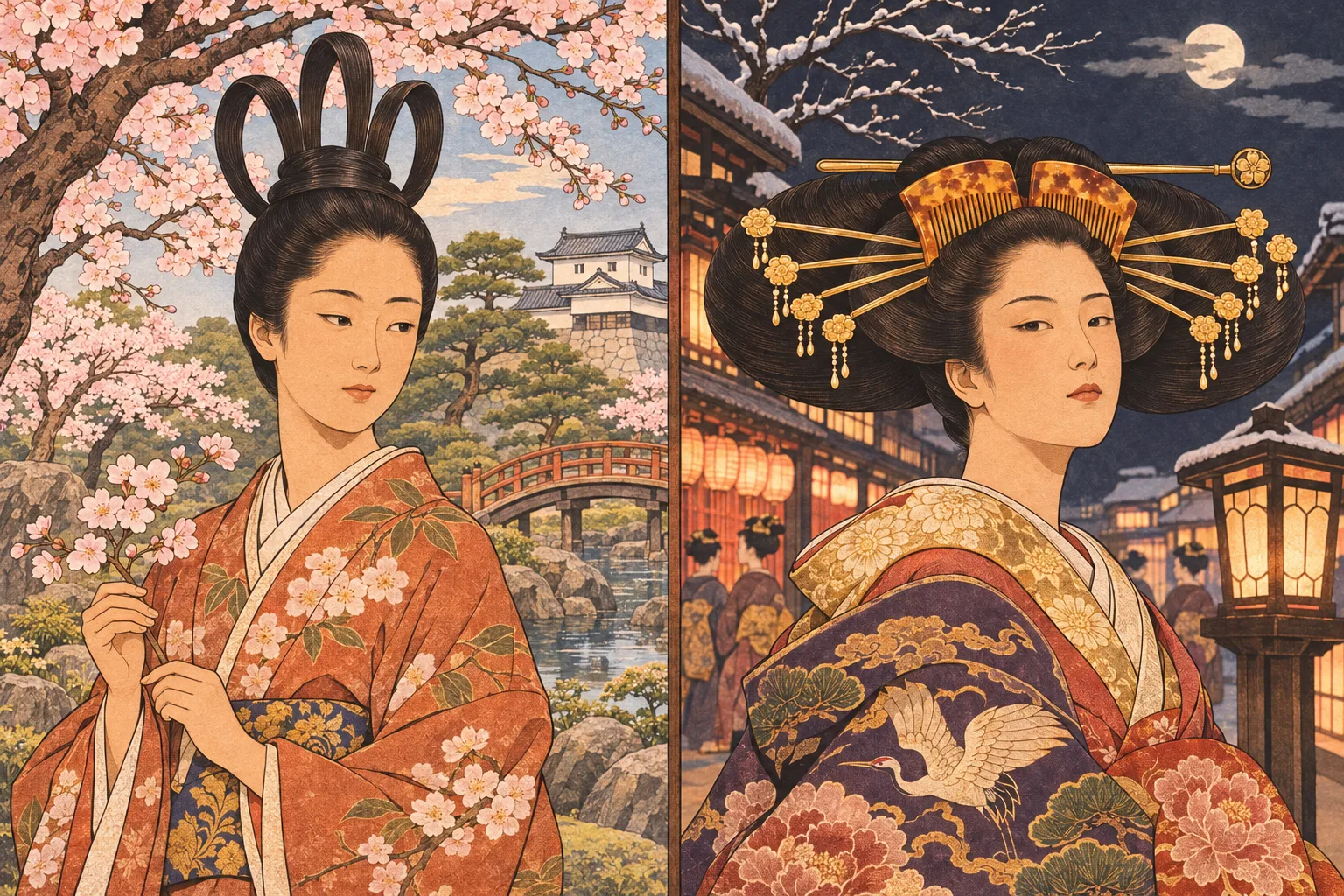
Left: karawa, with upright loops standing above the head. Right: an oiran’s yoko-hyōgo, spread wide like wings and bristling with comb and pins (artist’s impression)
The third early style, katsuyama-mage, is tied to a named woman. According to tradition, Katsuyama was a celebrated yuna, a bathhouse attendant, in Edo in the mid-seventeenth century who entered the Yoshiwara after the shogunate banned bathhouse women, and her bold way of dressing, including a large forward-curving loop of hair at the back of the head bound with white paper cord, was copied across the city. The katsuyama is easy to spot: it is a hollow ring set sideways on the back of the head. Over the following century it flattened and filled in and moved from courtesans to respectable married women, eventually becoming the marumage described below. The name lives on: the grand style worn by the tayū of Kyoto’s Shimabara district is generally said to derive from the katsuyama.
03Anatomy of a Nihongami
By the mid-eighteenth century, what Japanese now call nihongami, "Japanese hair," had settled into a shared structure. Whatever the style, it had four parts. The maegami is a puffed forelock rising from the forehead. The bin are the side locks, swept outward over the ears. The tabo is a lobe of hair projecting backward and down at the nape. The mage is the main knot on top.
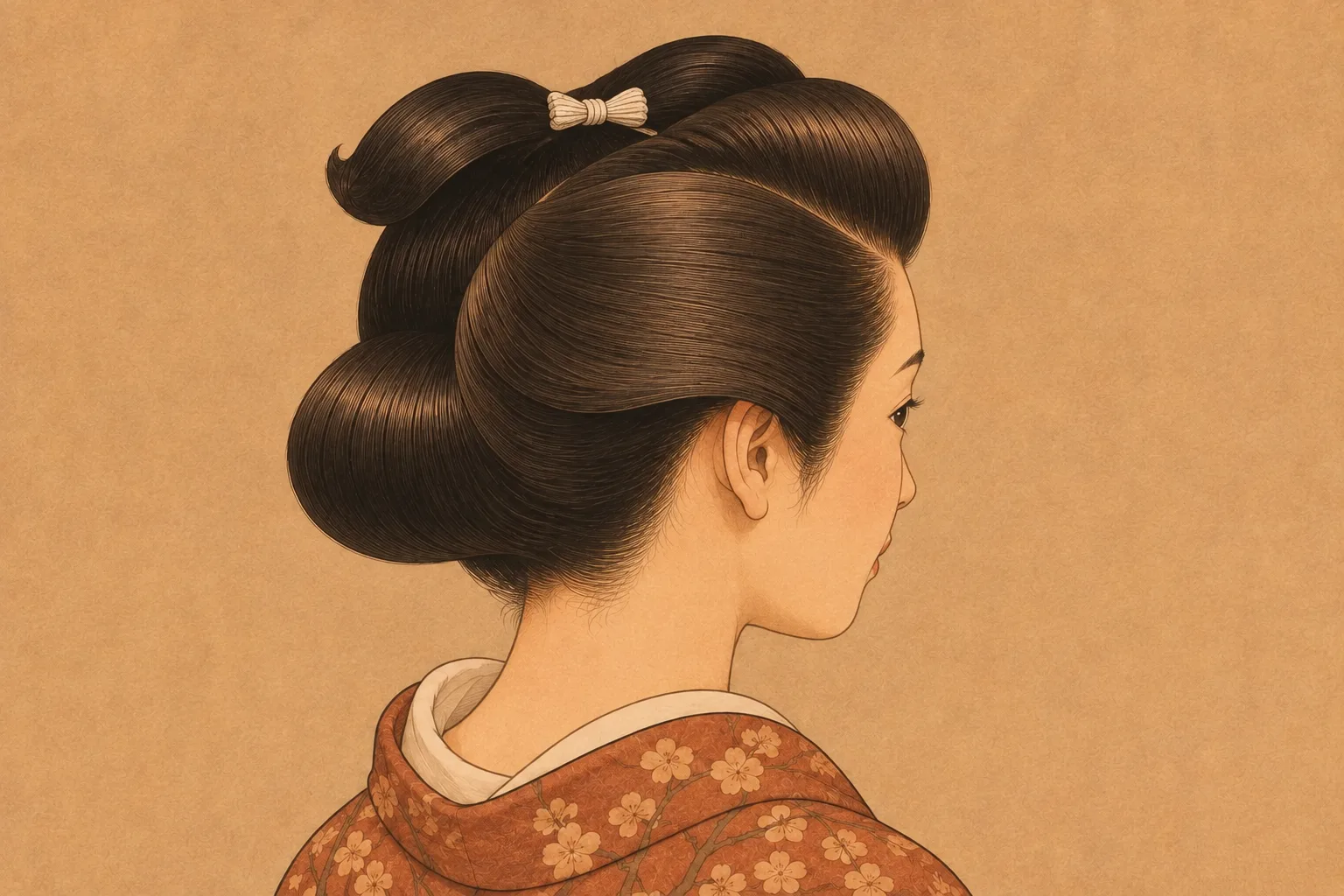
The four parts of a nihongami, seen from behind: the puffed maegami at the forehead, the bin swept out at the side, the tabo projecting at the nape, and the mage tied on top.
Different styles were mostly different ways of shaping the mage, and different amounts of spread in the bin and tabo. Everything was held in place with bintsuke-abura, a stiff pomade kneaded from vegetable wax and rapeseed oil with added fragrance. A finished style lasted five days to a week. Women slept with their necks on raised wooden pillows so as not to crush it, and did not wash their hair in between.
Building a nihongami was something like construction. The dresser wet and oiled the hair, combed it out with a coarse comb, then polished each section with a fine one. The hair was divided into five sections, and a motoyui, a stiff cord of twisted and starched paper, was tied tightly at the crown to form the ne, the root that anchored everything. The tabo was shaped first, then the bin, and finally the remaining hair was looped onto the root and tied into the mage. Women with thin hair padded it with hairpieces or shapes made of paper and cloth. An experienced dresser is usually said to have taken about an hour for a standard style.
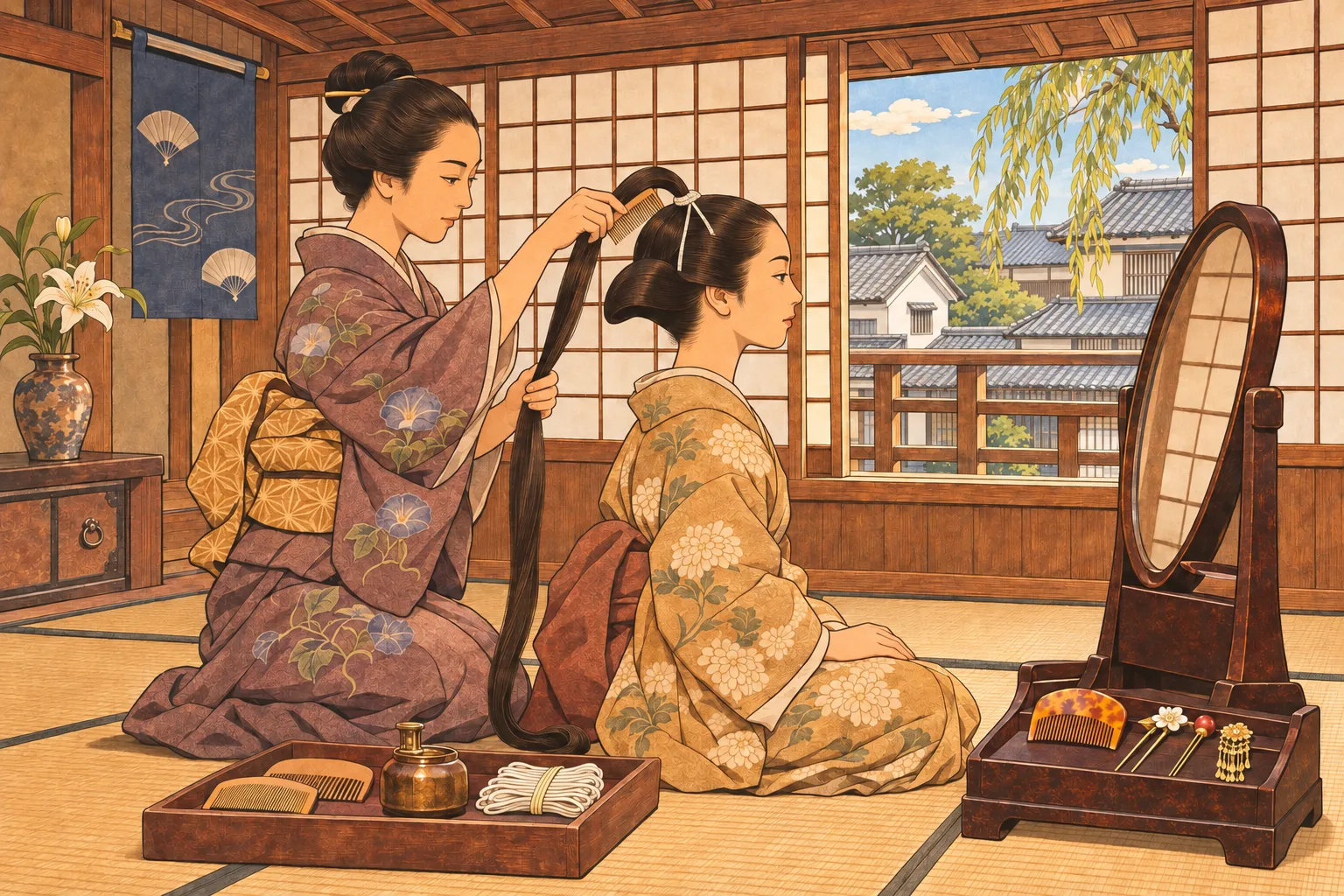
A hairdresser at work behind her client, lifting a long hank of hair; the tray holds combs, an oil jar and a bundle of motoyui cords (artist’s impression)
This was beyond most women’s ability to do themselves. Female hairdressers, onna-kamiyui, were working in the pleasure quarters by the early 1700s and had spread to ordinary townswomen by the 1790s, visiting clients at home several times a month. They worked only semi-openly, and the shogunate is said to have cracked down on them more than once, most severely during the Tenpō reforms of the 1840s. Each time the business came back.
04The Main Styles and Who Wore Them
The shimada was the classic style of unmarried young women from the Edo period through Meiji. The mage is stretched front to back and cinched in the middle by the paper cord, so in profile it looks like a folded ribbon, raised at both ends and pinched at the waist. It appeared in the early Edo period and spread in the Genroku era (1688–1704). Its origin is unsettled: the usual story credits courtesans of Shimada, a post town on the Tōkaidō highway; another credits a kabuki actor named Shimada Mankichi; a third derives the name from shimeta, "tightened," for the tightly bound root. The family of variants is huge. Taka-shimada raises the knot high. Bunkin taka-shimada lifts the root of the mage even higher so the whole knot tilts up and back; this became the bridal style still worn at Shinto weddings. Tsubushi-shimada, the "squashed shimada," sets the root low and flattens the knot, and was favoured in the entertainment districts. Yuiwata drapes a square of tie-dyed cloth over a tsubushi-shimada, a playful look worn by merchants’ daughters.
The marumage was the style of married women. Descended from the katsuyama and widespread by the 1780s, its mage is a solid, flattened oval, like a bun or half an egg, set toward the back of the crown. The giveaway is the tegara, a strip of crepe silk tucked under the knot. Newlyweds used red; in middle age the colour shifted to purple, wisteria or pale blue-green, and in old age to brown, iron grey or navy, while the knot itself became smaller and lower. In the Edo period a bride changed to marumage on marriage, blackening her teeth around the same time and shaving her eyebrows once she was pregnant or had a child. Hair, teeth and brows together announced each new stage of her life to the neighbourhood.
In the ichōgaeshi, the mage is split into two half-loops folded out to left and right, so from behind it resembles a ginkgo leaf, ichō. It began among teenage girls and townswomen at the very end of the Edo period and reached its peak in the Meiji and Taishō eras, when it was worn by fashionable young women and women of the entertainment districts, and in a smaller version by women in middle age.
The momoware, or "split peach," was the style of girls in their mid-to-late teens; dictionaries usually say sixteen or seventeen. Generally treated as a variant of the ichōgaeshi, it became popular in the Meiji era and was worn into the early Shōwa period. The mage is formed from two loops at the back of the head, split down the middle, with a piece of tie-dyed cloth, often red kanoko, showing through the split. From behind it looks like a peach broken open, with the red cloth as its flesh. Maiko in Kyoto begin their careers in the wareshinobu, which also shows red kanoko cloth in the knot; it is covered in our article on geisha.
By the late Edo period the hyōgo had become largely the preserve of top courtesans, while the katsuyama had turned into the married women’s marumage; today both survive in their original forms only in ceremony: to Kyoto’s tayū and to the costumed oiran dōchū processions staged at festivals.
There were dozens more, including the katahazushi of palace attendants and samurai wives, a loop pierced by a hair bar with one side left undone, and the kōgai-mage, popular in Kyoto, in which a long hair bar held the knot together. But if you can tell shimada, marumage, ichōgaeshi, momoware and the courtesan styles apart, you can place most women in a late Edo or Meiji woodblock print or a period drama.
05Reading the Code
Put together, hair followed a woman through her life. A small child’s hair was cropped or tied in little tufts. In her teens she wore a girl’s style, from the Meiji era usually the momoware. At marriageable age she switched to shimada. On marriage, marumage. A widow, or a woman who took Buddhist vows, cut her hair short or shaved it. The logic was the same as with kimono sleeves, where the long-sleeved furisode of an unmarried woman gave way to the short-sleeved tomesode of a married one.
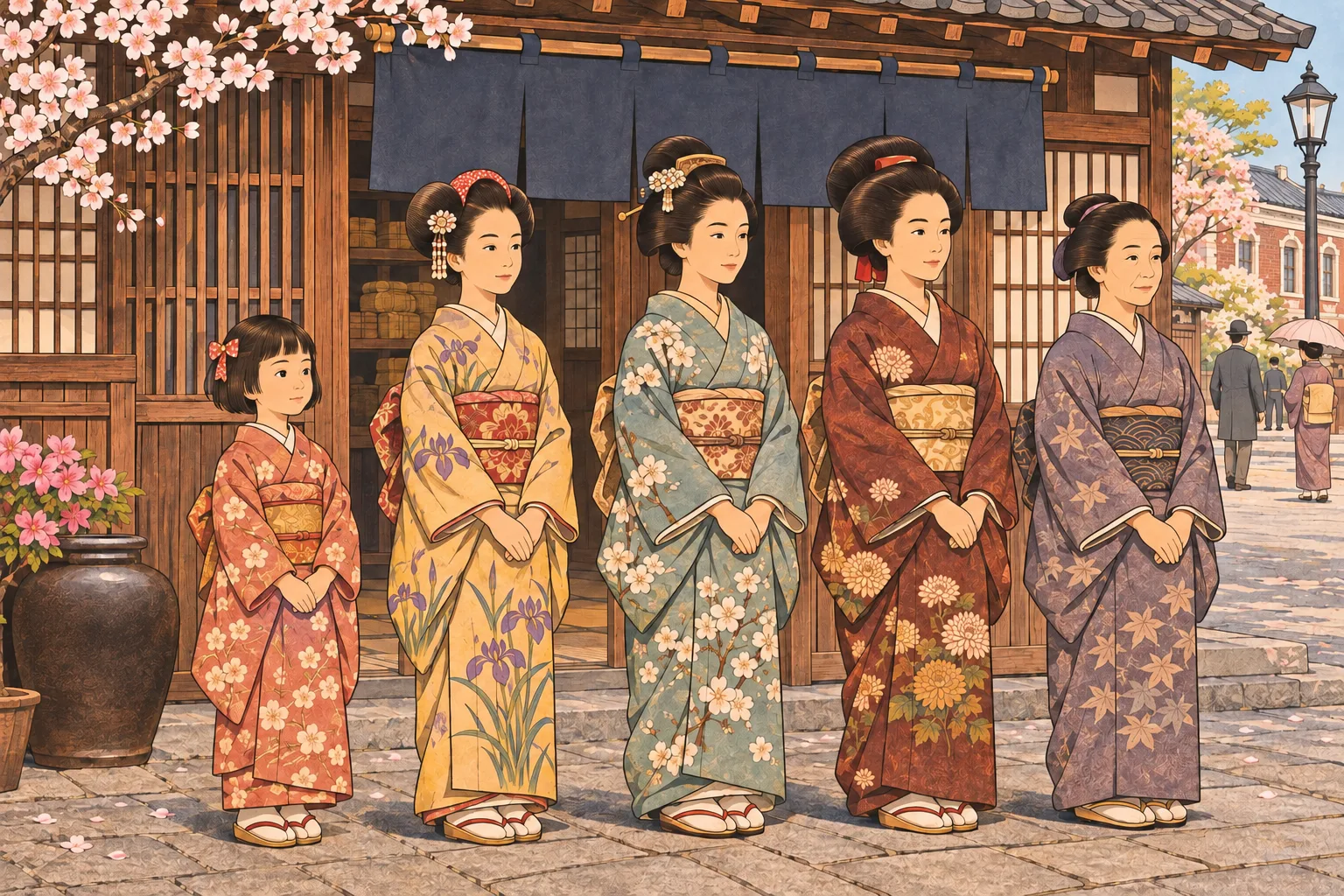
A Meiji-era family lined up by age, from left: a small girl with cropped hair, a teenager, a young woman of marriageable age, a young wife and a middle-aged woman (artist’s impression)
Class showed too. Samurai-family women wore compact, restrained styles with plain tortoiseshell and flat pins engraved with the family crest. Townswomen followed fashion and liked bright cloth and novelty. Courtesans and geisha set the trends. The geisha of Fukagawa, across the river from central Edo, cultivated a sleek, understated look with few ornaments, an aesthetic called iki. Kyoto and Edo differed as well, in the shaping of the bin and tabo and in the ornaments.
The soft accessories carried as much information as the pins. Motoyui paper cords came in white, red, gold and silver, the metallic ones for celebrations. A takenaga was a folded band of paper tied at the root of the knot. Tegara silk sat under the marumage and ichōgaeshi; kanoko tie-dye lit up the momoware. The rule of thumb across all of them: the redder, the younger.
06Combs, Bars and Pins
The ornaments fall into three groups: kushi (combs), kōgai (hair bars) and kanzashi (hairpins). In English, and loosely in Japanese, all three are often called kanzashi.
A kushi is a decorative comb, usually half-moon shaped with very fine teeth, pushed in between the forelock and the knot with its curved spine showing. It was not for combing. The finest were made of bekkō, tortoiseshell from the hawksbill turtle, ranging from clear amber to mottled brown; the pale yellow shirokō, free of dark mottling, was the most prized. Cheaper combs were boxwood, ivory or horn, often decorated in gold maki-e lacquer with autumn grasses or flowing water. An oiran wore two or three large combs at the front, each wider than a hand.
A kōgai is a straight bar pushed sideways through the base of the knot, its ends showing on either side. Its name comes from kamikaki, "hair scratcher"; it began as a tool, used by men as well as women, for arranging hair and scratching the scalp, and became purely decorative, with squared or carved ends. Combs and bars were often made as matched sets from the same tortoiseshell with the same lacquer design, and formed part of a bride’s trousseau. Seen from the front, the most striking things on a formally dressed Edo woman are the comb across her forehead and the bar across the back of her head.
Kanzashi in the narrow sense are pins, single- or double-pronged, pushed into the knot.
Hirauchi kanzashi are flat metal pins topped with a thin disc, often engraved or embossed with a family crest or flowers. Usually silver or brass and often worn at the back of the knot, crested ones are generally associated with samurai-class women, who could wear their family’s crest on their heads. Look for the coin-like flat disc.
Tama kanzashi are the simplest: a single shaft topped with one round bead of coral, jade, agate or glass. Red coral was the favourite. One custom, still followed by some kimono enthusiasts, assigns coral to the cold months and cool-coloured jade or glass to summer. A single tama kanzashi is enough to hold up a twist of hair, which makes it the most practical pin for everyday kimono.
Mimikaki kanzashi have a tiny spoon at one end that genuinely works as an earpick. The usual explanation is that when sumptuary laws restricted ornaments, craftsmen added an earpick so the pin could pass as a toiletry. The story is widely repeated and hard to prove, but earpick ends were extremely common in the late Edo period and appear on many flat and bead pins.
Birabira kanzashi, "dangling pins," have fine metal chains hanging from the top, ending in tiny bells, birds or petal-shaped plates that sway and chime as the wearer moves. They became popular at the very end of the Edo period and are generally seen as an ornament for young women, worn at the front of the knot so they shimmered beside the face, and usually set aside with age.
Hana kanzashi, flower pins, also called tsumami kanzashi, are built from tiny squares of silk folded with tweezers into petals and glued onto a base to form plum, cherry, chrysanthemum or wisteria blossoms, sometimes with long trailing strings of flowers. Tsumamu means "to pinch." The craft developed in Edo, and Edo tsumami kanzashi was designated a traditional craft of Tokyo in 1982. Bright and fabric-soft, flower pins are worn by girls and young women and appear everywhere at Shichi-Go-San and Coming of Age Day. Kyoto maiko wear a different flower pin each month, made with the same technique.
Among materials, tortoiseshell ruled. It is really the shell of the hawksbill turtle, which came from southern seas through the port of Nagasaki, was expensive, and was at times banned. Merchants are said to have dodged the ban by calling it bekkō, "softshell-turtle shell," and the name stuck. Cheap imitations were also made from horse hoof, called bazu. Coral was imported through Nagasaki until red coral was found in Tosa Bay (modern Kōchi), usually dated to the late Edo period; organised coral fishing there began in 1871, and Kōchi remains Japan’s coral centre. Silver, gold, brass, ivory and glass were all used, and in the twentieth century celluloid offered a cheap imitation of tortoiseshell, letting ordinary women wear amber-coloured combs.
You will often hear that a kanzashi could be pulled out and used as a weapon in self-defence, especially by samurai women. That is legend: it turns up in fiction and period drama, and there is little to show it was a general practice.
07Side by Side
Seen in profile, the styles separate cleanly by the shape of the knot.
Karawa has two to four upright loops standing above the head and little spread at the sides, so the whole silhouette is narrow and tall. The yoko-hyōgo is the opposite: a knot spread sideways like wings, far wider than the head, with pins radiating outward. The katsuyama is a hollow ring set sideways at the back of the head, and you can see through it. The shimada is stretched front to back and pinched at the waist; the bunkin taka-shimada tilts the whole thing up and back. The marumage is a solid, flattened oval with a strip of coloured silk showing beneath it. The ichōgaeshi has two half-loops folded outward, which gives it a wavy outline, and the momoware is a round knot of two loops split down the middle with red cloth showing in the split.
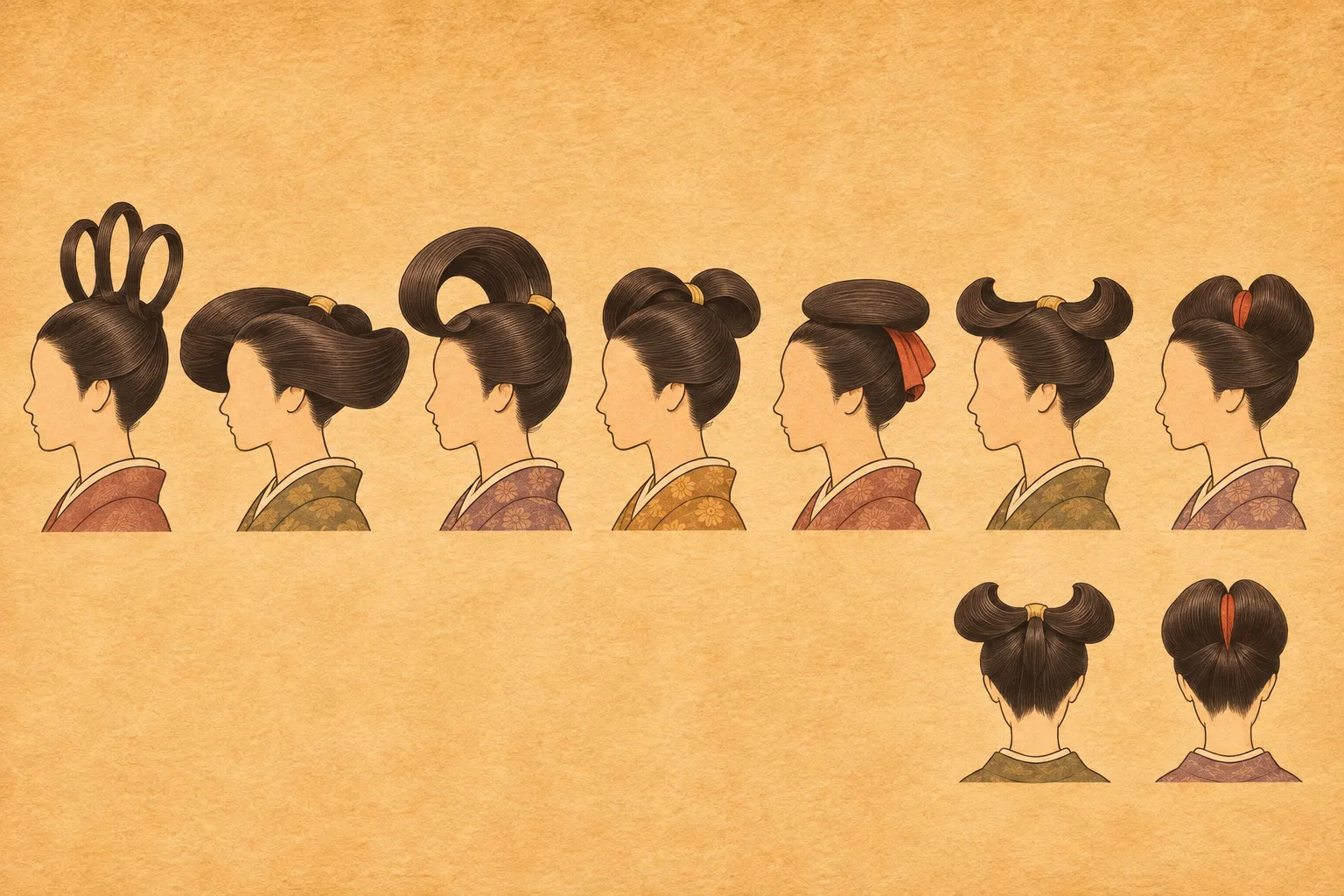
Seven knots in profile, from left: karawa, yoko-hyōgo, katsuyama, shimada, marumage, ichōgaeshi, momoware. Below: the ichōgaeshi and the momoware seen from directly behind.
A quick way to remember them: upright rings, karawa; wings, hyōgo; hollow ring, katsuyama; waist, shimada; solid bun, marumage; two leaves, ichōgaeshi; red split, momoware.
The pins are just as distinct. A flat disc means hirauchi. A single bead means tama. A tiny spoon at the tip means mimikaki. Chains and dangles mean birabira. A cluster of silk petals with no metallic shine means hana or tsumami. The half-moon kushi and straight kōgai are not pins in the strict sense, but nearly always appear with them.
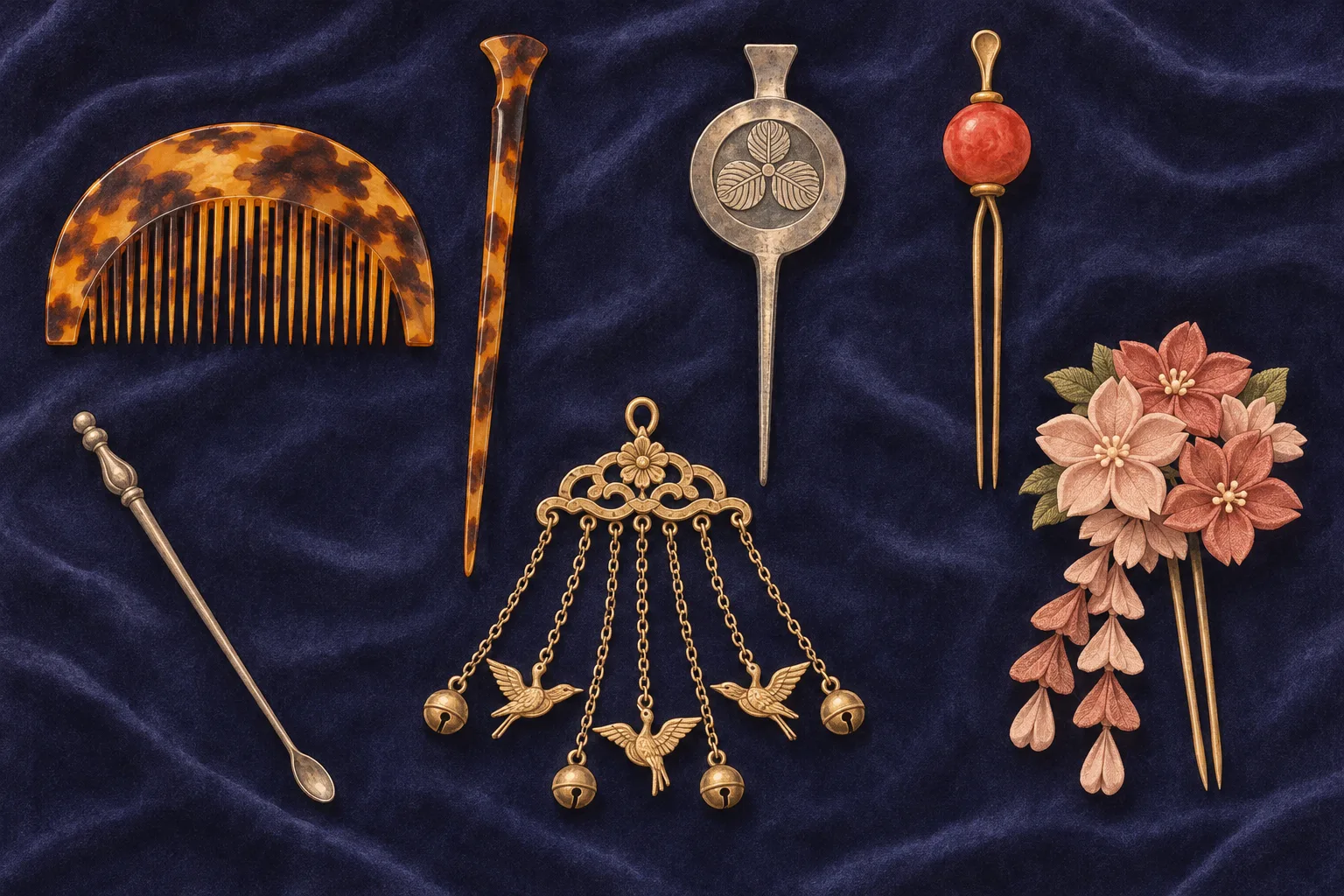
Top row, from left: tortoiseshell kushi, kōgai, hirauchi kanzashi, tama kanzashi. Bottom row: mimikaki kanzashi, birabira kanzashi, hana kanzashi.
Placement follows a pattern. On a formally dressed woman, from front to back, you will find: the comb above the forehead; flower or dangling pins at the front sides near the face; the knot; the bar through its base; and a bead or flat pin or two at the back.
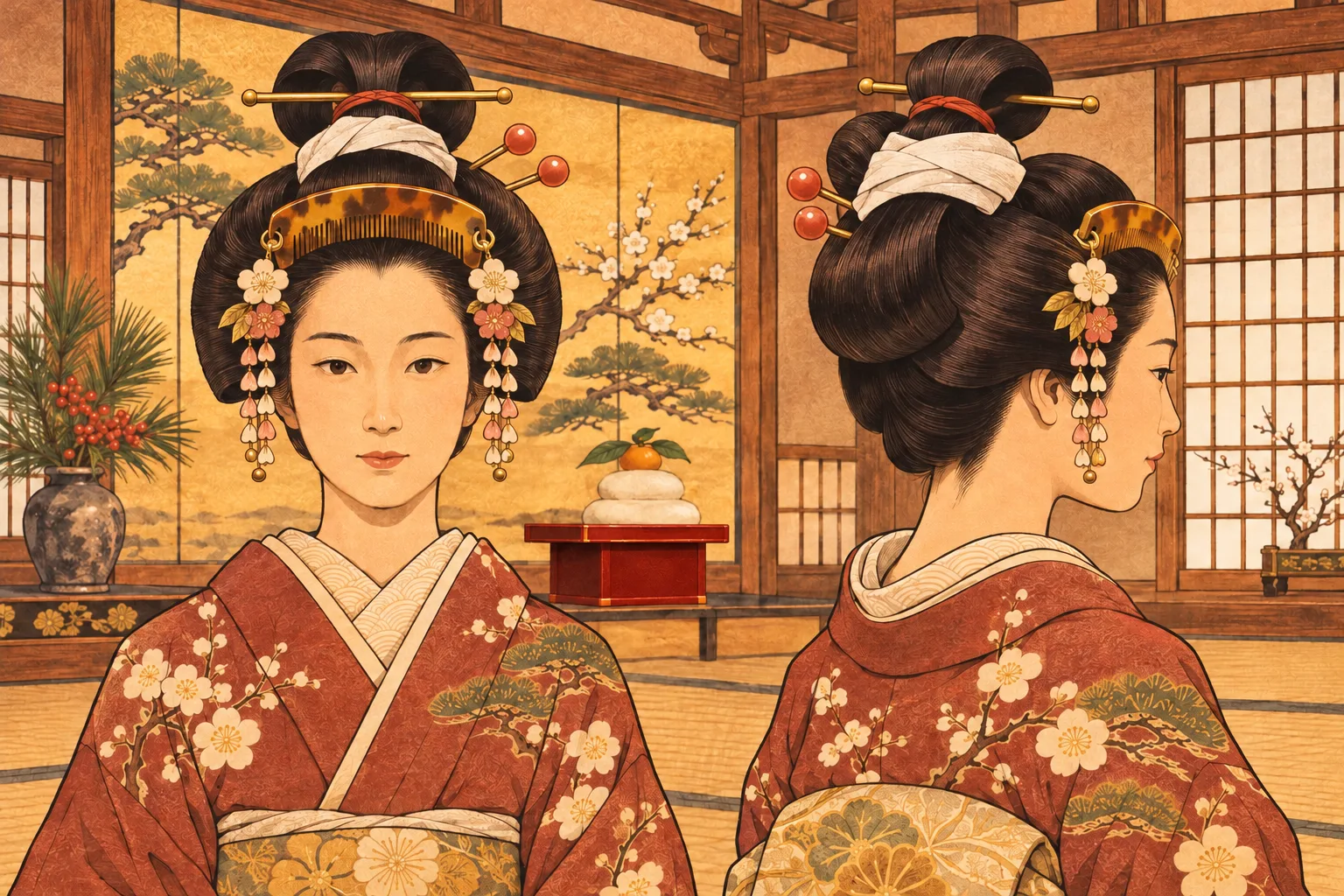
A formally dressed head, front and back: comb above the forehead, flower pins hanging beside the face, the bar through the base of the knot, bead pins at the back (artist’s impression)
08Why Edo Hair Kept Getting Bigger
Compare a katsuyama of the later seventeenth century with a shimada from around 1800 and the growth is startling. The later style has side locks spread out like translucent lantern paper, a tabo jutting back, and three or four pins and one or two combs on top. The whole head could be more than half the width of the shoulders.
Technology helped. In the 1760s and 1770s, the pleasure quarters took up binsashi, bow-shaped stiffeners of whalebone, inserted inside the side locks to hold them out. The result, tōrō-bin or "lantern side locks," was so thin that individual strands showed through. The cicada-wing side locks in the portraits of beauties by Kitagawa Utamaro and his contemporaries were mostly built this way. Similar inserts lifted the tabo, and improved pomade kept everything in place for days.
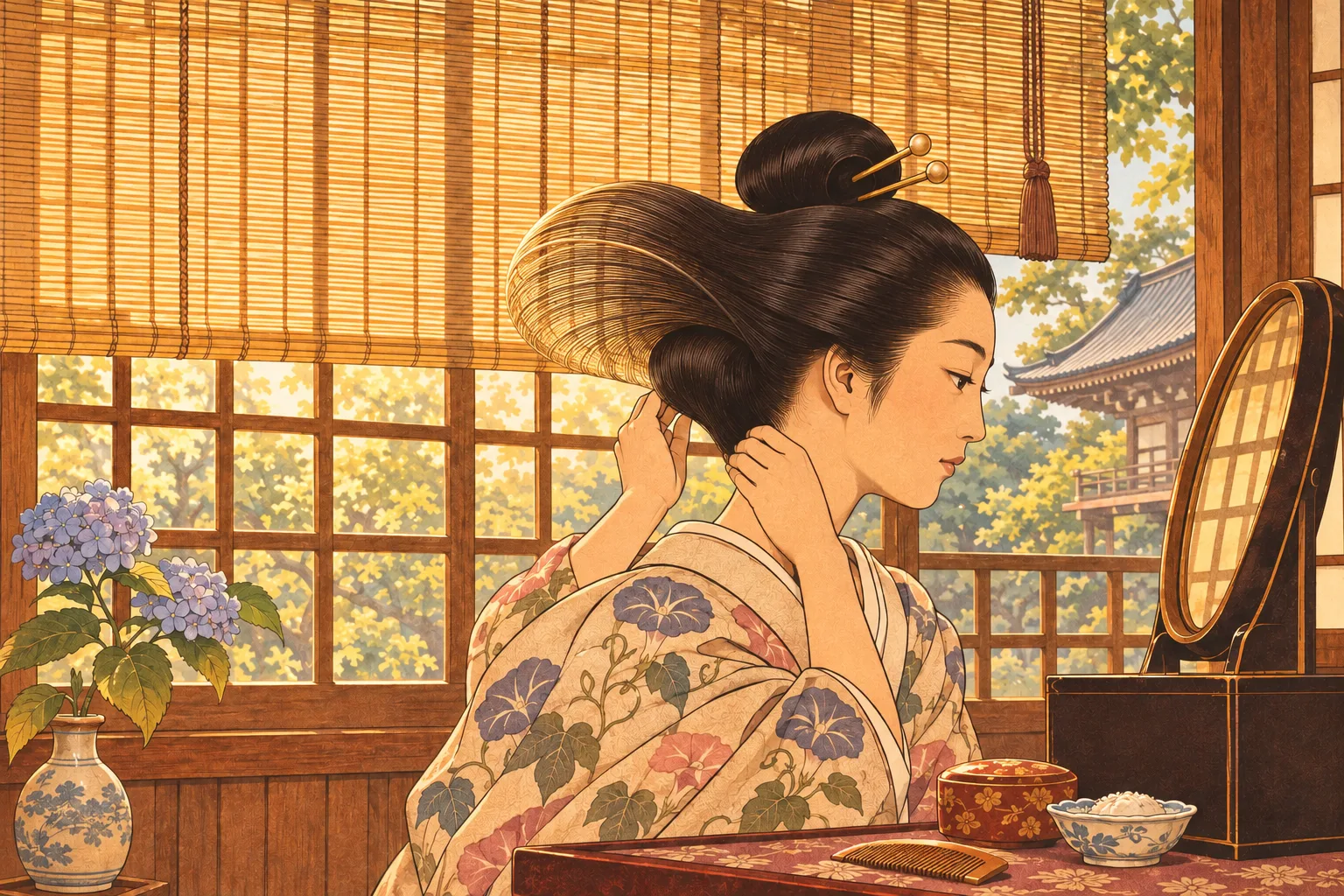
Tōrō-bin, "lantern side locks": the side hair is held out on a stiffener, thin enough for light and single strands to show through (artist’s impression)
Media spread it. Courtesans, geisha and the male onnagata actors who played women in kabuki launched new styles, and ukiyo-e artists drew them. The prints were cheap and sold widely, working much like fashion magazines; a look that started in the Yoshiwara could be on the streets within months.
And the tug-of-war between money and regulation fed it. As merchant families grew rich, they spent on their wives’ and daughters’ heads. The shogunate answered with sumptuary laws banning gold, silver and tortoiseshell and limiting the number of ornaments. Each restriction was met with a workaround: silver instead of gold, hawksbill shell renamed softshell-turtle shell, fewer pins made larger and finer.
By the end of the Edo period, a full nihongami was costly, slow and hard on the body. Dressing took an hour or two, hair went unwashed for a week, women slept on high pillows, and constant tight tying is said to have often left a bald patch at the crown. These burdens explain much of what came next.
09Meiji and After: The Rapid Retreat
In 1871 the Meiji government allowed men to cut off their topknots, and within a couple of decades the male topknot was nearly gone. Women took a different path. When some cut their hair short in imitation, the Tokyo prefectural government banned it with a notice in 1872, and the city’s minor-offences ordinance soon also penalised women for cutting their hair. So women kept their nihongami for the time being.
The turning point came in 1885, when the physician Watanabe Kanae and the economic journalist Ishikawa Eisaku founded the Fujin Sokuhatsu-kai, the Women’s Hair-Binding Society, which urged women to abandon nihongami for Western-style sokuhatsu, "bound hair." Its case was practical: Japanese styles were unhygienic, since hair went unwashed for days; uneconomical, requiring paid dressers, oil and ornaments; and inconvenient, interfering with work and sleep. Sokuhatsu meant simply combing the hair back and coiling it at the back or top of the head, without pomade or stiffeners. A woman could do it herself in minutes.
This was the era of the Rokumeikan, the Tokyo hall where the elite held Western-style balls, and fashionable women in Western gowns needed hair to match. The best known style was yakaimaki, "evening-party roll," in which the hair was twisted upward from both sides into a vertical roll against the back of the head and pinned. Other sokuhatsu variants carried names like "English knot" and "Margaret." Schoolgirls tied a large ribbon bow on their bound hair and wore maroon hakama, a look that came to define the Meiji schoolgirl. Around the Russo-Japanese War, a version of the hisashigami, "eaves hair," with a front that jutted high and forward, was nicknamed the nihyakusan-kōchi-mage, after Hill 203 at Port Arthur.
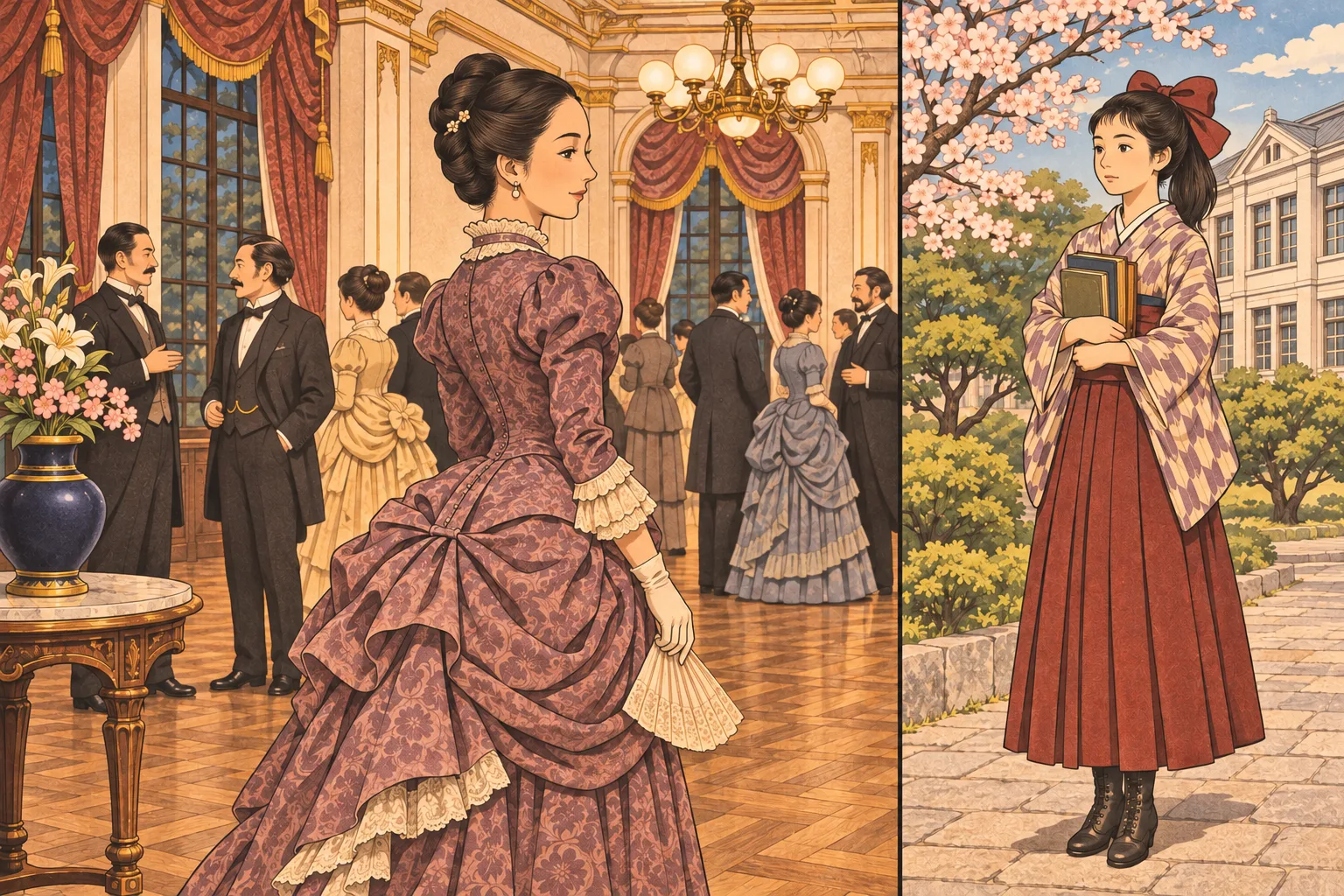
Left: a woman in a Western gown at an 1880s ball, her hair twisted up in a roll at the back. Right: a late Meiji schoolgirl with a large ribbon bow and maroon hakama (artist’s impression)
In the late Taishō era, mimikakushi, "ear-hiding," styles with iron-waved hair pulled low over the ears and gathered into a small bun, became popular, and in the Shōwa era more and more women cut their hair short and had it waved. Nihongami retreated to special occasions: weddings, New Year, the entertainment districts. After the Second World War it all but vanished from daily life, and the number of hairdressers able to build a full nihongami steadily shrank.
10Where to See It Today
The easiest place to see Japanese hair today is Coming of Age Day. On the second Monday of January, young people turning twenty attend ceremonies (most towns kept that age after the legal age of adulthood fell to eighteen in 2022), and many young women in furisode wear shin-nihongami, "new Japanese hair." It uses the woman’s own hair to create the outline of a traditional style, but without pomade or lantern side locks, keeping the bin and tabo small and rounded, and decorates it with dried flowers, mizuhiki cord, gold leaf, pearls and big silk flower pins. It takes a morning to dress and washes out the next day. Western-style updos with a modern kanzashi or two are increasingly common too.
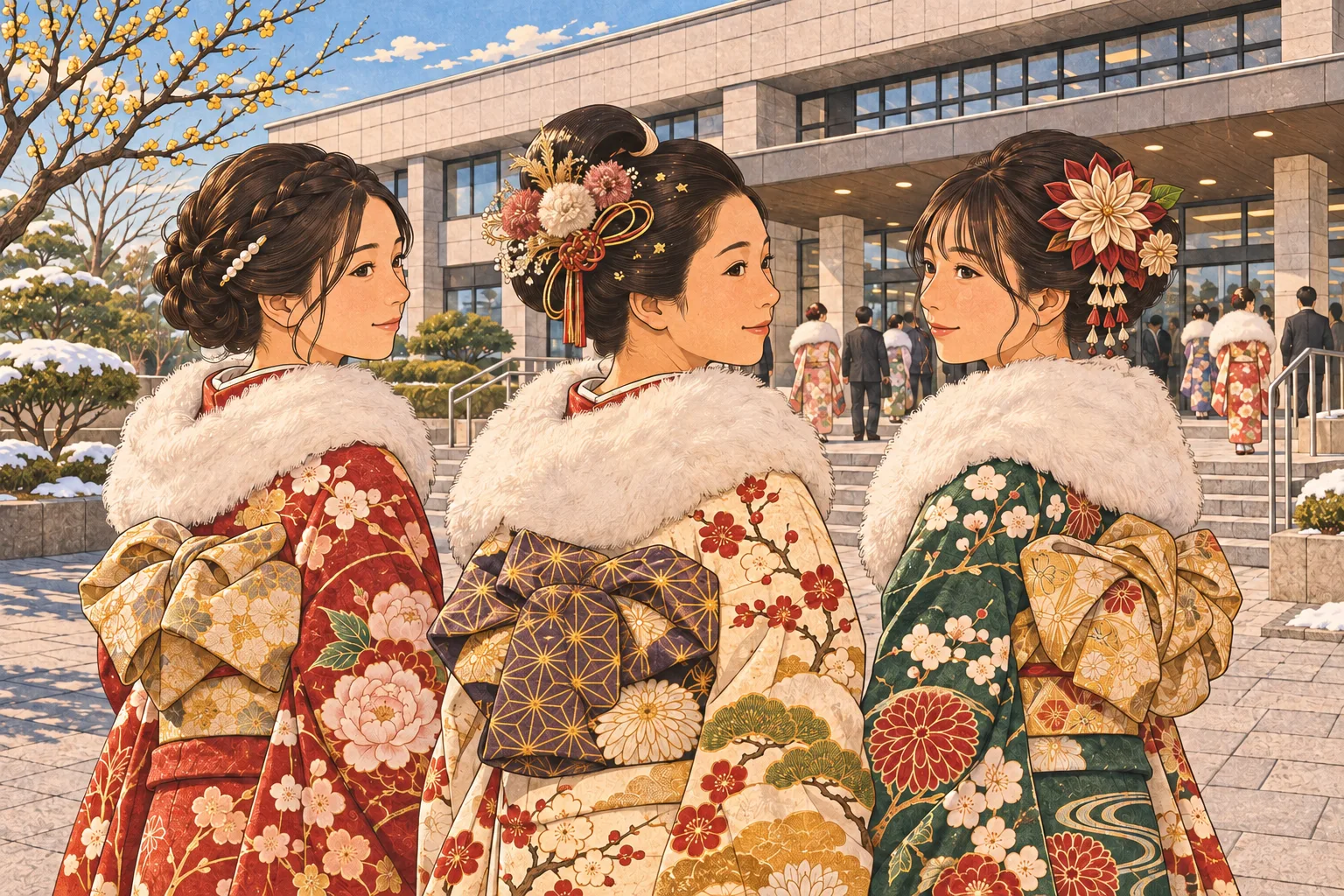
Coming of Age Day today: three young women in furisode, seen from behind to show their styled hair and large flower ornaments.
At weddings, brides at Shinto ceremonies wear bunkin taka-shimada, nearly always as a wig, with a full set of tortoiseshell combs, bar and pins, under a white hood or headband. Some brides now choose shin-nihongami with white silk flowers instead.
In period drama and kabuki, almost every hairstyle on screen or stage is a wig, katsura. A wigmaker shapes its thin copper base to the actor’s head; a specialist dresser called a tokoyama then styles it for the role, fits it before each performance and takes it off and stores it afterward. Use the code: a shimada is a young unmarried woman, a marumage a wife, a yoko-hyōgo an oiran.
Kyoto’s maiko still wear nihongami made from their own hair, restyled about once a week; they are almost the only women today who live with it every day. How their styles change with seniority is covered in our article on geisha.
Kyoto’s tayū and the oiran processions held at festivals show the grandest end of the spectrum: a dozen or more tortoiseshell pins and several large combs, swaying with each slow step.
Kyoto’s Festival of the Ages on 22 October parades costumed figures through the centuries, starting with the Meiji Restoration and working back to the founding of Kyoto, so Edo women in nihongami pass before Heian women with long loose hair. It is the whole story of this article walking past in reverse order.
Shops in Kyoto and Asakusa sell tsumami flower pins, tama kanzashi and hirauchi pins. Many people who wear kimono today use a single tama or flat pin to twist their hair up at the back, which is the easiest way to wear a kanzashi yourself.
More deep dives on this topic
 Kimono Types and Their RankSpend a Saturday afternoon in the lobby of a big hotel in Tokyo or Kyoto and you will see kimono that look, to an outsider, like variations on a single garment.
 The Obi and Its KnotsStand on a street corner in Kyoto’s Gion and watch two women in kimono walk away from you.
 Kimono Motifs and the SeasonsWalk through Kyoto in early March and you will see cherry blossoms on kimono sleeves weeks before a single tree has opened.
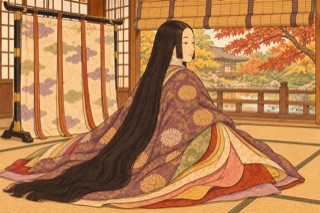 Japanese Hairstyles and KanzashiLook closely at a woodblock print of a street in late Edo or Meiji Japan and you can read the women in it like name tags.
 Men’s KimonoMost visitors to Japan see far more women in kimono than men, and when a man does walk past in kimono, he can look oddly uniform: dark colours, a short jacket, a narrow belt, flat…
 Putting On a Kimono, Layer by LayerWhen you rent a kimono in Kyoto or Asakusa, you stand in front of a mirror for fifteen or twenty minutes while someone wraps, pulls, tucks and ties, mostly out of your sight.
 KamonWalk through any old Japanese town and you will start to notice the same kind of image again and again: a small black-and-white emblem, perfectly symmetrical, usually inside a…
 The Life of a KimonoMost clothes are finished the day they are sewn.
- Back to the main article: Kimono →