
Walk through Kyoto in early March and you will see cherry blossoms on kimono sleeves weeks before a single tree has opened. By the time the real blossoms peak in early April, some careful dressers have already put their cherry kimono away. In the heat of July, someone passes in a sheer robe scattered with snowflakes; at a December tea gathering, a guest’s obi carries a single red camellia. Kimono motifs follow the calendar, and the core principle fits in one line: the season on the cloth should arrive a little before the season outside.
There is no national rulebook for this. Tea schools, Kyoto and Tokyo, and individual kimono shops all give slightly different answers, and many of the "meanings" attached to motifs are auspicious readings added long after the designs appeared. What follows is the common version you are most likely to hear. Learn a few dozen motifs, though, and a department-store kimono floor, a sweet shop’s glass case or a towel shop near a shrine suddenly becomes legible.
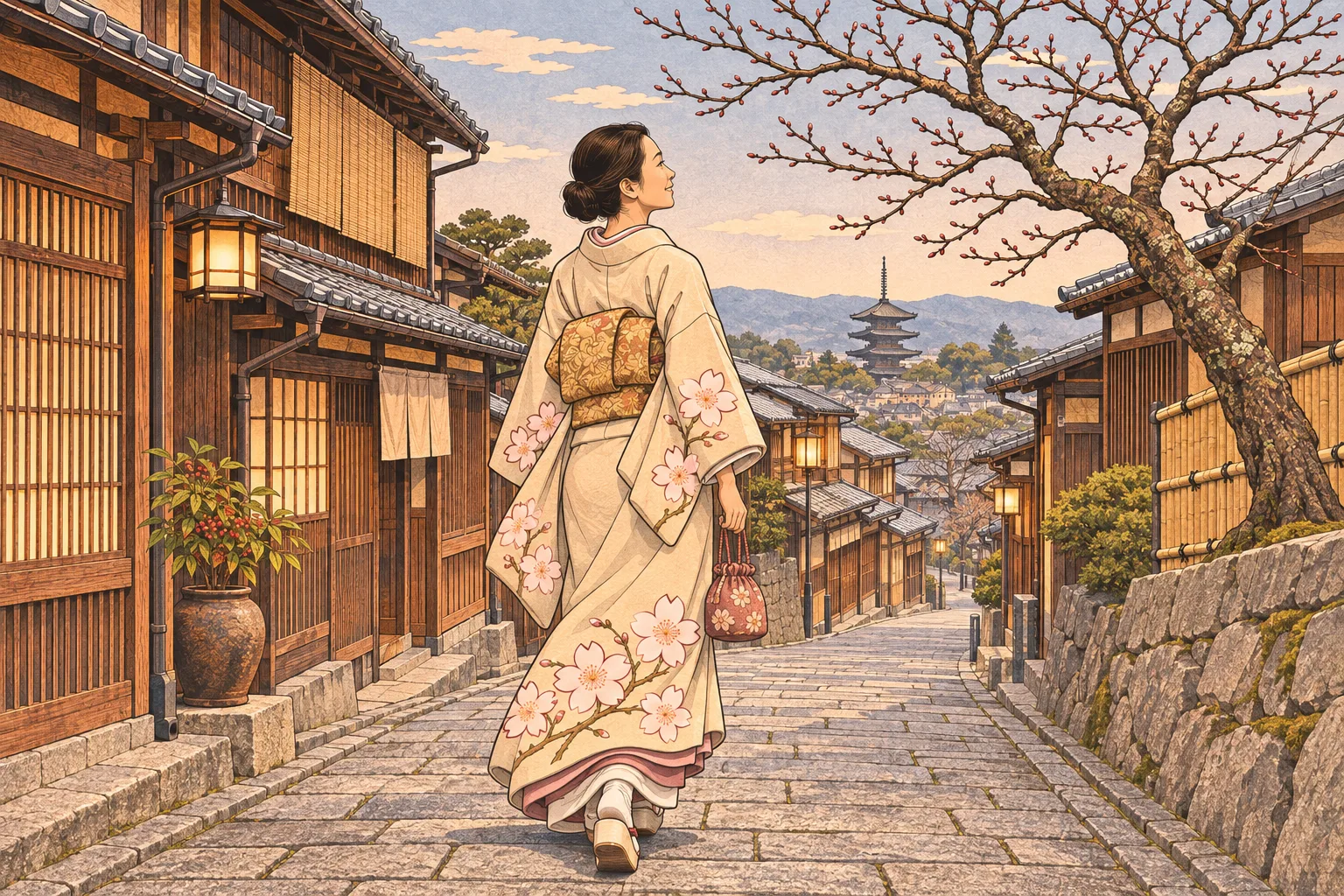
Kyoto in early March: the cherry tree by the road is still bare, but the blossoms are already out on her sleeves and hem.
01Why the Cloth Runs Ahead of the Season
Japanese seasonal sensibility is usually traced to classical poetry. Court poets of the Heian period (794–1185) wrote a great many of their poems about the seasons, and the tenth-century anthology Kokinshū arranges its spring, summer, autumn and winter books in a careful sequence, from the first day of spring to falling blossoms, from first snow to the year’s end. Later linked verse and haiku formalised this into kigo, season words: a single word that signals a time of year. Kimono motifs draw on that same ready-made vocabulary.
Heian aristocrats expressed the season mainly through colour, in the layered robes whose colour combinations carried seasonal names such as "cherry" or "autumn leaves." Pictorial motifs took over in the Edo period (1603–1868), when wealthy townspeople commissioned kosode robes from printed pattern books covered in bold designs of cherry, maple, chrysanthemum, flowing water and court carriages. Once a picture became the main event on a garment, the season moved from the colour into the image.
The fabric calendar is a separate track, covered in the main kimono article: lined awase from October to May, unlined hitoe in June and September, sheer usumono in high summer. Motif and fabric work together but do not map neatly onto each other. A lined kimono can carry cherries or maples; a sheer summer robe can carry pampas grass and bellflowers to announce autumn early.
Why run ahead? The usual explanation is that once the real flower blooms, the painted one loses. Wearing cherry blossoms under a tree in full bloom is said to compete with nature, which is both redundant and slightly gauche. A motif’s job is to announce, to tell the people around you that something is on its way. The same instinct runs through the tea ceremony, where scrolls, bowls and sweets also like to be half a step ahead.
02The Year in Flowers: January to June
Months below follow today’s calendar, but many customs grew out of the old lunar calendar, so a mismatch of two or three weeks here and there is normal.
January: pine, bamboo and plum. The trio known in China as the "three friends of winter" (pine stays green, bamboo stays upright, plum blooms in the cold) became Japan’s classic New Year combination, shōchikubai. Pine appears as radiating clusters of needles or as young pine shoots (wakamatsu); bamboo as small groups of leaves; plum as a branch or as five round petals in a simple crest. January kimono also carry battledores (hagoita), spinning tops and cranes, all New Year imagery.
February: plum (ume). The key to plum is roundness: five round petals, often just an outline with a few dots for stamens. Pointed or notched petals mean cherry; round ones mean plum, a rule that works on most kimono. Plum can be worn from late January, and by the time plum groves bloom in mid-February, a careful dresser is already hinting at peach or cherry. Plum is also tied to Sugawara no Michizane, the scholar enshrined as a god of learning, so plum crests mark Tenmangū shrines such as Dazaifu and Kitano, and many exam-season charms.
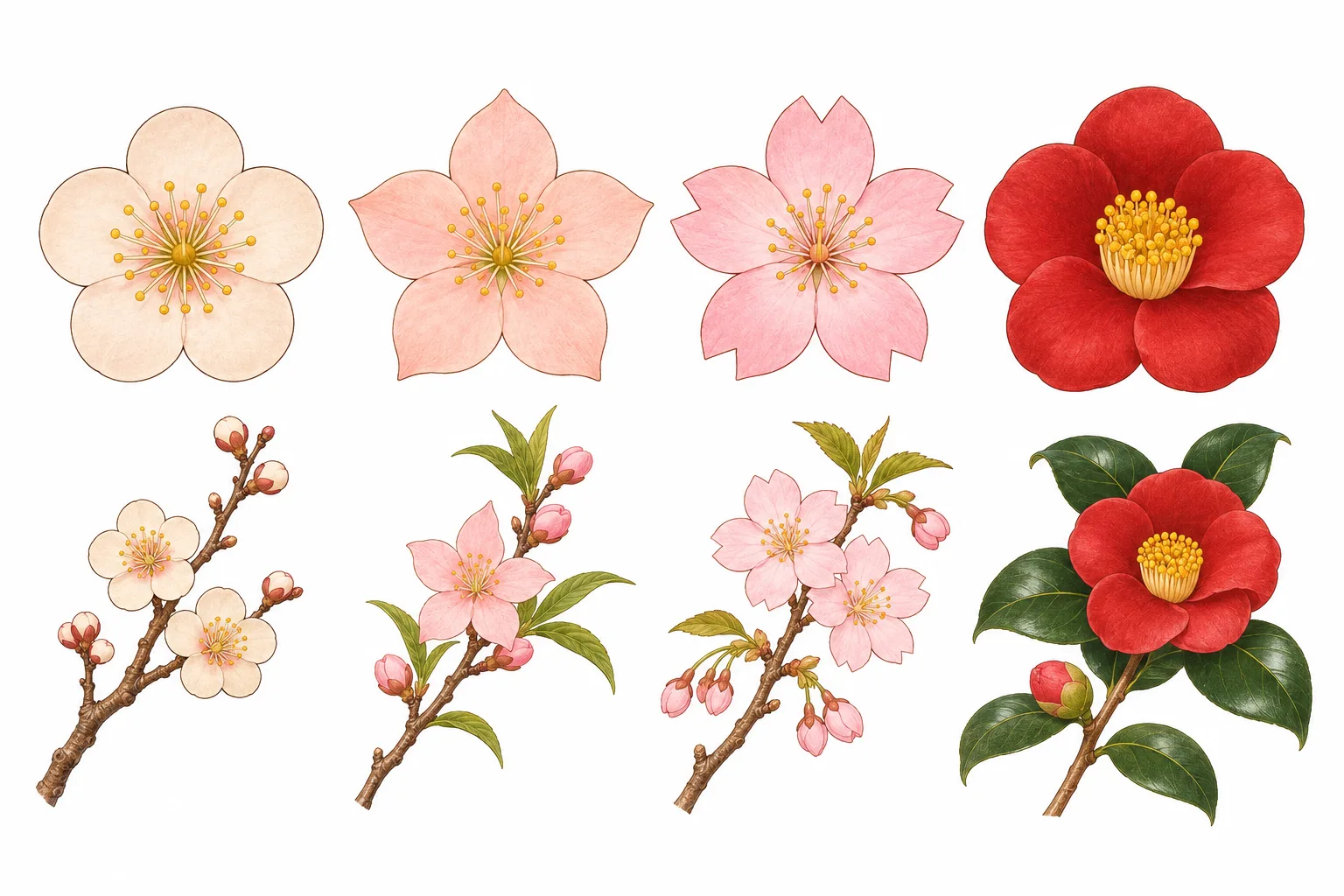
Four five-petalled flowers, from left: plum, with round petals; peach, with slightly pointed tips; cherry, with a small notch in each petal; camellia, with a heavy cluster of yellow stamens. Below, a sprig of each.
March: peach (momo). Peach blossoms look like plum with slightly pointed petal tips. Their season is tied to the Doll Festival on 3 March, so peach often appears with hina dolls, painted clam shells and diamond-shaped rice cakes. In Chinese lore peach repels evil, a meaning Japan inherited. After 3 March peach mostly disappears; its window is the shortest of all.
April: cherry (sakura). Cherry has the most rules. Look for a small notch at the tip of each of its five petals, and for loose petals scattered across the cloth (sakura chirashi). Cherry can be worn from March. Opinions split over the blossom season itself: those strict about running early say put it away so you don’t compete with the trees, the practice the main kimono article describes; others say Japan’s best-loved flower can be worn until the petals fall. A common compromise holds that realistic cherries should run early, while stylised ones are free. Cherry paired with maple, a design called unkin ("clouds and brocade," for blossoms like white clouds in spring and leaves like brocade in autumn), covers both seasons and can be worn all year.
May: wisteria and kakitsubata iris. Wisteria hangs in long purple racemes with curling vines, best from late April into May; the sagarifuji family crest bends two hanging racemes into a circle. The iris motif shows stiff sword-shaped leaves and three large drooping purple petals, often beside water. Its source is episode 9 of The Tales of Ise: travelling east, the hero reaches Yatsuhashi ("Eight Bridges") in Mikawa, sees irises blooming by the water, and composes a poem of longing for the capital whose lines begin with the five syllables of ka-ki-tsu-ba-ta. So the iris often appears with a zigzag plank bridge. Ogata Kōrin’s Irises screens at the Nezu Museum in Tokyo, shown each spring when the irises bloom, treat the same subject. Several irises (ayame, hanashōbu, kakitsubata) look alike and are freely mixed on kimono.
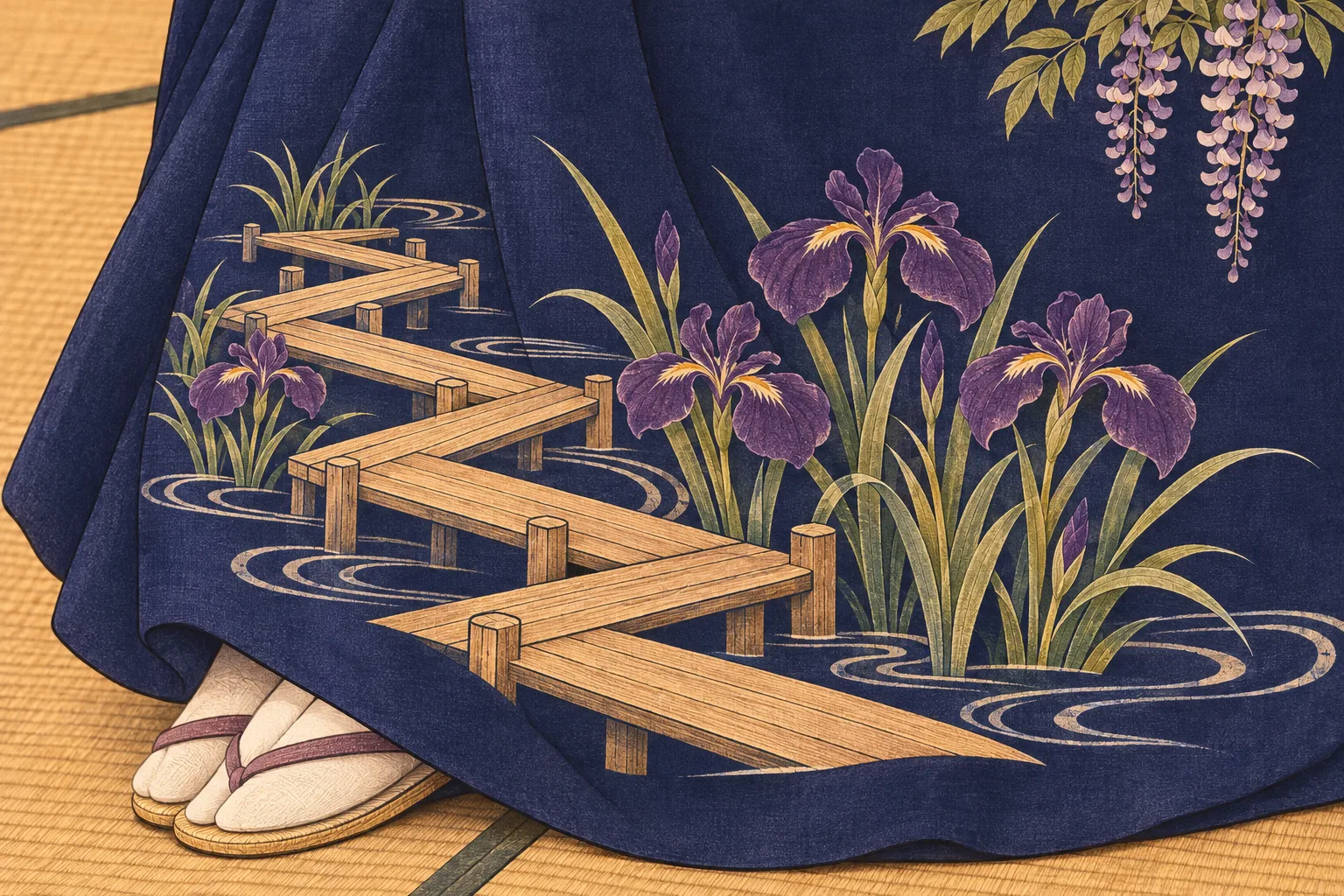
Yatsuhashi on a hem: irises with sword-shaped leaves and deep purple petals beside a zigzag plank bridge. The racemes hanging in the top right corner are wisteria.
June: hydrangea (ajisai). Hydrangea appears as a ball of tiny four-petalled flowers shading from blue to violet to pink. June is the rainy season and the month of unlined kimono, so hydrangea often comes with rain lines, snails or umbrellas. It was not especially popular in the Edo period (one theory says its changing colour suggested fickleness), and its current status as the rainy-season flower is fairly recent. June kimono also carry sweetfish and flowing water, anticipating summer’s cool.
03The Year in Flowers: July to December
July and August: morning glory, flowing water, dragonflies. In the sheer-fabric months, motifs shift from announcing the season to offering coolness. Morning glory (asagao) shows trumpet flowers, usually three-lobed leaves and curling tendrils, usually in blue, purple and white. The late-Edo craze for breeding odd varieties is covered in the yukata article; growing them took off at Iriya in Tokyo at the end of the Edo period and peaked in the Meiji era, and today’s July morning-glory fair there was revived in 1948. In haiku, asagao is technically an autumn word, but on kimono it belongs firmly to midsummer, one of several places where textile convention and poetic convention part ways. The yukata article covers morning glories, goldfish and dragonflies on cotton; they appear on summer silk too.
Flowing water (ryūsui) is summer’s main cooling device: a few undulating parallel lines, sometimes with swirls, as in kanzemizu, the eddy pattern associated with the Kanze school of Noh. Water itself has no season; what floats on it decides. Cherry petals on water make hanaikada ("flower rafts," spring); sweetfish make it summer; maple leaves make it autumn.
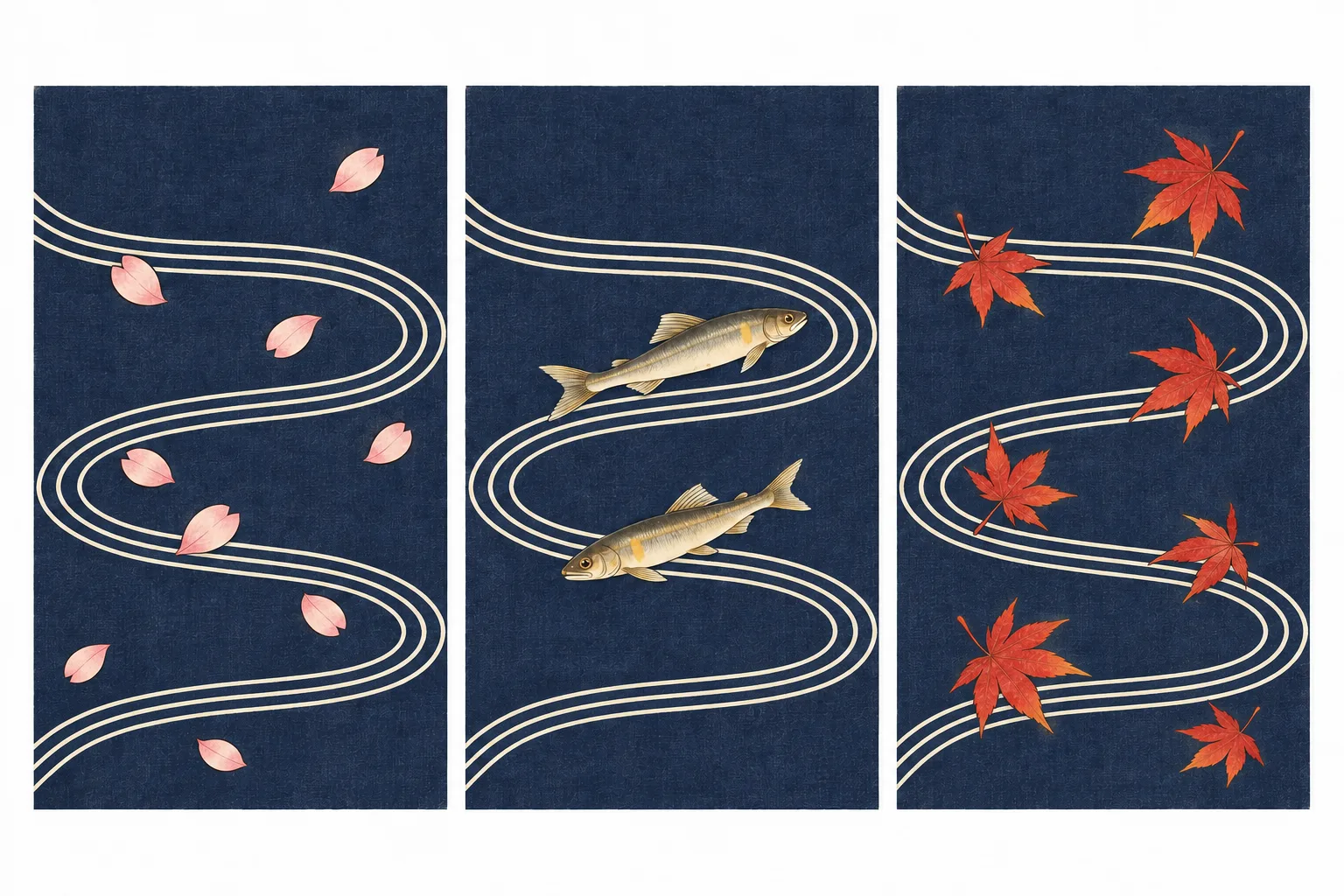
The same flowing water, three seasons, from left: cherry petals for spring (hanaikada), sweetfish for summer, maple leaves for autumn.
Dragonflies (tonbo) appear as slim silhouettes with two pairs of clear wings. Since they fly from late summer into autumn, July is anticipation and August is right on time. Samurai prized them as kachimushi, "victory insects," a point the yukata article covers.
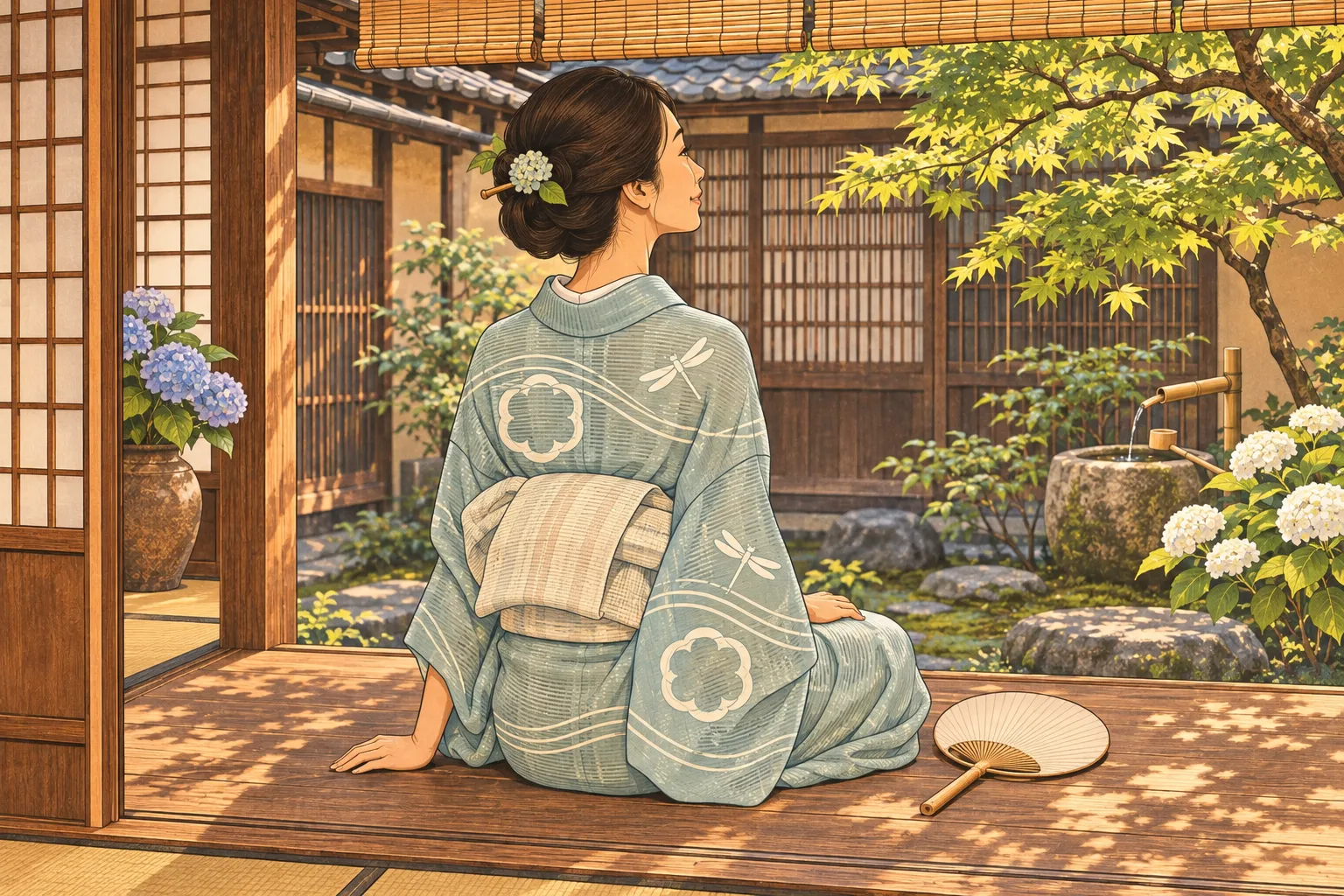
A sheer summer kimono dressed in coolness: lines of flowing water, plump snow rings and two dragonflies.
September: autumn grasses. The "seven grasses of autumn" (bush clover, pampas grass, kudzu, pink, patrinia, boneset and bellflower) come from two poems by Yamanoue no Okura in the eighth-century Man’yōshū (the plant he calls asagao is generally taken to be the bellflower). Kimono rarely show all seven; common choices are the long plumes of pampas grass, the tiny round leaves and magenta flowers of bush clover, and the star-shaped violet bellflower. Autumn grasses are a favourite for running early: on a sheer August robe they are much admired, a breath of autumn in the heat. 9 September is the Chrysanthemum Festival, when chrysanthemum motifs come in.
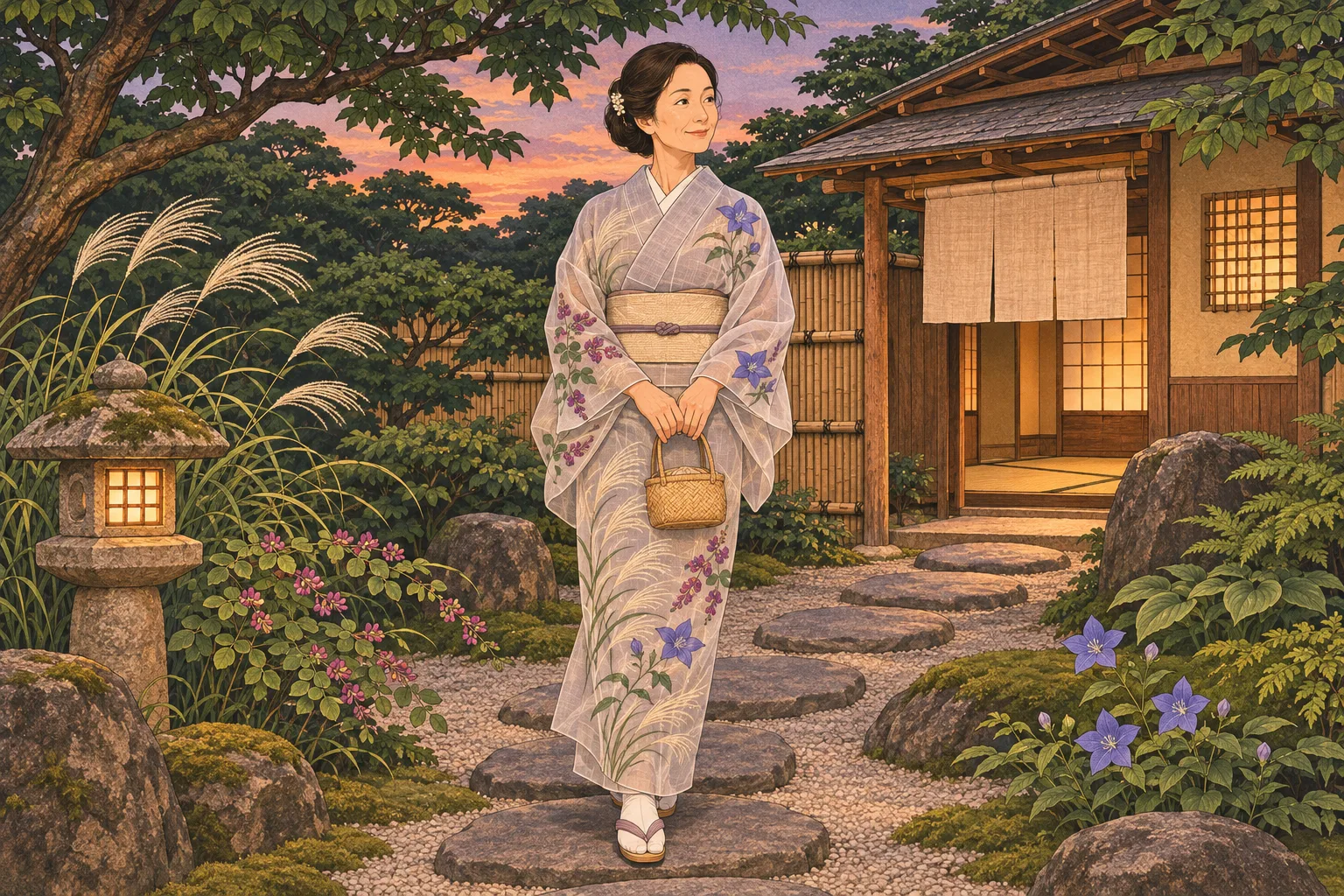
The trees are still summer green, but the kimono already shows autumn grasses: pampas plumes, magenta bush clover and star-shaped bellflowers.
October: chrysanthemum (kiku). Look for many slender petals radiating in a circle, realistic or rounded into fluffy balls or flat roundels. Imported from China, the chrysanthemum was linked to long life at the Heian court, where people drank chrysanthemum wine and wiped themselves with dew-soaked floss on 9 September. The sixteen-petal chrysanthemum is the imperial crest, a separate matter from kimono design. Because of its longevity meaning, stylised chrysanthemum is effectively worn all year.
November: maple leaves (momiji). Maple leaves have five to seven points, like small open hands. Maple on flowing water is the Tatsutagawa design, from Ariwara no Narihira’s poem in the Hyakunin Isshu anthology about the Tatsuta River dyed crimson by floating leaves. Maple can start in October; once the hills are fully red in mid-November, a careful dresser may switch to ginkgo or fallen leaves.
December: snow rings and camellia. The snow ring (yukiwa) is not a crystal but a circle with six rounded indentations, a plump six-lobed flower shape representing the outline of snow. At the end of 1832 (some sources say 1833) Doi Toshitsura, lord of Koga, published Sekka zusetsu ("Illustrations of Snow Flowers"), drawings of crystals he had studied through a Dutch microscope, and angular six-pointed "snow flower" patterns became fashionable in Edo. So kimono have two kinds of snow, round and angular. Surprisingly, snow rings also appear on sheer midsummer robes, for the cooling effect. And the snow ring often serves as a frame holding other flowers, at which point it loses its season.
The camellia (tsubaki) has five round petals around a thick bundle of yellow stamens, with glossy leathery leaves. It blooms from December to March and is a tea master’s favourite; the small white wabisuke camellia is nearly indispensable in winter tea rooms. A widely repeated story says samurai avoided camellias because the flower drops whole, like a severed head. Many Edo shoguns and lords were enthusiastic camellia breeders, so the story is generally thought to be a later invention.
04How Early Is Early, and What Works All Year
The practice of running ahead is called sakidori. The usual guidance is about a month early, stopping once the real thing begins to bloom: plum in January, cherry in March, maple in October. Some say half a month is enough and anything earlier looks impatient.
The rules are strictest at tea gatherings, formal seasonal events and certain old Kyoto shops. On the street, no one will scold you for cherry blossoms on 10 April. Kimono shop staff commonly say enjoyment comes first; just don’t wear heavy winter imagery in August.
A kimono you can wear for only one month is poor value, so a large share of designs are deliberately seasonless. They fall into four groups. First, all-seasons designs: cherry, wisteria, chrysanthemum and maple together on one garment (shiki no hana, "flowers of the four seasons"), common on furisode and visiting kimono that will be worn to coming-of-age ceremonies, weddings and New Year. Second, flowers stylised past the point of seasonality, such as round floral medallions (hanamaru). Third, auspicious motifs. Fourth, court patterns and geometrics. The next three sections take these in turn.
05Auspicious Motifs
Auspicious motifs are the language of celebration, concentrated on wedding robes, the hems of black formal tomesode, furisode, children’s Shichi-Go-San outfits and coming-of-age kimono.
Crane and tortoise. A proverb says "the crane lives a thousand years, the tortoise ten thousand," so the pair stands for long life. Cranes fly with wings spread or stand with a red crown; the roundel form, tsurumaru, is a family crest borrowed by Japan Airlines for its logo. Kimono tortoises often trail a long fringed "tail," which is actually seaweed grown on an ancient shell (minogame), a sign of great age. Cranes and tortoises in gold embroidery on red or white are standard on wedding uchikake.
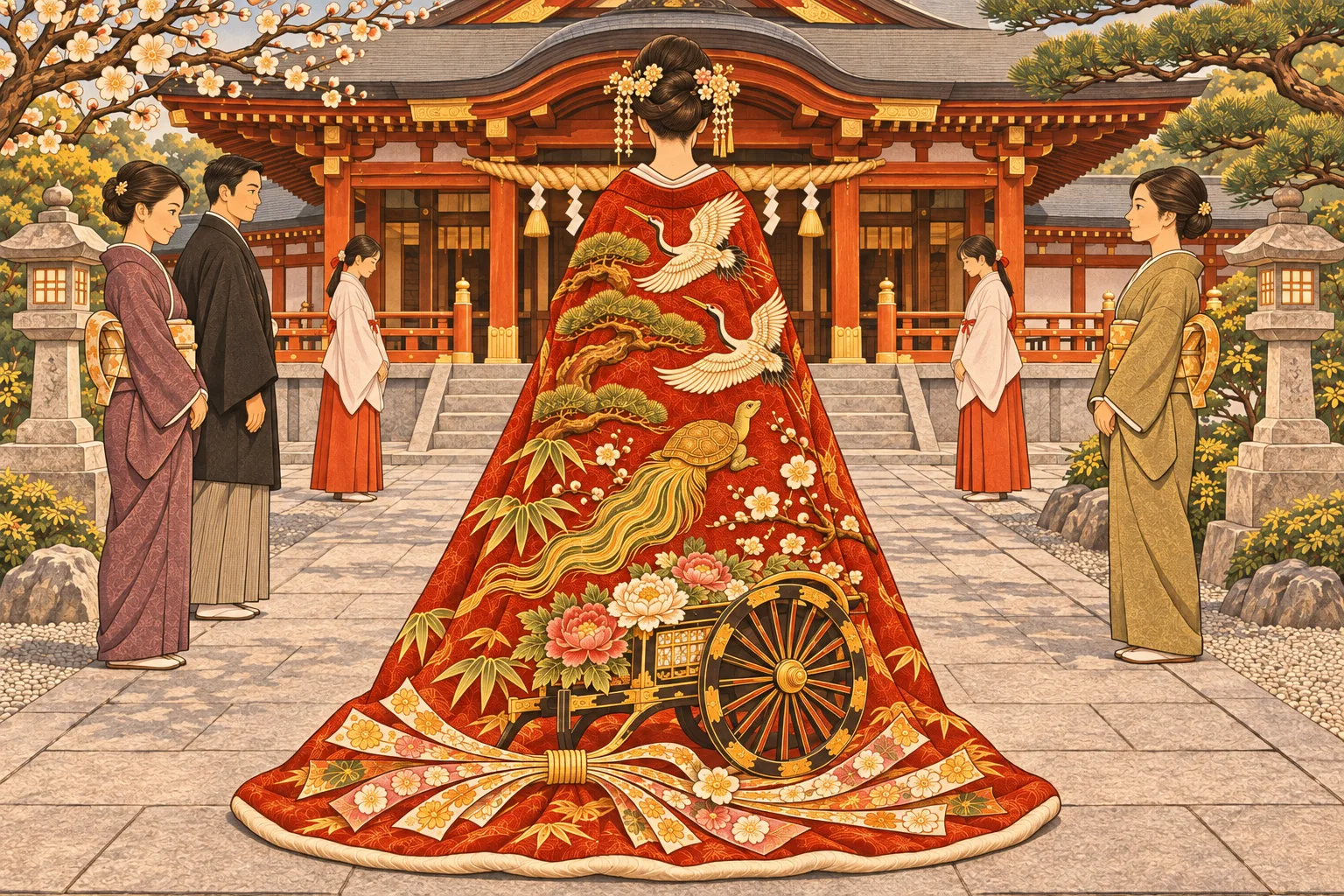
A wedding uchikake, gold on red and covered in auspicious motifs: flying cranes and pine above, a flower-filled court carriage below, and a bundle of noshi fanning out along the hem.
Pine, bamboo and plum. The trio is the most stable auspicious set. It is so familiar that restaurants use it as a ranking: sushi and eel sets often come as matsu, take and ume, with pine the most expensive. That ranking is a later commercial habit; originally the three were equals.
Treasures (takarazukushi). A scatter of magical objects derived from the Chinese "eight treasures": the wish-granting jewel, the magic mallet that produces whatever you want when shaken (the one Issun-bōshi uses to grow tall), the hat and straw cape of invisibility, a money pouch, a weight for measuring gold, clove buds, the key to a treasure house, scrolls and interlocking rings. Cheerful and busy, it suits children’s clothes, New Year obi and gift wrappings.
Court carriage (goshoguruma). The ox-drawn carriage of Heian nobles, with large spoked wheels and a curtained cabin. On kimono it is often heaped with flowers of every season (hanaguruma), which makes it wearable year-round and one of the most common furisode themes. Wheels alone are genjiguruma, evoking The Tale of Genji; wheels half-submerged in water (katawaguruma) recall the practice of soaking wooden wheels in the Kamo River to stop them cracking.
Fans (senmen). An open fan widens from its pivot, a shape called suehiro, "spreading toward the end," meaning growing prosperity, so fans are fixed features of weddings and celebrations. Fans often act as windows framing landscapes or flowers; fans drifting on water are ōgi nagashi.
Noshi. The motif foreign visitors most often mistake for ribbons: a bundle of long, narrow strips tied at the middle and fanning out, tabane noshi. Noshi were originally strips of abalone, shaved thin, stretched and dried, attached to gifts as a token of good fortune; the small folded hexagon on the upper right of a Japanese money envelope is its descendant. A bundle of many strips is usually read as many people’s blessings tied together, and each strip on a furisode is usually filled with its own flowers. Note that noshime is something different: a samurai garment worn under formal kamishimo, with a woven band of checks or stripes across the waist, later used as a Noh costume.
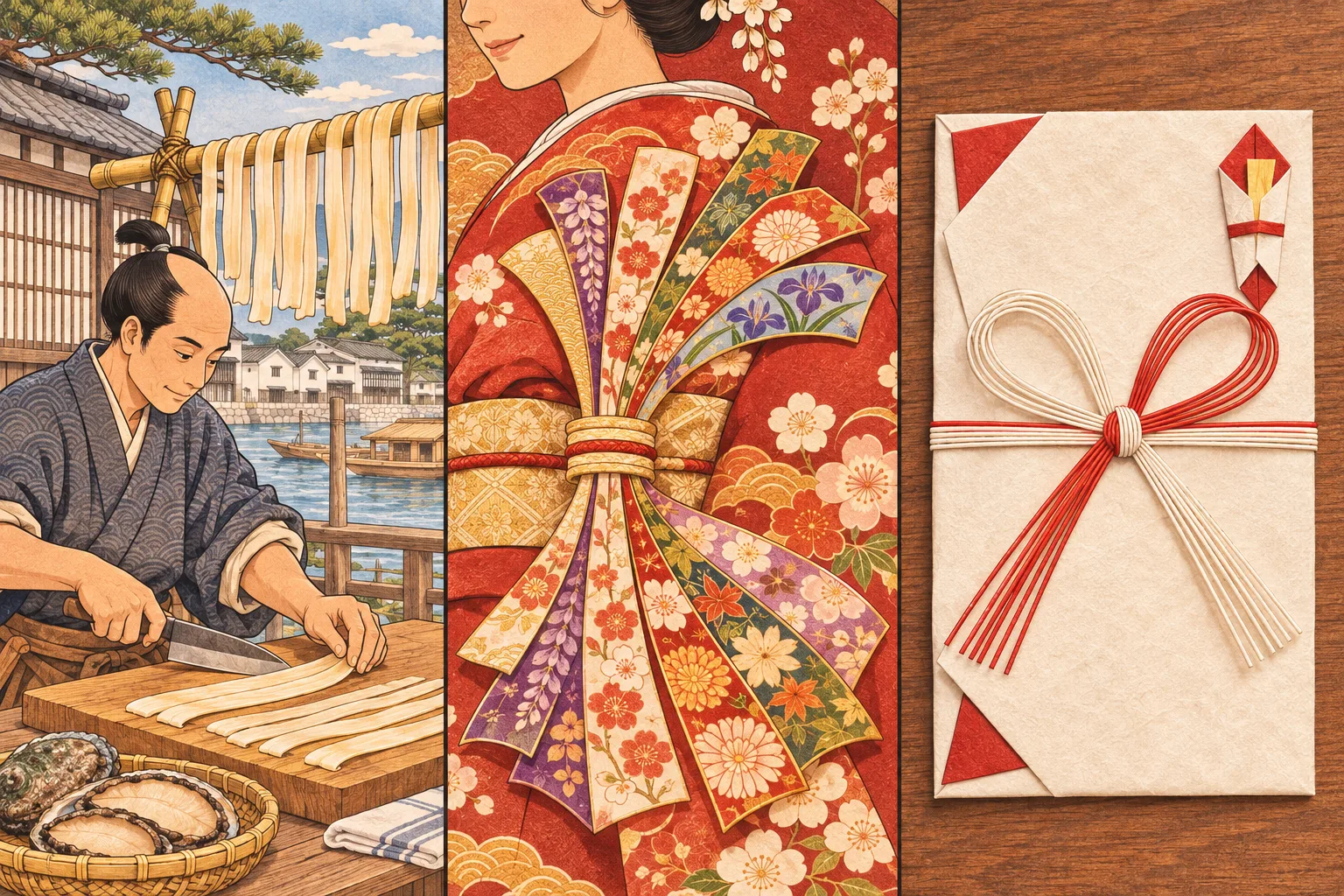
Where noshi comes from. Left: abalone shaved into strips and hung to dry. Centre: a bundle of noshi on a furisode. Right: the small folded noshi on the upper right of a modern money envelope (artist’s impression)
06Court Patterns (Yūsoku Mon’yō)
Yūsoku refers to the protocols of the imperial court. Yūsoku patterns are the regular, symmetrical, repeating designs fixed on court costume and furnishings from the Heian period on, many traceable to Tang China and beyond to the Silk Road. Today they signal refinement and appear on formal fukuro obi, visiting kimono, the woven ground of single-colour iromuji, weddings and tea.
Tatewaku (rising steam). Two vertical wavy lines that swell and pinch in mirror image, forming a chain of gourd-like shapes, said to represent rising vapour. The spaces are often filled: clouds (kumo tatewaku), wisteria or chrysanthemum. At court different versions reportedly marked rank, cloud tatewaku being reserved for the very highest. Today it is common on obi and on the silk cloths and paper used in tea.
Kikkō (tortoiseshell). A honeycomb of hexagons, from the pattern on a tortoise’s shell, and so a longevity sign. Hexagons are often filled with flowers; three hexagons combined into a pointed shape form bishamon kikkō, the armour pattern of the guardian deity Bishamonten. Izumo Taisha’s shrine crest is a double hexagon enclosing a four-petalled flower divided by sword blades (nijū kikkō ni ken hanabishi), visible on its curtains, lanterns and roof tiles.
Shippō (seven treasures). Circles overlapping each other by a quarter, repeated endlessly, leaving four-pointed stars between them. The name refers to the seven precious substances of Buddhist scripture; another explanation links the word to shihō, "four directions," since the pattern spreads infinitely. Today people say the linked rings stand for human bonds and harmony, a modern reading. Seasonless and everywhere: kimono, obi, towels, ceramics.
Seigaiha (blue sea waves). Rows of overlapping semicircles, each filled with concentric arcs, like an endless sea. The design is often traced to Persia, reaching Japan via China, and takes its name from the court dance Seigaiha, whose dancers wore it. In The Tale of Genji’s "Beneath the Autumn Leaves" chapter, Genji and Tō no Chūjō dance Seigaiha under the maples, one of the book’s most dazzling scenes. An Edo lacquer artist known as Seikai Kanshichi is said to have popularised it. It is usually said to mean calm seas and lasting luck, and appears on sushi-shop curtains and sweet wrappers.
Hishi (diamond). A square set on its point. It repeats plainly, blooms into four-petalled hanabishi, or stacks large and small diamonds into the stepped matsukawabishi ("pine bark"). Court costume from the Heian period on, including the ladies’ unlined hitoe robe, was often woven with a dense pattern of four flower diamonds combined into one large diamond. It was first called sakiaibishi; in the early modern period the name was rewritten with the lucky character for saiwai, "happiness," giving saiwaibishi. Court robes of modern times still use it, and it is a common auspicious weave on obi and single-colour kimono. The Takeda clan’s crest, four diamonds forming one large diamond, is everywhere in Yamanashi. On kimono the diamond is often woven into the ground, visible only up close.
Karakusa (Chinese grass). Endlessly curling, branching vines. The motif’s ancestry runs back to Egyptian and Greek plant ornament, travelling via the Silk Road to China and then Japan, hence "Chinese." Unbroken growth is usually read as family prosperity. Paired with peony or chrysanthemum it becomes botan karakusa or kiku karakusa. Every Japanese person knows the green-and-white karakusa furoshiki wrapping cloth: nearly every Shōwa-era household had one, and cartoon burglars always carry their loot in one, a standing comic image.
07Geometrics and Edo Komon
If court patterns came from the palace, another set of geometrics came from samurai and townspeople. Most are small, dense and seasonless.
Asanoha (hemp leaf). A hexagonal grid with lines radiating from each centre to form star-shaped "leaves," so the whole looks like interlocking six-pointed stars. Hemp grows fast, straight and strong, hence its use on baby clothes, as the yukata article explains. In the early nineteenth century it became fashionable among women in Kyoto and Osaka; one account credits the kabuki actor Arashi Rikan, who wore it as the greengrocer’s daughter Oshichi. Nezuko’s kimono in Demon Slayer revived it for a new generation. It also appears in the wooden latticework (kumiko) of temple and teahouse windows.
Ichimatsu (checkerboard). Alternating squares of two colours. The pattern is ancient, called ishidatami ("paving stones") at the Heian court. In 1741 the kabuki actor Sanogawa Ichimatsu wore white and indigo checked hakama as a young page at Edo’s Nakamura-za, and the pattern took his name. Tanjirō’s green-and-black haori in Demon Slayer and the Tokyo 2020 Olympic emblem (kumi ichimatsu mon) are modern variations. Its unbroken repetition is now commonly read as continuing prosperity.
Yagasuri (arrow feathers). Rows of fletching shaped like chevrons, offset row by row. An arrow, once shot, does not come back, so, the saying goes, Edo-period brides took arrow-feather kimono to their new homes as a promise not to return. The schoolgirl outfit of kimono and hakama described in the main article most often used arrow feathers, which is why yagasuri now stands for "Taishō romance" and turns up at university graduations.
Same (shark skin). Tiny dots arranged in overlapping fan-shaped arcs, like the minute scales on sharkskin. It is said to have been reserved for the Kishū branch of the Tokugawa family; hard sharkskin suggested armour and warded off evil.
Gyōgi (proper conduct). Tiny dots in neat diagonal rows, like orderly ranks of people; the name is usually explained as "good manners."
Kakudōshi (squares through). Tiny square dots in a strict vertical and horizontal grid, read as "following the straight path."
Same, gyōgi and kakudōshi are the "three great" Edo komon patterns, the most formal of the type. Komon ("small pattern") grew from the samurai’s formal kamishimo. Each daimyo house had its own fixed pattern, which others could not use, so retainers could be identified at Edo Castle. The patterns were so fine that from a distance the cloth looked plain. Townspeople took up komon too: plain from afar, intricate up close, it fitted the understated taste that the main article links to Edo sumptuary laws. Playful komon hide radishes, animals or the characters for "great luck" in what look like dots. The term "Edo komon" itself is surprisingly recent: it was coined in 1952, when the government selected Komiya Kōsuke’s stencil dyeing as an intangible cultural property and needed to distinguish it from ordinary komon.
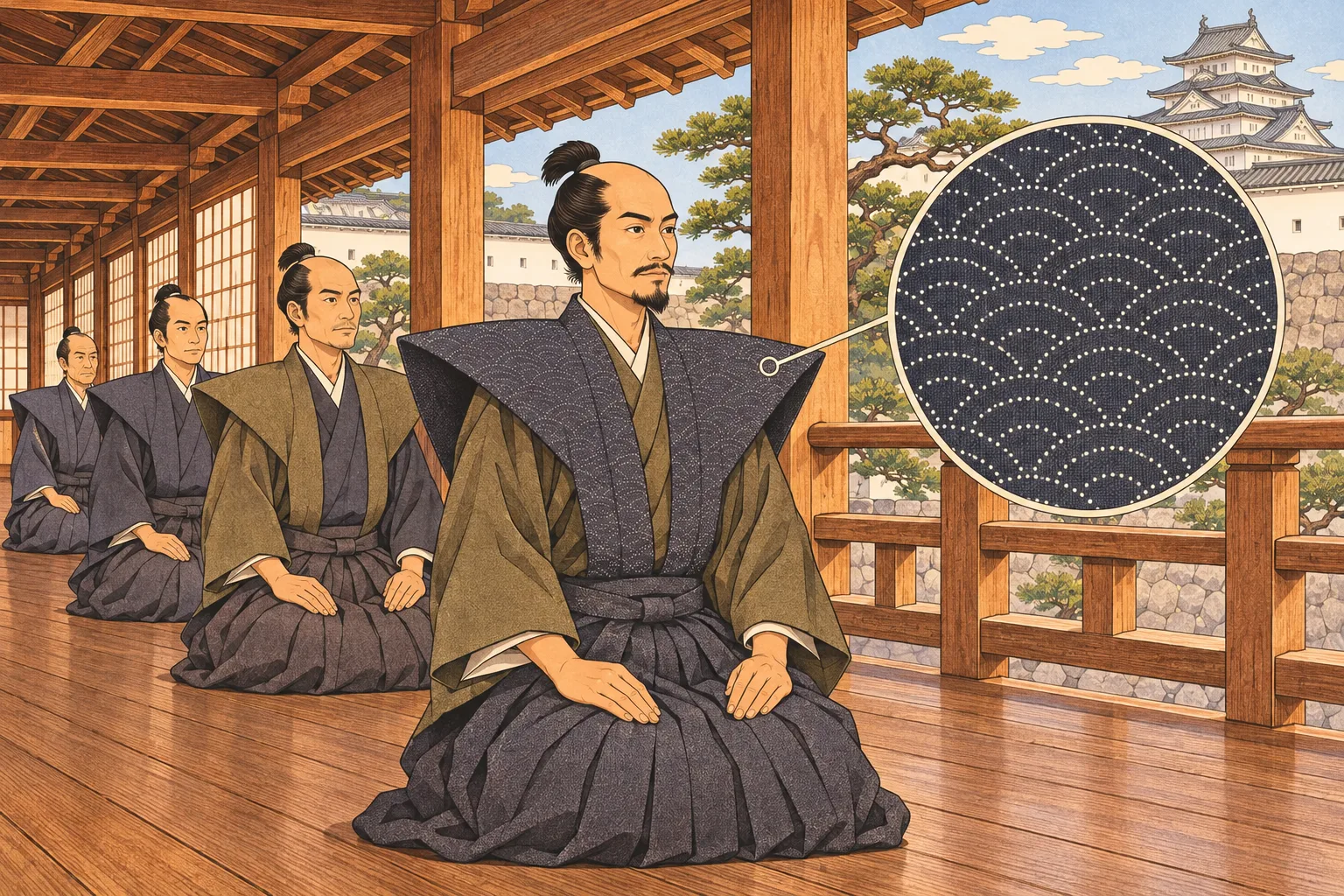
Samurai in kamishimo look plain from a distance; the magnified circle shows the cloth is covered in same, tiny dots in fan-shaped arcs (artist’s impression)
With a single family crest, one of the three great komon ranks with a one-crest iromuji and is suitable for tea gatherings. Other komon are smart everyday wear for shopping, theatre or lunch.
08Side by Side: The Twelve Months and the Geometrics
Five-petalled flowers. Plum, peach and cherry are the classic confusion. Plum petals are round with no gap between them; peach petals have slightly pointed tips; cherry petals have a small V-shaped notch. Camellia also has five round petals but is larger, with a heavy cluster of yellow stamens and glossy leaves; plum is often shown without leaves.
The calendar in one line. January pine-bamboo-plum; February plum; March peach; April cherry; May wisteria and iris; June hydrangea; July and August morning glory, water and dragonflies; September autumn grasses; October chrysanthemum; November maple; December snow ring and camellia. Shift each about a month earlier when wearing it.
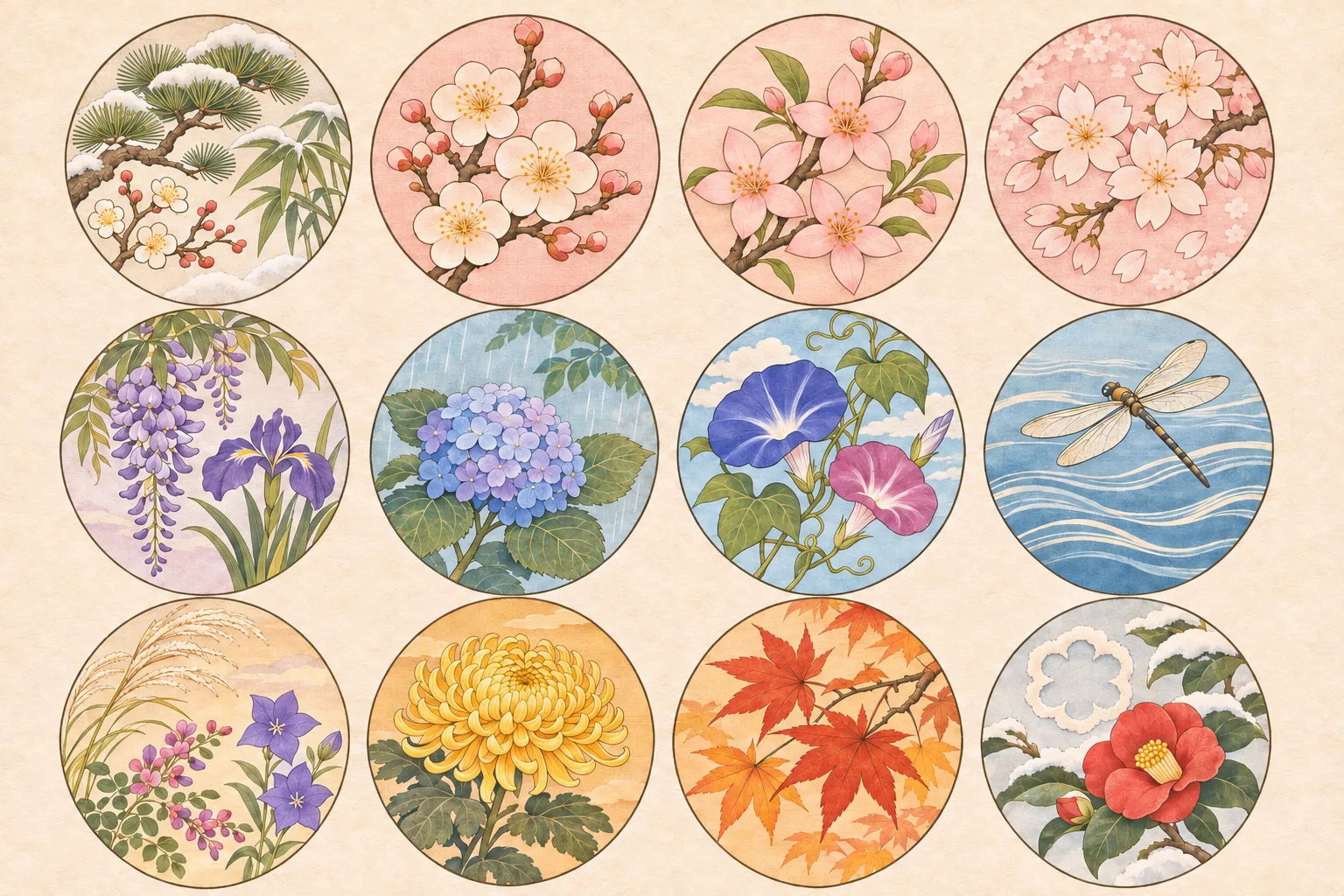
The year in motifs. Top row, from left: pine, bamboo and plum; plum; peach; cherry. Middle: wisteria and iris; hydrangea; morning glory; flowing water and dragonfly. Bottom: autumn grasses; chrysanthemum; maple; snow ring and camellia.
Geometrics by building block. Circles: shippō (overlapping rings), seigaiha (stacked semicircles), same (dots in arcs). Hexagons: kikkō (plain honeycomb), asanoha (honeycomb with radiating lines making stars). Squares: ichimatsu (checkerboard), hishi (squares on their points), kakudōshi (tiny squares in a grid). Lines: tatewaku (paired wavy verticals), yagasuri (chevrons), karakusa (curling vines). Gyōgi differs from same in that its dots run in straight diagonals rather than arcs.
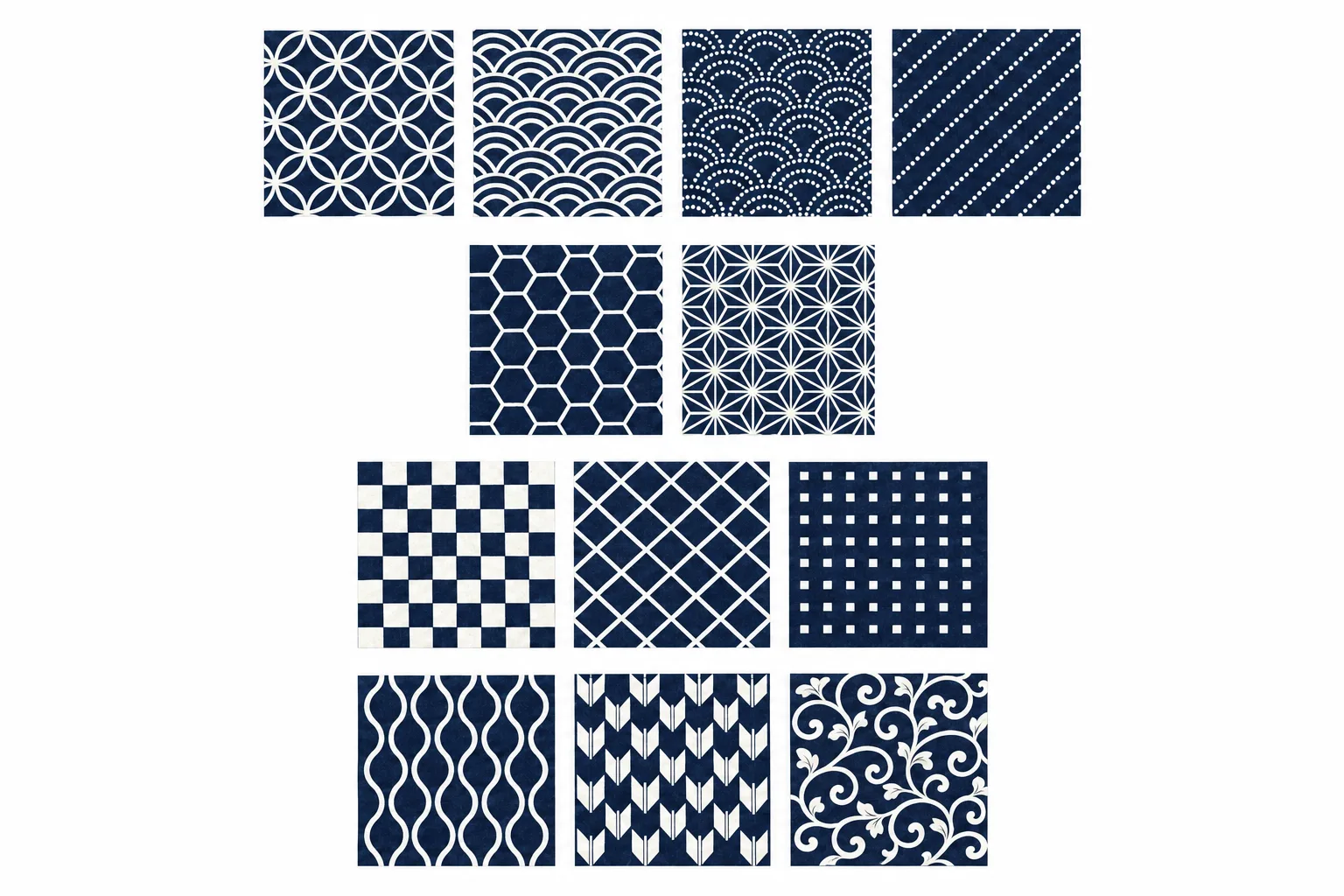
Twelve patterns with no season. Row 1, from left: shippō, seigaiha, same, gyōgi. Row 2: kikkō, asanoha. Row 3: ichimatsu, hishi, kakudōshi. Row 4: tatewaku, yagasuri, karakusa.
The maiko’s monthly hairpins, described in the main article, make a useful cross-check. They agree with the kimono calendar for January, February, April, October and November, but maiko wear willow in June, paper fans in July, pampas grass in August, bellflowers in September and, in December, small boards bearing kabuki actors’ names, a calendar of the Kyoto geisha districts’ own.
Seen together, the two families do different jobs. Flowers are realistic and time-bound: they say what season it is. Geometrics are abstract and timeless: they say who the wearer is or what they hope for. An obi often combines both, a tortoiseshell ground scattered with cherry blossoms, say, which makes it spring wear.
09Beyond the Kimono
Even if you never wear a kimono, you will meet these motifs everywhere. Confectioners’ jōnamagashi change shape monthly: white hanabira mochi at New Year, plum shapes and green uguisu mochi in February, cherry-leaf sakura mochi in spring, oak-leaf kashiwa mochi in May, triangular minazuki on 30 June, clear agar jellies with red goldfish in summer, chrysanthemum and chestnut shapes in autumn, maple-leaf nerikiri in November, snow-ring and camellia sweets in December. The sweet case is, almost exactly, the kimono calendar in sugar.
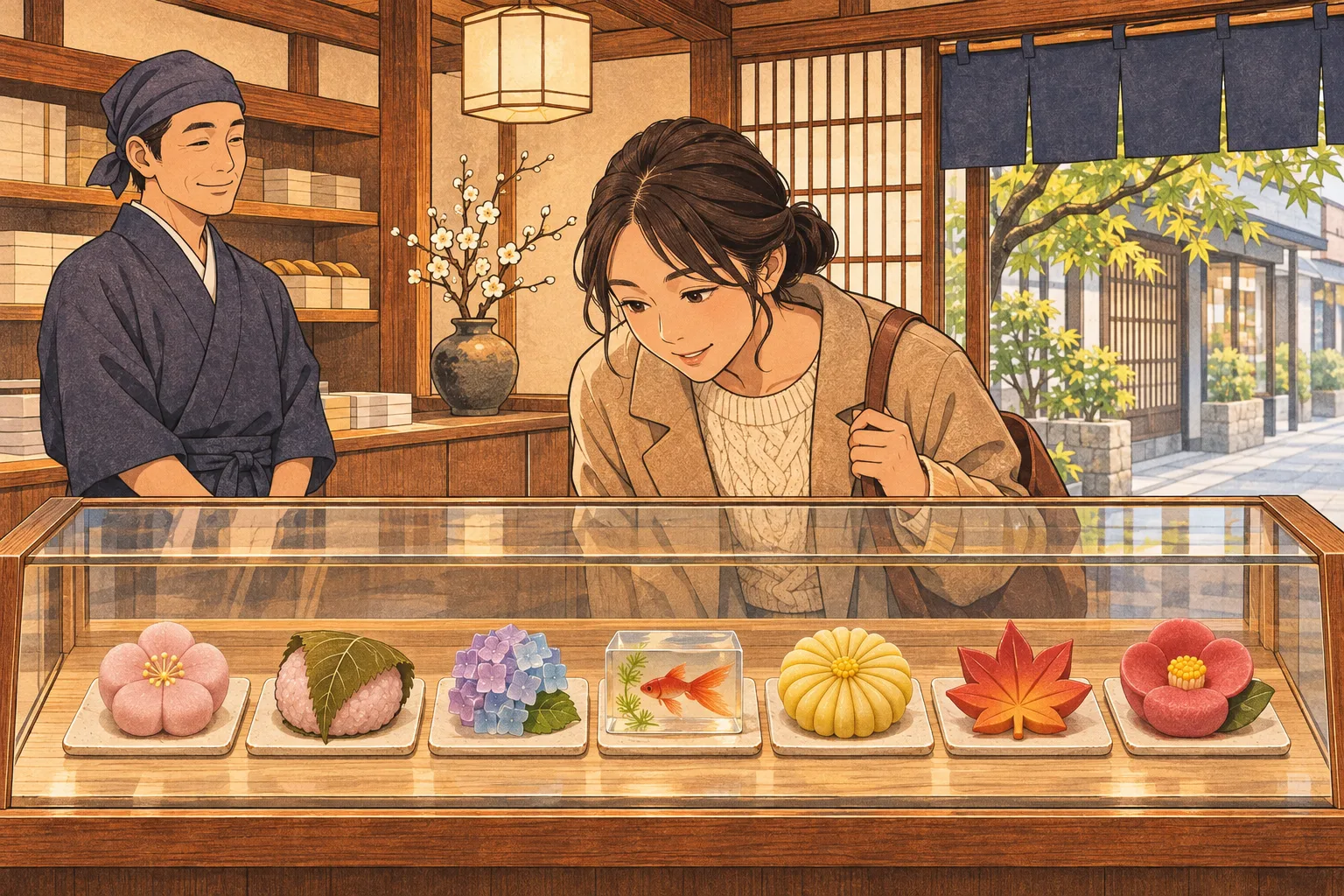
A confectioner’s glass case, from left: a plum shape, sakura mochi, a hydrangea, a clear agar jelly with a red goldfish, a chrysanthemum, a maple leaf and a camellia.
Seigaiha, shippō, asanoha and ichimatsu fill wrapping paper and shopping bags. Old shops wrap in karakusa or treasure-pattern furoshiki. Shrine charms are often woven with tortoiseshell, shippō or diamonds. Department-store kimono floors rotate seasonal obi and accessories, a good place to test yourself.
Towel shops (tenugui) in Kyoto and Asakusa change designs even faster than kimono, with morning glories and goldfish in July, moon and rabbits in September, snow rings in December; a wall of tenugui is a ready-made motif calendar. In temple and shrine architecture, watch for asanoha and kikkō in window lattices, and for shrine crests on tiles, lanterns and curtains: Dazaifu’s plum, Izumo’s tortoiseshell.
More deep dives on this topic
 Kimono Types and Their RankSpend a Saturday afternoon in the lobby of a big hotel in Tokyo or Kyoto and you will see kimono that look, to an outsider, like variations on a single garment.
 The Obi and Its KnotsStand on a street corner in Kyoto’s Gion and watch two women in kimono walk away from you.
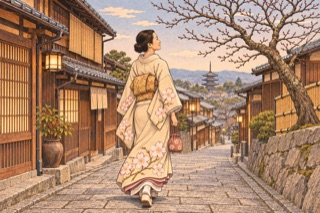 Kimono Motifs and the SeasonsWalk through Kyoto in early March and you will see cherry blossoms on kimono sleeves weeks before a single tree has opened.
 Japanese Hairstyles and KanzashiLook closely at a woodblock print of a street in late Edo or Meiji Japan and you can read the women in it like name tags.
 Men’s KimonoMost visitors to Japan see far more women in kimono than men, and when a man does walk past in kimono, he can look oddly uniform: dark colours, a short jacket, a narrow belt, flat…
 Putting On a Kimono, Layer by LayerWhen you rent a kimono in Kyoto or Asakusa, you stand in front of a mirror for fifteen or twenty minutes while someone wraps, pulls, tucks and ties, mostly out of your sight.
 KamonWalk through any old Japanese town and you will start to notice the same kind of image again and again: a small black-and-white emblem, perfectly symmetrical, usually inside a…
 The Life of a KimonoMost clothes are finished the day they are sewn.
- Back to the main article: Kimono →