
Walk through any old Japanese town and you will start to notice the same kind of image again and again: a small black-and-white emblem, perfectly symmetrical, usually inside a circle. It sits in the middle of a shop curtain, on the round end tiles of a castle roof, at the top of a granite gravestone, on the purple-and-white drapes hung around a shrine at festival time. These are kamon (家紋), Japanese family crests. They do the job European heraldry does, marking a household across generations, but with far looser rules and far simpler designs: one colour, one motif, no shields, no mottos. There are a couple of hundred basic motifs and, by the time variations are counted, many thousands of individual crests. Learn a dozen of them and the streets of Japan start talking back to you.
01Anatomy of a Crest
Most kamon are built from three things: a central motif, an optional enclosure, and a set of modifications. The name of a crest simply reads those layers out in order, which means that once you know the vocabulary you can draw a crest from its name.
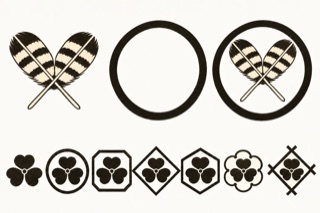
Take maru ni chigai taka no ha. Maru is a ring; ni means "with" or "containing"; chigai means "crossed"; taka no ha means "hawk feathers". So: a ring containing two crossed hawk feathers. Maru ni ken katabami is a ring containing a three-leaved wood sorrel with sword points between the leaves. Sumikiri kaku ni kikyō is a square with clipped corners containing a bellflower.
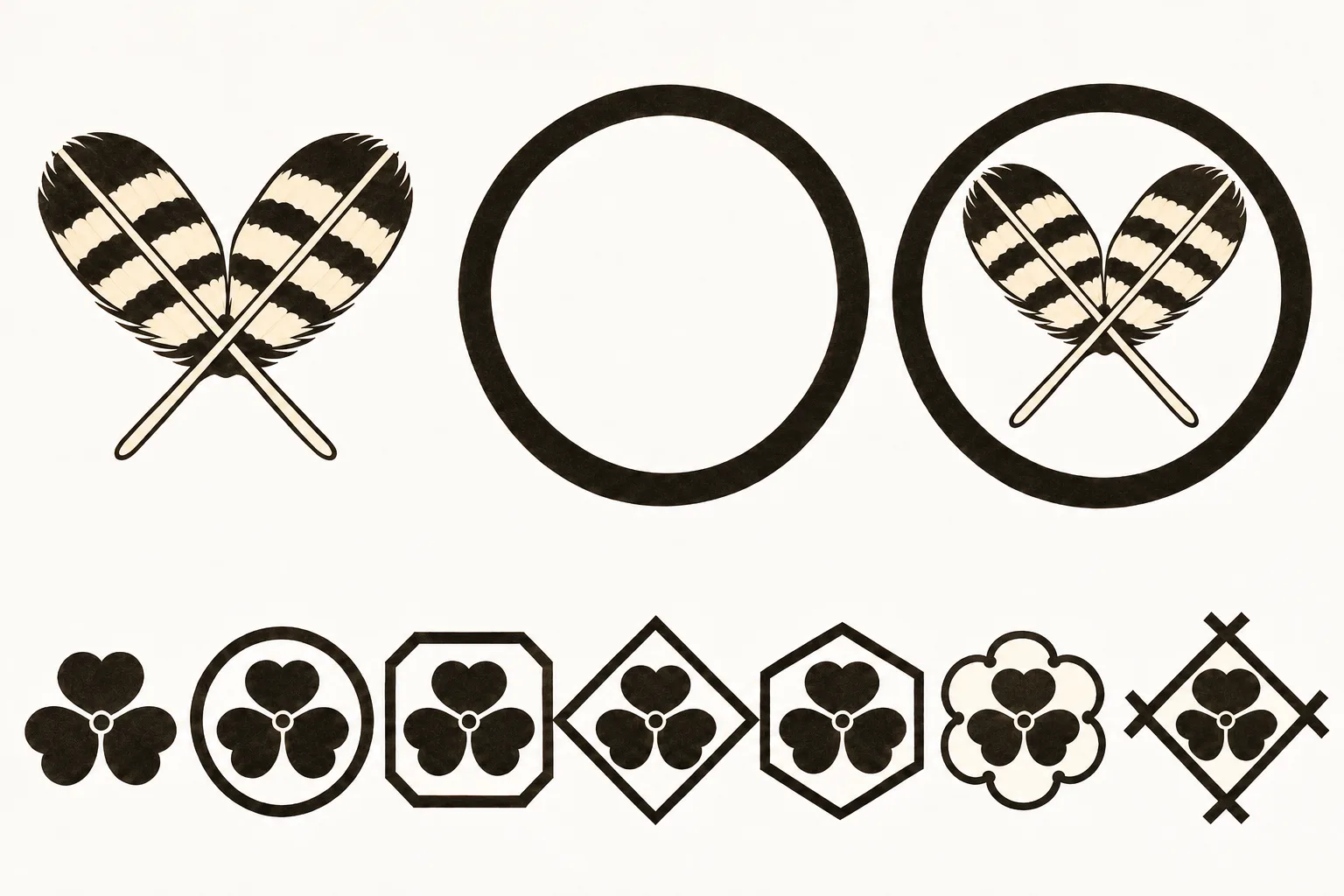
Top: two crossed hawk feathers plus a ring make maru ni chigai taka no ha. Bottom: one wood sorrel in different enclosures, from left: none, maru, sumikiri kaku, hishi, kikkō, yukiwa, igeta.
The enclosures are few. The ring (maru) is by far the most common, in thick, medium and hair-thin versions. There is the square (kaku), the clipped square (sumikiri kaku), the diamond (hishi), the hexagon called kikkō ("tortoise shell"), the scalloped "snow ring" (yukiwa) that looks like a soft-edged snowflake, and the igeta, the square wooden frame of a well head, drawn as a tilted hash sign. Enclosures carry no fixed meaning. Some families used them, or small changes to the motif, to tell a main house from its branch lines.
Modifications are where the vocabulary grows. Daki ("embracing") means two elements curving towards each other like arms. Narabi means side by side. Mitsumori means three of the same thing stacked in a triangle. Kage ("shadow") means the design is drawn only in outline, as opposed to the standard solid hinata form. Ura means seen from the back. Kōrin means drawn in the plump, rounded manner of the Edo painter Ogata Kōrin. Ken means sword points have been added. Numbers show up constantly: mitsu aoi is three hollyhock leaves, kuyō is nine stars.
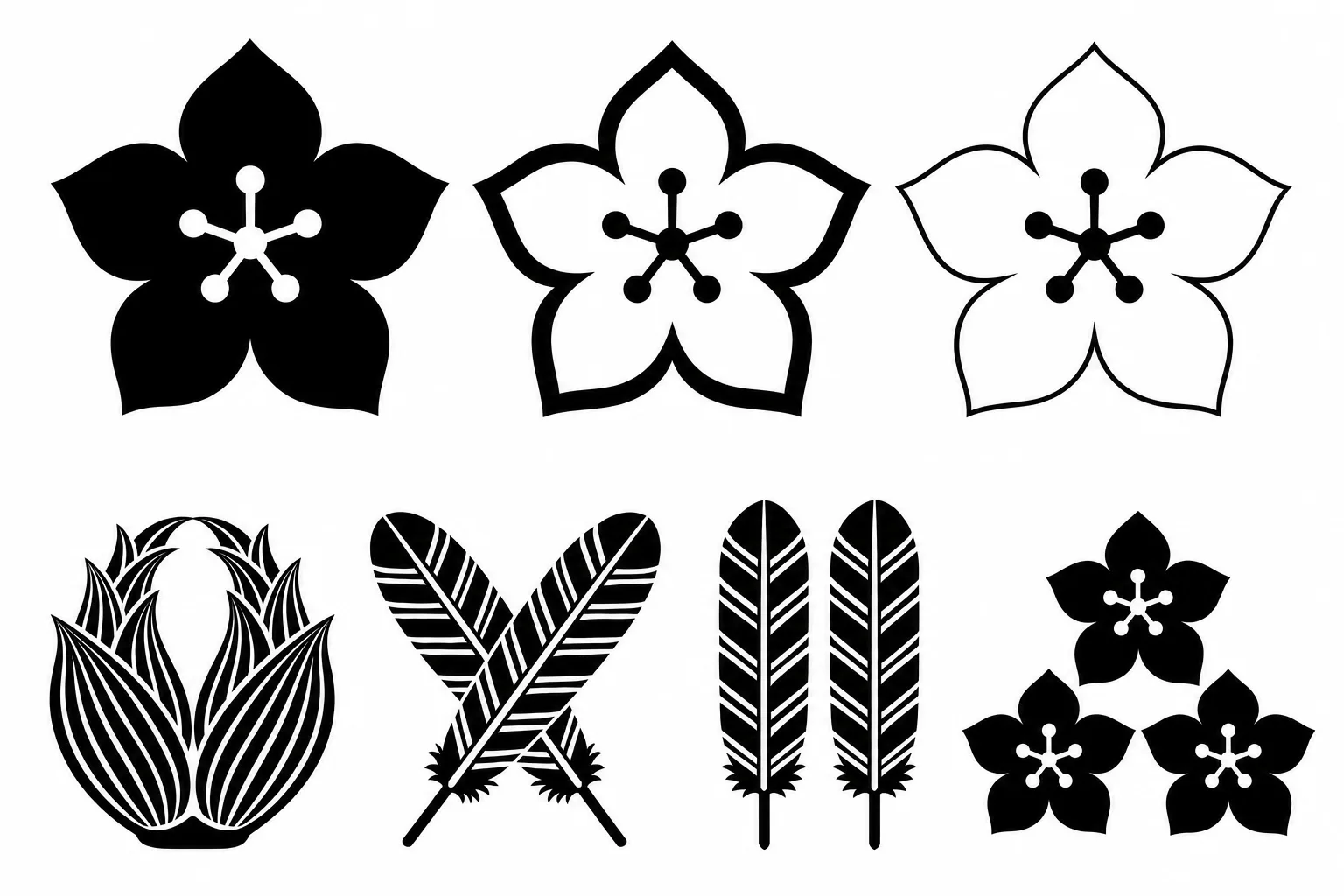
Top: one bellflower drawn three ways, from solid hinata on the left to outline-only kage on the right. Bottom, from left: daki (embracing) myōga, crossed hawk feathers, narabi (side by side) feathers, mitsumori bellflowers.
Motifs fall into broad families: plants (by far the largest group), animals (hawk feathers, sparrows, butterflies, cranes, geese), objects (fans, coins, wheels, arrows, anchors), heavenly bodies (sun, moon, stars), geometric shapes (diamonds, the comma-shaped tomoe, horizontal bars called hikiryō) and characters such as 一 or 大.
The simplicity is functional. A crest had to be recognisable at a distance, reproducible with a compass and ruler on cloth, and legible when shrunk to a centimetre on a lacquer box or a sword fitting. Colour is not part of a kamon. The same crest can be dyed white on a black kimono, woven in gold on a curtain, or carved into stone, and it is still the same crest. The craftsmen who hand-paint crests onto formal kimono, mon uwae-shi, still work with a bamboo compass and a fine brush, and most standard crest designs are constructed entirely from arcs and straight lines.
02The "Ten Great Crests"
Japanese books on kamon often speak of the jūdai kamon, the ten crest families used by the largest number of households. There is no official list and authors disagree at the edges, but a common version is wisteria, paulownia, hawk feathers, mokkō, wood sorrel, myōga ginger, oak, tachibana orange, ivy and omodaka, the arrowhead water plant. The first five are often singled out as the "five great crests", though some books put oak in place of paulownia. The bellflower is not on the usual list, but it is so famous that it belongs here too. Each family contains dozens or hundreds of variants.
Wisteria (fuji). The classic form, sagari fuji, shows two hanging clusters of wisteria flowers that droop down either side and curl back towards each other, almost closing into a circle at the bottom. The flower clusters are drawn as rows of small overlapping scales, with a few leaves at the top. Wisteria is tied above all to the Fujiwara, the great court clan whose name means "wisteria field". Kasuga Taisha in Nara, the Fujiwara’s tutelary shrine, uses the hanging wisteria, and so does the Honganji branch of Jōdo Shinshū Buddhism, whose head temple is Nishi Honganji in Kyoto.
Paulownia (kiri). Three upright flower spikes rise above three broad leaves. Count the blossoms on the spikes and you have the name: five on the centre spike and three on each side is gosan no kiri (the 5-3 paulownia); seven in the centre and five at the sides is goshichi no kiri (the 5-7). The paulownia was associated in Chinese lore with the phoenix and became an imperial emblem in Japan, then spread as emperors and shoguns granted it to loyal followers.
Hawk feathers (taka no ha). Long, leaf-shaped feathers with a central shaft and a few dark horizontal bands. The bands are the giveaway. The usual arrangement is two feathers crossed in an X. A warrior favourite, since hawks meant boldness and feathers fletched arrows. Aso Shrine in Kyushu uses crossed hawk feathers, and so did the Asano lords of Akō, which is why the crest turns up in every retelling of the Forty-Seven Rōnin story.
Mokkō. The name is written with the characters for "quince", but the design is not a fruit. It is a flower-like outline of four or five rounded lobes with a small blossom in the centre. One theory traces it to a Tang-dynasty textile pattern depicting a bird’s nest. Yasaka Shrine in Kyoto uses it, and because a cucumber sliced crosswise looks rather like it, some Kyoto families famously avoid eating cucumbers during the Gion Festival. The Oda family, Nobunaga’s clan, used a five-lobed version.
Wood sorrel (katabami). Three small heart-shaped leaves radiating from a centre. The plant is almost impossible to weed out, which made it a symbol of a family that keeps on growing, and it is among the most widely used crests in Japan. The ken katabami version adds three sword points between the leaves.
Bellflower (kikyō). Not one of the ten, but one of the best-known crests of all. A five-petalled flower with pointed tips, forming a rounded star. Closely linked with the Toki clan of Mino and their kinsman Akechi Mitsuhide, whose version was said to be dyed pale blue. Don’t confuse it with the Seimei kikyō of Seimei Shrine in Kyoto: same name, but it is a pentagram, a five-pointed star drawn in one stroke.
Myōga ginger (myōga). Usually daki myōga: two curved flower buds facing each other, joined at the base and closing at the top like praying hands, marked with fine diagonal lines. Myōga sounds like a word meaning divine protection, which gave it auspicious weight.
Oak (kashiwa). Broad leaves with a wavy, scalloped edge, usually three of them arranged tips-out in a circle. Oak leaves hang on the tree until the new buds open, so they suggest an unbroken family line; they were also used in antiquity to serve offerings to the gods. The Yamauchi lords of Tosa used the three-oak crest.
Tachibana. Japan’s native citrus. Three leaves on top, a round fruit below, the fruit dotted or lined. A tachibana tree stands before the main hall of the Kyoto Imperial Palace, paired with a cherry. The Ii family of Hikone used it alongside their well-frame crest, and the well frame with a tachibana inside is the emblem of Nichiren Buddhism.
Ivy (tsuta). A single lobed, pointed leaf with clear veins and a short stem. No embracing, no stacking: one leaf is the whole crest. The Tōdō lords of Tsu used it, as did several Matsudaira houses, and in the Edo period it was popular among women and entertainers, supposedly for the way ivy clings.
Arrowhead (omodaka). A water plant of rice paddies and ponds. The usual form shows three arrowhead-shaped leaves standing upright on slender stalks, the middle one tallest, with flower stems of small round buds between them. Because the leaves look like spear points, the plant was nicknamed "victory grass" and was popular with warrior families; the Mizuno used it as their crest, and the Mōri are said to have used it as an alternate.
Why are plants so dominant, and why these ten in particular? Part of the answer is the court taste that shaped the earliest crests: Heian nobles loved seasonal flowers and leaves, and the warrior families who came later borrowed the prestige along with the designs. Part is word-play and wishful meaning. A plant that spreads (sorrel, ivy), a tree that never drops its leaves too early (oak), a flower whose name sounds like divine favour (myōga): each carried a hope for the household. And part is simple inheritance. Once a powerful lord granted his crest to followers, or a great clan like the Fujiwara had thousands of descendants, the numbers snowballed across centuries.
03Crests of the Great Houses
Some crests matter not because many people use them but because of who used them.
Chrysanthemum (kiku). The imperial crest is the sixteen-petalled double chrysanthemum seen from the front, with the tips of a second row peeking out between the first. The link between the chrysanthemum and the throne is usually dated to Emperor Go-Toba around 1200, who loved the flower. Between 1868 and 1871 the new Meiji government issued a series of orders reserving the chrysanthemum crest for the imperial family; the princely houses were given a fourteen-petal, single-row chrysanthemum seen from behind. Japanese passports carry a simplified single-row version. Some shrines and temples with close imperial ties use chrysanthemum crests, often with a different petal count or drawn from behind.
Paulownia, again. It is the imperial family’s secondary crest. Emperor Go-Daigo granted it to Ashikaga Takauji, the Ashikaga shoguns granted it onward, and Toyotomi Hideyoshi, who received the paulownia first from Oda Nobunaga and later both chrysanthemum and paulownia from the court, handed the paulownia out so freely that it became one of the commonest crests in Japan. The paulownia designs Hideyoshi used are known collectively as taikō kiri; a familiar version has curving spikes and more ornate leaves. At Kōdaiji in Kyoto, the temple his widow built for him, paulownia crests cover the lacquerwork and metal fittings. Today the 5-7 paulownia is the emblem of the Japanese government and the prime minister; it sits in gold on the front of the podium at prime-ministerial press conferences, and a paulownia also appears on the 500-yen coin.
Hollyhock (aoi). The Tokugawa crest: three heart-shaped leaves meeting at the tips inside a ring, each with radiating veins. Aoi is not really hollyhock but wild ginger (futaba aoi), a woodland plant that grows two leaves per stem; three is a design choice. Wild ginger is the sacred plant of Kyoto’s Kamigamo and Shimogamo shrines, whose Aoi Festival every May is decorated with it, and many warrior families in Mikawa with ties to the Kamo used aoi crests; how the Tokugawa’s Matsudaira ancestors came to adopt it is told in several versions. The shogunate restricted its use by other families, formally from 1723, and even the three senior Tokugawa branches (Owari, Kii and Mito) drew their leaves slightly differently. You will see it everywhere at Nikkō Tōshōgū and at Zōjōji and Kan’eiji in Tokyo.
Oda. Nobunaga’s main crest was the five-lobed Oda mokkō. He also used a swallowtail butterfly, the coin of the Yongle era, and the paulownia granted in 1568 by the shogun Ashikaga Yoshiaki, who is generally said to have added the Ashikaga two-bar crest.
Toyotomi. The paulownia, specifically the taikō kiri. What Hideyoshi used before his rise is unclear; one account says arrowhead. He received the paulownia from Nobunaga, then the chrysanthemum and paulownia from the court around the time he became regent in 1585. Taikō kiri is not one fixed design.
Takeda. The Takeda bishi: a diamond split by a narrow cross into four smaller diamonds. From a distance it reads as one solid diamond. Diamond crests run through the Kai Genji lineage; their cousins the Ogasawara used a three-tiered stack of diamonds.
Uesugi. Take ni suzume: a ring of bamboo stems and leaves, with two sparrows facing each other inside. The design came from the court family of Kajūji, from whom the Uesugi descended. Uesugi Kenshin also received the paulownia from the shogun Ashikaga Yoshiteru in 1561, but the sparrows are what people remember. The Date of Sendai use a bamboo-and-sparrow crest too, traditionally said to have been a gift when Date Sanemoto was to be adopted by the Uesugi lord of Echigo, an adoption that never went through. Put them side by side and the Date version has more leaves and a busier composition.
Sanada. Rokumonsen, six coins in two rows of three, each with a square hole. The popular explanation is that they are the six coins needed to pay the ferryman across the Sanzu River to the afterlife. The Sanada also used a pair of wing-linked geese (musubi karigane) and a suhama (a stylised sandbar) as alternates; one account says the geese were the everyday choice.
Shimazu. Maru ni jūji, a bold cross in a ring. Early versions are generally thought to have had no ring. Explanations for the cross include two crossed dragons, a horse’s bit and two crossed brushes. It is often said that when Francis Xavier landed in Kagoshima in 1549, the resemblance to the Christian cross was remarked on.
Others worth knowing. The Mōri of Chōshū used a horizontal bar above three dots (ichimonji ni mitsuboshi), the dots often read as Orion’s belt. The Maeda of Kaga used a five-petalled plum with sword points, the Kaga umebachi, reflecting their claimed descent from Sugawara no Michizane, the scholar enshrined at Tenmangū shrines. The Hosokawa used kuyō, a large circle ringed by eight small ones, linked to the nine-star astrology that reached Japan with Buddhism.
04Side by Side
Lined up together, the ten great crests separate quickly if you count parts and look at silhouettes. Wisteria is the only one made of two drooping clusters forming a circle. Paulownia is top-and-bottom: flowers above, leaves below. Hawk feathers are long bands with stripes, usually crossed. Mokkō is a lobed outline with a flower in the middle. Wood sorrel is three small hearts. Myōga is a pair of curved buds embracing. Oak is three scalloped leaves. Tachibana has a ball at the bottom. Ivy is one leaf. Arrowhead is three upright spear-point leaves, the middle one tallest. And the bellflower, off the list but everywhere, is a five-pointed flower.
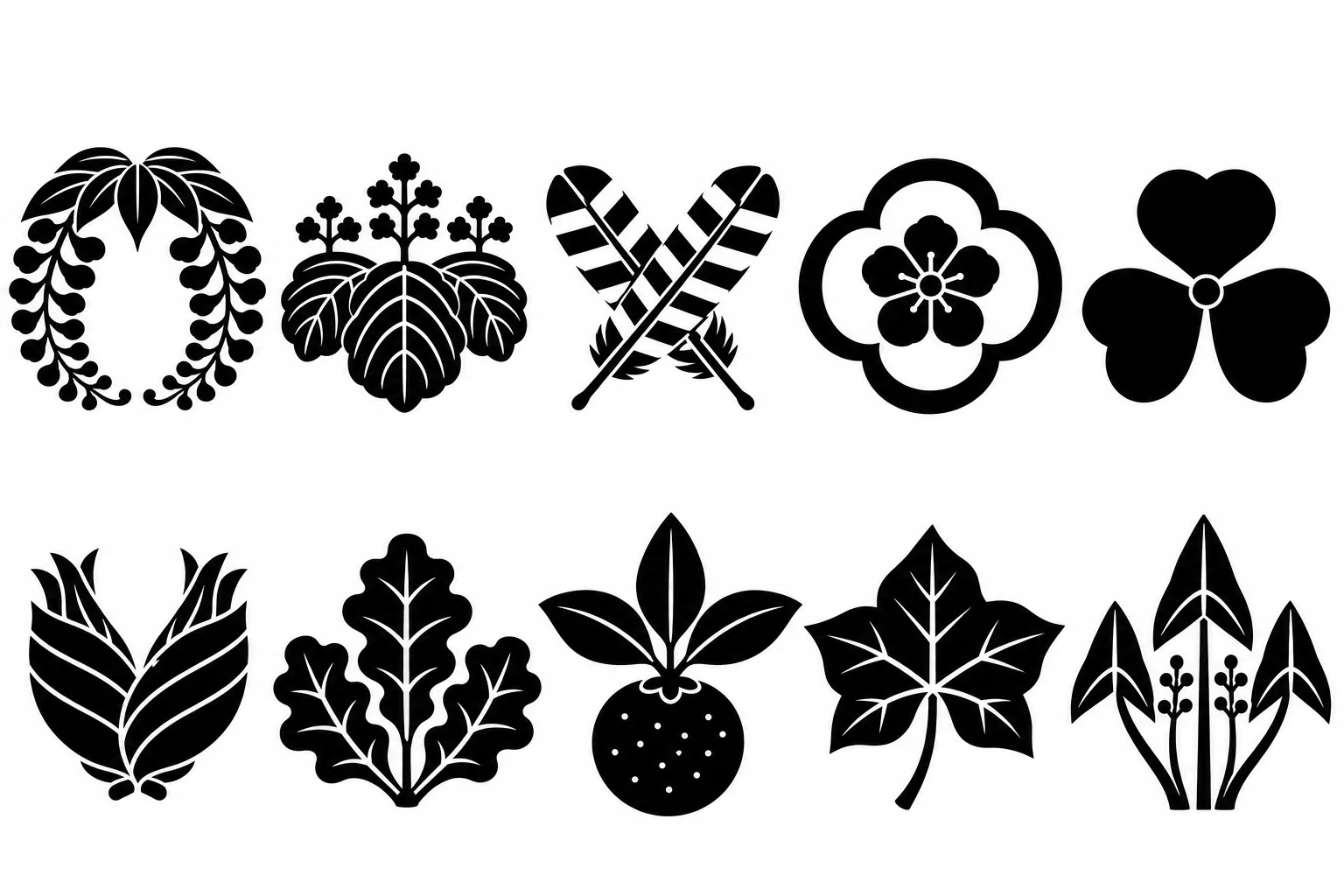
The ten great crests. Top row, from left: wisteria, paulownia, hawk feathers, mokkō, wood sorrel. Bottom row: myōga ginger, oak, tachibana, ivy, arrowhead.
The leaf crests are where people go wrong. Wood sorrel leaves are small, heart-shaped and smooth-edged; oak leaves are long with wavy edges; paulownia leaves always have flower spikes above them; ivy is a single pointed leaf on a stem. Daki myōga is often confused with the gyōyō (an ornamental horse-harness pendant) of the Nabeshima of Saga; the gyōyō has more regular inner lines and its two halves are not joined at the base like the myōga buds. To tell paulownia variants apart, count the blossoms on the centre spike.
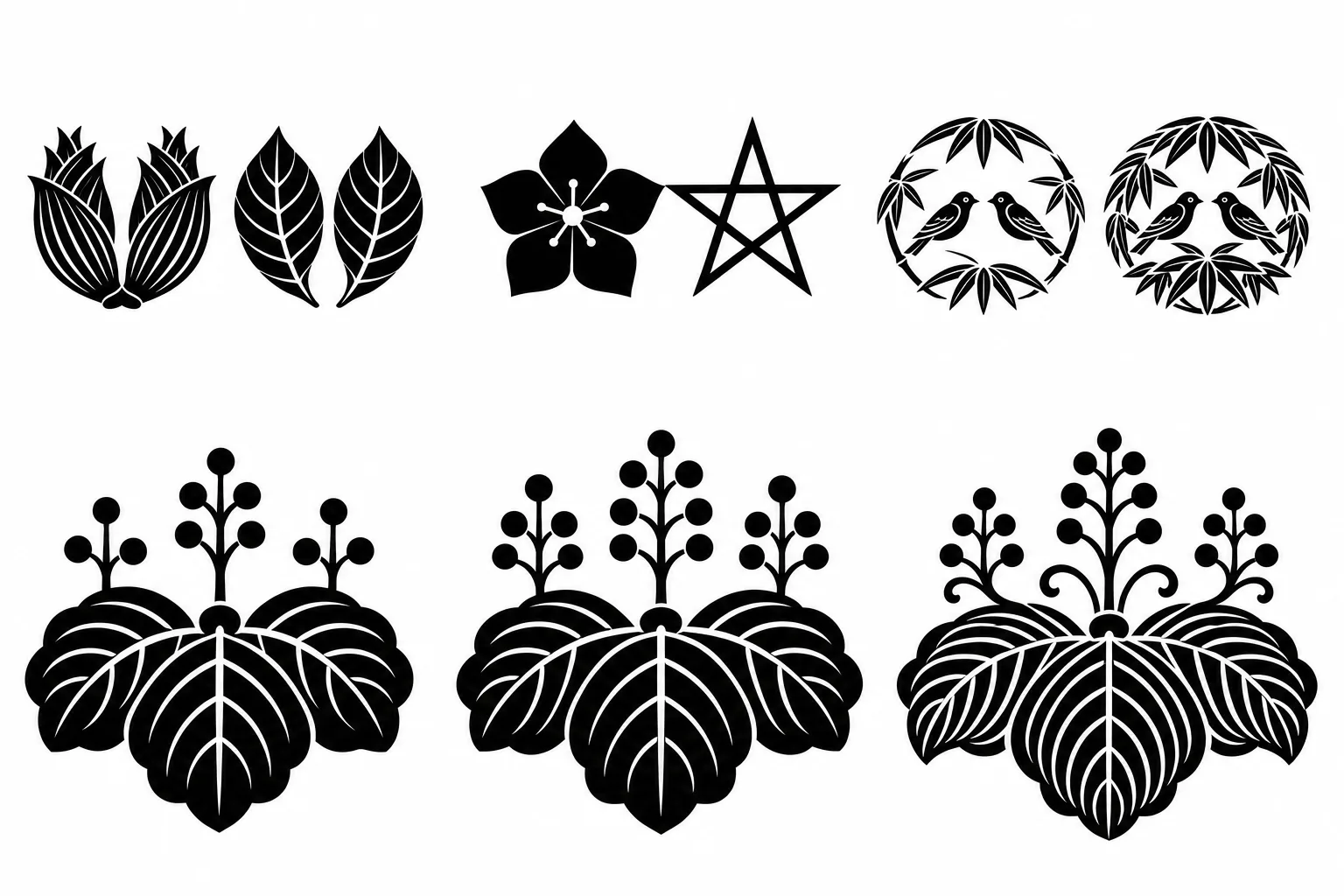
Easily confused pairs. Top, from left: daki myōga beside the gyōyō; the bellflower beside a five-pointed star; two sparrows-in-bamboo crests, Uesugi and Date. Bottom: 5-3 paulownia, 5-7 paulownia, taikō kiri.
Lined up again, the warlord crests: three leaves meeting at the tips (Tokugawa); a lobed flower outline (Oda); flowers over leaves (Toyotomi); a split diamond (Takeda); sparrows in bamboo (Uesugi); six holed coins (Sanada); a cross in a ring (Shimazu); a bar over three dots (Mōri); a plum with blades (Maeda). Only the sparrows are pictorial. Everything else leans towards geometry.
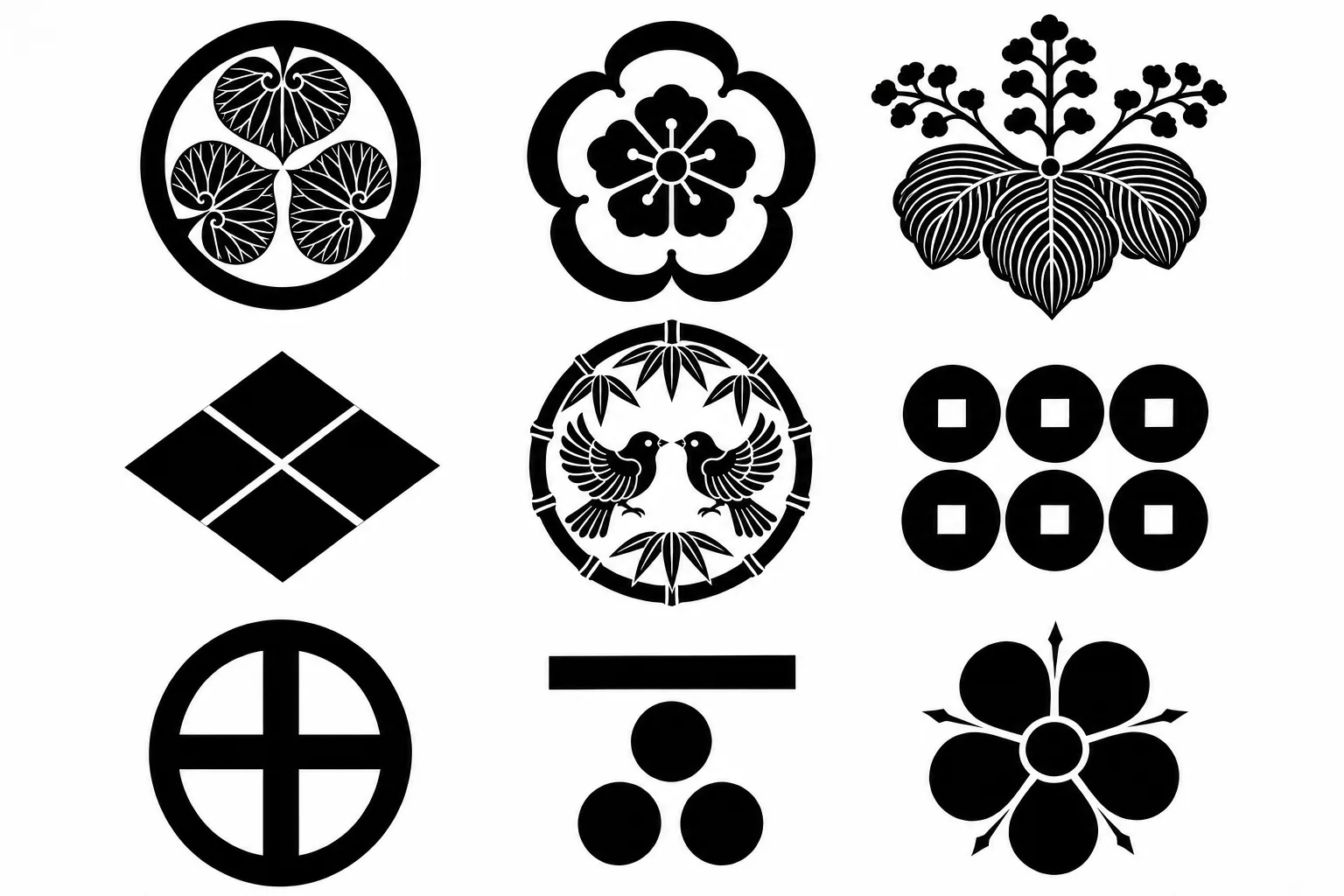
Warlord crests. Top row, from left: Tokugawa hollyhock, Oda mokkō, Toyotomi paulownia. Middle: Takeda diamond, Uesugi sparrows in bamboo, Sanada six coins. Bottom: Shimazu cross in a ring, Mōri bar over three dots, Maeda plum.
Round flower crests are another trap. The imperial chrysanthemum has sixteen narrow petals in two layers, seen from the front. The princely houses use fourteen petals in a single row, seen from behind; shrine and temple variants often have twelve, or a single layer. A plum crest (umebachi) has just five fat round petals around a centre, sometimes with little blades between them. And the Hosokawa kuyō is not a flower at all: it is nine separate discs, one large in the middle and eight small around it.
05From Ox Carts to Curtains
The first crests appeared among court nobles in the middle-to-late Heian period. Aristocrats travelled in ox carts, and when a row of similar carts waited outside a palace gate or temple, a fixed design on the side told everyone whose was whose. Many early motifs were borrowed from the textile patterns of court dress. Which family used a crest first is a matter of later speculation; the Saionji with a tomoe and the Tokudaiji with a mokkō are often named.
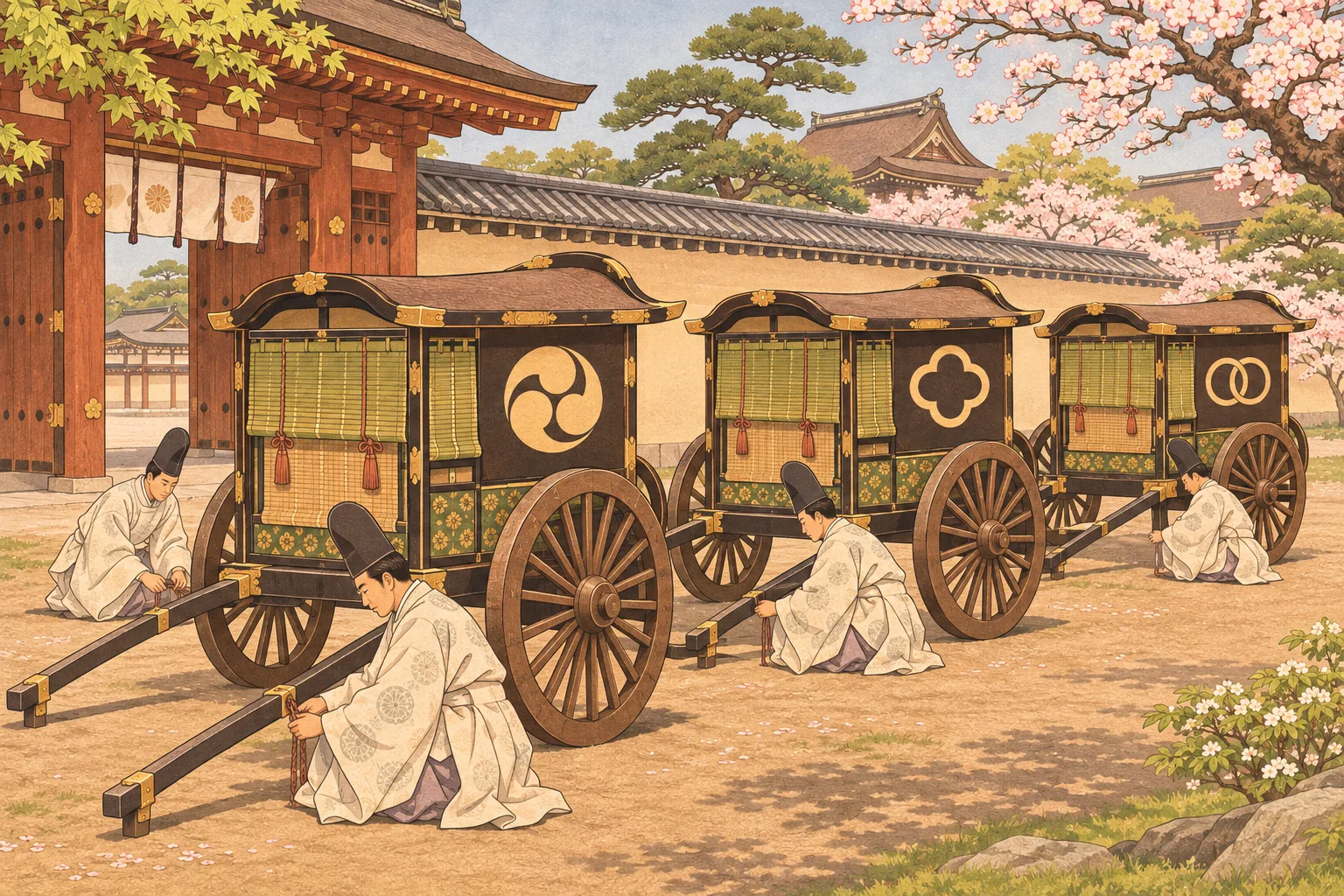
Three near-identical ox carts wait outside a Heian palace gate, told apart by the designs on their sides: from left, a tomoe, a mokkō and linked rings (artist’s impression)
Warrior families took up crests a little later and used them more bluntly. Painted on banners and on the long cloth curtains (jinmaku) that screened a camp, a crest showed whose people were where. That use pushed the designs towards bold, geometric shapes that could be read on cloth moving in the wind.
From the Muromachi period, granting a crest became a mark of favour, which is why many families ended up with several: a formal main crest (jōmon) and one or more alternates (kaemon).
It helps to understand what a crest actually belongs to. A kamon is attached to an ie, a household line, not to a surname or to blood. Two families called Satō may use completely different crests, and two unrelated families may share one. An adopted heir usually took on the crest of the house he entered. Crests could be changed, too: a family might adopt a new design after receiving one from a lord, or simply because a main branch asked a branch line to stop using its own. In parts of western Japan, women kept a crest passed down the female line, a custom the main kimono article touches on. The upshot is that a crest tells you about a house and its history, not about a bloodline in any strict sense.
06Edo: Processions, Actors and Shops
Two and a half centuries of peace moved crests off the battlefield and into daily life, and down through every class.
Daimyo processions travelling between their domains and Edo were read by onlookers through the crests on lacquered boxes, lanterns and spear covers. Commercially published directories called bukan listed each lord’s name, income and crests, a kind of field guide to the ruling class.
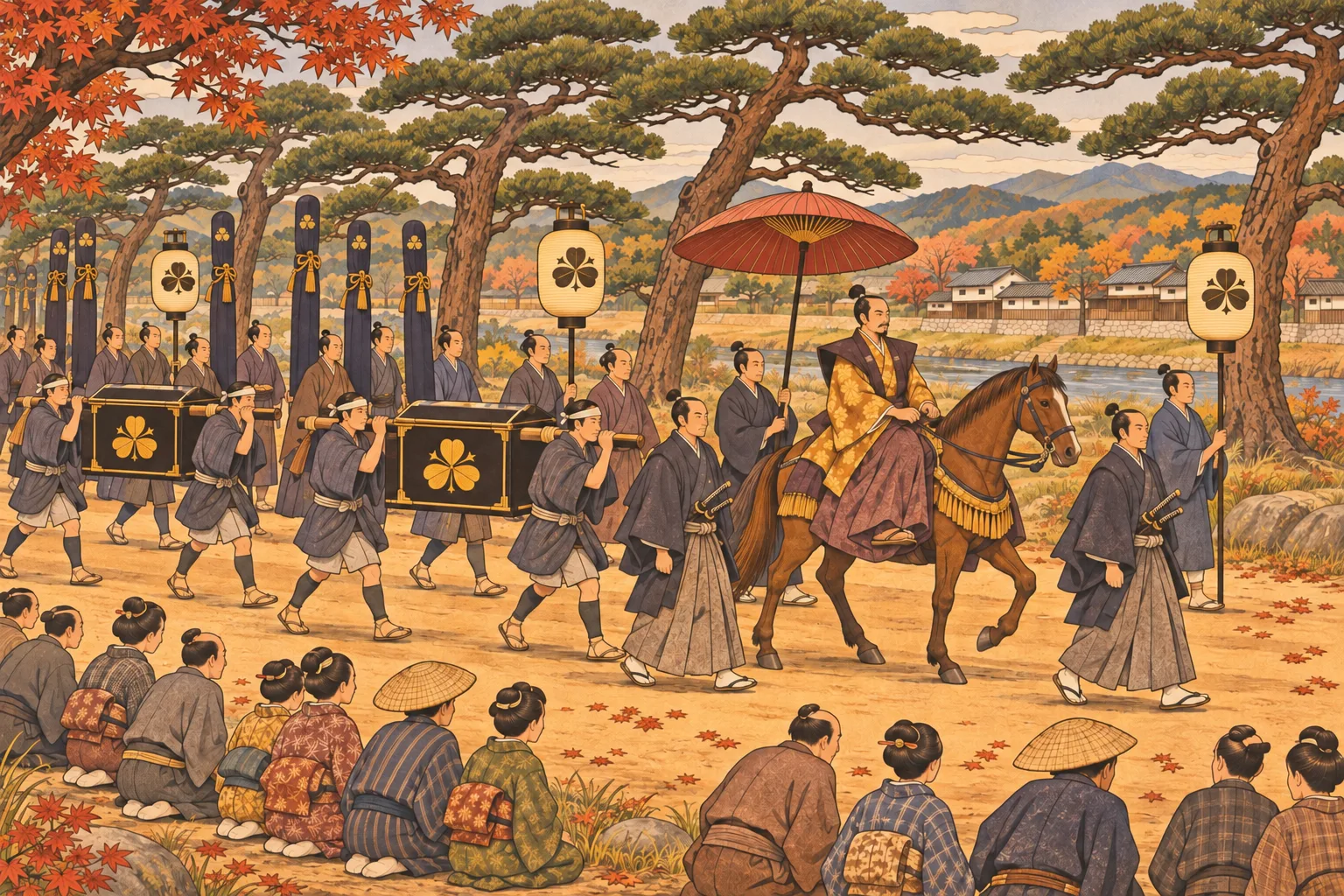
A daimyo procession on the Tōkaidō: the same crest repeats on the lacquered boxes and lanterns, telling onlookers whose retinue is passing (artist’s impression)
Commoners used crests freely. Apart from restrictions on the Tokugawa hollyhock, the imperial designs and the crests of local lords, the shogunate did not regulate ordinary families’ crests, so merchants, artisans and farmers chose their own and put them on wedding and funeral clothes, trousseau chests and lanterns. Many families had crests long before 1875, when all commoners were required to register surnames.
Crests needed craftsmen. Printed pattern books, monchō, collected hundreds of designs for customers to choose from and for dyers to copy. Specialist crest painters worked inside the dyeing trade, reserving a white circle on cloth before dyeing and then drawing the crest into it with compass and brush. Lantern makers painted crests onto paper lanterns for weddings, funerals and the Bon festival, when families hung lanterns to welcome back the spirits of their ancestors. A good share of the crest designs in use today were standardised in these Edo pattern books.
Kabuki actors had crests that worked like fan merchandise. The Ichikawa Danjūrō line uses mimasu, three nested square measuring boxes seen from above. The seventh Danjūrō popularised a rebus pattern, a sickle (kama), a ring (wa) and the syllable nu, read together as kamawanu, "I don’t care". The Onoe Kikugorō line answered with an axe (yoki), a koto (koto) and a chrysanthemum (kiku): yoki koto kiku, "hear good things". Fans wore their favourite’s crest on towels and yukata, and in woodblock prints the crest on an actor’s sleeve tells you who he is.
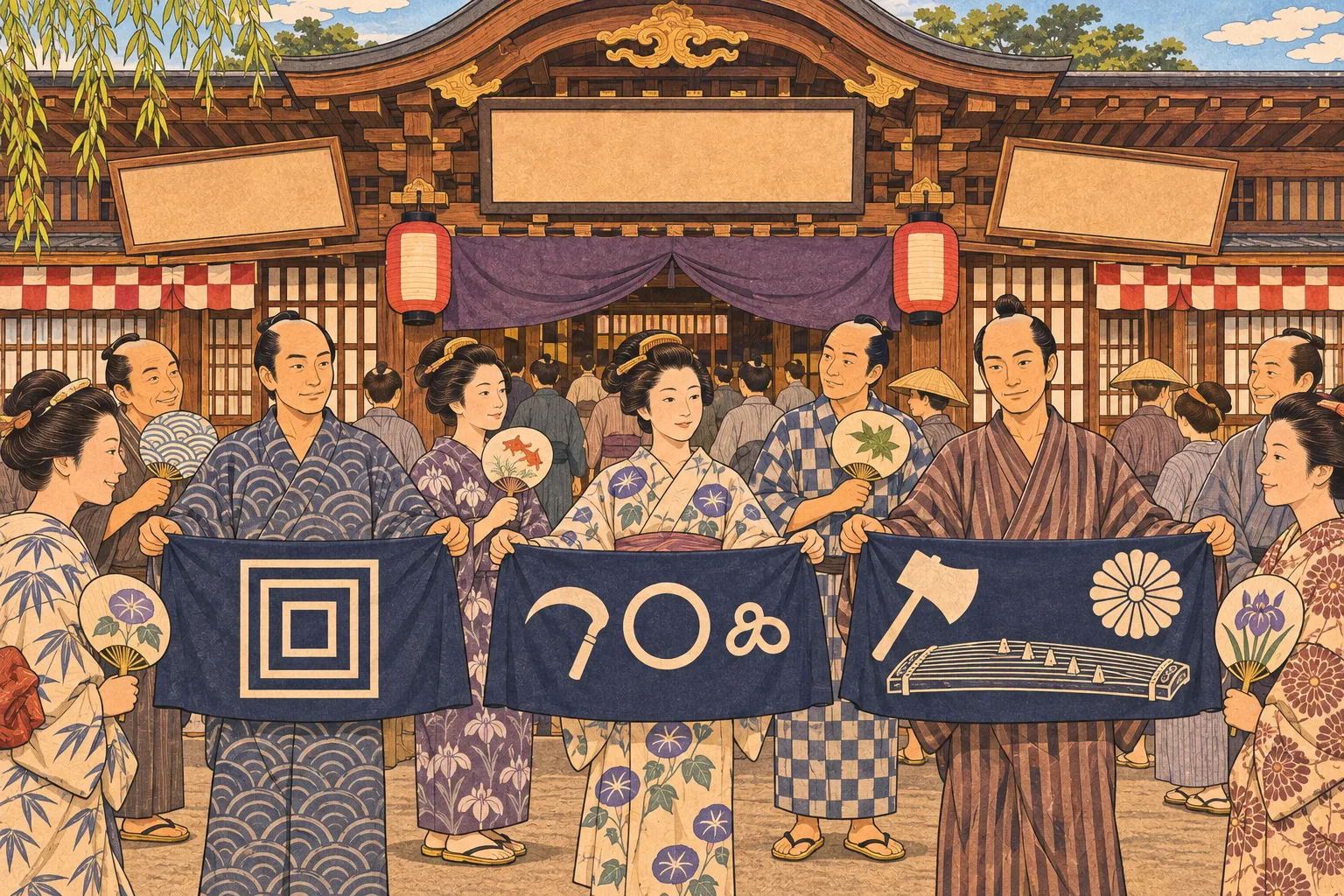
Three towels outside a kabuki theatre, from left: the nested squares of mimasu; sickle, ring and the syllable nu for kamawanu; axe, koto and chrysanthemum for yoki koto kiku (artist’s impression)
Shops developed yagō-mon, house marks, often a simple shape with a character: a peaked line for "mountain" (yama), a carpenter’s square (kane), a circle. Yamasa soy sauce in Chōshi still uses its mountain over the syllable sa. The Mitsui family’s Echigoya used a ring around a well-frame with the character 三 inside. These marks went on curtains, umbrellas, barrels and the backs of workers’ jackets.
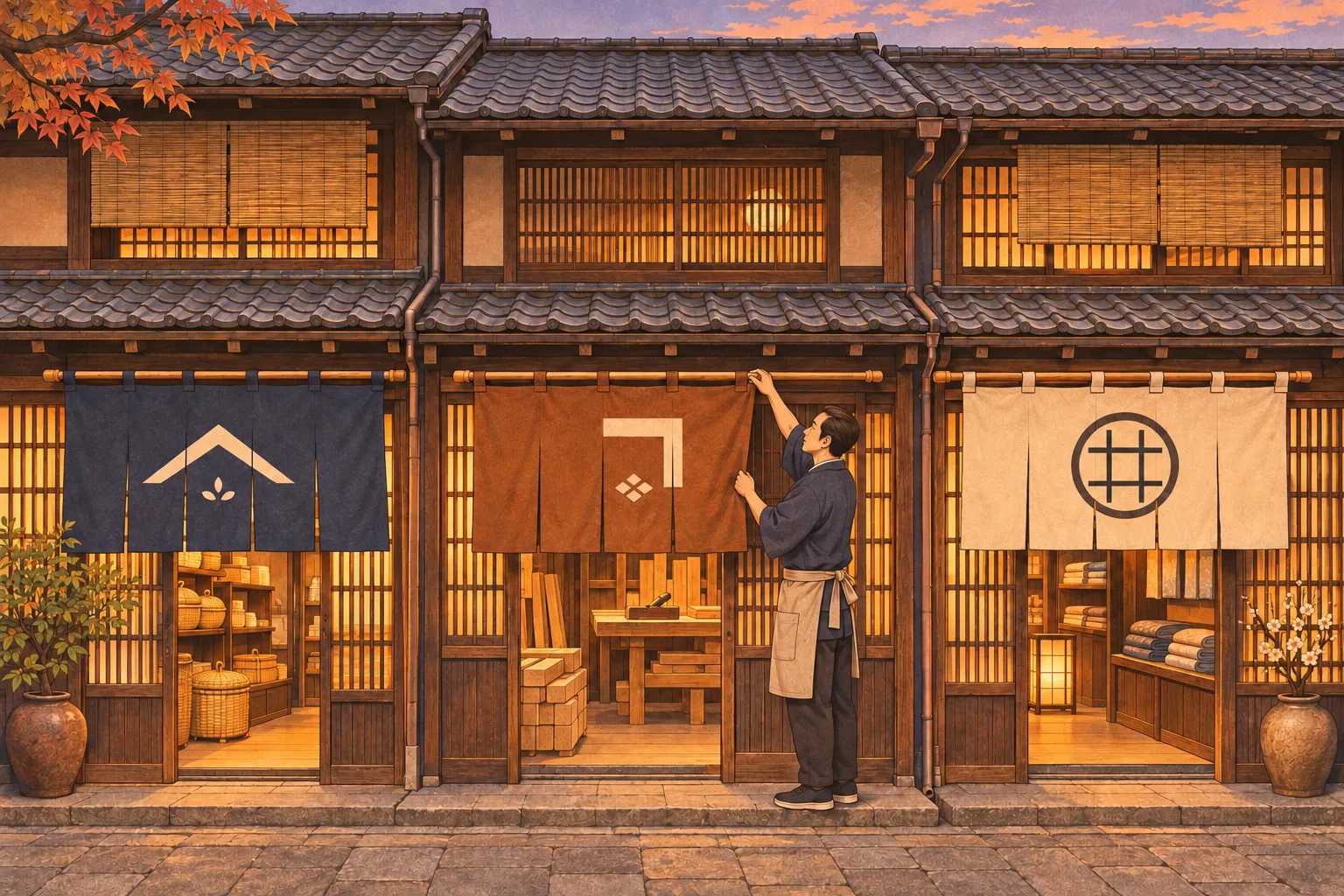
Noren at three old shops, each dyed with a house mark: a peaked "mountain" line on the left, a carpenter’s square in the middle, a well-frame in a ring on the right.
07Where You’ll See Kamon Today
Plenty of young Japanese couldn’t tell you their family crest without checking the family grave. But crests are all around.
On formal kimono, white crests on black silk at the back, chest and sleeves; the number and placement, and the generic paulownia shops use when a customer doesn’t know their own, are covered in the main kimono article.
On noren curtains at old Kyoto shops, often a single white crest on indigo. On rows of paper lanterns at shrine festivals.
On castle roofs. The round end tiles (nokimarugawara) along the eaves are stamped with the lord’s crest, and when lords changed, new tiles got the new crest. Himeji Castle’s roofs mix the butterfly of the Ikeda, the sword-sorrel of the Sakai, the hollyhock of the Honda and paulownia tiles, usually credited to Hideyoshi’s era, though some attribute them to the Ikeda.
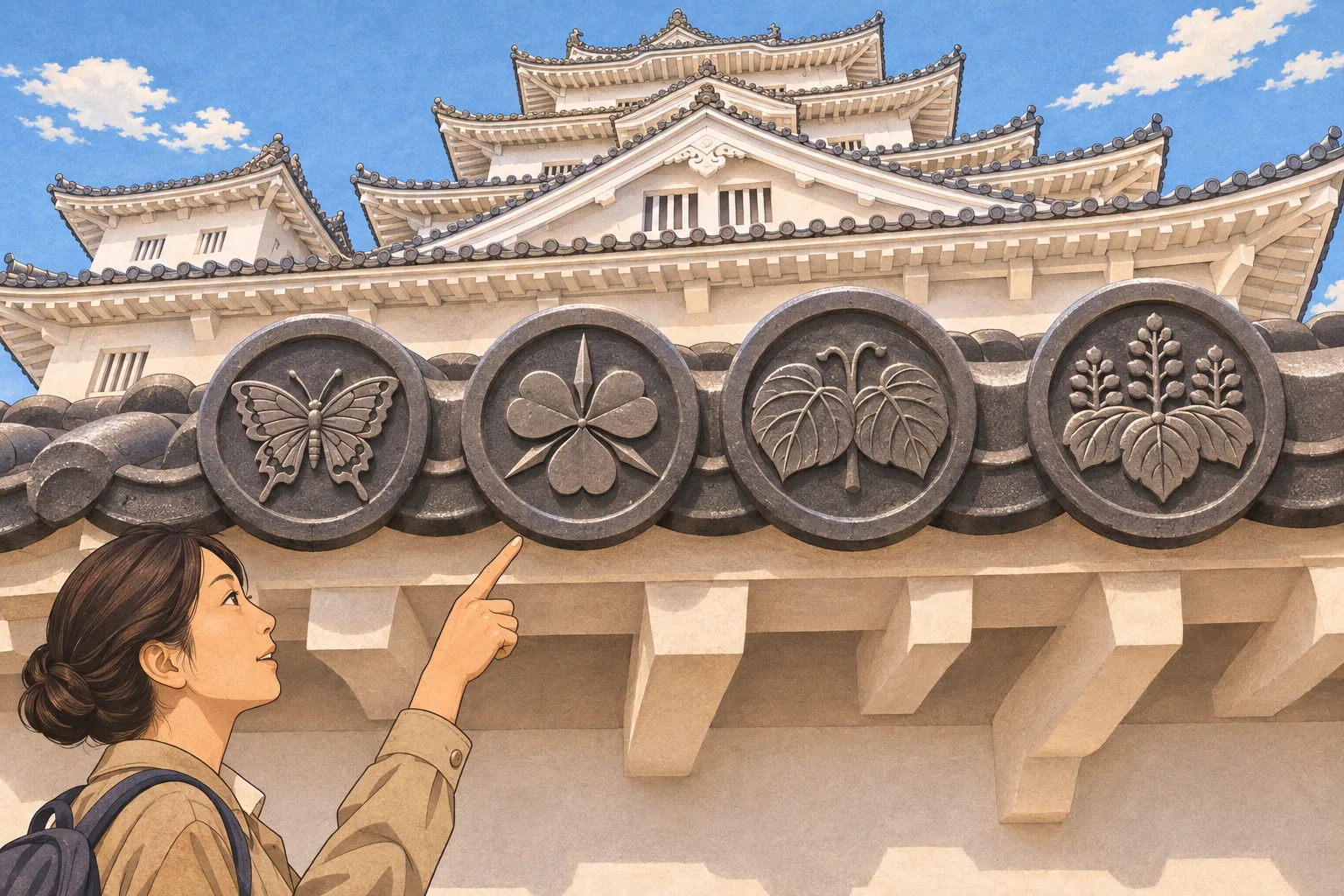
Eave-end tiles at Himeji Castle, from left: the Ikeda butterfly, the Sakai sword-sorrel, the Honda hollyhock, and a paulownia.
On gravestones, usually carved near the top of the main stone or on the water basin in front. A walk through a temple cemetery is a lesson in local crest frequency: sorrel, wisteria, paulownia and oak again and again.
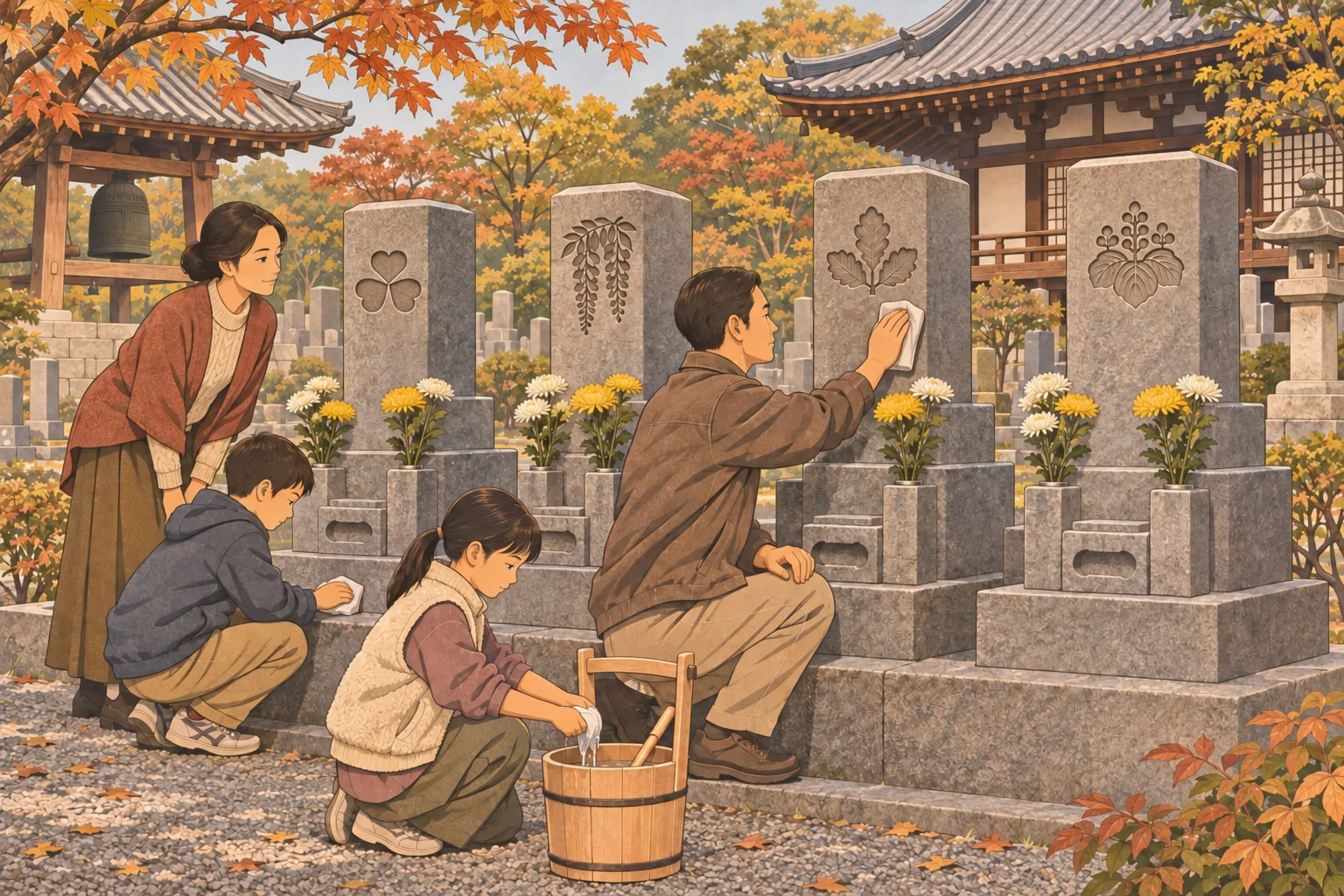
In a temple cemetery, each gravestone carries a family crest near the top, from left: wood sorrel, wisteria, oak, paulownia.
This is also how many Japanese people find out their own crest. Asked at a wedding rental shop which crest to put on the formal wear, plenty of people phone a parent, who in turn remembers the stone at the family grave. Old trousseau chests, the lacquered boxes handed down from a grandmother, and the funeral lanterns stored in a family Buddhist altar often carry it too.
On shrine and temple curtains. At New Year and festival time, white curtains with purple or black crests are hung around shrine halls. Yasaka Shrine shows mokkō and tomoe, Kitano Tenmangū a plum blossom, Kasuga Taisha hanging wisteria, Kamigamo and Shimogamo wild ginger, Fushimi Inari a pair of embracing rice sheaves, Izumo Taisha a double tortoise-shell hexagon around a flower split into four by sword blades. Hachiman shrines often use the mitsudomoe, three comma shapes swirling in one direction, which also appears on roof tiles everywhere, reputedly because it suggests a whirlpool of water and so wards off fire.
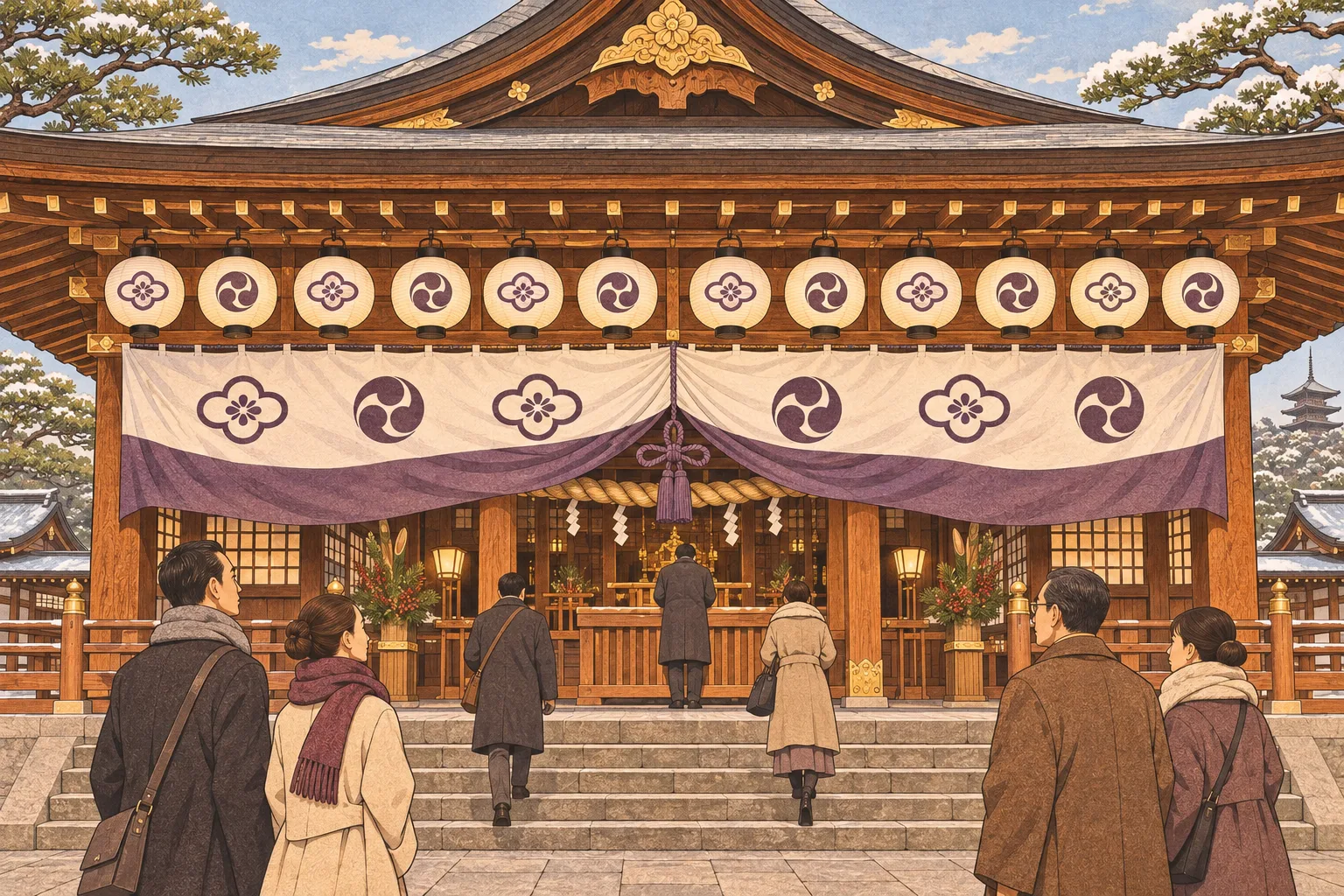
A shrine hall at New Year: mokkō and tomoe crests alternate along the white-and-purple curtain and repeat on the row of paper lanterns above.
In company logos. Mitsubishi’s three diamonds are usually explained as a blend of the Yamauchi oak crest and the Iwasaki family’s stacked diamonds. Mitsui’s logo comes from the Echigoya mark; Sumitomo’s well frame from its old shop name, Izumiya ("spring house"); Kikkoman’s is the character 萬 inside a tortoise-shell hexagon.
In government. The 5-7 paulownia for the government and prime minister; the chrysanthemum for the imperial family and on passports; the paulownia on the 500-yen coin. Many towns’ municipal emblems are adapted from their old lord’s crest.
And on everything else: the openings of historical TV dramas, game character cards, manhole covers in castle towns, sweet boxes, T-shirts. Japanese people don’t treat kamon as sacred. Some look up their family crest and wear it at their wedding. Others just like the Sanada coins and put them on a phone case.
More deep dives on this topic
 Kimono Types and Their RankSpend a Saturday afternoon in the lobby of a big hotel in Tokyo or Kyoto and you will see kimono that look, to an outsider, like variations on a single garment.
 The Obi and Its KnotsStand on a street corner in Kyoto’s Gion and watch two women in kimono walk away from you.
 Kimono Motifs and the SeasonsWalk through Kyoto in early March and you will see cherry blossoms on kimono sleeves weeks before a single tree has opened.
 Japanese Hairstyles and KanzashiLook closely at a woodblock print of a street in late Edo or Meiji Japan and you can read the women in it like name tags.
 Men’s KimonoMost visitors to Japan see far more women in kimono than men, and when a man does walk past in kimono, he can look oddly uniform: dark colours, a short jacket, a narrow belt, flat…
 Putting On a Kimono, Layer by LayerWhen you rent a kimono in Kyoto or Asakusa, you stand in front of a mirror for fifteen or twenty minutes while someone wraps, pulls, tucks and ties, mostly out of your sight.
 KamonWalk through any old Japanese town and you will start to notice the same kind of image again and again: a small black-and-white emblem, perfectly symmetrical, usually inside a…
 The Life of a KimonoMost clothes are finished the day they are sewn.
- Back to the main article: Kimono →