
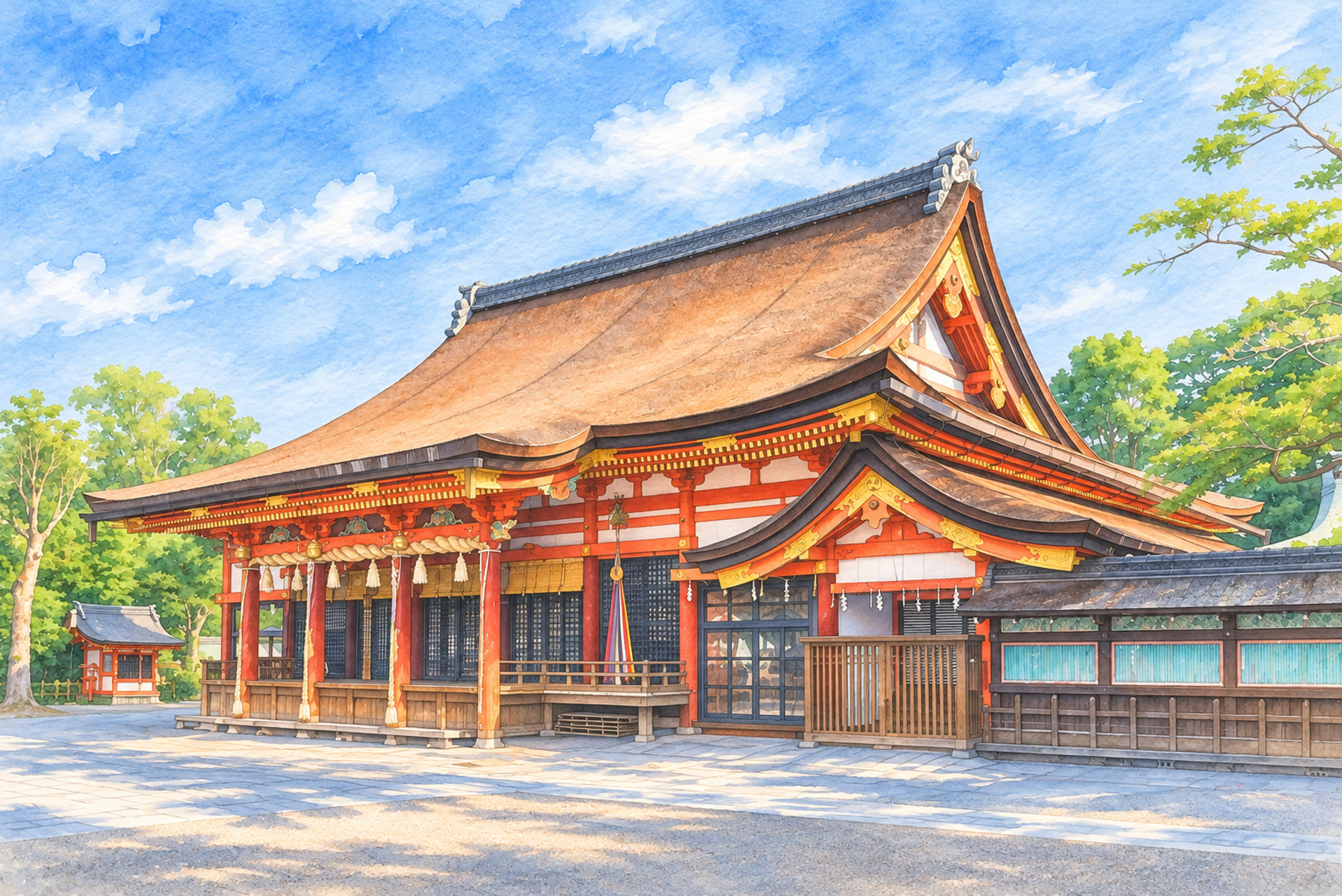
Yasaka Shrine stands in the Gion district of Higashiyama Ward, Kyoto. Its vermilion west gate faces straight down Shijō-dōri, making it one of the busiest shrines in the city. Before the Meiji period it was known as Gion-sha or Gion Kanshin-in, a combined shrine and Buddhist temple, and the district of Gion takes its name from it. The Gion Festival held every July is Yasaka’s festival, with roots in a Heian-period rite to placate angry spirits.
01The origins of Gion-sha
Today the shrine’s main deity is Susanoo. Accounts of its founding differ. The shrine’s own tradition says that in 656 an envoy from the Korean kingdom of Goguryeo, recorded in Japanese sources as Irishi, brought the deity here; another account credits the monk Ennyo with building a hall on the site in 876. The god worshipped here in premodern times was Gozu Tennō, an ox-headed deity of complex origin believed both to bring and to ward off epidemics, and identified with Susanoo. He was also regarded as the guardian of Jetavana, the monastery of the Buddha, known in Japanese as Gion Shōja, which explains the name Gion. The shrine was at first under the authority of Kōfuku-ji in Nara, but records show that by 974 it had become a branch of Enryaku-ji on Mount Hiei, and in the medieval period it was often drawn into Enryaku-ji’s quarrels. In 1868 the Meiji government ordered the separation of Shinto and Buddhism. Gion-sha was renamed Yasaka Shrine, and its Buddhist halls and images were removed.
02The beginnings of the Gion Festival
Records say that in 869, during an epidemic in the capital, 66 halberds, one for each province of the realm, were set up at the Shinsen-en garden and the deity of Gion was carried out in procession to end the sickness. This is regarded as the first Gion goryōe. From the medieval period, the merchant households of Shimogyō paid for the lavishly decorated floats called yama and hoko, and the festival grew ever larger. It stopped for more than 30 years after the Ōnin War and resumed in 1500. Today the festival fills all of July, and its best-known events are the float processions on the 17th and 24th. In 2009 the float rites were inscribed on UNESCO’s Representative List of the Intangible Cultural Heritage of Humanity, and in 2016 they were folded into the listing for Yama, Hoko, Yatai float festivals.
03What can be seen today
The present main hall was rebuilt in 1654 by Tokugawa Ietsuna, the fourth Tokugawa shogun. It covers the sanctuary and the worship hall under a single great roof, a rare form called Gion-zukuri, and was designated a National Treasure in 2020. The west gate was rebuilt in 1497, in the late Muromachi period, was moved and enlarged in 1913, and is an Important Cultural Property. Among the subsidiary shrines, Ekijinja honors Somin Shōrai, the figure behind the charms reading "descendants of Somin Shōrai" handed out during the festival. On New Year’s Eve, crowds come for Okera-mairi, carrying home sacred fire from the shrine on lengths of smoldering rope.