
The Fushimi-Momoyama Castle historic area covers the hills of eastern Fushimi Ward in Kyoto, Kyoto Prefecture. Toyotomi Hideyoshi made his last political capital here and died in the castle, and Tokugawa Ieyasu received his appointment as shogun at Fushimi before the new regime settled in Edo. The castle itself has long gone; what remains is buried archaeology, an imperial mausoleum, and a modern replica keep.
01Two Fushimi Castles
In 1592 Hideyoshi began a retirement residence at Shigetsu, above the Uji River, and after the birth of his son Hideyori the following year he enlarged it into a full castle. The great Keichō Fushimi earthquake of 1596 wrecked Shigetsu, and Hideyoshi immediately built a new castle on the higher ground of Kohatayama to the northeast, largely complete by 1597. He died there in 1598. Daimyo mansions filled the surrounding slopes, and river traffic on the Uji linked Fushimi with both Kyoto and Ōsaka.
02Siege, Rebuilding and Abandonment
After Hideyoshi’s death Ieyasu governed from Fushimi. When he marched east against the Uesugi in 1600, he left his retainer Torii Mototada in command. The western coalition besieged the castle for more than ten days; it fell, Mototada was killed, and the buildings burned, opening the campaign that ended at Sekigahara. Ieyasu rebuilt the castle and was named shogun there in 1603, and the appointments of Tokugawa Hidetada and Iemitsu are generally said to have taken place at Fushimi as well. The castle was abandoned and dismantled around 1623. Many temples and shrines claim gates or halls brought from Fushimi, though most of these traditions are unproven. Peach trees later planted on the bare hill gave it the name Momoyama, which in turn named the Momoyama period.
03The Site Today
The core of the Kohatayama castle is now occupied by the mausoleum of Emperor Meiji and the adjoining mausoleum of Empress Shōken, administered by the Imperial Household Agency, so the main enclosure cannot be explored. Excavations in recent decades have exposed moats, stone walls and gold-leaf roof tiles of the Shigetsu castle, mostly beneath the modern town. A stretch of stone wall found in 1977 was moved to a nearby elementary school for preservation. The large and small keeps on the hill were built in reinforced concrete in 1964 for an amusement park and do not follow the original design. The park closed in 2003; the keeps remain in a public park, and as of the 2020s their interiors are closed over earthquake-safety concerns.
Fushimi Castle
01A Castle You Cannot See
Walk east from Momoyama-goryōmae Station in southern Kyoto and the streets rise gently toward a wooded ridge. This is Momoyama, "Peach Hill." Somewhere to the north, above the trees, a white keep with gilded trim catches the light. Most visitors assume it is Fushimi Castle. It is not. That keep is a reinforced-concrete building put up in 1964 for an amusement park, and it does not even stand where the real castle’s main keep stood.
The real Fushimi Castle is almost entirely gone. Its central enclosure lies under the tomb of Emperor Meiji, closed to the public. Its buildings were taken apart four centuries ago and carried off to temples, shrines and other castles. And yet this vanished castle gave its name to an entire era. Japanese historians call the late sixteenth century the Azuchi-Momoyama period: Azuchi for Oda Nobunaga’s castle on Lake Biwa, Momoyama for this hill.
In roughly thirty years Fushimi Castle was built, shaken down by an earthquake, rebuilt on a new site, burned in a siege, rebuilt again and finally dismantled. Toyotomi Hideyoshi, the man who unified Japan, died here. Tokugawa Ieyasu, the man who took Japan from Hideyoshi’s heir, ran the country from here and was named shogun here. The story of this hill is the story of how power passed from one house to the other.
02A Retirement Villa Grows Into a Castle
At the end of 1591 Hideyoshi handed the title of kanpaku, the imperial regent, to his nephew Toyotomi Hidetsugu and took the title taikō, retired regent. A retired regent needed a residence, and Hideyoshi chose Fushimi, just south of Kyoto.
The choice made sense. Fushimi sat where the hills met the Uji River. To the south spread Ogura-ike, a large shallow lake that has since been drained. Boats could run downriver to Ōsaka; roads ran north into the capital. Since the Heian period (794–1185) Kyoto’s aristocrats had built villas here for the scenery.
In 1592 work began on a residence on a low hill called Shigetsu, a poetic name meaning roughly "pointing at the moon," near the riverbank. At first it was a retirement house. Then, in 1593, Hideyoshi’s consort Yodo-dono gave birth to a son, Hideyori. Hideyoshi, already in his late fifties, suddenly had an heir of his own blood, and the arrangement with Hidetsugu became awkward. The Fushimi project grew. Daimyo, the regional lords, were ordered to supply labor and materials, and the residence turned into a full castle with a keep.
In 1595 Hidetsugu was accused of plotting rebellion, exiled to Mount Kōya and ordered to commit suicide. His wives, concubines and children were executed in Kyoto. Hidetsugu’s palace, the Jurakudai, was demolished and many of its buildings were moved to Fushimi. From then on Fushimi was the center of Toyotomi government in the capital region.
03The Earthquake of 1596
Late on the night of the thirteenth day of the leap seventh month of 1596 (September 5 by the Gregorian calendar), a powerful earthquake struck the Kyoto area. It is known as the Keichō Fushimi earthquake, after the era name adopted later that year. The new Shigetsu castle was badly damaged and its keep collapsed. Hundreds are said to have died inside the castle. The Great Buddha at Hōkō-ji, Hideyoshi’s huge new temple in eastern Kyoto, was wrecked as well.
One story about that night became a favorite of the kabuki stage. Katō Kiyomasa, one of Hideyoshi’s leading generals, had been recalled from the Korean campaign and confined to his house after quarrels with Konishi Yukinaga and accusations from Ishida Mitsunari. When the earthquake hit, the story goes, Kiyomasa rushed to Fushimi without waiting for permission to guard his lord, and the grateful Hideyoshi pardoned him. The tale, known as "Jishin Katō" ("Earthquake Katō"), comes from Edo-period storytelling and plays, and historians treat it with caution.
The earthquake also disrupted diplomacy. Envoys from Ming China had come to negotiate an end to the war in Korea, and Fushimi had just been refurbished to receive them. With the castle in ruins, Hideyoshi received them at Ōsaka Castle in early autumn instead. The talks collapsed, and in 1597 Japanese armies invaded Korea a second time. The traditional story says Hideyoshi flew into a rage on learning that the Ming emperor was merely investing him as "King of Japan"; many historians now think the real sticking point was the demand that Japanese troops leave Korea.
04The New Castle on Kohata-yama
Hideyoshi did not rebuild on the damaged site. He moved the castle to higher ground to the northeast, a hill called Kohata-yama, and construction went fast. By 1597 the keep and main buildings were ready and Hideyoshi moved in. The new castle was large, with a main enclosure on the summit surrounded by second and third enclosures and named baileys such as the Matsu-no-maru (Pine Bailey) and Nagoya-maru.
From the early years of the Fushimi project, Hideyoshi also reshaped the landscape below. He built embankments that changed the course of the Uji River, which had flowed into Ogura-ike, and directed it past the foot of the castle to create a river port. Causeways across the lake carried the road from Nara straight to Fushimi. These works are remembered collectively as the Taikō-zutsumi, "the Retired Regent’s embankments." For nearly three centuries afterward, Fushimi was the river port where traffic between Kyoto and Ōsaka changed boats.
Around the castle the great lords built mansions, and their names survive in the street addresses of today’s Momoyama neighborhood: Mōri-Nagato, Fukushima-Dayū, Ii-Kamon, Tsutsui-Iga, Masamune. They are generally taken to recall the residences of the Mōri, Fukushima Masanori, the Ii, the Tsutsui and Date Masamune. Look at the address plates on utility poles as you walk through the quiet residential streets.
05The Death of Hideyoshi
In spring 1598 Hideyoshi held a lavish cherry-blossom party at Daigo-ji, his last great public spectacle. By summer he lay ill at Fushimi. On his deathbed he made the five senior lords, the Council of Five Elders (Tokugawa Ieyasu, Maeda Toshiie, Mōri Terumoto, Ukita Hideie and Uesugi Kagekatsu), and the Five Commissioners, including Ishida Mitsunari, swear again and again to protect his young son. His last letters beg them, in almost pleading terms, to look after Hideyori.
Hideyoshi died at Fushimi Castle on the eighteenth day of the eighth month of 1598 (September 18), aged sixty-two by the traditional Japanese count. A farewell poem is attributed to him: "I fell like the dew, and like the dew I vanish; even Naniwa [Ōsaka] is a dream within a dream." Whether he really composed it at the end is debated, but it has become inseparable from his memory.
His death was kept secret at first while Japanese troops were withdrawn from Korea. He was buried on Amidagamine, a peak in eastern Kyoto, where the Toyokuni mausoleum was built.
06Ieyasu Takes Over
Under Hideyoshi’s arrangements, Hideyori moved to Ōsaka Castle under the guardianship of Maeda Toshiie, while Ieyasu stayed at Fushimi to run the government. In 1599 Toshiie died. A group of generals including Katō Kiyomasa and Fukushima Masanori tried to attack Ishida Mitsunari, whom they hated. Mitsunari fled to Fushimi, and Ieyasu mediated a settlement under which Mitsunari retired to his castle at Sawayama in Ōmi. Ieyasu then moved into the main enclosure of Fushimi Castle, and people began calling him "the lord of the realm." Later that year he also installed himself in the western enclosure of Ōsaka Castle, beside Hideyori.
In summer 1600 Ieyasu marched east to punish Uesugi Kagekatsu in Aizu. He left Fushimi in the care of an old retainer, Torii Mototada. According to Edo-period accounts such as the Mikawa Monogatari, the two men talked through the night before Ieyasu left. Both understood that once Ieyasu was gone, Mitsunari’s side would rise, and Fushimi would be the first target. Mototada is said to have urged Ieyasu to leave him only a small garrison and take every man he could spare. The scene became a model of samurai loyalty in Tokugawa lore.
07The Siege of Fushimi
It happened as they expected. Mitsunari brought together Mōri Terumoto, Ukita Hideie and others, and the first objective of this Western Army was Fushimi, the gateway to Kyoto. Around the nineteenth day of the seventh month of 1600, some 40,000 troops under Ukita Hideie, Kobayakawa Hideaki, Shimazu Yoshihiro and others surrounded the castle. Mototada had about 1,800 men.
The castle held for more than ten days. According to later accounts, men from Kōga in the garrison were coerced by threats to their families and set fires inside, and the defenses broke. On the first day of the eighth month (September 8, 1600) Fushimi fell. Torii Mototada was killed, aged sixty-two, and nearly the whole garrison died with him. According to Shimazu family accounts, Shimazu Yoshihiro had offered to help defend the castle for Ieyasu but was refused entry, after which he joined the Western side, an episode often cited to show how confused alliances were on the eve of the decisive battle.
The siege tied down the Western Army for about two weeks. On the fifteenth day of the ninth month, Ieyasu won the Battle of Sekigahara.
The defenders’ blood soaked the castle’s floorboards. Afterward, according to tradition, the boards were taken down and installed as ceilings in several Kyoto temples, so that the dead would be prayed for and no one would walk on them. These "blood ceilings" (chi-tenjō) are shown today at Yōgen-in, Hōsen-in, Genkō-an, Shōden-ji, Kōshō-ji and elsewhere, and guides point out the stains of hands and feet. Whether all of them truly came from Fushimi cannot be proved; treat the attribution as temple tradition.
08The Tokugawa Castle
After Sekigahara, Ieyasu rebuilt Fushimi Castle quickly and governed from it. Lords came to Fushimi to pay their respects. Ieyasu also set up a silver mint (ginza) in Fushimi in 1601, one of the foundations of the Tokugawa currency system.
On the twelfth day of the second month of 1603, imperial envoys came to Fushimi Castle to appoint Ieyasu shogun, and the Tokugawa shogunate began. His son Hidetada received the same appointment at Fushimi in 1605, and his grandson Iemitsu in 1623. The first three Tokugawa shoguns all took office here, and in the early decades the castle served as the shogun’s base in the west.
Its importance faded fast once the Toyotomi were destroyed in the Ōsaka campaigns of 1614–15. Nijō Castle in Kyoto was enlarged, and Ōsaka Castle was rebuilt under direct shogunal control. In 1619 the shogunate decided to abolish Fushimi Castle, and after Iemitsu’s appointment in 1623 it was fully dismantled.
09A Castle Scattered Across Japan
When Fushimi Castle came down, its buildings and stones were sent elsewhere. The best documented survivor is the Fushimi Yagura, a three-story turret at Fukuyama Castle in Hiroshima Prefecture. Fukuyama was built in the early 1620s by Mizuno Katsunari, and the shogunate gave him a turret from Fushimi. During dismantling and repair between 1951 and 1954, an inscription was found carved into a second-floor beam identifying it as the eastern turret of the Matsu-no-maru, confirming the tradition. It is an Important Cultural Property, and the one building that can be firmly shown to have come from Fushimi.
When Nijō Castle was enlarged in the 1620s, its new keep was brought from Fushimi; it burned after a lightning strike in 1750 and only its stone base remains. Records also mention Fushimi buildings going to Yodo Castle and Edo Castle; the Fushimi Yagura at the Imperial Palace in Tokyo takes its name from this tradition.
Many temples and shrines claim Fushimi fragments. The Chinese-style gates (karamon) of Nishi Hongan-ji, Toyokuni Shrine, Daitoku-ji and Hōgon-ji on Chikubu Island, among others, are said to come from Fushimi Castle or from the Jurakudai. These are magnificent Momoyama-style buildings, many of them National Treasures, but the attributions are often impossible to confirm, and some have been disproved by research. Think of "a relic of Fushimi Castle" as a tradition rather than a certainty.
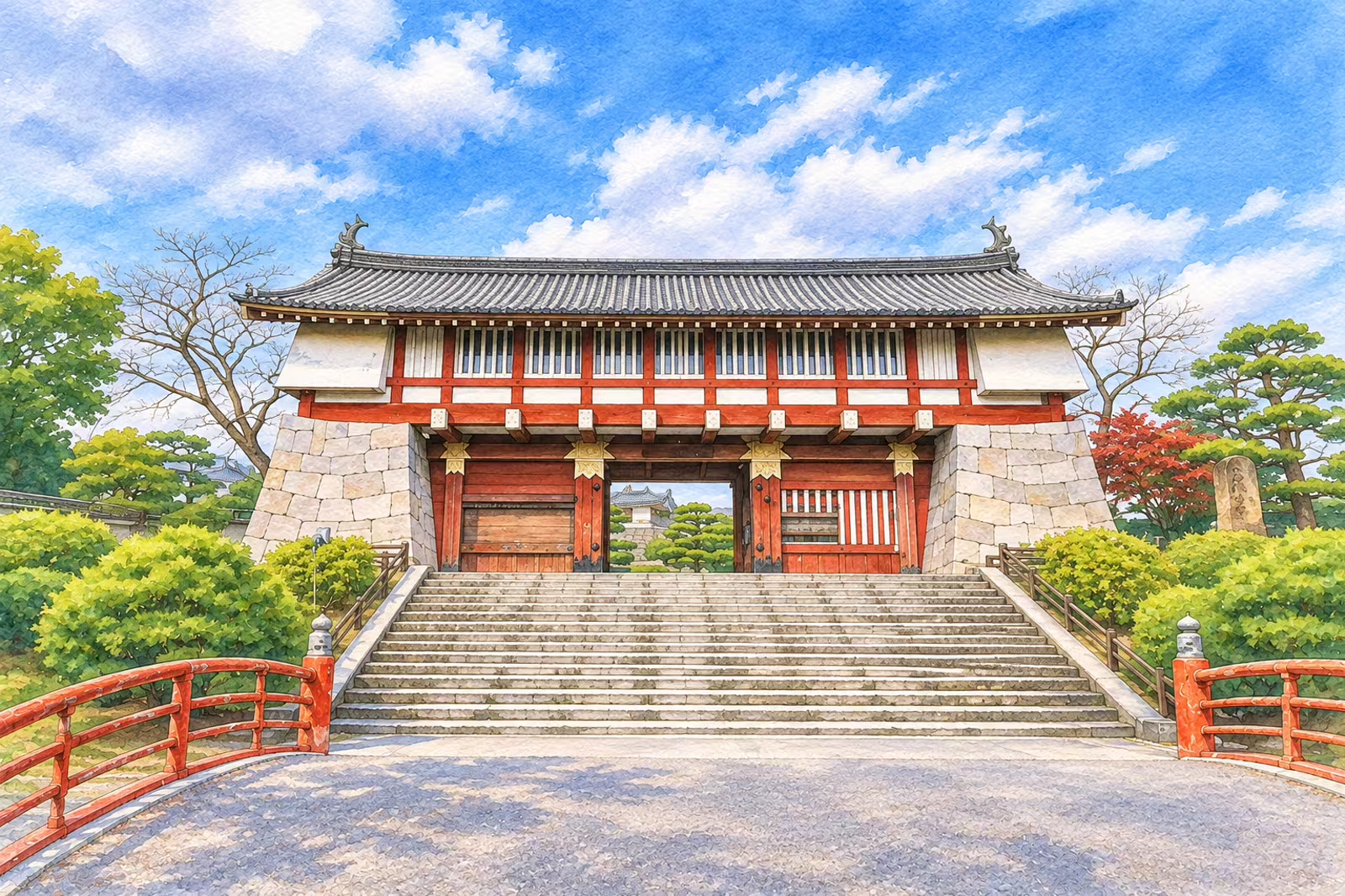
Gokōnomiya Shrine, at the foot of the hill, has as its front gate the former main gate of Fushimi Castle, moved here by Tokugawa Yorifusa in 1622; it is an Important Cultural Property. The shrine itself was moved by Hideyoshi when he built the castle, and Ieyasu returned it to its original site in 1605.
10How the Hill Got Its Name
Once the castle was gone, the hill was left bare. During the Edo period local people planted peach trees across it, and in spring the slopes turned pink. The hill came to be called Momoyama, and the castle was remembered as Momoyama Castle or Fushimi-Momoyama Castle. Modern historians borrowed the name for the age of Nobunaga and Hideyoshi, and "Momoyama" became shorthand for the opulent, gold-leafed art and architecture of that age.
Below the hill, Fushimi lived on as a river port and post town under a shogunal magistrate, and it became known for sake brewing. In the first month of 1868 the opening battle of the Boshin War, the Battle of Toba-Fushimi, was fought in its streets. Shinsengumi swordsmen and Aizu troops held the Fushimi magistrate’s office against Satsuma and Chōshū forces, and much of the town burned.
11Emperor Meiji’s Tomb
Emperor Meiji died in July 1912. He had wished to be buried in Kyoto, and the site chosen was the old main enclosure of Fushimi Castle. The funeral was held that September and the Fushimi-Momoyama Mausoleum was built, a mound with a round top on a square base. Empress Shōken, who died in 1914, lies in a separate tomb just to the east.
On the day of the emperor’s funeral, General Nogi Maresuke and his wife took their own lives in Tokyo to follow their sovereign in death. Nogi Shrine was later built near the tomb in his memory.
Because the heart of the castle site became an imperial tomb under the Imperial Household Agency, it is closed and cannot be excavated. For this reason the main part of Fushimi Castle has never been designated a national historic site, unusual for a castle of such importance.
12The Concrete Keep and What Lies Underground
In 1964 the Kintetsu railway group opened an amusement park, Fushimi Momoyama Castle Land, on the northern part of the old castle grounds, and built a large and a small keep in reinforced concrete. Their design loosely evokes Momoyama castle style but does not reconstruct Fushimi’s actual keep, and they stand away from the original main enclosure. The park closed in January 2003. The keep was due to be demolished too, but local residents petitioned to save it. The grounds became the City of Kyoto’s Fushimi Momoyama Castle Sports Park, with the keep as its landmark; the interior is closed because it does not meet earthquake standards.
Meanwhile, archaeology has begun to reveal the real castle. From 2015, excavations ahead of housing development in the Shigetsu area uncovered stone walls of the first, Shigetsu castle, followed the next year by gold-leaf roof tiles, the first archaeological confirmation of its remains. Construction around the city has turned up stones and tiles from the Kohata-yama castle as well.
13A Walk Around the Hill
Start at Momoyama-goryōmae Station and walk east along Ōtesuji to Gokōnomiya Shrine, where you can see the gate brought from the castle and taste the spring water for which the shrine is named. Continue uphill through the wooded approach to Emperor Meiji’s tomb. A long flight of about 230 stone steps leads up to it. From the top, look southwest over the city toward the plain where Ogura-ike once lay; this is the best place to understand why Hideyoshi wanted this hill. Empress Shōken’s tomb lies to the east, and Nogi Shrine is nearby.
North of the tomb, paths lead to the sports park and the concrete keep. South and downhill, near the Uji River, is Shigetsu, the site of the first castle. In the streets of the Momoyama district, address plates still carry the names Mōri, Fukushima, Ii and Masamune.
If you have time, visit Yōgen-in in eastern Kyoto to see a blood ceiling, or travel to Fukuyama to see the Fushimi Yagura. Most of what survives of Fushimi Castle lies somewhere else.