
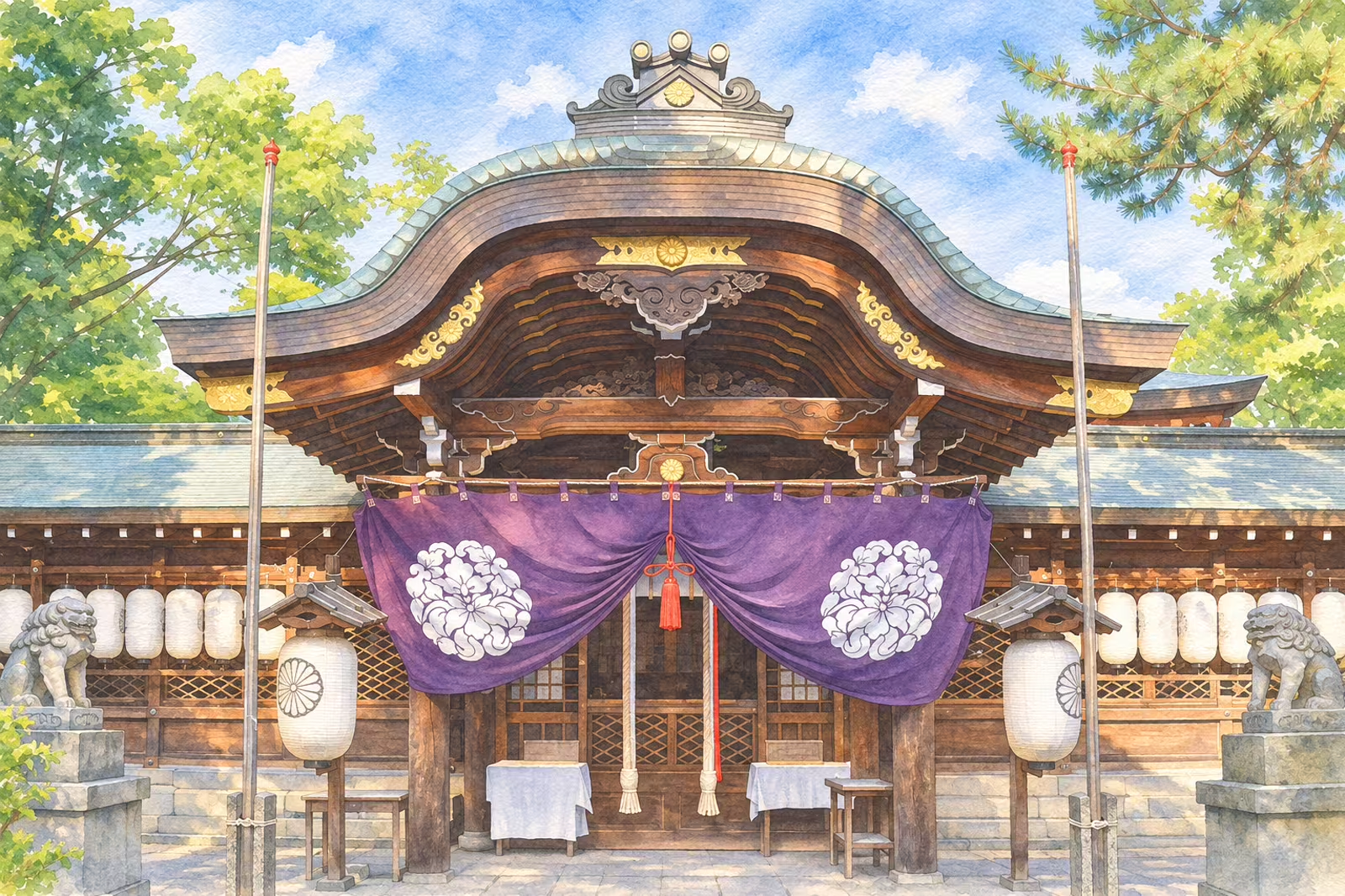
This area covers the northern part of Kyoto’s Kamigyō Ward, from Kamigoryō Shrine through Shōkoku-ji and the site of the Muromachi shoguns’ palace to the Nishijin district. It was the main battleground of the Ōnin War of 1467–1477. The Eastern Army was based around the shogun’s palace, the Western Army around the residence of Yamana Sōzen, and for ten years the two sides fought each other across a few city blocks while much of northern Kyoto burned. No intact battlefield survives; what remains are shrines and temples, stone markers, place names and scattered relics.
01The Battle of Goryō
Kamigoryō Shrine has, since the Heian period, been devoted to appeasing goryō, the spirits of those believed to have died with grievances. In the first month of 1467, Hatakeyama Masanaga took up a position in the woods around the shrine and fought his kinsman Hatakeyama Yoshinari, who drove him off. This Battle of Goryō grew out of a succession dispute within the Hatakeyama house and widened as Hosokawa Katsumoto and Yamana Sōzen each became involved; it is generally regarded as the start of the Ōnin War. In the fifth month of that year, Hosokawa’s Eastern Army and Yamana’s Western Army went to war in earnest across the capital.
02The two camps
The Eastern Army held the area around the shogunal palace built by Ashikaga Yoshimitsu, popularly called the Hana no Gosho, and surrounded it with earthworks and ditches. Shōkoku-ji, right beside the palace, became the scene of fierce fighting in the autumn of 1467, and most of the temple burned. The Western Army’s headquarters lay to the west near the Horikawa, where Yamana Sōzen’s residence stood. Around the Dodo Bridge over the Ogawa stream, between the two camps, a narrow front line was fought over again and again. Yamana Sōzen and Hosokawa Katsumoto both died in 1473, but the war dragged on until the Western commanders withdrew from Kyoto in 1477.
03What can be seen today
Kamigoryō Shrine is still an active shrine, and a stone marker in its grounds identifies it as the place where the Ōnin War began. Shōkoku-ji was rebuilt several times after the war; its present Dharma Hall dates from the early Edo period. Nothing of the Hana no Gosho or the armies’ earthworks remains above ground; only markers and scattered archaeological finds indicate where they stood. A stone marks the site of Yamana Sōzen’s residence, and the nearby neighborhood of Yamana-chō preserves his name. The name Nishijin, "western camp," comes from the Western Army’s position; weavers regathered here after the war, and Nishijin textiles took their name from the district. The old stone Dodo Bridge survived until the 1960s, when it was dismantled and some of its stones were moved elsewhere for preservation.