
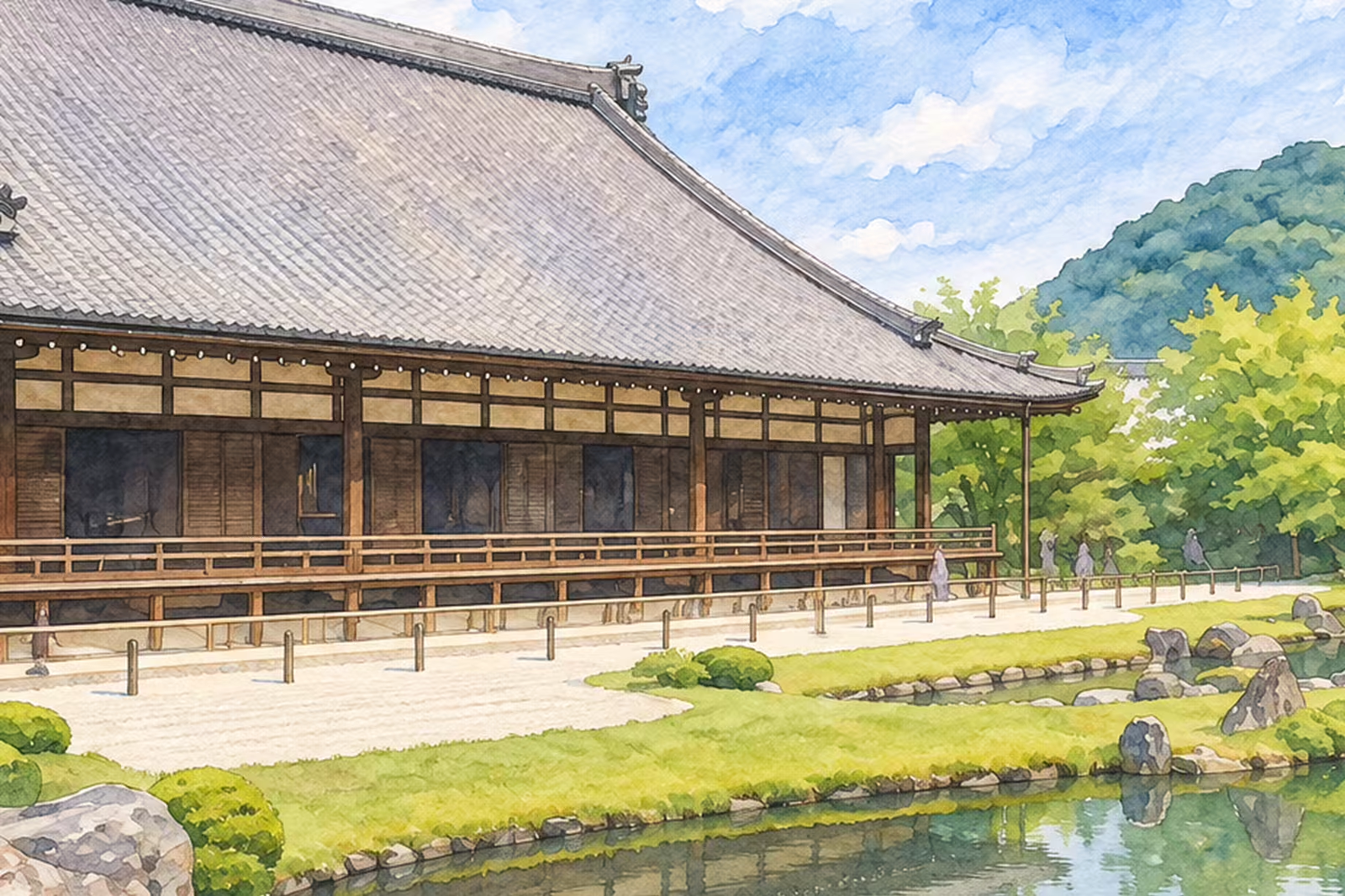
Ryōan-ji is a Rinzai Zen temple of the Myōshin-ji branch in Ukyō Ward, Kyoto, at the southern foot of Mount Kinugasa and a short walk from Kinkaku-ji. It is known above all for the rock garden in front of its abbot’s hall: fifteen stones set in a bed of raked white gravel, with no trees at all. This small dry garden has become, for many people, the image of a Japanese Zen garden.
01From aristocratic villa to Zen temple
In the Heian period the area was an outing ground for the court nobility, and it later became a villa of the Tokudaiji family. In 1450 the shogunal deputy Hosokawa Katsumoto acquired the land and invited Giten Genshō of Myōshin-ji to found a Zen temple there. Genshō named his own teacher, Nippō Sōshun, as the honorary founder, so the temple’s official founder and the monk who actually built it are two different people.
Katsumoto led the Eastern Army in the Ōnin War, and after fighting broke out in 1467 Ryōan-ji was burned. His son Hosokawa Masamoto rebuilt it around 1488. The temple prospered in the Edo period, but a fire in 1797 destroyed the abbot’s hall and other main buildings.
02The rock garden
The garden measures roughly 25 meters east to west and 10 meters north to south, enclosed on three sides by an oil-and-clay wall. The fifteen stones are arranged in five groups, and it is said that from any viewpoint at least one stone stays hidden behind another. No reliable record tells who made the garden or when. Tradition credits the painter Sōami; others suggest the Hosokawa family or the temple’s own monks. The back of one stone bears carved names, including Kotarō, generally taken to be those of the workmen. Most estimates place the garden between the late fifteenth and early seventeenth centuries. Readings such as "a tigress crossing a river with her cubs" are later interpretations.
03What you can see today
The present abbot’s hall originally belonged to Seigen-in, one of the temple’s sub-temples, and was moved here after the 1797 fire. It is generally dated to the early seventeenth century and is an Important Cultural Property. The rock garden is designated a Special Place of Scenic Beauty and a Historic Site. The Kyōyōchi pond preserves the layout of the villa garden that predates the temple, and behind the hall stands a stone water basin inscribed with the phrase "I only know contentment." In 1994 Ryōan-ji was inscribed on the World Heritage List as part of the Historic Monuments of Ancient Kyoto.
Ryōan-ji
01What You Are Looking At
Most visitors arrive at Ryōan-ji with one thing in mind. They take off their shoes, step onto the wooden veranda of the abbot’s quarters, and sit down in front of a rectangle of raked white gravel roughly 25 meters long and 10 meters deep. Fifteen stones, set in five groups and fringed with moss, rise from the gravel. A low earthen wall closes the space on two sides. Beyond it, trees. Nothing else.
This is the most famous karesansui, or "dry landscape" garden, in Japan: a garden that represents water, mountains and islands using only stone and sand. It has been photographed, measured, analyzed by computer, and interpreted as tigers crossing a river, as islands in an ocean, and as a riddle about the limits of human perception. Yet nobody knows for certain who made it or when.
The temple around it has a longer and more concrete history. Ryōan-ji is a Zen temple of the Myōshin-ji branch of the Rinzai school, founded in the fifteenth century by one of the most powerful warlords of his day, on land that had already been an aristocratic villa and an imperial temple for several hundred years. Understanding that history makes the garden easier to see for what it is.
02Before the Temple: Emperors and Aristocrats
Ryōan-ji sits in the northwest corner of the Kyoto basin, at the foot of low wooded hills. In the Heian period (794–1185), this was choice suburban land for the imperial family and the court nobility. Ninna-ji, the temple founded by Emperor Uda, lies a short walk to the southwest, and the hills nearby were used for imperial burials.
In the late tenth century Emperor En’yū built a temple in this area, the En’yū-ji, and lived there after his abdication. It declined after his death. In the twelfth century the land passed to a branch of the Fujiwara family, later known as the Tokudaiji house, which built a villa and family temple here. The large pond you pass on the way in, Kyōyōchi, is generally thought to have been the garden pond of En’yū-ji, later incorporated into the Tokudaiji villa. Courtiers would have boated on it long before any Zen monk arrived.
03Hosokawa Katsumoto Founds a Temple
In the mid-fifteenth century the Tokudaiji estate was acquired by Hosokawa Katsumoto (1430–1473), reportedly in exchange for land elsewhere. A deed of 1458 in which Tokudaiji Kin’ari formally made over the land to the temple is quoted in an Edo-period gazetteer of the Kyoto region.
Katsumoto headed the main line of the Hosokawa, one of the three families that took turns holding the office of kanrei, the shogun’s deputy and the highest administrative post in the Ashikaga shogunate. He first took the office in 1445, at the age of fifteen by modern reckoning, held it three times for a total of more than twenty years, and dominated Kyoto politics for most of his adult life. He was also a man of cultivated tastes, with interests in poetry, painting, medicine and Zen.
In 1450 Katsumoto turned the estate into a Zen temple and named it Ryōan-ji, "Temple of the Peaceful Dragon." He invited the monk Giten Genshō of Myōshin-ji to serve as founding abbot. Giten, out of respect, named his own teacher, Nippō Sōshun, as the formal founder, while he himself ran the temple. The Myōshin-ji line was known for its strict practice and had been punished by the third shogun, Ashikaga Yoshimitsu, half a century earlier; it stood well outside the officially sponsored network of Zen monasteries known as the Five Mountains, so the patronage of a man like Katsumoto mattered a great deal to it.
Ryōan-ji became the family temple of the Hosokawa main line, a place to hold memorial services for ancestors and to bury family members.
04Burned in the Ōnin War
Katsumoto is best remembered as a commander in the Ōnin War, the conflict that began in 1467 over succession disputes in the shogun’s family and in two other great houses, the Hatakeyama and the Shiba. Katsumoto led the so-called Eastern Army; his father-in-law, Yamana Sōzen, led the Western Army. The names came from the positions of their headquarters: Katsumoto’s camp near the shogun’s palace lay to the east, Sōzen’s mansion to the west. Kyoto’s weaving district, Nishijin, literally "Western Camp," still carries the memory. Fighting raged through the city’s streets for eleven years and left much of Kyoto in ashes.
Ryōan-ji, less than twenty years old, was burned in 1468, in the second year of the fighting. Katsumoto died of illness in 1473, the same year as Yamana Sōzen, with the war still unresolved.
05Rebuilding under Hosokawa Masamoto
Katsumoto’s son Hosokawa Masamoto (1466–1507) began rebuilding the temple in 1488, installing the monk Tokuhō Zenketsu, who is honored as the temple’s restorer. A new abbot’s quarters was completed in 1499, and the rock garden is often assumed to have been laid out in front of it at that time, though there is no direct evidence. Masamoto was a remarkable figure in his own right. In 1493 he deposed the shogun Ashikaga Yoshiki and installed a cousin in his place, a coup that many historians treat as one of the starting points of the Sengoku, or "Warring States," period. He was a devotee of mountain asceticism, never married, and was assassinated by his own retainers in 1507, which plunged the Hosokawa into decades of internal war.
Despite the turmoil, Ryōan-ji survived and grew. Oda Nobunaga and Toyotomi Hideyoshi both granted it landholdings, and by the early Edo period it had numerous sub-temples, called tatchū, scattered across a large precinct. A camellia in the temple grounds is associated with Hideyoshi by tradition.
06The Fire of 1797 and a Borrowed Building
In 1797 a fire destroyed the abbot’s quarters, the Buddha hall and other main buildings. Instead of building anew, the temple moved the abbot’s quarters of one of its sub-temples, Seigen-in, to the site. That building dates from the early seventeenth century, usually given as 1606, and is now designated an Important Cultural Property.
The building follows the standard plan of a Zen abbot’s quarters, the hōjō. Two rows of three rooms run east to west. The large central room on the south side, facing the garden, was used for ceremonies and for receiving guests; the rooms behind and to the sides served as the abbot’s study, sleeping room and private chapel. In the medieval and early modern temple, the garden in front of the hōjō was not a place to walk in. It was a space to be seen from the rooms and the veranda, which is exactly how you encounter it today.
This means the veranda you sit on to view the garden is not the building the garden was originally designed to face. Whether the garden itself changed when the new building went up is a matter of scholarly debate.
The Kanō-school sliding-door paintings that once decorated the abbot’s quarters were sold in 1895, after Buddhist temples had lost much of their land and income in the early Meiji years. Ninety panels left the temple and were later dispersed; some are now in the Metropolitan Museum of Art in New York and the Seattle Art Museum, and the temple has bought a number of them back since 2010. The dragon paintings you see inside today were painted from 1953 onward by Satsuki Kakuō.
07Who Made the Garden, and When?
The temple keeps no record of the garden’s construction. Over the centuries it has been attributed to the painter and connoisseur Sōami, who served the Ashikaga shoguns as an artistic adviser, to Hosokawa Katsumoto himself, and to early Edo tea masters such as Kanamori Sōwa and Kobori Enshū. None of these attributions has firm support.
The best evidence is carved on the stones. One long stone near the wall bears two carved names, Kotarō and a second name usually read as Seijirō. They are thought to have been senzui kawaramono, garden laborers from an outcast group in medieval Kyoto who lived near riverbeds and specialized in moving stones and planting. Men of this background built many of the celebrated gardens of the Muromachi period. The best known, Zen’ami, worked on gardens for the shogun Ashikaga Yoshimasa, and his descendants carried on the craft. Their names on the stone suggest that the garden, whoever planned it, was physically made by skilled workers of low status.
Most scholars place the garden somewhere between the late fifteenth and the early seventeenth century. An illustrated guide to Kyoto gardens published in 1799, Miyako Rinsen Meishō Zue, is generally taken to show the stones in essentially their present arrangement, which provides a reliable fixed point.
The garden also belongs to a wider story. The term karesansui appears as early as the eleventh-century garden manual Sakuteiki, where it describes stone arrangements set apart from a pond. In the Muromachi period, Zen temples began to build whole gardens in this manner in the narrow spaces in front of abbots’ quarters. The garden of Daisen-in at Daitoku-ji, made in the early sixteenth century, uses stones and gravel to depict a waterfall and a river; Ryōan-ji’s goes much further, removing almost every representational clue. Whatever its exact date, it is the most abstract surviving example of the form.
It is worth remembering that in the Edo period Ryōan-ji was better known for its pond than for its rock garden: a popular 1780 guide to Kyoto, Miyako Meisho Zue, singled out the mandarin ducks on Kyōyōchi. The garden’s status as a world-famous masterpiece is largely a modern development.
08Reading the Stones
From east to west, the fifteen stones are grouped five, two, three, two, three. Combined they can be read as seven, five and three, auspicious numbers in Japanese custom, and the garden has sometimes been called the "Garden of Seven-Five-Three."
Visitors are often told that from any point on the veranda at least one stone is always hidden behind another, so that you can never see all fifteen at once. Some explain this as a Zen lesson about incompleteness. That interpretation is modern; the temple itself has always declined to give the garden a single meaning.
An older reading, in use since at least the Edo period, is "a tigress crossing the river with her cubs." Other viewers have seen islands in the sea, mountain peaks above clouds, or the shape of the Chinese character for "heart." A team of researchers in 2002 used computer modeling to argue that the empty spaces between the stone groups form a hidden branching pattern when viewed from the center of the abbot’s quarters. All of these are ways of looking, not answers.
Notice the wall. It is made of clay mixed with rapeseed oil, and over time the oil has seeped out to create the mottled patterns on its surface. The wall is not of even height: it is highest near the abbot’s quarters and drops toward the far corners, and the ground slopes slightly too, effects generally understood to make the garden appear deeper than it is. A roof of thin wooden shingles caps it, and the trees beyond change with the seasons.
09The Water Basin: "I Know Only Contentment"
On the north side of the abbot’s quarters is a stone water basin, or tsukubai, used for rinsing the hands before the tea ceremony. Its square central hole forms the shared element of four characters carved around it. Read together, they say ware tada taru o shiru, "I know only contentment," a Zen expression of being satisfied with what one has. The original basin is said to have been a gift from Tokugawa Mitsukuni, the lord of Mito. The one visitors see on the route is a replica; the original sits in the garden of the Zōroku-an tea house, which is not open to the public.
In the garden on the east side of the building grows the Wabisuke camellia, a variety with small, modest flowers. One story holds that the variety is named after a man called Wabisuke who brought it back from Hideyoshi’s invasions of Korea. The temple’s tree is a celebrated old specimen.
10Imperial Tombs and Hosokawa Graves
The hill behind the temple, called Shuzan, holds the tombs of five Heian-period emperors, Ichijō, Go-Suzaku, Go-Reizei, Go-Sanjō and Horikawa, and of Princess Teishi, Horikawa’s elder sister. They are managed by the Imperial Household Agency and are separate from the temple. The exact locations of several of these tombs had been forgotten by the Middle Ages, and the present sites were fixed during the tomb restorations of the 1860s. Still, the link to the court is real: Horikawa’s remains, for example, were interred in 1113 at En’yū-in, a cloister of Ninna-ji.
The temple also has a Hosokawa family cemetery with the graves of Katsumoto, Masamoto, Takakuni and other heads of the clan’s main line, as well as Katsumoto’s wife.
11From Local Temple to World Heritage
After the Meiji Restoration of 1868, the temple lost most of its land and many of its sub-temples disappeared. In 1929 a fire that started near the temple bath damaged part of the abbot’s quarters and one volume of the temple’s prized manuscript of the Taiheiki, a reminder of how close the building came to sharing the fate of its predecessors. In the twentieth century, as Japanese and foreign writers began to promote Zen aesthetics, the rock garden attracted growing attention. Queen Elizabeth II viewed the garden on May 10, 1975 during her state visit to Japan, and the coverage of her visit is generally credited with spreading its fame abroad; visitor numbers rose sharply.
The garden of the abbot’s quarters is designated a Historic Site and a Special Place of Scenic Beauty, and the wider temple garden around Kyōyōchi is a Place of Scenic Beauty. The abbot’s quarters and the imperial envoys’ gate are Important Cultural Properties, as is the temple’s Seigen-in manuscript of the Taiheiki, the medieval war chronicle. In 1951 a rainstorm sent a landslide down the hill behind the temple and covered the raked gravel with red mud; in 2021–22 the garden was closed for several months while the wall’s shingle roof was replaced. In 1994 Ryōan-ji was inscribed on the UNESCO World Heritage List as one of the components of the Historic Monuments of Ancient Kyoto.
12A Walk Through the Grounds
From the entrance, the path runs along the south side of Kyōyōchi pond. In spring the banks are lined with cherry blossoms; in summer, water lilies cover parts of the surface. This is the oldest landscape in the precinct, the one Edo-period visitors came to see.
Climb the stone steps to the kuri, the temple’s kitchen and office building, and enter the abbot’s quarters. Sit on the veranda, then move slowly from one end to the other and count the stones. Look at the oil stains on the wall, the difference in its height, and the rings raked around each stone group.
Follow the veranda around the east and north sides to see the Wabisuke camellia and the replica water basin. Then return to the pond and follow the path around it. Seigen-in, the sub-temple that gave Ryōan-ji its abbot’s quarters, now serves boiled tofu to visitors at lunchtime.
Kinkaku-ji, the Golden Pavilion, is about twenty minutes’ walk to the east, and Ninna-ji a short distance to the southwest. The road linking the three, called the Kinukake-no-michi, is a good way to see how this corner of Kyoto passed from Heian emperors to Muromachi shoguns and their deputies.