
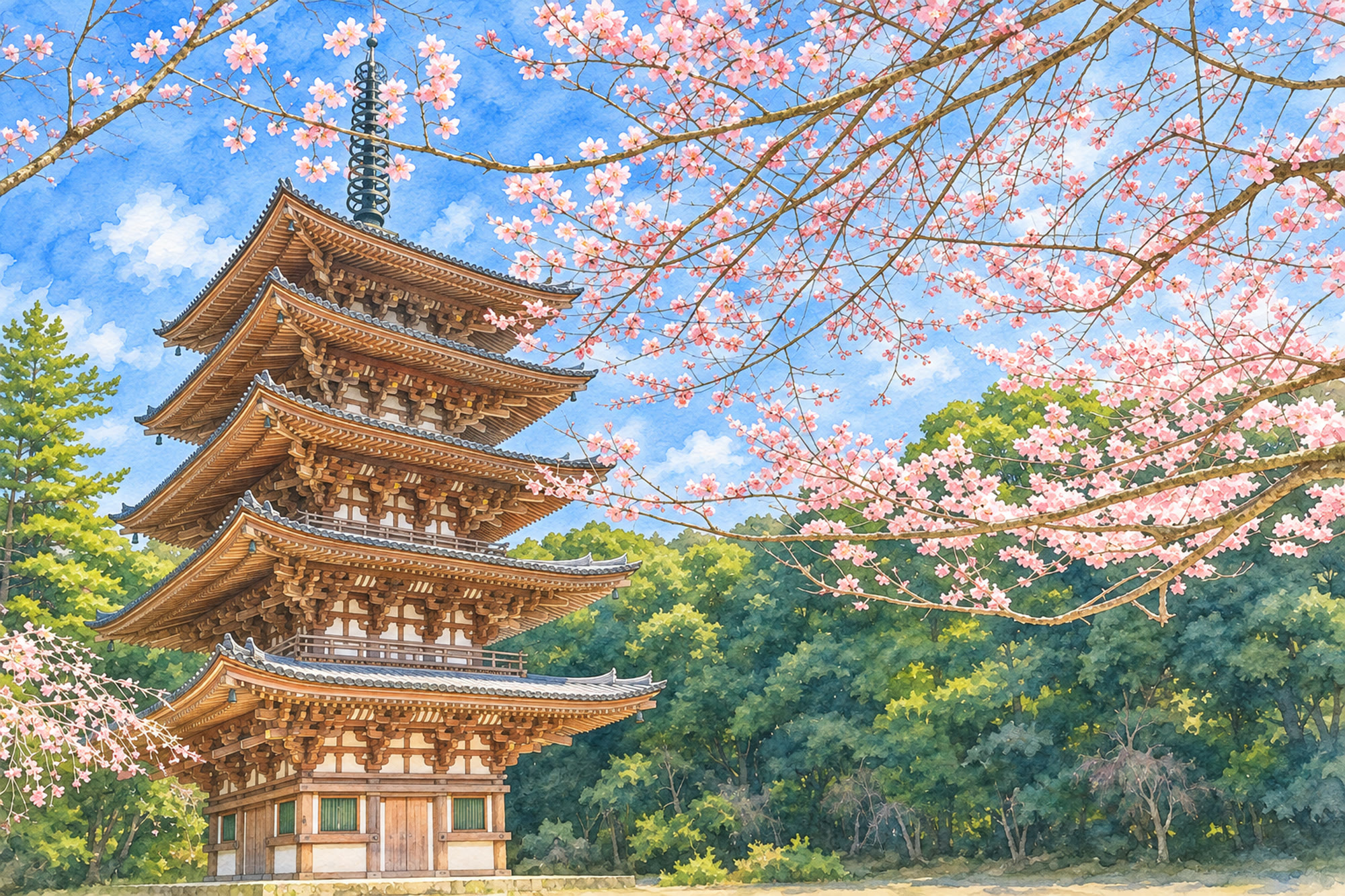
Daigo-ji is the head temple of the Daigo branch of Shingon Buddhism, spread across Mount Daigo, also called Mount Kasatori, on the eastern edge of Fushimi Ward in Kyoto, Kyoto Prefecture. Kami-Daigo (Upper Daigo) occupies the summit; Shimo-Daigo (Lower Daigo) and the subtemple Sanbō-in lie at its foot. Shimo-Daigo’s five-story pagoda is the oldest wooden building in Kyoto, and Toyotomi Hideyoshi’s lavish blossom-viewing party of 1598 made Daigo a byword for cherry blossoms.
01A hermitage on the summit and an emperor’s patronage
The temple traces its founding to 874, when the Shingon monk Shōbō built a small hall on the summit of Mount Kasatori. According to temple tradition, he met an old man drinking from a mountain spring who praised its taste as daigo, a Buddhist image for the finest of all flavors. The temple took its name from the word, and the spring still flows at Kami-Daigo.
Emperor Daigo made the temple one of his votive temples in 907, and the Yakushi-dō and Godai-dō halls rose on the summit. The emperor was buried nearby after his death in 930, and the name by which history remembers him comes from this place. His sons Emperor Suzaku and Emperor Murakami then built a temple complex at the foot of the mountain, including the five-story pagoda, vowed in 931 to pray for their father’s soul and finished in 951.
02Medieval power, war, and Hideyoshi’s revival
In 1115 the abbot Shōkaku founded Sanbō-in, which grew into the leading cloister of the temple. In the Muromachi period its monks served the Ashikaga shoguns closely. The most famous of them, Mansai, advised Ashikaga Yoshimitsu, Yoshimochi and Yoshinori and was nicknamed the "prime minister in black robes." During the turmoil around the Ōnin War, nearly every building at Shimo-Daigo burned. Only the pagoda survived.
Recovery came under the abbot Gien, who won Hideyoshi’s backing in the 1590s. Hideyoshi held his party here in the spring of 1598 and died that autumn. His son Toyotomi Hideyori carried on the work. The Kondō, or main hall, was moved here from Yuasa in Kii Province and completed in 1600. Hideyoshi is said to have sketched the plan of the Sanbō-in garden himself; Gien kept refining it for more than two decades.
03What survives today
National Treasure buildings include the pagoda and Kondō at Shimo-Daigo, the Yakushi-dō and the worship hall of the Seiryūgū shrine at Kami-Daigo, and the Omote Shoin and Karamon gate of Sanbō-in. The pagoda is original mid-Heian work; the Kondō and Kami-Daigo Yakushi-dō are essentially late Heian. The wall paintings inside the pagoda’s first story are a National Treasure in their own right, and the Sanbō-in garden is a Special Historic Site and Special Place of Scenic Beauty. In 1994 Daigo-ji was inscribed on the World Heritage List as part of the Historic Monuments of Ancient Kyoto. The Juntei-dō on the summit, by tradition the site of Shōbō’s first hall, was destroyed by a lightning fire in 2008 and had not been rebuilt as of 2026.
Daigo-ji
01A temple the size of a mountain
Most visitors meet Daigo-ji at the bottom of the hill, among the pagoda, the main hall and the cherry trees of the lower precinct. That is only half the temple. Behind the lower halls a footpath climbs Mount Daigo, also known as Mount Kasatori, to a second group of buildings on the summit. The two halves are called Kami-Daigo, "Upper Daigo," and Shimo-Daigo, "Lower Daigo," and the upper one is the older: the temple began on the mountaintop, and the complex below came several decades later. Beside the approach, before you reach the lower precinct, stands Sanbō-in, the senior cloister of the temple, famous for its garden and its late sixteenth-century reception rooms.
Daigo-ji is the head temple of the Daigo branch of Shingon, the esoteric Buddhist school brought from China by Kūkai in the early ninth century. It lies in Fushimi Ward on the southeastern edge of Kyoto, where the Yamashina basin meets the hills. For an aristocrat of the Heian capital this was close enough to visit and remote enough for mountain practice.
Over more than eleven centuries the temple was favored by Heian emperors, by the Ashikaga shoguns of the Muromachi period and by Toyotomi Hideyoshi, and it was devastated by war in between. Its surviving buildings fall neatly into those layers. The five-story pagoda is original mid-tenth-century work and the oldest wooden building in Kyoto. The main hall and the Yakushi-dō on the summit are late Heian. Sanbō-in and the great gate of the lower precinct belong to the revival led by Hideyoshi and his son Hideyori around 1600.
Two things above all have made Daigo-ji famous: that pagoda, and the cherry-blossom party Hideyoshi gave here in the spring of 1598, remembered as the Daigo no Hanami. It was the last great festivity of his life. He died five months later.
02Shōbō and the spring of Daigo
The founder of Daigo-ji was Shōbō (832–909), honored centuries later with the title Rigen Daishi. Accounts of his family background vary. He became a monk young, studied the exoteric Sanron teachings at Tōdai-ji in Nara, and received esoteric initiation from Shinga, Kūkai’s younger brother, which placed him in the second generation of Kūkai’s lineage. He was a significant figure at Tōdai-ji as well, where he founded the Tōnan-in cloister.
The temple’s founding story is set in 874. Shōbō, exploring Mount Kasatori, met an old man scooping water from a spring on the summit. The old man drank and exclaimed that it tasted of daigo. In Buddhist writing daigo is the last and richest of the five products refined from milk, and it serves as a metaphor for the highest teaching. The old man gave the mountain to Shōbō and vanished; later tradition identified him as Yokoo Myōjin, the local deity of the mountain. Shōbō built a hermitage on the summit and enshrined images of Juntei Kannon and Nyoirin Kannon, two esoteric forms of the bodhisattva of compassion.
This is a founding legend rather than a record of events, but it explains the name, and the spring is still there. The Daigo water flows at Kami-Daigo today.
Shōbō had a second life in the mountains. He practiced for long periods in the Yoshino and Ōmine ranges south of Nara, and the Tōzan branch of Shugendō later honored him as its restorer. Shugendō is a tradition of ascetic mountain practice that blends Buddhism with older Japanese reverence for sacred peaks; its practitioners are called yamabushi. Daigo-ji remained bound to this tradition. By the Edo period the abbot of Sanbō-in presided over the whole Tōzan branch, so the temple was both a great center of esoteric Buddhism and a headquarters for mountain ascetics.
03Emperor Daigo and the summit halls
During Shōbō’s lifetime the temple won the patronage of Emperor Daigo, who reigned from 897 to 930. His reign and that of his son Emperor Murakami were later idealized together as the "Engi and Tenryaku eras," a golden age when emperors were thought to have governed in person rather than through regents. In 907 Emperor Daigo made the temple one of his votive temples, an institution praying on behalf of the sovereign and the realm. The Yakushi-dō and the Godai-dō, the Hall of the Five Wisdom Kings, were built on the summit in this period.
Shōbō died in 909. His disciple Kangen continued his work and later, as head of Tō-ji, successfully petitioned the court to grant Kūkai the posthumous title Kōbō Daishi.
Emperor Daigo’s death came in dramatic circumstances. In the summer of 930 lightning struck the Seiryōden, the emperor’s residential hall in the palace, killing courtiers. The emperor fell ill from the shock, abdicated, and died within months. Contemporaries blamed the vengeful spirit of Sugawara no Michizane, the minister who had died in exile at Dazaifu after being banished in Daigo’s reign, and the episode fed the cult that eventually made Michizane the god Tenjin. The emperor was buried in the hills near the temple, and the name by which history knows him, Daigo, was taken from the place. Three centuries later Emperor Go-Daigo, who hoped to restore the personal rule of the Engi era, is generally said to have chosen his own posthumous name in tribute, so even he carries the name of this mountain.
The Yakushi-dō on the summit today is not the hall of 907. It was rebuilt in 1121 and is a National Treasure of late Heian architecture. Its Yakushi triad, also a National Treasure, has been moved down to the temple museum, the Reihōkan, for safekeeping. The Godai-dō burned in 1932 and was rebuilt in 1940.
04The pagoda
After Emperor Daigo’s death his sons Emperor Suzaku and Emperor Murakami turned to the foot of the mountain and built Shimo-Daigo. The Shaka-dō, the main hall of the lower precinct, was finished in 926. In 931 Prince Yoshiakira, a son of Emperor Daigo, vowed to build a five-story pagoda to pray for his father’s soul, and the records say the plan had the backing of Daigo’s consort Fujiwara no Onshi, mother of both Suzaku and Murakami. Construction began under Suzaku in 936, and the pagoda was completed under Murakami in 951, twenty years after the vow.
The pagoda rises roughly 38 meters, and its bronze finial, the sōrin, makes up nearly a third of that height, which gives the building its firm, grounded silhouette. It has come through the civil wars of the late Heian period, the Ōnin War, the wars of the sixteenth century and many earthquakes and typhoons, and remains essentially a tenth-century structure. Earthquake damage in the late sixteenth century was repaired as part of Hideyoshi’s revival, by the usual account just before the blossom party of 1598. After a typhoon in 1950 it underwent another major restoration, completed in 1960.
Inside, on the first story, the wall panels and pillars are painted with deities of the two great mandalas of esoteric Buddhism and with the eight patriarchs of Shingon, the line of teachers running from the Indian master Nāgārjuna through Huiguo in Tang China to Kūkai. The paintings date from the pagoda’s construction and rank among the earliest surviving esoteric paintings in Japan. They are designated a National Treasure separately from the building.
When fire swept Shimo-Daigo in the Ōnin War era, the pagoda was the only building to survive. Of everything you see in the lower precinct today, it is the one structure that belonged to the original Heian complex. The main hall is also Heian, but it was brought here from elsewhere, as we will see.
05Sanbō-in and the lineages of esoteric practice
By the late Heian period Daigo-ji was one of the most influential temples in the Shingon school. Esoteric ritual knowledge passed down in distinct lineages, and the great family of lineages centered on the Ono district southeast of Kyoto, the Ono-ryū, had Daigo-ji as one of its main bases. In 1115 the abbot Shōkaku founded Sanbō-in, the "Cloister of the Three Treasures." Its own lineage, the Sanbō-in-ryū, became one of the most prestigious in Shingon, and its heads so often served as abbot of Daigo-ji that the cloister became the effective center of the whole temple.
On the summit stands Seiryūgū, the shrine of the temple’s guardian deity. Seiryū Gongen is said to be a goddess who crossed the sea from the Qinglong Temple in Chang’an, the temple where Kūkai studied under Huiguo; the name Seiryū, "clear waterfall," is a play on the Japanese reading of Qinglong, "blue dragon." She was enshrined at Kami-Daigo in the late eleventh century, and a second shrine was later built below. The worship hall at the upper shrine dates from 1434 and is a National Treasure of Muromachi architecture; the main sanctuary of the lower shrine, from 1517, is an Important Cultural Property. Before the government forcibly separated Shinto and Buddhism in the Meiji era, shrines like these routinely stood inside temple grounds.
06Monks in black robes: Kenshun and Mansai
Daigo-ji reached the height of its political importance between the 1330s and the mid-fifteenth century.
At the end of the Kamakura period the monk Monkan, a close confidant of Emperor Go-Daigo, had received esoteric initiation at Daigo-ji’s Hōon-in, and under Go-Daigo’s Kenmu government he rose to head Tō-ji and also served as abbot of Daigo-ji. Another Daigo-ji monk took the opposite side. In 1336 Ashikaga Takauji, defeated in Kyoto and retreating west, received from the Sanbō-in monk Kenshun an edict issued by the retired emperor Kōgon of the rival Jimyō-in line. With that document Takauji was no longer a rebel against the throne but a commander acting on imperial authority. He regrouped in Kyūshū, marched back east the same year, defeated Kusunoki Masashige at Minatogawa and reentered the capital. Kenshun became abbot of Daigo-ji and one of the shogun’s personal ritual guardians, and from then on Sanbō-in was tied closely to the Ashikaga house.
That relationship peaked with Mansai (1378–1435). Born into a court family, he was adopted in name by Ashikaga Yoshimitsu and became head of Sanbō-in and abbot of Daigo-ji while still young. He served three shoguns, Yoshimitsu, Yoshimochi and Yoshinori, not only as a ritual specialist but as a political adviser and go-between with the great provincial lords. Contemporaries called him the "prime minister in black robes," the black being the color of a monk’s dress. In his later years he received the rank of jugō, an honor equal to that of the empresses, and his diary, the Mansai Jugō nikki, is a basic source for the politics of the Muromachi shogunate.
His most famous moment came early in 1428. The fourth shogun, Yoshimochi, lay dying without naming an heir. The senior lords decided to choose among his four brothers, all of them monks, by drawing lots before the god at Iwashimizu Hachimangū, and Mansai helped manage the process. The lot fell to Gien of Shōren-in, who returned to lay life and the next year became the sixth shogun, taking the name Ashikaga Yoshinori. Yoshinori became notorious for his harshness and was assassinated by Akamatsu Mitsusuke in the Kakitsu Incident of 1441. Mansai, who died a few years before that, remained his most trusted counselor to the end. The worship hall of the upper Seiryūgū was built while Mansai led the temple.
07Fire and ruin
The Ōnin War broke out in 1467 and dragged the capital and its surroundings into a decade of fighting, followed by a century of disorder. Daigo-ji stood near the routes leading southeast out of Kyoto and could not escape. By the usual account, in fighting around 1470 nearly all of Shimo-Daigo burned, including the Shaka-dō, leaving the pagoda standing alone. The summit halls suffered less, but the temple as a whole sank into a long decline, and the lower precinct lay largely in ruins for more than a century.
Remarkably, the temple’s documents and sacred texts survived: ritual manuals, scriptures, records of ceremonies and estate papers in the tens of thousands. This archive is one of the richest sources for the religious and social history of medieval Japan, and in 2013 some 69,000 items from it were designated a National Treasure as a single group.
08Gien and Hideyoshi
The revival of Daigo-ji was the work of the abbot Gien (1558–1626), not to be confused with the shogun-to-be of 1428, and of Toyotomi Hideyoshi.
Gien came from the Nijō, one of the regent houses of the court nobility; he was a son of the regent Nijō Haruyoshi and was adopted in name by the last Ashikaga shogun, Yoshiaki. As head of Sanbō-in and abbot of Daigo-ji he too received the rank of jugō. From 1596 until shortly before his death he kept a diary, the Gien Jugō nikki, which records the rebuilding of the temple in detail, along with much of what he saw and heard in Hideyoshi’s last years and the period around the Battle of Sekigahara.
Hideyoshi’s involvement was concentrated in the final years of his life. When earthquakes in the late sixteenth century damaged the temple, he paid for repairs to the pagoda and other buildings. Early in 1598 he visited Daigo-ji and decided to hold a blossom-viewing party there. He ordered the paths and gardens from Sanbō-in up toward the hill called Yarisan put in order, had some 700 cherry trees brought in from around the Kinai region, set up teahouses along the route and began rebuilding the halls of Sanbō-in. All of this was done in a matter of weeks.
09The Daigo no Hanami
The party took place on the fifteenth day of the third month of Keichō 3, April 20, 1598. The guests included Hideyoshi’s young son Hideyori, then four years old by Western count; his principal wife, Kita no Mandokoro (Nene); his consorts Yodo-dono, Matsunomaru-dono (Kyōgoku Tatsuko), Sannomaru-dono and Kaga-dono; and Matsu, the wife of his old comrade Maeda Toshiie. With attendants, the company is said to have numbered about 1,300, almost all of them women. According to the records, the ladies changed their costumes twice during the day, with every outfit provided by Hideyoshi. Daimyo were assigned to build and furnish the teahouses along the mountain path, and Hideyoshi’s party moved from one to the next, drinking and admiring the trees. The grounds were tightly guarded and closed to outsiders.
One anecdote is told about the day more than any other. As the sake cup was passed in order of precedence, Yodo-dono, mother of the heir, and Matsunomaru-dono, a daughter of the distinguished Kyōgoku house, quarreled over who should receive it after Kita no Mandokoro, and Matsu stepped in to calm them. The story comes from later accounts, and its details may not be reliable, but it captures the rivalries inside Hideyoshi’s household.
The Daigo no Hanami is often paired with the Kitano Grand Tea Gathering of 1587 as one of the two great extravaganzas of Hideyoshi’s later years. They were quite different events. The Kitano gathering was public, open in principle to anyone regardless of rank. Daigo was a private party for Hideyoshi’s family and the women of his household. He was 61 by Western reckoning, his health was failing, and his armies were still fighting in Korea. He fell ill not long after, and died at Fushimi Castle on the eighteenth day of the eighth month, September 18, 1598.
Every spring the temple still holds a costumed procession in memory of the party, with participants dressed in the fashions of the Momoyama period.
10After Hideyoshi: the Kondō, the Niō Gate and the Sanbō-in garden
The rebuilding was unfinished when Hideyoshi died, and Gien and Hideyori carried it on.
The Shaka-dō had been lost in the war, so in Hideyoshi’s lifetime it was decided to bring a Heian-period hall from the temple of Mangan-ji at Yuasa in Kii Province, on the coast of present-day Wakayama, and re-erect it as the new main hall. The work was completed in 1600, the year of Sekigahara. The Kondō is therefore a late Heian building, altered when it was moved, and it is a National Treasure. Its principal image is a seated Yakushi, the Buddha of healing.
The Niō Gate, the western gate of the lower precinct, was rebuilt by Hideyori in 1605. The guardian figures inside it are late Heian work, some four and a half centuries older than the gate. Hideyori also rebuilt the Nyoirin-dō (1606) and the Kaisan-dō (1608) on the summit; the Kaisan-dō, the founder’s hall, enshrines an image of Shōbō.
Sanbō-in received equal attention. Its Omote Shoin, the formal reception building, is a National Treasure of Momoyama architecture, and so is its Karamon, a gate whose doors carry huge chrysanthemum and paulownia crests. In a recent restoration the gate’s black lacquer and gold leaf were returned to their original brilliance.
The garden is said to follow a plan Hideyoshi himself sketched for the blossom party. After his death Gien kept working on it with the garden designer Kentei, and according to Gien’s diary the work continued into the 1620s. It is a pond garden meant to be viewed from the buildings, crowded with islands, bridges and carefully placed rocks, and it is a Special Historic Site and Special Place of Scenic Beauty.
The most celebrated rock is the Fujito stone. Tradition links it to an episode at Fujito in Bizen Province during the Genpei War, and says it passed through the hands of Ashikaga shoguns, Oda Nobunaga and Hideyoshi, stood for a time at Hideyoshi’s Jurakudai palace and was brought to Sanbō-in for the party. Much of this pedigree rests on legend, but the stone has long been called the finest in the land.
11Daigo-ji in the modern age
Through the Edo period Daigo-ji kept its standing as an imperial-rank temple and as the center of Tōzan Shugendō. The Meiji government’s separation of Shinto and Buddhism, and its abolition of Shugendō in 1872, hit it hard: the yamabushi of the Tōzan branch were forced into the Shingon or Tendai schools, and the temple’s estates were cut back sharply. After the Second World War the Daigo branch of Shingon became independent, with Daigo-ji as its head temple, and its mountain tradition was revived.
In 1994 Daigo-ji was inscribed on the World Heritage List as part of the Historic Monuments of Ancient Kyoto.
In August 2008 lightning set fire to the Juntei-dō on the summit and destroyed it. The hall stood on the spot where Shōbō is said to have built his first hermitage, and it was the eleventh stop on the Saigoku pilgrimage to thirty-three temples of Kannon. After the fire the image of Juntei Kannon was moved down to the Kannon-dō in the lower precinct, where pilgrims now pay their respects. As of 2026 the hall had not been rebuilt, and the temple was raising funds for its reconstruction.
12A walk through the temple
Enter by the main outer gate and Sanbō-in is on your right. Its entrance hall, reception rooms and garden form one composition; sit in the Omote Shoin and look out over the pond, picking out the Fujito stone and the rock groupings on the far bank. Just outside, the Karamon shows its black doors and gold crests.
Continue along the approach to the Niō Gate of Shimo-Daigo and look at the Heian guardian figures. Inside, the Kondō is on your left, the hall brought from Kii, with Yakushi enthroned within. Beyond it stands the pagoda. Walk all the way around it to see how the tall finial balances the broad roofs; this is the oldest wooden building in Kyoto. The lower Seiryūgū shrine is nearby. Farther in are the Kannon-dō and the Benten-dō, whose pond and red bridge draw crowds in the autumn leaf season.
At the far end of the lower precinct the path to Kami-Daigo begins. It is steep and takes a good while on foot. Near the top you reach the spring of the Daigo water, the spring of the founding legend, and above it the worship hall of Seiryūgū, the Yakushi-dō, the Godai-dō, the Nyoirin-dō and the Kaisan-dō. From around the founder’s hall the view opens over the Yamashina basin toward Kyoto. The site of the Juntei-dō is here too, where the temple’s history began.
If you do not climb the mountain, the lower precinct and Sanbō-in still show three ages of the temple side by side: the mid-Heian pagoda, the late-Heian Kondō and the Momoyama splendor of Sanbō-in. The Reihōkan holds many of the images that once stood in the halls, the Yakushi triad from the summit among them, along with a selection from the temple’s archive.