
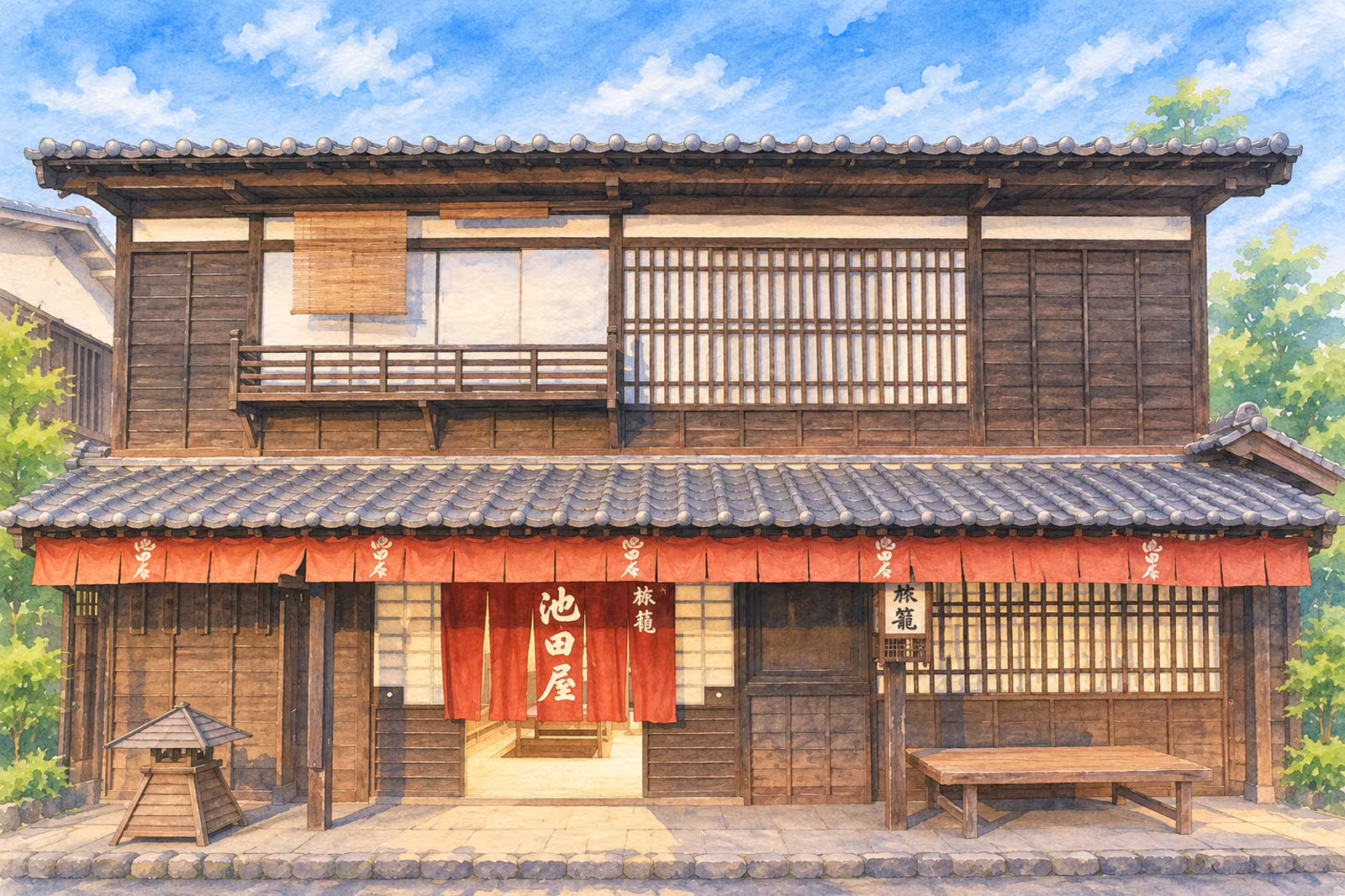
This group of historic sites brings together two places in Kyoto associated with the Shinsengumi. One is Mibu, in the southwest of the city, where the corps was formed and quartered for about two years. The other is the former site of the Ikedaya inn on Sanjō Street in the city center, where in 1864 the Shinsengumi raided a gathering of pro-imperial loyalists and became famous across the country. Both lie in Nakagyō Ward, Kyoto, Kyoto Prefecture: Mibu in the west of the ward, the Ikedaya site near Sanjō-Kawaramachi.
01Headquarters in Mibu village
In 1863 the shogunate recruited masterless samurai into the Rōshigumi to escort the shogun Tokugawa Iemochi to Kyoto, and the band was lodged in Mibu, then still a farming village. Its leader, Kiyokawa Hachirō, soon took most of the men back to Edo, but a dozen or so, including Serizawa Kamo and Kondō Isami, stayed in Kyoto under the command of Matsudaira Katamori, lord of Aizu and Protector of Kyoto, as the Mibu Rōshigumi. They helped guard the palace during the coup of the 18th day of the eighth month that year and afterward received the name Shinsengumi. The men lodged in the houses of local gentry families such as the Yagi and Maekawa and trained in the grounds of nearby Mibu-dera. That autumn Serizawa was assassinated by his own comrades in the Yagi house, leaving Kondō’s faction in control. In 1865 the corps moved to Nishi Hongan-ji and left Mibu.
02The night at Ikedaya
In the sixth month of 1864 the Shinsengumi arrested Furutaka Shuntarō, who had ties to Chōshū, and learned under interrogation that loyalists were planning action. On the night of the fifth day of that month, Kondō and his men burst into the Ikedaya, an inn near the Sanjō Kobashi bridge, and fought the activists from Chōshū, Tosa, Higo and elsewhere who had gathered there. Miyabe Teizō and many others were killed or captured. According to the records, the loyalists planned to set fires in Kyoto and seize the emperor, though the scale and even the reality of that plan are still debated. The raid enraged Chōshū, and the Kinmon Incident broke out a month later.
03What can be seen today
The Yagi residence and the former Maekawa residence both survive and remain privately owned, with differing arrangements for visitors. Mibu-dera is far older than the Shinsengumi and is known for its Mibu Kyōgen plays; its main hall was rebuilt after a fire in 1962, and the Mibuzuka in its grounds holds the graves of Serizawa and others along with a bust of Kondō. The Ikedaya building itself is long gone, the site is now occupied by commercial premises, and a stone marker by the street records the location.
Mibu and Ikedaya
01Where You Are Standing
Mibu is a quiet residential district in southwest Kyoto, a short walk from Ōmiya Station. In the 1860s it was a farming village just outside the city, known for a leafy vegetable called mibuna and for an old temple, Mibu-dera, famous for its masked Buddhist pantomime. A few well-off village families, gōshi (rural gentry with samurai-like status), owned large houses here.
In the spring of 1863 those houses filled up with armed men from Edo (present-day Tokyo). Within two years this group, the Shinsengumi, had become the most feared police force in Kyoto. Mibu was their first headquarters. The inn called Ikedaya, about three kilometers to the northeast near Sanjō Bridge, was where they made their name in a single night in the summer of 1864. Visiting the two places together covers the most famous chapter of the Shinsengumi story.
02Kyoto in Crisis
By the early 1860s the Tokugawa shogunate, which had ruled Japan from Edo for more than two and a half centuries, was losing control of Kyoto, the seat of the emperor. The treaties signed with Western powers in 1858 had angered many samurai, and a movement known as sonnō jōi, "revere the emperor, expel the barbarians," drew activists from all over the country to the imperial capital. Many were rōnin, masterless samurai, or men who had left their domains. Political assassinations, called tenchū or "heaven’s punishment," became routine, and heads were displayed on the riverbanks.
The shogunate responded in 1862 by creating a new post, the Kyoto Protector (Kyōto shugoshoku), and appointing Matsudaira Katamori, lord of the Aizu domain in northeastern Japan. Katamori brought about a thousand of his own troops to the city. Meanwhile, the young shogun Tokugawa Iemochi was preparing to travel to Kyoto, the first shogunal visit in over two hundred years.
03The Rōshigumi Comes to Mibu
A political schemer from Shōnai named Kiyokawa Hachirō proposed a novel idea: recruit unemployed swordsmen in the Edo area and send them ahead to guard the shogun in Kyoto. The shogunate agreed, partly in the hope of getting troublesome ronin out of Edo. Over two hundred men signed up for this "Rōshigumi," or ronin corps.
Among them were two groups who would matter later. One came from the Shieikan, a small fencing school in Edo teaching the Tennen Rishin style, run by Kondō Isami. With him came Hijikata Toshizō, Okita Sōji, Inoue Genzaburō, Yamanami Keisuke, Nagakura Shinpachi, Harada Sanosuke and Tōdō Heisuke. The other was a group from Mito led by Serizawa Kamo, with his associates Niimi Nishiki, Hirayama Gorō and Hirama Jūsuke.
The corps left Edo in early 1863 and reached Kyoto after about two weeks on the Nakasendō highway. The men were billeted in Mibu, in temples and in the homes of village families. Kondō’s and Serizawa’s men lodged with the Yagi family, headed by Yagi Gennojō.
Almost immediately, Kiyokawa revealed his real plan. He told the corps that its true loyalty was to the emperor and the cause of expelling foreigners, and he submitted a petition to the court. The shogunate, realizing it had been outmaneuvered, ordered the corps back to Edo. Most of the men went. Kiyokawa himself was assassinated in Edo a few weeks later.
04The Mibu Rōshi
Kondō and Serizawa refused to leave. Together with a handful of others, they asked to stay in Kyoto to protect the shogun, and the Aizu domain took them under its wing. They were placed under Aizu’s custody and funding, an informal arrangement rather than full membership in the domain. Locals called them the Mibu Rōshi, and sometimes "Mibu wolves," a pun on the word rōshi.
The group recruited quickly. At first it had three commanders: Serizawa, Kondō and Niimi. Hijikata and Yamanami served as vice-commanders. Their uniform was a pale blue haori jacket with a white sawtooth pattern on the sleeves, said to be modeled on the costumes worn by the forty-seven ronin in the popular drama Chūshingura. The banner bearing the single character makoto, "sincerity," became their emblem, and a strict code of conduct, which made desertion and dishonorable behavior punishable by forced suicide, is closely associated with them, although its exact wording is known mainly from later accounts.
05The Coup of 1863 and a New Name
On the eighteenth day of the eighth month of 1863 (September 30), Aizu and Satsuma troops carried out a palace coup that expelled the Chōshū domain, the leading radical power, and its allied court nobles from Kyoto. The Mibu Rōshi were called out to help guard the palace. Shortly afterward they received a new name: Shinsengumi, the "Newly Selected Corps." Who granted the name is disputed; some sources credit Aizu, others an official of the imperial court.
From then on the Shinsengumi patrolled the streets as an auxiliary police force under the Kyoto Protector, hunting down radical activists.
06The Killing of Serizawa Kamo
Serizawa was a problem. Stories of his behavior include extorting money from merchants, a brawl with sumo wrestlers in Ōsaka, and setting fire to a silk merchant’s storehouse in Kyoto after a dispute over a loan. Some of these tales come from later reminiscences and may have grown in the telling, but Aizu was clearly unhappy with him.
His ally Niimi Nishiki was forced to commit suicide first. Then, on a night in the ninth month of 1863 (the eighteenth day by the most common account, though some sources give the sixteenth), after a party at the Sumiya house in the Shimabara pleasure quarter, Serizawa returned to the Yagi house drunk and went to bed with his mistress, a woman named Oume. Several men broke in and cut them both down. Hirayama Gorō, sleeping in the same building, was also killed; Hirama Jūsuke escaped. The killing was blamed on Chōshū assassins, and Serizawa received a grand funeral. Later testimony makes it clear that the attackers were Kondō’s men, generally named as Hijikata, Okita and others, almost certainly with Aizu’s approval.
Much of what is told about that night comes from Yagi Tamesaburō, a son of the household who was a boy at the time. His memories were recorded by the writer Shimozawa Kan in his 1929 book Shinsengumi Ibun. From this point on, Kondō Isami was the sole commander, with Hijikata Toshizō as his vice-commander and the real enforcer of discipline.
07Furutaka Shuntarō and the Plot
After the 1863 coup, Chōshū loyalists and their allies were officially banned from Kyoto, but many remained in hiding. In the summer of 1864 the Shinsengumi’s spies focused on a shop near Shijō called Masuya, run by a man calling himself Masuya Kiemon. His real name was Furutaka Shuntarō, an activist from Ōmi who was stockpiling weapons and passing messages for the Chōshū network.
On the morning of the fifth day of the sixth month of 1864 (July 8), the Shinsengumi raided the shop, found weapons and letters, and took Furutaka to Mibu. There, by tradition in a storehouse on the Maekawa property, he was tortured under Hijikata’s direction. According to shogunate-side accounts, he revealed a plan to set fire to the city on a windy day around the time of the Gion Festival, seize Prince Nakagawa (an imperial prince who had backed the coup), attack Matsudaira Katamori, and take the emperor to Chōshū. Historians disagree about how much of this confession is accurate or exaggerated, but it is clear that Furutaka’s arrest set off an emergency meeting among the loyalists still in the city.
08The Ikedaya Incident
That evening the Shinsengumi split into two teams to search the inns and teahouses along the Kamo River. Hijikata led one group, whose size is given differently in different sources, toward Gion. Kondō took only about ten men through the Sanjō area. At around ten at night, Kondō’s group reached Ikedaya, an inn just west of the small Sanjō Kobashi bridge over the Takase canal, and found roughly twenty activists from Chōshū, Tosa, Higo and elsewhere meeting upstairs.
Kondō entered with a handful of men, including Okita Sōji, Nagakura Shinpachi and Tōdō Heisuke, while the rest guarded the exits. The fight in the dark, cramped building lasted well over an hour. Tōdō was cut on the forehead and had to withdraw. A famous story says that Okita collapsed after coughing up blood, an early sign of the tuberculosis that would kill him; many historians now doubt that detail. When Hijikata’s team arrived the outcome was settled, and Aizu and Kuwana troops soon surrounded the area.
Among the activists, Miyabe Teizō of Higo took his own life, while Yoshida Toshimaro of Chōshū, Kitazoe Kitsuma and Mochizuki Kameyata of Tosa, and others were killed either at the inn or nearby as they fled. More than twenty were arrested. Katsura Kogorō of Chōshū, later known as Kido Takayoshi and one of the leaders of the Meiji government, survived; by his own account he had arrived early, found few people there, and left for the nearby Tsushima domain residence. On the Shinsengumi side, Okuzawa Eisuke was killed, and Andō Hayatarō and Nitta Kakuzaemon died later of their wounds.
09After Ikedaya
The shogunate and Aizu rewarded the Shinsengumi handsomely, and the corps grew rapidly. For Chōshū, the deaths of so many key men were a deep provocation. A few weeks later, on the nineteenth day of the seventh month (August 20, 1864), Chōshū troops marched on Kyoto and fought Aizu and Satsuma forces around the palace gates in the Kinmon Incident, or Hamaguri Gate Rebellion. They were defeated, and the fighting started a fire that burned a huge part of the city.
Opinions on Ikedaya have always been divided. Meiji-era histories, written by the winners, cast the Shinsengumi as reactionary killers; there is an old saying that the incident either delayed the Meiji Restoration by a year or hastened it by a year. From the twentieth century, novels by Shimozawa Kan and later Shiba Ryōtarō turned the Shinsengumi into romantic heroes, and the Ikedaya raid became one of the best-known scenes in Japanese popular culture, endlessly retold in film, television, manga and games.
10Leaving Mibu
As the corps expanded, the Mibu houses grew too crowded. In the spring of 1865 the Shinsengumi moved to the great temple of Nishi Hongan-ji, occupying a hall and the drum tower in its precincts, much to the temple’s displeasure, since it sympathized with Chōshū.
Just before the move, Yamanami Keisuke, a former vice-commander who now held the title of general secretary (sōchō), left the corps without permission, was brought back, and committed seppuku, ritual suicide, in a room of the Maekawa house, with Okita traditionally named as his second. Why he deserted is still unknown. He is buried at Kōen-ji, a small temple near Mibu.
The corps moved again in 1867 to a new compound at Fudōdō village, and its members were made retainers of the shogun. After the shogunate returned power to the court, the Shinsengumi fought and lost at the Battle of Toba-Fushimi in January 1868. Kondō was captured and beheaded at Itabashi near Edo that spring. Hijikata kept fighting all the way to Hakodate in Hokkaidō, where he was killed in 1869.
11What You Can See in Mibu Today
The Yagi house is the heart of the Mibu sites. The gatehouse was built in 1804 and the main house in 1809, and the residence has been a Kyoto City cultural property since 1983. It is still owned by the Yagi family and open to visitors, with entry through the neighboring confectionery shop Kyoto Tsuruya Tsurujuan, which serves matcha and a sweet with the tour. You can see the room where Serizawa was killed and marks on a lintel said to be sword cuts from that night. A stone marker in front reads "Site of the Shinsengumi Headquarters."
Almost across the street is the former Maekawa house, which served as the main barracks. Much of the building survives, including the storehouse where Furutaka was tortured and the room where Yamanami died, but it is a private residence. Visitors can only look at its gate and walls from the street.
Mibu-dera stands just south of the Yagi house. The temple traces its founding to 991 and is dedicated to Jizō, a bodhisattva who protects children and travelers. It is famous for Mibu Kyōgen, a silent masked pantomime said to have been begun by the monk Engaku in 1300 to teach Buddhist ideas to ordinary people. It is still performed in spring, autumn and at Setsubun in early February on a stage in the Dainenbutsu-dō hall, a two-story building rebuilt in 1856 and designated a national Important Cultural Property. Shinsengumi members drilled with swords and cannon in the temple grounds and are said to have watched the plays. The main hall is not original: it was destroyed by arson in 1962 along with the old principal image, rebuilt in 1970, and given a new Jizō statue transferred from Tōshōdai-ji in Nara.
Inside the temple, a small enclosure called the Mibu-zuka holds a bust of Kondō Isami, a memorial containing his hair, a shared grave for Serizawa Kamo and Hirayama Gorō, and memorials to other members. Fans leave offerings here year-round.
12Ikedaya Today and a Walk Between the Two
Nothing of the original Ikedaya survives. The site, on Sanjō-dōri a few steps west of the Sanjō Kobashi bridge, is now occupied by a restaurant-bar that uses the Ikedaya name and Shinsengumi decor. A stone monument outside marks it as the site of the Ikedaya disturbance.
From there, walk east over the little bridge and on to the Sanjō Ōhashi bridge across the Kamo River. One of the decorative bronze caps on its railing posts carries a gash that, according to local lore, was made by a sword during the Ikedaya fighting. Nearby are markers for the assassinations of Sakuma Shōzan and Ōmura Masujirō, reminders of how violent this neighborhood was in the 1860s.
A good half-day route starts at Mibu-dera, then the Mibu-zuka, the Yagi house, a look at the Maekawa gate, and Yamanami’s grave at Kōen-ji. From there take a bus or train toward Kawaramachi and walk north to Sanjō to find the Ikedaya marker. If you have time, the drum tower at Nishi Hongan-ji, the Shinsengumi’s second headquarters, is a short trip from Kyoto Station.