
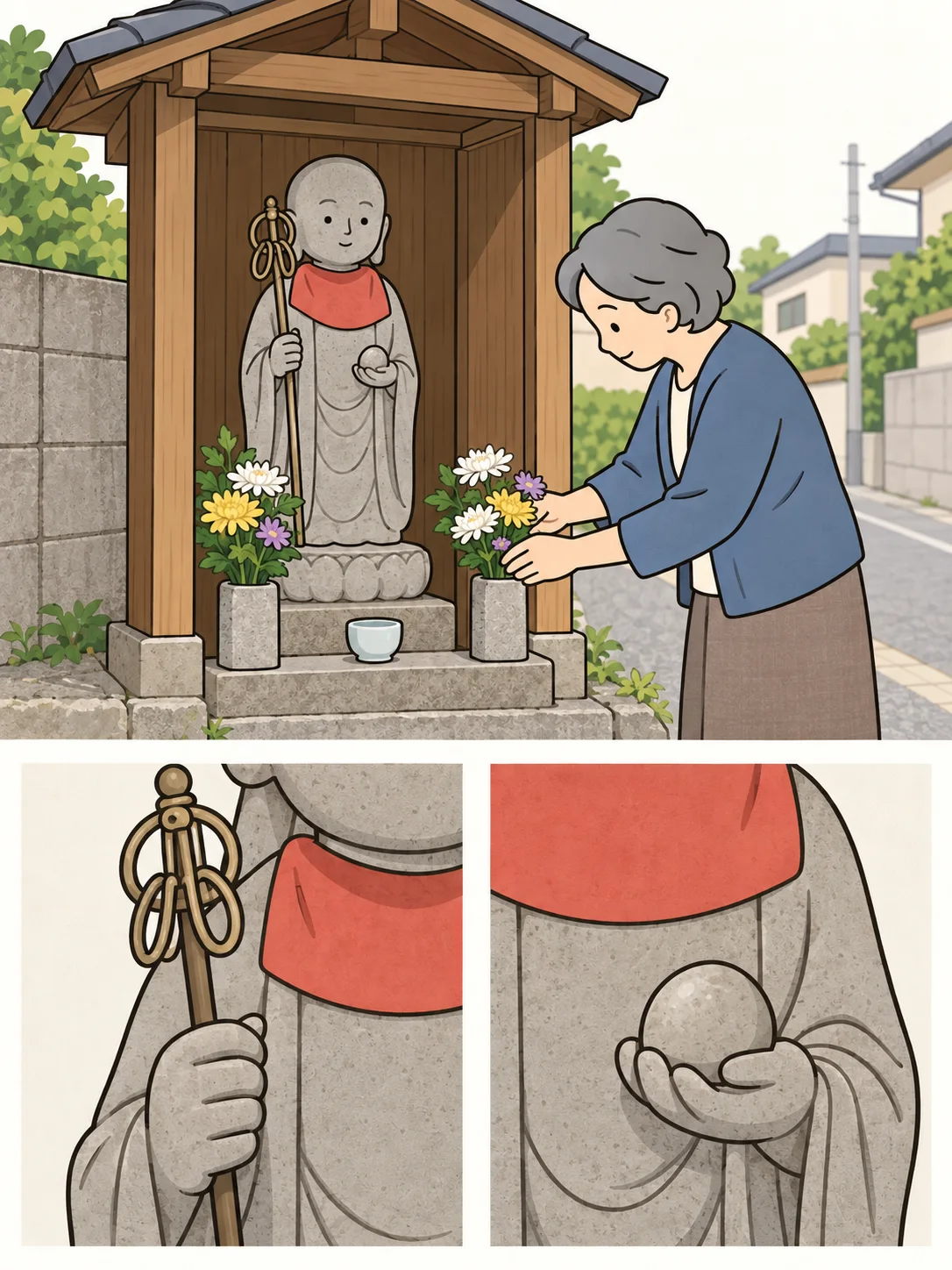
At a glance
Why Japan’s most familiar bodhisattva looks like a plain monk, and how he came to guard dead children, travelers and street corners, from red bibs to mizuko rites.
- Jizō’s name means "womb of the earth"; he saves beings in the six realms during the Buddhaless age between Shakyamuni’s death and Maitreya’s coming.
- He looks like a monk, with a shaven head and robe, a wish-granting jewel in his left hand and a ringed staff in his right.
- Jizō worship reached ordinary people in Japan only in the late Heian period, amid fears of the Latter Age of the Dharma and of hell.
- The legend of Sai no Kawara made him the guardian of children who die young; red bibs are mostly offered by mothers for their children.
- Zōjō-ji in Tokyo has about 1,300 child-raising Jizō statues; Kyoto’s Jizōbon is now mostly held on late-August weekends.
Walk anywhere in Japan for long enough and you will meet Jizō. He stands in small wooden shrines on village lanes, at the foot of hillside stairways, in rows at the gates of cemeteries, and on the edges of temple grounds: a small stone figure with a shaved head and a round, calm face, often wearing a red bib, sometimes a knitted cap, with a cup of water or a wrapped sweet at his feet. He is Jizō Bosatsu, the bodhisattva Kṣitigarbha, and for many Japanese people he is the most familiar and most affectionately treated figure in the whole Buddhist pantheon. People call him Ojizō-sama or simply Ojizō-san, the way they might speak of a neighbor. This is an introduction to who he is, why he looks like a monk rather than a prince, why he is bound up with children, travelers and the dead, and how to make sense of him when you find him on a street corner.
01A Bodhisattva for the Time Without a Buddha
A bodhisattva is a being who has reached the threshold of enlightenment but stays in the world to help others. Kṣitigarbha’s Sanskrit name means something like "earth store" or "womb of the earth," and the Chinese translation, Dizang, which the Japanese read as Jizō, keeps that sense: he holds and nourishes everything, as the ground does.
In India he was a minor figure. His career took off in China, where scriptures such as the Sutra of the Past Vows of Earth Store Bodhisattva gave him a defining job. After the historical Buddha, Shakyamuni, passed into nirvana, the world entered a long interval before the coming of the future Buddha, Maitreya, an interval Buddhist cosmology measures in billions of years. In that gap, beings keep cycling through the six realms of rebirth: hell, hungry ghosts, animals, fighting demigods (asura), humans and heavenly beings. Jizō vowed to work in all six until every being was saved, and he is remembered in East Asia for a vow that he would not become a Buddha himself until the hells were empty.
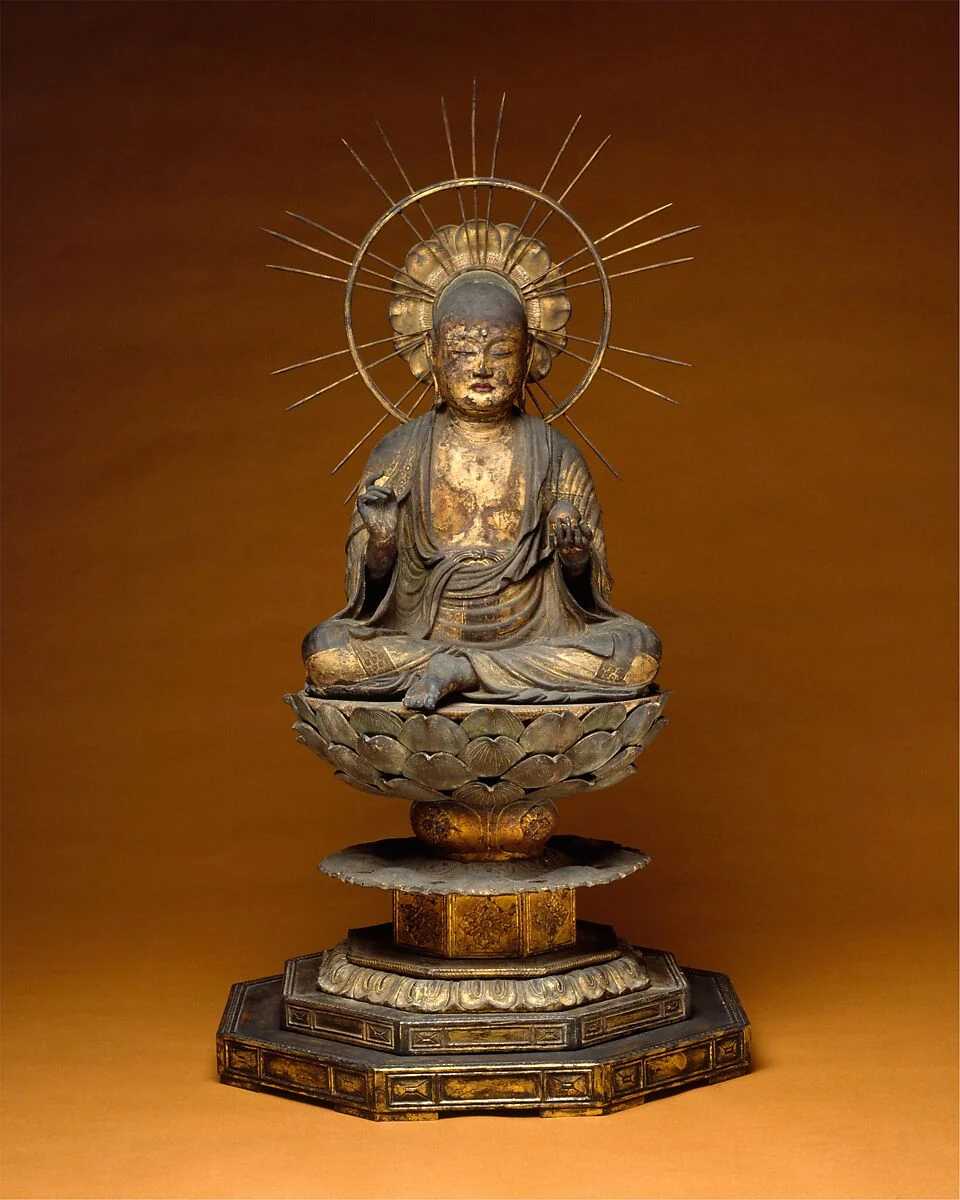
A Kamakura-period wooden Jizō: shaven head, monk’s robe, a jewel in his hand, and no crown or jeweled ornaments.The Metropolitan Museum of Art, Seated Jizō Bosatsu (Kamakura period, second half of the 13th century)
That job explains his appearance. Most bodhisattvas, such as Kannon (Avalokiteśvara), are shown in the dress of Indian nobility, with crowns, jewelry and flowing scarves. Jizō is shown as a plain Buddhist monk with a shaved head and a simple robe. In his left hand he usually holds a wish-granting jewel; in his right, a shakujō, a monk’s staff topped with jingling metal rings that wandering monks shook to warn off animals and announce themselves at a door. He is a traveling monk, on the road through all the worlds, and that ordinariness is a large part of his appeal.
02Coming to Japan: Hell and the Hope of Rescue
Jizō arrived in Japan with Buddhism, and scriptures about him had reached Japan by the Nara period (710–794), though images of him stayed rare for a long time; his popularity grew in the late Heian period, in the eleventh and twelfth centuries. This was a time of political disorder and widespread belief in mappō, the "latter days of the Dharma," an age in which Buddhist teaching was thought to have decayed so far that people could no longer reach enlightenment by their own efforts. Vivid descriptions of hell circulated, most famously in the monk Genshin’s Ōjōyōshū (Essentials of Rebirth in the Pure Land, 985), and painted scrolls of the six realms and their torments hung in temples.
Two kinds of hope answered this fear. One was faith in Amida Buddha, who promised rebirth in his Pure Land to those who called his name. The other was Jizō, who did not wait in a paradise but went down into hell himself. Collections of Buddhist tales from the period, such as the Konjaku monogatari shū, include many stories in which ordinary, even sinful people, dragged before Enma, the king of hell, are saved because they once made an offering to Jizō, who appears at the trial to speak for them. A later belief in Japan even held that Jizō and Enma were two faces of the same being: the judge and the rescuer as one.
03Six Jizō for Six Realms
Because Jizō works in all six realms, Japanese temples often represent him six times over. These groups, called Roku Jizō, stand in a line at the entrances to cemeteries and temple grounds, six similar figures each holding slightly different objects. A cemetery is the meeting point of the living and the dead, and the six figures make a simple promise: whichever realm the dead are bound for, a Jizō will be there.
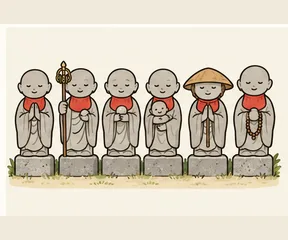
Six Jizō stand side by side, one for each realm, each holding slightly different objects.
Kyoto has a famous version. According to legend, the Heian-period courtier Ono no Takamura, who was said to serve as Enma’s assistant in the underworld by night, carved six Jizō figures from a single cherry tree after witnessing Jizō’s work in hell. The statues were later placed at the six main roads leading into the capital, guarding travelers coming and going. The six temples still stand, and one district in Fushimi is named Rokujizō after the figure at Daizen-ji there. On August 22 and 23, just after the Bon season when ancestral spirits are welcomed and sent off, many Kyoto residents make a circuit of all six temples, collecting a colored paper banner at each to hang at their door as protection for the household.
04Guardian of Children: The Riverbank of Sai
Above all, in Japan Jizō is the protector of children, especially children who have died. The image at the heart of this is a folk legend about the Sai no Kawara, the riverbank of Sai, on the shore of the Sanzu River that the dead must cross.
Children who die before their parents, the story goes, cannot cross, because they have caused their parents grief and could not repay their care. They stay on the stony riverbank and pile up little towers of pebbles, one stone for their father, one for their mother. Each evening demons come and kick the towers down, and the children must begin again. Then Jizō appears, gathers them into the sleeves of his robe, and tells them to think of him as their parent in the world of the dead. A hymn that spread widely in the Edo period, the Sai no Kawara Jizō Wasan, tells this story in a plaintive chanting meter and was sung at funerals and memorial gatherings across the country.
This legend explains many things you will see. Small cairns of stones appear on temple grounds, beside mountain streams and in volcanic landscapes such as Osorezan in Aomori, a volcanic peak with a desolate crater lake, long associated with the world of the dead; visitors add a stone to help the children with their work. The red bibs and caps on Jizō statues are commonly explained as offerings from parents who lost a child, asking Jizō to look after them, and red has a long association with warding off illness and evil. Some bibs carry a child’s name. People knit hats for Jizō in winter and replace his bib with a fresh one each year, as if dressing a child of their own, or the one who is now minding their child.
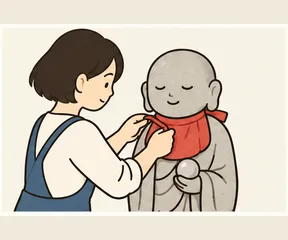
Tying a red bib on Jizō, asking him to look after a child.
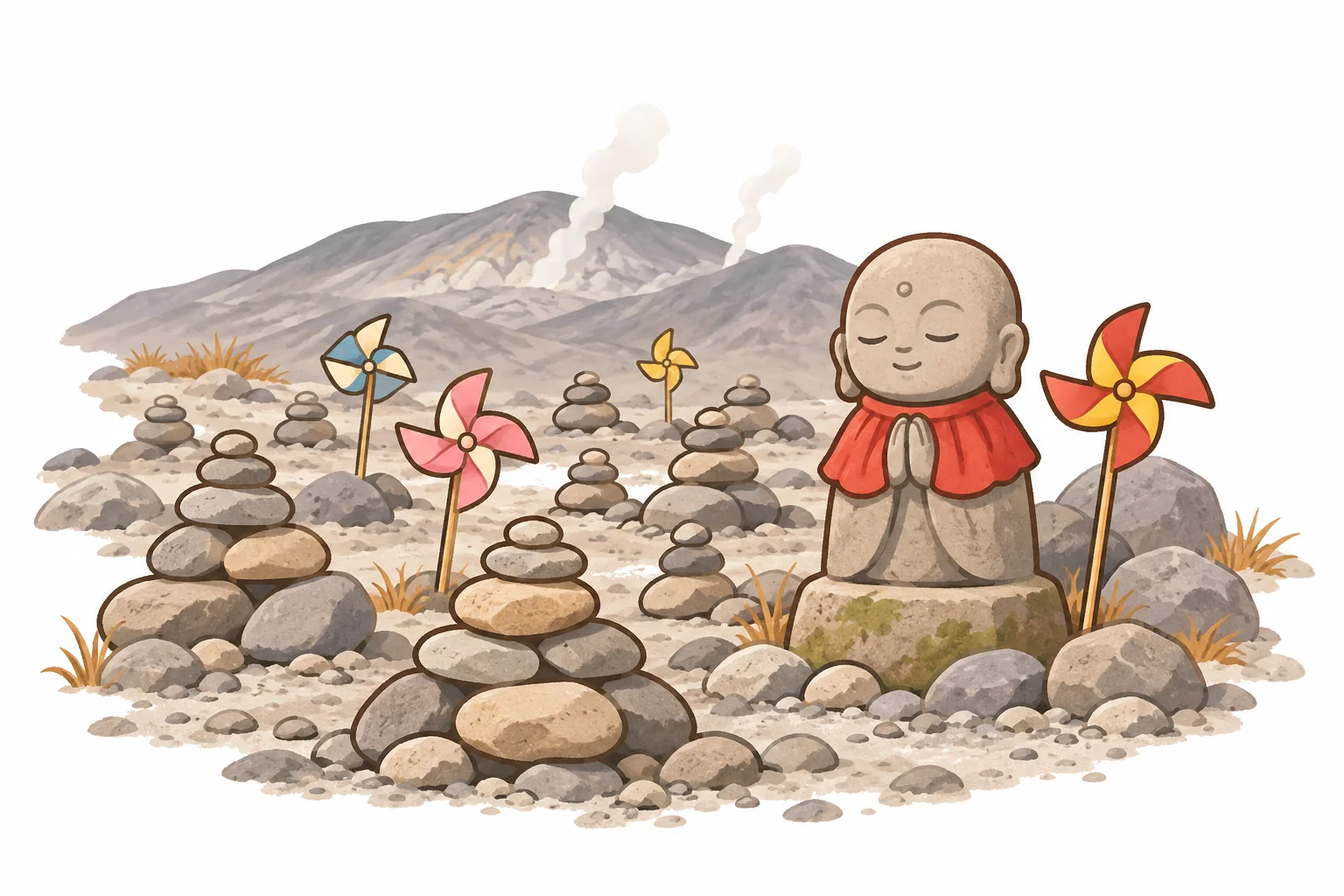
Small stone piles left on a bleak riverbank, with little Jizō figures and pinwheels beside them (illustration).
Jizō’s care for children extends to the living too. Figures known as Koyasu Jizō or Kosodate Jizō are prayed to for safe childbirth and healthy growing up. Sculptors often carve him small, round-headed and soft-featured, so that he looks a little like a child monk himself.
05Mizuko Kuyō
After the Second World War, Jizō’s role with children took on a newer and more complicated form: mizuko kuyō, memorial rites for "water children." Mizuko once referred to infants who died very young; in modern usage it mostly means a fetus lost to miscarriage, stillbirth or abortion. Japan’s Eugenic Protection Law of 1948 made abortion broadly available, and it was common in the postwar decades. From the 1970s onward, some temples began offering dedicated memorial services and small Jizō figures for these lost pregnancies, and the practice spread quickly.
At Zōjō-ji in central Tokyo, along the northern edge of the grounds, some 1,300 small stone Jizō stand in rows, each wearing a red knitted cap and bib, with a plastic pinwheel at its feet. When the wind picks up the pinwheels spin together, a quiet and affecting sight with Tokyo Tower rising behind. Hase-dera in Kamakura has a hillside crowded with similar figures. Dedicating one is a way of giving a child who was never born a place in the world.
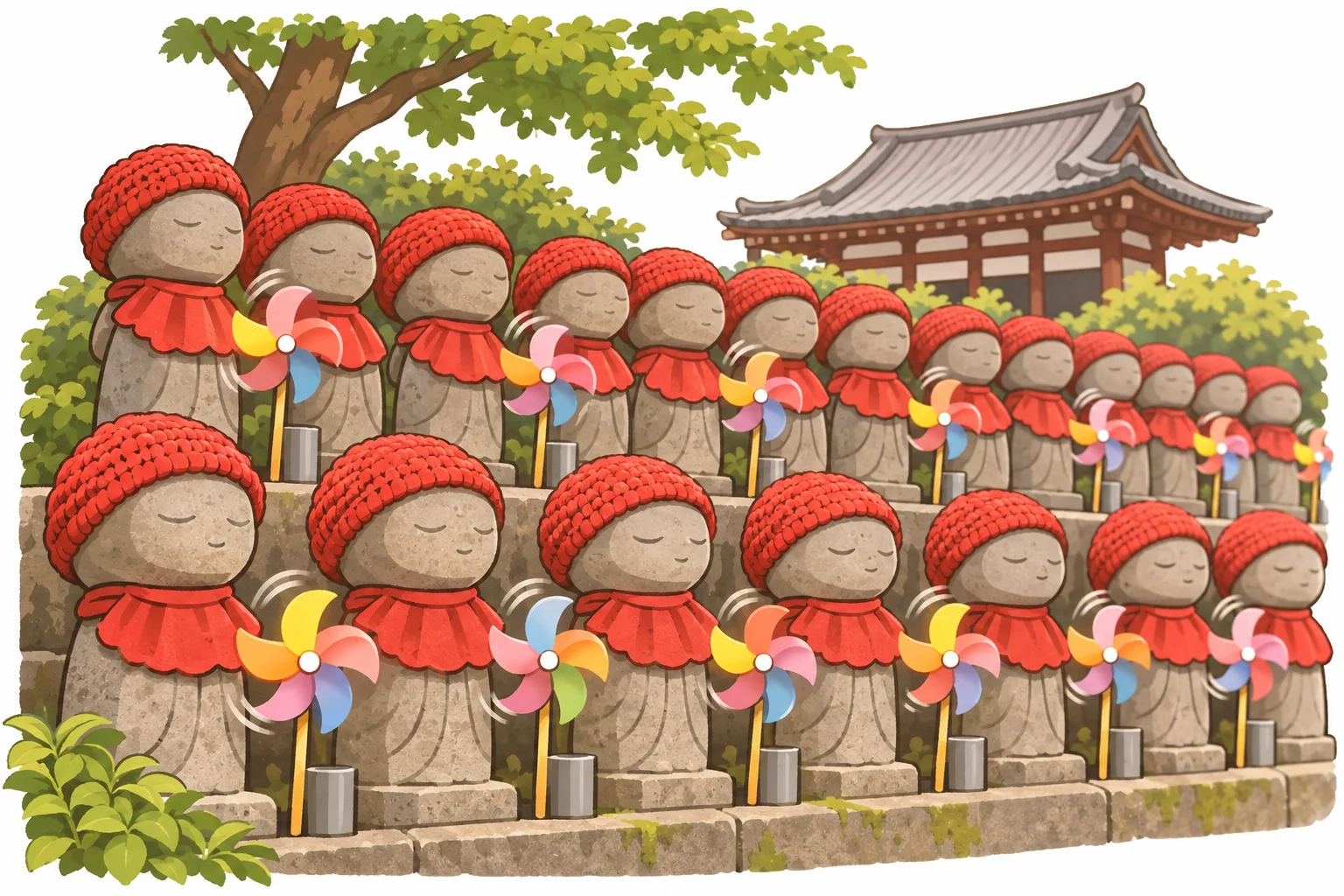
The thousand child-raising Jizō at Zōjō-ji: rows of small stone figures in red caps and bibs, pinwheels at their feet (illustration).
Mizuko kuyō has drawn criticism, inside Japan and out. Some temples have been accused of charging large fees and playing on guilt, even suggesting that unappeased fetal spirits cause misfortune. Others see the rites as offering a form of mourning for losses that otherwise have no ritual at all. Either way, the pinwheels mark real grief, and it is kind to pass them quietly and leave the camera down.
06Roadside Guardians with Local Names
Jizō is the most common stone Buddha in Japan, and nobody knows how many there are. He often stands at crossroads, bridges and village boundaries, places that folk belief long treated as thresholds where harm might slip in. These spots already had their own guardian deities, the dōsojin or sae no kami, gods of roads and borders, and Jizō merged with them early on. So he became a protector of travelers and of neighborhoods as well as of the dead.
Many individual statues have their own names and specialties, usually earned through a local miracle story. At Kōgan-ji in Sugamo, Tokyo, the Togenuki Jizō, the "splinter-pulling Jizō," is said to have saved a woman who had swallowed a needle: she swallowed a slip of paper printed with Jizō’s image, and the needle came up with it. Today the temple is the center of a shopping street nicknamed "the Harajuku for grannies," lined with shops selling red underwear (red for good health) and traditional sweets, and visitors queue to wipe a statue of Kannon with damp cloths on the part of the body that troubles them. At Nanzō-in in Katsushika, Tokyo, the Shibarare Jizō, the "bound Jizō," is wrapped in straw rope by people making a wish; according to a temple legend, the famous Edo magistrate Ōoka Tadasuke once had the statue tied up and brought in for questioning over a theft. When a wish comes true, the petitioner unties a rope, and at year’s end the ropes are all cut away together. Elsewhere there are Migawari Jizō who take an injury or misfortune in a believer’s place, Enmei Jizō who grant long life, and Shio Jizō covered in salt by people making requests.
07Jizōbon and the Straw Hat Story
In Kyoto and the wider Kansai region, Jizō has a festival that belongs to children: Jizōbon. It was once held on the 24th day of the seventh lunar month, Jizō’s feast day, later settled around August 23 and 24, and is now usually held on a weekend in late August. Neighborhood associations clean the little street shrines, wash the statues, sometimes paint their faces, put on new bibs and hang lanterns bearing local children’s names. Children spend the day playing games, eating watermelon and collecting snacks in front of the shrine. A highlight in many neighborhoods is juzu mawashi, in which everyone sits in a circle and passes around a huge string of prayer beads while chanting. In modern Kyoto, Jizōbon is sometimes the one event that still brings a whole block together, and many people who grew up there remember it as the end of summer.
Jizō also appears in some of the best-loved Japanese folktales. In Kasa Jizō, a poor old man goes into town on New Year’s Eve to sell straw hats and sells none. On the way home through the snow he passes six Jizō statues with snow piled on their heads, and he ties a hat onto each. He has one too few, so he gives the last statue his own cloth. That night there is a noise outside: the six Jizō have dragged a sled loaded with rice cakes, rice and treasure to his door. Nearly every Japanese child knows the story, and it captures the relationship well. Jizō stands out in the cold and needs looking after, and he looks after you in return.
08Meeting Jizō
You do not need any special etiquette with a roadside Jizō. Japanese passersby often just pause, put their palms together, bow slightly and walk on. A coin or a small offering is welcome. Leave other people’s offerings, bibs and stones alone; they were placed there for someone.
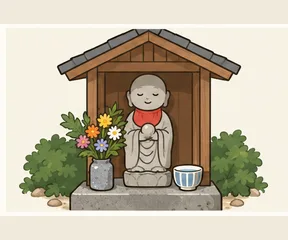
Flowers and water at a roadside shrine; these were left by others for their loved ones, so leave them alone.
For places to see Jizō in numbers, Zōjō-ji in Tokyo and Hase-dera in Kamakura are easy to reach. In Kyoto, Mibu-dera has Jizō as its principal image and a stupa built from roughly a thousand old stone Buddhas gathered from around the city; in spring and autumn the temple stages Mibu Kyōgen, a silent masked theater performed to drums, gongs and flute. If you are in Kyoto in late August, walk into a residential lane in the early evening and you may stumble on the lanterns of a Jizōbon. Sugamo’s Togenuki Jizō is at its liveliest on fair days, which fall on dates ending in 4, when the shopping street fills with older visitors.
In the hills near Lake Ashi, beside Shōjin pond on the Yusaka road, the medieval route over the Hakone pass, a group of Kamakura-period stone Buddhas is carved into the rock. The largest is a Jizō more than 3 meters tall, cut into a rock face. Travelers crossing the pass on foot once walked right past him, asking for safe passage much as people on a Tokyo side street still do today.