
At a glance
How a fisherman’s son built a school on chanting one phrase, survived exile and near-execution, and left followers from Kyoto merchants to modern lay movements.
- Nichiren Buddhism was founded by the 13th-century monk Nichiren, who taught that the Lotus Sutra alone, and chanting its title, leads to Buddhahood.
- On the 28th day of the fourth month of 1253, Nichiren first chanted Namu Myōhō Renge Kyō at Seichō-ji; this is counted as the school’s founding.
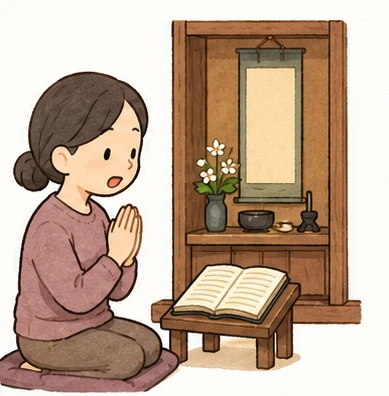
- The core practice is chanting Namu Myōhō Renge Kyō; the object of worship is a mandala Nichiren wrote, made almost entirely of words.
- In the 15th and 16th centuries wealthy Kyoto townspeople converted en masse, and the city came to hold 21 head temples.
- The head temple is Kuon-ji on Mount Minobu in Yamanashi; as of 2026, Ikegami Honmon-ji in Tokyo holds the Oeshiki festival every October.
Walk past certain temples in Japan and you will hear it before you see anything: a steady thump of hand drums and voices repeating the same seven syllables, Namu Myōhō Renge Kyō. That chant belongs to the tradition founded by Nichiren, a thirteenth-century monk who argued that the Lotus Sutra alone held the Buddha’s full teaching and that ordinary people could reach enlightenment simply by chanting its title. Nichiren was also a man who repeatedly told the government it was wrong, was exiled twice and nearly beheaded, and left behind a movement that has never quite lost his combative edge. His legacy runs from the merchant quarters of medieval Kyoto to the poet Miyazawa Kenji and to Sōka Gakkai, one of the largest religious organizations in Japan today. This is an introduction to the man, to why his message took hold, and to where you can see and hear it on a trip to Japan.
01A Fisherman’s Son in an Anxious Age
Nichiren was born in 1222 in Kominato, a fishing village in Awa Province on the Pacific coast of what is now Chiba Prefecture. He later called himself the son of a sendara, an outcaste, emphasizing that he came from humble fishing stock rather than the aristocratic or warrior families that produced most eminent monks. That background is part of why his followers have always felt close to him. At twelve by the traditional count (about eleven by Western reckoning) he went to study at Seichō-ji, a nearby mountain temple, and he was ordained there at sixteen by the same count.
He came of age in a frightening period. The Kamakura shogunate had only recently established warrior rule, and the country suffered famines, earthquakes, and epidemics. Buddhists widely believed the world had entered mappō, the "latter age of the Dharma," when the Buddha’s teaching had decayed so far that people could no longer attain enlightenment through their own efforts. The most popular response was the nenbutsu, the practice of calling on the name of Amida Buddha in hope of rebirth in his Pure Land after death, spread by Hōnen and his followers.
The young Nichiren wanted to know which of the many competing Buddhist teachings reflected the Buddha’s true intention. He spent more than a decade studying in Kamakura, on Mount Hiei near Kyoto (the headquarters of the Tendai school), and in Nara and other centers of learning. His conclusion was that the answer lay in the Lotus Sutra, the scripture Tendai held in highest regard, and that the fashionable nenbutsu was leading people away from it.
On the twenty-eighth day of the fourth month of 1253, according to tradition, Nichiren returned to Seichō-ji and chanted Namu Myōhō Renge Kyō for the first time in public as the sun rose over the ocean. Nichiren Buddhists treat this as the founding of their school. His outspoken attacks on the nenbutsu angered the local steward, a devotee of Amida, and Nichiren had to leave. He settled in a hut at Matsubagayatsu in Kamakura, the shogun’s capital, and began preaching on the streets.
02A Warning to the Government and a Life of Persecution
In 1260 Nichiren submitted a treatise called Risshō ankoku ron, "On Establishing the Correct Teaching for the Peace of the Land," to Hōjō Tokiyori, the retired regent who still held real power in the shogunate. Written as a dialogue between a host and a guest, it opens with a vivid picture of a land filled with disaster, starving people, and corpses by the roadside. Its argument is that these calamities came from the nation’s embrace of false teachings, above all Hōnen’s nenbutsu. If the country did not return to the Lotus Sutra, Nichiren warned, two further disasters predicted in the scriptures would follow: internal rebellion and invasion from abroad.
The government ignored the warning, and Nichiren’s followers count what came next as a series of hōnan, persecutions suffered for the Dharma. Soon after the treatise was submitted, a mob of nenbutsu believers burned his hut. In 1261 he was exiled to the Izu Peninsula. In 1264, while visiting his mother in Awa, he was ambushed at Komatsubara by the steward Tōjō Kagenobu; disciples were killed, and Nichiren was wounded on the forehead and had his left hand broken.
The most famous episode came in 1271. Nichiren was arrested and taken at night to the execution ground at Tatsunokuchi, west of Kamakura, to be beheaded. According to the tradition preserved by his followers, a brilliant object flew across the sky from the direction of Enoshima just as the sword was about to fall, the executioner was dazzled, and the officials abandoned the execution. Whatever happened that night, Nichiren was not killed. He was instead exiled to Sado, an island in the Sea of Japan.
Sado in winter was brutal, and Nichiren was first housed in a dilapidated chapel next to a graveyard. It was there that he wrote his two most important works. Kaimoku shō, "The Opening of the Eyes," argued that his sufferings proved he was the votary the Lotus Sutra foretold would spread its teaching in the latter age amid persecution. Kanjin no honzon shō, "The Object of Devotion for Observing the Mind," laid out the focus of practice for his followers. In 1272 a violent dispute broke out within the Hōjō clan, which his followers saw as the predicted internal rebellion.
Pardoned early in 1274, Nichiren returned to Kamakura and warned the authorities a third time. Still unheeded, he withdrew that summer to Mount Minobu in Kai Province (now Yamanashi Prefecture). Later that year a Mongol fleet attacked northern Kyūshū, and the second prediction seemed to have come true as well. He lived there for more than eight years, training disciples and writing letters to followers across eastern Japan. In the autumn of 1282 he set out for a hot spring to treat his failing health, but he died on the way, at the residence of a follower named Ikegami Munenaka in Musashi Province. He was sixty years old by Western reckoning (sixty-one by the traditional count). The site is now Ikegami Honmon-ji in Tokyo’s Ōta Ward.
03What Nichiren Taught
The core practice is strikingly simple. It is called shōdai, "chanting the title": repeating Namu Myōhō Renge Kyō, which means roughly "I devote myself to the Lotus Sutra of the Wonderful Dharma." Nichiren taught that the title, Myōhō Renge Kyō, contained the entire merit of the sutra. People living in the latter age did not need to master Tendai’s elaborate philosophy. Faith in the sutra and chanting its title were enough to connect them with the Buddha’s own awakening.
In one sense this resembled what Hōnen and Shinran were doing with the nenbutsu: both movements took the path to salvation out of the hands of learned monks and offered it to farmers, fishermen, and townspeople. The difference lay in where salvation was found. The nenbutsu looked toward rebirth in a Pure Land after death. Nichiren insisted that buddhahood could be attained in this body, in this life, and that the world itself should be transformed into a buddha land. That is why his first major work was addressed to the government: for Nichiren, religion and the fate of the country were inseparable.
The object of devotion, or honzon, that Nichiren created for his followers is also distinctive. He inscribed by hand many large calligraphic mandalas. Down the center, in bold characters, runs Namu Myōhō Renge Kyō; arranged around it are the names of Shakyamuni and Many Treasures Buddha, bodhisattvas, guardian kings, and even Japanese deities such as Amaterasu and Hachiman. The whole thing is made almost entirely of writing. The strokes of the central characters often trail off into long, whisker-like tails, a style called hige daimoku, "whiskered title," which you will see carved on temple monuments and gravestones throughout Japan. Household altars of Nichiren believers commonly enshrine a copy of such a mandala.
What most set Nichiren apart, and what made him enemies, was his attack on other schools. Later tradition summed it up in four sharp phrases: the nenbutsu leads to the hell of incessant suffering; Zen is the work of devils; Shingon will ruin the nation; and the Ritsu precept school is a traitor to the country. He advocated shakubuku, actively refuting wrong teachings, rather than the gentler approach of accommodating others’ views. This uncompromising stance put Nichiren’s followers at odds with rulers and rival schools again and again over the centuries.
It would be easy to imagine him only as a fiery polemicist, but his surviving letters show another side. Many are addressed to warriors, warriors’ wives, and elderly widows in the countryside. He thanks them for a sack of rice, a cask of sake, or a few taro roots sent to his mountain retreat, comforts them on the death of a child or husband, and explains the teaching through homely comparisons. Revered as gosho, "honored writings," these letters are still read daily by believers.
04Schools, Splits, and the Lotus Merchants of Kyoto
Shortly before his death, Nichiren named six senior disciples, known as the Six Elder Monks: Nisshō, Nichirō, Nikkō, Nikō, Nitchō, and Nichiji. After he died they disagreed over the care of his tomb at Minobu and over questions such as whether followers could honor other schools’ deities. Nikkō left Minobu and established his own line at the foot of Mount Fuji, centered on the temple Taiseki-ji; that lineage became today’s Nichiren Shōshū. Kuon-ji on Mount Minobu became the head temple of the largest branch, Nichiren-shū. The lineages kept dividing, and today dozens of organizations trace themselves to Nichiren.
The movement’s great breakthrough came in Kyoto. In 1294 Nichizō, a disciple of Nichirō, brought the teaching to the capital, preaching to artisans and merchants, and in 1321 he founded Myōken-ji, the city’s first Nichiren temple. Over the following two centuries the prosperous townspeople of Kyoto, known as machishū, converted in large numbers, and the city came to have twenty-one head temples of the Lotus school. In the 1530s Lotus believers took up arms, fought the militant followers of the Ikkō (True Pure Land) school, and for a few years effectively ran much of Kyoto themselves, an episode known as the Hokke Ikki, or Lotus Uprising. In 1536 the warrior monks of Mount Hiei and their allies attacked the city, burned all twenty-one temples, and killed or drove out the believers, in what is called the Tenbun Lotus Disturbance.
The Lotus faith of Kyoto’s townspeople left a deep mark on Japanese art. The family of Hon’ami Kōetsu, the great calligrapher, potter, and designer, were devout Lotus believers, and the artists’ community Kōetsu established at Takagamine north of Kyoto was also a community of faith. The painter Hasegawa Tōhaku came from a Lotus family and relied on the temple Honpō-ji when he first came to the capital. Honnō-ji, where Oda Nobunaga was killed in 1582, was likewise a Lotus temple.
One branch carried Nichiren’s refusal to compromise to its logical end. The Fuju-fuse school, whose name means "neither receiving nor giving," refused to accept offerings from non-believers or perform rites for them, even if the non-believer was the ruler. Its founder Nichiō refused in 1595 to take part in a great memorial service sponsored by Toyotomi Hideyoshi, kept defying the authorities under Tokugawa Ieyasu, and was exiled to Tsushima; the Tokugawa shogunate later banned the school outright. Its followers kept the faith in secret until the ban was lifted in the Meiji era.
05Modern Japan: Nationalists, a Poet, and Mass Movements
After the Meiji Restoration, Nichiren’s idea of "establishing the correct teaching for the peace of the land" was read in new ways. Tanaka Chigaku founded the lay organization Kokuchūkai and promoted what he called Nichirenism, a fusion of Nichiren faith and Japanese nationalism that attracted intellectuals and military officers. One of its members was Ishiwara Kanji, the army officer who helped engineer the Manchurian Incident of 1931. Another was Miyazawa Kenji, the poet and author of children’s stories such as Night on the Galactic Railroad, who joined in his twenties. His best-known poem, "Ame ni mo makezu" ("Unbeaten by the Rain"), was found in a pocket notebook after his death, and the same notebook is filled with devotional writing addressed to the Lotus Sutra and Nichiren.
Many of the new religious movements that flourished in twentieth-century Japan also belong to the Nichiren family, among them Reiyūkai and Risshō Kōseikai. The largest is Sōka Gakkai. It was founded in 1930 by the educator Makiguchi Tsunesaburō and his disciple Toda Jōsei as a lay group affiliated with Nichiren Shōshū. During the war Makiguchi refused to enshrine a talisman from the Ise Grand Shrine, was imprisoned, and died in custody in 1944. After the war Toda built the organization through vigorous proselytizing, and under his successor Ikeda Daisaku it expanded overseas and founded the political party Kōmeitō in 1964. In 1991 Nichiren Shōshū excommunicated Sōka Gakkai, and the two have gone separate ways since. For many Japanese today, the Nichiren tradition is most visible through the public presence of these organizations.
06Seeing and Hearing It in Japan
The most rewarding place to visit is Kuon-ji on Mount Minobu in Yamanashi Prefecture, a few hours from Tokyo. Between the great Sanmon gate and the main hall rises a flight of 287 steep stone steps called the Bodaitei, the "Stairway to Enlightenment"; the saying goes that climbing it in one go brings you to awakening. The mountain holds Nichiren’s tomb and an enormous main hall, and in early spring its weeping cherry trees draw large crowds. Morning services are open to visitors, and you can sit in the hall while the monks recite the sutra and chant the title. Temple lodgings on the mountain let you stay overnight and attend at dawn.
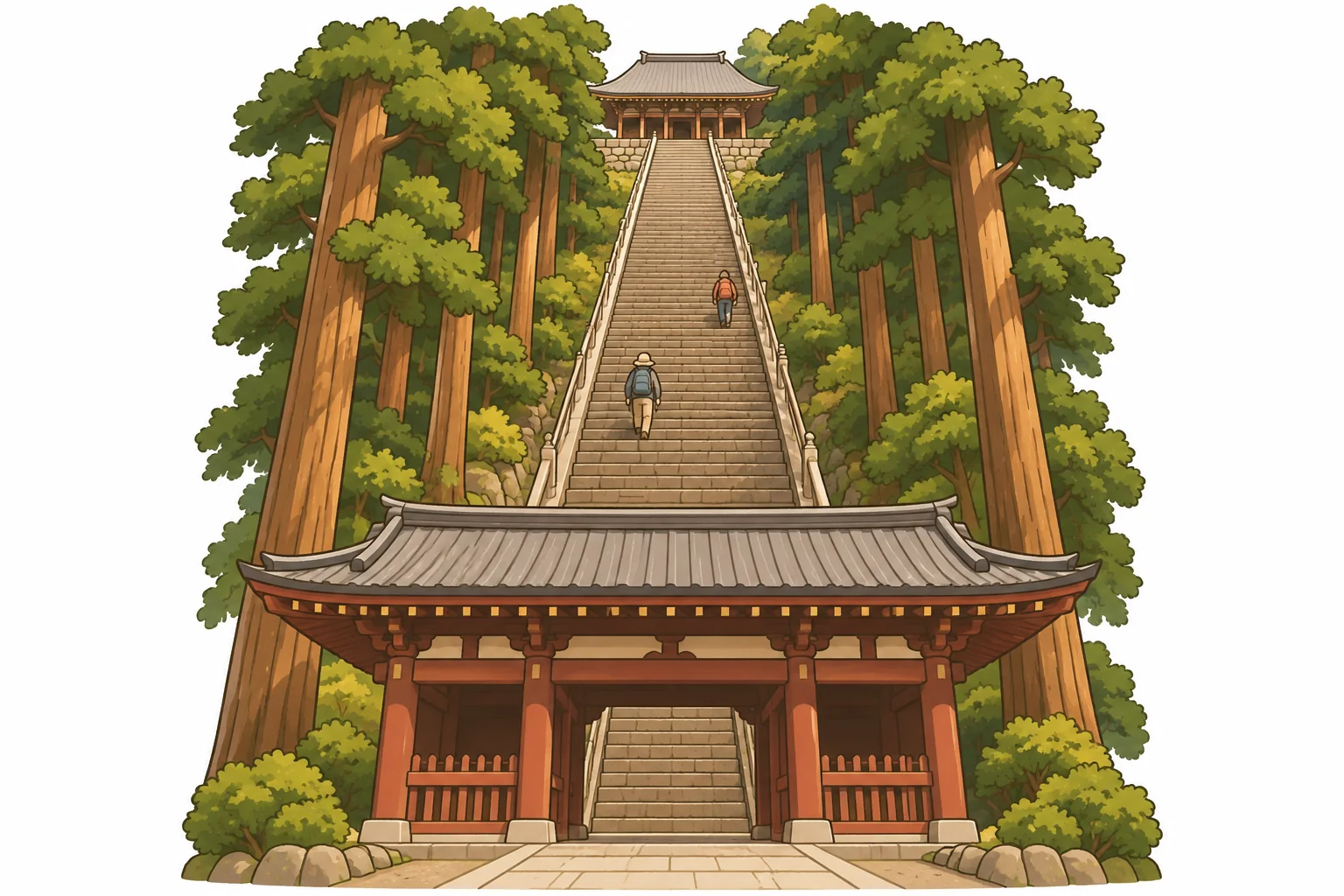
The Bodai-tei stairs at Kuon-ji on Mount Minobu, seen from below, rising straight and steep (illustration).
In Tokyo, Ikegami Honmon-ji marks the place where Nichiren died. As of 2026 it still holds the Oeshiki, the memorial for his death, every year from October 11 to 13. On the night of the twelfth, groups of believers from around the region parade to the temple carrying mandō, tall lantern towers decorated with paper cherry blossoms that recall the flowers said to have bloomed out of season when he died, accompanied by flutes and the pounding of hand drums. The crowds continue late into the night, making it one of Tokyo’s liveliest autumn festivals.
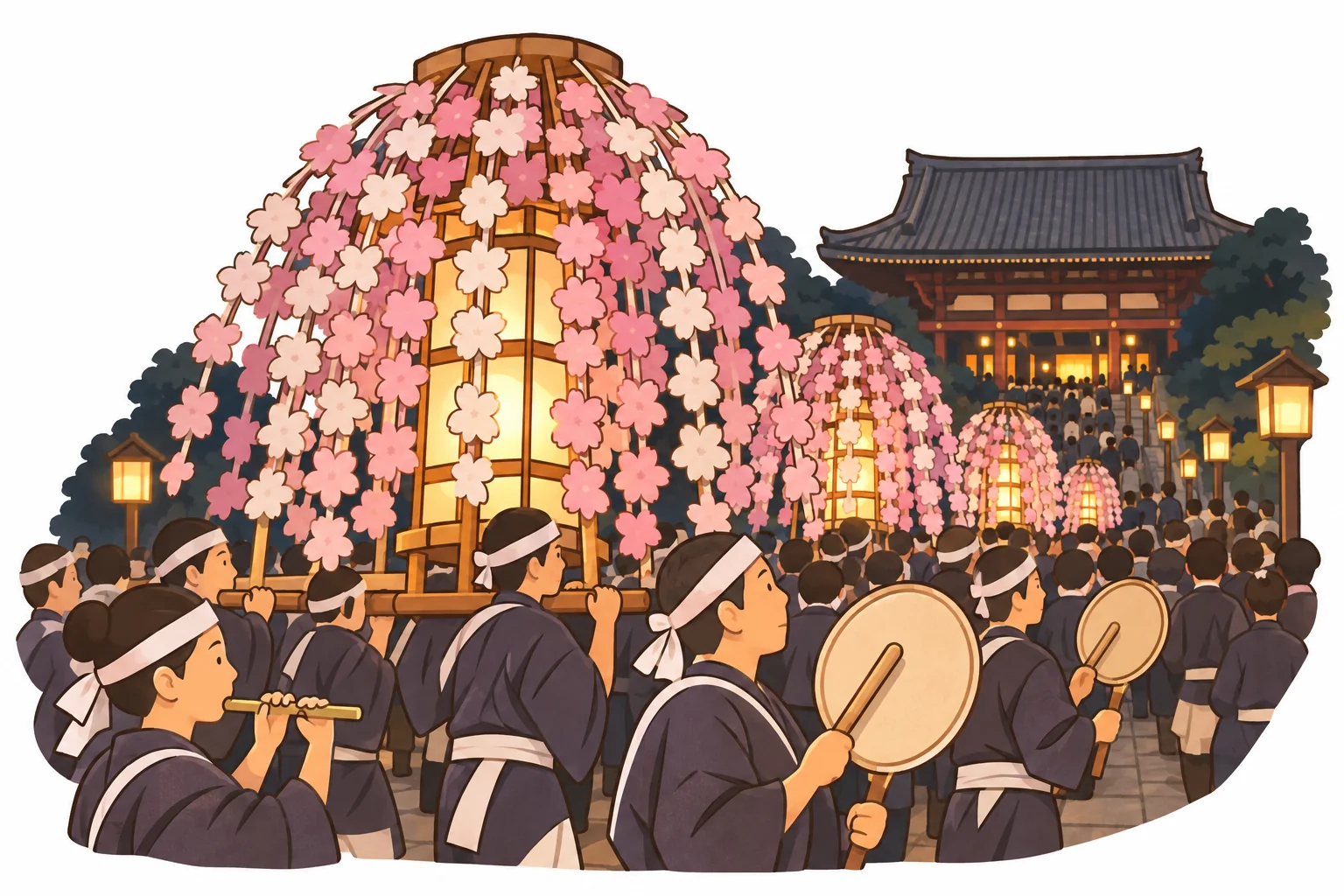
Oeshiki night at Ikegami Honmon-ji: mandō lantern towers hung with paper blossoms, carried to fan-drum beats (illustration).
Nearly every chapter of Nichiren’s life is commemorated by a temple. In Kamogawa, Chiba, there are Tanjō-ji at his birthplace and Seichō-ji on the mountain where he first chanted. In Fujisawa, Ryūkō-ji stands at the old execution ground of Tatsunokuchi, a short walk from the Enoshima causeway and an easy addition to a day in Kamakura. Kamakura itself has temples tied to his preaching there, such as Myōhon-ji and Ankokuron-ji. On Sado Island, temples such as Konpon-ji and Myōsen-ji recall his exile. In Kyoto, Myōken-ji, Honpō-ji, and Honnō-ji preserve the memory of the Lotus merchants. Two places many Tokyo residents know well also belong to the Nichiren tradition: Shibamata Taishakuten, the temple at the heart of the beloved film series Otoko wa Tsurai yo, and the Kishimojin hall at Zōshigaya.
A few things are worth watching for at any Nichiren temple. The first is the uchiwa daiko, a fan-shaped drum with a single drumhead and a handle, which believers strike as they chant; its simple, insistent rhythm is the sound of the tradition. The second is the whiskered daimoku on stone monuments. The third concerns temple stamps. Many visitors collect goshuin, the calligraphic seals that temples and shrines write in a visitor’s book. At Nichiren temples you may instead receive a goshudai, in which the priest writes Namu Myōhō Renge Kyō rather than the temple’s name. Some temples write it only in a book dedicated to Nichiren temples, and in an ordinary book may write simply Myōhō or something else, so it is worth asking first. Chanting services are generally open to observers. You are welcome simply to sit quietly; if you want to join in, follow the rhythm of the people around you and repeat the seven syllables.
- 1
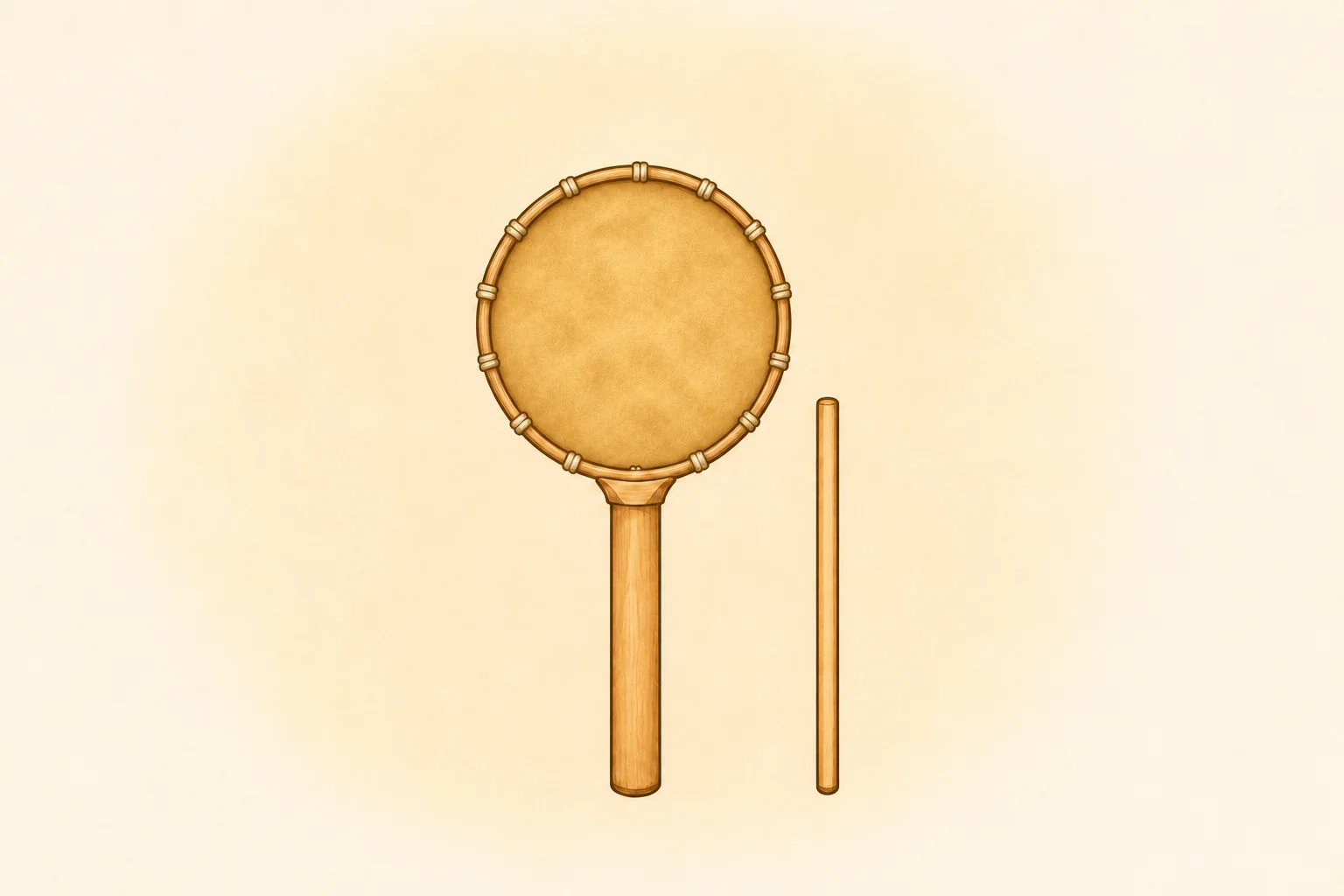 A round hand drum with a single drumhead and a handle, shaped like a fan.
- 2
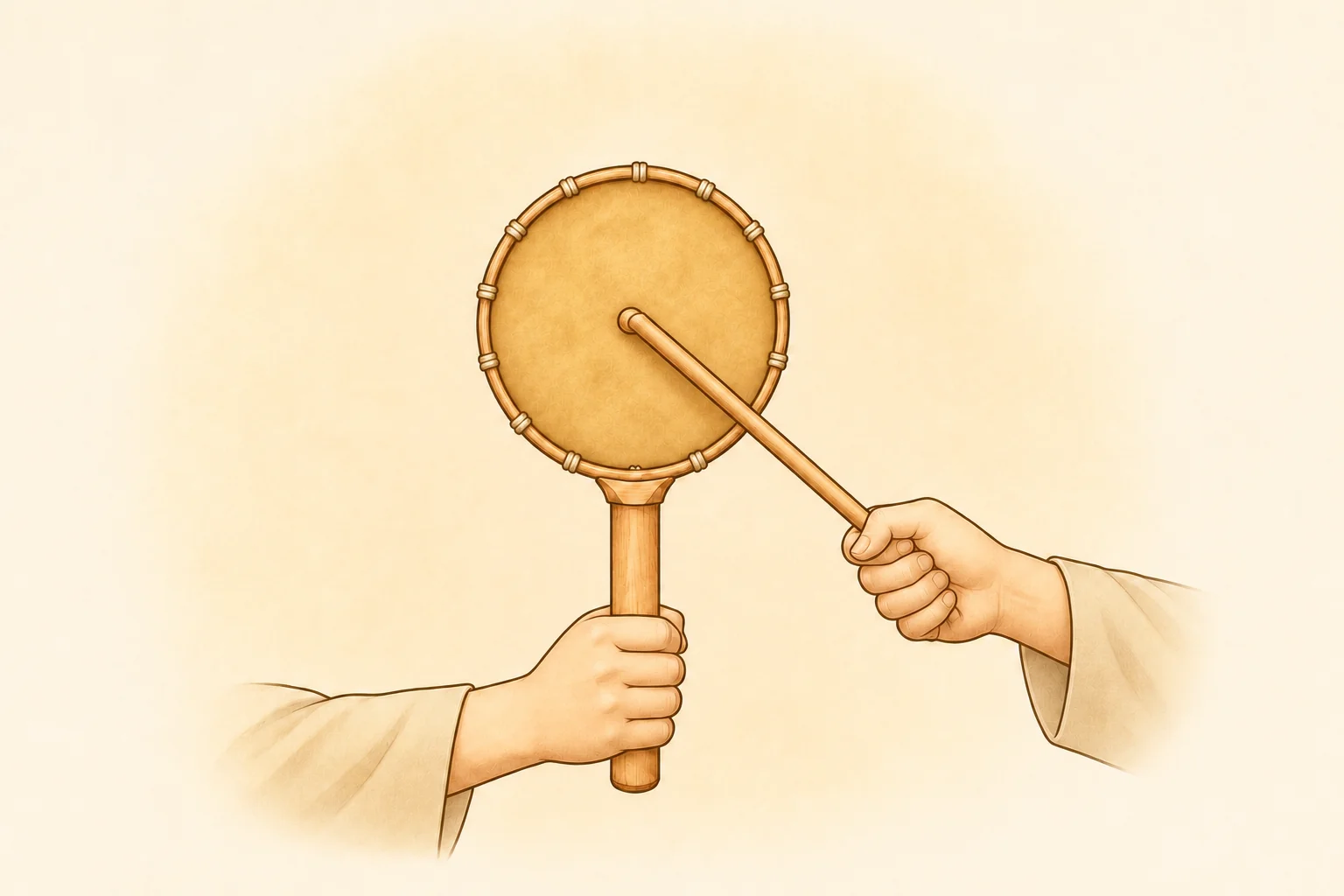 One hand holds the handle, the other strikes the drumhead as the believer chants.