
At a glance
How the eighty-eight-temple circuit took shape, why pilgrims believe Kūkai walks beside them, and what the gear, temple rituals, roadside gifts and walking it today involve.
- The Shikoku Pilgrimage circles the island of Shikoku, visiting eighty-eight temples in order over about 1,400 km.
- Walking the whole route usually takes 40 to 50 days; today most pilgrims travel by car or bus.
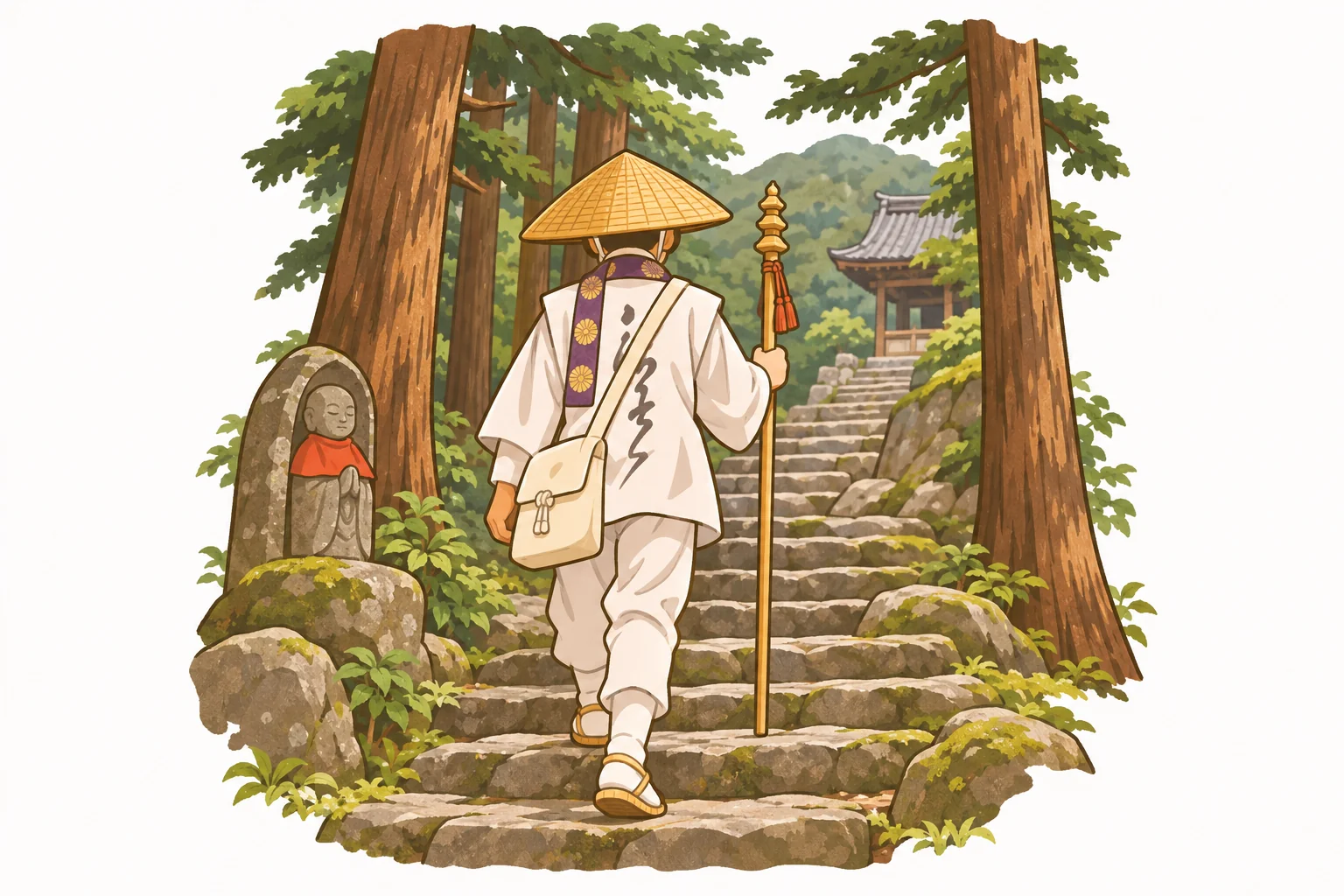
- Pilgrims wear white and a sedge hat and carry a kongōzue staff, believing Kōbō Daishi (Kūkai) walks with them: "two traveling together."
- In 1687 Shinnen published the first guidebook for ordinary people, and commoner pilgrims multiplied.
- Local people hand pilgrims oranges, tea or coins as osettai; the pilgrim accepts and gives a name slip in return.
The Shikoku pilgrimage, known in Japanese as the ohenro, is a loop of eighty-eight Buddhist temples around Japan’s fourth-largest island. On foot it covers roughly 1,400 kilometers and takes most walkers six or seven weeks. Pilgrims wear white, carry a wooden staff, and believe they are walking alongside Kōbō Daishi, the ninth-century monk Kūkai, who is said to have trained on these coasts. Local people hand them oranges, cans of coffee and coins along the way. What began as a route for hardened ascetics is now walked, driven and bused by retirees, the bereaved, the restless and a growing number of foreigners. This is an introduction to what the pilgrimage is, why people do it, and what it is like to join them.
01A Circle of Eighty-Eight Temples
Shikoku is made up of four prefectures: Tokushima, Kōchi, Ehime and Kagawa, which were the old provinces of Awa, Tosa, Iyo and Sanuki. The eighty-eight temples, called fudasho (literally "places of the placard," after the paper slips pilgrims leave), are numbered in a clockwise sequence. Temple 1, Ryōzen-ji, stands in Naruto in the island’s northeast corner, near the bridge from Awaji Island and Kansai. Temple 88, Ōkubo-ji, sits in the mountains of Kagawa, not far away. The route traces the whole coast and cuts inland over passes, and its two ends nearly touch.
Each province carries a stage of the spiritual journey. Awa, with twenty-three temples, is the "place of awakening the aspiration"; Tosa, with only sixteen spread along an enormous coastline, is the "place of ascetic training"; Iyo’s twenty-six temples are the "place of enlightenment"; and Sanuki’s twenty-three are the "place of nirvana." The scheme is a later overlay rather than something the earliest pilgrims recognized, but almost every modern walker knows it, and it fits the terrain surprisingly well. Tosa really is where the walking becomes training.
- 23Awa (Tokushima): awakening the aspiration
- 16Tosa (Kōchi): ascetic training
- 26Iyo (Ehime): enlightenment
- 23Sanuki (Kagawa): nirvana
In clockwise order, one square per temple; Tosa has only sixteen, spread along an enormous coastline.
Why eighty-eight? Nobody knows. Popular explanations include the eighty-eight worldly passions of Buddhist teaching, one removed at each temple; the sum of the unlucky ages for men (42), women (33) and children (13), all reckoned by traditional count; and the fact that the character for rice, 米, can be read as the strokes for "eight, ten, eight."
The difficulty is uneven. The first ten temples in Tokushima are close together, and a walker can visit five or six in a day. Then comes Temple 12, Shōsan-ji, reached by a long climb to some 700 to 800 meters that pilgrims call henro korogashi, "where pilgrims tumble." In Kōchi the gaps stretch out: from Temple 37, Iwamoto-ji, to Temple 38, Kongōfuku-ji at Cape Ashizuri, is somewhere between 80 and 90-odd kilometers depending on the path taken, three days or more of coastal road. The highest temple, Unpen-ji (66), sits above 900 meters and, though it counts as a Sanuki temple, actually lies just inside Tokushima.
02"Two Traveling Together": The Presence of Kūkai
Written on most pilgrims’ hats is the phrase dōgyō ninin, "two traveling together." The second traveler is Kōbō Daishi.
Kūkai (774–835) was the founder of Shingon, Japan’s main school of esoteric Buddhism, and one of the most revered figures in Japanese history. He was born in Sanuki, in what is now Zentsūji city, where Temple 75, Zentsū-ji, claims to stand on his family’s land. As a young man he left the government academy in the capital and wandered the mountains and capes of Shikoku practicing austerities. At Cape Muroto, near Temple 24, Hotsumisaki-ji, there is a seaside cave called Mikurodo. Tradition says that Kūkai meditated here and, seeing nothing from its mouth but sky (kū) and sea (kai), took the name by which he is known. He later traveled to Tang China, returned with the esoteric teachings, and founded a monastic center on Mount Kōya in present-day Wakayama, where he died in 835. Believers hold that he did not die but entered eternal meditation, and that he still sits in the Okunoin, the inner sanctuary on Kōya, while also walking Shikoku to help those in need.
Many of the eighty-eight temples say in their founding legends that Kūkai established them or visited them. These are temple traditions, and there is no evidence that he laid out the circuit himself; historians generally see it as having taken shape gradually between the medieval and early modern periods. For pilgrims this hardly matters. Every temple has two main halls: the hondō, for the temple’s principal Buddha or bodhisattva, and the daishidō, dedicated to Kūkai. Pilgrims pray at both.
The best-known origin story is the legend of Emon Saburō. He was a wealthy man in Iyo who, when a mendicant monk came begging at his gate, struck the monk’s bowl and broke it into eight pieces. Over the following years his eight sons died one after another. Realizing that the monk had been Kōbō Daishi, Saburō gave away his property and set out around Shikoku to find him and apologize. Twenty circuits brought no meeting. On the twenty-first he walked the route in reverse, and collapsed on the mountain path near Shōsan-ji, where the Daishi finally appeared to him. As he died, the saint placed an inscribed stone in his hand. A son was later born to the Kōno family, the rulers of Iyo, clutching that stone, which is now kept at Temple 51, Ishite-ji, "Stone-Hand Temple," in Matsuyama. The tale is a later legend, but it explains living customs: walking the route counterclockwise, called gyaku-uchi, is thought to bring more merit and a better chance of meeting the Daishi, especially in a leap year.
03From Ascetic Path to Popular Journey
The word henro is usually traced to hechi, "remote places," meaning the rocky shores and mountain edges of the island. Late Heian texts already mention ascetics making rounds of Shikoku’s coasts. These were monks and mountain practitioners seeking hardship.
In the medieval period, devotion to Kōbō Daishi spread across Japan, carried in part by the wandering holy men of Mount Kōya known as Kōya hijiri. Graffiti left by pilgrims in the Muromachi period survives at some temples, showing that the circuit was becoming a recognized route.
The great expansion came in the Edo period. In 1687 Shinnen, a Kōya hijiri living in Ōsaka, published the Shikoku henro michi shirube, the first guidebook written for ordinary pilgrims, with routes, distances and places to lodge. Shinnen also set up stone signposts at confusing junctions, carved with a pointing hand and directions, and many still stand beside the old paths. Farmers, merchants and townspeople took to the road in growing numbers. So did the sick, the destitute and people who had nowhere else to go; some walked hoping for a cure, and some died on the way. Small pilgrim graves still line parts of the route. Domains such as Tosa are generally thought to have tried at times to restrict pilgrims, wary of beggars and vagrants among them.
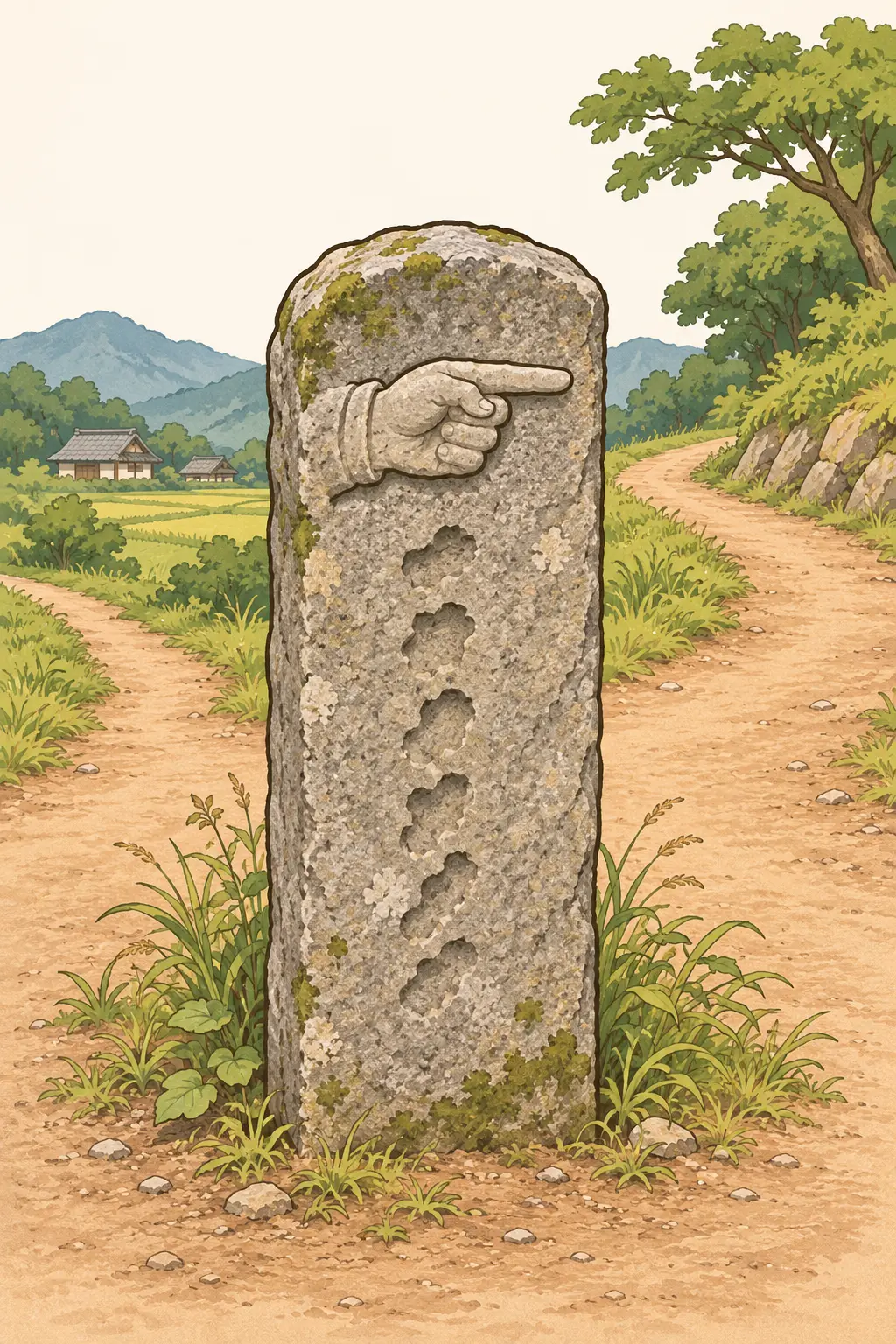
Shinnen set up stone signposts at confusing junctions, carved with a pointing hand and directions.
The early Meiji separation of Buddhism and Shinto, and the anti-Buddhist violence that accompanied it, damaged or altered several temples, but the pilgrimage survived. In the twentieth century roads and motor vehicles changed it fundamentally. From the 1950s bus companies ran organized tours that completed the circuit in about ten days instead of forty or fifty. Today most pilgrims travel by bus or car, and only a few thousand a year walk the whole thing (as of the 2020s). In 2015 the pilgrimage was designated a Japan Heritage site, and as of 2026 the four prefectures are still campaigning for UNESCO World Heritage listing.
04White Robes, Sedge Hats and the Staff
Pilgrims are easy to recognize on Shikoku’s roads.
The hakui is a white vest or jacket, often printed on the back with Namu Daishi Henjō Kongō, an invocation of Kōbō Daishi. White is the color of the Japanese burial shroud. Pilgrims of earlier centuries wore it as a sign that they were ready to die on the road, and if they did, they were already dressed for it. The sugegasa, a conical hat of woven sedge, is inscribed with "two traveling together" and a short Buddhist verse.
The kongōzue, a wooden staff whose top is usually shaped like a five-tiered stupa, is treated as the body of Kōbō Daishi himself. At the end of the day a pilgrim washes its tip before washing their own feet, and stands it in the place of honor in the room. Pilgrims do not tap the staff on bridges. The reason is a legend from Ōzu in Ehime: Kūkai, refused lodging, once slept under a bridge there, and the cold night felt as long as ten nights. The bridge is still known as the "Ten-Night Bridge" (Tōyogahashi; the reading is given in more than one way), and pilgrims lift their staffs so as not to wake him.
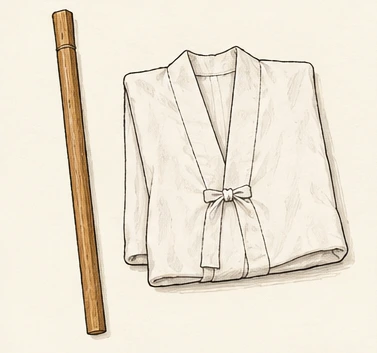
The kongōzue staff and the white robe: the staff stands for Kōbō Daishi himself, and white was once the color of burial clothes.
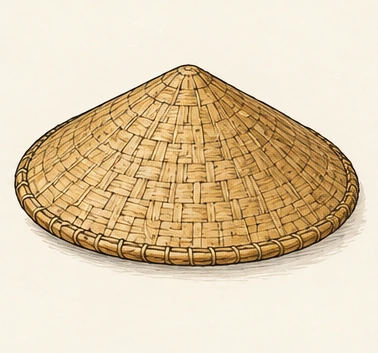
The sugegasa, a hat woven from sedge, on which pilgrims write "two traveling together."
Other gear includes a stole called a wagesa, a shoulder bag for sutra books and supplies, prayer beads and a small bell. The most important item is the nōkyōchō, a blank accordion-fold book. At each temple’s stamp office, a staff member writes the temple’s name and its principal deity in brush calligraphy and adds red seals, certifying that you came and chanted. By the end the book is full, and many families keep it as a treasured object, sometimes placing it in the coffin of its owner. It resembles the goshuin stamp books that visitors collect at temples and shrines throughout Japan, but it is made specifically for this circuit. Some pilgrims have the seals stamped on a hanging scroll or on their white jacket instead.
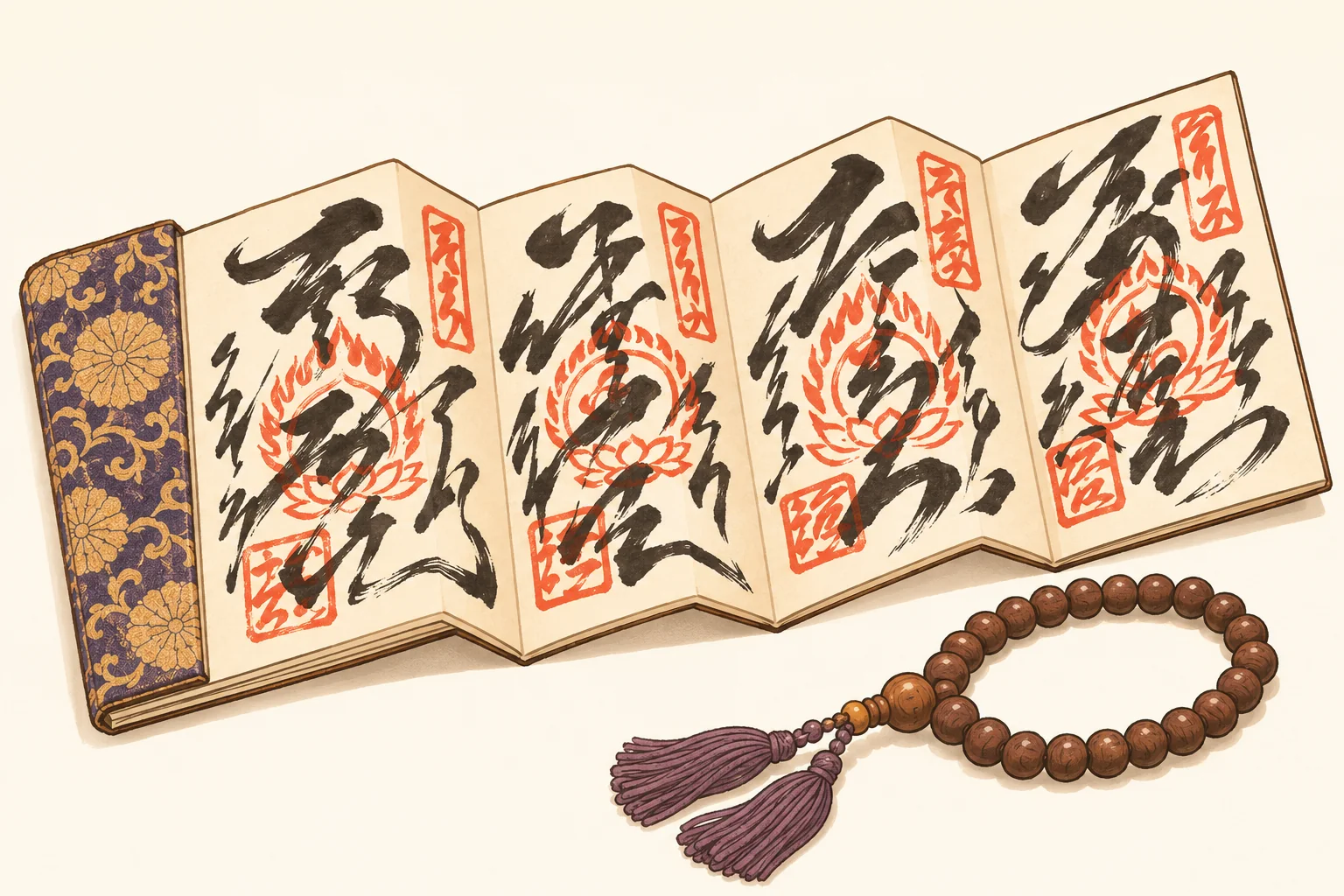
An open Shikoku pilgrimage nōkyōchō, each page filled with brush calligraphy and red seals (illustration).
05At the Temple
Worship follows a fixed sequence. Bow at the gate, rinse hands and mouth at the water basin, and ring the temple bell if it is allowed (striking it on the way out is considered bad form). At the main hall, light a candle and three sticks of incense, drop an osamefuda, a paper slip with your name, address and date, into the box, make an offering, and chant. The usual recitation is the Heart Sutra, the mantra of the temple’s deity, the Mantra of Light, and finally the invocation Namu Daishi Henjō Kongō. Then repeat the process at the Daishi hall, and finish at the stamp office. The stamping fee was raised in 2024.
The color of the osamefuda shows how many times a pilgrim has completed the circuit: white for the first four, green for five or six, red from seven, silver from twenty-five, gold from fifty, and brocade from one hundred. There are pilgrims who have walked or driven it more than a hundred times, and local people prize their brocade slips as charms.
Finishing all eighty-eight temples is called kechigan, the fulfillment of the vow. Many pilgrims then travel to Mount Kōya to report to Kōbō Daishi at the Okunoin. Some walk from Ōkubo-ji back to Ryōzen-ji to close the circle. Doing the whole route in one go is tōshi-uchi; doing it in sections over months or years is kugiri-uchi, and it is how many working Japanese manage it.
06Osettai: The Gift to the Pilgrim
What moves many first-time pilgrims most is osettai, the giving of gifts to pilgrims. A woman steps out of her house with a tangerine. A man at a gas station hands over a cold drink. An elderly couple presses a few hundred yen into your hand. A driver stops and offers a lift. Some households run zenkon’yado, free lodgings opened to pilgrims as an act of merit.
The logic is that a gift to a pilgrim is a gift to Kōbō Daishi, who walks beside them, and that the giver shares in the pilgrim’s merit, as if sending part of themselves along the road. For that reason a pilgrim should not refuse. The proper response is to accept with thanks and give an osamefuda in return; many recipients keep these slips on the household altar.
In the Edo period osettai was organized on a larger scale. Associations from villages in Kii (Wakayama), such as those of Arida, and by some accounts from Ōsaka as well, would cross the sea each year to hand out rice, straw sandals and money at fixed spots. Today it is mostly individual, though volunteers have built small rest huts along lonely stretches of the Kōchi coast where walkers can shelter from rain.
07Walking It Today
Walking the full circuit usually takes forty to fifty days at twenty-five to thirty kilometers a day. Pilgrims sleep in family-run inns called minshuku, business hotels and temple lodgings (shukubō). Spring (March–April) and autumn (October–November) are the best times; summer is hot and humid, and winter can bring snow to the mountain temples. The route is well marked. Besides Shinnen’s old stones, small red stickers showing a pilgrim in a hat are fixed to poles and guardrails at nearly every turn.
People with less time often walk a single province, such as Tokushima from Temple 1 to Temple 23, Yakuō-ji, which takes about a week, or just the first ten temples, which takes two or three days and gives a fair taste of the experience. Bus tours led by a sendatsu, a certified pilgrim guide who leads the chanting and explains each temple, are a common way for older Japanese to complete the circuit. The shops in front of Ryōzen-ji sell full outfits; a jacket, hat, staff and stamp book together cost in the range of ten to twenty thousand yen (as of the mid-2020s).
You do not have to be Buddhist. Walkers today include people mourning a parent or a child, people marking retirement, young people between jobs, and a growing number of foreign hikers. The monks at the stamp offices do not ask what you believe, and neither do the people offering osettai. At the temples, follow the temple’s customs: bow at the gate, pray quietly, keep your voice down. On the road, other pilgrims will greet you with otsukaresama desu, an all-purpose "thank you for your effort," and a nod.