
At a glance
Who the seven gods on the treasure ship are, how deities from Japan, India and China became one group, and how to walk a New Year pilgrimage route.
- Of the seven, only Ebisu is native to Japan; the others come from India and China.
- Kyoto townspeople of the Muromachi period put the group together, and by the Edo period it had largely settled into today’s seven.
- The number seven is usually traced to the Benevolent Kings Sutra: "the seven calamities will vanish and the seven fortunes will arise."
- In the Edo period people slept with a treasure-ship picture under the pillow at New Year to bring a lucky first dream.
- The New Year pilgrimage usually runs from January 1 to 7: visit seven temples and shrines and collect a stamp or seal at each.
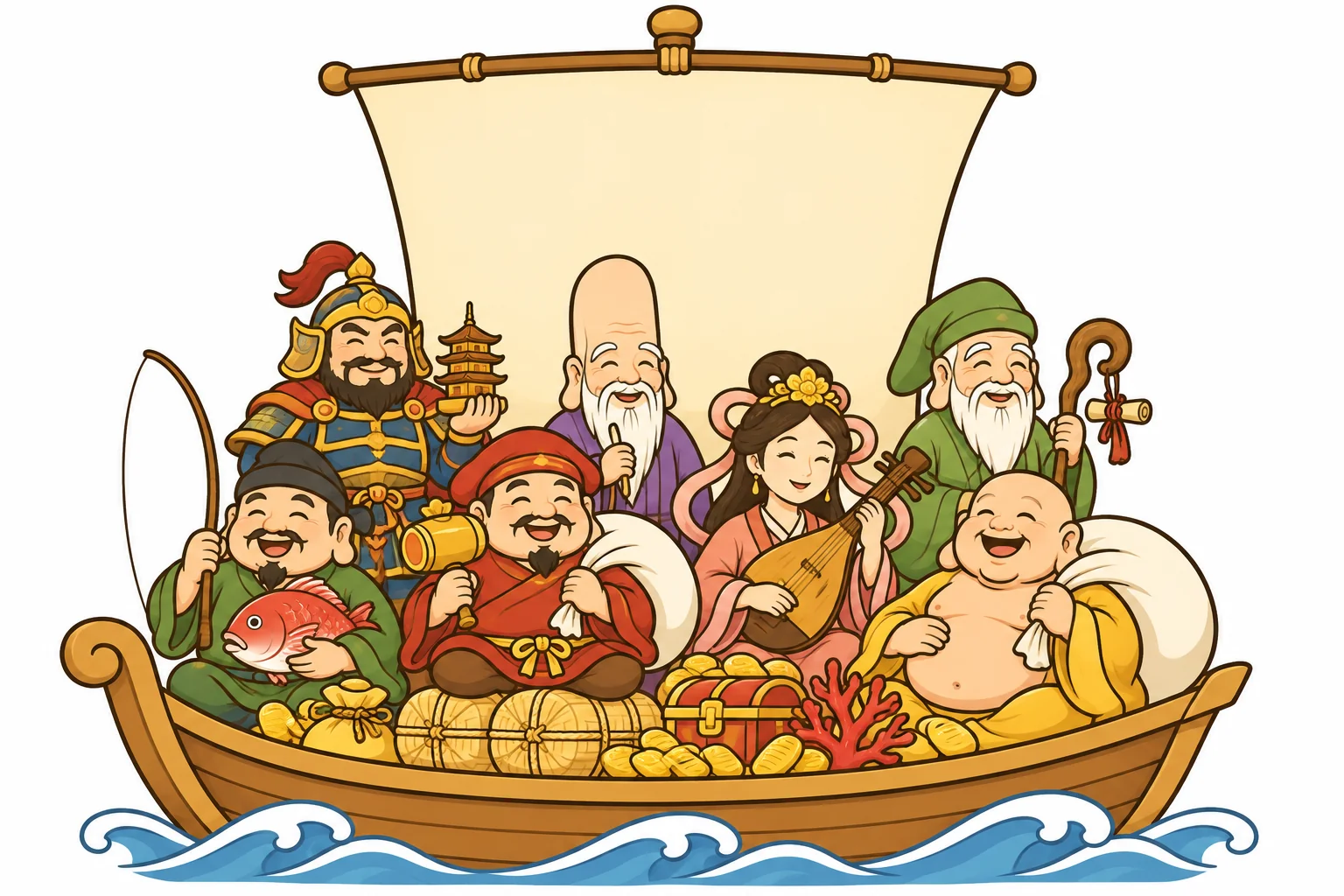
Walk into a Japanese shop around New Year and you may find a small ship painted on a card by the till, crowded with seven cheerful figures: a fisherman holding a sea bream, a stout man sitting on rice bales, a warrior in armor, a woman with a lute, an old man with an impossibly tall head, another with a deer, and a laughing monk with a huge belly. These are the Shichifukujin, the Seven Lucky Gods. Only one of them is native to Japan. The others came from India and China, by way of Buddhism, Daoism and Zen painting, and were gathered into a single crew by merchants and townspeople who wanted gods for this life rather than the next. This piece introduces each of the seven, explains how they came to sail together, and suggests how a visitor can meet them, especially on the New Year pilgrimage routes that thread through Tokyo, Kyoto and dozens of other towns.
01Meet the Crew
Ebisu is the one who was born in Japan. He wears the tall black cap of a Heian courtier, holds a fishing rod in his right hand, and clutches a red sea bream (tai, a fish whose name echoes medetai, "auspicious") under his left arm. His grin is the broadest in the group. Ebisu began as a god of fishermen. Along the coasts, anything the sea delivered unasked, from driftwood to a stranded whale, could be called ebisu, a gift from beyond the horizon. Later, priests identified him with figures from the classical myths: either Hiruko, the first child of the creator gods Izanagi and Izanami, who was set adrift in a reed boat, or Kotoshironushi, a son of the god Ōkuninushi who was fond of fishing. As markets grew, Ebisu became the patron of trade, and today he is above all the merchants’ god. In Ōsaka people call him, affectionately, Ebessan.
Daikokuten stands or sits on two bales of rice, wearing a soft round cap, a sack slung over his shoulder and a small mallet in his raised hand. That mallet is the uchide no kozuchi, a magic hammer that showers out treasure when shaken. His origins could hardly be further from this genial figure. He descends from Mahākāla, "the Great Black One," a fierce form associated with the Hindu god Shiva, who entered Buddhism as a protector deity. In Chinese monasteries he guarded the kitchen and the food stores, and tradition credits the monk Saichō, founder of the Tendai school, with bringing his cult to Mount Hiei. In Japan a pun did the rest: daikoku, "great black," can be read the same way as daikoku, "great land," the first part of Ōkuninushi’s name. The two merged, the dark warrior softened into a smiling farmer, and Daikoku became the god of harvests and household wealth. He and Ebisu are often paired, sitting side by side on kitchen shelves and shop altars across the country.
Bishamonten is the only member in armor. He holds a small pagoda in one hand and a spear or staff in the other, and he often tramples demons. He comes from the Indian Vaiśravaṇa, also known as Kubera, a god of wealth. In Buddhism he became one of the Four Heavenly Kings who guard the cardinal directions, the guardian of the north. Worshipped on his own, he is both a war god and a giver of riches. The sixteenth-century warlord Uesugi Kenshin was so devoted to him that he flew a banner bearing the single character bi, the first syllable of Bishamon. Kurama-dera in the hills north of Kyoto and Chōgosonshi-ji on Mount Shigi in Nara Prefecture are famous centers of his cult.
Benzaiten is the only goddess. She plays a biwa, a pear-shaped lute, and her robes trail like water. Her ancestor is Sarasvatī, the Indian river goddess of music, speech and learning. Chinese translators of Buddhist scripture rendered her name as "Goddess of Eloquence," written with characters read benzaiten. In Japan she kept her bond with water and is usually enshrined on islands, beside ponds, or near springs. Over time the character for "eloquence" was swapped for a homophone meaning "wealth," and the patron of the arts also became a goddess of money. Three island shrines are traditionally counted as Japan’s great Benzaiten sites: Enoshima near Kamakura, Chikubushima in Lake Biwa, and Itsukushima, better known as Miyajima. In Tokyo, her octagonal hall on an island in Shinobazu Pond in Ueno Park is a familiar landmark.
Hotei is the one based on a real person. He was a Chinese Buddhist monk of the tenth century, known as Qici, who wandered the area around Mingzhou, present-day Ningbo, with a cloth bag on his back. Fat, cheerful and half-dressed, he became a legend, and after his death people said he had been an incarnation of Maitreya, the Buddha of the future. That is why the laughing, pot-bellied Buddha at the gate of many Chinese temples looks exactly like him. Zen monks brought his image to Japan, where ink painters loved to show him pointing at the moon, napping, or playing with children. Among the Seven he stands for contentment and generosity, and rubbing his belly is said to bring luck.
Fukurokuju and Jurōjin are the two old men, and they cause the most confusion, because both come from Chinese Daoist belief about the Old Man of the South Pole Star, a deity of longevity. Fukurokuju is short, with a domed forehead nearly as tall as the rest of him, and is often accompanied by a crane. His name strings together three Chinese blessings: fuku (happiness), roku (an official’s salary, hence prosperity) and ju (long life). Jurōjin is a white-bearded sage with a staff from which hangs a scroll, said to record the lifespans of all beings, and a deer at his side. Because the two overlap so much, some older lists dropped one of them and added Kichijōten, a Buddhist goddess of fortune, or other figures such as the sake-loving sprite shōjō and, by some accounts, Inari. The lineup was not fixed from the start.
- 1
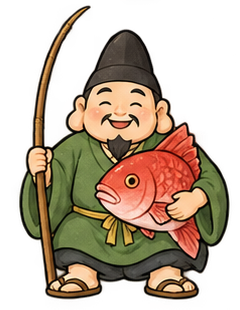 Ebisu: court cap, fishing rod in his right hand, a red sea bream under his left arm.
- 2
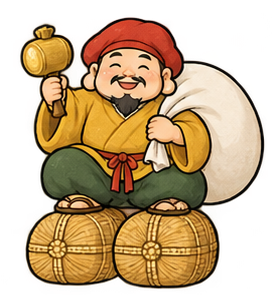 Daikoku: round hood, feet on rice bales, a magic mallet raised and a big sack on his shoulder.
- 3
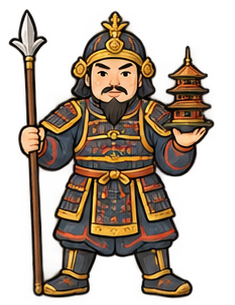 Bishamonten: the only one in full armor, holding a pagoda and a halberd.
- 4
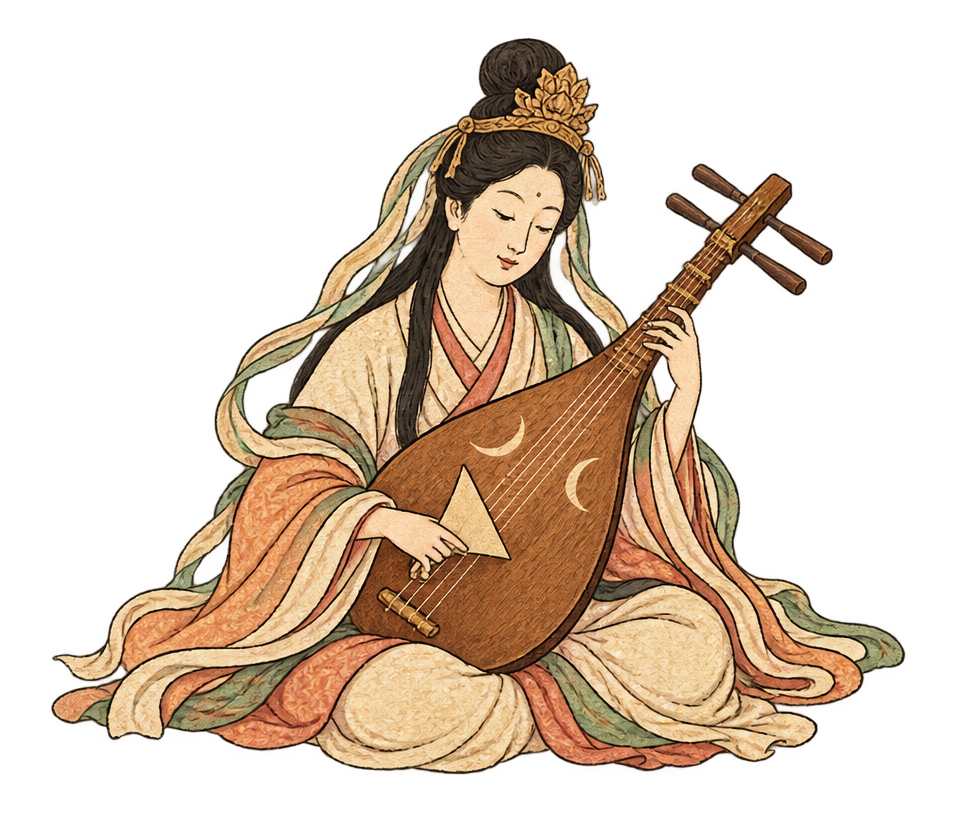 Benzaiten: the only goddess, holding a biwa lute.
- 5
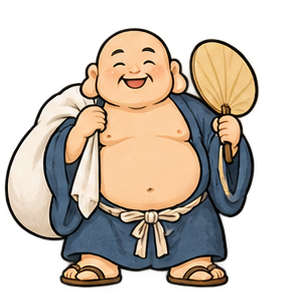 Hotei: bare belly, a cloth sack on his back.
- 6
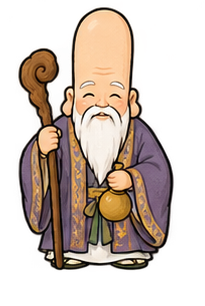 Fukurokuju: short, with a towering domed head.
- 7
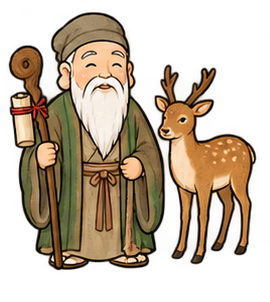 Jurōjin: a white-bearded old man with a scroll tied to his staff and a deer at his side.
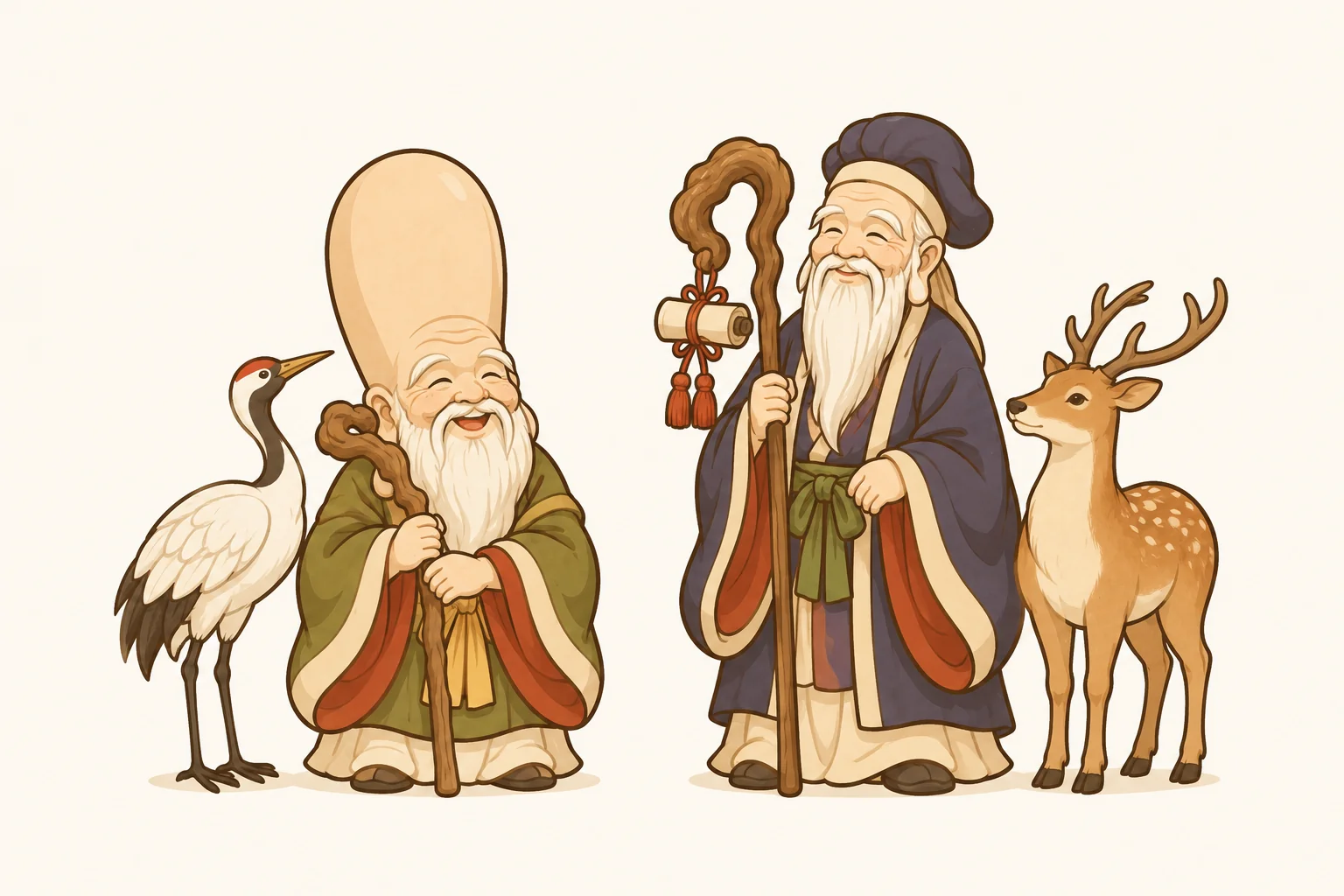
Fukurokuju, with his towering domed head and a crane, beside Jurōjin, white-bearded with a staff and a deer.
02How Seven Gods Ended Up on One Boat
The grouping took shape in Kyoto during the Muromachi period (1336–1573), when commerce was booming and townspeople were eager for gods who would help with practical matters. Ebisu and Daikoku were already a pair. Bishamonten and Benzaiten had large followings of their own. Hotei, Fukurokuju and Jurōjin were well known from Chinese paintings and the ink work of Zen monasteries. Scholars often suggest that the idea of a set was influenced by a favorite subject of those same Zen painters, the Seven Sages of the Bamboo Grove.
The number seven is usually tied to a line from the Benevolent Kings Sutra, a text recited for the protection of the state, which promises that "the seven calamities will vanish and the seven fortunes will arise." Seven was already an auspicious number in Buddhism, and the phrase gave the new grouping a ready-made scriptural ring.
By the Edo period (1603–1868) the membership had largely settled into today’s seven, and the gods had spread to ordinary city dwellers. A well-known story credits the Tendai monk Tenkai, adviser to Tokugawa Ieyasu, with telling the shogun that the seven represented seven virtues: longevity, fortune, popularity, integrity, dignity, amiability and magnanimity. Ieyasu, the story goes, was delighted and had painters of the Kanō school depict them. The tale appears in later accounts and is hard to verify, but it captures how people of the time thought about the gods: each one stood for something useful in business and in life.
That practicality is the key to their popularity. The Seven Lucky Gods are not remote like the sun goddess Amaterasu, and they are not concerned with salvation like Amida Buddha. They look after sales, harvests, talent, health and a long life. Their origins span Shinto, Buddhism and Daoism, and nobody in Japan has ever seemed bothered by putting them in the same boat. For centuries, gods and buddhas in Japan were worshipped side by side, and the Seven Lucky Gods are the most relaxed expression of that habit.
03The Treasure Ship and the First Dream
The classic image shows all seven aboard the takarabune, the treasure ship. It sails in from the sea piled with gold, coral, wish-granting jewels, a magic mallet and a cloak of invisibility, with the character for "treasure" often painted on its sail.
In the Edo period, people slipped a printed picture of the treasure ship under their pillows at New Year. The first dream of the year, hatsuyume, dreamed on the first or second night of January, was believed to foretell the coming twelve months, and the picture was meant to steer it in a lucky direction. Street vendors walked the city in the first days of the year calling out "Otakara, otakara!" to sell them. Many prints carried a short poem that reads the same forwards and backwards:
Nagaki yo no / tō no nefuri no / mina mezame / naminori fune no / oto no yoki kana
Roughly: "In the long night, all wake from their distant sleep; how pleasant the sound of the ship riding the waves." Because the poem loops back on itself, it was thought to keep good fortune circling. If you had a bad dream anyway, you could float the picture away on a river the next day.
Few people still sleep on a treasure ship, but the motif is everywhere in January: on New Year cards, shrine amulets, shop decorations and the wrapping of seasonal sweets. The proverbial luckiest first dreams are of Mount Fuji, a hawk and an eggplant, and a dream of the treasure ship ranks right alongside them.
04Where to Find Them
Each of the seven has temples and shrines of his or her own, and some of their festivals draw enormous crowds.
The liveliest is Tōka Ebisu, held from January 9 to 11. At Nishinomiya Shrine in Hyōgo Prefecture, the head shrine of Ebisu worship, the main gate opens at dawn on the 10th and thousands of runners sprint about 230 meters to the main hall. The first few to arrive are named that year’s fukuotoko, "lucky men." The race was called off in 2021 and 2022 because of the pandemic, resumed in 2023, and as of 2026 is still held and regularly makes the national news. At Imamiya Ebisu Shrine in Ōsaka, crowds chant "Shōbai hanjō de sasa motte koi!" ("For good business, bring your bamboo!"). Visitors buy a branch of bamboo grass and have the shrine’s fukumusume, young women chosen as "lucky maidens," hand it over hung with lucky charms such as gold coins, sea bream and rice bales, then take it back to their shops for the year.
For money luck, many people head to Zeniarai Benzaiten Ugafuku Shrine in Kamakura. You walk through a tunnel cut into the cliff and come out in a hollow where spring water trickles from a cave. Visitors place coins and banknotes in small bamboo baskets and rinse them in the spring; money washed here is said to come back multiplied. The custom is to spend it, not hoard it, so the luck keeps moving.
Tokyo’s most famous Ebisu may be the neighborhood. In 1890 the brewery that later became part of Sapporo Breweries launched Yebisu Beer, brewed on a site in what is now Shibuya Ward. A freight station was built to ship it and named after the beer, and the district eventually took the name too. A god became a brand, and the brand became a place.
The gods also live in everyday language. A broad, beaming smile is an ebisu-gao, an "Ebisu face." The thickest pillar in a traditional farmhouse is the daikokubashira, and the word also means the breadwinner who holds a family up. In many shops, next to the beckoning cat and the Daruma doll, you will find a little Ebisu and Daikoku sitting together.
05Walking the Seven Lucky Gods Pilgrimage
The best way for a traveler to meet the Seven Lucky Gods is the Shichifukujin meguri, a pilgrimage to seven temples and shrines that each house one of them. Hundreds of such routes exist across Japan. The custom took off in Edo in the late eighteenth and early nineteenth centuries as a New Year outing, and the Yanaka route in Tokyo, running from Tōkaku-ji in Tabata down through old temple streets to the Benten hall at Shinobazu Pond, is generally regarded as one of the oldest.
Tokyo alone has dozens. The Sumidagawa route follows the east bank of the Sumida River through Mukōjima. The Nihonbashi route is made up entirely of shrines and can be walked in an hour or two, which makes it popular with office workers on their first day back. Shibamata, Asakusa and Yamanote routes all have their fans. Kyoto’s Miyako Shichifukujin links famous temples such as Tō-ji, Rokuharamitsu-ji, Sekizan Zen-in and the Chinese-style Manpuku-ji in Uji. Kamakura, Ōsaka, Nara and many small towns have their own versions.
The traditional season is the first week of January, the matsu no uchi period when pine decorations stand at the gates, though some routes keep special stalls open until January 15 or through the month. During this time the temples and shrines set up tables selling route maps, special shikishi boards, and miniature figures of the gods. One popular approach is to buy a board at the first stop and collect a red seal stamp at each of the seven, then frame the finished board at home. Another is to buy a small boat at the first stop and add a tiny figure at each, so that by the end your treasure ship is fully crewed.
Order doesn’t matter, though maps suggest the most efficient sequence. At each stop, pay your respects first, then get your stamp. At a shrine, bow twice, clap twice and bow once. At a temple, simply put your palms together; don’t clap. Most routes are under ten kilometers, and walking one on a cold, bright January morning, with stalls selling warm amazake rice drink and grilled rice cakes along the way, is one of the pleasantest ways to see a Japanese neighborhood at New Year.
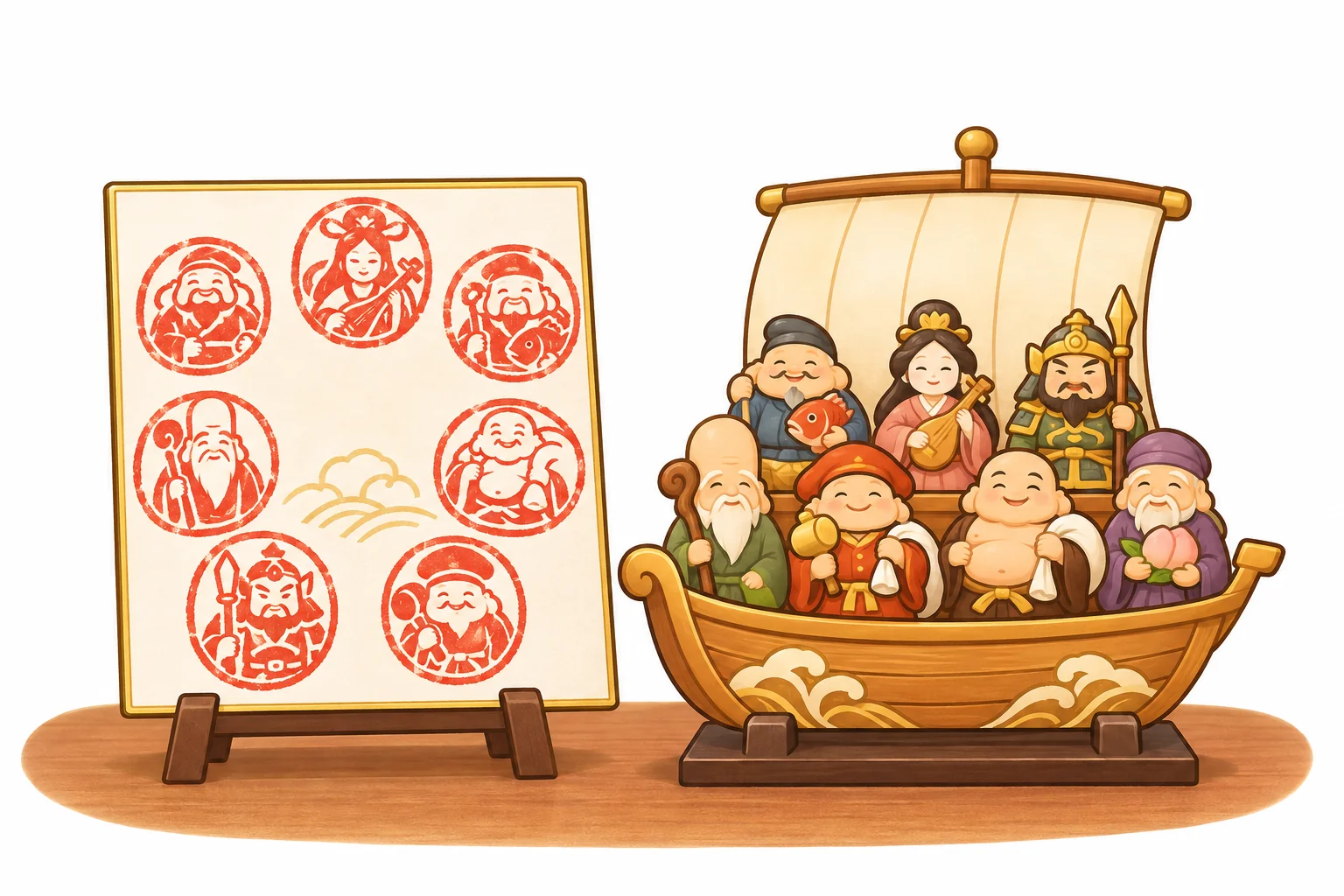
A pilgrimage card bearing all seven seals, beside a treasure-ship stand holding seven small figures of the gods (illustration).
If you visit outside January, many routes can still be walked, although smaller temples may not offer stamps out of season. And even on an ordinary sightseeing day, once you can recognize a fishing rod, a rice bale, a lute or a magnificent belly, you will start spotting the Seven Lucky Gods on temple grounds, shop shelves and beer labels all over the country.