
At a glance
How Japan’s mountain ascetics fused kami worship with esoteric Buddhism, why entering the peaks means symbolic death and rebirth, and how visitors can join them today.
- Shugendō fuses Japanese mountain worship with esoteric Buddhism and Daoist magic; its practitioners are called yamabushi.
- Its founder is En no Ozunu (En no Gyōja), a late-7th-century figure, given the title Jinben Daibosatsu in 1799.
- Its core is mine-iri, entering the peaks: going into the mountain is dying, the ordeals there pass through ten realms, and coming out is rebirth.
- The government abolished Shugendō in 1872; after 1945 its lineages re-emerged as independent sects.
- The Ōmine Okugake trail, about 120 km from Yoshino to Kumano, became part of a World Heritage site in 2004.
Hike the old trails of Yoshino, Kumano or Mount Haguro and you may hear it before you see it: a long, low moan rolling through the cedars, the sound of a conch shell. Then a line of figures appears in pleated hemp robes, small black caps perched on their foreheads, pompoms of colored wool on their chests, staffs in hand. These are yamabushi, "those who lie down in the mountains," practitioners of Shugendō. Shugendō is a religion of mountains: a fusion of Japan’s ancient reverence for peaks with esoteric Buddhism and Chinese Daoist lore, practiced not in temple halls but on cliffs, ridges and under waterfalls. It flourished for a thousand years, was abolished by government decree in 1872, and came back after the Second World War. Today anyone, with some sweat and humility, can follow the yamabushi into the mountains for a few days.
01The Mountain as Temple
Long before Buddhism reached Japan, mountains were sacred. They were where the gods (kami) descended and dwelled, where the souls of the dead went, and where the water that fed the rice fields came from. Many peaks were themselves objects of worship, approached only from below.
When Buddhism arrived in the sixth century, some monks and lay practitioners went the other way and climbed. They meditated in caves, fasted, recited spells under freezing waterfalls, and believed that the power of the mountain would give them supernatural abilities: to heal, to exorcise, to bring rain. The Nara-period court tried to keep monks inside their temples and required permission for mountain retreats, which tells us that unlicensed mountain hermits were already common. These figures blended local mountain worship with the spells and rituals of esoteric Buddhism and with Daoist ideas of immortals and talismans. By the late Heian period, a name had settled on their practice: shugen, "acquiring power through practice." Shugendō is "the way of shugen."
The central act of Shugendō is mine-iri, "entering the peaks." To a yamabushi, the mountain is many things at once: the realm of the Buddhas, a mother’s womb, the land of the dead. To enter it is to die. The ordeals inside correspond to passing through the ten realms of existence, from hell through hungry ghosts and animals all the way up to Buddhahood. To walk out again is to be reborn. This idea of symbolic death and rebirth runs through every robe and ritual, and it explains much of Shugendō’s appeal: it promises transformation not in some afterlife but here, in this body, within a few days.
- 1
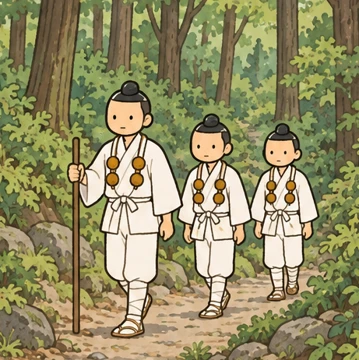 Entering: a leader takes the group into the mountain, a symbolic death
- 2
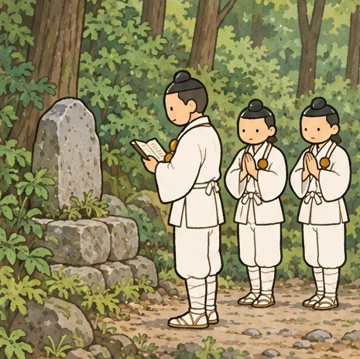 In the mountain: worship and austerities at sacred rocks, passing through ten realms
- 3
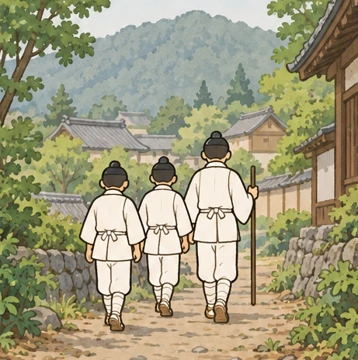 Coming out: walking back to the world, reborn
02En no Gyōja and the Wrathful Zaō Gongen
Shugendō traces itself to a single founder, En no Ozunu, known to later generations as En no Gyōja, "En the Ascetic." He was a real person, a spell-worker from the Katsuragi mountains near Nara in the late seventh century. The official chronicle Shoku Nihongi records that in 699 he was accused of misleading people with sorcery and exiled to the Izu peninsula. That is almost all history tells us. Legend tells much more. He commanded two demons, Zenki and Goki, to fetch his water and firewood; he walked on the sea; in exile he flew each night to train on Mount Fuji. In Shugendō lore, nearly every sacred mountain in Japan was first opened by En no Gyōja. In 1799, on the 1,100th anniversary of his death, Emperor Kōkaku granted him the title Jinben Daibosatsu, "Great Bodhisattva of Miraculous Transformations."
The best-known legend comes from the Ōmine range south of Yoshino. En no Gyōja is said to have prayed on the summit of Sanjōgatake for a deity strong enough to save people in a degenerate age. The historical Buddha appeared, then the thousand-armed Kannon, then Maitreya, the Buddha of the future; each seemed too gentle. At last, from the rock itself, burst a blue-black figure with flaming hair, bared fangs and one leg kicked high: Kongō Zaō Gongen. A gongen is a Buddha appearing in the guise of a Japanese god, and the name itself sums up Shugendō’s refusal to separate Buddhas from kami.
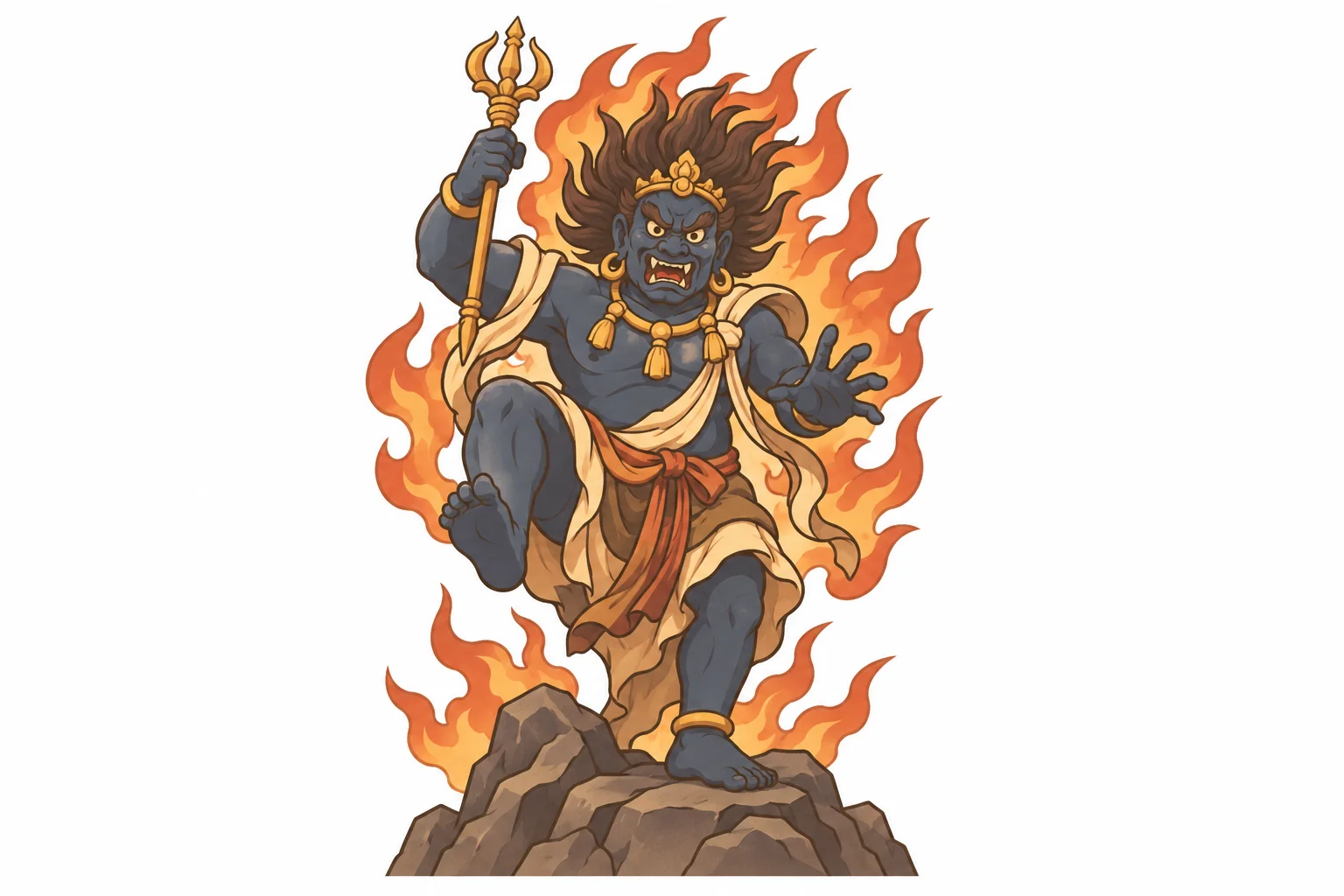
Zaō Gongen: dark blue-black, hair flaring in rage, one leg raised high, standing on a rock (illustration).
You can meet Zaō Gongen at Kinpusen-ji temple in Yoshino. Its main hall, the Zaōdō, is around 34 meters tall and one of the largest wooden buildings in Japan. Inside stand three Zaō Gongen statues, each roughly seven meters high, glaring and fanged. They are hidden images, shown to the public only during special openings. Even with the doors closed, the hall conveys something of Shugendō’s rough, muscular spirit, very different from the refined temples of Kyoto.
03Yoshino, Kumano and the Three Mountains of Dewa
Shugendō never had a single headquarters. It grew around regional sacred mountains, each with its own traditions. The most important is the Ōmine range on the Kii peninsula. The ridge route running roughly 120 kilometers from Yoshino in the north to Kumano in the south is the Ōmine Okugake-michi, Shugendō’s great training path. The whole range is regarded as the two mandalas of esoteric Buddhism, usually with the Yoshino end as the Diamond Realm and the Kumano end as the Womb Realm, so walking the ridge means passing physically through the cosmos. In 2004 the route became part of the UNESCO World Heritage Site "Sacred Sites and Pilgrimage Routes in the Kii Mountain Range," alongside the better-known Kumano Kodō.
On the summit of Sanjōgatake stands Ōminesan-ji, the root training ground of Shugendō. It is famous for the nishi no nozoki, "peering over the west." The trainee is tied with a rope and lowered head-first over a cliff edge, held by the ankles or the rope by senior yamabushi, with a drop of hundreds of meters below. By most accounts, the guides ask questions: will you be good to your parents? will you work hard? The answer must be a loud "yes." As of 2025, Sanjōgatake is also one of the last mountains in Japan still closed to women. A "women’s boundary gate" stands on each trail. The ban draws regular criticism, and the temple and its supporting lay associations have so far kept it.
In the northeast, in Yamagata Prefecture, the Three Mountains of Dewa (Dewa Sanzan) form the other great center. Mount Haguro stands for the present life, Mount Gassan for death, and Mount Yudono for rebirth; a pilgrimage across all three is a journey through life, death and new life. Haguro’s approach climbs 2,446 stone steps through an avenue of ancient cedars, passing a five-story pagoda that is among the oldest in northern Japan. Each late summer, the roughly week-long Aki no Mine ("autumn peak") retreats held separately by Dewa Sanzan Shrine and by Haguro-san Shugen Honshū are among the most important mine-iri in the country. On New Year’s Eve, the Shōreisai festival, led by two yamabushi who have kept a hundred-day period of purification, is the region’s great winter rite.
- 1Mount Hagurothe present life
- 2Mount Gassandeath
- 3Mount Yudonorebirth
Each mountain stands for one stage; crossing all three is a journey through life, death and new life.
Other centers included Mount Hiko in Kyūshū, Mount Ishizuchi in Shikoku, Mount Haku and Mount Tate on the Sea of Japan side, and Mount Takao on the western edge of Tokyo. Many of the hiking trails Japanese people use today were first cut by yamabushi.
04Robes, Conches and Staffs
A yamabushi’s outfit is instantly recognizable, and each piece carries meaning. The small black cap, the tokin, has twelve pleats for the twelve links of dependent origination. The hemp robe is the suzukake. The sash with woolly pompoms on the chest is the yuigesa; the pompoms are usually said to number six, standing for the six stages of a bodhisattva’s practice. An animal-skin pad, the hishiki, hangs from the back so the wearer can sit anywhere. The ringed metal staff, the shakujō, jingles as he walks, warding off evil spirits and warning animals. A wooden backpack-shrine, the oi, carries sutras and ritual tools, and some carry, instead of the metal one, a plain wooden staff, the kongōzue, often said to be cut with eight sides.
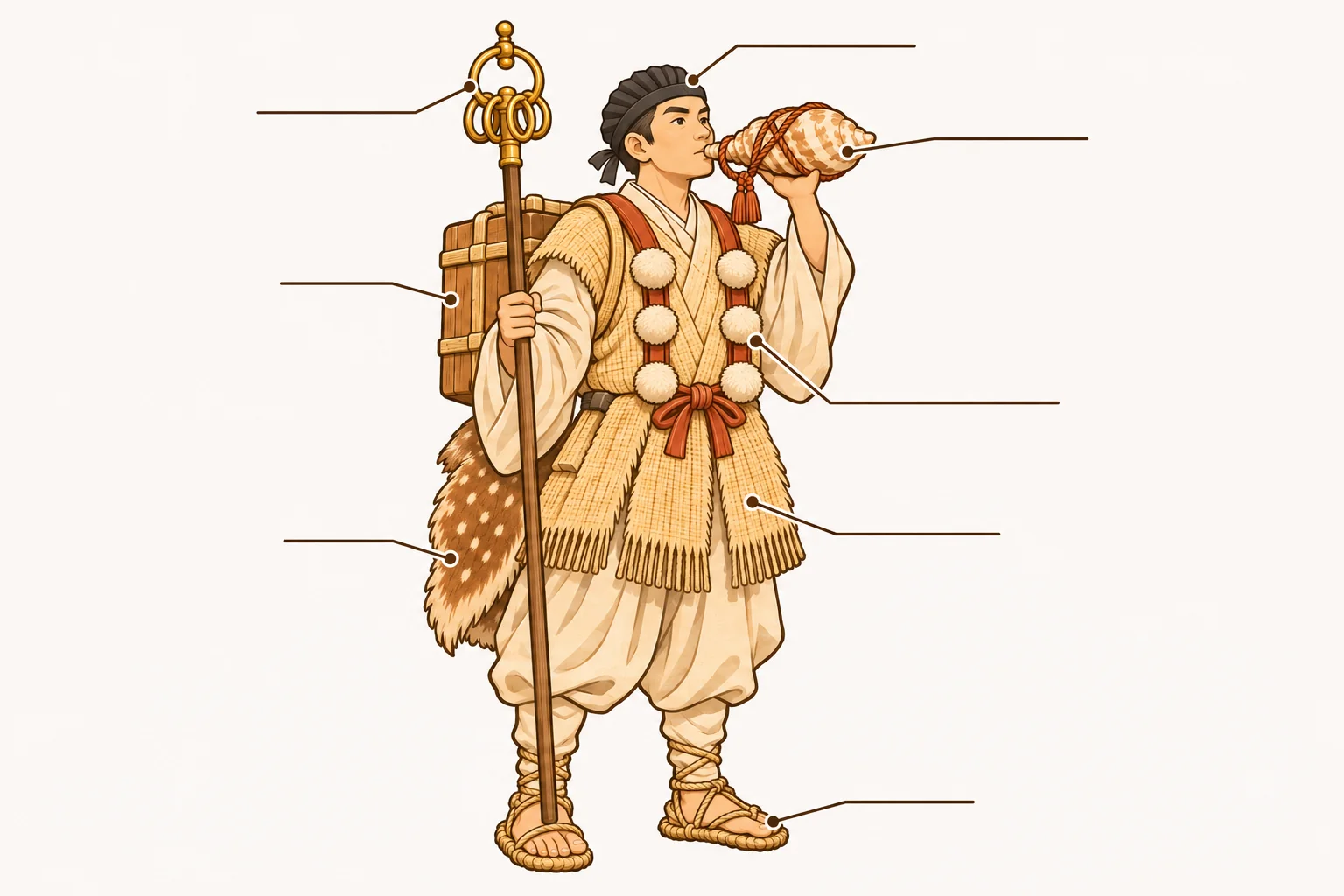
A yamabushi's outfit: tokin cap, suzukake robe, yuigesa sash, hishiki pad, shakujō staff and oi.
The emblem of the yamabushi is the conch trumpet, the horagai. Fitted with a mouthpiece, it carries a long way, by some accounts for kilometers. In the mountains, different calls mean depart, gather, arrive. The sound is also taken as the voice of the Buddhist teaching, driving off evil. In Japanese films and television, a single conch blast is enough to tell the audience that yamabushi are near.
Many Japanese first meet the yamabushi through the kabuki play Kanjinchō ("The Subscription List"). The fugitive general Minamoto no Yoshitsune and his loyal monk-warrior Benkei, fleeing north, disguise their party as yamabushi. Stopped at the Ataka barrier, Benkei unrolls a blank scroll and pretends to read from it a list of donors for rebuilding Tōdai-ji temple, then answers the guard’s rapid-fire questions about the meaning of every piece of yamabushi gear. That exchange is practically a guide to the costume.
05Rise, Abolition and Return
From the medieval period on, Shugendō organized itself. One branch, centered on Shōgo-in temple in Kyoto and tied to the Tendai school, became the Honzan-ha. Another, centered on Sanbō-in at Daigo-ji and tied to the Shingon school, became the Tōzan-ha. In 1613 Tokugawa Ieyasu ruled on a dispute between the two, in what is usually called the Shugendō Regulations (Shugendō hatto), and the shogunate went on to place every yamabushi in one or the other.
In the Edo period, the most typical yamabushi was not a hermit on a cliff but a village religious specialist. He prayed for villagers, exorcised spirits, treated the sick, read omens, led festivals, and often looked after both the local shrine and the temple. He organized pilgrimage confraternities (kō) that took villagers to climb Fuji, Ontake or Ōyama. In the northeast, yamabushi carried folk performing arts such as yamabushi kagura, masked dances still performed today.
The Meiji Restoration nearly destroyed all of this. The new government set out to separate Shinto from Buddhism, and Shugendō, which mixed the two at every level, was an obvious target. In 1872 it was formally abolished. Yamabushi were ordered to join the Tendai or Shingon schools or become Shinto priests; by common estimates well over a hundred thousand practitioners lost their status. Temples were converted into shrines, and deities like Zaō Gongen were renamed or removed. Kinpusen-ji in Yoshino was for a time turned into a shrine before being restored as a temple. On Mount Haguro, most of the Buddhist institutions became Dewa Sanzan Shrine, and the buildings on the mountain still show the seams of that change.
After 1945, with religious freedom guaranteed, Shugendō groups re-formed as independent denominations: the Honzan Shugen-shū at Shōgo-in, the Kinpusen Shugen Honshū at Kinpusen-ji, the Daigo branch of Shingon at Daigo-ji, and Haguro-san Shugen Honshū, among others. Today’s yamabushi include temple priests, but many are office workers, teachers or retirees who live ordinary lives and put on the robes for the training season.
06Walking with the Yamabushi
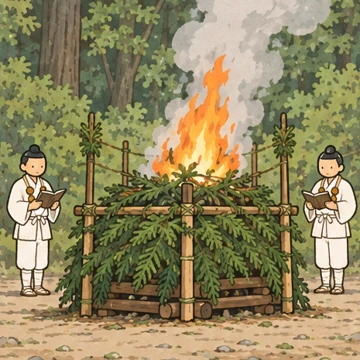
The easiest way for a visitor to encounter Shugendō is a saitō goma, an outdoor fire ritual. Yamabushi build a great pyre of cedar and cypress boughs inside a roped enclosure, shoot arrows to the four directions and cut the air with a sword to drive off evil, then set it alight. Thick smoke boils up while dozens of yamabushi chant and blow conches, and worshippers throw in wooden sticks inscribed with their wishes. Yoshino, Mount Takao and Shōgo-in hold these on fixed dates. At some sites, once the fire dies down, lay people walk barefoot across the embers.
To go further, you can join a training program open to the public. Temple lodgings (shukubō) at Mount Haguro run two- and three-day yamabushi experiences in summer and autumn. Participants change into white, climb with the yamabushi, stand under waterfalls, and endure the nanban ibushi, in which chili peppers are burned in a closed hall until everyone is choking and weeping, a passage through hell. Throughout, the only permitted reply to any instruction is uketamō, "I accept." No questions, no refusals. Many participants say the hardest part is not physical: it is setting aside their own judgment and simply doing as told.
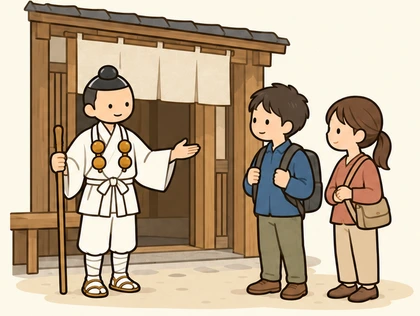
Haguro’s pilgrim lodgings take ordinary visitors on two- to three-day yamabushi experiences in summer and autumn
On the Ōmine side, Dorogawa Onsen in Tenkawa village, Nara Prefecture, is the traditional base. Its old inns still hang wooden plaques from pilgrimage associations all over Japan. Men can climb from here to Sanjōgatake and experience the nishi no nozoki, usually with a guide or group. Women can climb nearby Mount Inamura, opened after the war as a training mountain for female practitioners.
A few things are worth remembering on a Shugendō trail. The stone Buddhas, small shrines, iron chains and carved rocks along the way are mostly training stations, not playground equipment; do not climb or sit on them. If you meet a group of yamabushi, step aside; they will usually nod, and sometimes answer with a blast of the conch. Their practice is not a show, so ask before taking photographs.
Part of Shugendō’s pull for modern Japanese is how direct it is. You do not need to master scripture. You walk into the mountain, sweat, shiver, feel afraid, and walk out again. In a society where most people rarely face death, the yamabushi offer a controlled, symbolic one, and a fresh start on the other side.