
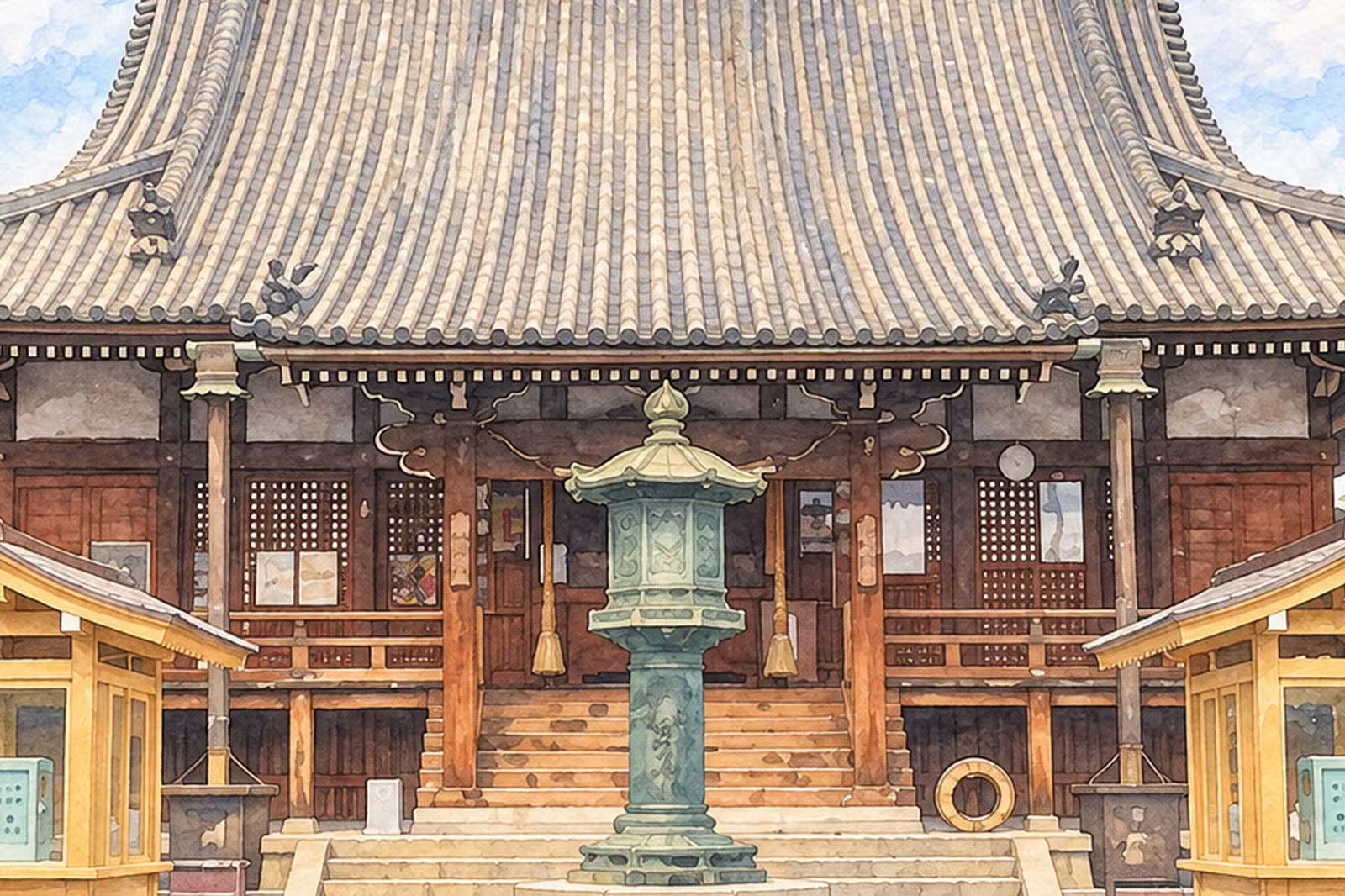
Rokuhara lies in Higashiyama Ward, Kyoto, east of the Kamo River between Gojō and Matsubara streets. It is home to Rokuharamitsu-ji, a temple founded in the Heian period. In the late Heian period the district became the base of the Taira clan, and under the Kamakura shogunate it housed the Rokuhara Tandai, the office that watched the imperial court and governed the west of the country. The temple still stands; the warrior residences and government offices lie buried beneath the modern neighborhood.
01Kūya and the temple
In 951, during an epidemic in the capital, the monk Kūya, known for chanting the nenbutsu in the streets, had a statue of the Eleven-Headed Kannon made and founded a temple called Saikō-ji to pray for the epidemic’s end. This was the origin of Rokuharamitsu-ji. After Kūya’s death, his disciple Chūshin gave the temple its present name in the later tenth century. Today it belongs to the Chizan branch of Shingon Buddhism and is one of the Saigoku Thirty-Three Kannon pilgrimage temples.
02The Taira and the Rokuhara Tandai
In the twelfth century, three generations of the Taira, Masamori, Tadamori and Kiyomori, built residences at Rokuhara. The clan’s houses spread across the district, and "Rokuhara" became almost a byword for Taira power. When the Taira abandoned the capital in 1183, they set fire to these residences. Minamoto no Yoritomo later used the site as his base when he came to Kyoto.
After the Jōkyū War of 1221, Hōjō Yasutoki and Hōjō Tokifusa stayed at Rokuhara to handle the aftermath, and their post developed into the Rokuhara Tandai. It had northern and southern chiefs, kept watch on the court, and dealt with lawsuits and public order among warriors in the west. In 1333 Ashikaga Takauji attacked Kyoto. The Tandai Hōjō Nakatoki and others fled east and took their own lives at Banba in Ōmi, and the Rokuhara Tandai fell together with the Kamakura shogunate.
03What can be seen today
The present Main Hall of Rokuharamitsu-ji was rebuilt in 1363 and is an Important Cultural Property. The principal image, the Eleven-Headed Kannon made at the temple’s founding, is a National Treasure and is normally kept hidden. The most famous work in the temple’s collection is the standing statue of Kūya by Kōshō, with six tiny Amida Buddhas issuing from his mouth to stand for the six syllables of the nenbutsu. The collection also includes a seated figure in monk’s robes traditionally identified as Taira no Kiyomori and works from the circle of Unkei and Tankei, most of them Important Cultural Properties, shown in the temple’s museum. Nothing survives above ground of the Taira residences or the Tandai offices; only place names and stone markers indicate roughly where they stood.