
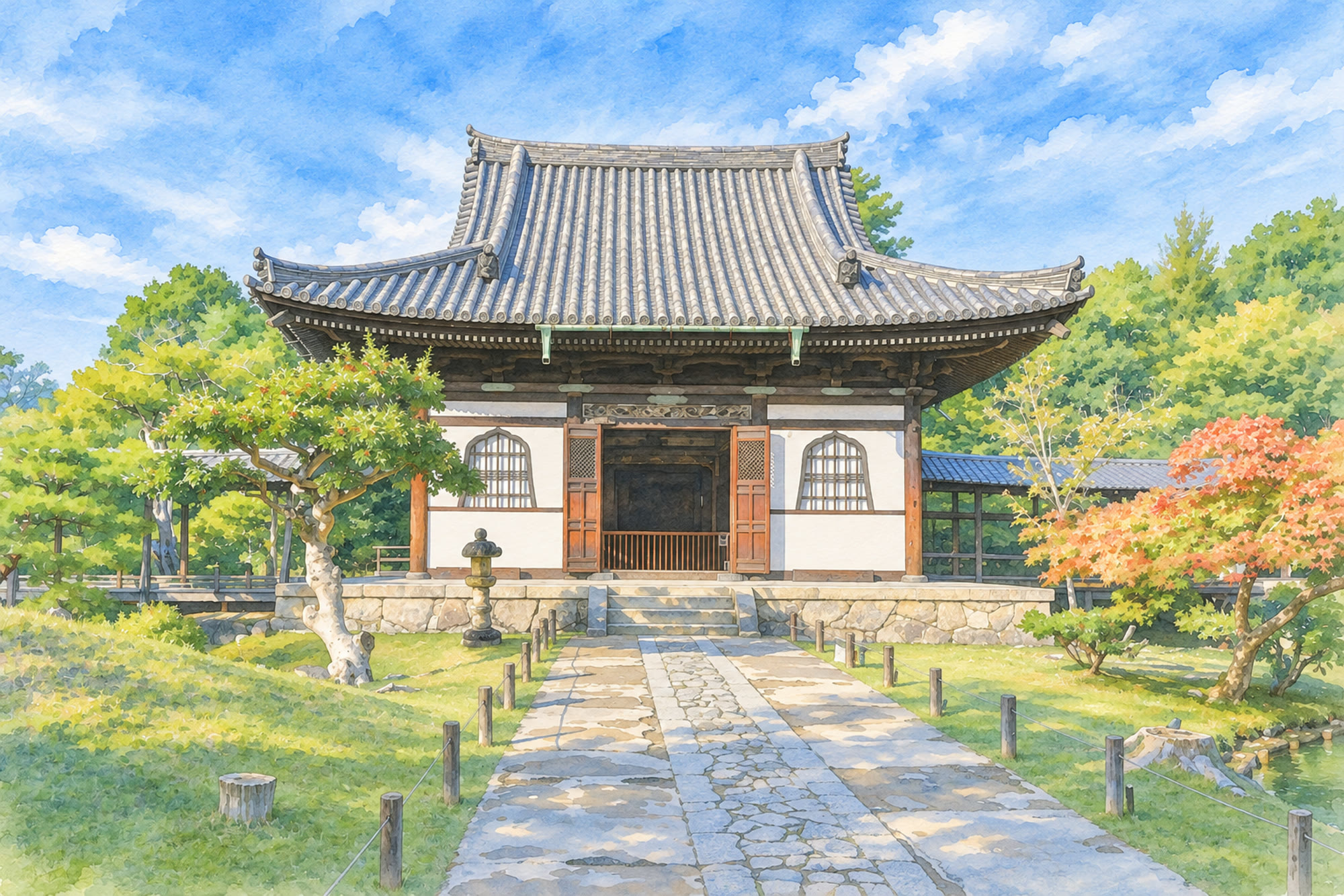
Kōdai-ji, formally Jubusan Kōdai Jushō Zen-ji, is a temple of the Kennin-ji branch of Rinzai Zen in Higashiyama Ward, Kyoto, set on the lower slopes of the Higashiyama hills between Kiyomizu-dera and Yasaka Shrine. It was founded by Nene, the principal wife of Toyotomi Hideyoshi, to pray for her husband after his death, and she spent her last years beside it. Its mortuary hall preserves some of the finest lacquer of the Momoyama period, so much so that the style is known simply as Kōdai-ji maki-e.
01A widow’s temple
Hideyoshi died at Fushimi Castle in 1598. Nene, until then known by the title Kita no Mandokoro, left Ōsaka Castle and took Buddhist vows in 1603, receiving from the court the name Kōdaiin. She resolved to found a temple for Hideyoshi, and Kōdai-ji was completed in the Higashiyama hills in 1606. Tokugawa Ieyasu, who had just established his shogunate, backed the project generously, sending his own retainers to oversee construction and supplying much of the money, which is why the temple was built on such a large scale. It is generally thought that Ieyasu was cultivating Nene and the former Toyotomi vassals close to her in order to keep relations with the Toyotomi camp in Ōsaka steady. The temple was at first affiliated with the Sōtō school; according to the temple, in the seventh month of 1624 it invited Sankō Jōeki of Kennin-ji as its founding abbot and became a Rinzai temple (some accounts date his appointment to 1622). Nene lived out her later years in a residence next to the temple, keeping up ties with both court nobles and warrior houses, and died in 1624. She is buried beneath the mortuary hall.
02The mortuary hall and its lacquer
The Otamaya, or mortuary hall, houses wooden statues of Hideyoshi and Nene, and Nene’s grave lies under her image. The altar platform and the doors of the shrine cabinets are decorated in gold hiramaki-e, flat sprinkled-gold lacquer, on a black ground, with autumn grasses and paulownia and chrysanthemum crests. The bright, generous designs are considered representative of Momoyama lacquer, and lacquerware in a similar manner came to be called Kōdai-ji maki-e. The temple also owns many lacquered furnishings said to have belonged to Nene.
03What can be seen today
Kōdai-ji was struck by fire several times in the Edo period, and its main abbot’s hall and other major buildings are not original. The founder’s hall, the mortuary hall, the front gate, the moon-viewing platform, and two teahouses on the hillside, the Kasatei and the Shigure-tei, survive from the time of the founding and are Important Cultural Properties. The two teahouses are said to have been moved from Fushimi Castle, though the claim lacks firm proof. The gardens beside the founder’s hall are traditionally attributed to Kobori Enshū and are designated a Historic Site and Place of Scenic Beauty. Entoku-in, just below the temple, is closely tied to Kōdai-ji and is generally regarded as the site of Nene’s last residence.