
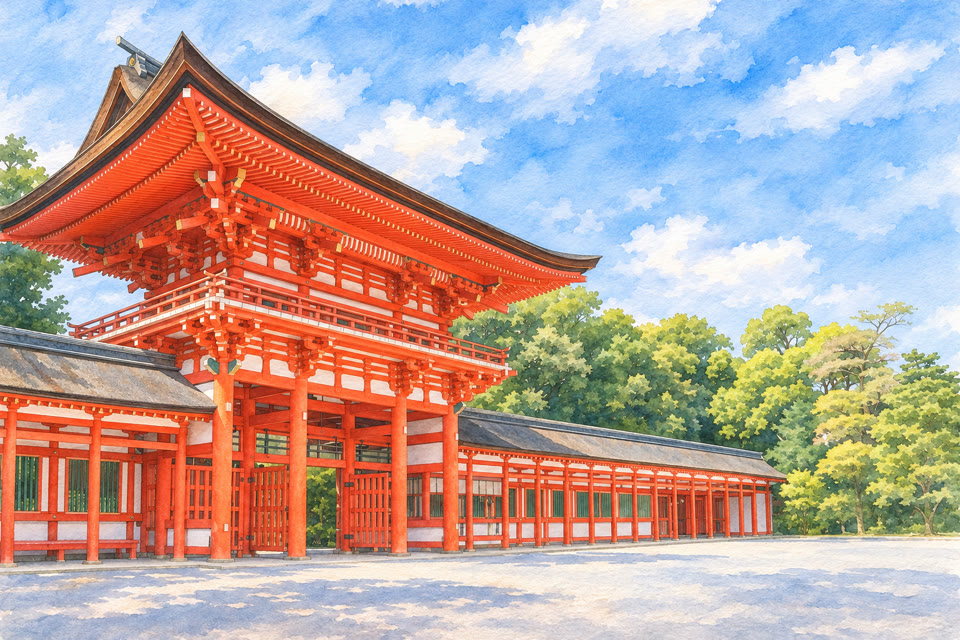
Shimogamo Shrine, formally Kamo Mioya Jinja, stands in Sakyō Ward, Kyoto, on the triangle of land just north of where the Kamo and Takano rivers meet. Together with Kamigamo Shrine (Kamo Wakeikazuchi Jinja) to the north, it forms the Kamo Shrines, which are older than Kyoto itself. From the Heian period on they ranked among the most important protectors of the capital, and Shimogamo was honored as the first shrine of Yamashiro Province. The Aoi Festival processes here every May, and the shrine’s approach runs through Tadasu no Mori, a remnant of the ancient forest that once covered the valley floor.
01The shrine of the Kamo clan
Shimogamo enshrines Tamayorihime and her father, Kamo Taketsunumi. According to the shrine’s legend, Tamayorihime found a red-lacquered arrow floating down the river, became pregnant, and gave birth to Kamo Wakeikazuchi, the deity of Kamigamo. That is why Shimogamo is called "mioya," the shrine of the ancestors. Both shrines were served by the Kamo clan, a powerful local family settled in the northern part of the basin well before the court arrived. After the capital moved to Heian-kyō in 794, the Kamo Shrines rose quickly in court favor. Records say that from 810, in the reign of Emperor Saga, an unmarried imperial princess was appointed as saiin, a priestess dedicated to the Kamo deities, a practice that lasted into the early Kamakura period; the last saiin stepped down in 1212. Kamo no Chōmei, author of the Hōjōki, was born into Shimogamo’s priestly family and hoped, without success, to inherit the priestly post at its subsidiary Kawai Shrine.
02The Aoi Festival and periodic renewal
The Aoi Festival, properly the Kamo Festival, is traditionally said to have begun in the sixth century under Emperor Kinmei as a rite to end a series of disasters. In the Heian period it became a great court ceremony; when courtiers spoke simply of "the festival," this was the one they meant. Participants and ox-carts are decorated with leaves of aoi (wild ginger), which gives the festival its popular name. Today, on May 15, a procession in Heian court dress leaves the Kyoto Imperial Palace, stops at Shimogamo, and continues to Kamigamo. The shrine also keeps up shikinen sengū, a cycle of renovating its buildings every 21 years. In the most recent round, the 34th, the deities were returned to the renewed sanctuaries in 2015, and the associated rebuilding was finished in 2024 (as of 2026).
03What can be seen today
The two main sanctuaries, east and west, were rebuilt in 1863 at the end of the Edo period in the nagare-zukuri style, with a long sweeping roof over the front. Both are National Treasures, and many other buildings, including the two-story gate and the dance pavilion, are Important Cultural Properties. Tadasu no Mori covers about 12 hectares of mostly broadleaf trees such as zelkova and hackberry and is designated a Historic Site as part of the shrine precinct. In 1994 the shrine was inscribed as part of the World Heritage Site "Historic Monuments of Ancient Kyoto." Within the grounds, Kawai Shrine also honors Tamayorihime. A summer purification rite at the Mitarashi pond is generally regarded as the source of the name of mitarashi dango, the sweet-glazed rice dumplings.