
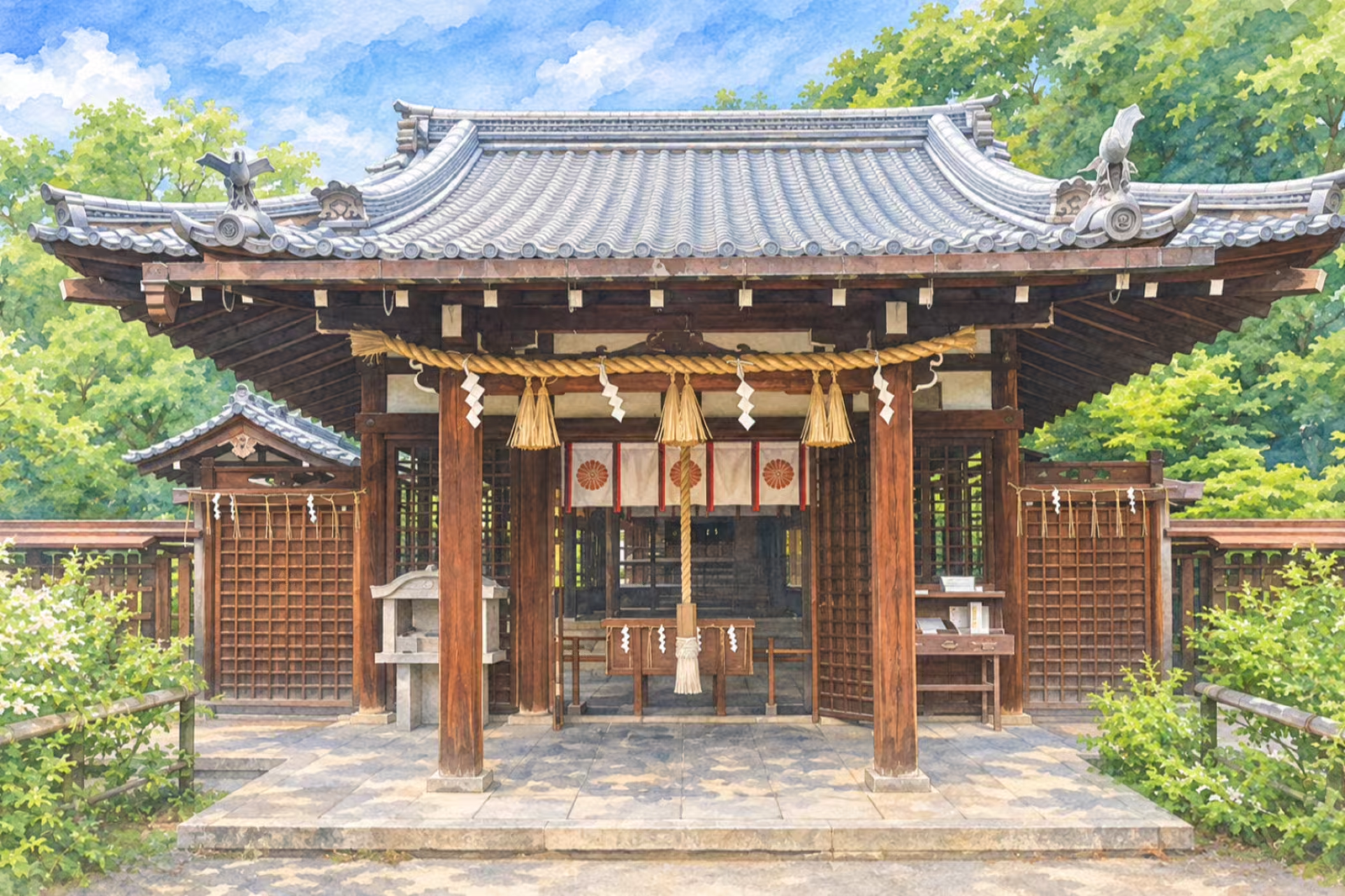
Shin-Kumano Shrine stands in the Imakumano district of Higashiyama Ward, Kyoto. Its name is written with characters meaning "new Kumano" but read Imakumano. Founded by the retired emperor Go-Shirakawa in 1160, it brought the deities of the Three Grand Shrines of Kumano on the Kii Peninsula into the capital. The precinct is small, yet it connects three stories: Go-Shirakawa’s rule as retired emperor, a Kumano-style sanctuary rebuilt in the early Edo period, and the sarugaku performance through which Kan’ami and his son Zeami won the patronage of the shogun Ashikaga Yoshimitsu.
01Go-Shirakawa and a Kumano in Kyoto
Go-Shirakawa made the long pilgrimage to Kumano more often than any other retired emperor, by one count more than thirty times. In 1160 (Eiryaku 1) he established Shin-Kumano near his palace complex, Hōjūji-dono, as its guardian shrine; the Buddhist hall of the same complex, Rengeō-in, survives as today’s Sanjūsangen-dō. Tradition holds that Taira no Kiyomori oversaw the construction and that earth, timber and stone were brought from Kumano for the site. In the usage of the time, "new" was read as ima, so the name meant a newly established Kumano in the capital.
02Decline and rebuilding
Hōjūji-dono was burned when Kiso Yoshinaka’s forces attacked it in 1183, and the shrine later declined through the Ōnin War and the fighting that followed. Its revival came in the early Edo period under Prince Dōkan, a son of the retired emperor Go-Mizunoo and abbot of Shōgo-in. The present main sanctuary was rebuilt in 1673 in the Kumano-zukuri style characteristic of Kumano shrines, rare in Kyoto, and is designated a Tangible Cultural Property of Kyoto Prefecture.
03What can be seen today
At the entrance stands a huge camphor tree known as the Yōgō no Ōkusu, the tree where the deity manifests. It is said to have been transplanted from Kumano when Go-Shirakawa founded the shrine, and it is designated a Natural Monument by Kyoto City. The precinct also has a stone monument to the Imakumano sarugaku performance. In 1374 (some accounts say 1375), Kan’ami and the young Zeami, then 11 (12 by traditional count), performed here before the teenage shogun Yoshimitsu, who afterward became the patron of their troupe; with that support Noh went on to reach its mature form. Behind the main sanctuary, a group of small shrines represents the pilgrimage routes of Kumano in miniature.