
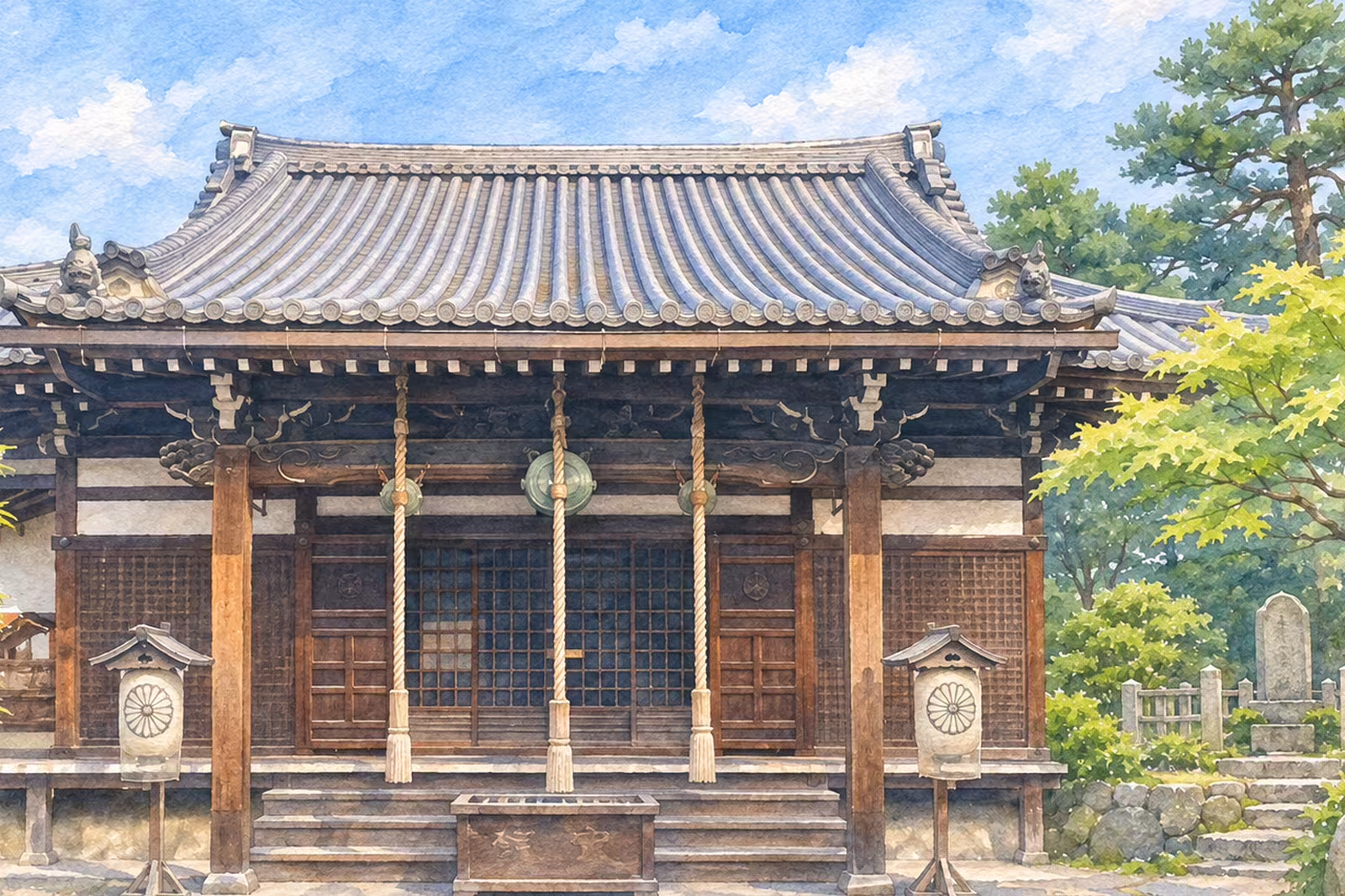
Rozan-ji stands on Teramachi-dōri in Kamigyō Ward, Kyoto, just east of the Kyoto Imperial Palace grounds. It is generally held to occupy the site of the residence of Fujiwara no Kanesuke, great-grandfather of Murasaki Shikibu, where she grew up, married and wrote The Tale of Genji. A few kilometers to the northwest, near Horikawa-Kitaōji in Kita Ward, is a mound traditionally identified as her grave. Together the two places are the most direct memorials in Kyoto to the Heian author.
01The temple’s history
Rozan-ji’s origins are traced to 938, when the Tendai monk Ryōgen (known as Ganzan Daishi) founded a temple near Funaokayama on the northern edge of the capital; it later took the name Rozan-ji. The temple rose and declined several times and suffered in the Ōnin War. In the late sixteenth century, when Toyotomi Hideyoshi reorganized Kyoto, it was moved to its present site. The Great Tenmei Fire of 1788 destroyed it, and the present Main Hall and other buildings were rebuilt afterward. The temple is now head temple of the Enjō school. In other words, Rozan-ji did not stand here in Murasaki Shikibu’s lifetime.
02Murasaki Shikibu’s home
Fujiwara no Kanesuke was known as the Tsutsumi Chūnagon, and his residence was called the Tsutsumi-tei because it lay near the embankment (tsutsumi) of the Kamo River. It later passed to Murasaki’s father, Fujiwara no Tametoki. In 1965 the historian Tsunoda Bun’ei argued that the residence had stood on the Rozan-ji grounds. A marker was set up in the temple, and the Genji Garden was created at the same time. It is a modern dry garden of white sand and moss, planted with Chinese bellflowers that bloom in summer, and it is now the temple’s most popular sight, but it is not a Heian garden. Nothing of the Heian house itself survives.
03The grave
The grave lies in a small plot beside Horikawa-dōri, next to that of Ono no Takamura, an early Heian official and poet. Kakaishō, a fourteenth-century commentary on The Tale of Genji, already places Murasaki’s grave here, so the tradition is at least six centuries old. A popular legend holds that Takamura pleaded on her behalf in the underworld. The identification of the grave rests on tradition and has not been confirmed by archaeology.