
At a glance
What Murasaki Shikibu’s long court tale is about, why it endures, and how it was copied, translated, painted in twelfth-century scrolls and printed in Edo.
- A long tale in fifty-four chapters, written in the early eleventh century by Murasaki Shikibu, a lady-in-waiting at court.
- It has more than 400 characters, spans about seventy years, and contains 795 waka by the usual count.
- A remark in Murasaki Shikibu’s diary for 1008, "Is Young Murasaki here?", is the key clue to when it was written.
- Nineteen paintings survive from the twelfth-century Genji scrolls, a National Treasure: fifteen at the Tokugawa Art Museum, four at the Gotoh Museum.
- The Eiri Genji, with an afterword dated 1650, printed all fifty-four chapters with pictures; the National Diet Library copy can be read free online.
Some time around the year 1000, a widowed lady-in-waiting at the Japanese court began writing a story about a prince so beautiful that people called him "the Shining One." She kept going until it ran to fifty-four chapters, followed four generations of emperors, and ended, without quite ending, on the banks of a cold river south of Kyoto. The Tale of Genji is often called the world’s first novel, a claim that is debatable and not very interesting. What matters more is that Japanese poets, painters, playwrights, perfumers, and, in our own time, manga artists and television writers have been returning to it for a millennium. This introduction explains who wrote it, what happens in it, and why readers still care, and then follows the book off the page: into a twelfth-century set of illustrated scrolls, into a woodblock edition from the 1650s that you can leaf through online today, and out to the temples and museums in Kyoto, Uji, Nagoya, and Tokyo where the tale still lives.
01What Kind of Book It Is
Genji monogatari (monogatari means "tale" or "story") is written in Japanese, in the flowing kana syllabary that court women used, rather than the classical Chinese that men used for official business. It is long: a full English translation runs well over a thousand pages. Its fifty-four chapters each carry an evocative title, often taken from a poem or image in that chapter: "The Paulownia Pavilion," "Young Murasaki," "Suma," "The Bell Cricket," "A Drifting Boat," "The Floating Bridge of Dreams." Several hundred characters pass through it. Woven into the prose are nearly eight hundred waka (795 by the usual count), short poems of thirty-one syllables, which characters exchange in place of saying what they mean outright.
We know the book was circulating at court by late 1008 because its author says so, more or less. Her diary records a banquet held on the first day of the eleventh month of that year, at Michinaga’s mansion, to celebrate the fiftieth day of a newborn prince. A tipsy courtier, Fujiwara no Kintō, poked his head into the area where the ladies-in-waiting sat and asked whether "young Murasaki" was there, a joke that only works if people already knew the heroine. On the strength of that entry, Japan celebrated the tale’s millennium in 2008 and later made November 1 "Classics Day."
Readers usually divide the book into three parts. The first follows Genji from birth to the height of his power, in a world of brilliant color and romantic adventure. The second covers his later years, when the consequences of his choices come home. The third, thirteen chapters set after his death, moves to the village of Uji and centers on two young men of the next generation; its final ten chapters are known as the Uji chapters. The tone darkens steadily from start to finish, so that the last section reads almost like a different, quieter book.
02Murasaki Shikibu and Her World
We do not know the author’s real name. "Murasaki Shikibu" is a nickname: "Shikibu" comes from a post in the Ministry of Ceremonial held by her father, Fujiwara no Tametoki, and "Murasaki," most likely, from her own heroine. She was born in the 970s, give or take a few years. Her father was a scholar of Chinese literature from the middle ranks of the aristocracy, and she recalls in her diary that when he tutored her brother in the Chinese classics (later commentators usually say it was the Shiji, the Records of the Grand Historian), she picked them up faster than the boy did. Her father’s response was to lament that she had not been born a son.
As a young woman, in 996, she accompanied her father to his provincial post in Echizen, in present-day Fukui Prefecture, then returned to the capital and married a much older man, Fujiwara no Nobutaka. They had a daughter. Within a few years he was dead, probably in an epidemic, and it is generally thought that she began writing the tale during her widowhood. Her reputation as a writer seems to have been what brought her to court around 1005 or 1006, as a lady-in-waiting to Empress Shōshi, consort of Emperor Ichijō.
Shōshi’s father was Fujiwara no Michinaga, the most powerful man in Japan. The Fujiwara ruled by marrying their daughters to emperors and serving as regents for their grandsons, so an empress’s household was also a political machine. Talented women made it glamorous and drew the emperor to it. A rival household, that of Ichijō’s earlier empress Teishi, had employed Sei Shōnagon, author of The Pillow Book. The two writers were not at court at the same time, but Murasaki’s diary contains a famously sharp passage dismissing Sei Shōnagon as a show-off whose learning was thin. Readers ever since have paired them: The Pillow Book quick, witty, and fragmentary; Genji long, inward, and slow.
To read Genji well, it helps to picture how Heian aristocrats lived. They occupied sprawling mansions in a style called shinden-zukuri, with pavilions linked by corridors and set around a garden pond. Interiors were open spaces divided by blinds, curtains, and folding screens. Well-born women stayed behind these screens and rarely showed their faces, even to men they were talking to. Courtship usually began on paper. A man who heard of an attractive woman sent her a poem, written on paper chosen to suit the season and often tied to a spray of blossoms; her reply, its wit, and her handwriting decided whether he would visit her some night. Much of the tension in Genji depends on this etiquette: a reply that arrives a day late, a poem with the wrong allusion, a glimpse of a sleeve beneath a blind.
03The Story
The opening line sets the tone: "In a certain reign, whose was it?" An emperor dotes on a consort of modest rank, the Kiritsubo Intimate, and the jealousy of the other women at court wears her down until she dies, leaving a small son of extraordinary beauty. Because the boy has no powerful maternal relatives to protect him, the emperor removes him from the line of succession and makes him a commoner with the surname Minamoto, written with the character read Gen. So he becomes Genji, "the Genji," and for his looks people call him Hikaru, Shining.
A thread runs through Genji’s whole emotional life: he is always looking for his lost mother. His father takes a new consort, Fujitsubo, who closely resembles the dead woman, and the boy falls for his stepmother. As a young man he seduces her, and she bears a son whom everyone takes to be the emperor’s. That child later becomes Emperor Reizei. The secret weighs on Genji and Fujitsubo for the rest of their lives and is the hidden spring of the first part of the book.
While recovering from an illness at a mountain temple north of the capital, Genji peers through a brushwood fence and sees a girl of about ten crying because someone has let her pet sparrow go. She is Fujitsubo’s niece and looks like her. Genji takes her into his household, raises her, and eventually marries her. She is Murasaki, the woman readers love most, and the central figure of his life.
Around them circle many other women, each drawn sharply. His first wife, Aoi, is formal and cool. The proud, older Lady Rokujō is so consumed by jealousy that her spirit leaves her body without her knowledge and kills Aoi in childbirth, an episode later turned into the Noh play Aoi no Ue. The gentle Yūgao dies in Genji’s arms in a desolate villa, apparently taken by a malign presence. Suetsumuhana, a princess with a red-tipped nose and no social graces, becomes a figure of comedy, though Genji loyally supports her for years. And the Akashi Lady, whom he meets by the sea, bears him a daughter who will one day be empress.
In his mid-twenties Genji’s affair with Oborozukiyo, a young woman promised to the emperor and the daughter of his political enemies, is exposed, and he withdraws into exile on the lonely coast at Suma. The Suma and Akashi chapters, with their storms, sea wind, and homesick poems, are among the most admired in the book. He returns to the capital, rises to the highest office, and builds the Rokujō estate, a vast compound divided into four quarters for the four seasons, each home to one of the women in his life. Murasaki lives in the spring quarter. It is the high point of his worldly splendor.
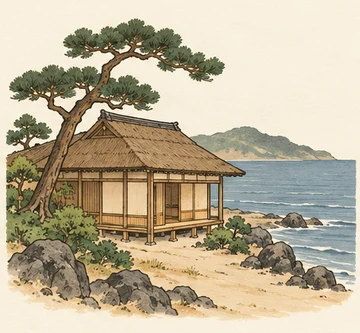
The shore at Suma where Genji withdrew; sea wind and storms color these chapters (illustration).
The second part turns that splendor sour. Around forty, Genji agrees at his elder brother’s request to marry the young Third Princess, whose rank makes her his principal wife and quietly displaces Murasaki. The princess is seduced by a young man named Kashiwagi and bears a son, Kaoru. Holding the baby, Genji realizes he is living through what he once did to his own father, and he can say nothing. Kashiwagi dies of guilt. Murasaki, who has asked repeatedly to become a nun and been refused, falls ill and dies one autumn. In the chapter "The Seer," Genji passes through a year of seasons remembering her, and then prepares to leave the world. The next chapter, "Vanished into the Clouds," exists only as a title, with no text, and is usually read as marking his death.
Part one: Fujitsubo and Genji
- Fujitsubo, the emperor’s new consort
- Genji seduces his stepmother
- She bears a son
- Taken to be the emperor’s; later Emperor Reizei
Part two: the Third Princess and Kashiwagi
- The Third Princess, Genji’s principal wife
- Kashiwagi seduces her
- She bears a son
- The boy is Kaoru; Genji can say nothing
Holding Kaoru, Genji realizes he is living through what he once did to his own father.
The Uji chapters belong to Kaoru, who suspects the truth of his birth and is drawn to Buddhism, and to his friend and rival Niou, Genji’s grandson, charming and careless. In the hills at Uji, Kaoru befriends a reclusive prince and falls in love with his eldest daughter, Ōigimi, who refuses to marry and wastes away. Later a half-sister who resembles her appears: Ukifune. Both men pursue her. Caught between them, she tries to drown herself in the Uji River, is found alive by a Buddhist priest, and takes the tonsure. In the last chapter, Kaoru sends her younger brother with a message. She will not acknowledge him. The book stops there.
04Why People Love It
First-time readers are often unsettled by the plot. A prince sleeps with his stepmother, takes a ten-year-old girl home to raise as his future wife, and pursues women relentlessly. Japanese readers discuss this openly too, and it would be strange not to. But the book does not celebrate Genji’s behavior so much as trace what it costs everyone around him. Murasaki is adored for decades and never secure. When she asks to take religious vows, Genji will not let her go, and she spends her last years in the most beautiful house in the capital, wearing herself out. The suffering of the women in Genji is written with remarkable restraint and precision, and it accumulates.
In the eighteenth century the scholar Motoori Norinaga, after a lifetime of reading the tale, argued that its essence was neither moral instruction nor Buddhist teaching about karma but mono no aware, roughly "the pathos of things": the feeling that rises unbidden when you see blossoms fall, hear autumn insects, or remember someone who has died. His phrase became one of the most quoted keys to Japanese aesthetics, and it is a fair description of what Genji does to a reader.
The book is also a manual of how to feel the seasons. Emotions are always set against flowers, moonlight, the color of a robe, the sound of rain. After Murasaki’s death, Genji’s grief is measured by the plum blossoms she will not see, the cuckoo she will not hear, the fireflies of a summer evening. Much of the seasonal awareness that runs through Japanese life, from the seasonal greeting that opens a letter to sweets and kimono patterns matched to the month, can be traced back through later poetry to this book.
The style is demanding. Sentences are long, subjects are usually left unstated, and the level of honorific language is often the only clue to who is acting. A narrator occasionally steps in with an aside, as if a lady-in-waiting were passing on gossip. Modern Japanese readers cannot read the original without training. High school students study a few passages in classical Japanese class; most people know the story through modern translations, manga, or television.
05How It Survived a Thousand Years
Murasaki’s own manuscript is long gone, and the oldest surviving copies date from about two centuries after she wrote. Most modern texts descend from an edition prepared in the early thirteenth century by the poet Fujiwara no Teika, called the Aobyōshi-bon or "blue-cover text" after the color of its covers. A rival line, the Kawachi-bon, was edited at about the same time by Minamoto no Mitsuyuki and his son Chikayuki. The standard modern editions mostly rest on the Ōshima manuscript, considered the closest surviving copy to Teika’s text. In 2019 a volume of "Young Murasaki" from Teika’s own edition turned up in the possession of a former daimyo family, and it made national news.
Readers were devoted from the start. A few decades after the tale was written, the girl now known as the Daughter of Takasue recorded in her Sarashina Diary how she longed to read the whole thing and finally received fifty-odd chapters in a box from an aunt. She shut herself behind her curtains and read them one after another, and wrote that she would not have traded the experience to be empress. By the medieval period the tale was required knowledge for poets, who were expected to recognize its scenes and phrases, and scholars wrote commentary after commentary.
In the twentieth century almost every generation has produced its own modern Japanese version. The poet Yosano Akiko published two versions, in 1912 and 1938, the second a complete translation. The novelist Tanizaki Jun’ichirō published three versions over nearly three decades. Enchi Fumiko, Setouchi Jakuchō, and more recently Kakuta Mitsuyo followed. Yamato Waki’s manga Asaki yumemishi, begun in 1979, introduced the story to millions of schoolgirls. In 2024 the public broadcaster NHK made Murasaki Shikibu the heroine of its year-long historical drama, Hikaru kimi e (Dear Radiance), which sent fresh crowds to the places associated with her.
In English, Arthur Waley’s free and elegant translation appeared in six volumes between 1925 and 1933 and put Genji on the map of world literature; Virginia Woolf reviewed the first volume. Edward Seidensticker’s leaner, more faithful version followed in 1976, Royall Tyler’s richly annotated translation in 2001, and Dennis Washburn’s in 2015. For a first read, Tyler is the most accurate guide to the texture of the original, Seidensticker the easiest to get through, and Waley the most pleasurable as English prose, though he cut and embroidered freely.
06Words and Pictures: The Twelfth-Century Scrolls
About a century after the tale was written, in the first half of the twelfth century, someone at court commissioned a set of handscrolls illustrating it. Each scene was paired with a passage of the text, written out in fine calligraphy on decorated paper. A reader unrolled the scroll from right to left, read a passage, then reached the painting, then the next passage. These are the Genji monogatari emaki, the Illustrated Handscrolls of the Tale of Genji, a National Treasure and the oldest surviving Genji paintings.
The original set was almost certainly much larger; one estimate puts it at about ten scrolls with eighty or ninety scenes. What survives is nineteen paintings with their text, covering twelve chapters, divided between two museums: fifteen scenes at the Tokugawa Art Museum in Nagoya and four at the Gotoh Museum in Tokyo, with some further fragments elsewhere. In the Edo period the two groups belonged to the Owari Tokugawa and the Hachisuka daimyo families, and they reached their present homes in the twentieth century. The Tokugawa scenes include episodes from the chapters "The Wormwood Patch," "At the Pass," "The Oak Tree" (Kashiwagi), "The Flute," "Bamboo River," "The Maiden of the Bridge," "Early Ferns," "The Ivy," and "The Eastern Cottage"; the Gotoh holds two scenes from "The Bell Cricket," one from "Evening Mist," and one from "The Law." Paper and pigment this old are fragile, and the originals go on view only briefly each year, a few scenes at a time.
Two conventions give the scrolls their look. The first is fukinuki yatai, "blown-off roof": the painter removes roofs and ceilings and shows interiors from a high, oblique angle. Heian life took place behind screens and blinds; the device lets the viewer see what no one inside could. The second is hikime kagibana, "line for an eye, hook for a nose." Faces are nearly identical: a slit for each eye, a tiny hook for the nose, a dot of red for the mouth. This is a deliberate choice, not a lack of skill. Emotion is carried instead by posture, by the color and spread of layered robes, by the diagonals of beams and blinds that cut across the scene, and above all by the text that came just before.
Take the most famous scene, from the chapter "The Oak Tree." Genji sits holding the infant Kaoru at the baby’s fiftieth-day celebration, his head bowed, surrounded by heaps of brilliantly colored silk. On its own, the painting shows a ceremonial moment with a proud grandfatherly figure. Read the passage first, and you know he is holding his wife’s child by another man, and thinking of the child he himself fathered with his father’s consort. The calm surface of the painting and the turmoil in the text complete each other. Art historians have long noted how the compositions tilt and crowd when the characters are troubled, so that the architecture itself seems uneasy.
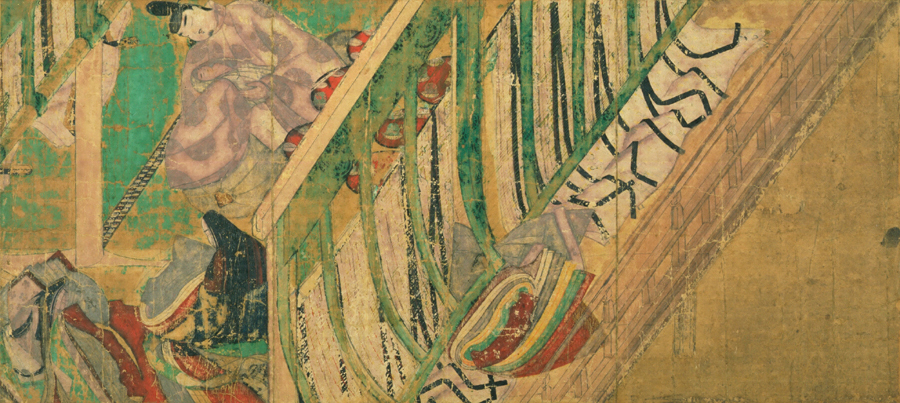
From the Tale of Genji scroll, "Kashiwagi": Genji holds the infant Kaoru, the room cut by steep diagonals.
You may already own a piece of this scroll without knowing it. The ¥2,000 note, issued in 2000, reproduces on its back a scene from "The Bell Cricket," in which Genji and the retired emperor Reizei sit facing each other under the autumn moon while young courtiers play flute and mouth organ on the veranda, along with a strip of the calligraphy and a portrait of Murasaki Shikibu taken from a scroll illustrating her diary. Both scrolls belong to the Gotoh Museum. As of 2026, no ¥2,000 notes have been printed since 2004, and you will rarely be handed one, but they remain legal tender.
After the scrolls, Genji painting became a genre of its own. Painters of the Tosa school produced albums with one small, jewel-like painting for each chapter, paired with calligraphy, which became prized items in the trousseaux of daimyo daughters. Folding screens with Genji scenes were made by Kanō painters and by Tawaraya Sōtatsu, whose 1631 screens of the "At the Pass" and "Channel Buoys" chapters, now at the Seikadō Bunko Art Museum in Tokyo, are a National Treasure; Genji himself never appears in them, only an ox carriage and a boat that announce him. Incense connoisseurs invented Genji-kō, a game in which players smell five samples in turn and decide which are the same. Answers are drawn as five vertical lines, with horizontal bars joining those judged alike; there are fifty-two possible patterns, each named for a chapter, leaving out only the first and last. Those little diagrams still appear on kimono fabric, sweets packaging, and temple souvenirs.
07The Tale in Print: The Eiri Genji of 1650
Scrolls and albums belonged to aristocrats and daimyo. What put Genji in the hands of ordinary readers was commercial woodblock printing, which flourished in Kyoto in the seventeenth century as publishers discovered there was a market for the classics. The landmark was the Eiri Genji monogatari, the "Illustrated Tale of Genji," edited by Yamamoto Shunshō, one of the leading maki-e lacquer artists of Kyoto, said to have been versed in waka as well, who also drew its pictures.
Shunshō’s afterword is dated to the winter of Keian 3, or 1650, and the edition is known as the Keian edition, though some scholars think it actually came off the press a few years later, in the Jōō era (1652–1655). He wrote that he added pictures so that women and children could read it too. It printed the complete text of all fifty-four chapters, sixty slim volumes in all with the supplements, and illustrated nearly every chapter, with 226 pictures by one scholar’s count. The pictures are simple black-line drawings designed to be carved and printed: blown-off roofs, figures behind blinds, garden plants, carriages. They draw on the earlier painting tradition but strip it down. The set also included aids for the reader: chapter summaries, genealogical charts to keep the huge cast straight, notes identifying the older poems the characters quote, and Yamaji no tsuyu, an early sequel.
Its importance is that it turned a manuscript treasure into a book you could buy. From then on, Genji belonged to townspeople as well as courtiers. Digests, simplified retellings, and parodies followed. The most successful, Ryūtei Tanehiko’s A Rustic Genji by a Fraudulent Murasaki, transposed the story to the fifteenth-century shogunal court and came with illustrations by the ukiyo-e artist Utagawa Kunisada; it ran to thirty-eight installments from 1829 and was a bestseller until the authorities banned it during the Tenpō Reforms, leaving it unfinished. The Eiri Genji itself was recut and reissued, including a horizontal-format edition in 1660, and copies are held by libraries across Japan.
The National Diet Library in Tokyo holds a copy and has digitized it in full, so anyone can page through it free on the library’s online Digital Collections. It is worth doing. Each volume opens with a title slip; inside, dense lines of cursive kana fill the pages, and every few pages a half- or full-page picture appears. In "Young Murasaki," you find Genji peering through the brushwood fence at the old nun and the little girl, the scene Genji painters have returned to more than almost any other. Even if you cannot read a word of the script, the pictures let you find your place in the story. That was their job in 1650, too. They were signposts.
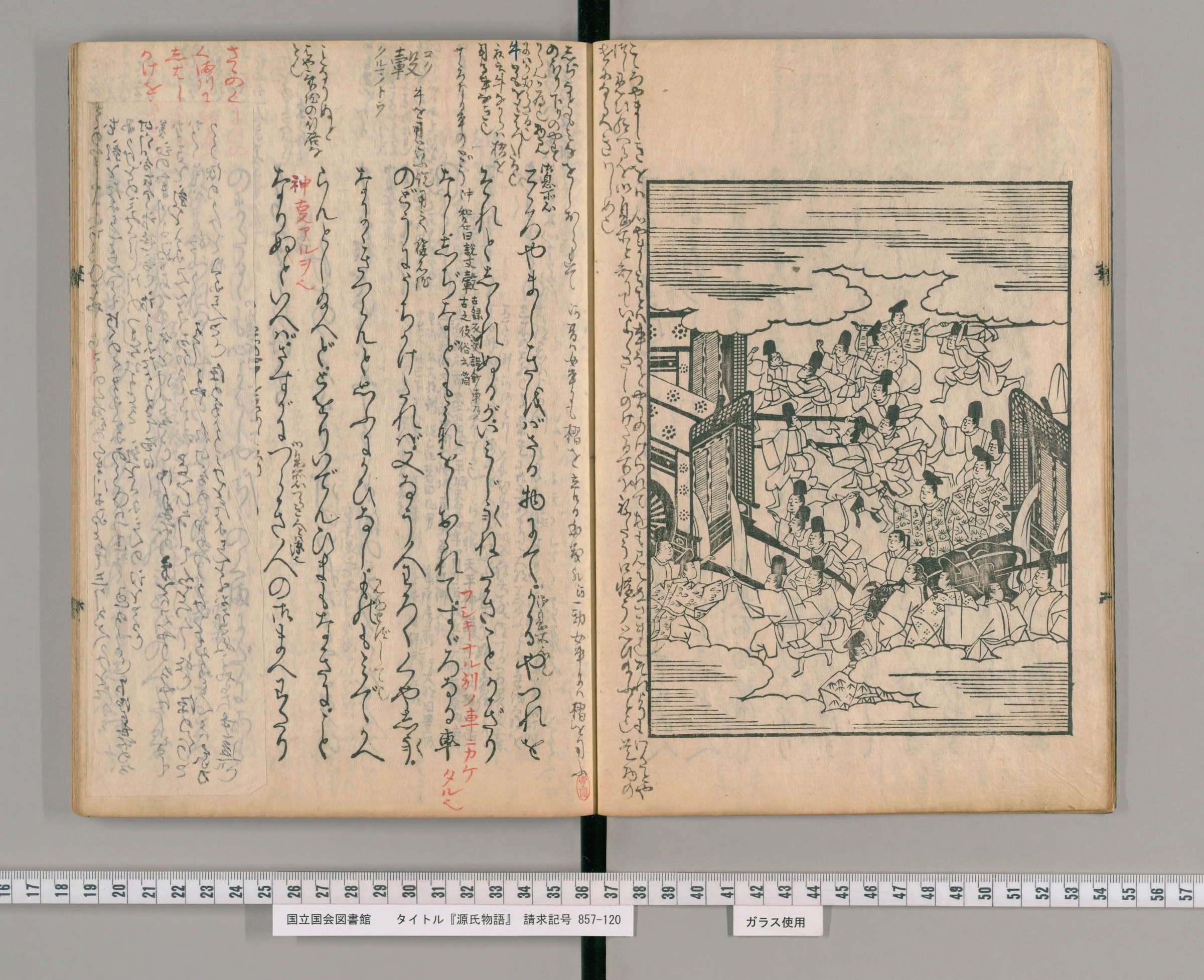
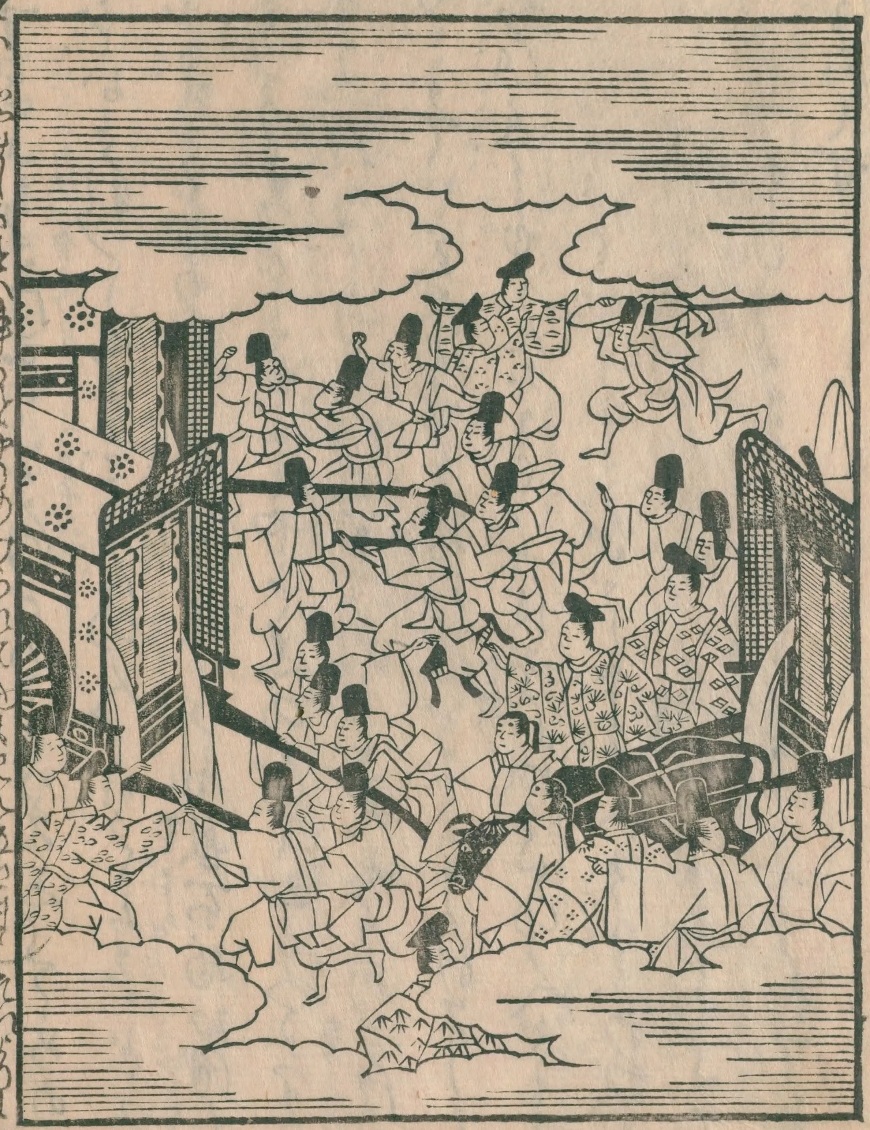
An opening of the National Diet Library copy: cursive kana text on the left, an "Aoi" illustration on the right.
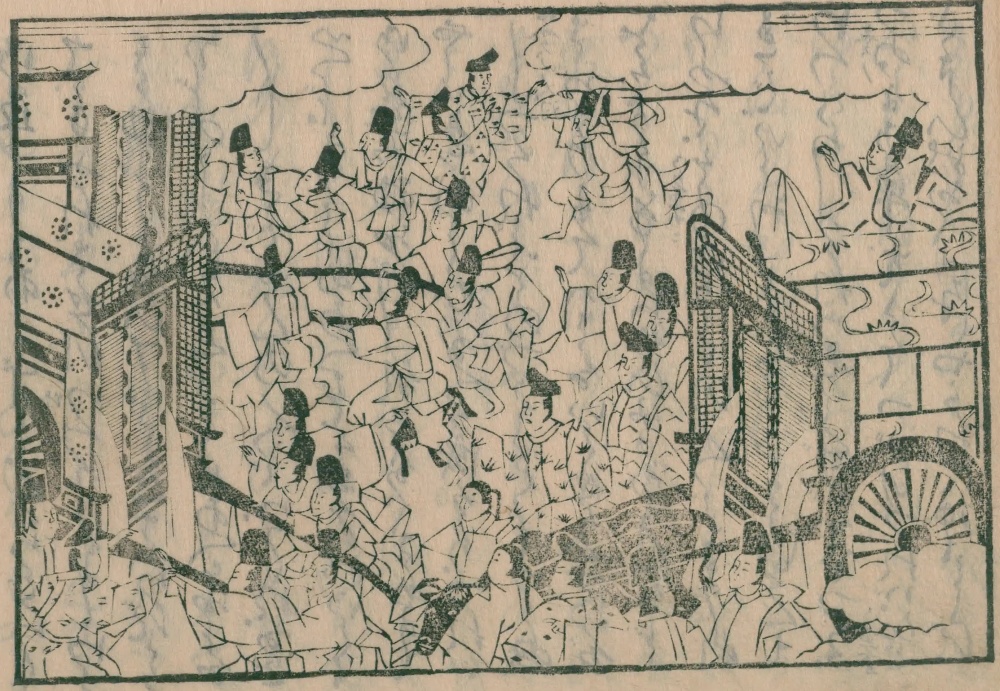
The same scene in the horizontal-format edition of 1660, spread out sideways.
National Diet Library, The Tale of Genji (Eiri Genji monogatari, call no. 857-120); also its 1660 oblong edition of The Tale of Genji
Comparing the print edition with the twelfth-century scrolls shows how differently the same story could be seen. The scrolls are lavishly colored, few in number, and choose the moments of greatest emotional complexity; each one is a work of art to be contemplated slowly by a small circle. Shunshō’s illustrations are monochrome, numerous, nearly one or more for every chapter, and choose the most recognizable episodes, the way illustrations in a modern novel do. One was made for connoisseurs; the other was made so that many more people could get through a very long book.
08Finding Genji in Japan Today
Kyoto is the place to start. Rozan-ji, a small temple in the city’s Kamigyō ward, stands on what is believed to be the site of Murasaki Shikibu’s family residence. Its "Genji garden" of white gravel and moss is planted with Chinese bellflowers that bloom violet in summer. The Aoi Festival, held in May by the Kamigamo and Shimogamo shrines, was known in Heian times as the Kamo Festival. In the chapter "Heart-to-Heart," it is at the purification procession held just before the festival that Aoi’s attendants shove Lady Rokujō’s carriage out of its viewing place, a public humiliation that sets her vengeful spirit loose.
Uji, the setting of the final chapters, is about half an hour south of central Kyoto by train. A stone statue of Murasaki Shikibu stands near the Uji Bridge, and markers for the different chapters are scattered along the river. The Tale of Genji Museum in Uji uses a full-size ox carriage, models of aristocratic mansions, and short films to recreate the world of the book, and is worth visiting before or after you read it. Stand by the river and listen to the rush of the water, and you understand why the tale makes Uji a place of unease; it is that sound that drives Ukifune to despair. The nearby Byōdō-in, a regent’s villa turned into a temple in 1052, with its Phoenix Hall built the following year, gives a good sense of the kind of country retreat the characters would have known.
On the shore of Lake Biwa in Ōtsu, the temple of Ishiyama-dera preserves a legend that Murasaki Shikibu, in retreat there, looked out at the full moon of the eighth month and conceived the Suma chapters. It is a later tradition rather than history, but the temple keeps a "Genji room" with a figure of her at her desk, and it is especially pleasant in the moon-viewing season.
To see the original scrolls, you need to plan around the museums’ calendars. Both the Tokugawa Art Museum, east of Nagoya Castle, and the Gotoh Museum, in the leafy Kaminoge district of Setagaya in Tokyo, show the originals only for short displays and show reproductions the rest of the time. A showing of both museums’ scenes together is rarer still; the Tokugawa held one for its ninetieth anniversary in 2025. When you do get in front of them, lean close. Look at the colors of the robes stacked at the hems, the diagonal beams that slice across the picture, the tiny hooked noses, and remember what the text said a moment before.
If you cannot get to a museum, the National Diet Library’s digitized Eiri Genji is a gallery that never closes. Pick a chapter, open the illustrations beside a modern translation, and you are reading much as a Kyoto townsman did in the 1650s. You do not have to start at chapter one: many readers begin with "Young Murasaki," the Suma and Akashi chapters, and the Uji chapters, then fill in the rest; others start with a manga or a film. That has been the pattern for a thousand years.
Once you know the tale, you start seeing it everywhere. Murasaki Shikibu has a poem in Hyakunin isshu, the anthology of one hundred poets used for the New Year card game karuta: a friend glimpsed after long absence vanishes as quickly as the moon behind clouds. Kyoto confectioners name autumn sweets after "The Bell Cricket" or "Evening Faces." Kimono shops sell obi printed with Genji-kō patterns. None of this requires you to have read the book. But if you have, it is like recognizing an old acquaintance in a crowd, again and again.