
At a glance
Kawabata Yasunari from orphaned boyhood to the Nobel Prize: what Snow Country and The Izu Dancer do, and where to follow them in Yuzawa and Izu.
- Kawabata Yasunari won the Nobel Prize in Literature in 1968, the first Japanese writer to do so.
- The tunnel in Snow Country’s opening line is real: the Shimizu Tunnel, Japan’s longest when the Jōetsu Line opened in 1931.
- Snow Country appeared in fragments from 1935, came out as a book in 1937, and reached its definitive form only in 1948.
- The Izu Dancer (1926) grew out of a solo walking trip to Izu he made at nineteen.
- Born in Ōsaka in 1899, he lost both parents before he was three and was left an orphan when his grandfather died in 1914.
Kawabata Yasunari was the first Japanese writer to win the Nobel Prize in Literature, and he is still the name most readers abroad meet first when they go looking for Japanese fiction. His novels are short, quiet and strangely unfinished: a man watches a woman’s face reflected in a train window, a geisha practices the shamisen alone in a snowbound inn, an old man hears the mountain rumble in the night. This introduction explains where that sensibility came from, what happens (and does not happen) in Snow Country and The Izu Dancer, why his Nobel lecture still shapes how the world imagines Japan, and where a traveler can walk into his books today.
01Through the Tunnel
Snow Country opens with one of the most quoted sentences in modern Japanese:
国境の長いトンネルを抜けると雪国であった。
Edward Seidensticker’s classic translation reads: "The train came out of the long tunnel into the snow country." It is a fine sentence, but it adds something the Japanese leaves out. The original has no subject. Nobody, grammatically, comes out of the tunnel. It is the train, the passenger Shimamura, and the reader all at once, and the snow country simply arrives. The next line, yoru no soko ga shiroku natta, says literally that "the bottom of the night turned white," as if darkness were a deep bowl with snow glowing at the base.
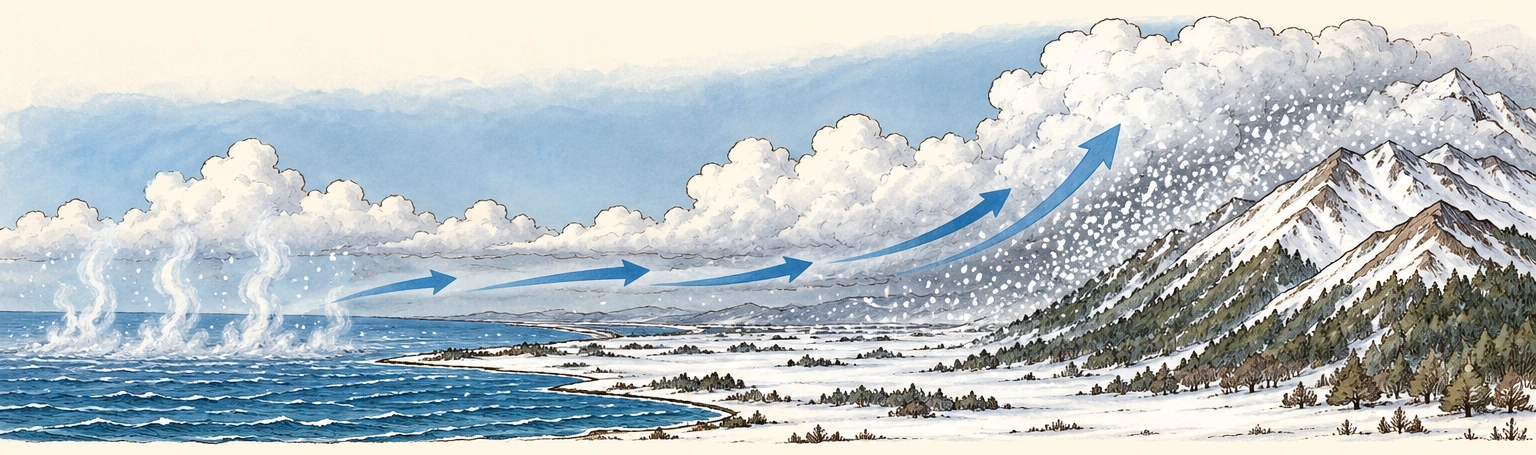
The tunnel was real. When the Jōetsu Line opened in 1931, the Shimizu Tunnel cut through the mountains between Gunma and Niigata, 9.7 kilometers long and at the time the longest railway tunnel in Japan. For the first time, a Tokyo resident could leave the dry, bright winter of the Kantō Plain and, a few hours later, emerge into the deep snow of the Sea of Japan side. Anyone who rides the Jōetsu Shinkansen in January still gets the effect: the train goes into the mountain under a blue sky and comes out into white.
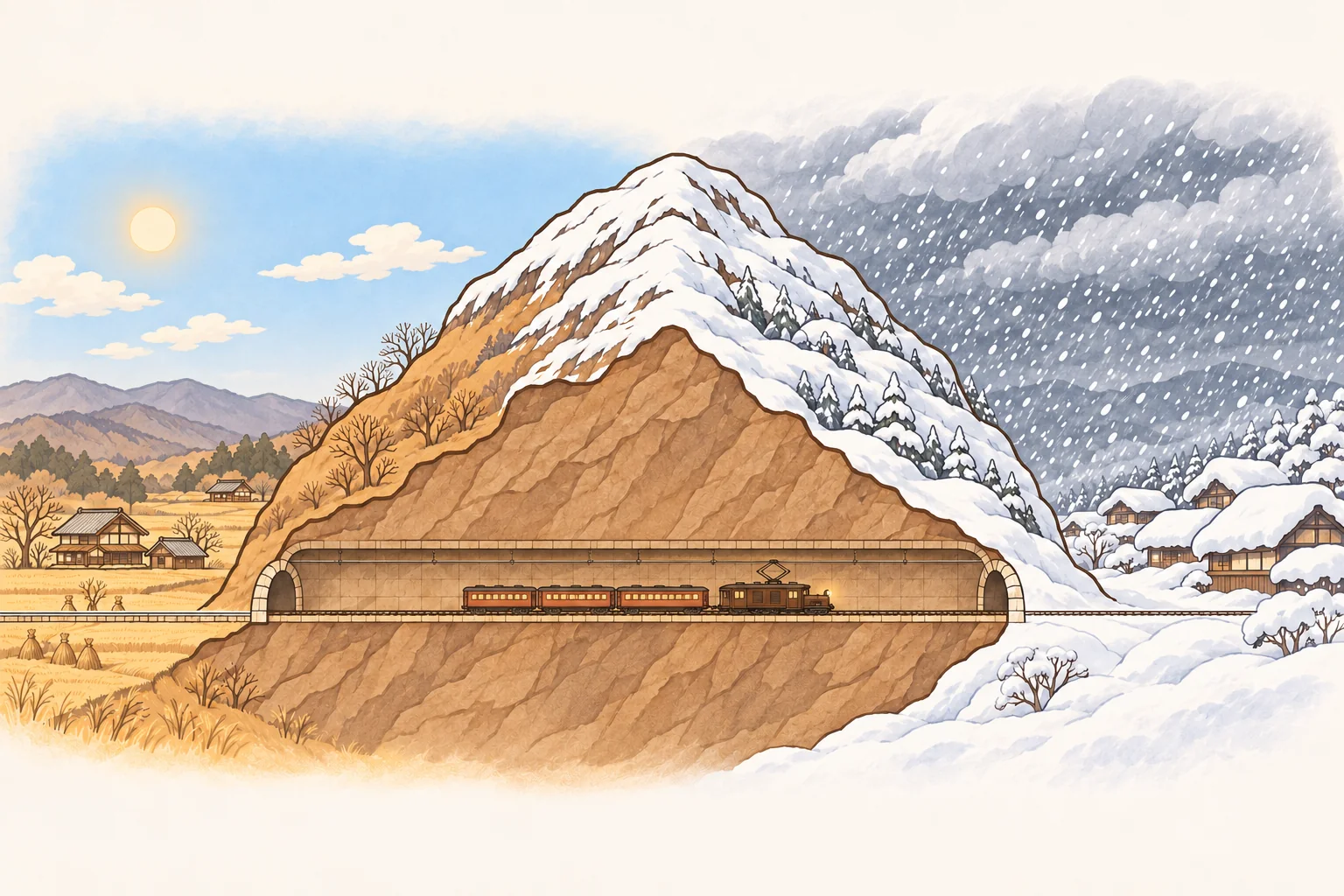
The Shimizu Tunnel links the dry, bright winter of the Kantō Plain with the deep snow of the Sea of Japan side.
- 1Gunmathe dry, bright winter of the Kantō Plain
- 2Shimizu TunnelJōetsu Line, 1931; 9.7 kilometres, then the longest railway tunnel in Japan
- 3Niigatathe deep snow of the Sea of Japan side
The two ends of the tunnel have different weather: the dry, bright Kantō Plain on one side, the deep snow of the Sea of Japan side on the other.
02The Master of Funerals
Kawabata was born in Ōsaka in 1899. His father, a doctor, died in 1901 and his mother the following year, before the boy turned three. He was taken to his grandparents’ house in the countryside north of Ōsaka, in what is now Ibaraki city. His grandmother died the year he started primary school. His only sister, raised separately by relatives, died a few years later. In 1914 his blind, bedridden grandfather died too, and the boy was left with no immediate family at all. He was sent to so many relatives’ funerals that in 1923 he wrote a story whose title, with dry humor, called him a sōshiki no meijin, a "master of funerals."
As a teenager he sat by his grandfather’s bed and wrote down everything: the old man’s complaints, his groans, the indignities of his illness. Those notes were later published as Diary of a Sixteen-Year-Old (the age counted in the traditional way). The two qualities that run through all of Kawabata’s work are already present there: a cool, almost clinical eye, and a loneliness so deep that the coolness reads as a kind of self-protection. Kawabata himself wrote of an "orphan’s disposition" that made him wary and closed off and hungry for simple kindness. Critics have traced to this childhood the distance in his fiction, where men gaze at women and landscapes they cannot or will not reach.
03The Izu Dancer and the New Sensationalists
In 1917 Kawabata entered the elite First Higher School in Tokyo. The next autumn, at nineteen, he went walking alone on the Izu Peninsula and fell in with a troupe of traveling entertainers, among them a girl dancer of about fourteen. He walked with them for several days, over the Amagi Pass and down to the port of Shimoda. Years later this became The Izu Dancer (Izu no odoriko), published in 1926.
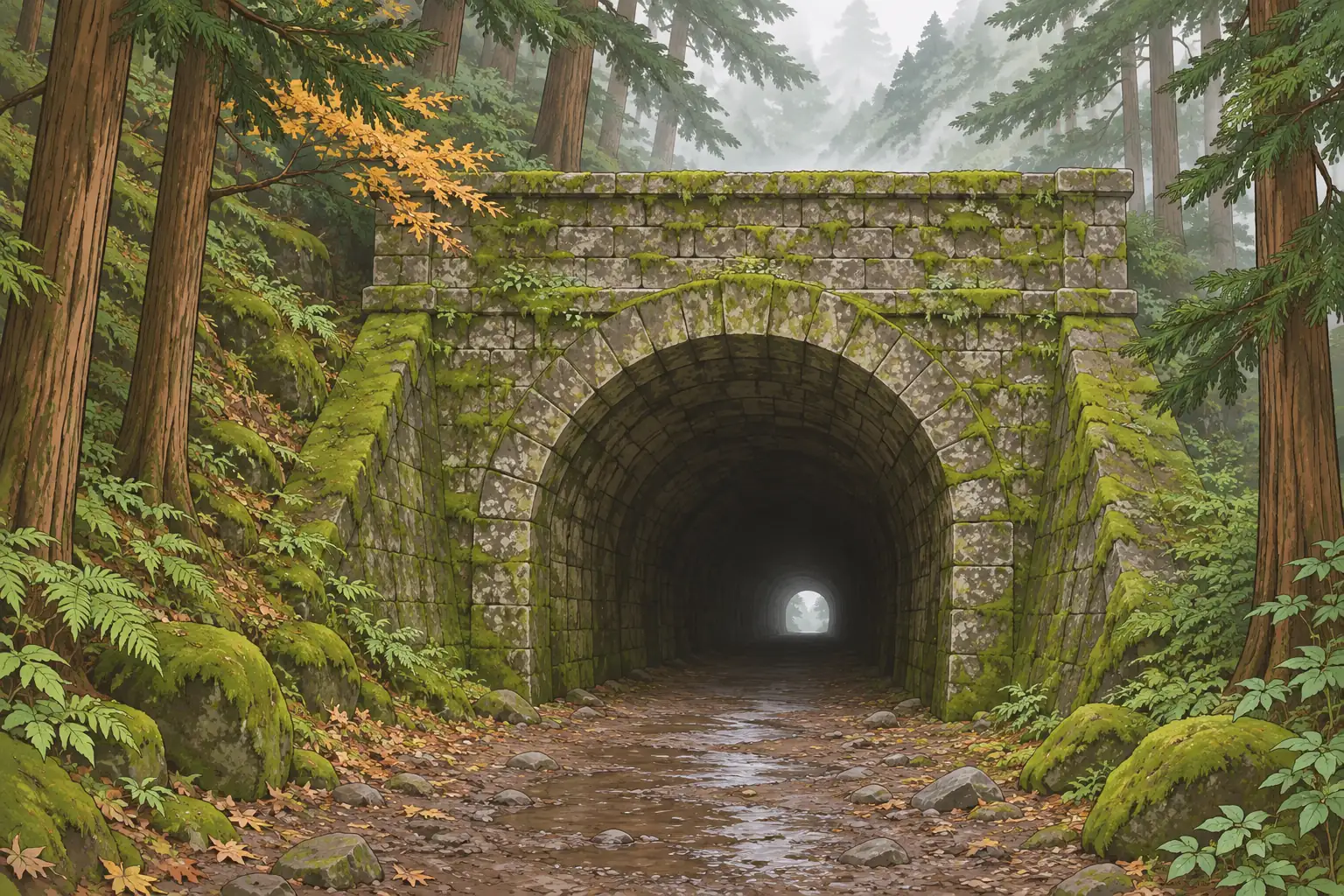
The stone portal of the old Amagi Tunnel, a damp mountain road leading in between cedars and moss (illustration).
Almost nothing happens in it. A gloomy student who thinks of himself as twisted by his orphan upbringing travels with a family of performers whom the villages treat as vagrants. He imagines the dancer is older and is shaken when he sees her wave to him, naked and unselfconscious, from a hot-spring bath across the river: she is just a child, and something in him suddenly clears. He overhears her tell her companions that he is "a nice person," and the plain words heal him. At Shimoda they part. On the boat he cries until his head feels empty and sweet. The story is so simple it is almost transparent, which is why generations of Japanese readers have treated it as the archetypal story of first love. It has been filmed six times, with the dancer played by, among others, Misora Hibari, Yoshinaga Sayuri and Yamaguchi Momoe.
By then Kawabata was already a recognized young writer. While a student at Tokyo Imperial University he published a story in 1921 that caught the attention of the editor and novelist Kikuchi Kan, and in 1924 he and Yokomitsu Riichi launched the magazine Bungei Jidai (The Literary Age). Their circle was labeled the Shinkankaku-ha, the "New Sensationalists." They rejected both the confessional realism that dominated Japanese fiction and the proletarian literature of the left, and wanted prose that jumped between sensations like cuts in a film. Yokomitsu went further into experiment; Kawabata gradually folded that sharpness back into the lyricism of older Japanese writing. Over his life he also wrote more than a hundred "palm-of-the-hand stories" (tenohira no shōsetsu), pieces of a few pages that catch a single moment the way a haiku does. They are the quickest way into his style.
04What Happens in Snow Country
In 1934 Kawabata traveled to the hot-spring town of Echigo-Yuzawa in Niigata and stayed at an inn called Takahan. He returned repeatedly, and from 1935 began publishing the novel in fragments, scattered across different magazines. A book edition came out in 1937, but he kept revising and adding, and the definitive version did not appear until 1948. It is a short novel (by one count under 100,000 characters) that took him over a decade.
The plot fits in a paragraph. Shimamura, a Tokyo man living on inherited money, calls himself an expert on Western ballet, which he has never seen. He visits a hot-spring village in the snow three times and has an affair with a local geisha, Komako. She keeps diaries, reads novels, and has taught herself the shamisen well enough to play whole pieces facing the open valley. She gives him everything; he watches. He thinks of her devotion as "wasted effort," and finds it beautiful precisely because it is wasted. A second woman, Yōko, whom he first sees nursing a sick man on the train, has a voice so lovely it is almost painful. In the novel’s most famous image, the darkening train window turns into a mirror, and Shimamura sees Yōko’s face float over the passing landscape, a light in the hills shining through her eye. At the end a cocoon warehouse catches fire, Yōko falls from the balcony, and as Shimamura looks up, the Milky Way seems to pour down into him with a roar.
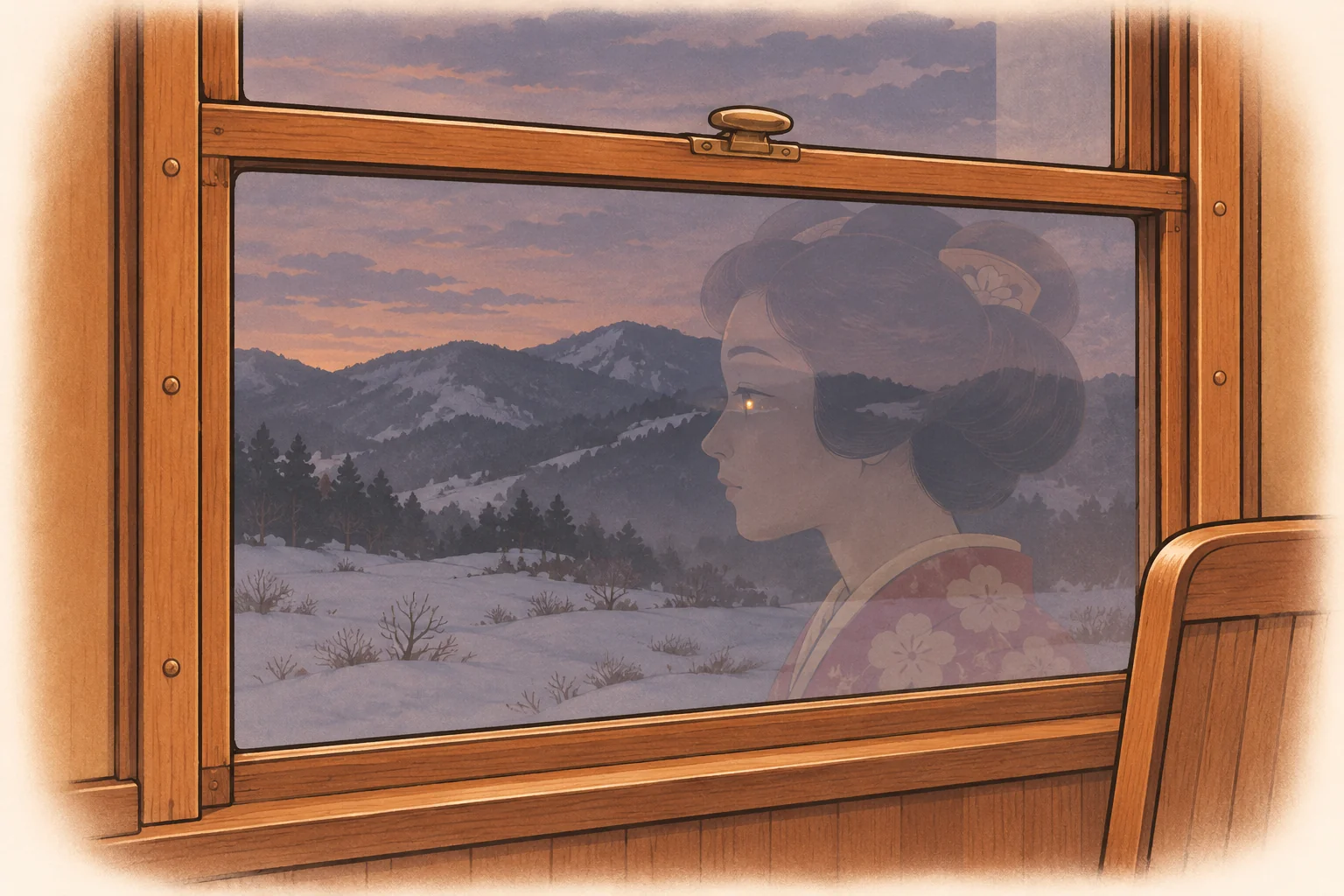
As in Snow Country’s most famous image, a darkening train window becomes a mirror, a distant light shining through a reflected eye.
First-time readers often want to know whether Shimamura loves Komako, and what becomes of them. Kawabata does not say. The book lives in its stopped moments: Komako’s red cheeks in a mirror full of snow, the cold of early morning, the cedars on the hill, moths dying on the window screen. Shimamura turns everything, including people, into scenery to be looked at, and the novel lets you feel both the beauty of that gaze and how cold it is. That double feeling is what makes Kawabata unsettling as well as lovely.
Komako had a real model, generally identified as a Yuzawa geisha whose professional name was Matsue, whom Kawabata met during his stays in the town; one account says they met at the Takahan. Years later, according to some reports, she told an interviewer she was unhappy with parts of how the novel portrayed her.
05After the War
During the war Kawabata lived in Kamakura, read The Tale of Genji, and wrote about go. In 1938 he covered, for a newspaper, the retirement game of the great go master Hon’inbō Shūsai, and later turned it into the novel The Master of Go (Meijin), about an old champion losing his last game under new, modern rules. After the defeat in 1945 he said that from now on he could only write of the sorrow and beauty of Japan.
The postwar years were his peak. Thousand Cranes (Senbazuru) is set around the tea ceremony and traces a young man’s tangled relations with his late father’s mistress and her daughter; a lipstick stain on the rim of a tea bowl carries more weight than anything the characters say. The Sound of the Mountain (Yama no oto) follows an aging Kamakura businessman through dreams, failing memory and a hidden tenderness for his daughter-in-law, and is often called his finest novel. The Old Capital (Koto) tells of twin sisters separated at birth in Kyoto, one adopted by a kimono wholesaler in the Muromachi district, the other working in the cedar groves north of the city; it moves through the city’s festivals and seasons and doubles as a portrait of Kyoto. Late in life came House of the Sleeping Beauties, in which old men pay to spend the night beside drugged young women. It is dark and decadent. Gabriel García Márquez is said to have spoken of how deeply it affected him, and he later took a passage from it as the epigraph of his late novel Memories of My Melancholy Whores.
Kawabata was also a pillar of the literary world. He succeeded Shiga Naoya as president of the Japan PEN Club in 1948, held the post for seventeen years, and hosted the International PEN Congress in Tokyo in 1957. He had a sharp eye for new talent: just after the war his recommendation got the young Mishima Yukio’s story "Cigarette" into print, the start of Mishima’s postwar career, and their friendship lasted more than twenty years. He was a serious art collector as well; two paintings he owned, Uragami Gyokudō’s Frozen Clouds Sifting Snow and an album of Ten Conveniences and Ten Pleasures by Ike no Taiga and Yosa Buson, are now designated National Treasures.
06The Nobel Prize and "Japan, the Beautiful and Myself"
In 1968 the Swedish Academy gave Kawabata the Nobel Prize "for his narrative mastery, which with great sensibility expresses the essence of the Japanese mind." He was the first Japanese laureate, and is often described as the second Asian writer to win after Tagore; at the banquet he remarked that the prize had last gone to someone from the East fifty-five years earlier, to Rabindranath Tagore. Much of his reputation abroad rested on Edward Seidensticker, who translated Snow Country, Thousand Cranes and The Sound of the Mountain, and who traveled with him to Stockholm.
Kawabata accepted the prize in kimono and gave a lecture titled Utsukushii Nihon no watakushi, "Japan, the Beautiful and Myself." He said almost nothing about his own novels. Instead he quoted poems by the Zen master Dōgen and the monk Myōe, talked about Ikkyū and Ryōkan, about Zen, the tea ceremony, flower arrangement and The Tale of Genji, and about how the Japanese, seeing snow, moon or blossoms, think first of their friends. The lecture presented Japan as a land of quiet, mystical, emptiness-loving beauty, and it shaped foreign ideas of Japanese culture for decades. When Ōe Kenzaburō won the prize in 1994, he pointedly titled his own lecture "Japan, the Ambiguous, and Myself."
The years after the prize were not happy. Kawabata slept badly and had long relied on sleeping pills. In November 1970 Mishima killed himself by ritual disembowelment after a failed attempt to rouse the Self-Defense Forces; Kawabata is said to have hurried to the scene that day, and he was badly shaken. On April 16, 1972, he was found dead from gas in the apartment he used as a workroom in Zushi, south of Tokyo. He was seventy-two (seventy-four by traditional count) and left no note. Whether it was suicide or an accident is still argued over.
07Walking into the Books
Echigo-Yuzawa is a little over an hour from Tokyo on the Jōetsu Shinkansen, and in winter you still come out of the mountains into white. As of 2026 Takahan is still in business, and the room where Kawabata wrote, the Kasumi-no-ma ("Mist Room"), was moved intact when the inn was rebuilt. In town, the Yukiguni-kan, the local history museum, displays Kawabata’s own brush calligraphy of the famous opening line and objects he used, and upstairs a "Komako’s room" recreates a geisha’s quarters of the period. Do not expect the hushed village of the novel: Yuzawa is now a busy ski resort. But walk out after dark in fresh snow and the silence that swallows sound is the same.
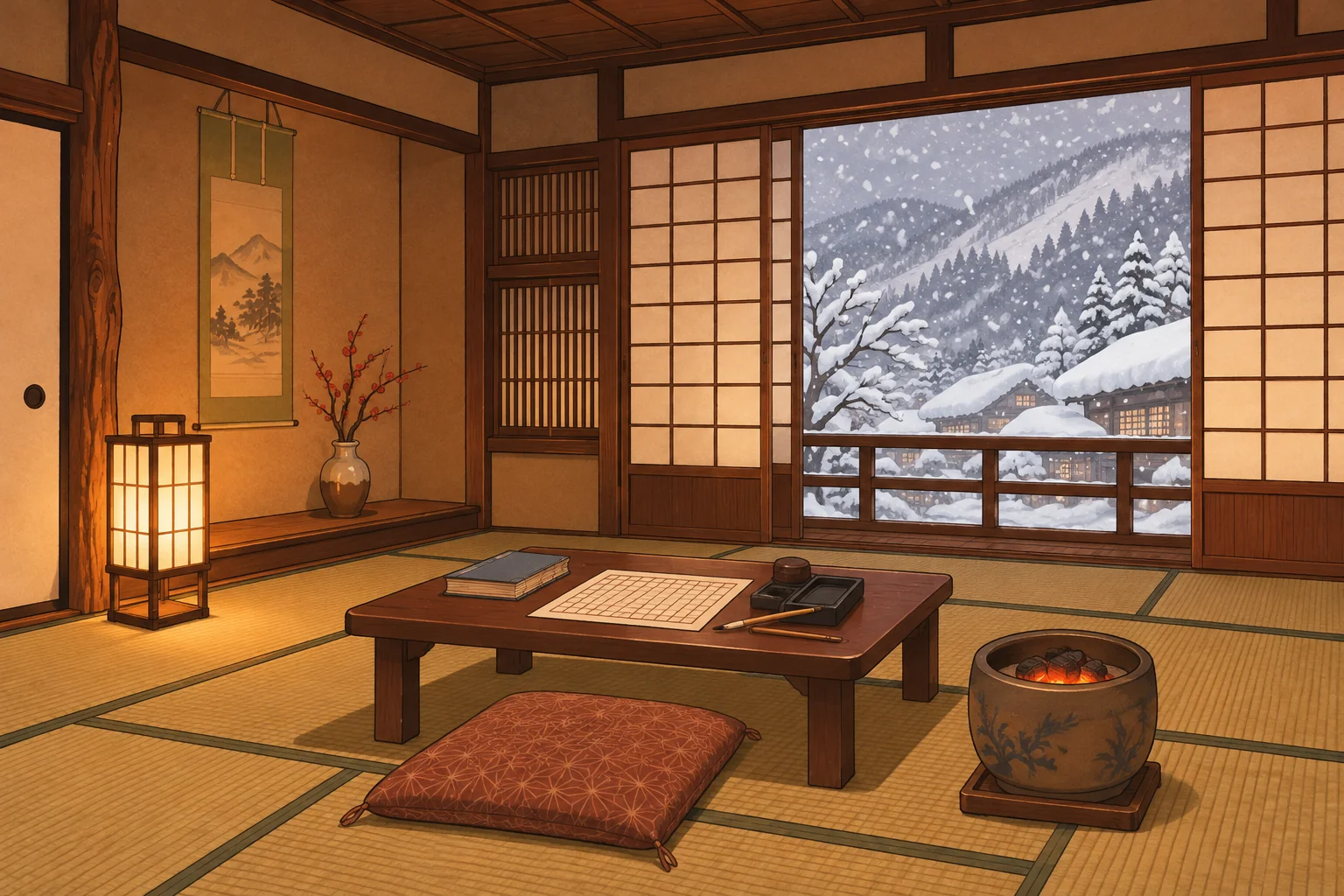
A preserved early-Shōwa tatami room with low desk, cushion and brazier, Echigo-Yuzawa's snowy hills outside (illustration).
For The Izu Dancer, start at Shuzenji and head south. At Yugashima hot spring, the inn Yumotokan, where Kawabata stayed often and worked on the story, was still in business as of 2026. Further south, the road the troupe walked is now a walking trail that runs from the Jōren Falls, where a statue of the dancer stands at the entrance, over the Amagi Pass and down toward Kawazu. At the pass, the old Amagi Tunnel, a stone tunnel completed in 1904, is now a nationally designated Important Cultural Property. In spring or autumn, a day on part of the trail after reading the story is about as good a literary walk as Japan offers.
In Ibaraki, the Ōsaka suburb where he grew up, the city’s Kawabata Yasunari Literary Museum holds manuscripts, letters and records of his schooldays, and helps make sense of the lonely boy behind the books. His house in the Hase district of Kamakura is private, but it is close to the Kamakura Museum of Literature and Hase-dera temple, and the hills around it are the hills of The Sound of the Mountain.
For a first reading, begin with The Izu Dancer, then Snow Country, then Thousand Cranes and The Sound of the Mountain, with a few palm-of-the-hand stories between them. Read slowly, and stop worrying about what happens next.