
At a glance
What Sei Shōnagon put in her lists, court scenes and seasonal sketches, why her sharp eye still feels modern, and the court tragedy her book leaves unsaid.
- The Pillow Book was written by Sei Shōnagon while serving Teishi, consort of Emperor Ichijō, and has about 300 sections.
- Its sections fall roughly into three kinds: lists, diary-like court episodes, and musings on nature and the seasons.
- The opening, “Haru wa akebono,” picks the best moment of each season and is taught in Japanese schools.
- Its keyword is the bright, amused okashi, often contrasted with the mono no aware of The Tale of Genji.
- With Hōjōki and Tsurezuregusa it forms the “three great zuihitsu,” and it is two to three centuries older than both.
Around the year 1000, a lady-in-waiting at the imperial court in Kyoto filled a stack of paper with whatever caught her eye: lists of things she found adorable or infuriating, scenes from palace life, sharp little verdicts on the seasons, on men, on servants and on carriages. She was Sei Shōnagon, and the result, Makura no sōshi or The Pillow Book, is one of the founding works of Japanese prose. It is also one of the easiest classics in the world to pick up and enjoy, because its author sounds so much like someone you might know: observant, funny, snobbish, competitive and very sure of her own taste. This is an introduction to what the book is, the woman who wrote it, the troubled court world behind its bright surface, and how to read it today.
01"In spring, the dawn"
Almost every Japanese person can recite the book’s first line, which schoolchildren meet early in their study of classical Japanese: Haru wa akebono, "In spring, the dawn." The passage goes on to say that the best thing in spring is the moment when the sky along the mountain ridge slowly whitens and brightens, and thin trails of purplish cloud stretch across it.
Then she moves briskly through the year. In summer, the night: moonlit nights, of course, but dark nights too, when fireflies weave back and forth, or even when it rains. In autumn, the evening, when the setting sun nears the hills and crows hurry home in twos and threes, and geese pass in a small, far-off line. In winter, the early morning, especially with snow, or white frost, or simply a sharp cold, when people rush to light charcoal and carry braziers down the corridors. And then, a final twist: by midday, as the cold eases, the charcoal in the braziers burns down to white ash, and that is unattractive.
Those few lines tell you everything about how the book works. There is no argument and no preamble. Each season is reduced to the single moment the author thinks shows it best, and she states her choice as fact. The ending, a small sniff at a messy brazier, is pure Sei Shōnagon: even in her most lyrical passage she cannot resist pointing out something that falls short. For many Japanese readers this opening has become shorthand for the idea that each season has its proper hour, a sensibility that still shapes everything from tea ceremony to convenience-store seasonal snacks.
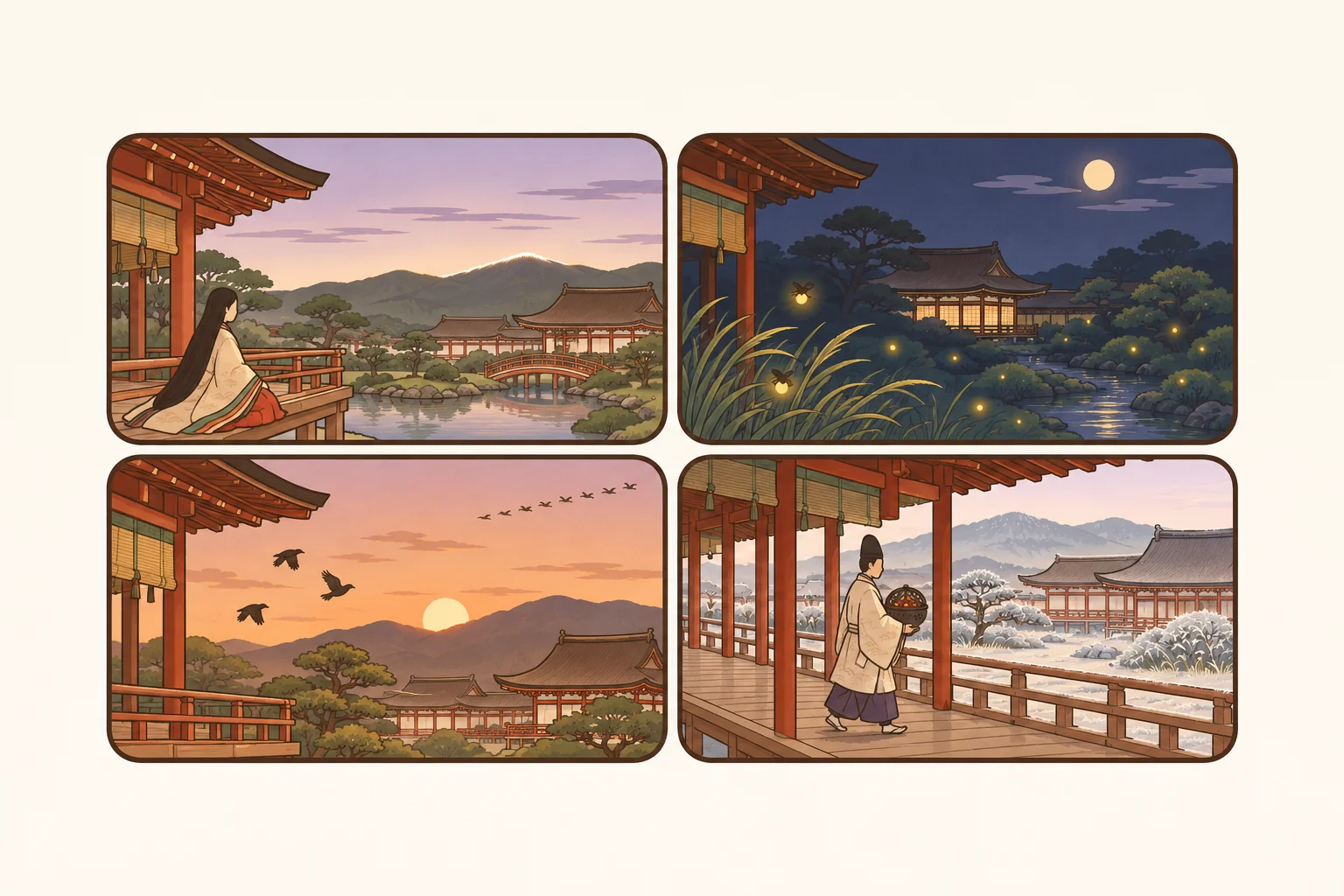
In spring the dawn, in summer the night, in autumn the evening, in winter the early morning (illustration).
02Sei Shōnagon and Empress Teishi
"Sei Shōnagon" is a court nickname, not a personal name, which is unknown. Sei comes from her family, the Kiyohara clan; Shōnagon, a title meaning "minor counselor," was attached to her for reasons nobody has fully explained, since no male relative of hers is known to have held the post. Her father, Kiyohara no Motosuke, was a noted poet and one of the scholars who compiled the imperial anthology Gosen wakashū. Her great-grandfather (some accounts say grandfather) Kiyohara no Fukayabu was also a poet. She grew up in a middle-ranking family that prized learning, and she knew Chinese literature well, which was unusual, and sometimes frowned on, in a woman of her time.
In the early 990s she entered the service of Teishi (also read Sadako), the young consort of Emperor Ichijō. Teishi was the daughter of Fujiwara no Michitaka, the regent and the most powerful man at court. Her salon was lively and cultivated, and she clearly delighted in clever conversation. In the book she appears again and again: setting poetic puzzles for her ladies, teasing them, rescuing Sei Shōnagon from embarrassment, laughing at a well-turned reply. The affection is unmistakable.
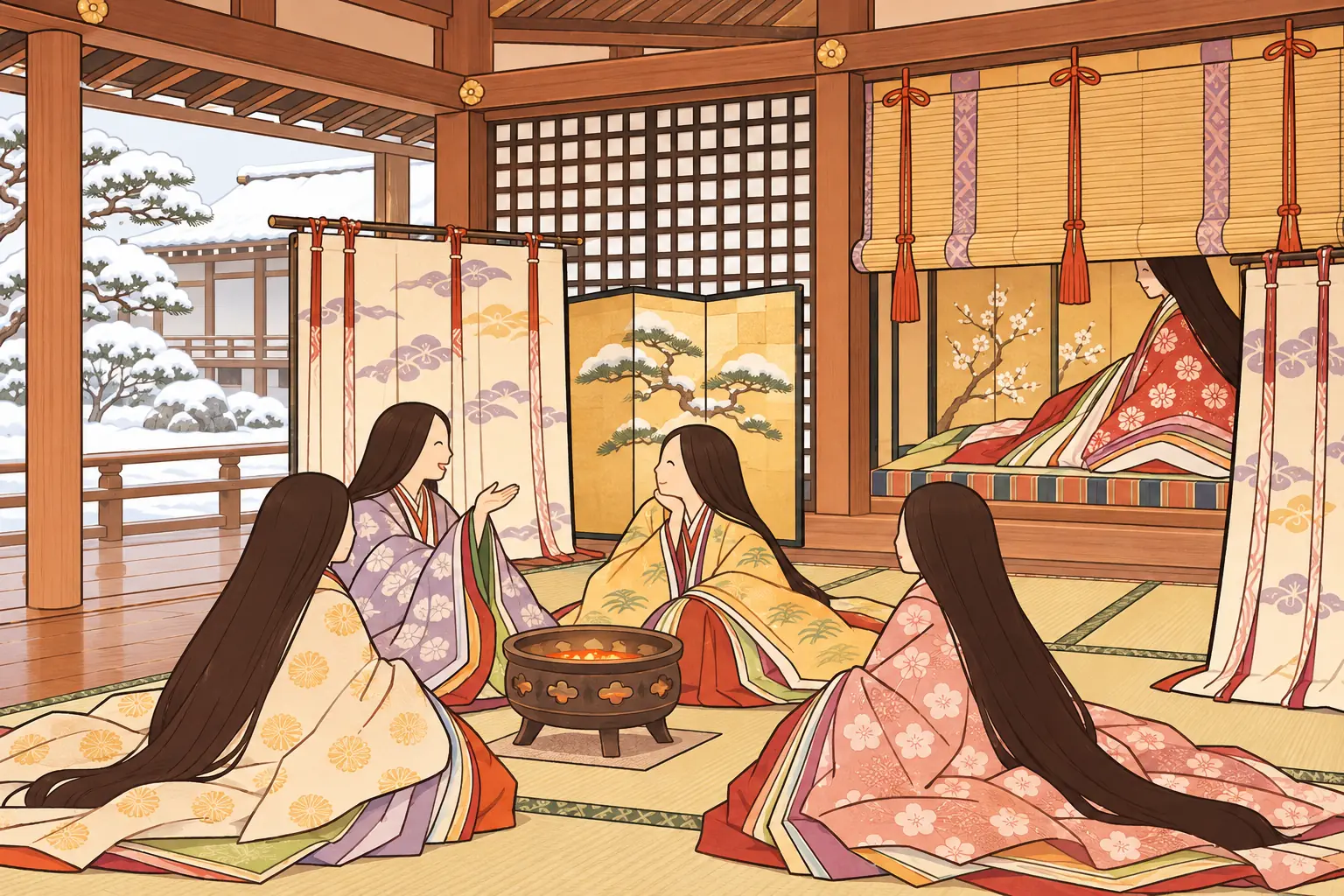
A corner of Empress Teishi's quarters: ladies-in-waiting sit around her as she sits behind a half-raised blind (illustration).
The good times did not last. Michitaka died in 995, and power passed to his younger brother, Fujiwara no Michinaga. In 996 Teishi’s brothers Korechika and Takaie were disgraced and sent away from the capital after an incident in which arrows were shot at a retired emperor’s party, and Teishi, devastated, briefly took religious vows. Michinaga then placed his own daughter, Shōshi, in the palace and had her named empress alongside Teishi, an arrangement with no real precedent. At the end of 1000 by the Japanese calendar (January 1001 by the Western one), Teishi died the day after giving birth to a daughter, at about twenty-four (twenty-five by traditional count). Sei Shōnagon left court soon afterward, and what happened to her later is known only through scraps and legends.
What makes this history matter is that The Pillow Book almost entirely leaves it out. Teishi in its pages is always radiant and composed; her household is always full of wit. The family’s collapse, the exiles, the slow sidelining of a beloved mistress, all stay offstage. Readers have long taken this as an act of loyalty: Sei Shōnagon chose to preserve Teishi as she was at her best. If you know what was happening outside the frame, the cheerful scenes acquire a quiet ache.
The book’s title comes from its afterword. Korechika presented Teishi with a supply of fine paper, and she asked what they should write on it, since the emperor’s side was using theirs to copy the Chinese history Shiji (Records of the Grand Historian). Sei Shōnagon replied that she would make a "pillow" of it, and Teishi gave her the paper. Nobody is sure what she meant. A pillow book might be a notebook kept at the bedside; or she might have been punning, since Shiki (the Japanese reading of Shiji) sounds like shiki, a mattress or bedding, so a pillow would go with it; or the word might refer to the poetic "pillow words" and famous place names that court poets kept in reference notes. Whatever she intended, the book began with a joke traded between a mistress and her quick-witted servant.
03Lists, diaries and musings
The book contains roughly three hundred sections, from a single line to several pages. Scholars usually sort them into three kinds, though many sections drift from one kind into another.
The first, and most beloved, are the lists. Each has a heading along the lines of "Things that…" Under "Adorable things" she puts a child’s face painted on a melon; a baby sparrow that comes hopping when you squeak at it; a toddler of two or three crawling quickly along, who spots a tiny speck of dust on the floor and picks it up in its little fingers to show the grown-ups. Under "Dispiriting things" come a dog barking in daytime, a fish weir (a winter device) still standing in the river in spring, and a plum-pink robe still worn in the third or fourth month, after its season has passed. "Hateful things" include a visitor who stays and talks when you are busy, and a mosquito whining thinly round your face just as you are falling asleep. A separate section is devoted to lovers leaving at dawn, and the bad one fumbles for his fan and his sash, muttering to himself, making no graceful exit at all. "Rare things" are a son-in-law praised by his father-in-law, a daughter-in-law loved by her mother-in-law, and a pair of silver tweezers that can actually pull out a hair.
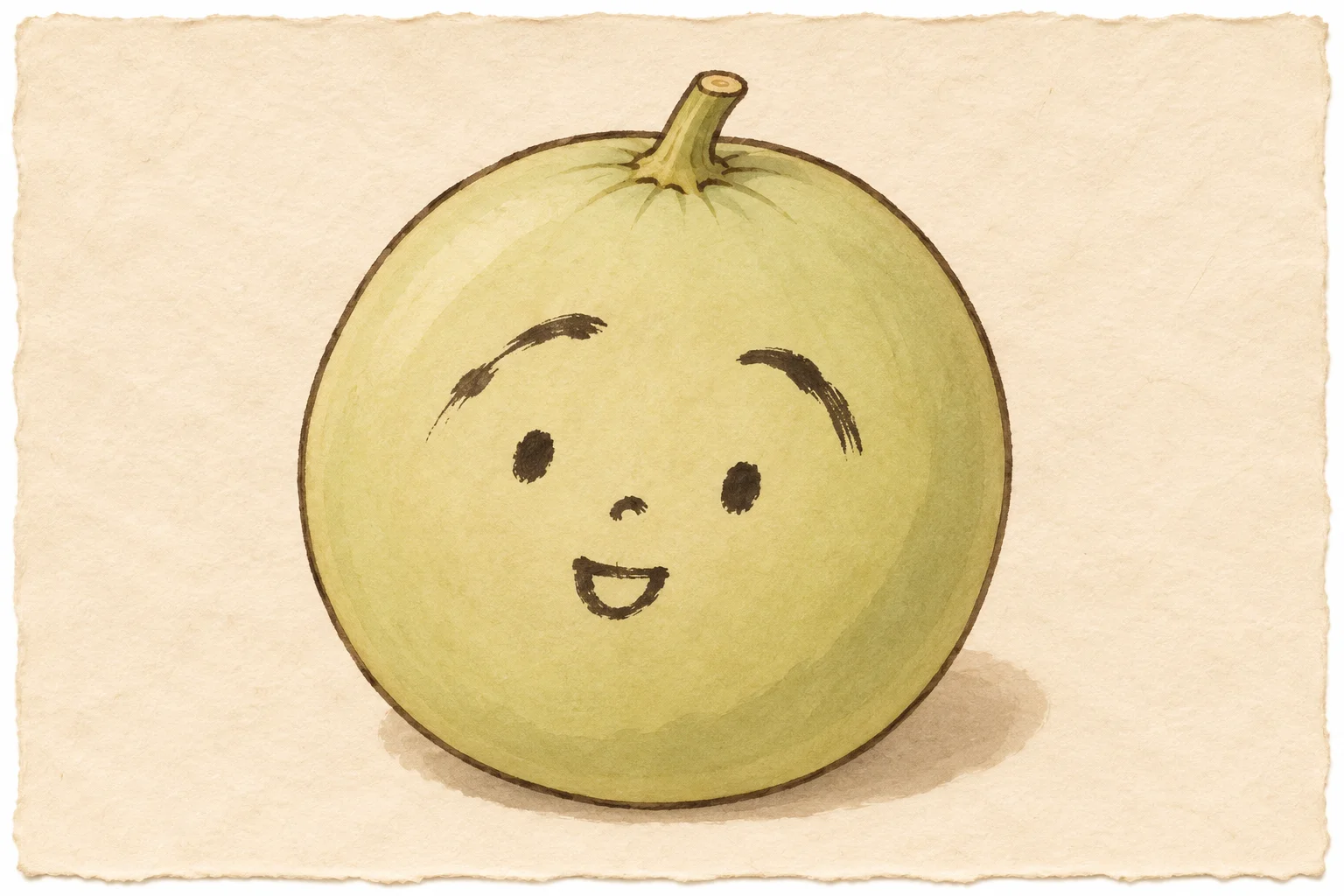
A child’s face painted on a melon is one of the entries in Sei Shōnagon’s list of "Adorable things."
The lists work because of their range and their precision. The elegant, the trivial, the absurd and the cruel sit side by side, and each item is a small recognition. She names the feelings that everyone has and nobody bothers to write down, and they are still true. Modern readers often find these sections the most immediately funny pieces of premodern literature they have ever read.
The second kind are diary-like episodes from life at court. The most famous is "The Snow of Xianglu Peak." On a day of heavy snow, the ladies have closed the lattice shutters and are chatting around a brazier when Teishi asks, "Shōnagon, how is the snow on Xianglu Peak?" Sei Shōnagon immediately has the shutters raised and rolls the blind up high herself, and the empress smiles. The reference is to a poem by the Tang poet Bai Juyi, in which he lies listening to a temple bell and "rolls up the blind to look at the snow on Xianglu Peak." Instead of quoting the line, she acted it out. The other ladies say that they all knew the poem, and could even recite it, but would never have thought to answer like that. The episode appears in nearly every Japanese classical-literature textbook. It shows how thoroughly Chinese poetry ran through court culture, and it shows Sei Shōnagon exactly as she liked to be seen: learned, quick and slightly showing off.
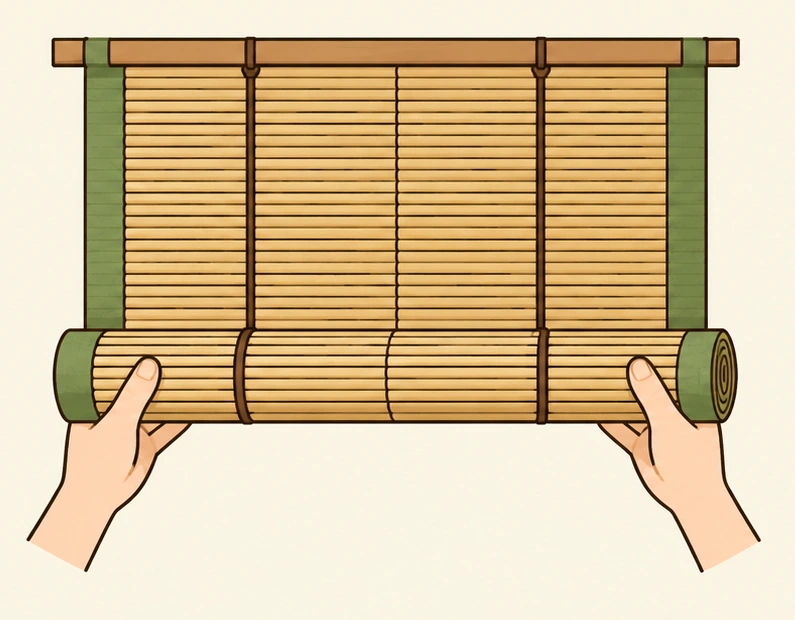
Asked about the snow on Xianglu Peak, Sei Shōnagon answers by rolling the blind up high herself.
The third kind are musings on nature and the seasons, like the opening passage. There are short sections on mountains, rivers, birds, insects and flowers. She remarks, for example, that pear blossom seems plain and uninteresting, until you remember that Chinese poets compared it to the tear-stained face of the beauty Yang Guifei, and then it takes on a different charm.
No manuscript in the author’s hand survives, and the book has come down in several textual lines that differ considerably: the Sankanbon and Nōinbon lines, which present the sections in a mixed order, and the Maedabon and Sakaibon lines, which group similar sections together. Most modern Japanese editions follow the Sankanbon text, but section numbers vary between editions and translations, which is worth knowing if you try to look up a passage someone has mentioned.
Mixed order
- Sankanbon
- Nōinbon
Similar sections grouped
- Maedabon
- Sakaibon
The two orders are why section numbers differ between editions; most modern editions follow the Sankanbon.
04The eye of okashi
Readers often set The Pillow Book beside The Tale of Genji, written a few years later by Murasaki Shikibu. The comparison usually comes down to two words. Genji is associated with mono no aware, a deep, sorrowful sensitivity to the passing of things. The Pillow Book is associated with okashi: delightful, interesting, charming, amusing. Where aware moves you, okashi catches your attention and makes you smile. Sei Shōnagon’s first response to something is rarely to grieve over its transience; it is to decide whether it is pleasing, apt and fresh.
That cast of mind makes the book feel surprisingly modern. She is acutely sensitive to color, sound, scent and gesture: dew on chrysanthemums after rain, a flute heard far off at night, the trace of incense still clinging to a robe the next day, an ox carriage crossing a shallow stream under the moon, its wheels breaking the water into splinters like crystal. She is also openly prejudiced. She looks down on shabby people and on servants who speak coarsely, mocks pompous men, and records her victories in verbal duels with high-ranking courtiers with undisguised satisfaction. Many modern readers love her for this. Others find her insufferable. Both responses are part of the experience.
The most famous reader who found her insufferable was Murasaki Shikibu herself. In her diary, Murasaki describes Sei Shōnagon as dreadfully pleased with herself, someone who scattered Chinese characters around to show off her learning, though her knowledge did not bear close inspection, and she predicts that a person so eager to be different will come to a bad end. Murasaki served Shōshi, the rival empress, but she seems to have arrived at court around 1005 or 1006, after Sei Shōnagon had left, so the two women probably never served there at the same time. Their celebrated "rivalry," a staple of later novels and television dramas, rests largely on this one-sided passage.
05Poems, essays and echoes
Japanese literary history groups The Pillow Book with two later works as the "three great zuihitsu," a term usually translated as "essays" or, more literally, "following the brush": Hōjōki (An Account of My Hut) by Kamo no Chōmei, written in 1212, and Tsurezuregusa (Essays in Idleness) by Yoshida Kenkō, from the fourteenth century. Those two are the work of men who had withdrawn from the world, and they are tinged with Buddhist reflections on impermanence. The Pillow Book is two centuries older, worldly and bright, and it established the form that the label was later applied to.
Sei Shōnagon was also a poet in her own right, and one of her poems is included in the Hyakunin isshu, the famous anthology of one hundred poems by one hundred poets that is still played as a card game at New Year. Her poem, number 62, plays on a story from the Shiji: a Chinese lord escaped through a border barrier at night when one of his followers imitated a rooster’s crow, fooling the guards into opening the gate early. She tells a courtier that he may fool that barrier with fake cockcrow, but he will never get through the Ōsaka Barrier, the "barrier of meeting," that guards her. The exchange behind the poem, with the courtier Fujiwara no Yukinari, is described in The Pillow Book itself. It is a neat summary of her style: a flirtatious rebuff built from a classical Chinese allusion and delivered with perfect timing.
The list form has had a long afterlife. Japanese magazines and essayists still write their own catalogs of "things I like" and "things that annoy me," and readers recognize the model immediately. The book has been retold many times for young readers, including in manga form, and in the late 1980s the writer Hashimoto Osamu produced a hugely popular version that rendered Sei Shōnagon’s voice in the slangy speech of a contemporary teenage girl, an approach that turned out to suit her remarkably well. In the English-speaking world the title is perhaps best known through Peter Greenaway’s 1996 film The Pillow Book, which borrows the name and some of the spirit but tells a quite different story.
06Reading it, and finding it in Kyoto
English readers have two excellent complete translations. Ivan Morris’s 1967 version is graceful and comes with extensive notes on court life; Meredith McKinney’s 2006 translation for Penguin Classics is crisper and closer to the rhythm of the original, with a helpful introduction. Arthur Waley’s earlier selection from 1928 is charming but partial. You do not need to read the book straight through. It rewards browsing: start with the lists, see what a woman a thousand years ago found adorable or unbearable, then turn to the Xianglu Peak episode and the scenes with Teishi. Read those again once you know how Teishi’s story ended, and they become something else.
In Kyoto, the place most closely tied to the book’s world is the southern end of the Higashiyama hills around Sennyū-ji, the temple long associated with the imperial family’s tombs. Teishi’s burial mound, Toribeno no Misasagi, lies on the wooded slope nearby. Within the Sennyū-ji precinct stands a stone monument inscribed with Sei Shōnagon’s Hyakunin isshu poem; some guides place it in the grounds of Imakumano Kannon-ji, one of Sennyū-ji’s subtemples. Tradition holds that she spent her later years in this area, near her mistress’s grave. That is a story rather than an established fact, but standing in the quiet woods there, it is easy to see why people want to believe it.
Better still is to take the opening passage with you through the seasons. Get up early on a spring morning and watch the ridge of the Higashiyama hills turn pale. Go looking for fireflies on a summer night. Watch crows heading home at dusk in autumn. Walk through a frosted temple garden early on a winter morning. Sei Shōnagon was not writing about famous sights. She was writing about moments anyone can see but few people stop to notice, and she still teaches her readers to notice them.