
At a glance
How an unknown Hanamaki farm-school teacher turned minerals, local dialect and his sister’s death into Night on the Galactic Railroad and Unbeaten by the Rain.
- Miyazawa Kenji was born in Hanamaki, Iwate Prefecture, in 1896 and died of illness in 1933, aged thirty-seven.
- In his lifetime he self-published only two books, both in 1924: the poems Spring and Asura and the stories The Restaurant of Many Orders. Neither sold.
- He began Night on the Galactic Railroad around 1924 and was still revising it, unfinished, when he died.
- "Unbeaten by the Rain" is a passage he wrote in katakana in a pocket notebook on November 3, 1931.
- "Ihatov," his private name for Iwate, is now a common nickname for the prefecture.
In his lifetime Miyazawa Kenji was a schoolteacher and amateur agronomist in a poor corner of northern Japan who paid to print two books that almost nobody bought. He died in 1933 at thirty-seven (thirty-eight by traditional count). Today he is one of the most loved writers in Japan: children meet him in their school readers, adults can recite his most famous poem from memory, and his unfinished story Night on the Galactic Railroad has given the country one of its enduring images, a small train running through the stars. This is an introduction to who he was, why his stories feel unlike anyone else’s, and where to find him if you travel to Iwate.
01A Pawnbroker’s Son in a Cold Country
Kenji was born in August 1896 in Hanamaki, a market town in Iwate Prefecture in the northeast of Honshū. That summer the Meiji Sanriku tsunami had devastated the Iwate coast, and four days after his birth the Rikuu earthquake struck the region. Disaster and crop failure framed his whole life. Iwate is high, cold country where a cool summer can stop the rice from ripening, and in bad years farmers pawned clothes and tools to survive.
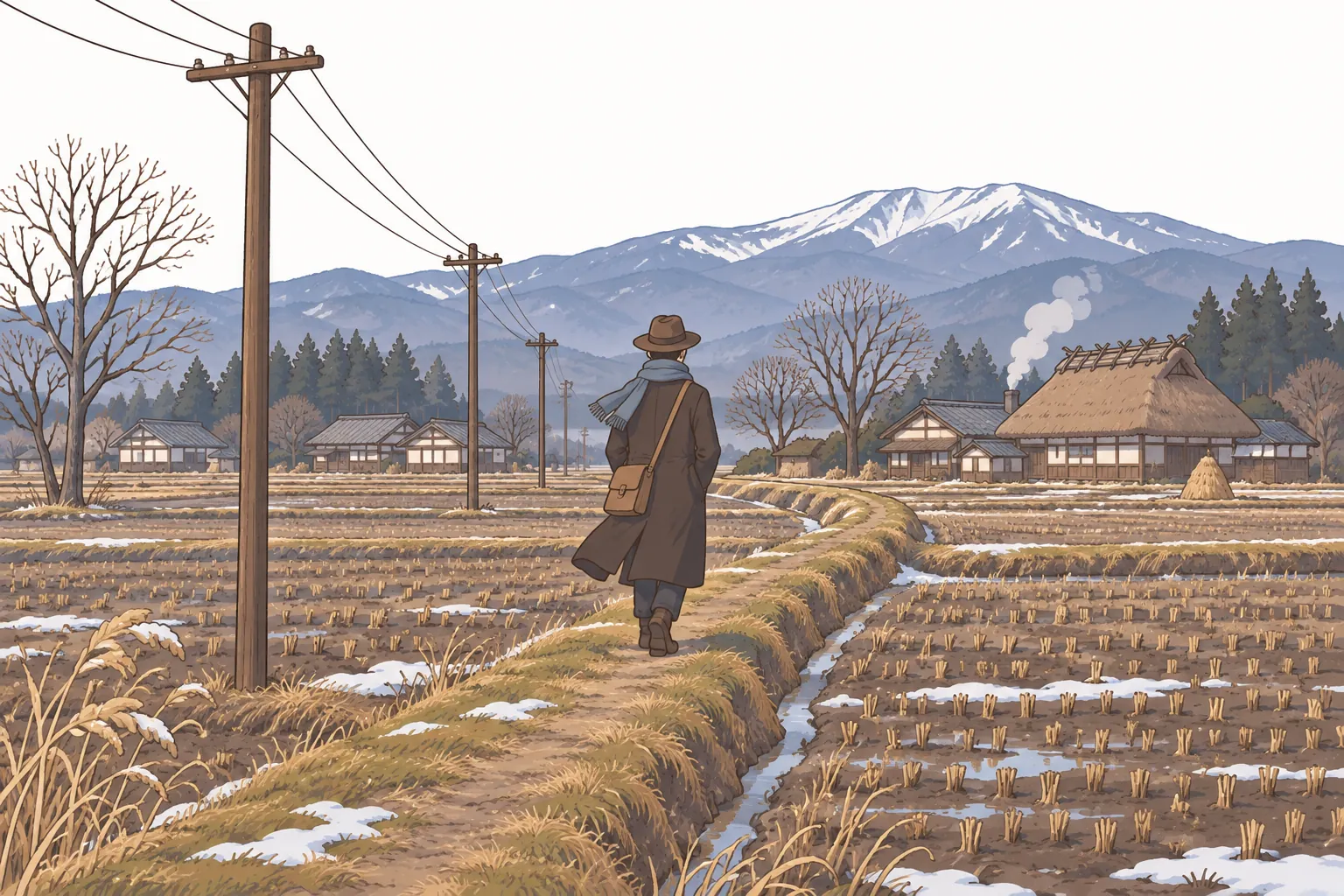
A thin young man in a wide-brimmed hat and long coat walking alone along paddy ridges near Hanamaki, mid-1920s (illustration).
The Miyazawa family made its money from exactly that. They ran a pawnshop and secondhand clothing business and were among the richest families in town. Kenji grew up watching poor farmers hand over their belongings at the counter, and he carried a lifelong sense of guilt about where his comfort came from. Much of what he later did, and much of what he wrote, reads as an attempt to repay that debt.
His father, Miyazawa Masajirō, was a devout follower of Jōdo Shinshū (True Pure Land Buddhism) and invited well-known Shin preachers to Iwate to teach. As a boy Kenji was obsessed with collecting stones and insects; his family nicknamed him "Ishikko Kenji-san," roughly "Kenji the rock kid." In 1914 he read the Lotus Sutra and was overwhelmed by it. He turned to the Nichiren tradition, which places the Lotus Sutra at the center of everything, and spent years arguing with his father over religion. In 1920 he joined the Kokuchūkai, a lay Nichiren organization led by Tanaka Chigaku, and in early 1921 he left home for Tokyo without permission, working as a copyist and proofreader at a duplicating press and volunteering for the group. He is said to have written stories at a furious pace during those months.
He was also a trained scientist. In 1915 he entered Morioka Agriculture and Forestry College, now part of Iwate University, at the top of his class. He studied agricultural chemistry, soil science and geology, and spent days walking the mountains with a rock hammer. That training never left his writing. Opal, agate, quartz, electrons and nebulae sit in his stories right beside rice paddies, foxes and the wind, and this mix of science and folklore is one of the easiest ways to recognize his voice.
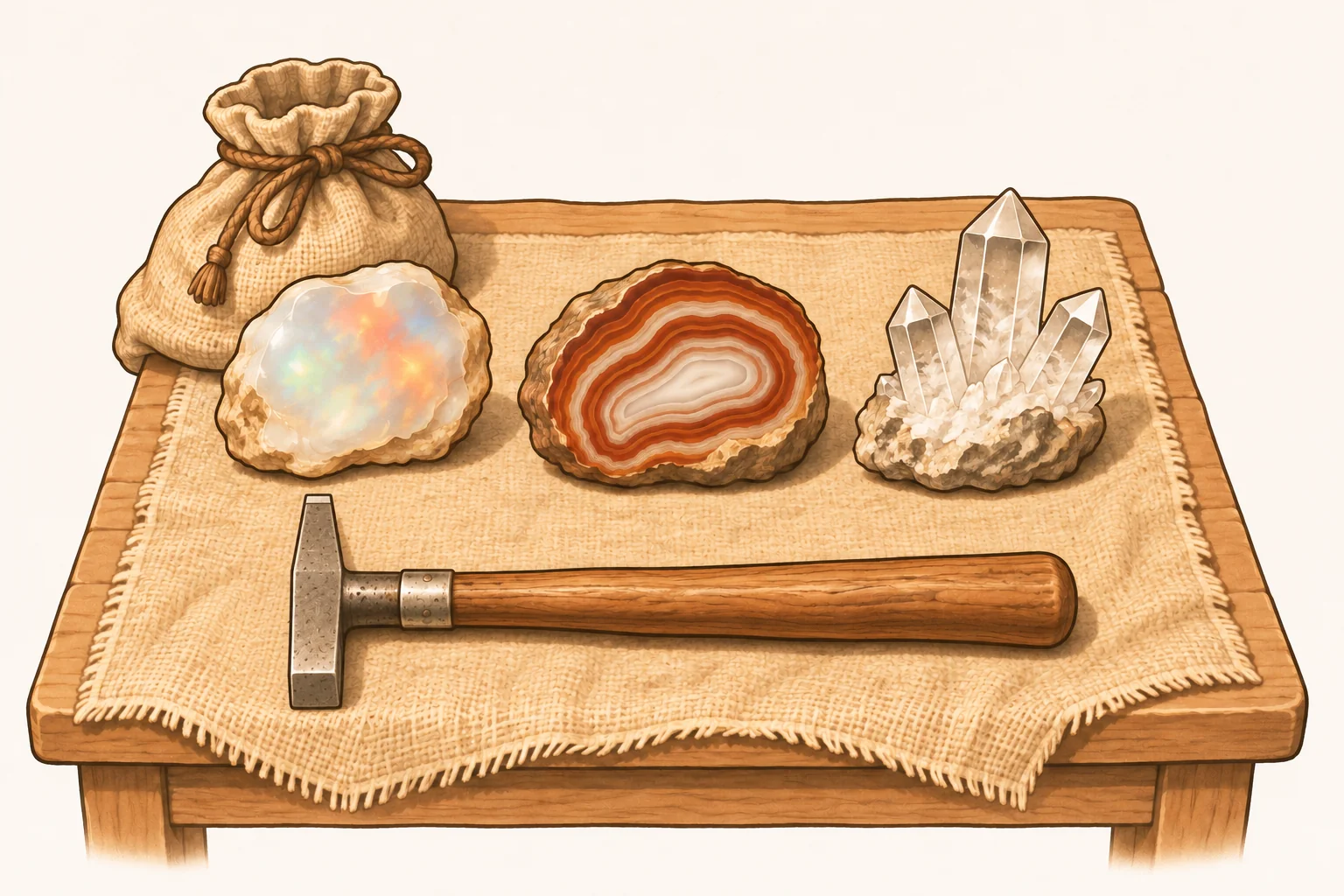
Opal, agate and quartz, with a rock hammer. The names of such minerals sit in Kenji’s stories beside rice paddies and foxes.
02Spring and Asura and the Death of Toshi
In the summer of 1921 his younger sister Toshi fell seriously ill, and Kenji came home. By the end of that year he was teaching at the local agricultural school in Hanamaki, covering chemistry, soils and fertilizer. These were probably the happiest years of his life. He took students out into the fields and hills, wrote and staged plays for them, and hunted for fossils along the Kitakami River, where a stretch of pale mudstone riverbed reminded him so much of the chalk coasts of England that he named it the "English Coast." Later writers often say it was the white cliffs of Dover he had in mind.
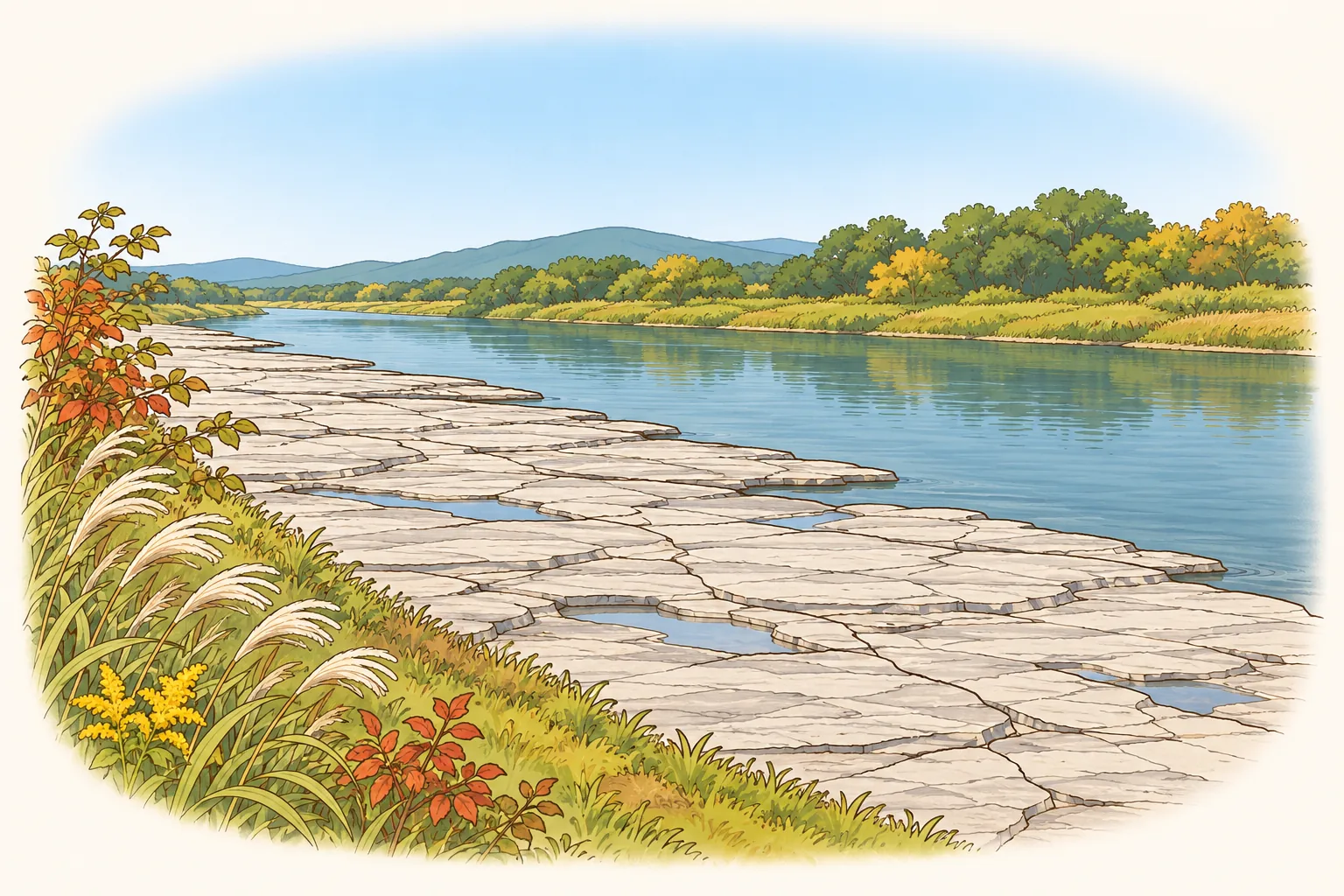
Pale mudstone along the Kitakami River, exposed when the water is low. Kenji named this stretch the "English Coast."
Toshi died in November 1922 at twenty-four (twenty-five by traditional count). She was the person closest to him and the one who shared his faith. On the day she died he wrote "Eiketsu no asa" ("The Morning of the Last Farewell"), built around a line she spoke in the Hanamaki dialect, asking him to bring her a bowl of sleet from outside: ameyuju totechite kenja. It was sleeting, and Kenji ran out with two bowls to scoop up snow for his dying sister. The repeated dialect phrase, in a sister’s weak voice, is what makes the poem unbearable.
The next summer he traveled north to Sakhalin, then partly Japanese territory, writing elegies along the way as he searched the northern seas, in his imagination, for wherever Toshi had gone. Many readers see this journey as the seed of Night on the Galactic Railroad.
In April 1924 he self-published Haru to shura (Spring and Asura). He refused to call its contents poems. He called them shinshō sukecchi, "mental sketches," records of images exactly as they arose in his mind. The preface opens by describing the self as "one blue illumination of a hypothetical organic alternating-current lamp." The idea of a person as a flickering phenomenon rather than a fixed thing comes from Buddhist teaching on impermanence, and the language comes from a chemistry classroom. Only 1,000 copies were printed and they barely sold; Kenji took back the unsold copies and gave them away; by another account, leftover copies ended up in secondhand bookshops, sold off cheaply. Still, a few readers in Tokyo noticed it, among them the poet Kusano Shinpei, who would later do more than anyone to make Kenji famous.
03Stories from Ihatov
In December 1924 a collection of children’s stories followed: Chūmon no ōi ryōriten (The Restaurant of Many Orders). Its subtitle called them tales of "Ihatov," Kenji’s private name for Iwate. The word is generally thought to be a playful reworking of "Iwate" that also sounds faintly European. In an advertisement for the book he described Ihatov as Iwate Prefecture as it exists in dreams, a place where anything can happen. This book did not sell either; Kenji, it is said, bought up a good number of copies himself.
The title story is the one nearly every Japanese child knows. Two young gentlemen from Tokyo, out hunting with expensive guns, get lost in the mountains and come upon a Western-style restaurant called the Wildcat House. Each door carries a polite request. Please comb your hair. Please leave your guns here. Please remove anything metal. Please rub cream on your face and hands. Please sprinkle yourself with salt. The two men obey every instruction, congratulating themselves on what a refined place this must be, until they realize that they are the dinner. Children love the mounting suspense; adults read a satire of city people who treat the countryside and its animals as things to consume.
Kenji’s stories live in their sound. He invented onomatopoeia freely, and Japanese readers know the gusting wind that opens Kaze no Matasaburō (Matasaburo of the Wind) by its strange syllables alone: doddodo dodōdo. Wildcats, acorns, bears, foxes and people all talk, and all are given dignity. In "Donguri to yamaneko" ("Wildcat and the Acorns"), a wildcat judge settles a quarrel among acorns over which of them is greatest by ruling that the silliest, messiest, least impressive one is the greatest. In "Yodaka no hoshi" ("The Nighthawk Star"), an ugly bird scorned by the others, unable to bear eating more insects to live, flies upward until it burns into a star. In Sero hiki no Gōshu (Gauche the Cellist), the worst player in a town orchestra is visited night after night by a cat, a cuckoo, a young raccoon dog and a field mouse, and without noticing becomes a real musician. In The Life of Budori Gusuko, a young man stays behind on a volcano to set off an eruption whose gases will warm the climate and save his region from famine.
Running through all of these is a question Kenji could not leave alone: if every living thing survives by eating other living things, how can anyone live rightly? He was vegetarian for long periods and even wrote a comic story about a vegetarian convention. His answers tend toward self-sacrifice, which gives the bright, funny surface of his stories an undertow of pain. Children read the adventure; adults rereading them years later notice the pain.
04Night on the Galactic Railroad
Kenji began Ginga tetsudō no yoru (Night on the Galactic Railroad, also translated Night Train to the Stars) around 1924 and kept revising it until he died. It survives in several drafts that differ substantially, the last of them unfinished and missing pages. Every edition readers hold today has been assembled by editors.
The story takes place on the night of the Centaurus Festival. Giovanni is a poor boy. His father, a fisherman, has been away for a long time, and classmates whisper that he has been arrested. His mother is ill, and after school Giovanni works in a print shop picking type. The other boys taunt him about his father. Only his old friend Campanella does not join in, though the two have drifted apart.
That evening Giovanni goes to fetch milk for his mother, climbs a hill alone and lies looking up at the Milky Way. He hears a voice calling "Galaxy Station, Galaxy Station," and finds himself sitting in a small train. Across from him sits Campanella, his clothes soaking wet.
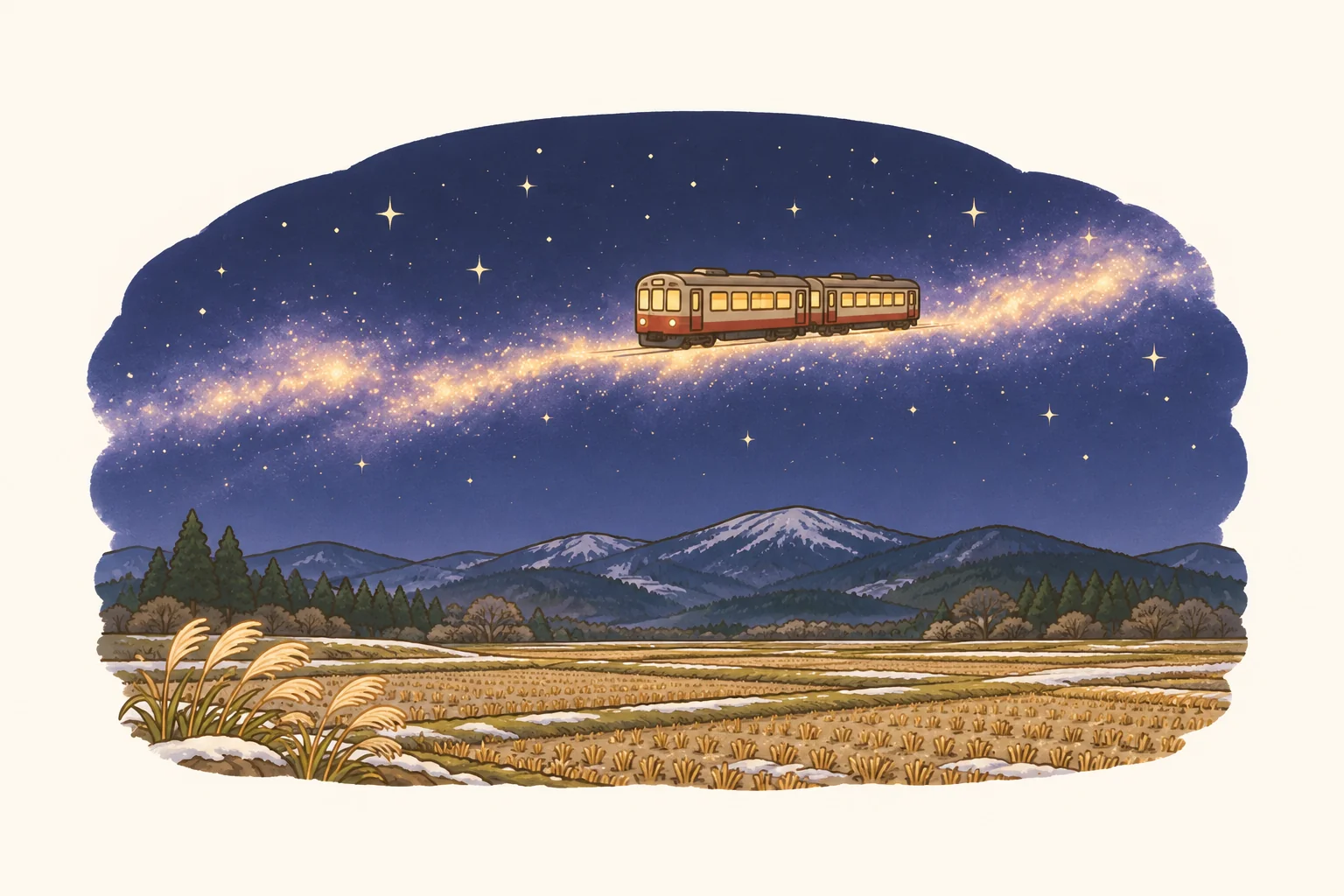
The train runs south along the river of stars, from the Northern Cross past the Swan and Eagle stations toward the Southern Cross. Outside are glowing survey markers, silver pampas grass and phosphorescent water, and on one riverbank men are digging up ancient fossils. Passengers come and go: a bird-catcher who presses herons and geese flat and sells them as sweets; a young tutor with a brother and sister in his care, who tell how their great ship struck an iceberg and how they gave up their places in the lifeboats. The girl tells the story of the scorpion, who ate countless small creatures all its life, and who, falling into a well while fleeing a weasel, regretted not giving its body to the weasel and prayed that its body might burn for the happiness of everyone. It became the red fire of the scorpion in the night sky.
Giovanni discovers that his ticket is unlike anyone else’s. The bird-catcher, examining it, is astonished: it will take him anywhere, even to the true heaven. At the Southern Cross the other passengers leave the train and walk into the light. Giovanni tells Campanella that they will go together, anywhere, and that like the scorpion he is no longer afraid to burn for the "true happiness" (hontō no saiwai) of everyone. Campanella, in tears, says he feels the same. Then the Coal Sack opens in the Milky Way, a great black hole in the sky, and Giovanni says he is no longer afraid even of that darkness and that they will go together to look for everyone’s true happiness. Campanella suddenly points to a beautiful field in the distance: everyone is gathered there, that is the true heaven, and there is his mother. When Giovanni turns back, his friend is gone.
Giovanni wakes on the hill and runs down toward the river, where a crowd has gathered. Campanella jumped in to save a boy who had fallen into the water, Zanelli, the classmate who mocked Giovanni the most. Zanelli was saved. Campanella has not come up. His father, watch in hand, says it has been forty-five minutes. Then he tells Giovanni that his own father will be home soon. Giovanni runs home to his mother with the milk and the two pieces of news.
What makes the story unforgettable is that it turns a death into a journey. Giovanni does not know his companion is dead, and the reader only confirms it at the end; looking back, the wet clothes and Campanella’s worried words about his mother all take on new meaning. Ever since Toshi’s death Kenji had been asking where the dead go, and this is his longest answer. At its center is the idea of "true happiness": to live for the happiness of all beings, knowing that one has to walk that road alone.
The image has traveled far. Matsumoto Leiji’s manga and anime Galaxy Express 999 borrowed the idea of a train through space. In 1985 director Sugii Gisaburō released an animated film of the story, with the characters drawn as cats after the designs of manga artist Masumura Hiroshi and music by Hosono Haruomi. In Japan, a train in the night sky is practically Kenji’s signature.
05The Rasu Farmers’ Association and "Unbeaten by the Rain"
In the spring of 1926 Kenji resigned from teaching. He is usually said to have felt he could not keep drawing a salary while telling students to go home and farm. He moved into a family cottage on the outskirts of Hanamaki, cleared land to grow vegetables and flowers, and founded the Rasu Chijin Kyōkai, usually rendered the Rasu Farmers’ Association. He lectured young farmers on soils, fertilizer and what he called peasant art, held record concerts, and taught himself the cello. In his Outline of Peasant Art he wrote that individual happiness is impossible until the whole world is happy.
He also offered free fertilizer consultations in village after village, reportedly drawing up more than two thousand fertilizer plans. Yet he remained the rich pawnbroker’s son, and many farmers never fully trusted him. The authorities, nervous about rural political movements, eyed his gatherings with suspicion, and after a local newspaper reported on them in early 1927 the association’s meetings soon stopped, though he went on advising farmers on his own; some accounts count the association’s life, all told, at about two years. In the summer of 1928, worn out, he fell ill with a lung infection and moved back to his parents’ house.
In 1931, partly recovered, he took a job as an engineer and salesman for a company that ground limestone into a soil conditioner, which could neutralize the acid soils of the northeast. He hauled heavy samples from town to town. That September, on a sales trip to Tokyo, he collapsed with a high fever and wrote farewell letters to his family before being brought home.
On November 3, 1931, he wrote in a small pocket notebook the lines now known as "Ame ni mo makezu" ("Unbeaten by the Rain"). It begins:
Ame ni mo makezu / kaze ni mo makezu / yuki ni mo natsu no atsusa ni mo makenu / jōbu na karada o mochi
Unbeaten by the rain, unbeaten by the wind, unbeaten by snow or the summer heat, with a strong body. It goes on to describe a person who eats four cups of brown rice a day with miso and a few vegetables, who goes east to nurse a sick child and west to carry rice sheaves for a tired mother, who weeps in drought and walks anxiously through a cold summer, who is called a blockhead and is neither praised nor a burden to anyone. It ends: "That is the kind of person I want to be." On the notebook page, it is followed directly by Buddhist invocations.
It was never meant for readers. It is a sick man’s private vow, which is why it is so plain, almost clumsy, and why so many Japanese people turn to it in hard times. After the earthquake and tsunami of March 2011, which struck the Iwate coast among others, it was read aloud across the country.
Kenji died at home in Hanamaki on September 21, 1933. According to his family, the evening before, a farmer came to ask about fertilizer, and Kenji dressed, sat up, and answered him at length. On his deathbed he asked his father to print a thousand copies of a Japanese translation of the Lotus Sutra and give them to friends.
06Fame After Death
He left behind a mountain of manuscripts covered in revisions. After his death his younger brother Miyazawa Seiroku found the notebook containing "Unbeaten by the Rain" in his trunk, by most accounts at a memorial gathering organized in Tokyo in 1934 by Kusano Shinpei and others. The first collected works appeared that same year, and editors would spend decades working out the order of his revisions. Few Japanese writers have gone from obscurity to national fame so completely after death. Akutagawa Ryūnosuke, his contemporary, was a literary celebrity in his own lifetime; Kenji’s work entered school textbooks in a big way only after the Second World War.
Today he is everywhere. "The Restaurant of Many Orders" and "Unbeaten by the Rain" appear in school readers, Matasaburo of the Wind has been filmed and also made into an anime, and in 1982 Takahata Isao turned Gauche the Cellist into an animated film; Miyazaki Hayao’s generation of animators is generally thought to owe him something too. "Ihatov" has become a poetic name for Iwate itself. His image as a gentle saint who wanted to do something for everyone and never felt he had done enough is powerful in Japan, though some readers point out that sanctifying him hides how strange, funny and sharp his writing can be.
07Visiting Hanamaki
Hanamaki lies south of Morioka, about three hours from Tokyo by the Tōhoku Shinkansen to Shin-Hanamaki Station. Most Kenji sites cluster near the station on and around Koshiō Hill. The Miyazawa Kenji Memorial Museum, partway up the hill, displays his manuscripts, his cello, and his hand-drawn geological and astronomical materials, which together show how wide his interests ran. At the foot of the hill, the Miyazawa Kenji Fairy Tale Village turns scenes from his stories into gardens and exhibits that work well for families, and the nearby Ihatov Center holds research collections.
The cottage of the Rasu Farmers’ Association has been moved to the grounds of Hanamaki Agricultural High School and preserved. At its original site stands a stone monument inscribed with "Unbeaten by the Rain," and memorial events are held around September 21, the anniversary of his death. On the Kitakami River, when the water is low, the pale mudstone of the "English Coast" emerges, and standing on it you can see what he saw.
East from Hanamaki toward Tōno and Kamaishi runs the JR Kamaishi Line, nicknamed the "Ginga Dream Line," whose stations carry secondary names in Esperanto, a language Kenji studied. The line grew out of the Iwate Light Railway that Kenji knew. Along it, the Miyamorigawa Bridge, a five-arch bridge rebuilt in 1943 and known locally as the "Spectacles Bridge," with stone piers from the light-railway era still standing beside it, is lit at night and often described as one of the inspirations for the galactic railroad, though that is a later association rather than anything Kenji said. If you step outside Hanamaki on a clear autumn night and see the Milky Way crossing the sky from north to south, it is hard not to think of the little train.
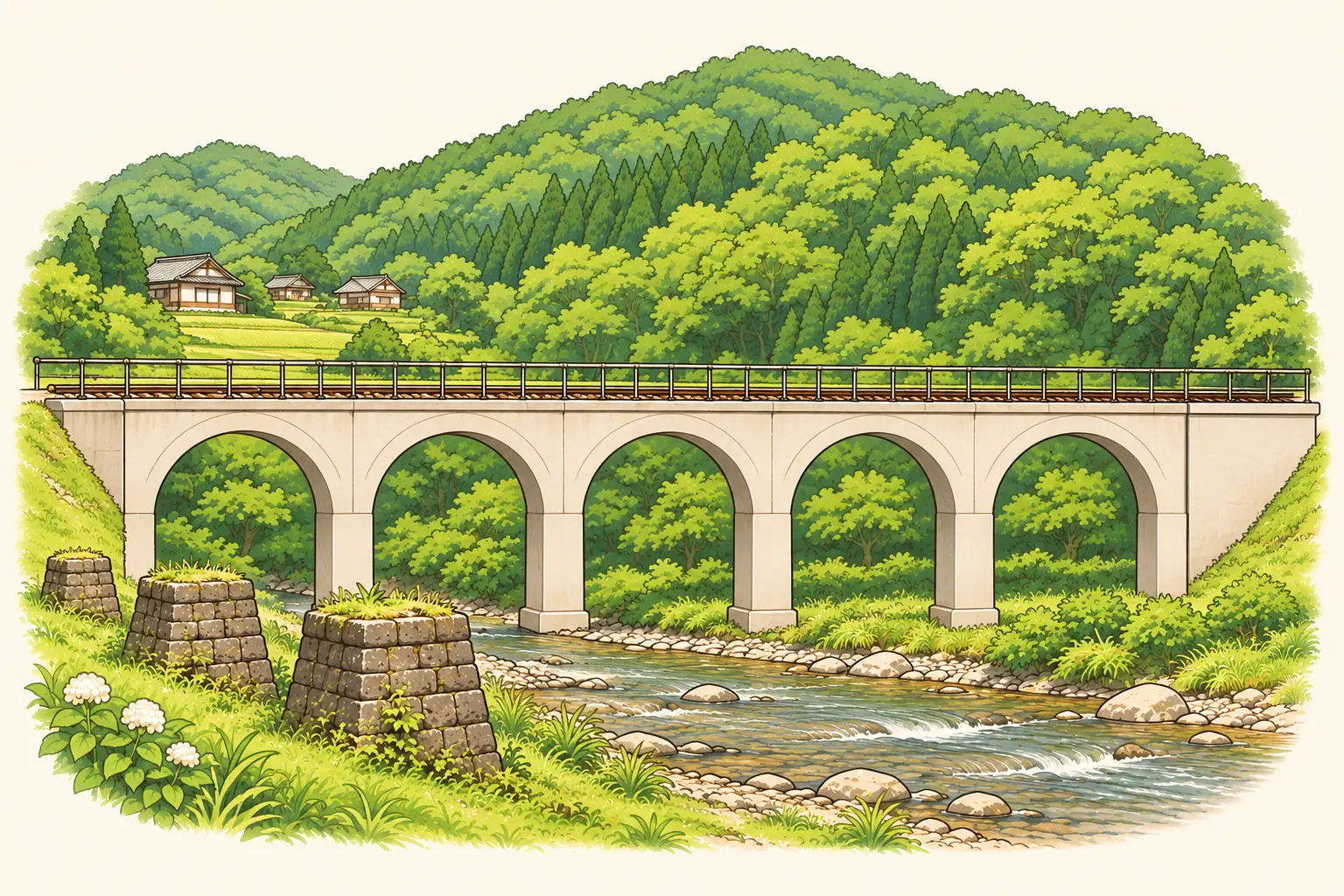
The Miyamorigawa Bridge on the Kamaishi Line, the five-arch "Spectacles Bridge," with stone piers from the light-railway era beside it.