
At a glance
Japan’s oldest poetry anthology, where emperors sit beside frontier guards and unnamed farmers: its key poets, its Chinese-character script, and the source of the Reiwa era name.
- The Man’yōshū is Japan’s oldest surviving anthology of poetry: 20 volumes, about 4,500 poems, the latest from 759.
- Its poets range from emperors and court poets to eastern farmers and frontier guards; more than 1,800 poems are anonymous.
- Ōtomo no Yakamochi has more than 470 poems in it, and most scholars regard him as the final compiler.
- Written before kana existed, the poems were recorded in Chinese characters; those used only for sound, man’yōgana, later gave rise to hiragana and katakana.
- The era name Reiwa, adopted in 2019, comes from the Chinese preface to a plum-blossom party held in 730.
The Man’yōshū, usually translated as the Collection of Ten Thousand Leaves, is the oldest surviving anthology of Japanese poetry. Its twenty volumes hold roughly 4,500 poems, most written over a little more than a century and ending in 759. Emperors and princesses sit beside court professionals, provincial officials, frontier conscripts, and farmers whose names nobody recorded. The poems are about love, grief, hunger, homesickness, wine, plum blossoms, and snow on Mount Fuji, and many of them still sound startlingly direct. When Japan chose the name of its current imperial era, Reiwa, in 2019, it took the words from this book. This introduction explains what the anthology is, who wrote in it, why it was so hard to read, and where a visitor to Japan can still find it.
01What kind of book it is
The title is itself a small puzzle. Man means ten thousand, shū means collection, and yō means leaf. "Leaves" may stand for words, as in the leaves of speech that grow from the heart, which would make the title "a collection of countless poems." Another reading takes yō in its older sense of "age" or "generation," so the book is meant to last ten thousand generations. Scholars have argued about this for centuries, and both readings remain in circulation.
The book has no preface and no named editor. It was clearly not compiled in one sitting. Internal evidence suggests several smaller collections were stitched together and expanded over decades, which is why the twenty volumes do not follow one plan. Some are arranged by reign. Some divide poems into three broad categories: zōka (miscellaneous poems, often public or ceremonial), sōmon (poems exchanged between lovers, friends, or family), and banka (laments for the dead). The last four volumes read almost like a personal poetic diary. Their owner was Ōtomo no Yakamochi, a statesman-poet with more than 470 poems in the collection, far more than anyone else. Most scholars regard him as the final compiler, and the very last poem in the book is his, a New Year’s verse composed in 759 while he served as governor of Inaba Province.
Three verse forms appear. The tanka, or short poem, has five lines of 5-7-5-7-7 syllables, 31 in all; there are about 4,200 of these, and the form would dominate Japanese poetry for the next thousand years. The chōka, or long poem, alternates lines of five and seven syllables for as long as the poet likes and closes on a seven-seven couplet; about 260 survive, often followed by one or two short "envoys" (hanka) that sum up or echo the theme. A handful of sedōka run 5-7-7-5-7-7, a shape that may come from call-and-response singing. The long poem faded quickly after this period, so the Man’yōshū is essentially the only place to read it at its best.
The anthology opens with a poem attributed to Emperor Yūryaku, who reigned in the late fifth century (Volume 2 has poems ascribed to an even earlier figure, Iwanohime, empress of Emperor Nintoku). He meets a girl gathering herbs on a hillside, admires her basket and digging stick, asks her name and home, and announces that he rules the land. It is almost certainly an old folk song attached to a legendary ruler, but it sets a tone: the book begins outdoors, with a proposal. The poems that can be reliably dated come from roughly the mid-seventh to the mid-eighth century, the years when the court moved between palaces in the Asuka area and finally settled at Nara.
02The court poets
The early star is Princess Nukata (Nukata no Ōkimi). She bore a daughter to Prince Ōama, the future Emperor Tenmu, and later joined the household of his elder brother, Emperor Tenji. In 668, during a royal hunt on the fields of Gamō, she addressed a poem to Ōama: as she walks through the fields of purple gromwell, the royal preserve, won’t the warden see you waving your sleeve at me? He answered that if he hated her, lovely as the purple flowers, he would hardly be longing for another man’s wife. For centuries readers took this as evidence of a dangerous love triangle between two royal brothers. Many modern scholars think the exchange was performed at the banquet after the hunt, a flirtatious joke in front of everyone, including Tenji. Either reading works, which is part of its charm.
Kakinomoto no Hitomaro, active under Empress Jitō and Emperor Monmu around the 690s, was later honored as the "saint of poetry." He was a court poet in the professional sense, writing grand long poems for imperial excursions and solemn laments for dead princes. His imagery can be huge. In one famous short poem composed on the Aki moor he sees the first light rising in the eastern fields, turns around, and finds the moon sinking in the west, dawn and moonset held in a single glance. Almost nothing is known of his life, not even when he died, and that gap filled up with legends.
Yamabe no Akahito, a younger contemporary, is the great landscape poet. His envoy on Mount Fuji describes coming out from Tago Bay and seeing the high peak white with fallen snow. A reworded version later entered the Hyakunin isshu, the classic set of one hundred poems by one hundred poets, where the snow "keeps falling" instead of "has fallen." The original is a finished view, sharp and still; the later version is softer and more dreamlike, and the difference is a neat lesson in how Japanese taste shifted between the eighth and thirteenth centuries.
03Wine, poverty, and plum blossoms
Yamanoue no Okura traveled to Tang China with a diplomatic mission in 702 and came back steeped in Chinese learning and Buddhist ideas. What he did with that learning was write about suffering. His "Dialogue on Poverty" is a long poem in which one poor man and one poorer man talk through a freezing night: no smoke from the stove, spiders spinning webs in the rice steamer, the village headman at the door with a whip demanding taxes. He also wrote about children, in lines that every Japanese schoolchild meets: silver, gold, jewels, what good are they? No treasure surpasses a child. Court poetry after the Man’yōshū almost never went near subjects like these.
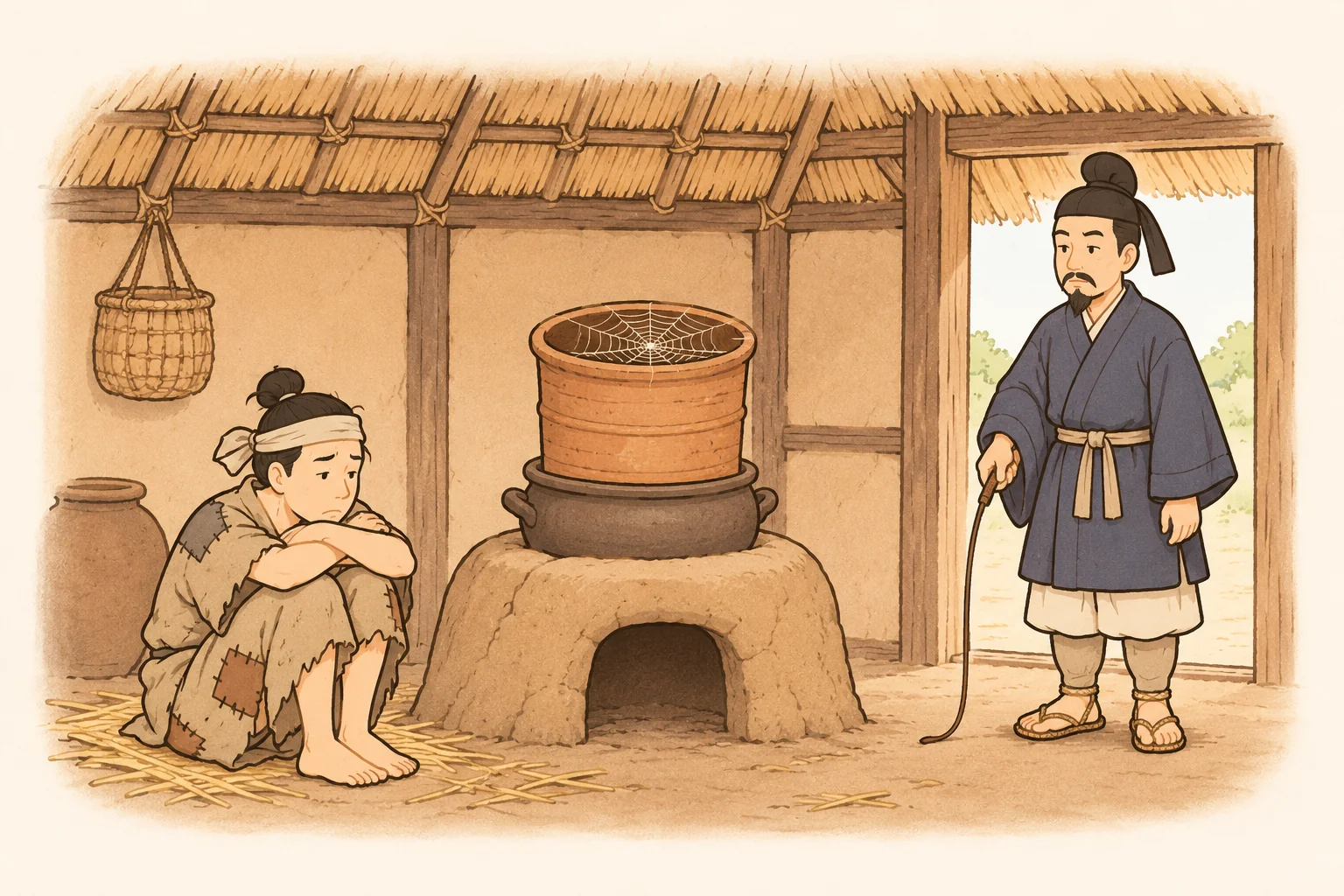
The poor man of the "Dialogue on Poverty," with the village headman demanding taxes at his door.
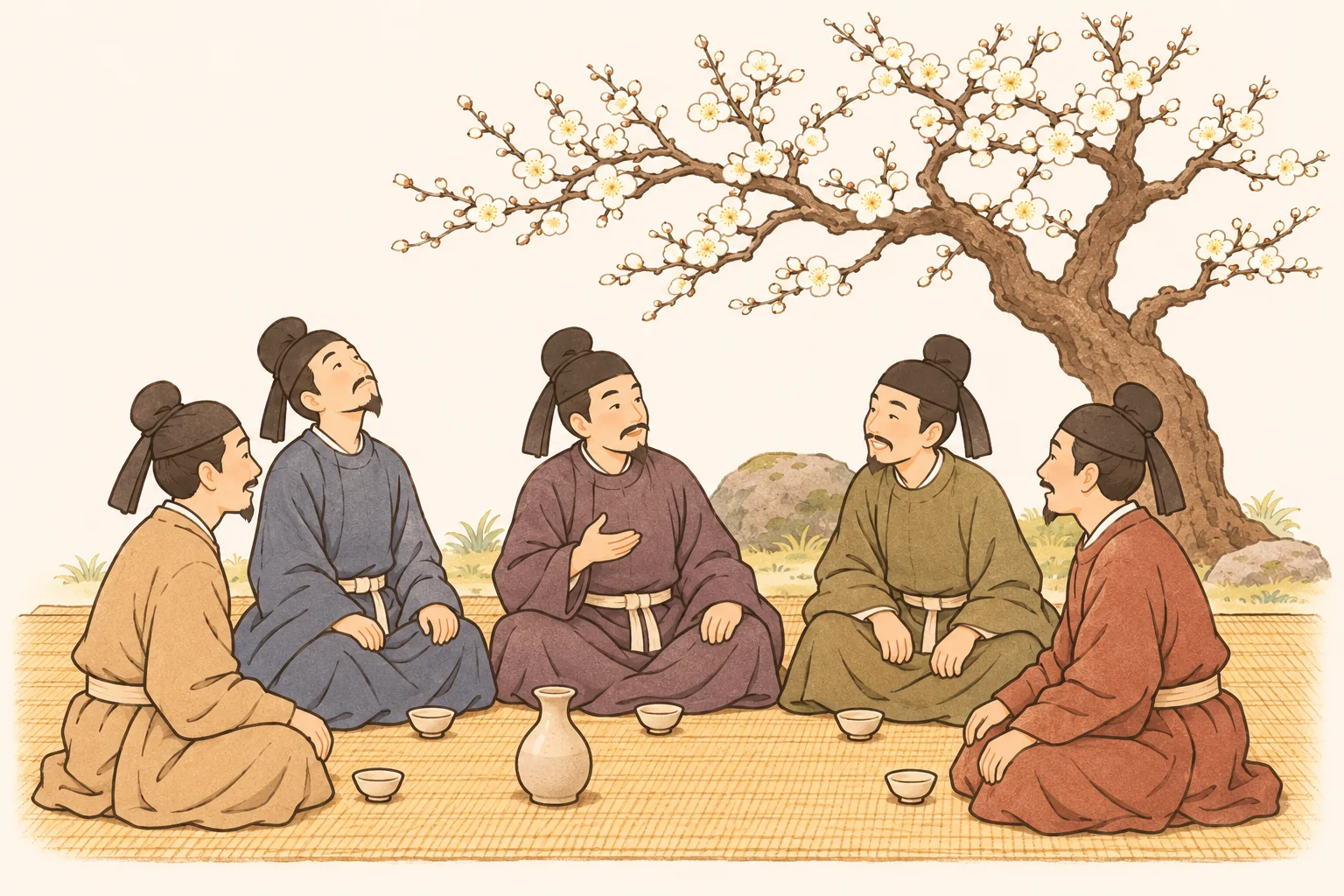
Poets at the plum-blossom party held at Dazaifu in 730.
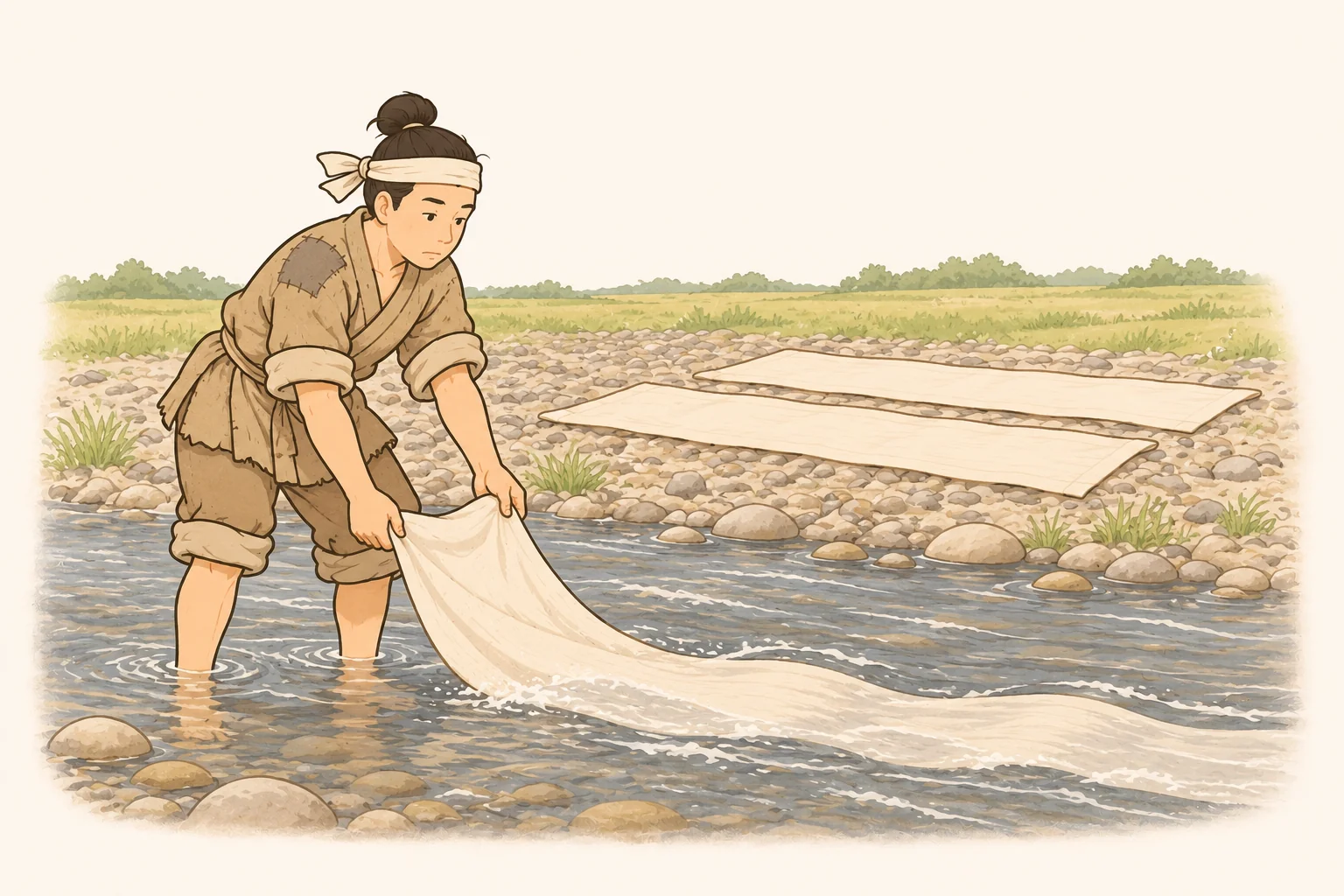
An eastern farmer rinsing handwoven cloth in the Tama River, from the azuma-uta.
A sakimori leaving for Kyūshū, his children clinging to the hem of his robe.
Ōtomo no Tabito, Yakamochi’s father, served late in life as governor-general of Dazaifu, the government outpost in northern Kyūshū that handled relations with the continent. He left a sequence of thirteen poems in praise of sake, arguing that it is better to get drunk and weep than to play the solemn sage. In the first month of 730 he held a plum-blossom party at his residence. Thirty-two people at the gathering each composed a poem on the blossoms, and the set was introduced by a preface in classical Chinese describing an auspicious early spring month when "the air is fine and the breeze is gentle." Two characters from that passage, rei and wa, became the name of the Reiwa era. Plum trees are generally thought to have arrived from China not long before, and they were still an exotic, fashionable flower, so the party itself was an exercise in continental elegance.
Yakamochi carried the anthology to its close. Posted as governor of Etchū Province, today’s Toyama Prefecture, from 746 to 751, he wrote some of his finest poems far from the capital. His style is more delicate and melancholy than his predecessors’, with a habit of solitude. One spring poem shows a garden glowing with peach blossoms and a young woman standing on the path below, lit by their color.
04The voices without names
More than 1,800 poems, about a third of the anthology, are by unknown authors, and these are among the most affecting. Volume 14 collects azuma-uta, "songs of the East," from twelve eastern provinces centered on today’s Kantō region around Tokyo and reaching west to Tōtōmi and Shinano. They are full of dialect and earthy detail: handwoven cloth rinsed and bleached in the Tama River, its swish becoming the sound of a lover asking why this girl is so painfully dear, couples meeting in fields, anxieties about mothers who might find out.
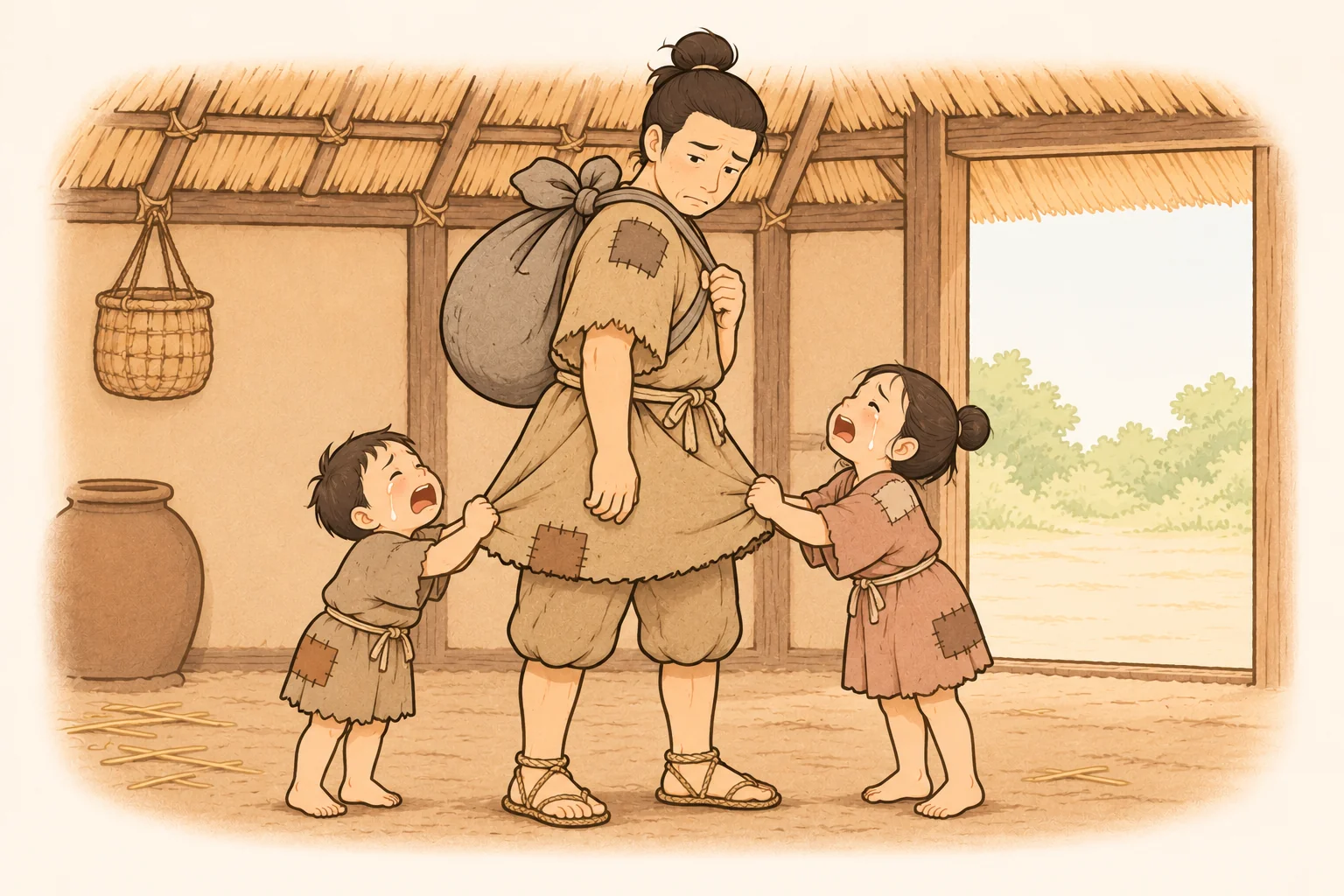
Volume 20 includes sakimori no uta, poems by frontier guards. These were men conscripted from the eastern provinces and sent to guard the coasts of northern Kyūshū for three years at a time. In 755 Yakamochi, then an official in the Ministry of War, oversaw the gathering of conscripts at Naniwa, the port that became Ōsaka, and had the poems they submitted collected. He kept 84 of them. They speak of a mother’s parting words, a wife left behind, and in one poem children clinging to the hem of their father’s robe and crying as he leaves them, motherless, to go to the frontier. Most of these men could not write. Their poems survive because a poetry-loving bureaucrat happened to be in charge of the paperwork.
This is the root of a modern idea that the Man’yōshū is a "national" anthology embracing everyone from emperor to commoner. The idea is somewhat inflated, since the commoners’ poems passed through officials’ hands and may have been polished. Still, compared with the imperial anthologies that followed, written almost entirely by aristocrats, its range of voices is remarkably wide.
05Japanese written in Chinese characters
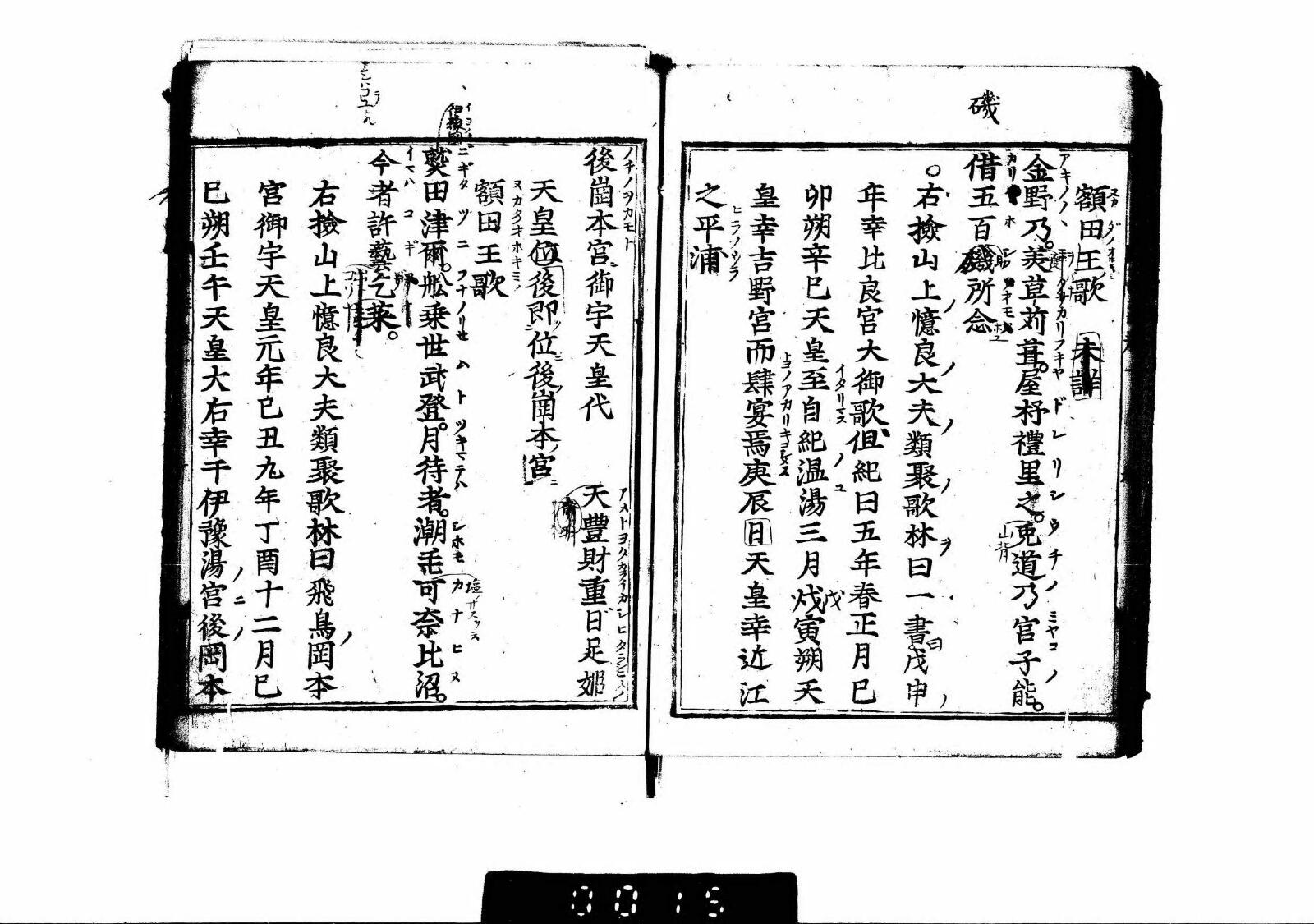
When the anthology was compiled, Japan had no kana syllabaries. Everything was written in Chinese characters, used in inventive and inconsistent ways. Sometimes a character was used for its meaning and read with the Japanese word. Sometimes it was used purely for its sound, regardless of meaning, so that two characters meaning "night" and "hemp" spelled yama, mountain. This sound-only use came to be called man’yōgana, and both modern kana scripts grew out of simplified forms of such characters.
Scribes also played games. The number sixteen could be written to spell shishi, because four times four is sixteen and shi means four. The phrase "a mountain on top of a mountain" could stand for the verb "to go out," because the character for "out" looks like two mountain characters stacked. These puzzles show people who knew Chinese writing intimately and enjoyed bending it.
| Written as | Read as | How it works |
|---|---|---|
| “night” + “hemp” | yama (mountain) | sound only: man’yōgana |
| “sixteen” | shishi | puzzle: four times four |
| “a mountain on top of a mountain” | “to go out” | puzzle: “out” looks like two mountains stacked |
The sound-only use came to be called man’yōgana, the source of both kana scripts; the puzzles bend Chinese writing for fun.
The cost was legibility. By the mid-tenth century the anthology had become difficult even for educated courtiers. In 951 Emperor Murakami assigned five scholars, among them Minamoto no Shitagō, to work out readings in the Pear Pavilion of the palace. Later generations carried the work forward: the monk Sengaku in the thirteenth century produced careful collations and commentary, and in the Edo period the scholar-monk Keichū and nativist thinkers such as Kamo no Mabuchi pushed further. A few lines are still disputed today. Any modern edition printed in kana represents a millennium of people slowly reading the book back into Japanese.
06Rediscovery and reuse
The next great anthology, the Kokin wakashū, commissioned in 905, set the standard for Heian court poetry: refined, witty, indirect. Beside it the Man’yōshū looked rough and plain. In the eighteenth century Kamo no Mabuchi turned that roughness into a virtue. He called the Man’yōshū style masuraoburi, manly and straightforward, against the taoyameburi, the feminine grace, of the Kokinshū, and he saw in the older book an authentic ancient Japanese spirit.
In the 1890s the poet Masaoka Shiki, famous also for reforming haiku, attacked the Kokinshū in a series of essays and held up the Man’yōshū as a model of honest, observed poetry. His followers founded the Araragi school, which made the Man’yō manner central to modern tanka. Since then the anthology has been a fixture of school textbooks.
It was also put to darker uses. During the Second World War a line by Yakamochi, "if we go to sea, corpses soaking in the water," was set to music as Umi Yukaba and sung as a solemn military anthem, and the frontier guards’ poems were promoted as models of loyal sacrifice. Postwar scholars pushed back, stressing how much of those poems is about missing home and family.
On April 1, 2019, the government announced the new era name Reiwa and explained that for the first time an era name had been drawn from a Japanese classic rather than a Chinese one. Commentators quickly pointed out that the plum-blossom preface echoes the Han-dynasty writer Zhang Heng’s "Return to the Fields," which describes a fine month of mid-spring with harmonious air, and that its setting recalls Wang Xizhi’s preface to the Orchid Pavilion poems. The exchange captured the anthology’s position nicely: it is the fountainhead of Japanese poetry, and it grew up inside a shared East Asian literary culture.
07Finding the Man’yōshū in Japan
The heart of Man’yō country is the Nara basin. In Asuka, the Nara Prefecture Complex of Man’yo Culture uses dioramas, film, and a large collection of paintings to bring the period to life. Around it, the names in the poems are still on the map: the three mountains of Yamato, Mount Miwa, Kagu, the Asuka River. Climb the low Amakashi hill for a view over the plain and you are looking at a landscape the poets knew. In Nara Park, the Man’yō Botanical Garden of Kasuga Taisha grows about 300 plants linked to those named in the anthology, each labeled with a poem.
Takaoka in Toyama, once the provincial capital where Yakamochi served, has the Takaoka Man’yō Historical Museum and statues of the poet. From the Amaharashi coast on a clear day you can see the Tateyama range rising beyond Toyama Bay, a view Yakamochi praised. In Kyūshū, the ruins of the Dazaifu government office and the small Sakamoto Hachimangū shrine nearby, thought to stand close to Tabito’s residence, became pilgrimage spots after the Reiwa announcement, especially in late winter when the plum trees bloom.
Across Japan, stone monuments carved with Man’yō poems stand at temples, parks, and roadside spots wherever a poem names the place, and travelers stumble on them constantly. For reading, English translations by Ian Hideo Levy and the older selection published by the Nippon Gakujutsu Shinkōkai are good starting points, and any Japanese bookstore’s paperback section will have pocket editions with modern Japanese translations for those who read the language.