
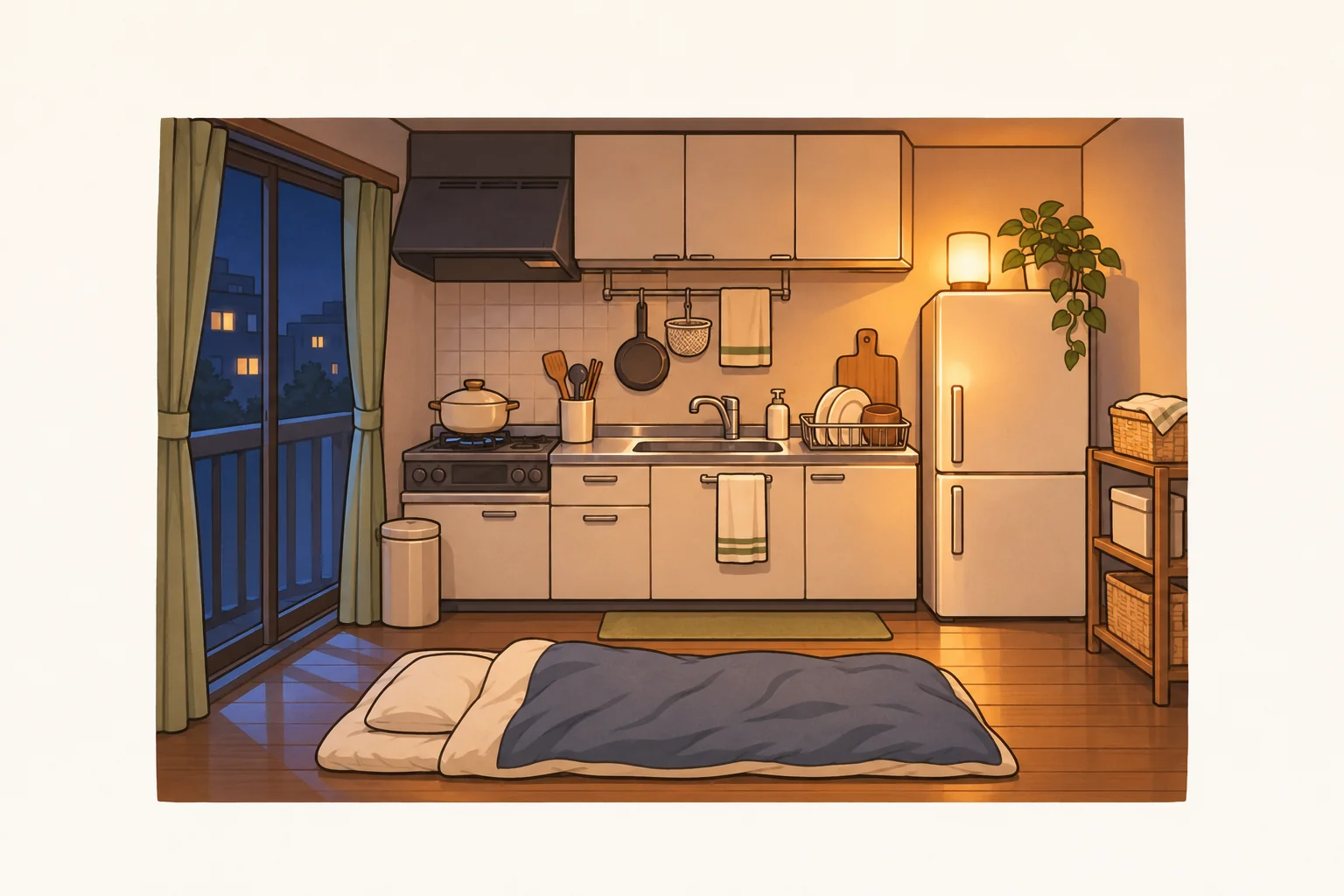
At a glance
How Yoshimoto Banana wrote grief through late-night kitchens and a bowl of katsudon, why Kitchen became a phenomenon, and which of her books to read next.
- Yoshimoto Banana, born Yoshimoto Mahoko in Tokyo in 1964, is the daughter of the postwar critic and poet Yoshimoto Takaaki.
- Kitchen won the Kaien Newcomer Writers Prize in 1987 and came out in 1988 in one volume with Full Moon and Moonlight Shadow.
- Around 1989 several of her books were on the year’s best-seller lists at once, and the press called it "Bananamania."
- The English translation of Kitchen, by Megan Backus, was published in the United States in 1993.
- Start with Kitchen; a good second book is Goodbye Tsugumi, set in a seaside town modeled on Toi in western Izu.
In 1988 a slim book called Kitchen, written by a 23-year-old recent graduate with a fruit for a pen name, became one of the best-selling books in Japan. Within a few years it had sold millions of copies at home and abroad, and "Yoshimoto Banana" (known in English as Banana Yoshimoto) had become, along with Murakami Haruki, one of the two Japanese contemporary writers most foreign readers could name. Her stories are short, plainly told and often about death: a grandmother gone, a lover killed in an accident, a parent murdered. Yet people read them for comfort. This is an introduction to who she is, why Kitchen struck such a nerve, which of her books to read next, and where in Japan you can find the places she writes about.
01A Critic’s Daughter with a Comic-Book Education
Yoshimoto Banana was born Yoshimoto Mahoko in Tokyo in 1964. Her father, Yoshimoto Takaaki, was one of postwar Japan’s most influential critics and poets, a thinker whose books were read with near-religious intensity by the student radicals of the 1960s. Her older sister, who publishes as Haruno Yoiko, became a manga artist.
Growing up in a house full of serious literature, Yoshimoto has said that what really shaped her was less the canon than girls’ comics (shōjo manga), especially the work of Ōshima Yumiko, and the horror novels of Stephen King. She wanted to write stories that felt the way those did: immediate, emotional, slightly uncanny.
The pen name came from the flowers of the banana plant, which she loved as a student; red ones, by some accounts. She has called it cute and purposely androgynous, and it was deliberately unliterary. The story goes that some early readers, seeing the name in hiragana, assumed she was a cartoonist.
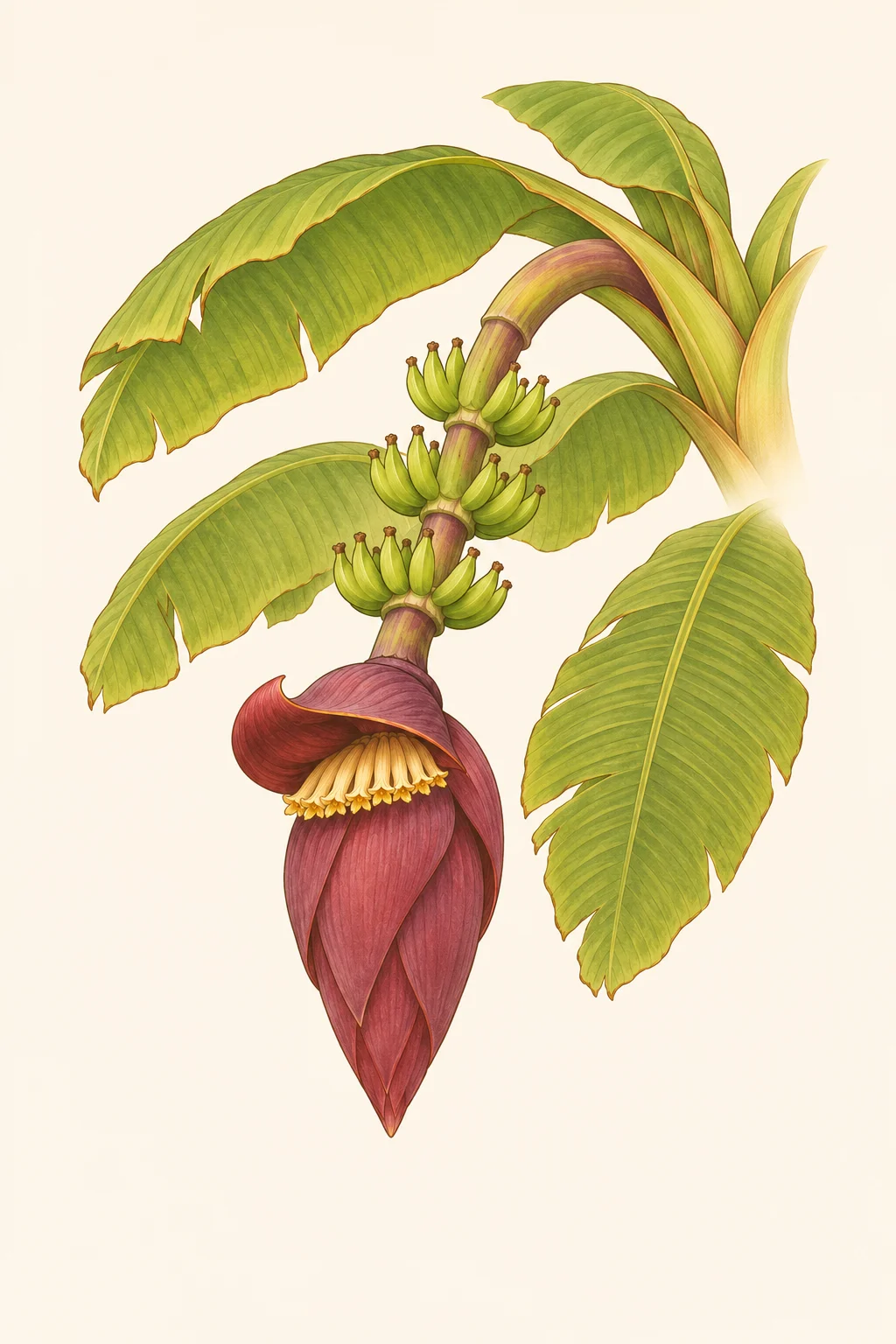
The hanging flower bud of a banana plant. Her pen name came from these flowers, which she loved as a student.
She studied creative writing in the College of Art at Nihon University. Her graduation piece, the novella Moonlight Shadow, won the dean’s prize of the College of Art and was later bundled with Kitchen. After graduating she worked as a waitress in a restaurant, reportedly in Tokyo, and is said to have written at night after her shifts. Kitchen came out of that period.
02Kitchen: The One Place She Can Sleep
The novel opens with a sentence every Japanese reader of a certain age knows: "The place I like best in this world is the kitchen."
The narrator, Sakurai Mikage, lost her parents young and was raised by her grandmother. As the book begins, the grandmother has just died, and Mikage is alone in the apartment. The only place she can fall asleep is on the floor beside the refrigerator, lulled by its hum. Then a young man named Tanabe Yūichi, who worked at the flower shop her grandmother liked, turns up and invites her to come and live with him and his mother, Eriko.
Eriko is dazzling. She runs a nightclub, buys appliances on impulse, and treats Mikage as if she has always belonged there. Only later does Mikage learn that Eriko was once Yūichi’s father; after his wife died, he had a sex-change operation and raised his son as a mother. Nobody in the Tanabe apartment is related to anyone else in the usual way, and yet it is the most functional family in the book. Mikage sleeps on their enormous sofa, a few steps from their wonderfully equipped kitchen. She starts cooking for them. Slowly, through meals and late-night television, she comes back to life.
In the sequel, Full Moon, published in the same volume, Eriko is killed by a man obsessed with her, and now it is Yūichi who falls apart. Mikage, by this point an assistant to a cookery teacher, is away on a work trip. Late one night she eats a superb bowl of katsudon, pork cutlet and egg over rice, at a small restaurant and is overwhelmed by the wish that Yūichi could taste it too. She has a second bowl packed up, takes a taxi through the night to the inn where he is staying, climbs onto a roof and in through his window, and hands it to him while it is still warm. It is the most famous scene in all her work. There is no grand speech; the bowl of rice speaks first, and what it says is: keep living, I’m here.
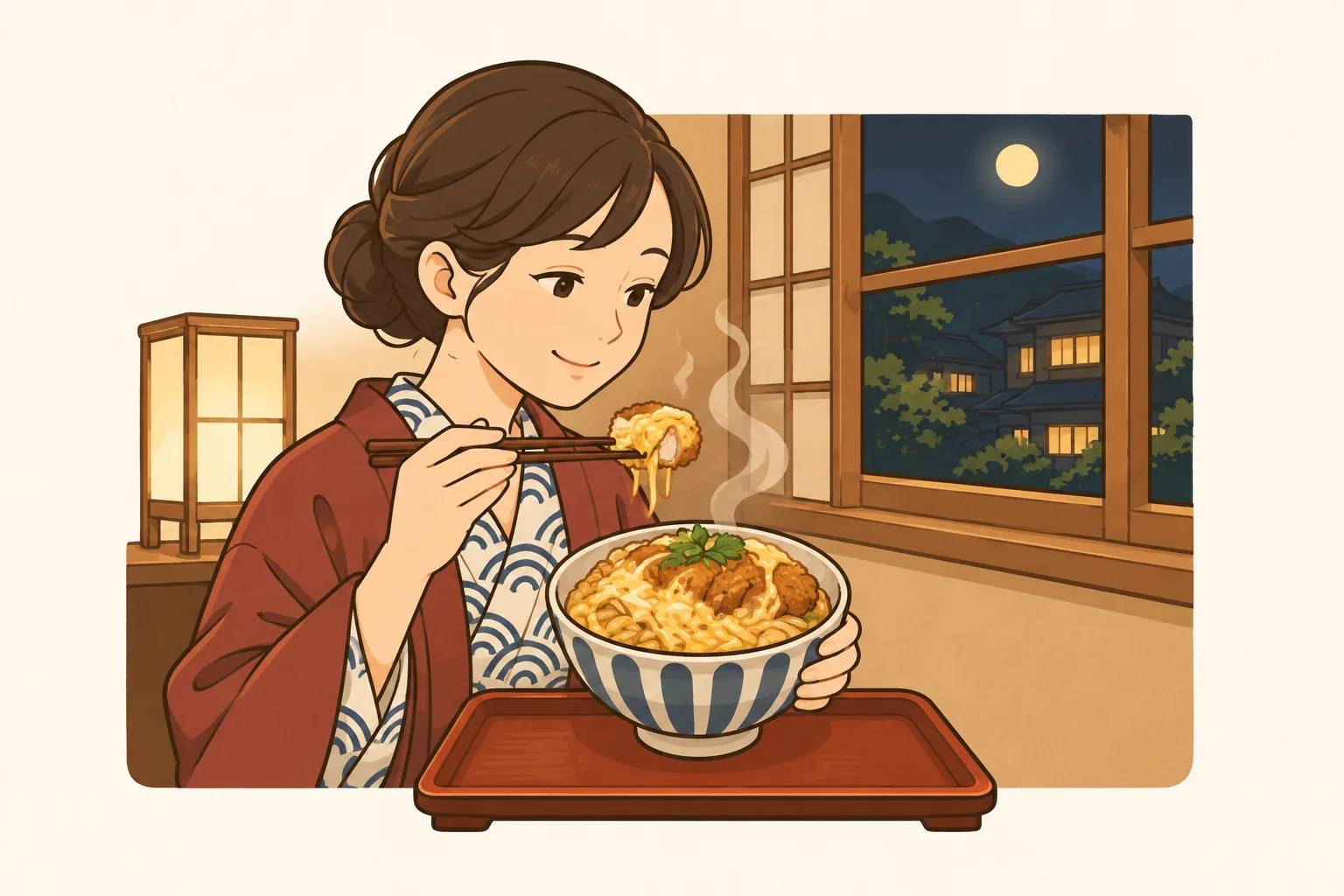
The still-warm katsudon Mikage carries through the night to Yūichi's window at the inn (illustration).
What made this land so hard in Japan? Partly timing. The late 1980s were the height of the bubble economy, a period of easy money, glittering nightlife and, for many young people, a feeling of emptiness underneath. Kitchen did not offer a grand diagnosis. It described grief with great precision, as insomnia, as not wanting to eat, as waking up on someone else’s couch, and it described recovery with the same precision: a clean kitchen, hot food, someone awake in the next room. The prose was as light and conversational as a letter from a friend. Older critics found it thin. Younger readers found it exactly true.
Kitchen won the Kaien Newcomer Writers Prize in 1987 and appeared as a book in early 1988. By 1989 Yoshimoto had several titles on the year’s best-seller lists at once, and the press was talking about "Bananamania."
03The World of Her Fiction
Read a few of her books and certain things keep returning.
The first is mourning. In Moonlight Shadow, a young woman named Satsuki has lost her boyfriend in a car crash. She takes up jogging at dawn just to get through the hours, and at a bridge over the river she meets a strange woman called Urara who promises her a chance to say goodbye, a rare phenomenon that happens only once in a long while. Meanwhile her boyfriend’s younger brother, who lost his own girlfriend in the same accident, has started going to school in her sailor-suit uniform. Nobody tells him to stop. In Yoshimoto’s fiction grieving people are allowed to be odd, and the oddness is treated with tenderness rather than alarm.
The second is night and sleep. Asleep (Shirakawa Yofune) follows a woman who sleeps more and more, avoiding her life, while her lover’s wife lies in a coma. Many of Yoshimoto’s best scenes happen between midnight and dawn, the hours when people are least defended.
The third is food, always ordinary: katsudon, ramen, rice porridge, a convenience-store pudding. Eating, in her books, is the smallest unit of staying alive.
The fourth is the unconventional family. Transgender parents, half-siblings, children with psychic gifts, households assembled by chance. She does not write these as problems to be solved. They are simply the people next door, which was unusual in Japanese fiction of the 1980s and helped win her a loyal queer readership abroad.
There is also a strong vein of the spiritual and the supernatural. In the long novel Amrita, the heroine’s little brother begins to show psychic powers; the later Kingdom series follows a young woman raised in the mountains by a grandmother who makes herbal medicines. Some readers love this side of her work; others find it too soft-focus. Japanese critics have argued about her for nearly forty years, some dismissing her as a writer of glorified girls’ comics, others crediting her with giving literary form to a generation’s real emotional life. She is often paired with Murakami: both broke through in the late 1980s, both wrote in a light, colloquial voice, and both seemed to signal a break with the heavy, politically charged literature of the postwar decades.
From the early 2000s until 2015 she signed her work entirely in hiragana, without the kanji surname, before returning to the original form.
04Abroad: Italy First, Then Everywhere
Her foreign success came early and was especially intense in Italy, where the translation of Kitchen became a best-seller in the early 1990s and she won several literary prizes, including the Scanno Prize. Italian newspapers treated her as the face of contemporary Japan for much of that decade.
The English translation of Kitchen, by Megan Backus, was published in the United States in 1993 and was widely reviewed. It remains the book most English-language readers meet first, and it is still in print.
Kitchen has been filmed twice: by Morita Yoshimitsu in Japan in 1989, and in 1997 by the Hong Kong director Yim Ho, whose version moved the story to Hong Kong. Tsugumi was filmed in 1990 by Ichikawa Jun, with Makise Riho as the title character.
05Where to Start
Start with Kitchen. The English edition contains Kitchen, Full Moon and Moonlight Shadow, and can be read in an afternoon. Almost all of her early themes are there.
Next, try Goodbye Tsugumi (published in Japan as TUGUMI). The narrator, Maria, looks back on her last summer in a small seaside town where she grew up, and above all on her cousin Tsugumi: frail since birth, beautiful, foul-mouthed, cruel, and braver than anyone around her. The town is modeled on Toi, on the western coast of the Izu Peninsula, where Yoshimoto is said to have spent every summer with her family as a child. It is one of her brightest books, full of sea air and the feeling of a season about to end.
If you want more of her writing on loss, NP is a stranger, darker novel about a cursed manuscript and the people connected to it, and Amrita is a long, wandering book about a family after a death. For something from her later career, Moshi Moshi follows a young woman whose father dies in a mysterious double suicide; she moves to the Shimokitazawa neighborhood of Tokyo, works in a small bistro, and is joined, unexpectedly, by her mother. It doubles as a love letter to the neighborhood.
06Finding Yoshimoto Banana in Japan
Any Japanese bookstore will have her in paperback. Look for the small bunkobon editions, a few hundred yen each as of 2026, from publishers such as Shinchōsha, Kadokawa and Gentōsha. Her Japanese is simple and conversational, with short sentences and everyday vocabulary, and many learners of the language choose Kitchen as the first novel they read all the way through in the original.
For the real thing, go to Shimokitazawa, a few stops from Shibuya or Shinjuku. Yoshimoto is said to have lived in the area for years and wrote an essay collection about it, and the narrow lanes, secondhand clothing shops, small theaters and cafés of Moshi Moshi are still there. Go on a weekday evening, eat something simple at a small restaurant, and you will be closer to her books than at any monument.
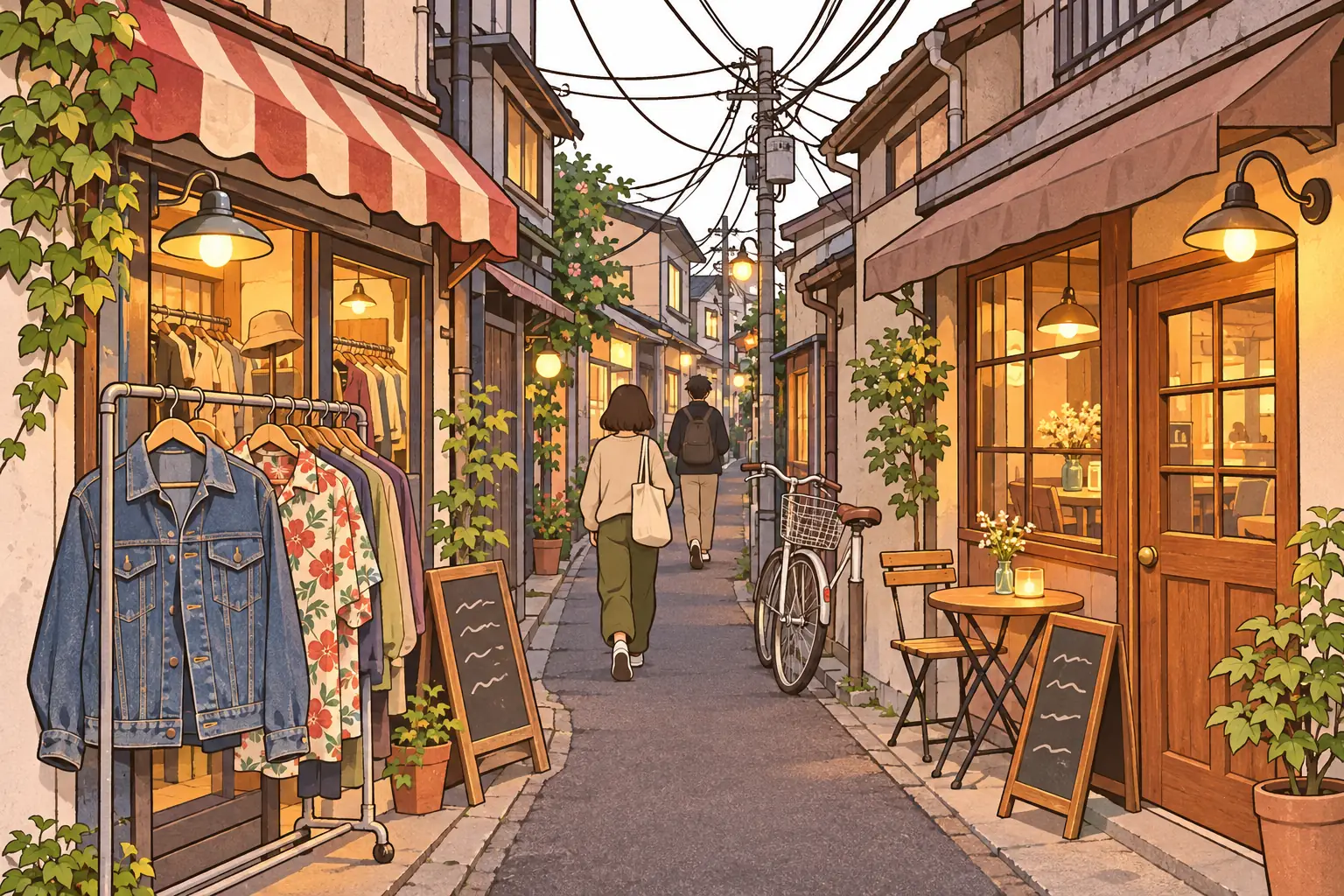
A narrow Shimokitazawa lane on a weekday evening, lights just coming on in vintage shops and small cafés (illustration).
In summer, the west coast of the Izu Peninsula is Tsugumi country. Toi is about 50 minutes by bus from Shuzenji Station, or about 90 minutes by the Suruga Bay ferry from Shimizu Port (both as of 2025), and has small inns, a fishing harbor and clear water. There is no museum or plaque. It is just an ordinary seaside town, which suits her.
Many Japanese readers say her books are best read on a night when you cannot sleep. If you are staying somewhere with a small kitchen, a late trip to the convenience store for a rice ball and a pudding, and a few pages of Kitchen under the lamp, is about as faithful an introduction as you can get.