

At a glance
Traces Japanese crime fiction from Ranpo’s grotesque tales through Seichō’s social realism and the shin-honkaku revival to Higashino, with a suggested reading order for newcomers.
- Japanese readers divide the genre into honkaku, centered on the puzzle, and the social school, centered on motive and background.
- Edogawa Ranpo’s "The Two-Sen Copper Coin," published in Shin Seinen in 1923, is seen as the start of original Japanese detective fiction.
- Matsumoto Seichō’s Points and Lines, serialized from 1957, launched the social school; its puzzle turns on a four-minute window at Tokyo Station.
- Ayatsuji Yukito’s The Decagon House Murders (1987) opened the way for the writers called shin honkaku, the "new orthodox."
- Higashino Keigo’s The Devotion of Suspect X (2005) won the Naoki Prize and topped all three major mystery rankings.
Japan reads more crime fiction than almost anywhere else, and it reads it with unusual seriousness about the rules. Japanese fans argue over whether a solution played fair, sort writers into schools, and wait each December for the annual rankings the way film fans wait for award season. In the last two decades the books have also traveled: Higashino Keigo, Miyabe Miyuki, Shimada Sōji and Ayatsuji Yukito now sit on English-language shelves, and "locked-room mystery" and "honkaku" have become small selling points in their own right. This is an introduction to the tradition behind them: where it came from, the arguments that shaped it, the writers worth starting with, and where to find its traces if you go to Japan.
01Puzzle versus society
Two words will get you most of the way through any conversation about Japanese mystery fiction. The first is honkaku, "orthodox" or "authentic," which means the puzzle mystery in the Golden Age mold: an impossible crime, clues laid out in plain sight, a detective who gathers everyone in one room, and a solution the reader could in principle have reached. The second is shakai-ha, the "social school," which treats the crime as a window into the society that produced it. A shakai-ha novel cares less about how the body got into the sealed room than about why a person was driven to kill: poverty, corruption, the war, discrimination, a past that cannot be spoken of.
For about a century these two impulses have taken turns at the front. Prewar writers built Japanese detective fiction out of Poe and Conan Doyle, with a strong streak of the grotesque. The postwar years brought a burst of pure puzzle writing. Matsumoto Seichō then pulled the genre out into the streets in the late 1950s, and the social school dominated for decades. In 1987 a group of young writers struck back with what critics called shin honkaku, the "new orthodox" school, and Higashino Keigo, the most popular writer of the genre in recent decades, has spent his career finding ways to satisfy both camps at once.
A third term is worth knowing. Henkaku, "unorthodox," was the prewar label for stories that leaned toward horror, fantasy and abnormal psychology rather than deduction. Much of Japanese horror, and a fair amount of manga, descends from it.
Even the genre’s name has a history. Before the war it was tantei shōsetsu, "detective fiction." After 1946, when the government issued a list of characters approved for general use, the tei of tantei was left off, and publishers drifted toward suiri shōsetsu, "deduction fiction." Today most Japanese simply say misuterī, borrowed from English.
02Edogawa Ranpo and the grotesque
Western detective stories reached Japan in the Meiji period, mostly through Kuroiwa Ruikō, a newspaperman who from the late 1880s serialized loose adaptations of European crime novels with the names and places made Japanese. In 1917 the playwright Okamoto Kidō, an admirer of Sherlock Holmes, began Hanshichi torimonochō, detective stories set in old Edo with a police informant as hero; the torimonochō, or period detective story, is still a living genre. But the writer who gave Japan a detective fiction of its own was Hirai Tarō, who took the pen name Edogawa Ranpo.
Say the name aloud with a Japanese accent and you get Edgar Allan Poe. Born in 1894 in Nabari, in Mie Prefecture, Ranpo drifted through jobs, among them a clerk’s post at a shipyard and a secondhand bookshop he ran with his two younger brothers in Tokyo, and by some accounts spells as a reporter and selling ramen, before his story "The Two-Sen Copper Coin" appeared in the magazine Shin Seinen in 1923. Built around a cipher, it is usually counted as the first original Japanese detective story of note. Two years later, in "The Case of the Murder on D. Hill," he introduced Akechi Kogorō, a scruffy young amateur in a rumpled kimono who scratches his tangled hair when he thinks. Akechi went on to become Japan’s best-known fictional detective.
What made Ranpo lasting was less his deduction than his darkness. In "The Human Chair" a craftsman sews himself inside an armchair he has built and lives there, feeling the people who sit on him. In "The Stalker in the Attic" a bored young man crawls through the crawlspace above a boarding house, peering down at his neighbors until he decides to kill one of them. These stories, with their voyeurism and their fascination with bodies and disguise, are the root of the henkaku tradition, and they still read as genuinely strange. In 1936 Ranpo turned to children’s fiction with The Fiend with Twenty Faces, in which Akechi and a club of boy detectives battle a master thief of endless disguises. Generations of Japanese children met mystery fiction through that series.
After the war Ranpo became the genre’s patron. He helped found the Detective Authors Club, which later became the Mystery Writers of Japan, and in 1954 the Edogawa Ranpo Prize was created to mark his sixtieth birthday. Within a few years it became an open competition for unpublished novels, and it remains one of the main doors through which new crime writers enter the profession. His house in Ikebukuro, Tokyo, with the earthen-walled storehouse where he kept his books (often called the "Castle of Illusions," after the title of one of his essay collections), passed to Rikkyō University in 2002 and is open to visitors.
Ranpo’s era produced stranger books still. Oguri Mushitarō’s The Black Death Mansion Murders and Yumeno Kyūsaku’s Dogra Magra, together with Nakai Hideo’s postwar Offerings to Nothingness, are known in Japan as the "three great strange books," dense, digressive, almost anti-mysteries that readers still attempt as a kind of endurance test.
03Yokomizo Seishi and the haunted countryside
Detective fiction was effectively banned from publication during the later war years, and when the war ended the pent-up appetite for puzzles was enormous. Yokomizo Seishi, who had sat out the war in a village in Okayama, met it with The Honjin Murders in 1946: a locked-room killing on the wedding night of the heir to an old inn family, with a Japanese sword, a koto string, and an unbroken field of snow outside. The book introduced Kindaichi Kōsuke, a stammering, shabby detective in a worn kimono and hakama who scratches his head so hard when excited that dandruff flies.
Over the next decade Yokomizo built a whole landscape out of rural Japan: decaying great houses, feuding heirs, curses, old songs, isolated islands. In Gokumon Island the bodies are arranged to match lines from haiku; in The Village of Eight Graves a sixteenth-century massacre of samurai hangs over the present. This gloomy, ornate atmosphere is, for many readers, the essence of the Japanese mystery. In the 1970s the publisher Kadokawa reissued Yokomizo in paperback and in 1976 released a film of The Inugami Curse, directed by Ichikawa Kon, as the first of its own productions. Its image of a corpse plunged head-first into a lake, frozen over in some tellings, legs sticking straight up out of the surface, is one of the most recognizable shots in Japanese popular culture, endlessly parodied. The hero of the manga The Kindaichi Case Files is supposed to be Kōsuke’s grandson.
04Matsumoto Seichō and the social school
The writer who turned the genre around was a late starter with almost no formal education. Matsumoto Seichō was born in 1909 and grew up in Kokura in northern Kyūshū. He left school after the upper elementary level, worked as an apprentice printer and later designed advertisements for the Asahi Shimbun’s western office. He began publishing fiction in his forties and won the Akutagawa Prize, Japan’s leading literary award for new writers, in 1953 for a story about a man obsessed with reconstructing the lost Kokura diary of the novelist Mori Ōgai. He came to the mystery, in other words, from serious literature.
His breakthrough was Points and Lines, serialized in the travel magazine Tabi from 1957 and published as a book in 1958. Its puzzle turns on a railway timetable. At Tokyo Station there is a four-minute window each day when, from Platform 13, you can see across the intervening tracks to the express bound for Kyūshū standing at Platform 15. Two witnesses happen to see a man and a woman board it in that window; days later the couple is found dead on a beach in Fukuoka, apparently a double suicide. A detective who finds the sighting too convenient spends the book dismantling an alibi built out of trains and flights. The mechanics are classic puzzle, but what readers remembered was the setting: a bribery scandal in a government ministry, a junior official sacrificed to protect his superiors, and the sense that the real culprits sit above the reach of the police. Together with The Wall of Eyes, published the same year, it set off a "Seichō boom."
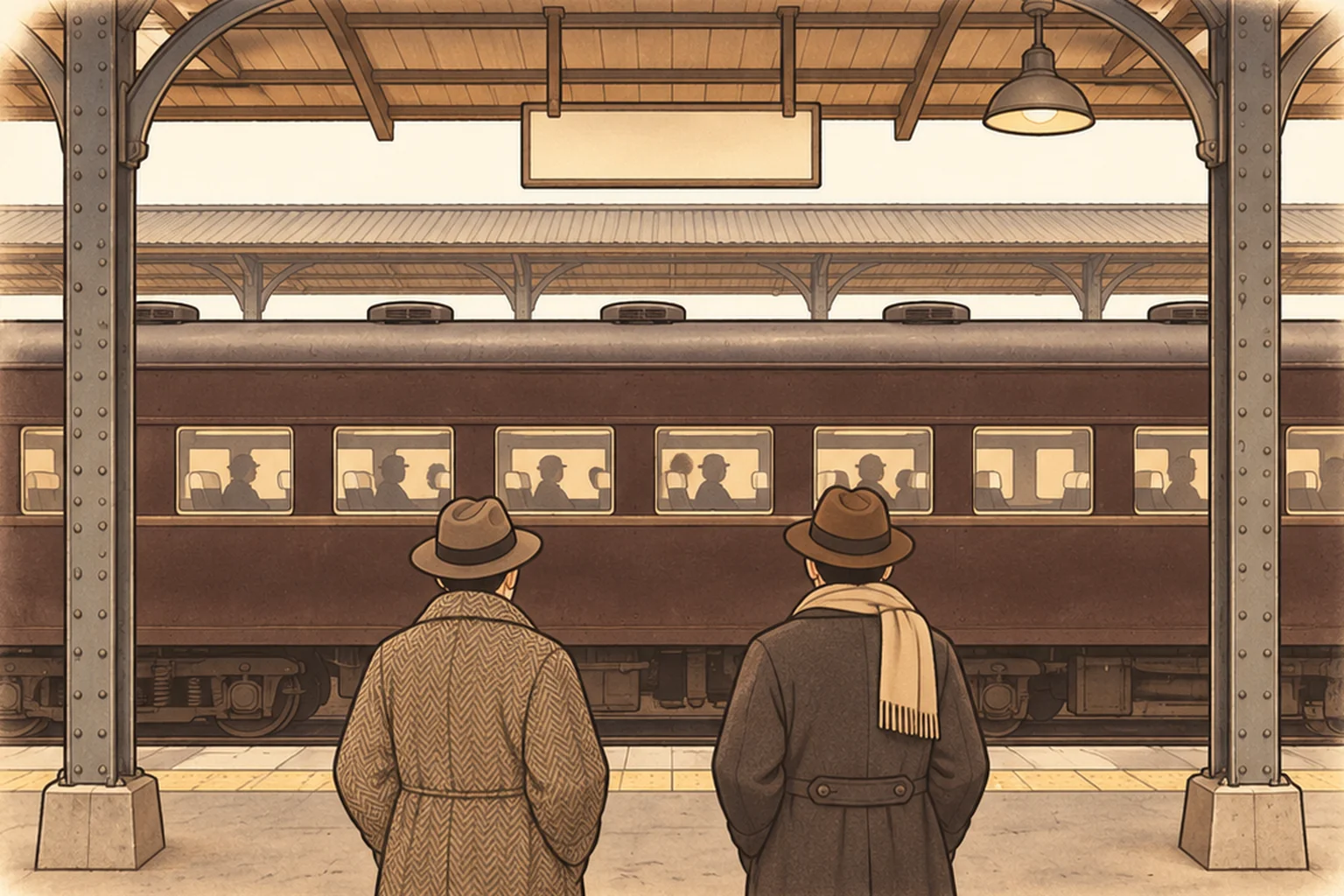
Most of the day, trains on the intervening tracks block the view across.
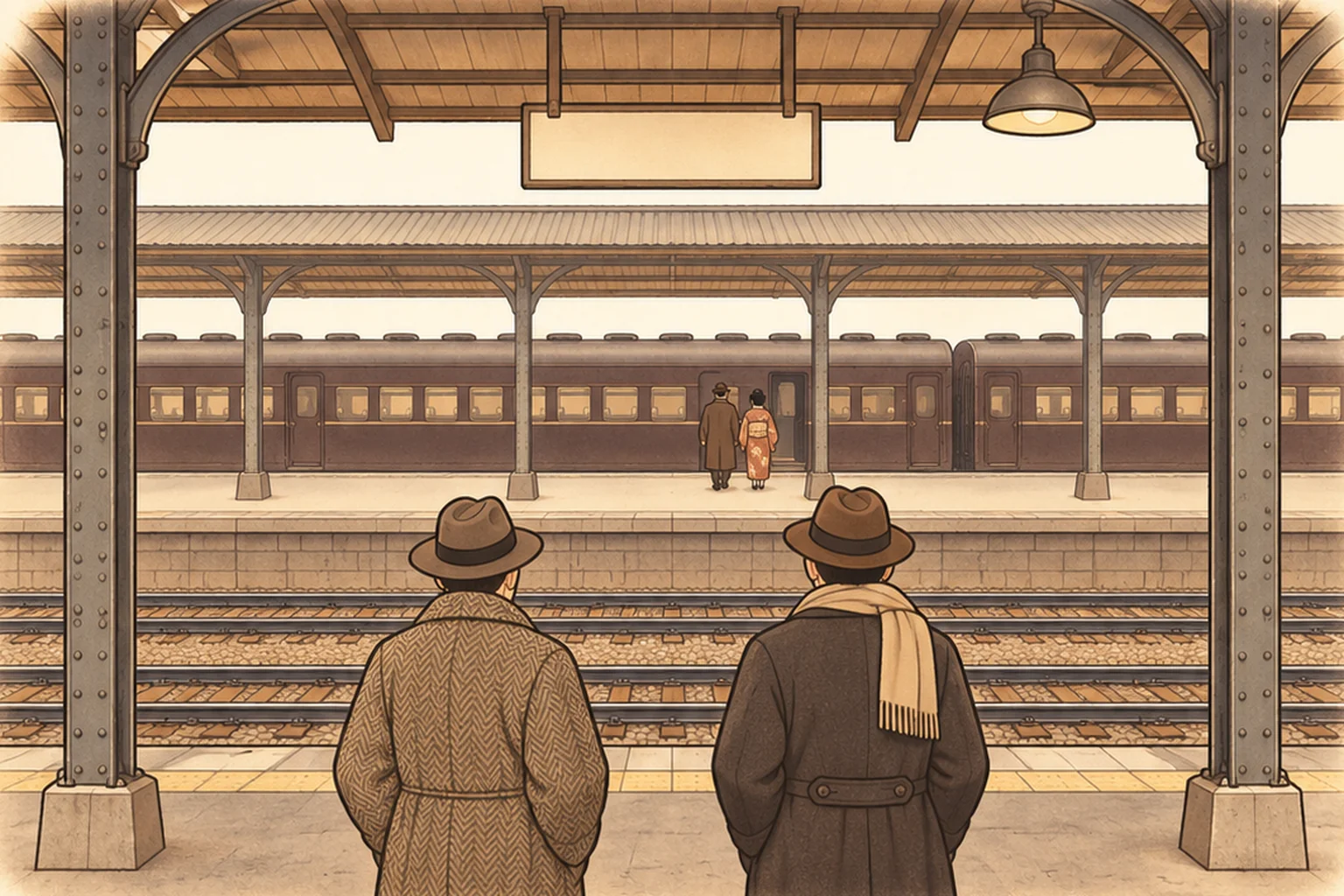
For four minutes each day the tracks are clear, and the express bound for Kyūshū can be seen.
Seichō said he wanted to take the mystery out of the haunted house and put it into real life. His killers are ordinary people pushed into corners, and his plots keep returning to what postwar Japan preferred to forget. Zero Focus reaches back to the Occupation years. Inspector Imanishi Investigates, published in Japanese as Suna no utsuwa ("vessel of sand") after serialization in the evening edition of the Yomiuri Shimbun in 1960 and 1961, follows a detective tracing a murder through a dialect clue to a remote corner of Shimane, and ends with a rising young composer whose crime is an attempt to bury his origins: his father had leprosy, and the two of them were driven out to wander the country. Nomura Yoshitarō’s 1974 film of the novel, with its long wordless sequence of father and son walking through the seasons to the composer’s own symphony, is still regularly named among the most affecting Japanese films ever made.
- 1Platform 13, Tokyo Stationlooking across the tracks to Platform 15
- 2A four-minute window each daythe express bound for Kyushu is in view
- 3Two witnessesa man and a woman board
- 4A beach in Fukuokathe couple found dead, apparently a double suicide
- 5The detective dismantles the alibitrains and flights
The whole puzzle rests on a timetable: a sighting that is too convenient leads to an alibi built out of trains and flights.
Seichō was astonishingly productive, writing hundreds of works including histories, studies of ancient Japan and nonfiction such as The Black Fog of Japan, which reopened unsolved postwar cases. He died in 1992. Through the 1960s and 1970s the social school was the mainstream. Mizukami Tsutomu’s Straits of Hunger and Morimura Seiichi’s Proof of the Man are among its best-known works. Its success had a cost: a flood of imitators produced plodding procedurals heavy on legwork and gloom and light on puzzle, and by the end of the 1970s the classic puzzle mystery looked old-fashioned.
05The new orthodox
Puzzle writing never disappeared. Ayukawa Tetsuya kept producing meticulous railway alibis, and in 1981 Shimada Sōji published The Tokyo Zodiac Murders, in which an artist in prewar Tokyo leaves a plan to assemble a perfect woman from parts of six young women, and the women are then found dead. Shimada’s solution is one of the most celebrated tricks in the genre, and he openly challenges the reader to solve it before the reveal.
The real turn came in 1987, when the publisher Kōdansha brought out The Decagon House Murders by Ayatsuji Yukito, a young writer from the mystery club at Kyoto University. A group of students from a university mystery society, who call each other by the names of Western crime writers such as Poe, Carr and Christie, go to stay on an island where a strange ten-sided house stands near the burnt ruins of a mansion, and begin to die one by one. It is a deliberate homage to And Then There Were None, and its solution arrives in a single line that has become one of the best-loved shocks in Japanese reading. Behind the debut were Shimada, who championed the young writers, and Kōdansha editor Uyama Hideomi.
Over the next few years Norizuki Rintarō, Abiko Takemaru, Arisugawa Alice and Utano Shōgo followed, and the movement was named shin honkaku. These writers embraced everything the social school had scorned: isolated islands, snowbound mountain lodges, eccentric architecture, genius detectives, explicit challenges to the reader. Critics complained that their characters were chess pieces. Young readers did not care, and the movement never really ended. In the 1990s Kyōgoku Natsuhiko debuted with The Summer of the Ubume, the first of a series of brick-thick novels that wrap their crimes in folklore, Buddhism and psychology, and Mori Hiroshi won the first Mephisto Prize with The Perfect Insider, a cool, engineer’s locked-room mystery set in a research lab on an island.
The new orthodox school sharpened a weapon Japanese writers now wield better than anyone: the narrative trick, or jojutsu torikku. Instead of hiding something in the crime, the author hides it in the telling, letting the reader’s assumptions about a narrator’s sex, age or place in time do the deceiving. Utano Shōgo’s 2003 novel whose title translates roughly as Thinking of You as the Cherry Leaves Come Out is the famous example. Such books are nearly impossible to film, which is part of their appeal: the effect exists only on the page.
06Higashino Keigo
Ask a Japanese reader, or a Chinese or Korean one, to name a single modern mystery writer, and the answer will almost always be Higashino Keigo.
Higashino was born in Ōsaka in 1958, studied electrical engineering at Osaka Prefecture University and went to work as an engineer at the auto-parts maker Nippondenso, now Denso. In 1985 he won the Edogawa Ranpo Prize with After School, a mystery set in a girls’ high school, and soon left his job to write full-time. For more than a decade he wrote prolifically in every mode, puzzle, social, comic, science-fictional, without much commercial success. The breakthrough was Naoko (in Japanese simply Himitsu, "secret"), published in 1998: after a bus crash, a dead mother’s mind wakes up inside her surviving daughter’s body. There is no murder; the mystery is how a family survives an impossibility. It won the Mystery Writers of Japan Award and was filmed. The following year came Journey Under the Midnight Sun, which follows a boy and a girl for nearly two decades after a pawnbroker’s murder in Ōsaka. The two almost never appear together, and the reader pieces together their bond from the outside.
Then, in 2005, The Devotion of Suspect X. A brilliant, unappreciated mathematics teacher helps the woman next door cover up the killing of her abusive ex-husband, and constructs an alibi of chilling precision. His opponent is his old university classmate, the physicist Yukawa Manabu. The novel won the Naoki Prize, Japan’s top award for popular fiction, along with the Honkaku Mystery Award, and topped all three major year-end rankings. Japanese critics argued at length over whether it counted as honkaku, and the argument shows what Higashino had pulled off. The trick is clever enough to satisfy puzzle purists, and the weight of the reveal comes from character, which is why readers who never touch mysteries finish it in tears.
Higashino keeps two long-running series. In the Galileo books, Yukawa uses experiments to demystify crimes that seem supernatural; the 2007 television adaptation starring the singer and actor Fukuyama Masaharu made his catchphrase, jitsu ni omoshiroi, "truly fascinating," a national joke. The other follows the detective Kaga Kyōichirō. In Malice he unpicks a writer’s murder through a duel of written testimonies; in Newcomer he has just been transferred to Nihonbashi Ningyōchō in Tokyo, and each chapter solves a small mystery in a different shop along its old streets, a rice-cracker maker, a clockmaker, a china shop. The book sent readers to walk the neighborhood. The Miracles of the Namiya General Store (2012), a gentle novel about an old shop where letters cross time, has almost no crime at all and became a phenomenon in China, where that book alone is reported to have sold more than ten million copies and was filmed with Jackie Chan. Higashino died of colorectal cancer in July 2026, at 68.
Around him the field has grown very wide. Miyabe Miyuki’s All She Was Worth (1992) follows a woman who has vanished into someone else’s identity to escape consumer debt, social-school fiction for the bubble years. Minato Kanae’s Confessions (2008), which opens with a teacher’s end-of-term address to the class she believes killed her daughter, helped drive a vogue for iyamisu, "mysteries that leave a bad taste." Isaka Kōtarō writes nimble, comic ensemble crime novels; Yonezawa Honobu writes "everyday mysteries" in which nobody dies and the puzzle is a small oddity of daily life. Under the single word misuterī, a Japanese bookshop now shelves everything from strict rule-bound puzzles to novels with barely a crime in them.
07On screen, in manga and in English
Many Japanese meet the mystery on television before they meet it in print. In 1977 TV Asahi launched Doyō Waido Gekijō, a Saturday-night slot for standalone dramas, 90 minutes at first and two hours from 1979, and in 1981 Nippon TV followed with its Tuesday suspense theater, which ran until 2005. The "two-hour drama" developed a formula every Japanese viewer can recite: a body at a hot spring, a tourist site or on a train; a detective, professional or amateur, hurrying between scenic locations; and a finale on a seaside cliff where the killer confesses the whole motive to the detective. The cliff-top confession is now a national joke, and it also shows how completely the social school’s interest in motive became a mass habit.
Much of the source material came from writers such as Nishimura Kyōtarō and Uchida Yasuo. Nishimura’s Murder on the Sleeper Express (1978) set Inspector Totsugawa chasing a killer with a railway timetable and started a vogue for "travel mysteries"; Nishimura went on to write hundreds of novels set on trains and in provincial resorts, and opened his own memorial museum in the hot-spring town of Yugawara. Uchida’s freelance writer Asami Mitsuhiko works his way through Japan’s historic sites, so that each book reads like a guidebook with a corpse in it. For a traveler they make an odd but useful map.
In 1994 Fuji TV began Furuhata Ninzaburō, written by Mitani Kōki and starring Tamura Masakazu, an inverted mystery in the manner of Columbo: each episode opens with the murder, usually committed by a guest star, and the pleasure lies in watching the detective find the flaw. That same January Aoyama Gōshō’s Detective Conan (Case Closed in some English editions) began in the manga weekly Shōnen Sunday. Its teenage detective, shrunk into a primary-school boy by a poison, is, as of 2026, still solving cases more than three decades later, and its annual spring films have kept setting new box-office records for the franchise. The Kindaichi Case Files, which had begun two years earlier in Shōnen Magazine, carried Yokomizo’s islands, old mansions and nursery-rhyme killings straight into boys’ manga. Between them they made "locked room" and "alibi" part of every Japanese child’s vocabulary.
English readers have caught up only recently. Shimada’s The Tokyo Zodiac Murders and Ayatsuji’s The Decagon House Murders appeared in translation and then found wide audiences through the British imprint Pushkin Vertigo, which since 2019 has also brought out Yokomizo’s The Honjin Murders and a run of other classic puzzle mysteries, many of them translated into English for the first time. The latest arrival is Uketsu, a masked YouTuber whose Strange Pictures and Strange Houses, mysteries built around drawings and floor plans, have sold more than a million copies in English.
08Reading and finding it in Japan
The way into all of this in Japan is the bunko, the small-format paperback that nearly every successful mystery eventually becomes. As of 2026 a bunko costs from several hundred to somewhat over a thousand yen, fits in a coat pocket and is the standard reading on trains. Bookshops shelve them by publisher, and each imprint has its house names: Shinchō, Kadokawa, Kōdansha, Bunshun and Sōgen, whose Sōgen Suiri Bunko line, launched in 1959, specializes in crime. Around December, shops build displays of the books on the year’s rankings, above all Kono Misuterī ga Sugoi! ("This Mystery Is Amazing!"), published by Takarajimasha since 1988, along with the lists from the weekly Shūkan Bunshun and the Honkaku Mystery Best 10 published by Hara Shobō. Staff tape handwritten recommendation cards to the covers. Secondhand shops, from the book town of Jinbōchō in Tokyo to the Book-Off chain, sell old bunko for a hundred-odd yen as of 2026.
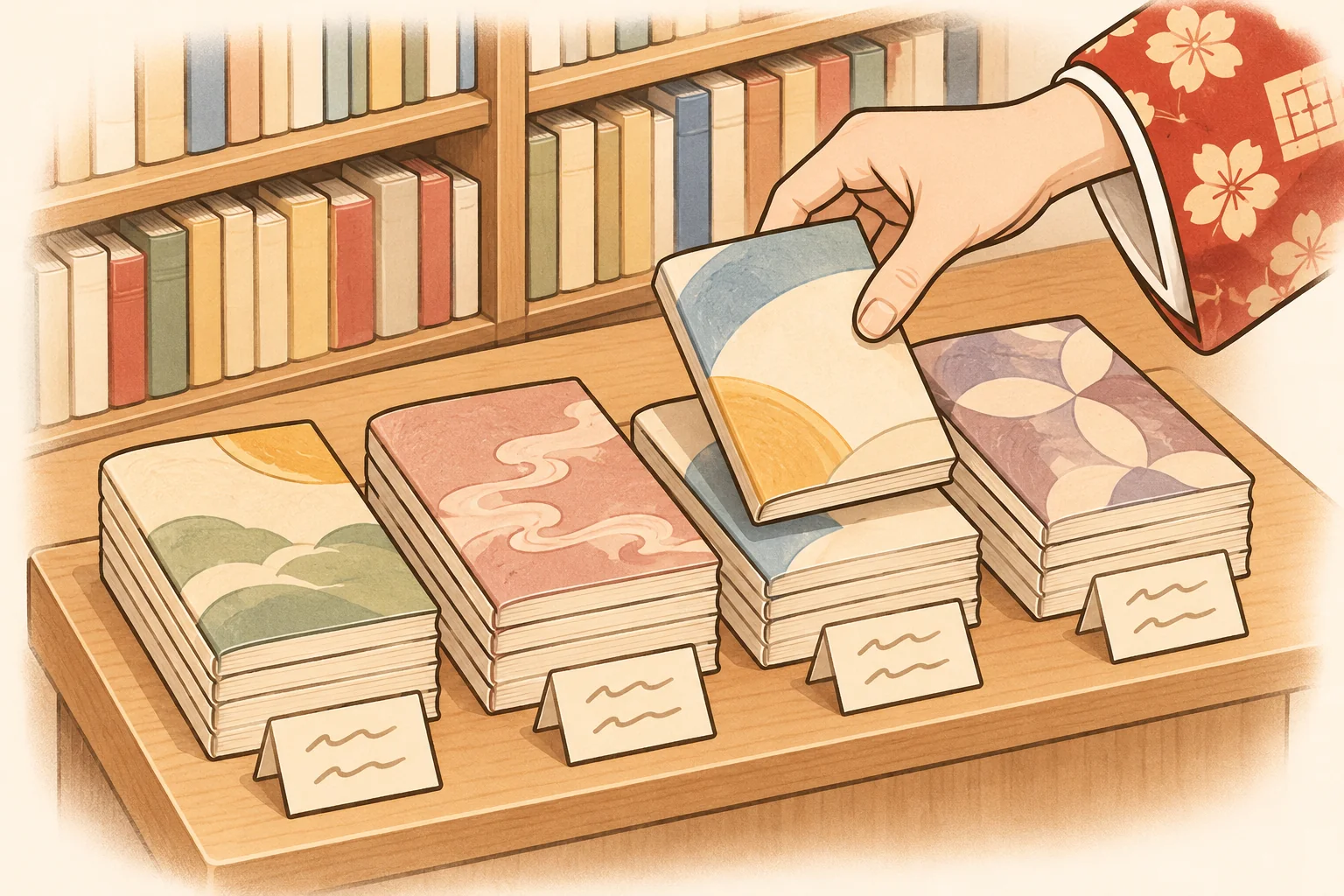
Bunko paperbacks stacked in a bookshop, small enough for a coat pocket, with the staff’s handwritten recommendation cards.
There are pilgrimages to make. The former Edogawa Ranpo residence sits beside the Rikkyō University campus in Ikebukuro, and the house, with its storehouse of books, is open to visitors. The Matsumoto Seichō Memorial Museum stands near Kokura Castle in Kitakyūshū and contains a reconstruction of part of his Tokyo house, including the study and the book-lined archive, which makes his output suddenly concrete. In Mabi, now part of Kurashiki in Okayama, the farmhouse where Yokomizo spent the war is preserved and as of 2025 the town still held Kindaichi events. In Hokuei, Tottori, the hometown of Detective Conan creator Aoyama Gōshō, the walk from Yura Station, nicknamed Conan Station, over the Conan Bridge to the Aoyama Gōshō Manga Factory is lined with statues of the characters, and since 2015 Tottori’s airport has carried the nickname Tottori Sand Dunes Conan Airport.
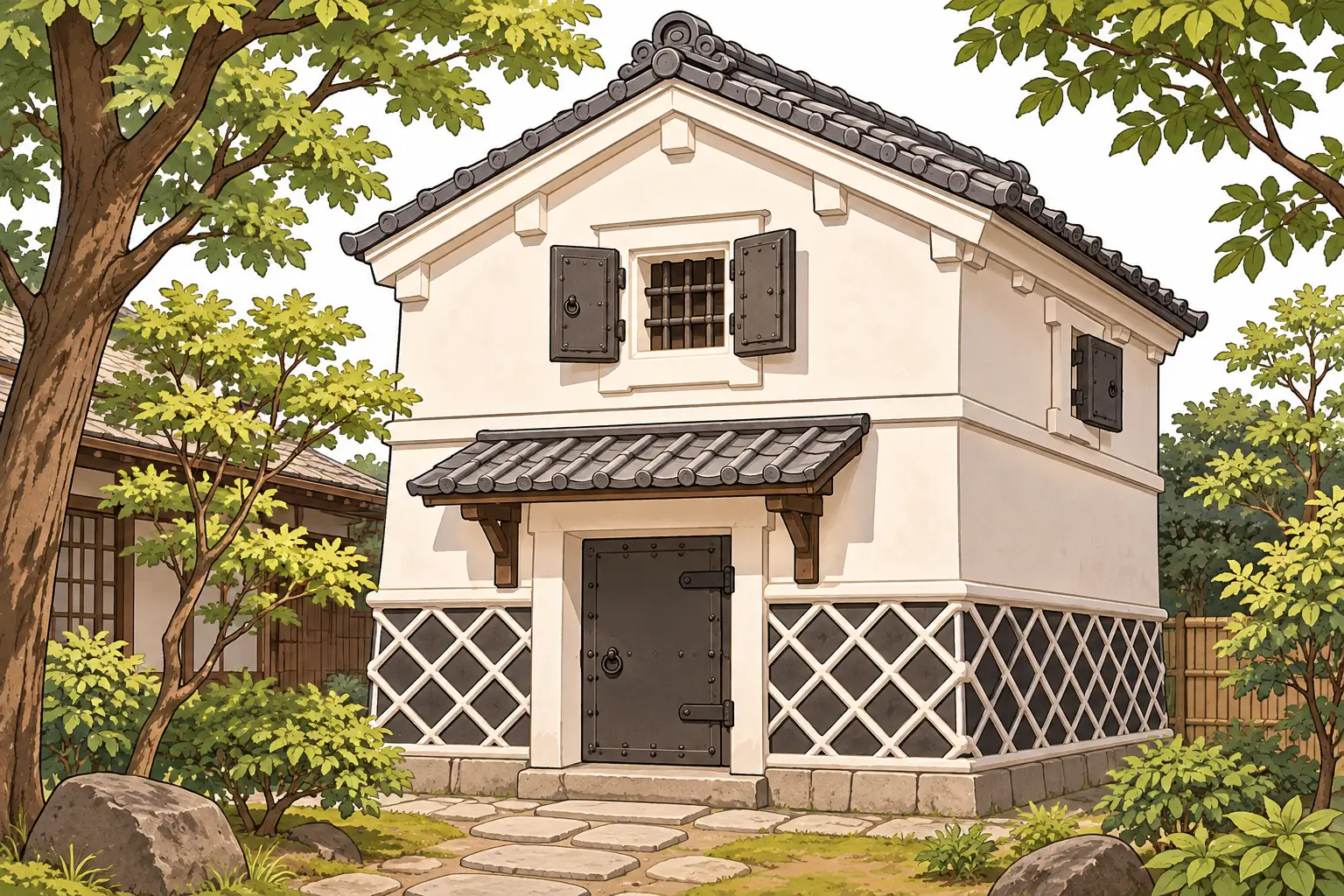
The white-walled storehouse where Edogawa Ranpo kept his books, among garden trees at his former Ikebukuro home (illustration).
The novels’ own settings are real and walkable: Tokyo Station and Kashii beach in Fukuoka from Points and Lines, the hill country of Okuizumo from Seichō’s Suna no utsuwa, Ningyōchō from Newcomer. Standing on a platform at Tokyo Station during the evening rush, trying to imagine a clear sight line across the tracks, is a good way to understand what Seichō did: he took the most ordinary scenery in Japan and found a crime in it.
If you want a reading order, begin with The Devotion of Suspect X, which has both the trick and the heart. Then read Points and Lines or Inspector Imanishi Investigates for the social school, Yokomizo’s The Inugami Curse or Gokumon Island for the haunted countryside, and The Decagon House Murders or The Tokyo Zodiac Murders for the pure puzzle. Finish with a volume of Ranpo’s short stories, Japanese Tales of Mystery and Imagination, to see where the whole thing began.