
At a glance
How the pocket-sized bunko took shape after Iwanami Bunko, why novels go from hardcover to bunko, what keeps Japan’s bookstores open, and how to browse one.
- The standard bunko is A6, about 105 by 148 mm, the size of a postcard.
- The modern format took shape with Iwanami Bunko, launched by Iwanami Shoten in 1927.
- New novels usually appear first as hardcover tankōbon and become bunko about two or three years later.
- As of the mid-2020s most bunko cost 700 to 900 yen, at the same fixed price nationwide.
- Japan had 9,993 bookstores at the end of March 2026, the first count below 10,000.
On almost any Tokyo train you will see someone reading a small paperback wrapped in plain paper, the title hidden from view. That book is almost certainly a bunko, the pocket-sized format in which most Japanese readers meet their novels, classics and essays. The format took its modern shape with Iwanami Bunko, launched by the publisher Iwanami Shoten in 1927, and it still organizes how books are written, sold and shelved in Japan. This piece explains what a bunko is, where it came from, why Japanese books appear first in hardcover and then again in this little edition, and how to read the shelves of a Japanese bookstore when you walk into one.
01A Book the Size of a Postcard
A bunko is printed in A6 size, about 105 by 148 millimeters, the dimensions of a postcard. It is a softcover on thin paper with tight, small type, and it almost always comes with a printed paper dust jacket wrapped around the plain cover underneath. Around the jacket sits an obi, a narrow paper band named after the sash of a kimono, printed with a blurb, a prize announcement or a line like "Now a major film." A 300-page bunko weighs well under 200 grams and slips into a jacket pocket.
Price is the other half of its appeal. As of the mid-2020s, a new novel in its first, larger edition might cost 1,600 to 1,800 yen; the bunko edition a few years later usually sells for 700 to 900, though rising paper and printing costs mean bunko priced above 1,000 yen are no longer unusual. For students and commuters, bunko are the books you buy for yourself rather than borrow from the library. Because Japan has a fixed-price system for books, that low price is the same in a flagship Tokyo store and in a small shop in the countryside.
Each publisher runs its own bunko line, and readers recognize them as brands: Iwanami Bunko, Shinchō Bunko, Kadokawa Bunko, Kōdansha Bunko, Bunshun Bunko, Shūeisha Bunko and many more. Within a line, the trim size, typeface and spine design are uniform, and each book carries a catalog number. A shelf of Shinchō Bunko looks like a single set, which is part of the pleasure of collecting them.
Next to the bunko sits a second small format, the shinsho, about the same width but taller: roughly 105 millimeters wide and 173 to 182 millimeters tall, depending on the publisher. Shinsho are short nonfiction books, introductions to a subject or arguments about current affairs. Roughly speaking, bunko carry literature and classics, and shinsho carry ideas.
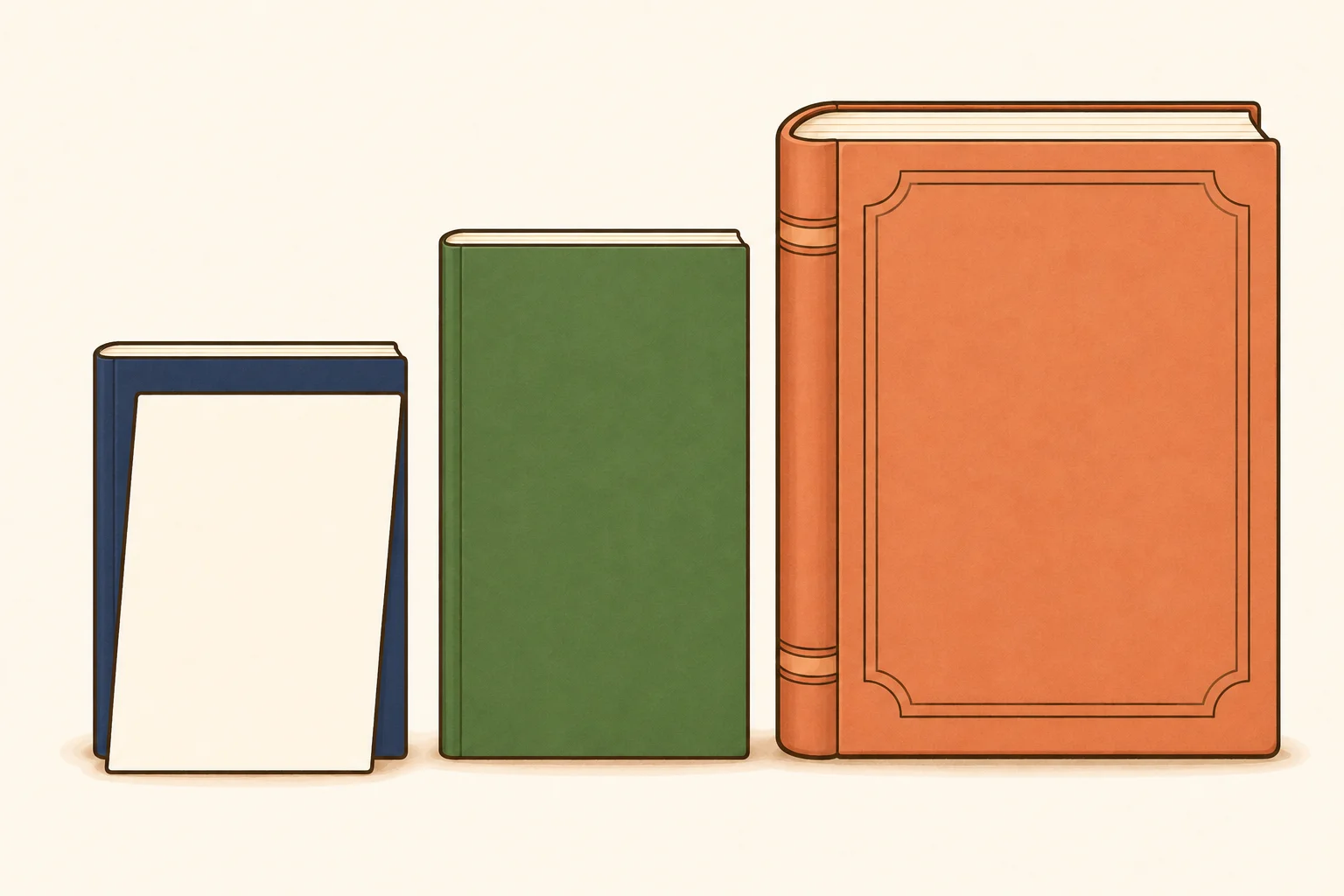
A bunko is the size of a postcard; a shinsho is about as wide but taller; the hardcover is the largest.
| Format | Size | Mostly |
|---|---|---|
| Bunko | A6, about 105 × 148 mm, the size of a postcard | Literature and classics |
| Shinsho | About 105 mm wide, 173–182 mm tall | Introductions and current affairs |
The two formats are about the same width, the shinsho taller; bunko carry literature and classics, shinsho carry ideas.
02Iwanami Shoten and the Birth of the Bunko
The story of the format runs through one company. Iwanami Shigeo, born in 1881, was a former schoolteacher who opened a secondhand bookshop in the Kanda Jinbōchō district of Tokyo in 1913. He is remembered for an unusual decision: he sold at marked prices and refused to haggle, at a time when bargaining was normal in the secondhand trade. The shop soon moved into publishing, and in 1914 it issued Natsume Sōseki’s novel Kokoro. Sōseki is said to have designed the book’s binding himself. After Sōseki’s death in 1916 Iwanami published his collected works, tying the firm to the most important novelist of modern Japan.
In 1927 the company launched Iwanami Bunko. Its model was the Reclam Universal-Bibliothek of Leipzig, a German series that had been printing the world’s classics as cheap little volumes since the 1860s. The first Iwanami Bunko books carried at the back of each volume a manifesto titled Dokushoshi ni yosu ("To Readers"), signed by Iwanami Shigeo and generally believed to have been drafted by the philosopher Miki Kiyoshi. Its argument was simple and confident: truth and beauty should not be the property of a privileged few, and the classics of East and West should be put into everyone’s hands at a price anyone could pay. Among the first titles were the ancient poetry anthology Man’yōshū, Sōseki’s Kokoro, and translations of European philosophy. Early volumes did not print a yen price. Instead they carried stars, each star standing for roughly 100 pages and a price of 20 sen, so a thicker book simply had more stars.
Iwanami Bunko looked austere for decades. Instead of a picture jacket, each book was wrapped in a thin sheet of translucent glassine through which you could read the plain printed cover, with a colored paper band around it. The color of the band told you the category: yellow for classical Japanese literature, green for modern Japanese literature, red for foreign literature, blue for philosophy, religion and history, and white for law, economics and the social sciences. Printed paper jackets began to appear in 1982, and from 1987 every new title came with one, retiring the glassine. The color scheme survived: it is now printed at the foot of the spine, and regular readers navigate the Iwanami shelves by color.
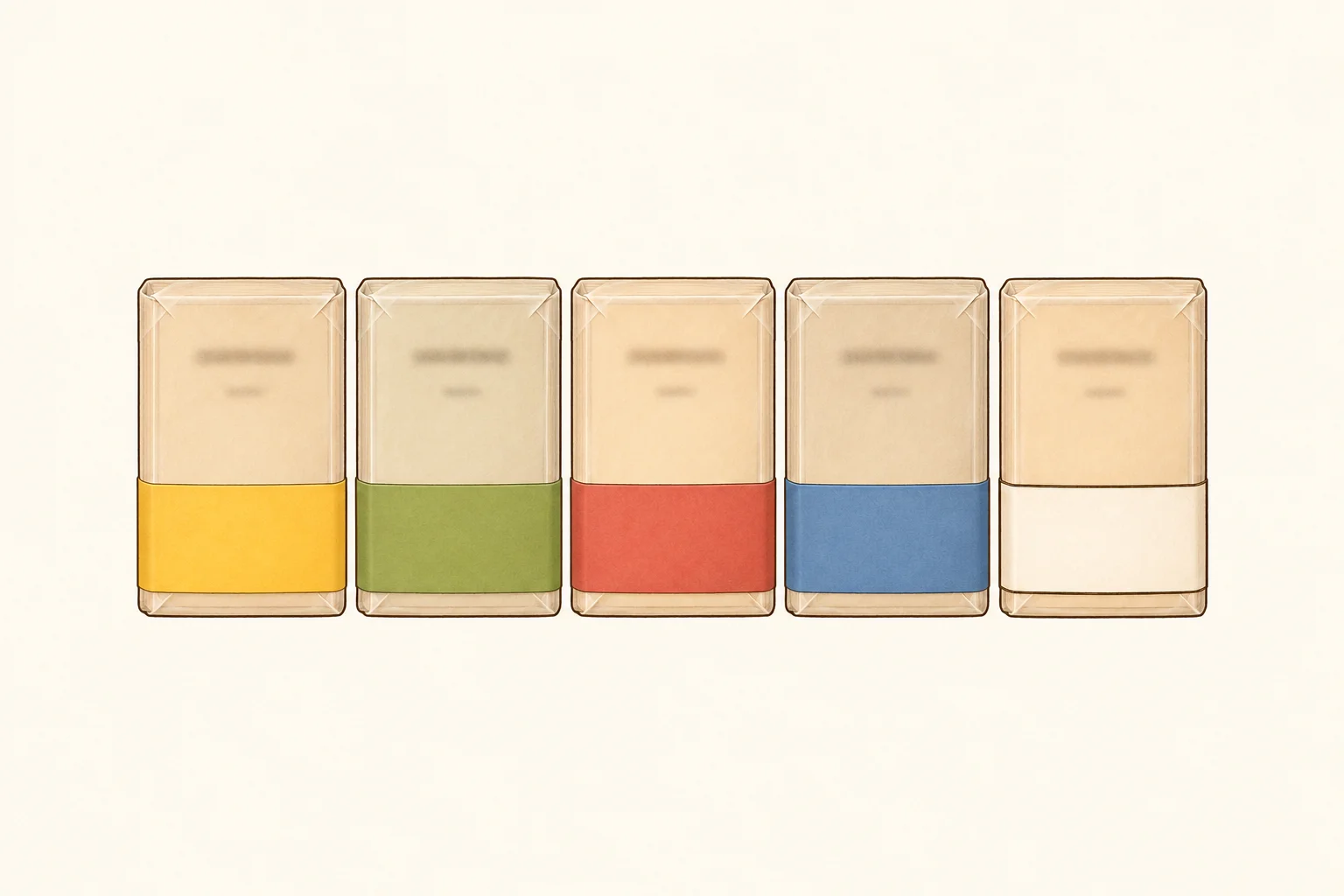
Older Iwanami Bunko came wrapped in translucent glassine, with a paper band in one of five colors marking the category.
- 1YellowClassical Japanese literature
- 2GreenModern Japanese literature
- 3RedForeign literature
- 4BluePhilosophy, religion and history
- 5WhiteLaw, economics and the social sciences
The color was once on the paper band and is now printed at the foot of the spine; readers find the category by color.
Iwanami went on to found Iwanami Shinsho in 1938, the monthly journal Sekai in 1946, the children’s series Iwanami Shōnen Bunko in 1950, and in 1955 the dictionary Kōjien, which became the reference book on Japanese family shelves. The company’s emblem is the sower from Jean-François Millet’s painting, scattering seed by hand. For much of the twentieth century "Iwanami" stood for serious, academic reading. A row of Iwanami Bunko on a university student’s shelf was a statement about who that student wanted to be.
03Hardcover First, Bunko Later
Japanese publishing follows a rhythm that readers know well. A new novel is first published as a tankōbon, a stand-alone edition, often in hardcover and at full price. After roughly two or three years it is bunko-ka, "made into a bunko," and reissued in the pocket format. Many readers wait for the bunko, and publishers sell the same book to two different audiences. Popular authors such as Murakami Haruki or the mystery writer Higashino Keigo appear on bestseller lists twice for a single book, once in each format.
- 1Tankōbonoften hardcover, about ¥1,600–1,800
- 2Bunko-ka after roughly two or three yearsoften adds an afterword or a kaisetsu
- 3Bunko editionusually ¥700–900
One novel sells twice; prices are typical of the mid-2020s, and bunko above 1,000 yen are no longer unusual.
The bunko edition usually adds something. There may be an afterword by the author written for the new edition, and there is very often a kaisetsu, a commentary essay by another writer or critic, printed at the back. Many Japanese readers pick up a bunko in the store and flip straight to the kaisetsu before deciding whether to buy. A good one is a small piece of criticism in its own right.
Some books skip the hardcover entirely. These are bunko kakioroshi, works written directly for the bunko format. Historical fiction is the classic case: Saeki Yasuhide built an enormous readership in the 2000s with samurai series published straight into bunko, one volume after another. Light novels, the illustrated genre fiction aimed at younger readers, also use the bunko size, and imprints such as Dengeki Bunko put anime-style art on the cover. In a modern bookstore the bunko section can look both like a library of classics and like a manga shop.
The format became a mass market after the Second World War. Shinchō Bunko had an early run in 1914 and relaunched in 1947. Kadokawa Bunko began in 1949. In the 1970s Kōdansha Bunko (1971), Bunshun Bunko (1974) and Shūeisha Bunko (1977) joined in what was called the bunko boom. Kadokawa, under Kadokawa Haruki, tied bunko novels to films produced by the same company and advertised them together. The tagline for the 1977 film Proof of the Man asked "Will you read it before you watch it, or watch it before you read it?", and the line is still remembered. From then on the bunko was not only the cheap edition of the classics but also the entry point to popular entertainment.
The longest-selling bunko, though, are still the classics. Sōseki’s Kokoro and Dazai Osamu’s No Longer Human were the two best-selling titles in the history of Shinchō Bunko as of 2021, in that order. Each summer Shinchō runs a campaign called "Shinchō Bunko’s 100 Books," a list of recommended titles with special covers and small giveaways, aimed at students on their summer break.
04Why Japan Still Has Bookstores
The number of bookstores in Japan has fallen sharply, from more than 20,000 around the year 2000 to 9,993 at the end of March 2026, the first time the count fell below 10,000, and many small towns no longer have one at all. Even so, Japan remains a country where bookstores are part of the street, at train stations, in shopping arcades and inside department stores. Several features of the trade explain this.
The first is resale price maintenance. Publishers set the retail price and bookstores do not discount new books, so big chains and small shops do not fight price wars. The second is consignment. Bookstores order through large wholesale distributors called toritsugi, the biggest of which are Tohan and Nippan, and unsold books can be returned. A small shop can stock the new releases without tying up much capital. The third is magazines and manga. For decades the little bookstore in front of the station made much of its living from weekly and monthly magazines that came in on a fixed schedule and brought customers through the door.
The big stores each have a history. Maruzen, founded in 1869, introduced Western books and stationery to Japan. In Kajii Motojirō’s short story "Lemon," the narrator leaves a lemon balanced on a pile of art books in the Kyoto Maruzen and walks out imagining it as a bomb, and the store has been a literary landmark ever since. Kinokuniya was founded in Shinjuku by Tanabe Moichi in 1927, the same year as Iwanami Bunko, and its main Shinjuku store is still one of the best-known bookstores in Tokyo. Sanseidō in Jinbōchō and Junkudō in Ikebukuro are stores measured in floors rather than shelves. Daikanyama Tsutaya Books, which opened in 2011, represents a newer idea: books shelved with coffee, stationery and design objects, grouped by lifestyle rather than by publisher.
Jinbōchō itself deserves a visit. The district where Iwanami began still has well over a hundred secondhand bookshops. Some deal in woodblock-printed books from the Edo period, others only in film material, art catalogs or foreign-language books. In autumn the Kanda Used Book Festival (still held as of 2026) lines the sidewalks with carts and shelves.
Bookstore staff also have a voice. Since 2004 the Japan Booksellers’ Award (Hon’ya Taishō), voted on by store clerks across the country, has been announced each spring, and its winners often become bestsellers. In stores you will see handwritten cards called "POP" propped beside books on the display tables, written by staff: "I cried on the train reading this." They are one of the most personal touches in Japanese retail.
05Walking into a Japanese Bookstore
Start with the flat display tables near the entrance. These hold new releases and books in the news, and the obi slogans and staff cards are the quickest guide to what people are reading. Bunko usually have their own section. The shelves are divided by publisher, and within each publisher books are arranged by the author’s name in Japanese syllabary order. To find a particular bunko, it helps to know who publishes it. If you don’t, there is usually a search terminal, and staff are used to looking things up.
Reading in the store is normal and has its own word, tachiyomi, "standing reading." As long as you don’t crease or damage a book, no one will mind. Many manga and photo books, however, are shrink-wrapped and cannot be opened.
At the register, the clerk will almost certainly ask, "Kabā okake shimasu ka?" — would you like a cover? Say yes, and they will fold a paper wrapper printed with the store’s name or design around your book in a few quick movements. It is free. Kinokuniya, Maruzen and many small local stores have their own designs, and some people collect them. The cover protects the book and keeps what you are reading private on the train, which is why so many Japanese readers ask for it. The clerk may also slip in a bookmark. Shinchō Bunko books come with a sewn-in ribbon bookmark and an untrimmed top edge, an old-fashioned touch the publisher has kept for decades.
- 1
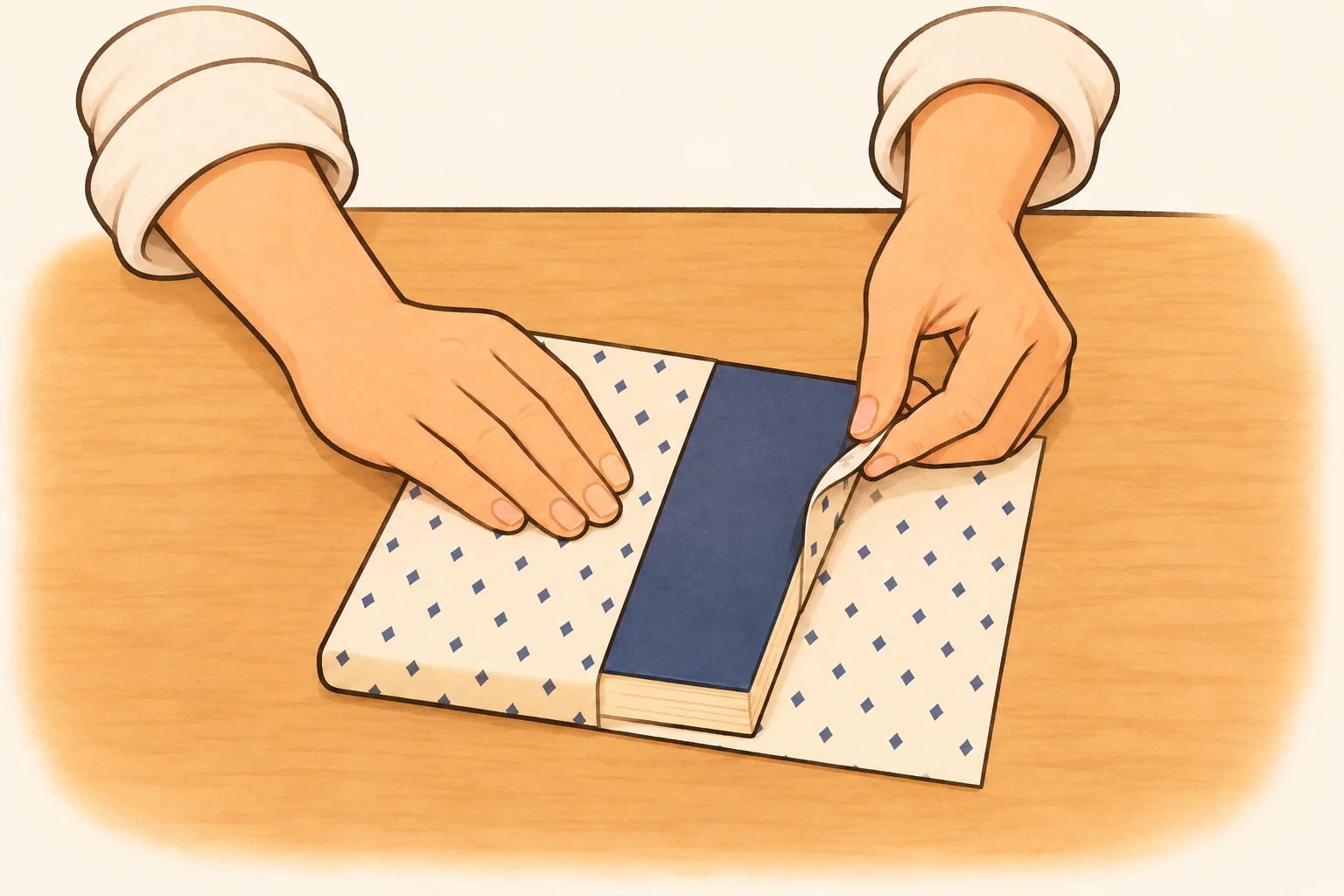 At the register, the clerk folds a printed paper wrapper around the bunko.
- 2
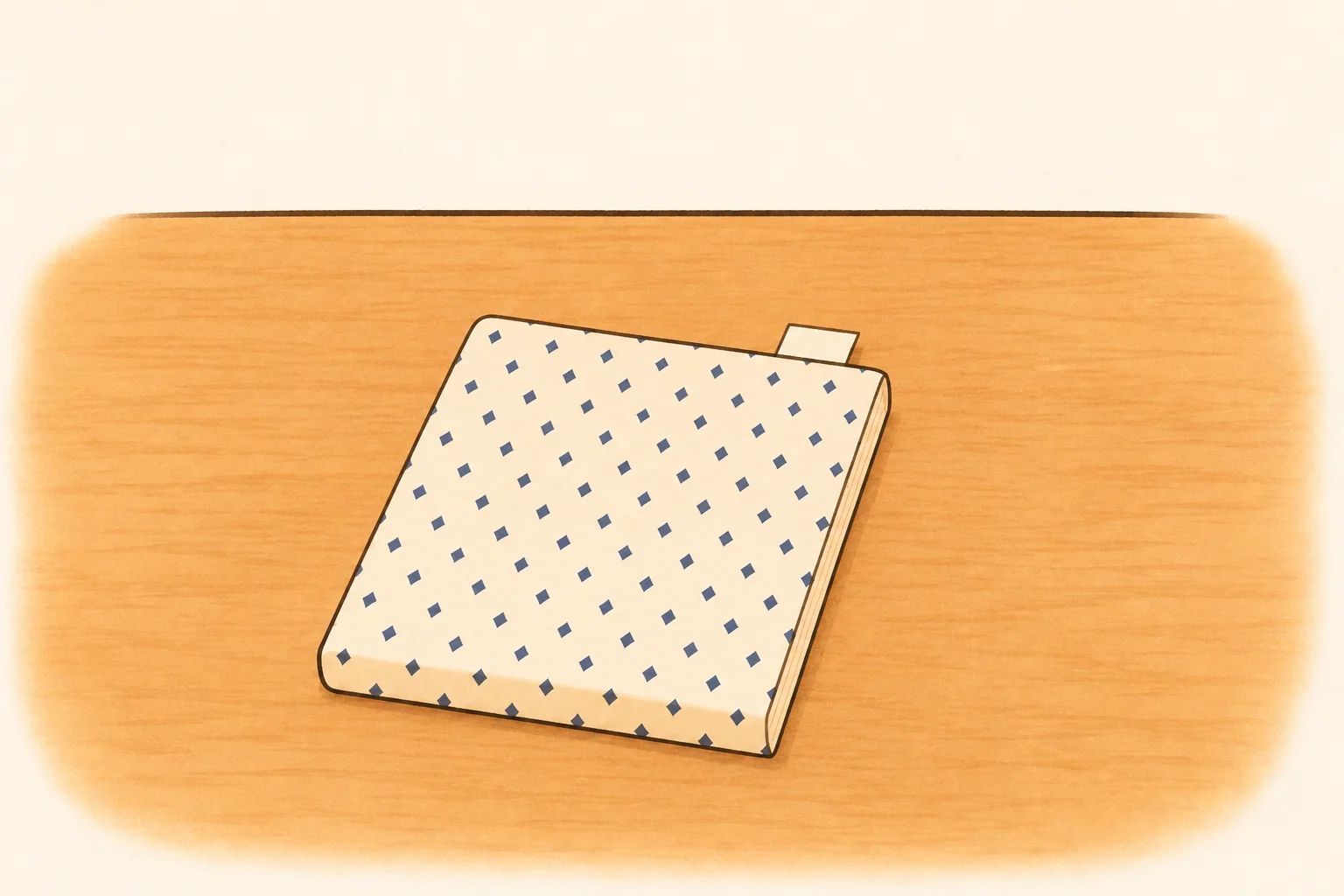 Once wrapped, the cover and title are hidden, keeping your reading private.
Even if you don’t read Japanese, a bunko makes a good souvenir. The color-coded spine of an Iwanami Bunko (older glassine-wrapped copies still turn up in Jinbōchō’s secondhand shops), the ribbon in a Shinchō Bunko and the hand-folded cover from the store can all be enjoyed without reading a word. If you want to try reading, pick a book you already know in translation, such as Sōseki’s Kokoro, Dazai’s No Longer Human, Kawabata Yasunari’s Snow Country or a Murakami novel, and hold the original beside your memory of it. It is a small, concrete way of sharing something with the person reading on the seat across from you.