
At a glance
How sumo works, from the split-second charge to the sacred ring, the ranking sheet, stable life and referees, plus Chiyonofuji’s story and a day at a tournament.
- A wrestler wins by making his opponent touch the ground with anything but the soles of his feet, or by forcing him out of the ring; there are no weight classes.
- As of 2026 there are 82 recognized winning techniques (kimarite); the most common are yorikiri and oshidashi.
- The banzuke has six divisions, from makuuchi and jūryō down to makushita, sandanme, jonidan and jonokuchi; jūryō and above are sekitori.
- A yokozuna is never demoted; if his results fall off, he can only sit out tournaments or retire.
- There are six 15-day tournaments a year: Tokyo in January, May and September, Ōsaka in March, Nagoya in July and Fukuoka in November.
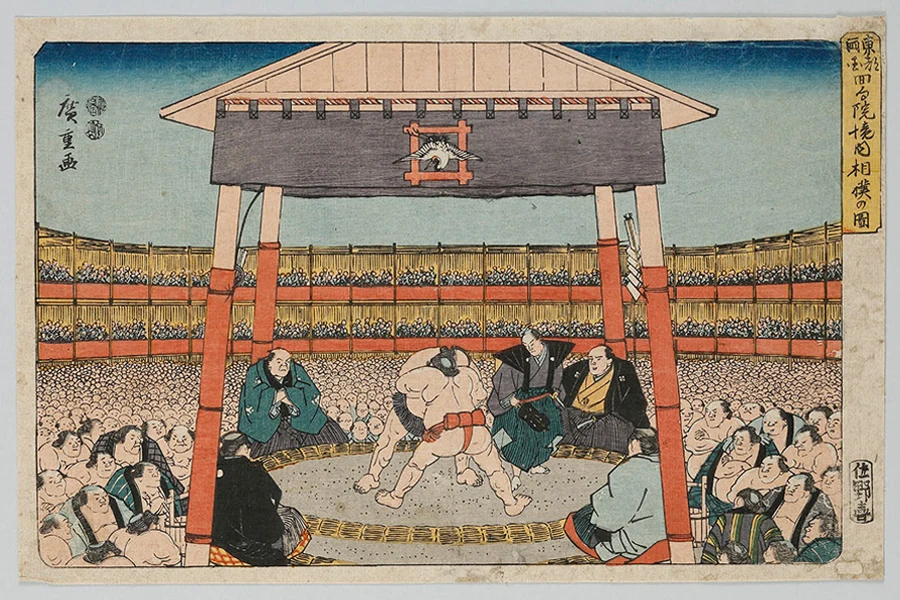
Most sumo bouts are over in less than ten seconds. Two very large men crouch, collide, and one of them ends up on the clay or outside a ring of straw bales. Yet a day at a sumo tournament runs for nearly ten hours, and the few seconds of fighting are wrapped in salt-throwing, stamping, staring and bowing, overseen by a referee dressed like a medieval courtier, under a roof built in the style of a Shinto shrine. Sumo is Japan’s oldest professional sport, but it is also a living institution with its own ranks, households, clothing, hairstyles and gods. This piece explains how a bout works, where the ritual comes from, how the ranking sheet and the training stables shape a wrestler’s life, what the belts and aprons mean, who the referees are, why the wrestler Chiyonofuji is remembered with such affection, and how to spend a day watching sumo in Japan.
01How a Bout Is Won
The rules fit in a sentence. You lose if any part of your body other than the soles of your feet touches the ground, or if any part of you touches the ground outside the ring. A fingertip, a knee, the top of your topknot brushing the clay: all of them count. There are no weight classes, no rounds and no points. A wrestler of 120 kilograms may face one of 200, and the lighter man often wins.
The decisive moment usually comes first. The initial charge, the tachiai, has no starting signal. The two wrestlers crouch behind white lines, and the bout begins when both have put their fists down and launched themselves in the same instant, by mutual consent. To get there, they go through a ritual called shikiri: crouching, glaring at each other, standing up, walking back to their corners, tossing a handful of purifying salt across the clay, and crouching again. In the top division this preparation is allowed to run for about four minutes. When the time limit is reached, the timekeeping judge signals it, and the next crouch is for real. Regulars know the rhythm, and the noise in the hall builds through the final round of staring until the moment the fists touch down.
The collision itself is tremendous. It is often compared to a low-speed car crash; according to press reports, researchers have made the same comparison. A wrestler who gets his head lower, or lands his hands on his opponent’s belt first, has usually won the bout already. Broadly, wrestlers fall into two styles. Pushers and thrusters (oshi-zumō) drive their opponent back with repeated shoves to the chest and throat. Belt fighters (yotsu-zumō) close in, grip the opponent’s belt and win through throws, lifts and trips. As of 2026, the Japan Sumo Association recognizes 82 winning techniques, called kimarite, plus five "non-techniques" such as an opponent simply stepping out or falling over on his own. In practice two techniques dominate: yorikiri, forcing the opponent out while gripping his belt, and oshidashi, pushing him out without one. Spectacular throws are rare enough that a single one can be the talk of a tournament.
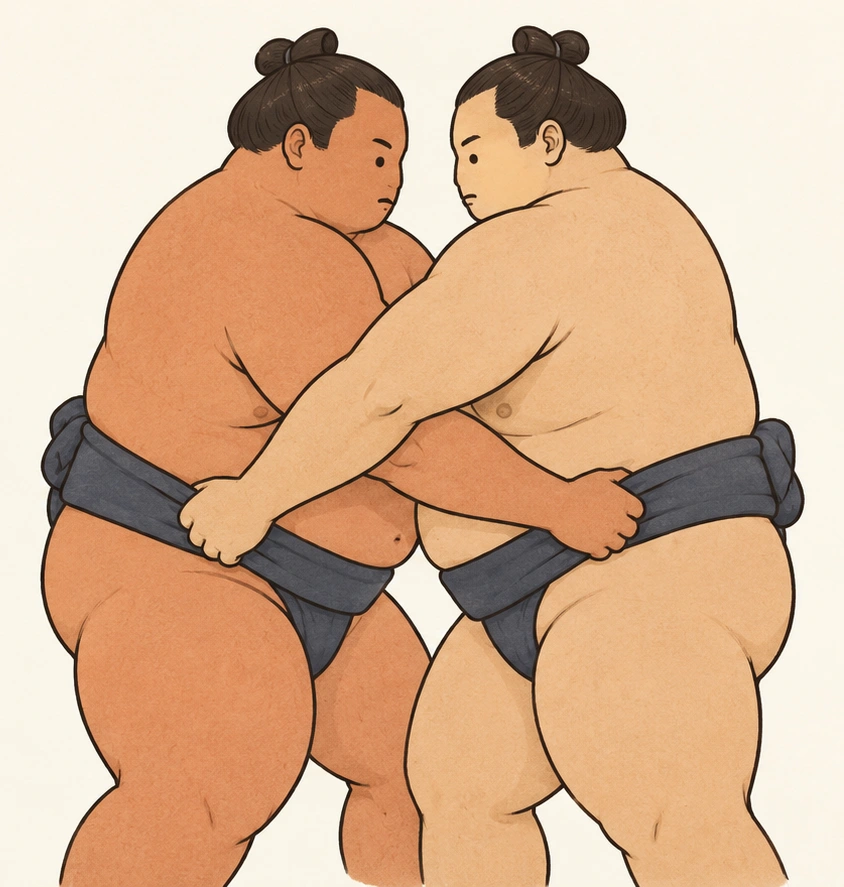
The arm slips under the opponent’s armpit and grips the belt from inside.
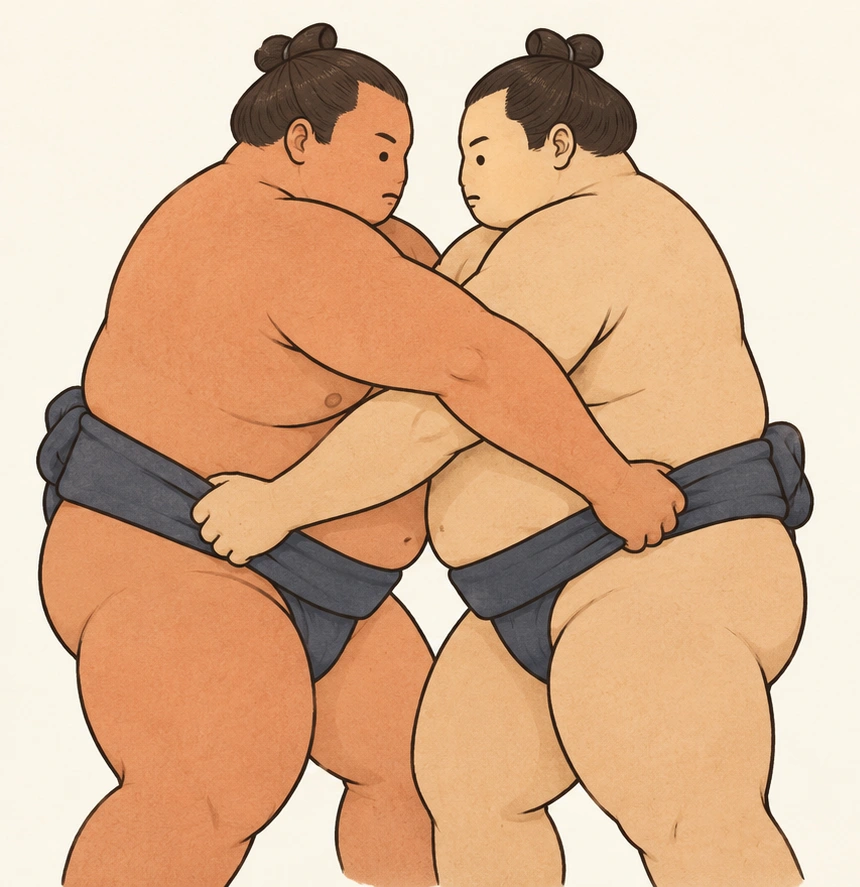
Gripping the belt from outside the opponent’s arm: the uwate.
Weight matters, but low balance matters more. Wrestlers build it through endless repetitions of shiko, the famous leg-stamp in which a wrestler lifts one leg high to the side and brings it crashing down. It strengthens the hips and legs. It is also, in traditional understanding, a way of stamping down evil spirits in the earth. Much of sumo works this way: a practical movement that is also a sacred one.
02The Ring and Its Roof
The ring, or dohyō, is a raised platform of packed clay, between about 34 and 60 centimeters high, with a circle marked out by straw bales sunk into its surface. The circle has a diameter of 15 shaku, or 4.55 meters. At the four cardinal points, one bale is set slightly outward, leaving a small gap. These are the tokudawara, the "bales of advantage." The common explanation is that they once let rainwater drain off when sumo was held outdoors. Today they give a wrestler backed against the edge a few precious centimeters, and the word has passed into everyday Japanese for a last-moment margin of safety.
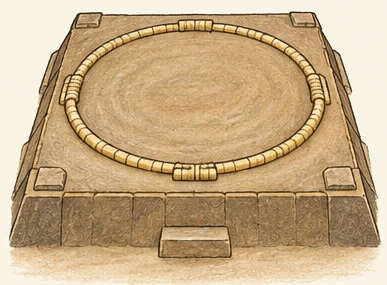
Straw bales mark the circle on a packed-clay platform; at each cardinal point one bale, a tokudawara, sits slightly outward.
The ring is rebuilt by hand before every tournament, not by construction crews but by the yobidashi, the ushers who also sing out the wrestlers’ names, sweep the ring and beat the drum outside the arena. Working with hoes, mallets and tampers, they spend around three days shaving off the old surface, adding fresh clay, packing it down and setting the bales. A band of fine sand is raked around the outside of the circle so that any footprint over the line can be seen.
- 1Dohyōpacked-clay platform, about 34–60 cm high
- 2Straw balessunk into the surface, marking a circle 15 shaku (4.55 m) across
- 3Tokudawaraone bale set slightly outward at each cardinal point
- 4Band of fine sandraked around the outside of the circle to show footprints
- 5Suspended roofshrine-style, hung from the ceiling since 1952
- 6Four tasselsgreen NE, red SE, white SW, black NW
Whether a foot has gone over the line is read from the band of fine sand outside the circle.
On the day before a tournament opens, a senior referee in Shinto priestly robes conducts the dohyō matsuri, a ceremony that consecrates the ring. Offerings including salt, rice, kelp, dried squid and chestnuts are buried in a small hole in the center. During the tournament, the ring is understood as a sacred space. This is why wrestlers purify it with salt, and it is also the stated reason why women are not permitted to step onto it. That rule has become a source of real controversy. In 2018, during a regional exhibition in Maizuru, Kyoto Prefecture, the city’s mayor collapsed while giving a speech in the ring. Several women from the audience, reportedly including a nurse, rushed up to give him first aid and were told over the public address system to leave the ring. The Sumo Association apologized for the announcement, but as of 2026 the rule for professional rings remains.
Above the ring hangs a roof in the style of a Shinto shrine. It used to be held up by four pillars, which blocked the view of spectators, and in 1952 the pillars were removed and the roof suspended from the ceiling. In their place hang four huge tassels: green in the northeast, red in the southeast, white in the southwest and black in the northwest. They represent the four seasons and the guardian beasts of the four directions, borrowed from Chinese cosmology.
03From Shrine and Palace to the Professional Stage
The earliest account of a sumo-like contest is in the Nihon shoki, the chronicle compiled in 720. It tells of a boastful strongman named Taima no Kehaya who was challenged, at the emperor’s command, by Nomi no Sukune from Izumo. Sukune broke his ribs and back, and Kehaya died. This is legend rather than history, and the fight sounds nothing like modern sumo, but Sukune is still honored as the ancestor of the sport. In early Japan, wrestling was bound up with agricultural ritual, and the result of a bout could serve as a divination for the harvest. Some shrines still hold ritual sumo of this kind. At Ōyamazumi Shrine on the island of Ōmishima, a wrestler grapples with an invisible rice spirit and, by tradition, loses.
In the Nara and Heian periods, sumo became a court ceremony. Strong men were summoned from the provinces to wrestle before the emperor at an annual festival called sumai no sechie, with competitors divided into Left and Right teams and accompanied by music and dance. The division of today’s rankings into East and West, and many of the formalities that surround each bout, are often traced back to this courtly heritage. When the court ceremony faded in the 12th century, sumo passed into the hands of the warrior class as a form of training. The warlord Oda Nobunaga was a famous enthusiast who staged large tournaments at his castle and rewarded winners with positions in his service.
Modern professional sumo grew out of kanjin-zumō, benefit tournaments held in the Edo period to raise money for temples and shrines. Over time these became commercial events run by organized groups of professional wrestlers in Edo, Ōsaka and Kyoto. By the late 18th century, Edo sumo was a major entertainment, and from 1833 it was held twice a year at Ekō-in, a temple in the Ryōgoku district. Wrestlers such as Tanikaze, Onogawa and Raiden Tameemon were celebrities on the level of kabuki actors, and their portraits sold as woodblock prints. Raiden, said to have stood nearly two meters tall, lost only ten bouts in his whole top-division career, a record of dominance no one has matched.
The title yokozuna also dates from this era. A yokozuna was originally a thick white rope worn around the waist of the strongest wrestlers in ring-entering ceremonies. In 1789 the Yoshida family of Kumamoto, which claimed authority over sumo etiquette, licensed Tanikaze and Onogawa to wear it, and this is usually treated as the start of the yokozuna tradition. For a long time, however, it remained an honor rather than a rank. The highest rank on the official ranking sheet was ōzeki. The title first appeared on the Tokyo banzuke in 1890, and yokozuna was formally established as a rank only at the end of the Meiji era, around 1909.
The Meiji Restoration brought hard times. Feudal lords who had sponsored wrestlers lost their domains, and to some modernizers the topknotted, near-naked wrestlers looked like an embarrassment in front of the West. Sumo survived with the support of the emperor and leading politicians, and with a building: in 1909, the first permanent sumo arena opened in Ryōgoku and was named the Kokugikan, the "Hall of the National Sport." No law has ever declared sumo Japan’s national sport, but the name stuck, and the idea with it.
The Tokyo and Ōsaka organizations merged in the 1920s. Tournaments were fixed at fifteen days in 1949, and the current pattern of six tournaments a year was set in 1958. After the war the Kokugikan moved to Kuramae, and in 1985 it returned to Ryōgoku, where the present arena stands beside the railway station.
04The Banzuke: A Life Written on One Sheet
About two weeks before every tournament, the Sumo Association releases the new banzuke, the ranking sheet. It is a large printed sheet covered in names written in a bold, heavy brush style known as sumō-ji, with thick strokes packed tightly together so that as little white space as possible remains. The crowding is meant to evoke a packed house. The sheet is written by hand by a senior referee. The higher a wrestler’s rank, the larger his name; the names in the lowest division are so small that the section is jokingly called the "magnifying glass" level.
The banzuke is a pyramid of six divisions. At the top is makuuchi, the top division of about 42 wrestlers, itself divided into ranks. Highest is yokozuna, the grand champion, followed by ōzeki, sekiwake and komusubi, with the rank-and-file maegashira below them, numbered from one downward. Under makuuchi comes jūryō, with 28 wrestlers, and then makushita, sandanme, jonidan and jonokuchi. Each rank has an East and a West slot, East being slightly the more prestigious.
- Makuuchiabout 42
- Jūryō28
- Sekitori line: salaried above
- Makushita
- Sandanme
- Jonidan
- Jonokuchi
Makuuchiyokozuna · ōzeki · sekiwake · komusubi · maegashira
Each rank has an East and a West slot, East slightly higher. Sekitori, jūryō and above, are salaried; those below are not.
The line between jūryō and makushita is the most important in a wrestler’s life. Wrestlers in the top two divisions are called sekitori. They receive a monthly salary, wear colored silk belts in competition, have their hair dressed in the elaborate ginkgo-leaf topknot called ōichō, and are assigned junior wrestlers as attendants who carry their bags, help them dress and scrub their backs in the bath. Wrestlers below that line are paid only small allowances and wear black cotton belts; those in the lowest divisions dress in thin cotton robes and wooden sandals even in winter, and no one below makushita may wear a coat. They do the cooking, cleaning and fetching for their seniors. Promotion to jūryō is described as going from hell to heaven overnight.
Movement up and down the banzuke depends on results. Sekitori fight fifteen bouts per tournament, one a day; lower-division wrestlers fight seven. A winning record, eight wins or more out of fifteen, is called kachikoshi and normally brings promotion; a losing record, makekoshi, brings demotion. Exactly how far a wrestler rises or falls is decided at a ranking meeting held a few days after each tournament, where the officials of the judging department weigh wins and losses, the strength of opponents and the slots available. The result is not a simple points table but a judgment, renewed every two months, of where each man stands.
- 1
 A few days after the tournament, stablemasters of the judging division meet to set promotions and demotions.
- 2
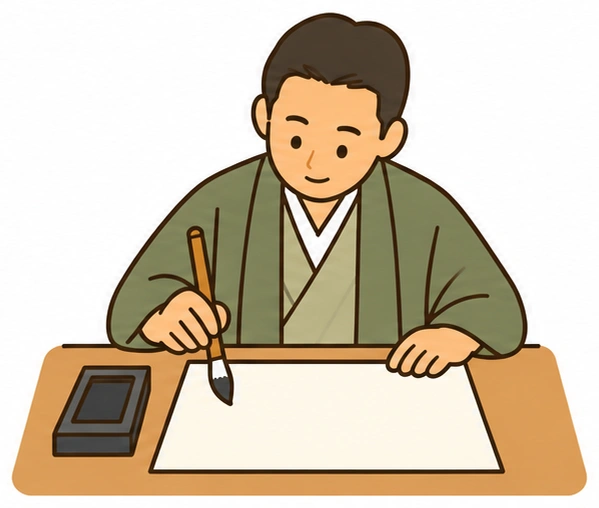 A gyōji writes out the names in thick, dense sumo-style lettering.
- 3
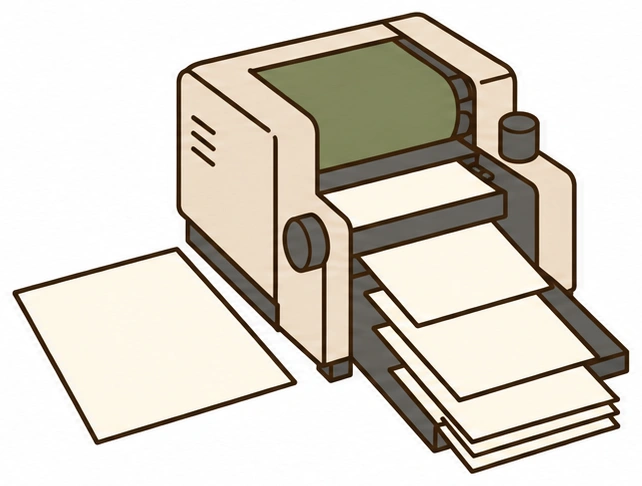 The finished sheet is printed and issued as a tall banzuke.
The two highest ranks have special rules. Promotion to ōzeki generally requires around 33 wins over three consecutive tournaments in the upper ranks. An ōzeki is demoted only after two consecutive losing records. Promotion to yokozuna is stricter still: usually two consecutive tournament championships as an ōzeki, or an equivalent record, followed by a recommendation from the Yokozuna Deliberation Council, a panel of outside advisers. Once promoted, a yokozuna can never be demoted. If his results slip, his only options are to sit out tournaments or retire. Because there is no way down, a yokozuna is expected to show not only strength but hinkaku, dignity, worthy of the rope.
05The Stable: Living Together, Eating Together
No one simply signs up to compete in professional sumo. A would-be wrestler must join a heya, usually translated as "stable," a training group that is also a household. It is run by a stablemaster, an oyakata who is himself a retired wrestler, and often by his wife, the okamisan, who manages much of the domestic side. Wrestlers live in the stable building, sleep in shared rooms when they are junior, and train in a practice ring on the ground floor that is identical in size to the tournament ring. As of 2026 there are forty-odd stables, most of them in eastern Tokyo around Ryōgoku, and they are grouped into larger factions called ichimon. Many recruits join straight out of junior high school, at fifteen.
The day begins early. The lowest-ranked wrestlers are up around five or six and train on an empty stomach. Practice starts with shiko, with suriashi, a gliding step in which the feet never leave the ground, and with teppō, thrusting palms against a wooden post. Then come practice bouts: the winner stays in the ring and picks his next opponent from the wrestlers clamoring around him, and a strong man may fight twenty times in a row. The hardest part is butsukari-geiko, in which a junior wrestler charges again and again into the chest of a senior, is shoved away, thrown down, and gets up covered in sand to charge again. The senior wrestlers come down later, and the stablemaster watches from a raised platform, often in silence.
Only when practice ends, close to midday, do the wrestlers eat. The food of a sumo stable is called chanko. Strictly speaking, any meal cooked and eaten by wrestlers is chanko, but the word usually means a large hot pot of chicken or fish, tofu and vegetables in broth, eaten with mountains of rice, often washed down with beer. Seniors eat first while juniors serve; the juniors eat what is left. Then everybody sleeps. Hard training on an empty stomach, a huge meal and an afternoon nap is how wrestlers put on weight: many arrive at seventy or eighty kilograms and weigh over 150 a few years later.
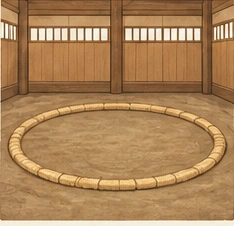
The stable’s ground-floor practice room, with a ring the same size as a tournament ring.
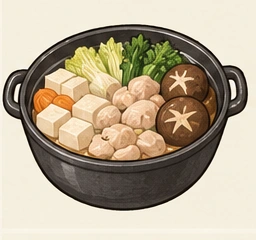
Chanko: chicken, tofu and plenty of vegetables in one big pot.
The communal life exists for a reason. Sumo is taught body to body. How to tie a belt, dress a topknot, bow on entering the ring, or hold a senior’s towel is learned by living with the people who know. The hierarchy is also the structure that holds the sport together: rank decides who serves whom, and a wrestler who reaches sekitori status must in turn look after the juniors who attend him. The system has a dark side. In 2007 a 17-year-old trainee at the Tokitsukaze stable died after being beaten by his seniors and his stablemaster, a case that led to criminal convictions and repeated efforts by the Association to stamp out violence.
A stablemaster must hold one of the 105 elder names, toshiyori myōseki, recognized by the Sumo Association. The number is fixed, so a retiring wrestler who wants to stay in the sport as a coach must inherit or acquire one. During tournaments, wrestlers from the same stable never face each other, which removes the temptation for stablemates to go easy and helps make each stable a team with its own rivalries.
06Belts and Aprons
In competition, a wrestler wears only the mawashi, a long, heavy band of cloth folded into a thick strip, passed between the legs, wound several times around the waist and knotted at the back. Sekitori fight in silk mawashi in colors they choose themselves: purple, navy, gold, emerald. Lower-ranked wrestlers wear black or dark cotton. The belt is part of the contest, not just a costume. Belt fighters spend the bout fighting for a grip on it, and where you grab it and how many layers you get hold of can decide the result. Experienced wrestlers wear it tight and hard so that it is difficult to grasp.
Hanging from the front of the belt is a fringe of stiffened cords called sagari, set with seaweed glue so they stand out from the body. They are purely decorative, and if one falls off during a bout nothing happens. If the mawashi itself comes off and exposes the wrestler, he loses. That rule is almost never applied, and when it is, it makes the news.
The most splendid belts appear in the ring-entering ceremony, dohyō-iri, held before the top two divisions begin their bouts each afternoon. The wrestlers of the East and then the West file into the ring in rank order, stand in a circle facing the crowd, perform a brief sequence of gestures and file out again. For this they wear the keshō-mawashi, a ceremonial apron of heavy silk that hangs from the waist well below the knees. It is often woven in the Hakata-ori style of Fukuoka and embroidered in gold and silver thread with dragons, tigers, Mount Fuji, landscapes from the wrestler’s hometown, or the name and logo of a sponsoring company, with a deep fringe at the bottom. Keshō-mawashi are usually gifts from a wrestler’s supporters’ club or corporate sponsors and can cost millions of yen. The ring-entering ceremony is, among other things, a parade of textile art.
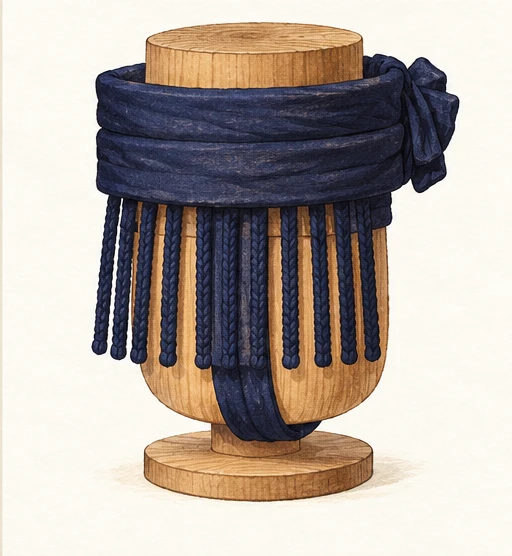
In a bout, only the mawashi, with a row of sagari cords hanging in front.
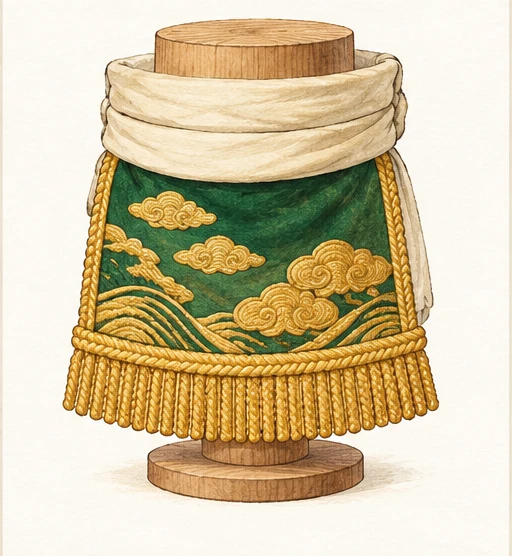
For the ring-entering ceremony: the embroidered keshō-mawashi apron with its fringe.
The yokozuna performs his own ring-entering ceremony, the most solemn moment of the day. Around his waist is the tsuna, a thick rope of twisted white hemp, from which hang five zigzag strips of white paper, the same shide seen on the sacred ropes of Shinto shrines. The rope marks the yokozuna as a figure touched by the divine. He enters with two attendants from the top division, one leading the way (the tsuyuharai, "dew sweeper") and one carrying a sword (the tachimochi). All three wear a matching set of aprons. In the center of the ring, the yokozuna claps, spreads his arms, stamps, and then rises slowly from a deep crouch in a movement called seriagari. There are two styles. In the Unryū style, he holds his left hand against his side while extending his right; in the Shiranui style, he extends both arms, and the rope is knotted differently at the back: by the usual account, with two loops for Shiranui and a single loop for Unryū. Before each tournament the rope is made fresh by the wrestlers of his stable in a ceremony called tsuna-uchi, with a crowd of men twisting the hemp together.
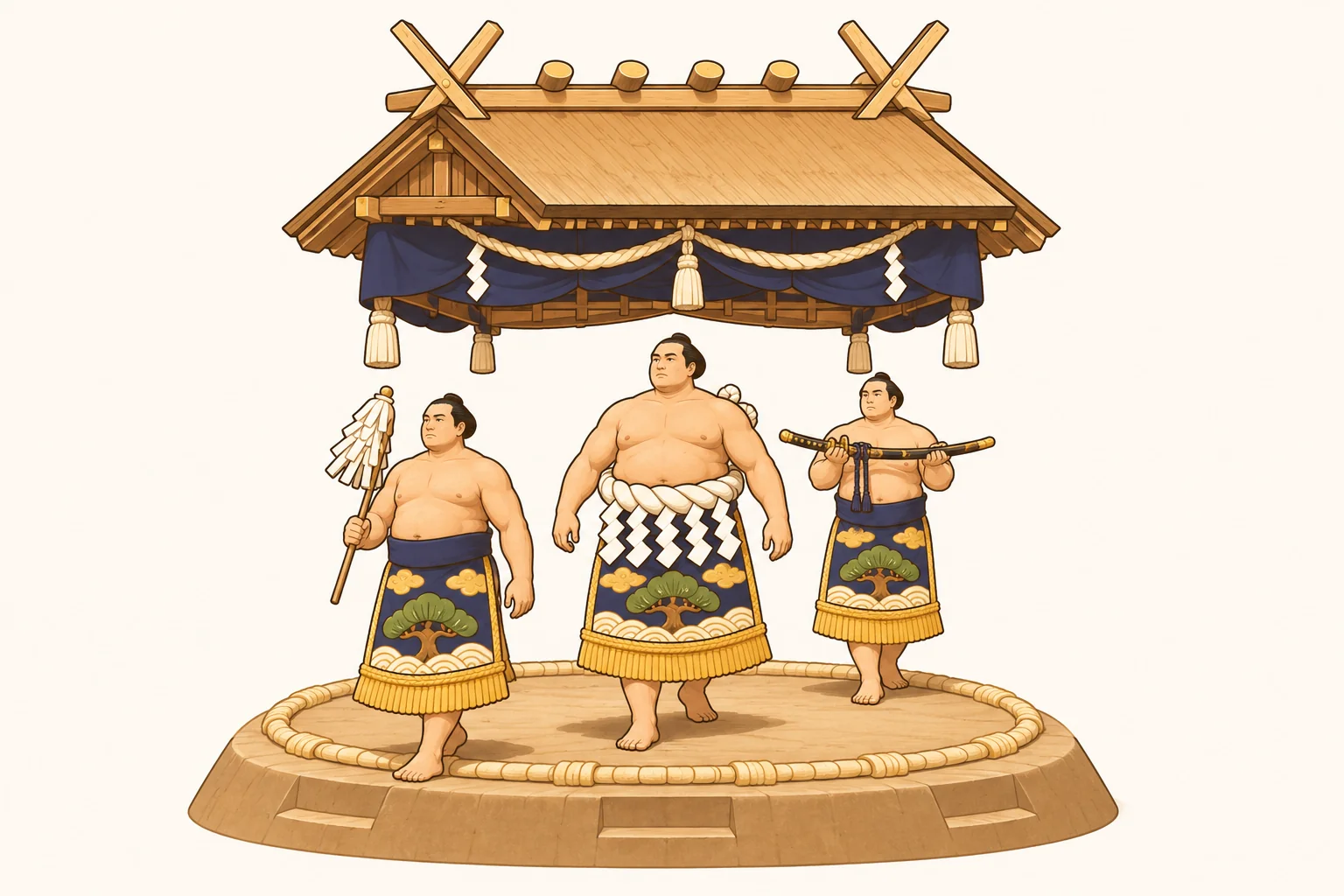
A yokozuna's ring-entering ceremony, with the tsuyuharai leading and the tachimochi carrying the sword.
07The Gyōji: A Referee in Court Dress
The only man in the ring who is not a wrestler is the referee, the gyōji. He wears a brilliantly colored silk robe with wide sleeves and a black lacquered cap modeled on the formal dress of the medieval warrior aristocracy; referees switched to this outfit from Edo-period dress in 1910. In his hand is a gunbai, a lacquered wooden war fan, used to signal the winner. Referees join the Association young and work their way up a ranking ladder of their own, and their privileges grow with rank: referees up to the makushita grade officiate barefoot, those from the jūryō grade wear split-toed socks, and those from the sanyaku grade up also wear straw sandals.
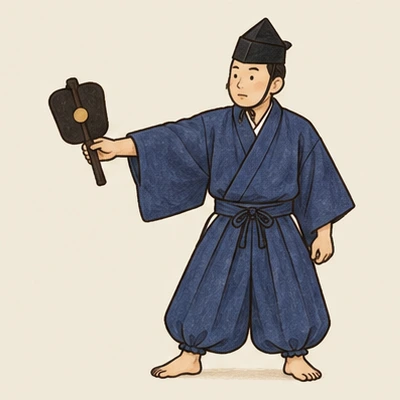
A gyōji today, in hitatare and eboshi, holding the gunbai.
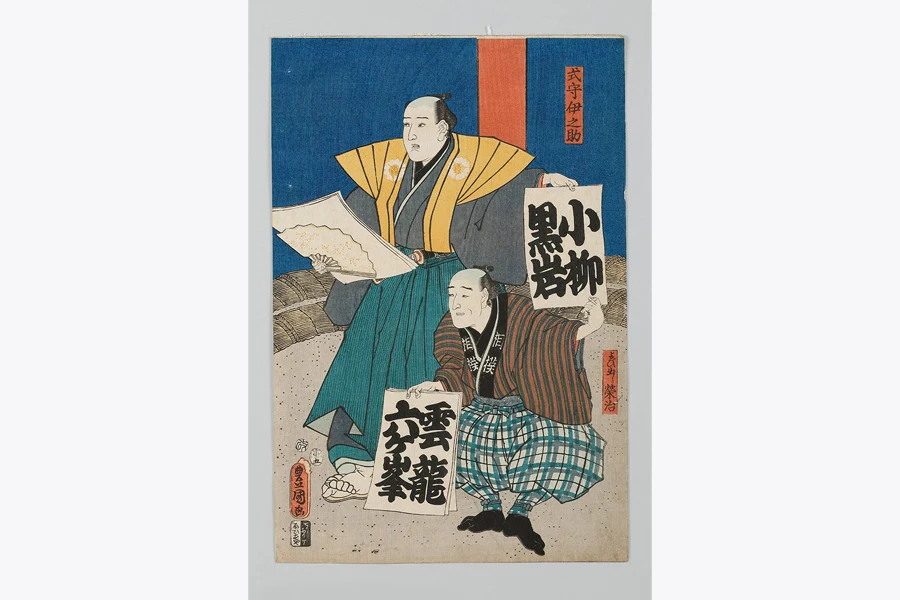
In an 1854 print the gyōji (standing) still wears Edo-style kamishimo, beside a yobidashi.Sumo Museum, Utagawa Toyokuni III, print of a referee and ring announcer (1854)
HO illustration; Sumo Museum, Utagawa Toyokuni III, print of a referee and ring announcer (1854)
At the very top are two tate-gyōji, who carry names passed from one holder to the next: Kimura Shōnosuke and Shikimori Inosuke. Shōnosuke’s fan carries a purple tassel; Inosuke’s is purple and white. Both wear a short dagger at the waist. Tradition says it signifies the referee’s readiness to take his own life should he make a wrong call. Nobody expects that today, but it conveys the weight placed on the referee’s judgment.
The gyōji runs the bout. He announces the wrestlers, manages the rhythm of the pre-bout preparation, and once the bout starts calls out "nokotta, nokotta" ("still in, still in") to tell the wrestlers and the audience that neither has lost yet. When the wrestlers lock up and stall, he urges them on with "hakkeyoi." At the end he points his fan toward the winner’s side.
His decision is not final. Five judges in black kimono, all senior stablemasters, sit around the ring. If any of them doubts the referee’s call, he raises a hand to call a mono-ii, and the judges climb into the ring to confer, consulting officials who watch video replays in a separate room. They may uphold the call, reverse it, or order a rematch. A reversal counts as a mark against the referee, and a senior referee with too many of them may be expected to resign. The arrangement is unusual: the referee carries the ceremony, and the judges carry the responsibility for getting it right.
Video review has its own famous origin story. In March 1969 the great yokozuna Taihō, on a 45-bout winning streak, was ruled to have lost to Toda, though photographs afterward appeared to show that Toda’s foot had gone out first. Shortly after, the Association began using video to assist the judges, usually dated from the May tournament of that year, though some sources give the following year.
08Chiyonofuji, the Wolf
Ask Japanese fans of a certain age who personified sumo at its most thrilling, and many will name Chiyonofuji Mitsugu. He was born Akimoto Mitsugu in 1955 in Fukushima, a fishing town at the southern tip of Hokkaidō that had already produced the yokozuna Chiyonoyama. He is said to have been a strong track athlete as a boy and to have caught Chiyonoyama’s eye. In 1970, while still in junior high school, he joined the Kokonoe stable that Chiyonoyama had founded. He was 183 centimeters tall and never weighed much more than 120 kilograms: slim by sumo standards.
As a young wrestler he was fast and aggressive and relied on forceful throws, and his left shoulder dislocated again and again. Told that he would have to protect the joint or give up, he took up weight training on a scale almost unknown in sumo, doing hundreds of push-ups a day and building a hard, muscular physique, while reworking his style around getting an early outside grip on his opponent’s belt with his left hand and finishing quickly with pulls and overarm throws. In January 1981 he beat the dominant yokozuna Kitanoumi in a playoff to win his first top-division championship, to wild excitement in the arena. Within the same year he was promoted to ōzeki and then to yokozuna, the 58th in the sport’s history.
The decade that followed was his. His sharp gaze and lean build earned him the nickname "the Wolf." He won 31 top-division championships, second at the time only to Taihō’s 32. In 1988 he put together a 53-bout winning streak, at the time second only to Futabayama’s 69 in the 1930s, until it was ended by Ōnokuni on the final day of the November tournament. In 1989 he became the first sumo wrestler to receive the People’s Honour Award, and his career total of 1,045 wins was then a record.
On the opening day of the May 1991 tournament, the 35-year-old Chiyonofuji lost to the 18-year-old Takahanada, the son of a former ōzeki and later the 65th yokozuna, Takanohana. Two days later he lost again, and he announced his retirement with a phrase that is still quoted: "tairyoku no genkai," the limit of my physical strength. The handover from one era to the next has rarely been so clear. He took over the Kokonoe stable and trained, among others, the ōzeki Chiyotaikai. He died in July 2016, at the age of 61.
His story captures much of what fans love about sumo: that size is not everything, and that a lighter man, rebuilt by training and armed with technique, can beat opponents far heavier than he is.
09Watching Sumo in Japan
There are six official tournaments, or basho, a year, each fifteen days long, held in odd-numbered months: January, May and September at the Ryōgoku Kokugikan in Tokyo; March in Ōsaka; July in Nagoya; and November in Fukuoka. Each tournament opens on a Sunday and finishes on a Sunday two weeks later. The final day is called senshūraku.
A tournament day is long. The lowest division starts in the morning, when the arena is nearly empty and you can sit close and hear the slap of bodies and belts. The makushita division, where many future stars are fighting their way up, takes over around midday. Mid-afternoon brings the jūryō ring-entering ceremony and bouts, and then, at around a quarter to four, the top-division ceremony and the yokozuna’s ring entry, the first high point of the day. Top-division bouts run until about six o’clock, ending with the final bout, the musubi no ichiban, usually featuring a yokozuna or the highest-ranked ōzeki. Afterward a lower-ranked wrestler performs the yumitori-shiki, twirling a long bow in a ceremony that closes the day.
Seats come in several kinds. The most traditional are box seats, masu-seki, on the lower level: small square floor areas fenced off by low metal rails and laid with cushions, meant for four people, who sit on the floor with their shoes off, eat bento and drink beer. They are cramped for anyone with long legs. Closest of all are the ringside seats, nicknamed sunakaburi, "sand-covered," where a wrestler falling out of the ring can land in your lap; eating, drinking and photography are not allowed there. Upstairs are ordinary chairs with a good view.
At the Kokugikan it pays to arrive early. The Sumo Museum inside shows rotating displays of old banzuke, woodblock prints and ceremonial aprons, and the arena sells yakitori made in its own basement kitchen. Chicken is considered a lucky food in sumo because chickens stand on two legs and never put their "hands" on the ground. In the early afternoon, sekitori arrive along the approach to the entrance in cotton robes and topknots, followed by their attendants, and fans line up to watch them pass.
Inside, look for the small things. Before some top-division bouts, ushers circle the ring carrying banners: these are prize offerings, kenshōkin, from sponsoring companies, and the winner collects a stack of envelopes from the referee’s fan, first making three chopping gestures in the air with his hand. When a yokozuna is beaten by a rank-and-file wrestler, spectators sometimes hurl their seat cushions toward the ring, a practice the Association forbids and the crowd keeps up anyway. On the final day, the champion receives the Emperor’s Cup, a huge silver trophy, followed by a parade of other prizes from embassies, prefectures and companies.
Between tournaments, wrestlers tour the country on exhibition circuits called jungyō, which are more relaxed and sometimes include sessions where wrestlers play with local children. Some stables allow visitors to watch morning practice quietly; visitors are expected to sit still, keep silent and avoid flash photography. And around Ryōgoku Station there are many chanko restaurants, several run by former wrestlers, where you can eat the food that built the bodies you saw in the ring.
10Sumo Today
Foreign-born wrestlers have shaped modern sumo. In 1972 Takamiyama, from Hawaii, became the first non-Japanese wrestler to win a top-division championship. In 1993 Akebono, also from Hawaii, became the 64th yokozuna and the first foreign-born one. Wrestlers from Mongolia followed and came to dominate: Asashōryū, Harumafuji, Kakuryū and above all Hakuhō, who won 45 top-division championships, far beyond Taihō’s old record. As of 2026, the Association limits each stable to one foreign-born wrestler, and stablemasters must hold Japanese citizenship, rules defended as protecting tradition and criticized as closing the sport to outsiders.
Sumo has also had its scandals. In 2011, text messages revealed that wrestlers had been fixing bouts, and the March tournament was canceled: the first time a regular tournament had been called off since 1946, and the first time ever over scandal. Violence and illegal gambling have dented its image too. But each time a new star emerges, the Kokugikan fills again, and in recent years the audience has become younger, more female and noticeably more international.
Beyond the professional ranks, sumo is practiced in school and university clubs across Japan, and amateur sumo, including women’s sumo, holds international championships. At many local shrine festivals, children in small mawashi wrestle on temporary rings, and at some, wrestlers hold babies up to see whose cries are loudest, because a crying baby is believed to grow up healthy. These are reminders of what sumo was before it was a profession: a prayer for a good harvest and a safe year.
Japan has other traditional combat disciplines, such as judo, kendo and kyudo, which have grading systems and international competition. Sumo never went that way. It has kept its Edo-period topknots, its courtly referees, its shrine roof and a ranking sheet rewritten by brush every two months. To spend a day at the Kokugikan is to watch a sport, and also to watch an old world going about its business.