
At a glance
Why the Japanese bow is gripped off-center, what the long pause at full draw is for, and how a battlefield weapon became a school discipline.
- The standard yumi is 7 shaku 3 sun, about 221 cm, with the grip roughly a third of the way up from the bottom.
- The usual distance, kinteki, is 28 meters, at a target 36 cm across.
- Every shot follows the shahō hassetsu, eight stages from ashibumi to zanshin.
- In 1686 Wasa Daihachirō shot 13,053 arrows at Sanjūsangen-dō in a day and a night; 8,133 went the full length.
- As of 2023, the All Nippon Kyudo Federation had about 130,000 registered members.
Kyudo, "the way of the bow," is Japanese archery as it is practiced today: a seven-foot bamboo bow gripped off-center, a target 28 meters away, and a sequence of movements so fixed that a beginner and an eighty-year-old master perform exactly the same steps. To a newcomer the most striking thing is how little seems to happen. An archer in a white top and black divided skirt walks to the line, raises the bow, draws it, and then simply holds, for what can feel like a very long time, before the arrow goes. This piece explains why the bow looks the way it does, what that long stillness is for, how a battlefield weapon became a discipline practiced by schoolchildren and retirees, and where a visitor to Japan can watch it or try it.
01A Bow Taller Than the Archer
The Japanese bow, the yumi, is long. The standard length is seven shaku three sun, about 221 centimeters, so it stands well above the head of almost anyone who uses it. Long bows exist elsewhere, but the yumi has a feature that is close to unique: the grip is not in the middle. It sits roughly a third of the way up from the bottom, so the upper limb is much longer than the lower one and the drawn bow makes a lopsided curve.
This asymmetry is very old. A Chinese chronicle compiled in the third century, describing the people of the Japanese islands, noted that they used wooden bows that were short below and long above. Nobody knows for certain why. The usual explanations are practical. A short lower limb clears the ground when an archer shoots kneeling and clears the horse when he shoots from the saddle. Holding the bow low is said to balance the vibrations of the two limbs at the moment of release, so less shock reaches the hand. And a very long bow can be drawn very far, which lets materials with modest spring, like bamboo and wood, store enough energy to send an arrow a long way. Each of these makes sense, and the honest answer is that the shape probably answered several needs at once.
A traditional bow is a laminate of bamboo strips around a wooden core, glued, bound tightly with cord, and shaped with heat. A good one takes months to make, and the number of craftsmen who can make one has dwindled; the Miyakonojō area of Miyazaki Prefecture is the best-known center for bamboo bows and makes most of those still produced. Most students and many club archers now shoot bows of fiberglass or carbon fiber, which cost a fraction of the price and do not mind humidity, though they keep the classic shape. Arrows were traditionally bamboo fletched with hawk or eagle feathers; aluminum and carbon shafts are common now.
The draw itself differs from Western archery. Instead of hooking the string with the fingers, a kyudo archer pulls with the right thumb, protected by a deerskin glove called a yugake that has a hardened thumb and a groove at its base where the string sits. Because of the thumb draw, the arrow rests on the right side of the bow, not the left.
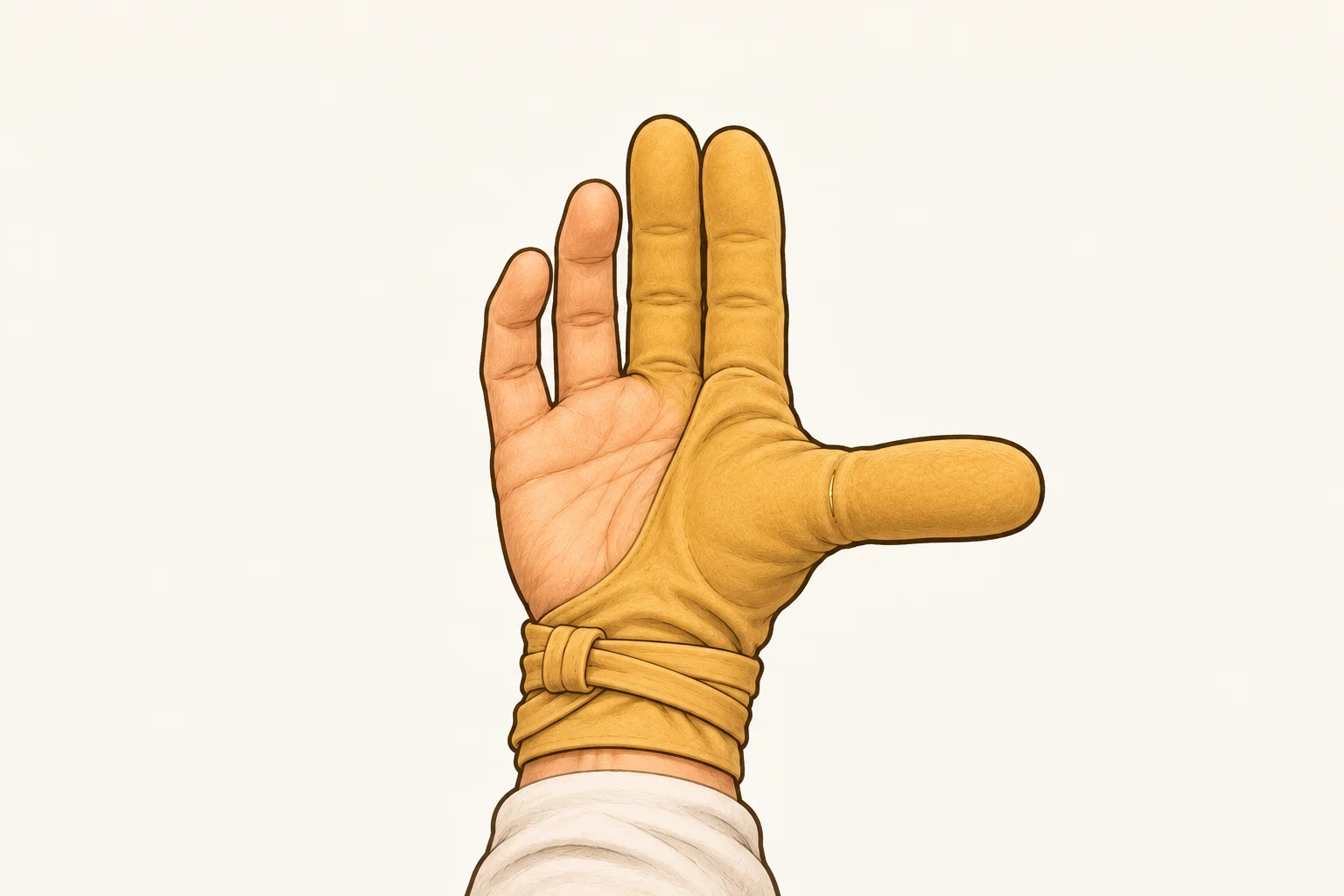
The yugake, a deerskin glove for the right hand, has a hardened thumb with a groove at its base for the string.
- 1Shajōthe shooting hall, polished wooden floor
- 2Yamichiopen lawn or gravel; 28 meters for kinteki
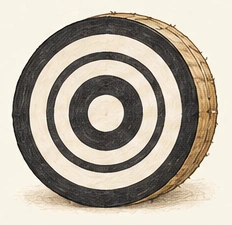
- 3Targetset in packed sand under a small roof; 36 centimeters across
Kinteki is shot at 28 meters at a target 36 centimeters across; enteki at 60 meters with larger targets.
The standard competition distance, called kinteki, is 28 meters, and the target is 36 centimeters across. Targets are set in a bank of packed sand under a small roof. The archers stand on the polished wooden floor of the shooting hall, the shajō, and between hall and targets lies an open strip of lawn or gravel, the yamichi or "arrow path." A longer form, enteki, is shot at 60 meters with larger targets.
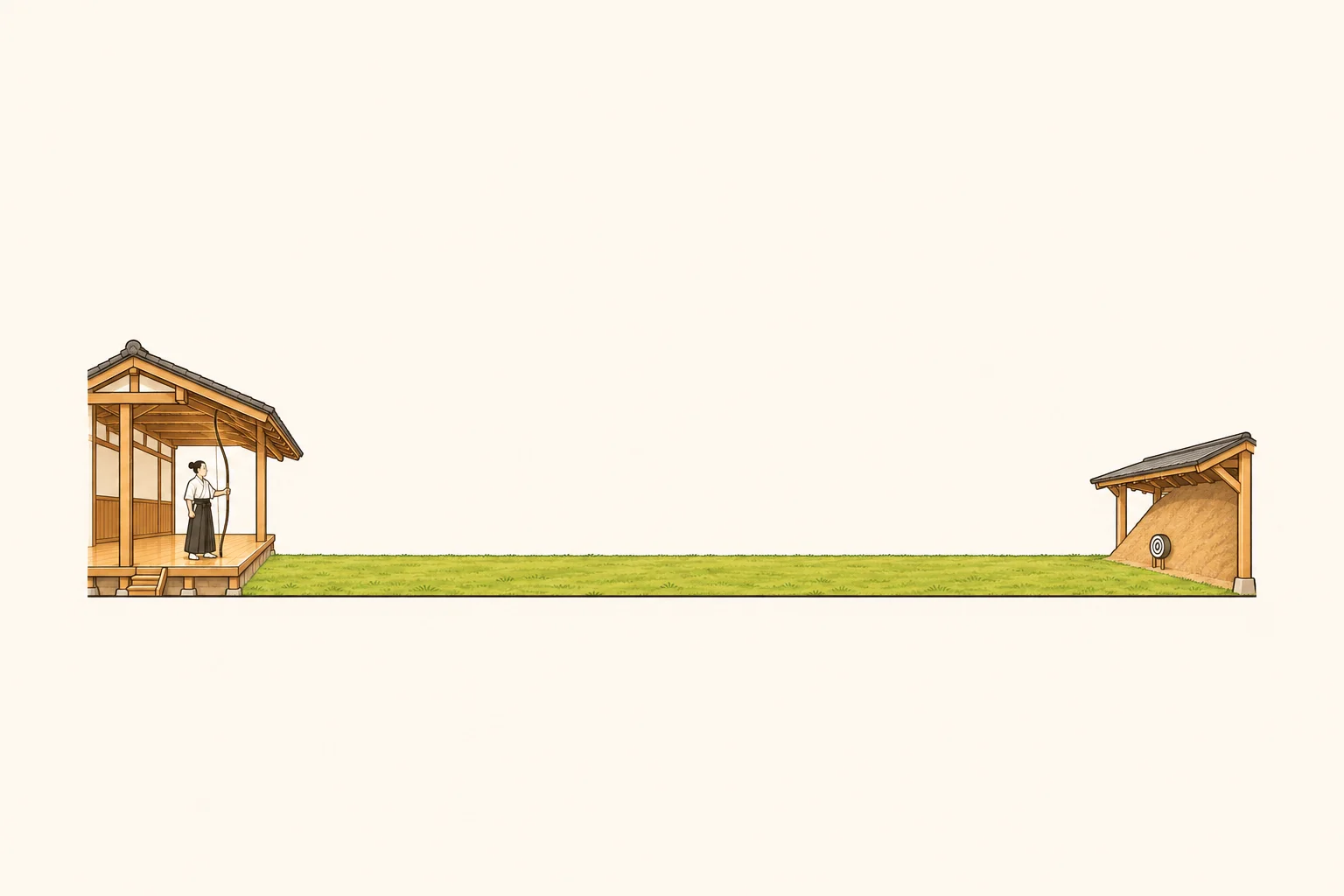
Archers shoot from the wooden-floored shajō across the open yamichi to targets set in a bank of sand.
02Eight Stages for One Arrow
Every shot in kyudo follows a sequence called the shahō hassetsu, the eight stages of shooting. Beginners learn it on their first day. Senior teachers still practice it every time they pick up a bow.
The archer first sets the feet (ashibumi), spreading them so that the line between them points at the target. Then comes dōzukuri, settling the torso so the spine and hips are stable. In yugamae the right hand takes the string, the left hand takes the grip, and the head turns toward the target. Uchiokoshi is the raising of bow and arrow together, high above the head. In hikiwake the arms spread apart and come down, opening the bow until the arrow lies along the cheek near the mouth. Then the archer reaches kai, the full draw, and stays there. The release, hanare, follows. The last stage, zanshin, is the posture held after the arrow has gone, eyes still on the target, body and attention not yet relaxed.
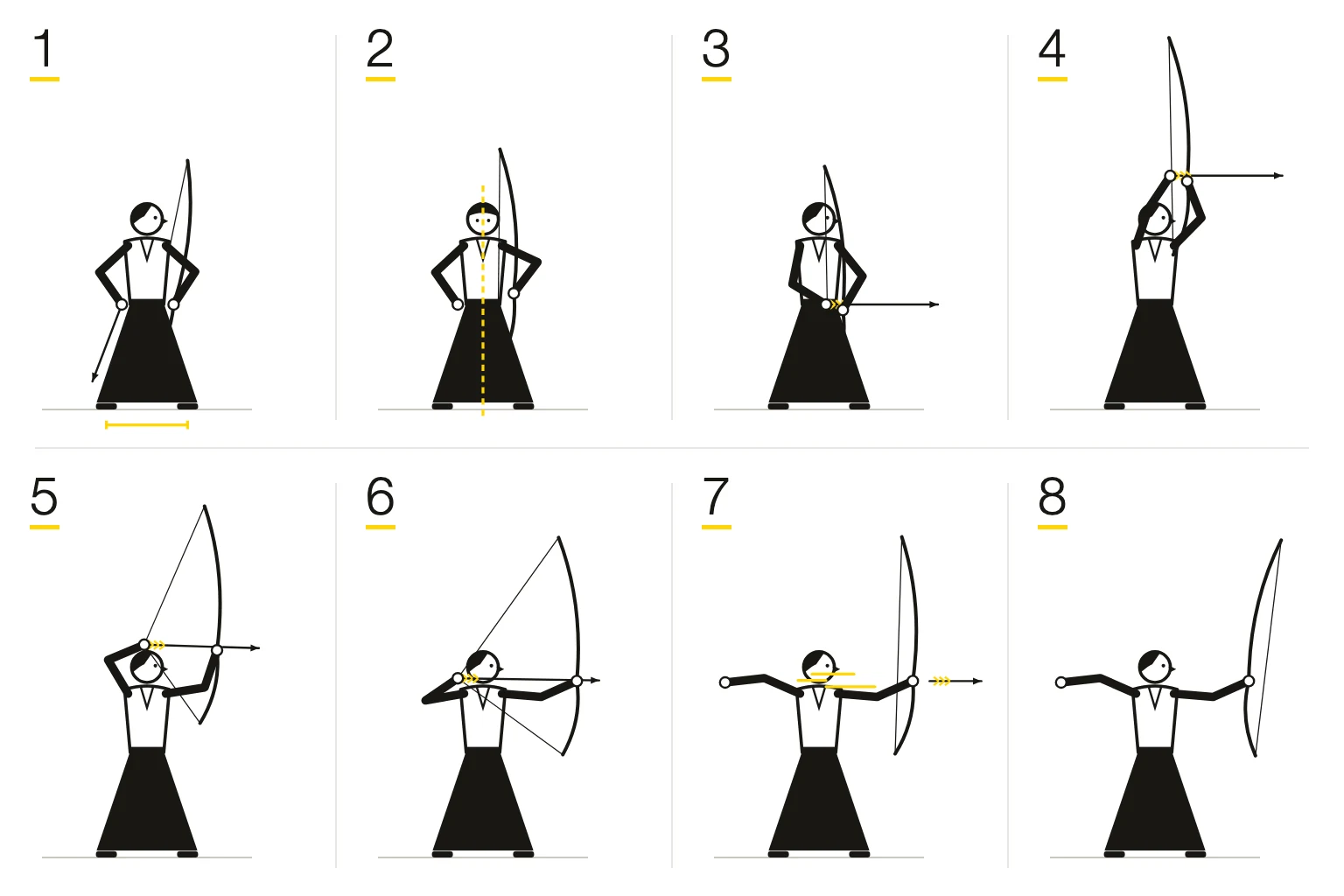
The eight stages of a shot (diagram): 1 ashibumi, 2 dōzukuri, 3 yugamae, 4 uchiokoshi, 5 hikiwake, 6 kai, 7 hanare, 8 zanshin.
Kai is the part that puzzles onlookers. The bow is fully drawn and the arrow aimed, so why wait? The kyudo answer is that the arrow should not be let go by an act of will. In kai the archer is not frozen but keeps expanding, pushing the bow forward and the string back, until at some moment the string slips from the thumb. Many teachers say that a deliberate release spoils the shot, and that in a really good one the archer cannot quite say when the release happened. A kai may last a few seconds; experienced archers hold longer.
Watch the bow hand at the release and you see something peculiar to the Japanese bow. The yumi spins in the archer’s loosened left hand, turning most of a circle so that the string ends up against the outside of the forearm. This is yugaeri, the "bow return," and it comes from the off-center grip and a slight twist the archer puts into the hand during the draw. A clean yugaeri goes with a clean, sharp sound of the string, the tsurune, and archers listen to each other’s shots as much as they watch them.
Behind all of this sits a phrase, seisha hitchū: correct shooting hits the target. If posture and mind are right, the arrow will go where it should. Matches count hits, and most competitions score simply hit or miss rather than rings. But in grading examinations the panel looks at the whole performance: posture, breathing, how the archer enters, bows, and withdraws. A hit with a scrambled form is not admired, and a miss with sound form can still earn a pass. That is the clearest difference from Olympic-style archery, where the score on concentric rings is everything.
03From Weapon to Way
Archery is older than the sword in Japan’s warrior culture. From the Heian period into the Kamakura period the essential skill of a mounted warrior was shooting from horseback, and the warrior’s calling was described as "the way of bow and horse." The most famous archery scene in Japanese literature comes from The Tale of the Heike, the epic of the Genpei War. At the battle of Yashima in 1185, the Taira hoisted a fan on a pole aboard a boat and dared the Minamoto to hit it; the young Nasu no Yoichi rode into the surf and shot it down, and both armies cheered. The episode is a literary set piece, embroidered in the telling, but it shows what counted as glory at the time.
Mounted archery survives as yabusame, in which riders gallop down a straight track and shoot at three wooden targets in turn. Over the medieval centuries archery split into schools. The Ogasawara school became the custodian of ceremonial archery and etiquette for the shogunate and the warrior houses. The Heki school emphasized effective shooting on foot and spun off many branches. Then in 1543 Portuguese traders landing on Tanegashima brought matchlock guns, and within a few decades firearms dominated the battlefield. The bow’s military value fell away.
The bow did not disappear. In the long peace of the Edo period, archery became a samurai accomplishment and a spectator sport. The great event was the tōshiya at Sanjūsangen-dō in Kyoto, the temple whose hall is about 120 meters long. Archers sat at one end of the veranda along its west side and shot down its length, trying to send arrows the whole distance under the low eaves without striking a beam. The most celebrated record belongs to Wasa Daihachirō of the Kii domain, who in 1686 shot 13,053 arrows in a day and a night, of which 8,133 went the full length. The contests were expensive and brutal on the body, and they faded in the later Edo period.
After the Meiji Restoration abolished the samurai class, archery went into decline. In 1895 the Dai Nippon Butokukai, an association to promote the martial arts, was founded in Kyoto; its training hall, the Butokuden, still stands near Heian Shrine. Because the schools shot in quite different ways, the Butokukai in 1934 issued unified guidelines for shooting, the Kyūdō Yōsoku, but many schools resisted them and they never really took hold; the eight-stage framework in use today is generally credited to the postwar federation’s teaching manuals. In the early Shōwa years the name kyūjutsu, "the technique of the bow," gave way to kyūdō, "the way of the bow," the same shift from technique to path that produced kendo and judo. After World War II the occupation authorities restricted martial arts; a national kyudo federation was founded in 1949 (it took its present name, the All Nippon Kyudo Federation, in 1957) and rebuilt competition and grading. It still sets the standard form and runs examinations.
Many Westerners first met kyudo through a short book. The German philosopher Eugen Herrigel taught at Tōhoku Imperial University in Sendai in the 1920s and studied archery under Awa Kenzō, a teacher with a strongly spiritual approach and no Zen training. Herrigel’s Zen in the Art of Archery (German 1948, English 1953) describes a master who told him not to aim but to let "it" shoot, and tells of the master hitting the target twice in the dark, the second arrow splitting the first. The book has been enormously influential, and it left many readers thinking that kyudo is a form of Zen meditation. Later scholars, notably the Japanese researcher Yamada Shōji, have pointed out that Awa’s views were idiosyncratic even within Japanese archery, that Herrigel’s Japanese was limited and he relied on an interpreter, and that much of the Zen framing was Herrigel’s own. Kyudo does care deeply about the state of mind, but its roots are in samurai etiquette and the craft of shooting rather than in Zen practice.
04Who Shoots Today
Kyudo is a living activity in Japan, not a museum piece. As of 2023, the All Nippon Kyudo Federation had about 130,000 registered members, and many more people have shot in school clubs without ever registering. Plenty of junior and senior high schools have a kyudo club with its own small range at the edge of the grounds, and after classes you can see students in hakama lined up at the shooting line. It is one of the few martial arts where women and men take part in roughly equal numbers; in many high school clubs girls outnumber boys. Because it rewards control rather than strength or speed, people take it up in middle age and keep shooting into their eighties.
Progress is measured in ranks, from first dan up to tenth, awarded by examination. A candidate shoots two arrows while a panel judges form and etiquette as well as hits. Above the higher ranks sit teaching titles, renshi, kyōshi, and finally hanshi, which very few people hold. Competitions include individual and team events; teams of three or five shoot in turn, and a hit draws applause or a shout of yoshi! from teammates.
The bow also keeps its place in Japan’s calendar. In January, Sanjūsangen-dō hosts the Ōmato Taikai, a successor to the old tōshiya, now shot at 60 meters in an open range beside the hall; it was still being held as of 2026. It falls around Coming of Age Day, and many of the archers are young people who have just turned adult, the women in long-sleeved furisode kimono with the sleeves tied back by a white cord. It is one of the most photographed scenes of the Kyoto New Year. Many shrines hold New Year archery rites to drive away evil for the year ahead. Yabusame appears at shrine festivals across the country; the performances at Tsurugaoka Hachimangū in Kamakura in September and at Shimogamo Shrine in Kyoto in early May, ahead of the Aoi Festival, draw large crowds.
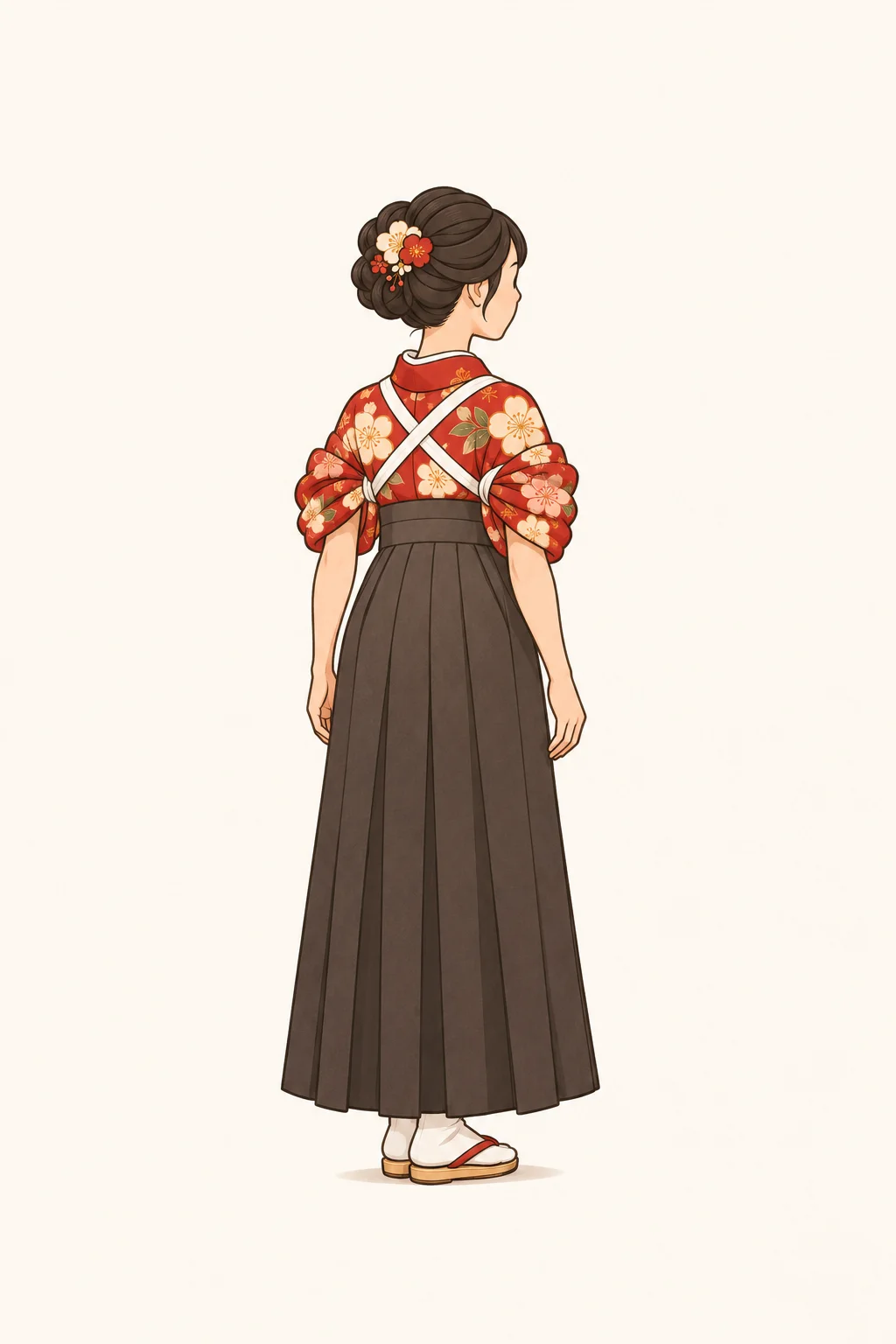
At the Ōmato Taikai at Sanjūsangen-dō, newly adult women wear furisode, the long sleeves tied back by a white cord.
Kyudo belongs to the family of Japanese martial arts, the budō, alongside kendo, judo, karate, and aikido, each with its own halls and ranks, while sumo runs as a professional world of its own. When martial arts became a required part of junior high physical education, some schools chose kyudo. What sets it apart from the rest is that there is no opponent. The archer faces a target and his or her own body.
05Watching and Trying It in Japan
The easiest way to see kyudo is at a seasonal event. The Ōmato Taikai at Sanjūsangen-dō in mid-January is crowded, so arrive early. For yabusame you stand along the rope beside the track; a horse covers the course in well under a minute, the riders shoot at full gallop, and when a target shatters the crowd roars. Dates vary by shrine, so check the shrine’s own schedule before you go.
To watch ordinary practice, look for a municipal martial arts hall or archery range; many allow quiet spectators. In Kyoto there is a range beside the Butokuden, and in Tokyo the Meiji Jingū Shiseikan has a kyudo hall that hosts a national tournament dedicated to the shrine around November 3, still held as of 2026. A few rules matter. Keep your voice down, above all while an archer is at full draw. Never step onto or cross the arrow path. Ask before taking pictures, and do not use a flash. Shoes come off before you step onto the wooden floor, and people bow toward the front of the hall when entering and leaving.
To shoot yourself, some ranges and tour operators offer one-time introductory sessions of an hour or two. A teacher walks you through the etiquette and the eight stages, lends you a glove and a practice bow, and has you shoot first at a straw bale, the makiwara, from a couple of meters away, before you try a few arrows at a real target. First-timers are often surprised: the bow looks light, yet drawing it fully takes real effort, and holding still at full draw is much harder than it looks. In a regular dojo, beginners often spend weeks or months on empty-handed form and the makiwara before they are allowed to shoot at the target at all. What a short session gives you is the feeling of standing in the hall when your own string sounds, and a better sense of what is going on during that long pause when you watch someone else.
At the end of a formal shot, a good archer does not celebrate a hit or show disappointment at a miss. The bow comes down, the archer bows, and the archer steps back from the line, every step and breath following the form. Once you know to look for that, the young women in furisode at Sanjūsangen-dō are worth watching after the arrow has landed as well as before.