
At a glance
How go became a salaried profession in Japan, why kaya boards and clamshell stones are prized, why Hon’inbō Shūsaku is still famous, and how a visitor can play.
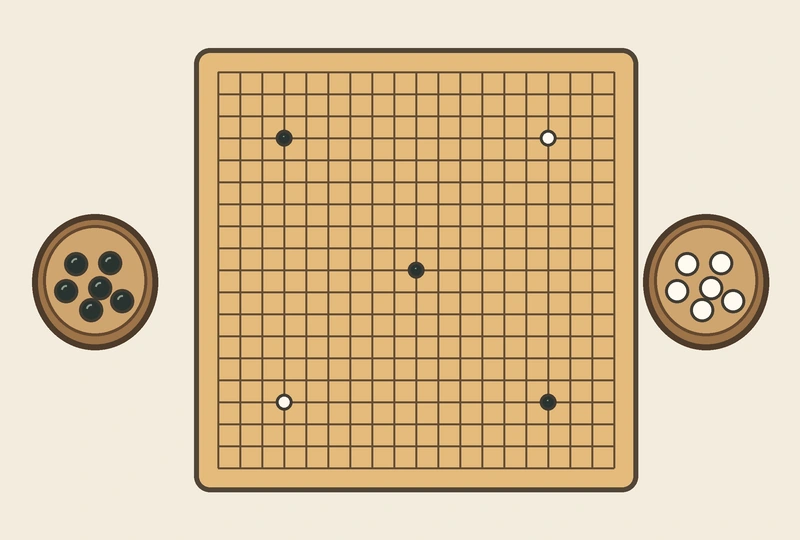
- The board has nineteen lines each way and 361 points; Black moves first, and under Japanese rules gives White 6.5 points of komi.
- Fine boards are kaya wood with lines laid in lacquer from a sword blade; white stones are clamshell, black stones Nachi slate.
- In the Edo period four houses, Hon’inbō, Inoue, Yasui and Hayashi, sent their best players to the castle games before the shogun.
- Hon’inbō Shūsaku won all nineteen of his castle games and died of cholera in Edo in 1862.
- The Nihon Ki-in was founded in 1924; professional go today is topped by seven major titles, including Kisei, Meijin and Hon’inbō.
Go is often called the oldest board game still played in something like its original form, and although it was born in China, Japan is where it became a profession, a craft tradition, and the version most of the Western world first learned. The English word "go" itself comes from the Japanese igo. This piece explains how the game works and why it grips people, what makes a Japanese board and a set of stones worth more than a car, how the Tokugawa shoguns turned four families of players into salaried officials, and why a young man from a small island in the Inland Sea, Hon’inbō Shūsaku, is still the most famous of them. It ends with how a visitor can sit down and play.
01A Game of Almost No Rules
The rules of go fit on an index card. Two players take turns placing black and white stones on the intersections of a grid of nineteen by nineteen lines, 361 points in all. Stones never move once placed. A stone or group of stones whose last empty neighboring point, or "liberty," is filled by the opponent is captured and removed. When neither side can gain anything more, the player who has surrounded more territory wins. Black moves first, and because that is an advantage, under Japanese rules White receives a compensation called komi of 6.5 points.
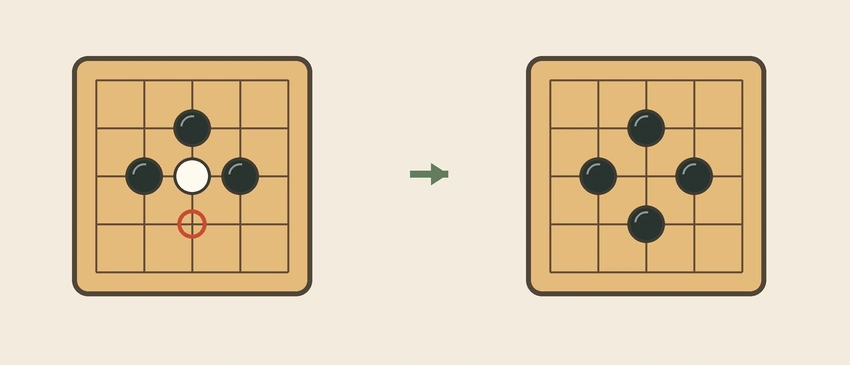
Left: the white stone has one liberty left, at the red circle. Right: Black plays there and the white stone is removed.
From those few rules comes a game of astonishing depth. A local fight in one corner affects the balance of the whole board, and a player who wins every skirmish can still lose the game. Japanese players speak of taikyokukan, a sense of the whole board, and the game has supplied the language with a remarkable number of everyday expressions. Fuseki, the opening layout, now means laying groundwork for a long-term plan. Jōseki, the established sequences for a corner, means doing things by the book. To ichimoku oku, "place one stone first," means to acknowledge someone as your superior, from the handicap stone a weaker player puts down before the game. Dame, the useless point neither side needs, is the ordinary Japanese word for "no good." And okame hachimoku, "the onlooker sees eight moves ahead," is the Japanese way of saying that bystanders see more clearly than the people involved.
Much of what Japanese players love about the game is physical. The stone is held between the tips of the index and middle fingers, nail on top, and set down with a short, firm press that makes a crisp click on the wood. A good board takes that sound and softens it. The whole Japanese tradition of go equipment exists to make that one gesture feel and sound right.
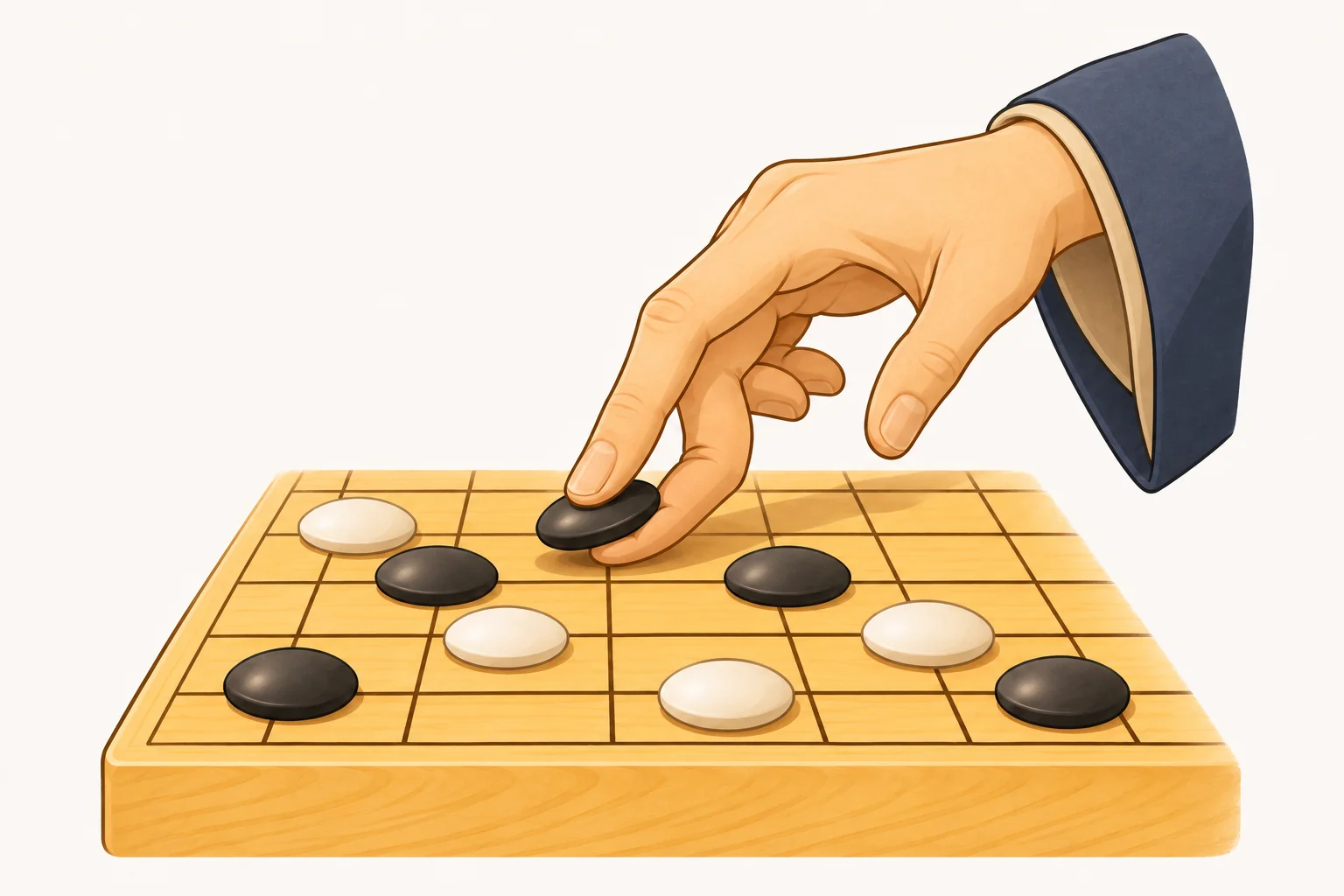
A black stone held between index and middle fingers, nail on top, set down on a kaya board.
02The Board
A traditional Japanese go board, a goban, is a solid block of wood several inches thick standing on four short legs, meant to be placed on tatami mats with the players kneeling on either side. The prized wood is kaya, Japanese nutmeg-yew. It is pale gold, faintly fragrant, and slightly yielding, so that the surface gives a little under each stone. That softness makes the sound mellow and saves the fingers over a long game. The most famous kaya comes from Hyūga, the old name for Miyazaki Prefecture on Kyūshū, and old trees are now very rare. A thick board cut so that straight, parallel grain runs across the top and down the sides, called tenchi-masa, can sell for several million yen. Most people play on far cheaper boards of other woods, or on folding boards.
A goban is not square. It is slightly longer from player to player than it is wide, and so is each cell of the grid, because a seated player looks at the board at an angle that foreshortens it. Made a little long, it looks square from where you sit.
The lines are laid on by a technique called tachimori, "sword-raising." The craftsman dips the edge of a Japanese sword blade in black lacquer and presses it down along a straightedge, leaving a fine, slightly raised line that you can feel with a fingertip. Nine small dots, the hoshi or "stars," mark key points, and the center point is called tengen, the "origin of heaven."
Turn a goban over and you find a square recess carved into the underside. It is popularly called the chidamari, the "blood pool," and a well-loved story says it was there to hold the head of a kibitzer who spoke up during a game. That story is folklore. In practical terms the hollow relieves stress in the thick wood so it is less likely to crack, and it improves the resonance of the board. The legs are carved in the shape of the gardenia fruit, kuchinashi, a word that sounds like "no mouth": a reminder, built into the furniture, that spectators keep quiet.
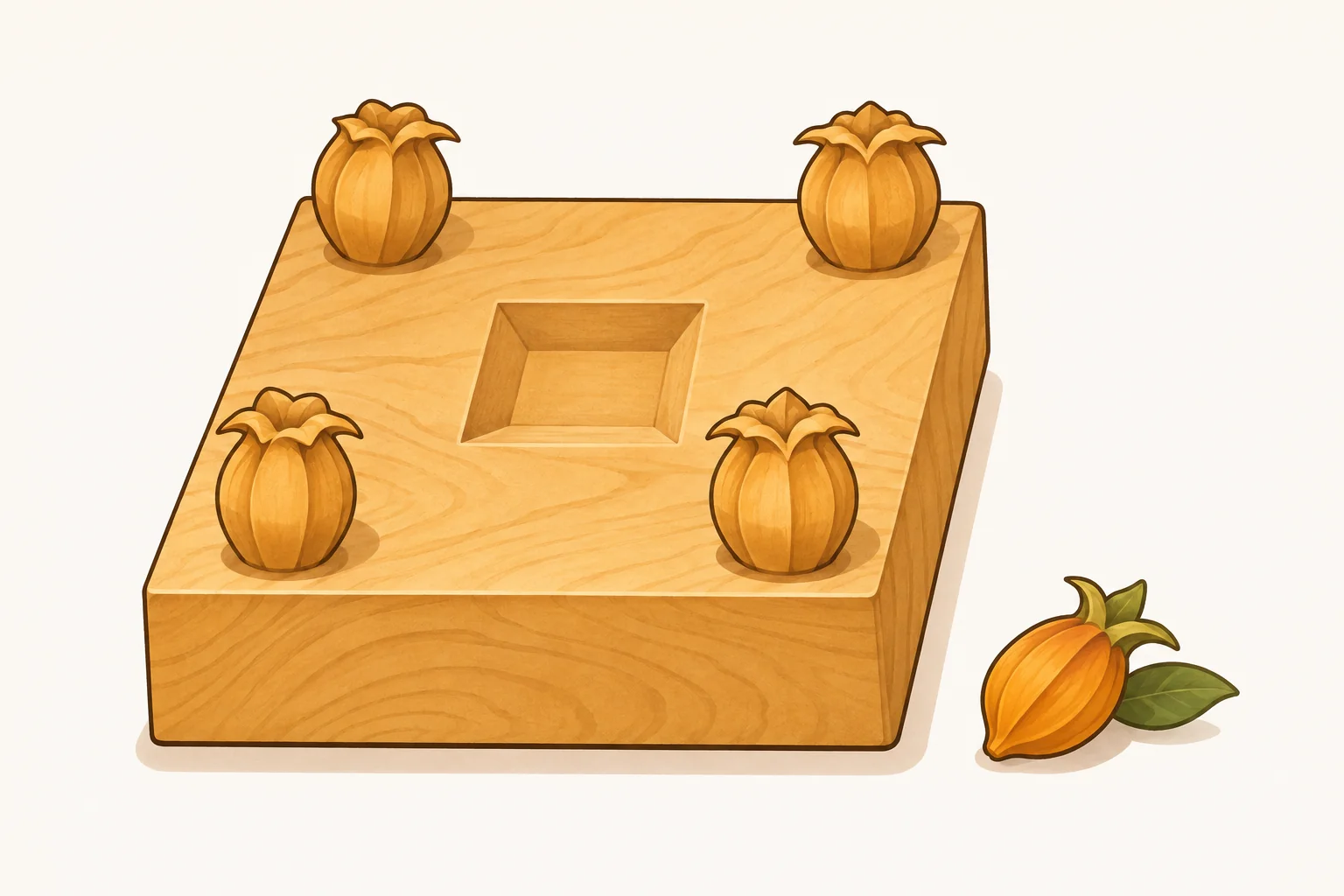
The underside of a goban: the square chidamari recess and legs carved like gardenia fruit.
How long the goban has been an object of luxury in Japan can be seen at the Shōsōin, the eighth-century imperial storehouse at Tōdai-ji in Nara. It holds a board faced with red sandalwood, its nineteen lines and star points inlaid in ivory (the star points, by one account, shaped as flowers), and its sides decorated with marquetry figures of camels, birds, and plants.
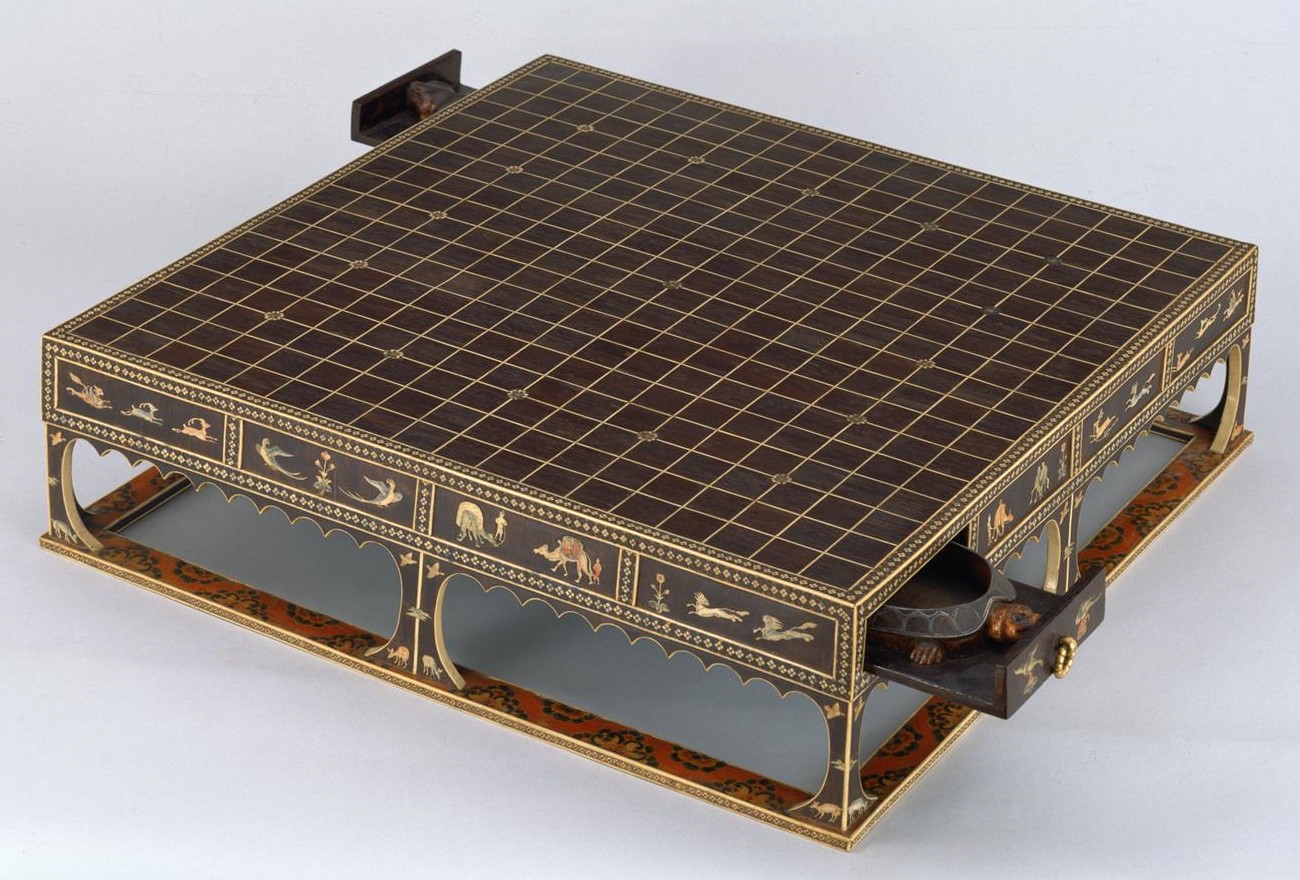
The Shōsōin’s 8th-century sandalwood go board: ivory inlaid grid lines, with camels and birds on the sides.
03The Stones
In play, black and white stones do exactly the same job. In a fine Japanese set they come from completely different worlds.
The best white stones are cut from the shell of a large clam, hamaguri. Discs are cut from the thick shell and ground into a lens shape, and on the finished stone you can see fine parallel lines from the shell’s growth. The finer and straighter those lines, the higher the grade; the best are called yuki, "snow." The clams of the Hyūga coast in Miyazaki were once the standard of quality, but they have been fished out, and today almost all clamshell stones are made from shell imported from Mexico. Old Hyūga stones are collectors’ items.
Black stones are made from Nachi-guro, a fine-grained black slate from the Kumano area of Mie Prefecture, the same stone used for inkstones, gravestones, and garden stones. Polished, it is not glossy but a soft charcoal black, and it slowly takes on a sheen from the oil of players’ hands. Shell and stone feel different in the fingers, in temperature as well as weight, and part of the pleasure of a good set is that contrast.
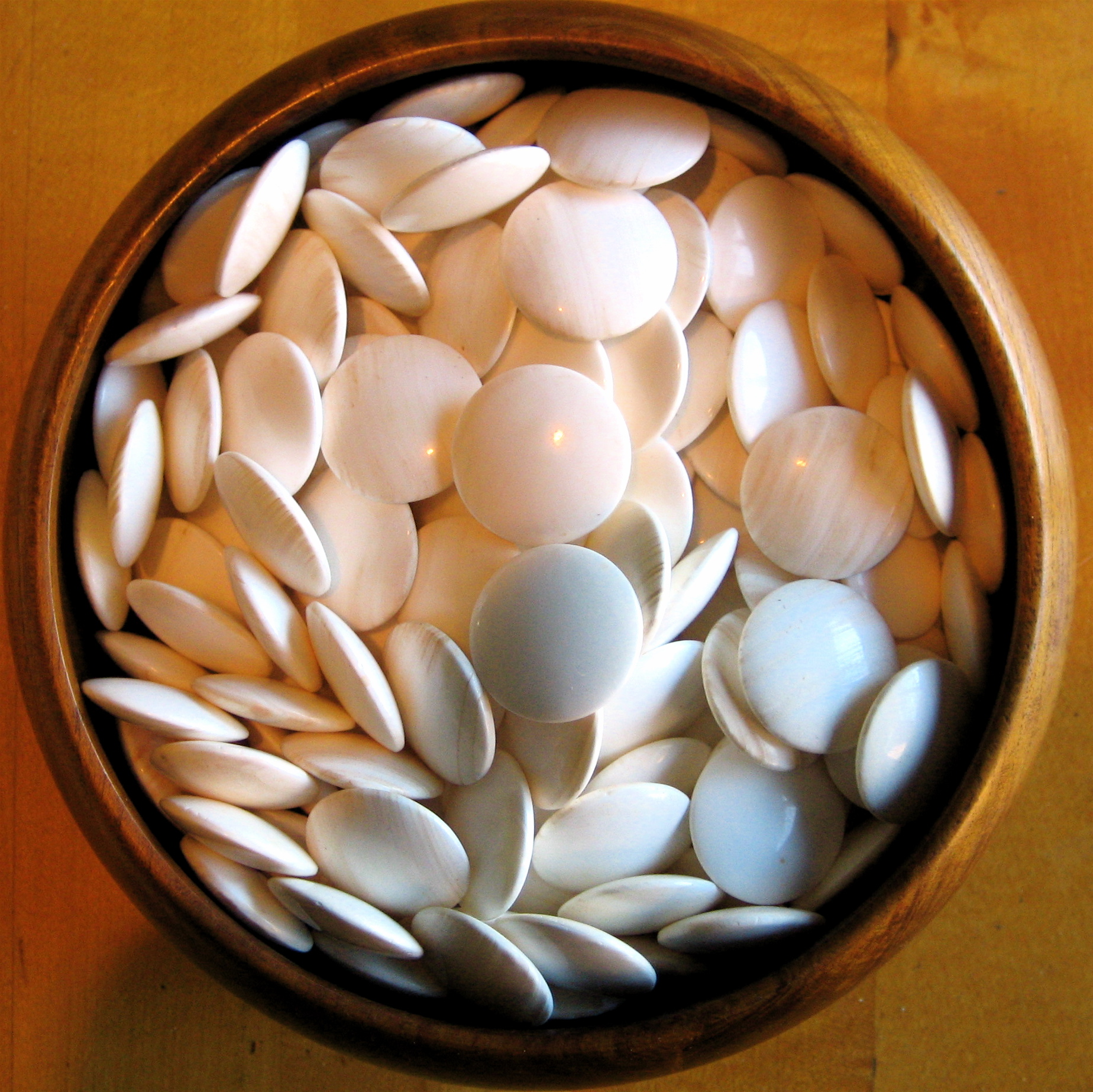
Clamshell white stones in their bowl; the fine parallel grain, shimame, is visible.liz west, "Shell go pieces sc," CC BY 2.0 · CC BY
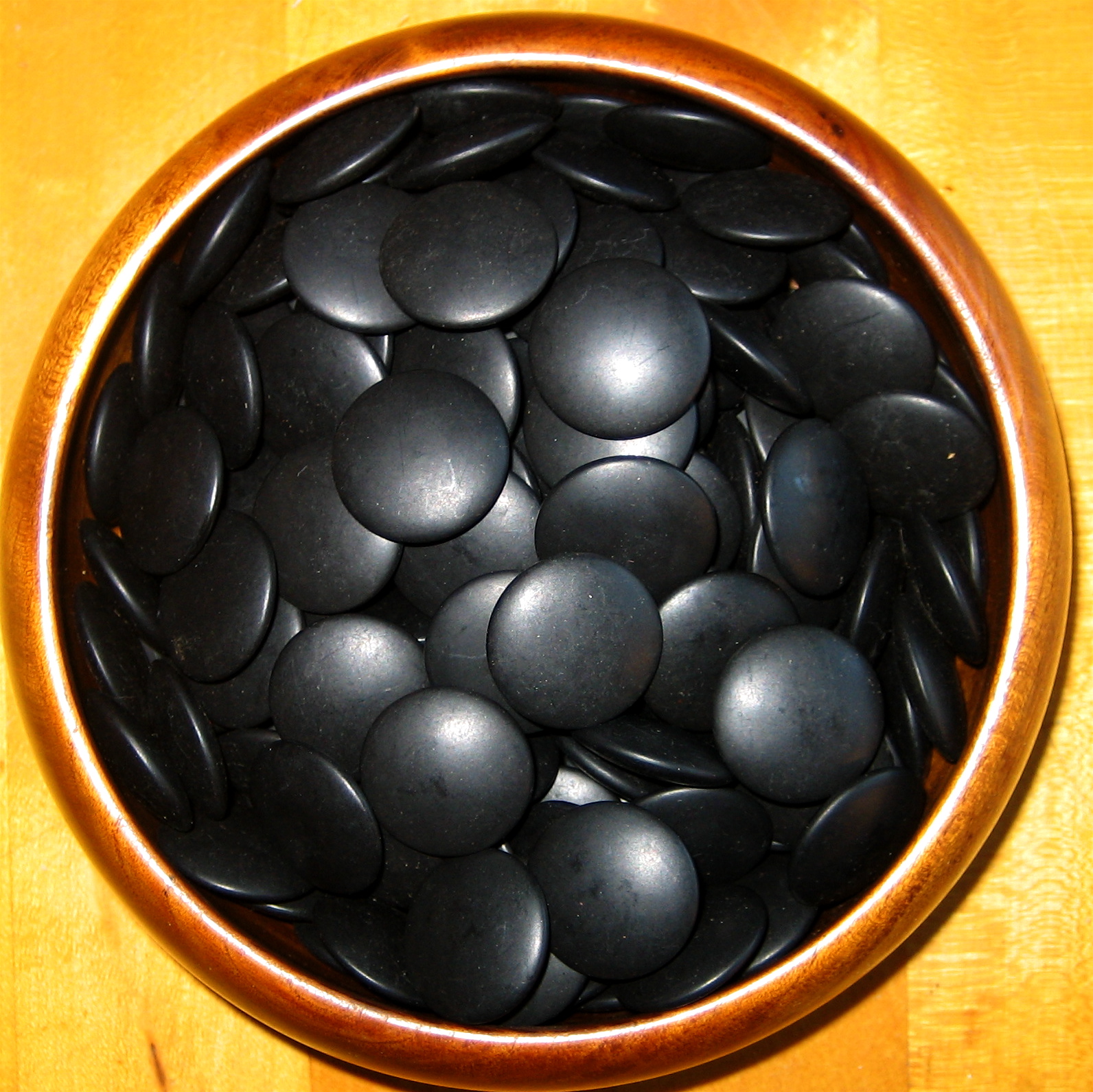
Slate black stones are not glossy but a quiet, slightly grayish black.liz west, "Slate go pieces sc," CC BY 2.0 · CC BY
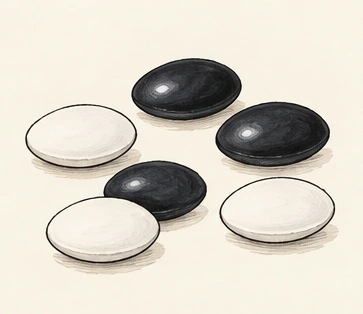
Finished stones swell in the middle and thin toward the edge.
A detail most players never notice: Japanese white stones are made very slightly smaller than black ones. White looks larger than black to the eye, so the white stones are shrunk a fraction to make the two colors appear equal on the board.
The stones sit in round lidded bowls, goke, ideally turned from mulberry or persimmon wood. Each player keeps a bowl at the right hand, and captured stones go into the upturned lid.
04From Court Pastime to Profession
Go reached Japan from China, generally thought to have come by way of the Korean peninsula around the seventh century, though the date and route are debated, and spread first among aristocrats and monks. In The Tale of Genji, written around 1000, Genji peeks through a blind at two women absorbed in a game, and Sei Shōnagon mentions go in The Pillow Book. By the sixteenth century, warlords played it in camp as training in strategy.
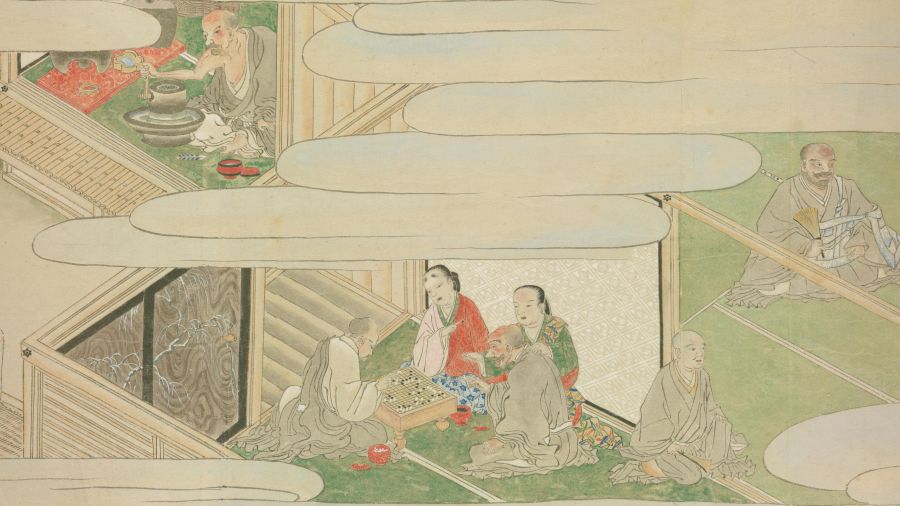
A go scene from the Shuhanron scroll: two players face each other across a thick board while others look on.National Diet Library, Shuhanron emaki (go-playing scene)
Professional go in Japan begins with a Buddhist monk of the Jakkō-ji temple in Kyoto named Nikkai, who lived in a sub-temple called the Hon’inbō. He was the strongest player of his age and played before Oda Nobunaga, Toyotomi Hideyoshi, and Tokugawa Ieyasu in turn. Tradition says Nobunaga praised him as a meijin, a "master," giving the word that later became go’s highest rank. Another legend has it that on the night before Nobunaga was killed at the Honnō-ji temple in 1582, Nikkai played a game before him that ended in a rare "triple ko," and that this was later remembered as an omen. Both stories come from later accounts. What is certain is that Nikkai, taking the name Hon’inbō Sansa, received a stipend from the Tokugawa shogunate, and that go became an officially recognized profession.
Over the Edo period (1603–1868) four houses dominated the game: Hon’inbō, Inoue, Yasui, and Hayashi. Each was run like a family business or an artistic school, adopting talented boys and passing the headship down. The top post, meijin godokoro, made one player the head of the whole go world, and the houses competed for it, sometimes bitterly, for more than two centuries. Every year the leading players of the four houses played before the shogun at Edo Castle in the oshirogo, the "castle games." These were the most important games of a player’s year, and a loss shamed the whole house. In practice the games were usually played out beforehand and then replayed from the record at the castle, but the record went to the shogun, and no one took them lightly.
Under this system Japanese go theory pulled ahead of the rest of the world. In the late seventeenth century Hon’inbō Dōsaku moved the game away from narrow calculation of local life and death toward the efficiency of stones working together across the board. He is remembered as a kisei, a "saint of go," and much of modern opening thinking traces back to him.
05Hon’inbō Shūsaku
Of all the Edo players, the one people still know by name is Shūsaku. He was born in 1829 on Innoshima, an island in the Inland Sea that is now part of Onomichi in Hiroshima Prefecture, as Kuwabara Torajirō. The story goes that his mother taught him the game as a small child and that the Asano family, lords of Mihara Castle, took notice of the prodigy and recommended him to Edo, where at eight (nine by Japanese reckoning) he entered the Hon’inbō house under Hon’inbō Jōwa. He rose quickly and was chosen as the heir of the next head, Hon’inbō Shūwa.
His most famous achievement is his record in the castle games. From his first appearance in 1849 until the last castle games were held in 1861, he never lost one, winning nineteen in a row. His opponents were the strongest players of the rival houses, in the most pressured setting of the year, and nothing like it was done before or after.
Earlier, in 1846, at seventeen, he played Inoue Gen’an Inseki, the head of the Inoue house, in Ōsaka. The game turned against him in the middle, and then he played move 127, a quiet move that worked in several directions at once. A doctor who was watching is said to have noticed that Gen’an’s ears flushed red at that moment, a sign that he knew he was in trouble. Shūsaku won, and the game has been known ever since as the "ear-reddening game." It is still one of the classical games Japanese players most often replay.
Playing Black, Shūsaku liked to open on three corners in a fixed, solid pattern now called the Shūsaku opening. In an age with no komi, moving first was already an advantage, and the idea was simply to keep it, safely, to the end. A remark attributed to him says that as long as the board stays the same size, his opening will never go out of date. No one knows if he really said it, but players love to quote it.
In 1862 cholera swept through Edo. When it reached the Hon’inbō household, Shūsaku nursed the sick himself, caught the disease, and died at 33 by Western reckoning (34 by the traditional count), before he could succeed to the headship. What survives is his games, collected by Ishitani Kōsaku in Kōgyoku Yoin (1897) and studied by every generation since.
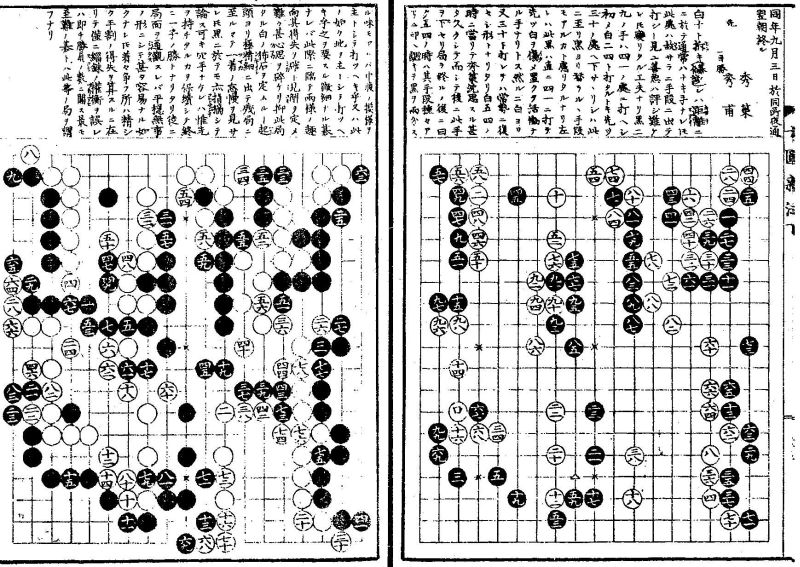
Record of an 1861 game by Shūsaku; the numbers mark the order of moves.
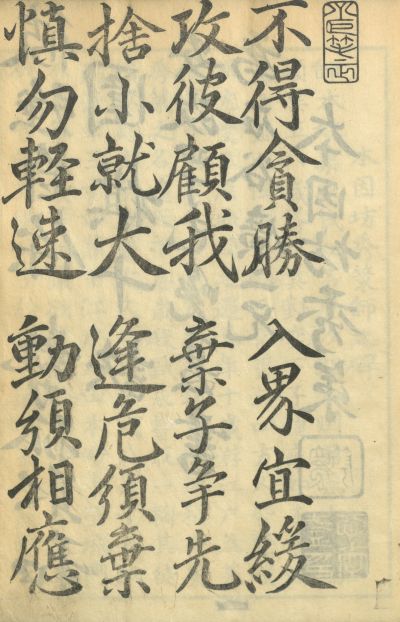
A page of Shūsaku’s calligraphy reproduced in Kōgyoku Yoin, published in 1897.
National Diet Library: record of the 1861 game between Hon’inbō Shūsaku and Murase Shūho; Shūsaku’s calligraphy from Kōgyoku yoin (ed. Ishitani Kōsaku, 1897)
A new generation met him through the manga and anime Hikaru no Go, in which the ghost of a Heian-period player named Fujiwara no Sai haunts a modern schoolboy and, the story reveals, once haunted Shūsaku, playing his famous games through him. The series set off a go boom among Japanese children around the turn of the century and brought many foreign readers to the game. On Innoshima there is now a memorial museum to Shūsaku, built around a reconstruction of the house where he was born.
06The Modern Go World
The Meiji Restoration ended the shogunate’s stipends, and the four houses declined. In 1924 players from rival factions came together, with backing from the businessman Ōkura Kishichirō, to found the Nihon Ki-in, the Japan Go Association. Professional go moved from family houses to an organization funded by newspaper-sponsored tournaments. The last hereditary head of the Hon’inbō house, Shūsai, decided in 1937 to retire and entrusted the name to the Nihon Ki-in. The Hon’inbō tournament was founded in 1939, and in 1941 the first titleholder emerged: "Hon’inbō" had become a title won in competition. Shūsai’s retirement game in 1938 against Kitani Minoru dragged on for half a year; the novelist Kawabata Yasunari covered it for the sponsoring newspaper and later turned it into his novel The Master of Go.
In 1933 Go Seigen, who had come to Japan from China in 1928 at fourteen, and Kitani together launched the "new opening" (shin fuseki), breaking with corner-bound conventions. In a series of ten-game matches between 1939 and 1956 Go Seigen beat every leading rival so decisively that he is often called the greatest player of the century. For decades afterward Japan was the center of the go world, and young Chinese and Korean players came to Japan to study.
Today Japanese professional go revolves around seven major titles: Kisei, Meijin, Hon’inbō, Ōza, Tengen, Gosei, and Jūdan. In 2016 Iyama Yūta became the first player to hold all seven at once, and in 2018 he received the People’s Honor Award alongside the shogi player Habu Yoshiharu. In 2019 Nakamura Sumire became a professional at ten years old. Since the 1990s, though, Chinese and Korean players have dominated international events, and after AlphaGo beat Lee Sedol in 2016 professionals everywhere have been relearning the game from artificial intelligence. Japan’s go-playing population is aging and shrinking, and neighborhood go clubs close every year. Still, as of 2026 NHK broadcasts its knockout tournament every Sunday, and newspapers still print go columns.
07Playing Go in Japan
The obvious place to start is the Nihon Ki-in headquarters in Ichigaya, Tokyo, which has a playing room open to the public and a shop where you can see kaya boards and clamshell stones up close; the price tags make clear how seriously these objects are taken. In Ōsaka there is the Kansai Ki-in. In older neighborhoods you can still find a gokaisho, a go club, often up a narrow staircase, where a single table fee buys a whole day, and the owner will find you an opponent of similar strength. Language is barely a problem. Say "onegaishimasu" before the game, "makemashita" ("I have lost") to resign, and "arigatō gozaimashita" at the end.
A few customs are worth knowing. Between players of similar strength, color is decided by nigiri: one player takes a handful of white stones and the other guesses odd or even. To resign, you can place one or two captured stones on the board. And after the game the two players usually replay it together from the beginning, pointing out where things went wrong. That post-mortem is often the warmest part of an afternoon in a Japanese go club.
If you would rather look than play, Jakkō-ji in Kyoto is the temple of Hon’inbō Sansa, and his grave is there. The Shōsōin’s sandalwood board occasionally appears at the annual autumn Shōsōin exhibition at the Nara National Museum. And at the Shūsaku museum on Innoshima you can see the board on which his mother is said to have taught him and a hanging scroll he wrote as a boy; some descriptions also mention his calligraphy and game records on display. Afterward, find the ear-reddening game online and play it through to move 127, and see whether you can tell what Gen’an saw.