
At a glance
How Ueshiba Morihei built aikido from Daitō-ryū and Ōmoto spirituality into a martial art without contests, how a class works, and how it spread worldwide.
- Ueshiba Morihei created aikido in the twentieth century; the name "aikido" was settled on around 1942.
- Apart from the Tomiki style, aikido holds no competitions; partners take turns as tori, who throws, and uke, who is thrown.
- Its core moves are irimi, stepping off the line of attack to the attacker’s side, and tenkan, turning to lead his momentum on.
- As of 2026 aikido is said to be practiced in more than 140 countries and regions.
- Each May the Aikikai holds the All Japan Aikido Demonstration at the Nippon Budōkan, with nothing scored.
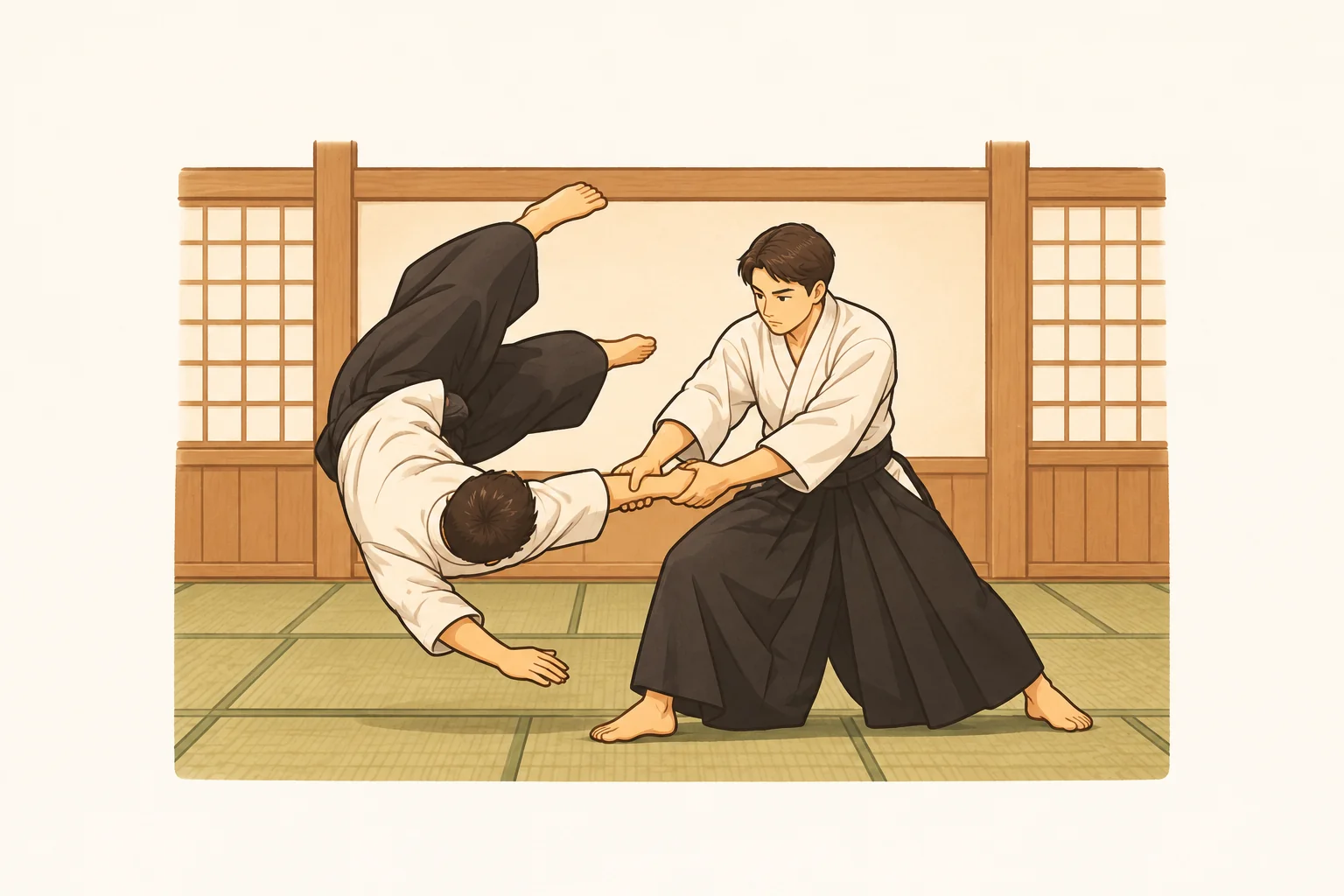
Aikido is the youngest of Japan’s major martial arts and in some ways the strangest. Most of its schools hold no tournaments, award no medals and keep no score. Two people take turns attacking and throwing each other, and the one who is thrown rolls up off the mat and comes straight back. The art was created in the twentieth century by one man, Ueshiba Morihei, who took the joint locks and throws of an older jujutsu school and reshaped them through his own religious vision into what he called a way of harmony. As of 2026 it is said to be practiced in more than 140 countries and regions. This is an introduction to what aikido is, why it is practiced the way it is, where it came from, and how a visitor to Japan can watch it or step onto the mat.
01What You See on the Mat
Watch an aikido class for the first time and it can look choreographed. One person grabs a wrist or brings a hand down like a sword cut toward the other’s head. The defender turns, steps off the line, and the attacker seems to be drawn along an arc until he lands on the mat, rolls and stands up again. Then the pair do it once more, and again, in a steady rhythm.
The principle is not mysterious. Aikido avoids meeting force head-on. The defender first gets out of the way of the attack and moves to the attacker’s side or behind him, a movement called irimi, "entering." He then turns his body, tenkan, so that the attacker’s own momentum carries on in the direction it was already going, only now slightly past the point where he can keep his balance. People are easiest to control in the instant they lose their footing, and aikido techniques are built to catch that instant and finish it either with a pin or with a throw.
- 1
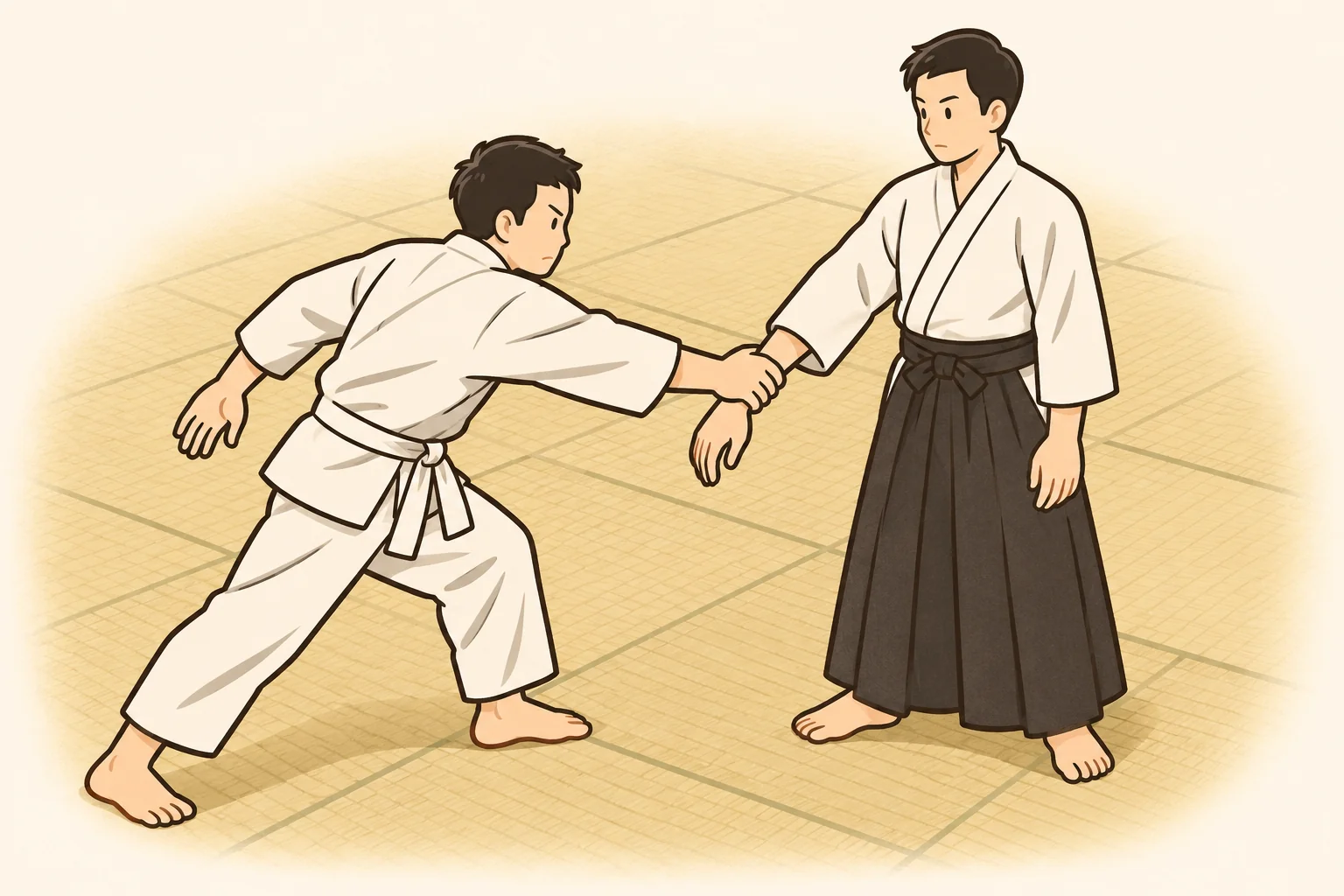 The attacker steps in and grabs the defender’s wrist, his force traveling in a straight line.
- 2
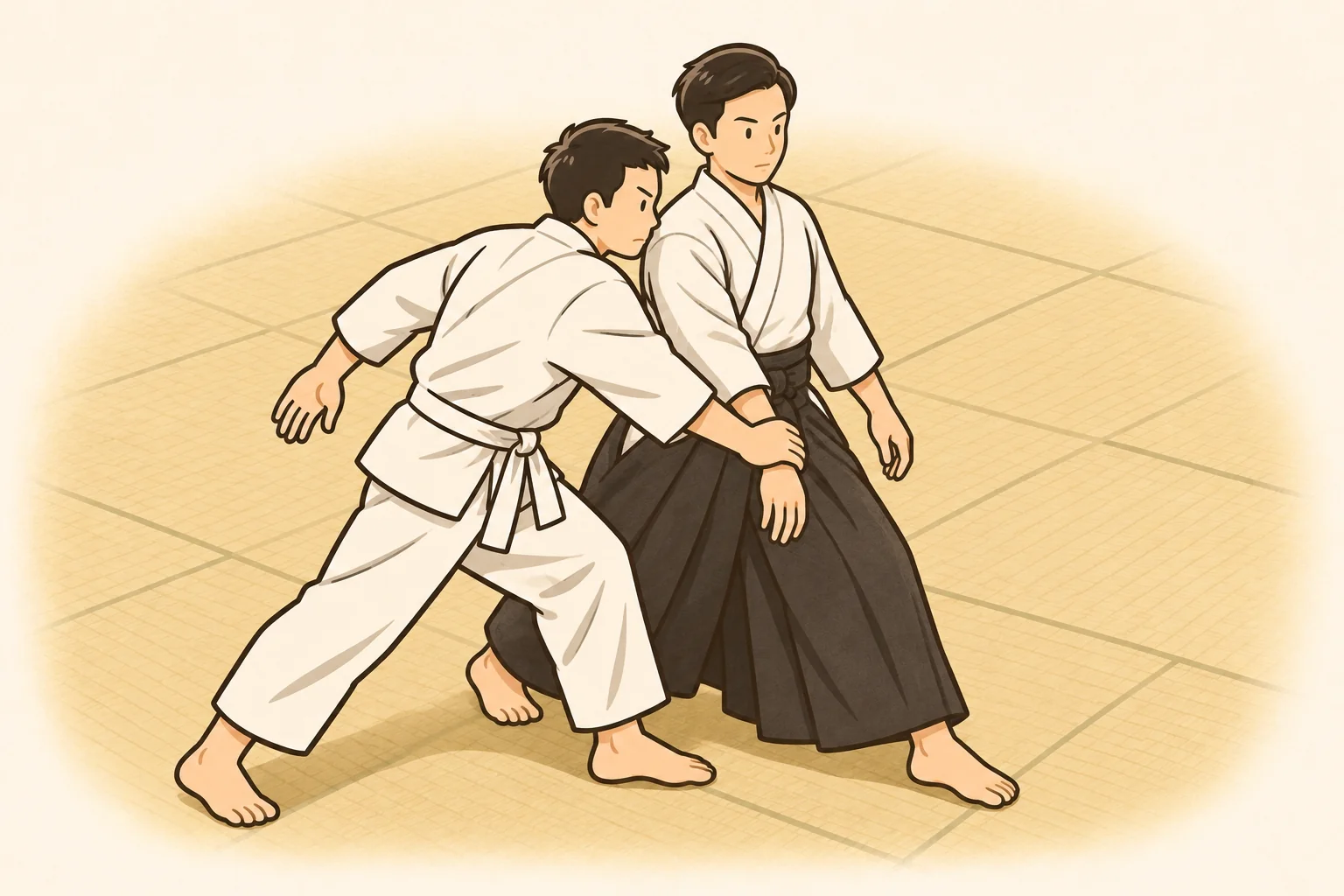 Irimi: the defender steps off the line of attack to the attacker’s side.
- 3
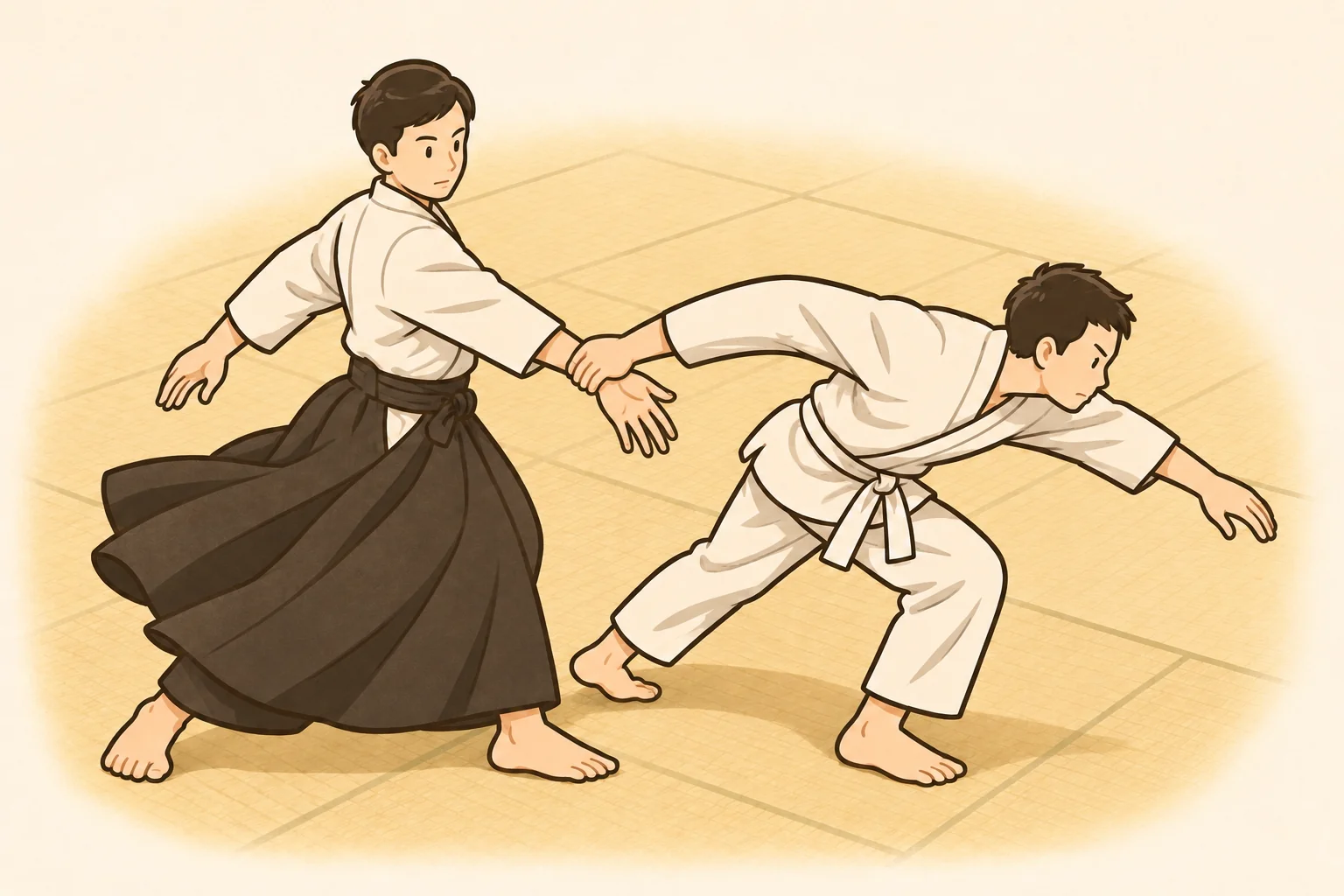 Tenkan: the defender turns, and the attacker’s own momentum carries him off balance.
- 1The attack comesa wrist grab or a cut toward the head
- 2Irimi, enteringout of the way, to the attacker’s side or behind him
- 3Tenkan, turninghis own momentum carries on in the same direction
- 4He loses his balancethe instant he is easiest to control
- 5A pin or a throw
Aikido avoids meeting force head-on: get out of the line, turn with the attacker’s momentum, and finish in the instant he loses his footing.
The names of the techniques are plain. Ikkyō through yonkyō, "first teaching" through "fourth teaching," are a family of arm controls that bring the attacker face down to the mat. Shihōnage, the "four-direction throw," lifts the attacker’s arm over the defender’s head and cuts it down like a sword stroke. Iriminage, the "entering throw," slips behind the attacker, draws his head in toward the defender’s shoulder and then sweeps him backward. Kotegaeshi turns the wrist outward so that the attacker flips over it. Kokyūnage, loosely "breath throws," use almost no grip at all, relying on timing and a whole-body turn. There is also suwariwaza, practice from a kneeling position, and hanmi handachi, where a kneeling defender handles a standing attacker, forms often explained as a legacy of the samurai’s need to respond to attacks while seated indoors.
The movement is circular, the footwork pivoting and the arms moving as if holding a sword. That is not an accident. Ueshiba trained in swordsmanship (and, by some accounts, the spear) and was known in the army for his bayonet work, and many aikido techniques correspond to cuts with a blade. Classes regularly use the bokken, a wooden sword, and the jō, a wooden staff a little over four feet long.
02Why There Are No Tournaments
Judo, kendo and karate all have competitions, and judo is an Olympic sport. Mainstream aikido does not compete at all. This was Ueshiba’s choice and it shapes everything about the art.
In his later years Ueshiba described true budō, the martial way, as a path of love: the aim was to remove the attacker’s reason for attacking rather than to defeat him. Victory and defeat, he said, were relative, two sides of the same contest. What he sought instead he called masakatsu agatsu katsuhayabi, "true victory is victory over oneself, swift victory here and now," a state in which conflict is resolved before it starts. The language is religious, and it came from a specific religious source, discussed below.
In practical terms, the absence of competition means that the two people on the mat are partners rather than opponents. The one who performs the technique is tori (or nage), and the one who receives it is uke. Uke’s job is not to stand and be thrown. He has to attack sincerely and then protect himself as he is thrown, falling, rolling and getting up in one motion. This skill, ukemi, is often the first thing beginners spend months learning, and it is what allows the partner to perform techniques fully. The characteristic sound of an aikido dojo is not shouting but the slap of bodies meeting the mat.
Critics have long asked how anyone can know that the techniques work if they are never tested against resistance. It is the oldest argument about aikido. Practitioners reply that many joint locks would injure people if applied at full force in a contest, and that what aikido trains is the ability to control a situation without harming the attacker, along with a set of physical habits: leave the line of attack, keep your center, don’t panic. The fact that the Tokyo Metropolitan Police adopted one aikido style for their training suggests the art has a real use where the goal is to restrain rather than to hurt.
03Ueshiba Morihei
Ueshiba was born in 1883 in Tanabe, on the coast of Wakayama Prefecture, into a prosperous farming family. He was a weak child, and his father encouraged him to build up his body. As a young man he studied Kitō-ryū jujutsu in Tokyo, then served in the army during the Russo-Japanese War, where he became known for his strength and his skill with the bayonet; while in the army he also trained in a Yagyū-ryū jujutsu under Nakai Masakatsu in Sakai.
Two encounters made him. The first came around 1915 in Hokkaidō, where Ueshiba had led a group of settlers from his home region to clear land at Shirataki in the island’s northeast. At an inn in the nearby town of Engaru he met Takeda Sōkaku, the master of Daitō-ryū aiki-jūjutsu, a small, notoriously prickly man whose technique left much bigger opponents helpless. Ueshiba became his student for several years. Many of aikido’s joint locks, and the word aiki itself, came from Daitō-ryū.
The second came in 1919. Hurrying home because his father was dying, Ueshiba stopped at Ayabe, near Kyoto, the headquarters of Ōmoto, a new religion led by the charismatic Deguchi Onisaburō. He settled there, opened a dojo on the movement’s grounds and taught martial arts to its followers. Deguchi’s Shinto-based mysticism, with its teachings on the spiritual power of sound and words and the unity of all things, deeply affected him. In 1924 he went with Deguchi on an ill-fated expedition to Mongolia, which aimed to found a utopian community; the party was captured by a local warlord, came close to being executed, and was released through the intervention of the Japanese consulate.
According to Ueshiba’s own later account, around 1925, after a bout with a naval officer armed with a wooden sword, he went out into his garden and felt the earth tremble and a golden light rise from the ground and envelop him, and he understood himself to be one with the universe. He treated this as his enlightenment. From then on his martial art was no longer simply a method of subduing people but a spiritual discipline. The story comes from Ueshiba himself and is repeated in every biography, but there is no independent way to confirm it.
He moved to Tokyo in 1927, and in 1931 opened a dojo called the Kōbukan in Wakamatsu-chō, Shinjuku. His students were mostly military officers, police and members of the elite, and the training was so severe that, as his students later recalled, the place was nicknamed the "hell dojo." His art went through several names, including aiki-jūjutsu and aiki-budō, before "aikido" was settled on around 1942.
During the war Ueshiba left Tokyo for the village of Iwama in Ibaraki Prefecture, where he farmed, built a small shrine dedicated to the spirit of aiki in 1943 and trained in an outdoor dojo. During the occupation, when the Allied authorities restricted martial arts, Iwama became the place where his mature style took shape. He died in Tokyo on April 26, 1969. Film footage from his last years shows a small, white-bearded old man in a kimono and hakama, turning gently while young men fly away from him in every direction.
- 1883Born in Tanabe, Wakayama
- c. 1915Meets Takeda Sōkaku of Daitō-ryū in Hokkaido
- 1919Meets Deguchi Onisaburō of Ōmoto at Ayabe
- 1924Mongolia expedition with Deguchi
- c. 1925His own account of enlightenment
- 1927Moves to Tokyo
- 1931Opens the Kōbukan dojo
- c. 1942“Aikido” settled as the name
- 1943Builds a shrine to aiki at Iwama
- 1969Dies in Tokyo
Two encounters, around 1915 and in 1919, made him; the name “aikido” was settled only around 1942.
04From One Man’s Art to the World
The person who turned aikido into something the public could join was Ueshiba’s son, Ueshiba Kisshōmaru. Before the war, students needed personal introductions to be accepted. After it, the Aikikai foundation, run by Kisshōmaru, opened the doors to ordinary citizens, held public demonstrations, published instruction books and sent teachers abroad. From the 1950s aikido spread to France, the United States and Britain, and then across Europe, South America and Southeast Asia. Kisshōmaru became the second dōshu, "keeper of the way," and was succeeded by his son Ueshiba Moriteru. The position has remained in the family.
The Aikikai’s headquarters, the Hombu Dojo, stands on the site of the old Kōbukan in Wakamatsu-chō. It is now a modern building of several floors where Japanese members and visitors from all over the world train on the same mats.
Several of Ueshiba’s students went their own way. Shioda Gōzō founded the Yoshinkan, known for its rigorous basics and precise, powerful form; it is this style that the Tokyo Metropolitan Police adopted for training, and riot police officers are said to have long trained at the Yoshinkan. Tomiki Kenji, who came to aikido from judo, combined the two and created the Tomiki style, the one branch of aikido that holds competitions, today centered on organizations such as the Shōdōkan in Ōsaka. Tōhei Kōichi, who emphasized ki, the body’s vital energy, and the unification of mind and body, left the Aikikai in 1974 and founded Ki Society aikido. Saitō Morihiro, who spent decades at Ueshiba’s side in Iwama, preserved and systematized his teacher’s later sword, staff and empty-hand curriculum, now known as Iwama style.
Outside Japan, aikido’s fame owes something to the movies. The American actor Steven Seagal spent much of the 1970s in Japan, training and teaching at his in-laws’ aikido dojo in Ōsaka, and later built his Hollywood action films around its wrist locks and throws, which for many Western viewers was the first time they had seen the art. Aikido teachers have mixed feelings about this. It brought students in, but it also gave the impression that aikido was mainly a way of beating people up.
05A Class in the Dojo
At a dojo you take off your shoes at the entrance and bow toward the front of the room before stepping onto the mat. The front wall usually holds a photograph of Ueshiba and a piece of calligraphy, and sometimes a small Shinto altar. Class begins and ends with everyone kneeling in a line, bowing to the front and then to the teacher.
The uniform is a white jacket and trousers much like a judo uniform. Beginners wear a white belt. Once they reach black-belt rank they put on the hakama, wide pleated trousers that swing as they move, and the most recognizable sight in aikido. Many dojo restrict the hakama to first dan and above, though some allow women to wear it from the start. Aikido has no rainbow of colored belts as karate does; it is essentially white and black, and promotion comes through graded demonstrations rather than competition results.
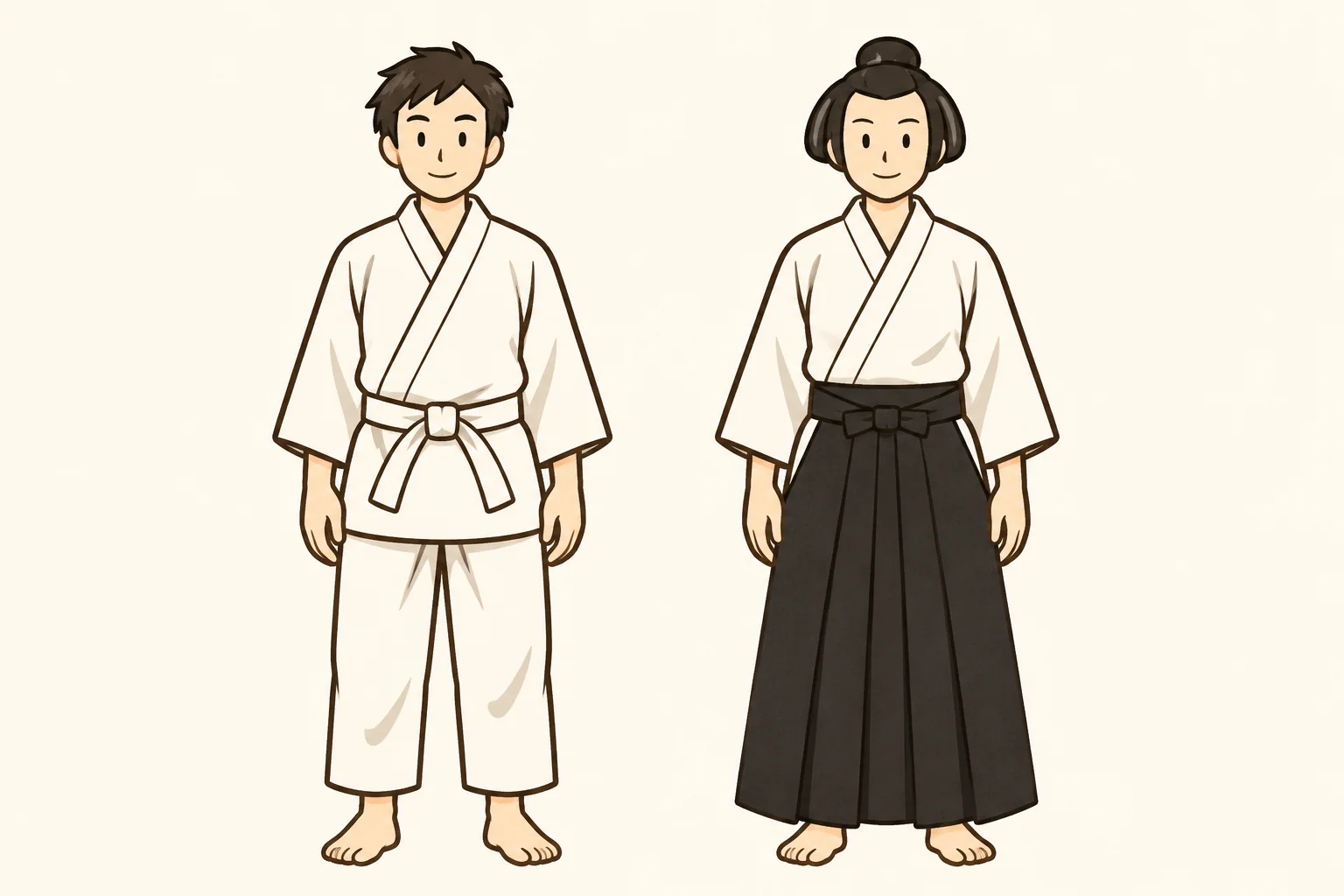
Beginners wear a white uniform and white belt; the wide pleated hakama comes with black-belt rank.
A class lasts about an hour. It opens with warm-up exercises and falling practice. The teacher then calls someone up, demonstrates a technique a few times with little explanation, and the class pairs off to try it, usually switching roles every four repetitions. The teacher circulates, correcting as he goes, and the most effective correction is often simply to take you as his uke so you can feel what being led actually feels like.
Part of aikido’s appeal is that people of any age and either sex can practice together. Since it does not depend on strength or speed, someone in their sixties can put a young man on the mat through position and timing. Many Japanese practitioners start in middle age and keep training for decades. Asked what aikido has given them, people often mention something very ordinary: they know how to fall, and when they slip on ice or trip on a step their bodies land safely without thinking about it.
06Watching and Training in Japan
In Tokyo, the easiest place to start is the Aikikai Hombu Dojo, where practitioners from Aikikai-affiliated dojos can join classes. Non-participants may also ask to observe practice, ideally by contacting the dojo in advance, though purely sightseeing visits may be turned away; watch quietly and without photographs. As of 2026, the dōshu himself and the dojo head, his son Ueshiba Mitsuteru, both teach classes there.
Each May the Aikikai holds the All Japan Aikido Demonstration at the Nippon Budōkan, where thousands of practitioners, from children to senior teachers, take turns demonstrating in groups. Nothing is scored. It is the best single chance to see the range of aikido in one place.
To see where the mature art took shape, go to Iwama, now part of Kasama city in Ibaraki. The Aiki Shrine is small and plain, and the dojo beside it is still in use. Each year on April 29 the shrine holds its grand festival, with demonstrations performed before the altar. Ueshiba’s hometown, Tanabe in Wakayama, has his grave at the temple of Kōzan-ji and a bronze statue of him, erected in 1988, in Ōgigahama Park by the sea; the city is also said to keep a display of materials in his memory.
Aikido sits at the end of a long line of Japanese martial traditions: sumo, still fought in the Ryōgoku Kokugikan; judo, an Olympic sport; karate, which came from Okinawa; kendo, fought with bamboo swords, and iaido, the art of drawing the blade; and kyudo, the meditative archery practiced in quiet ranges. Most of them were remade after the Meiji era from techniques for killing into paths of self-cultivation. Aikido took that transformation the furthest. It set aside winning altogether and kept only two people on a mat, attacking, leading, falling and getting up again.