
At a glance
How baseball became yakyū in Japan: school rivalries, the summer Kōshien tournament, the Giants and Tigers, players who crossed to the majors, and what to expect at a game.
- In 1872 the American teacher Horace Wilson taught baseball to students at a Tokyo school; in Japanese the game is called yakyū.
- Kōshien Stadium opened in 1924, named for that year’s place in the sixty-year cycle, with room for about 50,000.
- Summer Kōshien: some 3,360 high school teams (3,363 in 2026) play qualifiers; 49 reach Kōshien for single elimination.
- Since 1950 professional baseball has had two six-team leagues, Central and Pacific, whose champions meet in the Japan Series.
- Each team’s organized cheering section fills one outfield stand and sings a dedicated chant for every batter.
Baseball reached Japan in the early 1870s, and within a generation the Japanese had stopped treating it as an American import. They gave it a new name, yakyū, "field ball"; they trained for it the way samurai-era schools trained for swordsmanship; and they built around it a high school tournament that, every August, holds the attention of the whole country. Japan now has a twelve-team professional league that drew a record twenty-seven million spectators in 2025, a national team that had won the World Baseball Classic three times as of 2026, and in Ōtani Shōhei the most famous athlete on the planet. This piece explains how the game arrived, why a tournament for teenagers matters so much, how professional baseball fits into Japanese city life, and how to go and watch a game yourself.
01A Schoolyard Game
The usual starting point is Horace Wilson, an American teacher of English and mathematics at a government school in Tokyo that was renamed the Kaisei Gakkō in 1873 and later became part of the University of Tokyo. In 1872 he taught his students to throw, hit and run the bases. A few years later, in 1878, a railway engineer named Hiraoka Hiroshi, who had picked up the game while studying in the United States, founded the Shinbashi Athletic Club, generally counted as Japan’s first organized team. Both men are in the Japanese Baseball Hall of Fame.
What made Japanese baseball distinctive was where it took root: in the elite schools of the Meiji era (1868–1912), whose students were expected to become the country’s administrators, scholars and officers. The most important of these was the First Higher School in Tokyo, known as Ichikō. In 1896 Ichikō played a team of Americans from the foreign settlement in Yokohama and beat them 29–4. At a time when Japan was still bound by unequal treaties with the Western powers, the newspapers treated the result as a national triumph. From that moment, baseball in Japan carried a second question beneath the score: could the Japanese beat the West at its own game?
The Ichikō players answered by training with a severity that looked more like religious discipline than sport. They practiced through winter cold and summer heat, valued spirit over talent, and were said to keep fielding until their hands bled. This approach spread to other schools and gave Japanese baseball a vocabulary borrowed from the martial arts. People speak of yakyū-dō, "the way of baseball," in the same breath as kendo or judo, and the rituals of respect survive intact: in every high school game, the two teams line up facing each other at home plate and bow before the first pitch and after the last out.
The word yakyū itself dates from 1894, when Chūma Kanoe, an Ichikō man, translated "baseball" this way; the usual explanation is that he meant a ball game played in the field. A few years earlier the poet Masaoka Shiki, the great reformer of haiku, had been an enthusiastic player before tuberculosis confined him to bed. He wrote about baseball in verse and prose and coined Japanese terms for batter, runner and straight ball that are still in use. His childhood name was Noboru, and he punned on it by using the characters 野球 as a pen name, read "No-bōru." The Hall of Fame inducted him in 2002.
By the early twentieth century the center of gravity had moved to the universities. In 1903 Waseda challenged Keiō to a game, beginning the most famous rivalry in Japanese sport, the Sōkeisen. The games grew so heated that in 1906 they were called off amid fears of violence between rival cheering sections, and the two schools did not meet again until 1925, when the Tokyo Big Six University League was formed. Before there was professional baseball, the Big Six was the biggest show in Japan, and its organized student cheering squads, with their banners, drums and choreographed chants, set the template that every Japanese ballpark still follows.
02The Making of Kōshien
Not everyone approved. In 1911 the Tokyo Asahi Shimbun ran a series of articles, later remembered as the "baseball is harmful" campaign, in which educators denounced the game for distracting students and breeding vanity. The first installment featured Nitobe Inazō, then principal of Ichikō and author of Bushido: The Soul of Japan. The irony is that only four years later the company’s sister paper, the Osaka Asahi Shimbun, launched the National Middle School Baseball Championship. The first tournament was played in August 1915 at a ground in Toyonaka, north of Ōsaka, with ten schools, nine regional winners plus Waseda Jitsugyō; Kyoto Second Middle School beat Akita Middle School in the thirteenth inning of the final. A newspaper staged the event, and the event sold newspapers. That arrangement is still at the heart of Japanese school baseball.
Crowds quickly outgrew the early venues. The Hanshin Electric Railway, which ran trains between Ōsaka and Kōbe, decided to build a large stadium on the abandoned beds of two branch channels of the Muko River. It opened on August 1, 1924, a year that in the traditional sixty-year calendar was kōshi, the first year of the cycle. The stadium took the year’s name: Kōshien. For its time it was enormous, with room for some 50,000 people and reportedly billed as the largest in the East, and the railway’s trains brought fans straight to its gates in Nishinomiya, a city that has been known ever since mainly for one building.
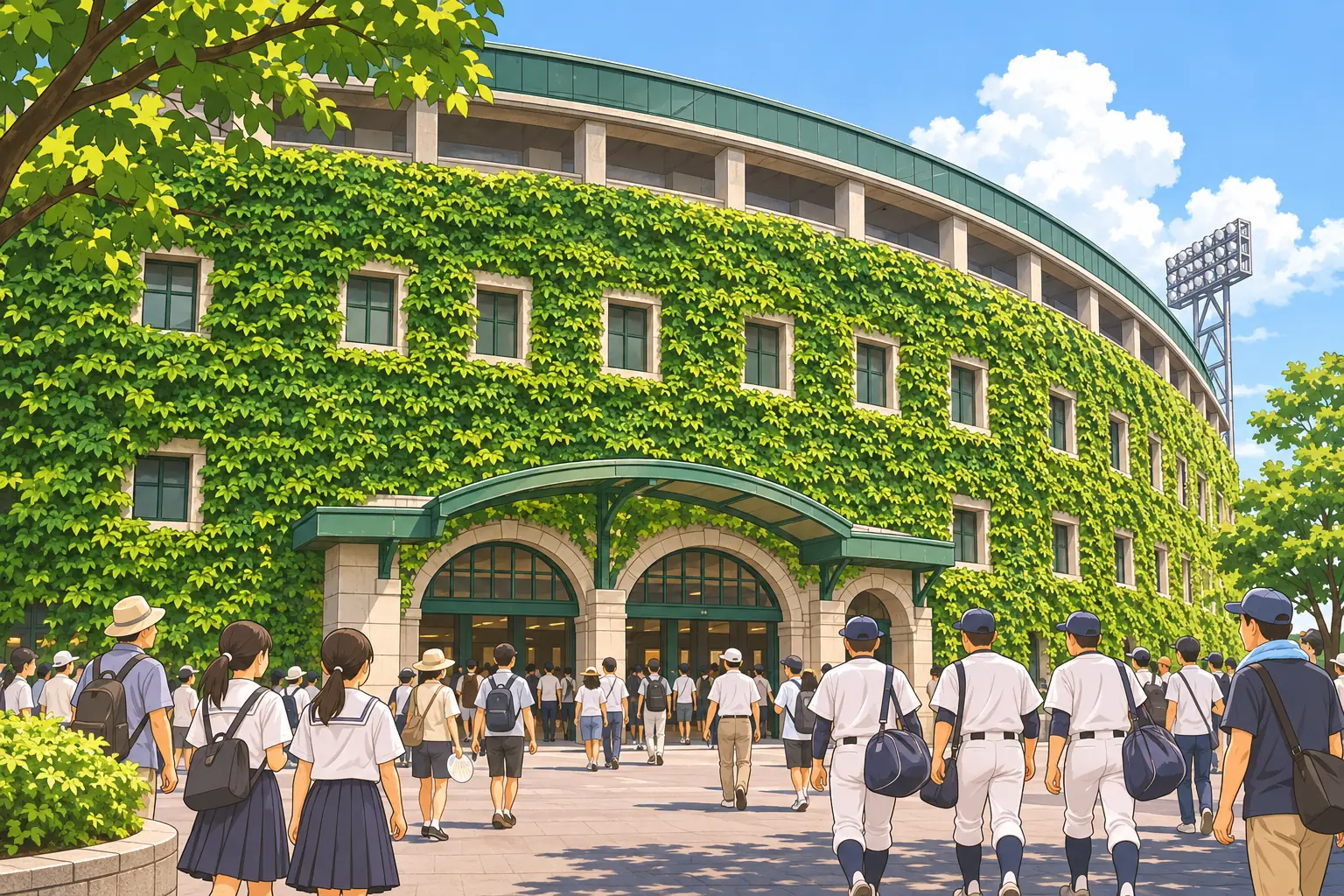
Kōshien looks much as it did a century ago. Its outer walls are covered in ivy first planted in December 1924; when the stadium was rebuilt in three phases between 2007 and 2010, the vines were taken down and replanted in the final phase, reportedly with plants grown from cuttings of the original vines. The infield is dark soil rather than grass, and the outfield is natural turf. The grounds crew who maintain it are famous in their own right; their speed at rescuing a waterlogged field during a summer downpour is the stuff of fan admiration.
The same year, 1924, the rival Mainichi newspaper started a spring tournament for eight schools at Yamamoto Stadium in Nagoya and moved it to Kōshien the following year. So Japan has two Kōshien tournaments. Spring Kōshien, the Senbatsu or "invitational," is run by the Mainichi, with around thirty-two teams chosen by a committee largely on the basis of autumn regional results. Summer Kōshien, run by the Asahi, is open to every school that can win its way through. After the war, when the school system was reorganized, "middle schools" became "high schools," and the summer tournament took its present formal name, the National High School Baseball Championship. Almost nobody uses it. To the Japanese, it is simply natsu no Kōshien, summer Kōshien.
03Summer Kōshien
The power of the summer tournament begins with its arithmetic. Through June and July some 3,360 high school teams (3,363 in 2026) play in prefectural qualifying tournaments, all of them single elimination. Each of Japan’s forty-seven prefectures sends one champion to Kōshien, except Hokkaidō and Tokyo, which send two each, making forty-nine. At Kōshien it is single elimination again. Of thousands of teams, exactly one finishes the summer without a loss. For almost every player, and above all for every third-year student, the season ends with a defeat, and for most of them that defeat is the last competitive game they will ever play.
- 1Prefectural qualifierssome 3,360 teams (3,363 in 2026), single elimination
- 2Kōshien49 teams: two each from Hokkaidō and Tokyo, one from each other prefecture
- 3Championone team without a loss
Both rounds are single elimination; of thousands of teams, exactly one finishes without a loss.
That is why Japanese viewers watch Kōshien differently from the way they watch professional baseball. They are watching teenagers stake everything on a final summer. The television cameras linger on the losing side: a pitcher crouched on the mound in tears, a catcher walking out to hold him, and then the image that has come to define the tournament, players kneeling by the dugout scooping the dark infield soil into bags to take home. The custom of taking Kōshien soil is decades old and its origin is disputed; one version credits Kawakami Tetsuharu, who reached the 1937 final with Kumamoto Technical and later managed the Yomiuri Giants and who is said to have spread the soil on his school’s field back home; another credits Fukushima Kazuo of Kokura, who in 1949, beaten in his bid for a third straight title, slipped soil into his pocket. Today the soil sits in jars in trophy cases and family homes as proof that its owner reached the place.
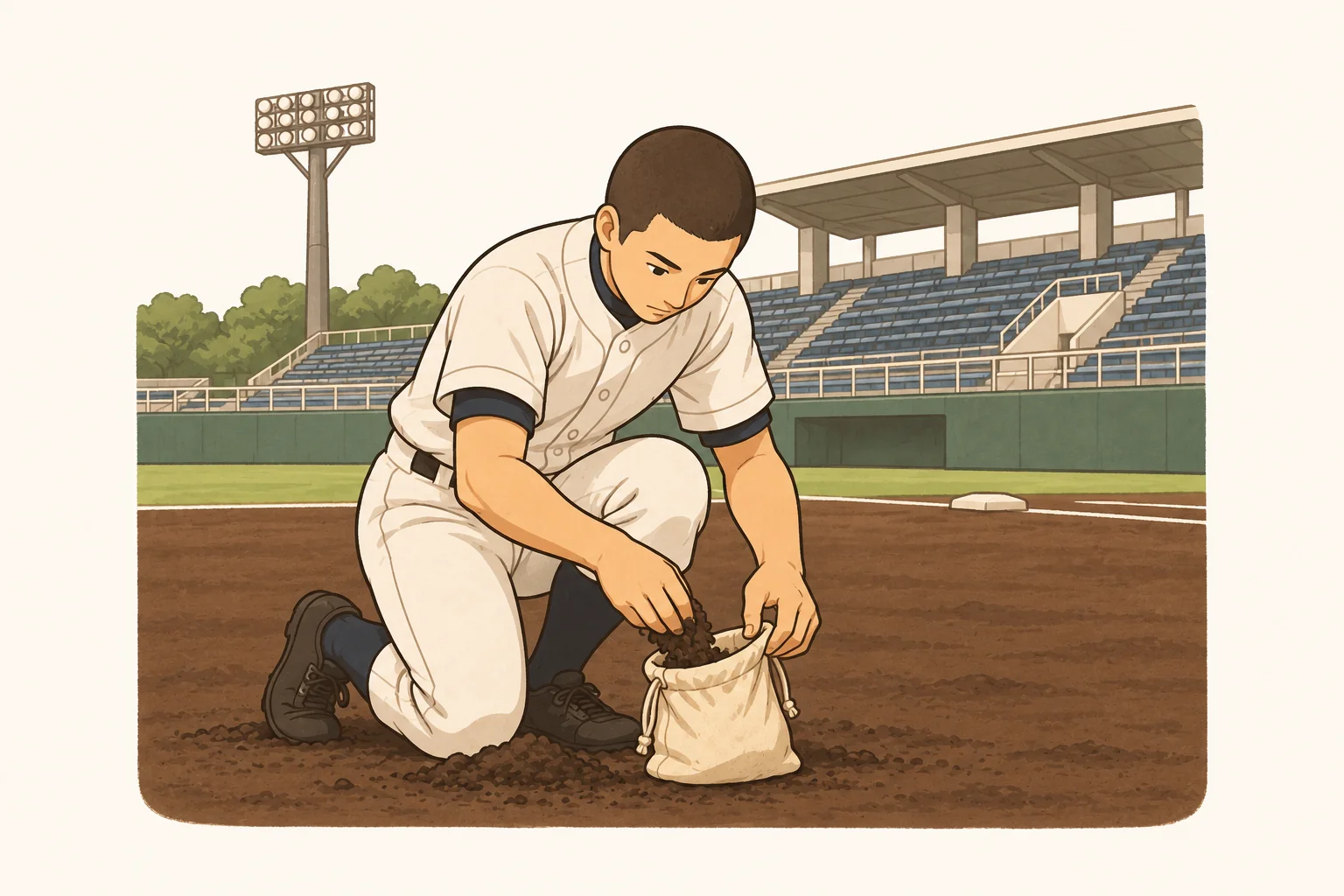
High-school players kneel by the dugout, scooping Kōshien's dark infield soil into bags.
The most affecting story about the soil comes from Okinawa. In 1958, when Okinawa was still under American administration, Shuri High School became the first Okinawan team to play at summer Kōshien. When the players sailed home to Naha, customs officers confiscated their soil as foreign earth under the plant protection law and dumped it into the sea. The story spread across Japan, and a Japan Airlines flight attendant collected pebbles from Kōshien, which the law did not cover, and sent them to the school. They are set into the Friendship Monument on the Shuri campus. In 2010 Okinawa’s Kōnan High School won both the spring and summer tournaments, and many Okinawans felt the debt had been repaid.
Summer Kōshien is also about home. The national broadcaster NHK televises every game, from the opening round to the final, and for two weeks in August the tournament plays on in offices, hospital waiting rooms and rural noodle shops. Teams are introduced not just by school but by prefecture, and a win for the local school is a win for the whole prefecture. Buses carry cheering parties overnight to Nishinomiya. In the big stands between the infield and outfield, known as the Alps stands because their tiers of white-shirted students reminded someone of snowy mountains, school brass bands play arrangements of pop songs and anime themes, cheerleaders dance in the heat, and substitute players who did not make the bench shout themselves hoarse in uniform. For generations no team from the Tōhoku region in the northeast had won either national title, and people said the championship banner had never crossed the Shirakawa Barrier, the ancient checkpoint marking the edge of the north. Sendai Ikuei finally carried it across in 2022.
The game itself is wrapped in ritual. A long siren sounds at the start and end of each game. The winning team lines up at home plate while its school song plays and the school flag is raised. The losing team bows to its opponents and to the stands and jogs off. Players almost never dispute an umpire’s call, a batter hit by a pitch runs to first without rubbing the spot, and hustle is treated as a basic courtesy: on a routine ground ball, the batter still sprints through first base. Many Japanese will tell you that this total effort, zenryoku, is exactly why they prefer Kōshien to the professional game.
Kōshien has its canon of legendary games, retold every summer. In the 1969 final, Misawa High School from Aomori and Matsuyama Commercial played eighteen scoreless innings; Misawa’s pitcher, Ōta Kōji, pitched the whole game and the replay the next day, lost, and became a national heartthrob anyway. From 1983 to 1985, Ōsaka’s PL Gakuen had the "KK combination" of pitcher Kuwata Masumi and slugger Kiyohara Kazuhiro, who reached the semifinals in all five of their appearances, winning twice and finishing second twice. In 1992, Meitoku Gijuku intentionally walked Seiryō’s Matsui Hideki five times in a single game; Meitoku won 3–2 as fans threw megaphones and trash onto the field, and the school was roundly condemned, and the episode is still the reference point for arguments about what counts as winning the right way. In 1998, Yokohama High School’s Matsuzaka Daisuke threw 250 pitches in a seventeen-inning quarterfinal against PL Gakuen, then pitched a no-hitter in the final. In 2006 Saitō Yūki of Waseda Jitsugyō and Tanaka Masahiro of Komazawa Tomakomai dueled to a fifteen-inning 1–1 tie in the final; Waseda Jitsugyō won the replay 4–3, and Saitō, because he wiped his face with a handkerchief on the mound (reportedly a blue one), became the "Handkerchief Prince."
Those stories point to the tournament’s sharpest controversy: young arms. A pitcher throwing hundreds of pitches in a few days is celebrated for grit and frequently pays for it with an injured elbow or shoulder. In 2019 the Ōfunato High School manager in Iwate kept his ace, Sasaki Rōki, out of the prefectural final the day after he had thrown 129 pitches; the team lost 12–2, and the decision divided the country. The rules have since shifted. A tiebreaker for extra innings came in 2018, a limit of 500 pitches per pitcher in any one week in 2020, in 2024 a new standard of metal bat with less rebound, and in the 2026 spring tournament the designated hitter. As of 2026, a proposal to shorten games to seven innings was still under debate. As Japanese summers have grown hotter, the tournament has also begun splitting days into morning and evening sessions to avoid the worst of the afternoon heat.
The culture around the teams is changing too. For decades high school players almost universally shaved their heads. That custom is fading, and in 2023 Keiō High School, whose players wore ordinary haircuts, won the summer title for the first time in 107 years, which many took as a sign of a new era. At the same time Japan’s falling birthrate is shrinking school baseball clubs, and some schools now combine with neighbors to field nine players. Since 2021 the final of the national girls’ high school tournament has been played at Kōshien.
04The Professionals
Japan had a passionate amateur game for half a century before it had a professional one. The man who changed that was Shōriki Matsutarō, owner of the Yomiuri Shimbun. In 1934 his paper brought over a team of American major league stars, including Babe Ruth and Lou Gehrig, for a tour, and assembled a team of Japanese players to face them. In a game at Kusanagi Stadium in Shizuoka that November, a seventeen-year-old pitcher named Sawamura Eiji, who had just left Kyoto Commercial School to join the team, struck out Charlie Gehringer, Ruth, Gehrig and Jimmie Foxx in succession and lost only 1–0, on a Gehrig home run. The Japanese team became the Dai Nippon Tokyo Yakyū Club, later the Yomiuri Giants, and in 1936 a professional league was formed.
Sawamura was drafted into the army and was killed in December 1944 when the transport carrying him was sunk, off Yakushima by one account, off Taiwan by another. He was twenty-seven (twenty-eight by traditional count). Since 1947 the Sawamura Award has gone to the best starting pitcher in Japanese professional baseball, the equivalent of the Cy Young. During the war baseball was suspect as an enemy sport; English terms were replaced with Japanese ones (a strike is said to have become seikyū, "correct ball," and an out taijō, "leave the field"), student baseball was halted in 1943, and the professional league suspended play in 1944.
After the war the game came back fast. In 1950 the professionals reorganized into two leagues, the Central and the Pacific, whose champions meet in the Japan Series, a structure that has lasted ever since. Each league has six teams. The Central League has the Yomiuri Giants, Hanshin Tigers, Chunichi Dragons, Hiroshima Tōyō Carp, Tokyo Yakult Swallows and Yokohama DeNA BayStars. The Pacific League has the Fukuoka SoftBank Hawks, Hokkaidō Nippon-Ham Fighters, Chiba Lotte Marines, Saitama Seibu Lions, Orix Buffaloes and Tōhoku Rakuten Golden Eagles. Most carry the name of a parent company, a railway, a newspaper, a food manufacturer, a telecoms or internet firm, because Japanese pro teams began as corporate advertising and still largely function that way. Hiroshima is the exception. With no parent company, the Carp nearly folded in the early 1950s and survived on donations from citizens, who dropped money into sake barrels at the ballpark gates, and when the team won its first pennant in 1975, the city that had been destroyed by an atomic bomb thirty years before went wild.
Professional baseball became the national pastime in the television era of the late 1950s. On June 25, 1959, Emperor Shōwa and Empress Kōjun attended a professional game for the first time, Giants against Tigers at Kōrakuen Stadium in Tokyo. In the bottom of the ninth, the Giants’ third baseman Nagashima Shigeo hit a walk-off home run off the Tigers’ Murayama Minoru. The "Emperor’s game" gave professional baseball a new standing, and Nagashima became the best-loved athlete of the postwar era. His teammate Oh Sadaharu, batting with a distinctive one-legged "flamingo" stance, hit 868 home runs in his career, still the professional record anywhere. Together they powered the Giants to nine consecutive Japan Series titles from 1965 to 1973, the "V9." A phrase from the period lists the three things every child loved: "the Giants, Taihō, and rolled omelette," Taihō being the reigning sumo grand champion.
The Giants are the most supported team in Japan and also the most resented, and their great rivals are the Hanshin Tigers, the team of the Kansai region, whose home is Kōshien itself. Tigers fans are known for devotion bordering on obsession. In 1985, the year the team won its first Japan Series, celebrating fans threw a statue of Colonel Sanders from a KFC into Ōsaka’s Dōtonbori canal (some accounts place this on the night the Tigers clinched the pennant, others after the Japan Series), and the long drought that followed was blamed on the "Curse of the Colonel." The Tigers did not win another Japan Series until 2023, under manager Okada Akinobu, who refused all season to say the word "championship" and called it only are, "that thing"; the word became that year’s buzzword. Every August, while the high school tournament occupies their stadium, the Tigers are sent on a long road trip that fans call the "road of death."
05Across the Pacific
For a long time Japanese players simply did not go to the major leagues. A Nankai Hawks pitcher named Murakami Masanori spent parts of 1964 and 1965 with the San Francisco Giants, but the door did not really open until 1995, when Nomo Hideo used a loophole to leave the Kintetsu Buffaloes and sign with the Los Angeles Dodgers. With his twisting "tornado" windup, he won the National League Rookie of the Year award. Many in Japan had called him a traitor for leaving; his success silenced them.
In 2001 Suzuki Ichirō moved from the Orix BlueWave to the Seattle Mariners and won both Rookie of the Year and Most Valuable Player in the American League. In 2004 he collected 262 hits, breaking a single-season record that had stood for eighty-four years. Ichirō embodied a Japanese ideal of the hitter: precise, tireless, repeating the same preparation every day. Matsui Hideki was World Series MVP for the Yankees in 2009, and a steady line of stars followed, including Darvish Yū, Tanaka Masahiro and Yamamoto Yoshinobu.
Ōtani Shōhei is the peak of that story. At Hanamaki Higashi High School in Iwate he famously filled out a goal-setting chart whose central aim was to be the first-round pick of eight professional teams. With the Nippon-Ham Fighters he both pitched and hit, and after joining the Los Angeles Angels in 2018 he revived the two-way player, a role almost nobody had attempted in the majors since Babe Ruth. In late 2023 he signed with the Dodgers for ten years and $700 million, and in 2024 he became the first player in major league history with fifty home runs and fifty stolen bases in a season. In Japan his games lead the morning news.
The national team, known as Samurai Japan, won the World Baseball Classic in 2006, 2009 and 2023, three titles as of 2026. The 2023 final in Miami ended with Ōtani on the mound striking out his Angels teammate Mike Trout, a moment watched by an enormous share of the Japanese television audience.
Japanese baseball is often contrasted with the American game. Japanese teams lean harder on bunts, steals and moving runners over; practice hours are long, spring camp opens on February 1, and some coaches still hit a "thousand-fungo" drill of ground balls until a fielder can barely stand. Regular-season games can end in a tie if they are still level after twelve innings. The American writer Robert Whiting, in You Gotta Have Wa, used the idea of wa, harmony, to explain the priority of the group over the individual. The contrast is sometimes overdrawn, but it reflects something real about how the Japanese understand the game: as something you refine through discipline, together.
06Going to a Game
The professional regular season runs from late March or early April through September, with the playoffs and Japan Series in October. Most stadiums are a short walk from a train station: Tokyo Dome, Meiji Jingū Stadium and Yokohama Stadium in the Tokyo area, Kōshien a few minutes from Hanshin Kōshien Station. The Nippon-Ham Fighters moved in 2023 to Es Con Field Hokkaidō in Kitahiroshima, which has a hot spring bath and sauna overlooking the field.
Before you go, decide which side you want. In Japanese ballparks the outfield bleachers belong to the two teams’ organized cheering sections, the home team usually in right field and the visitors in left. This is the loudest part of the stadium. A leader with a trumpet and a drum line set the rhythm, and the whole section sings a dedicated chant for each batter, with his name in the lyrics. When the visitors bat, the home section goes quiet and lets the other side have its turn, an unwritten courtesy that surprises many foreign visitors. If you want to watch the pitch-by-pitch duel between pitcher and catcher, sit in the infield. If you want the full Japanese fan experience, buy a ticket in the cheering section, stand when they stand, and wave your towel when they wave theirs. Nobody minds if you do not know the words.
Each ballpark has its rituals. At Kōshien, before the Tigers bat in the seventh inning, tens of thousands of long balloons are released at once while the crowd sings the team song, "Rokkō Oroshi." Carp fans in Hiroshima do a mass squat-and-rise cheer at key moments. Swallows fans at Jingū open small umbrellas and bob them to the tune of "Tokyo Ondo" whenever their team scores. Fans wear replica jerseys of their favorite player and carry team towels to hold overhead at a set line of the chant.
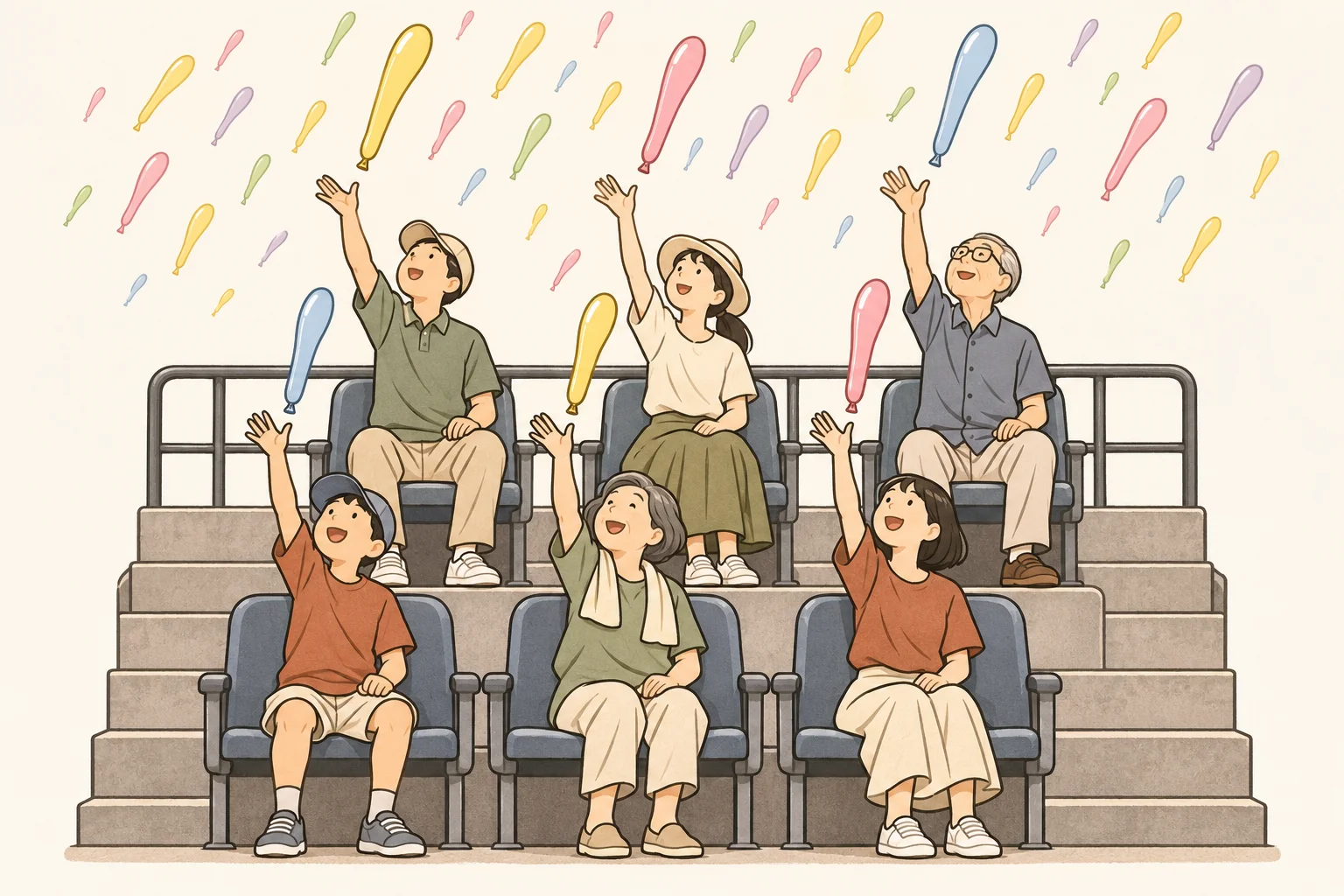
At Kōshien, long balloons are released at once before the Tigers bat in the seventh inning.
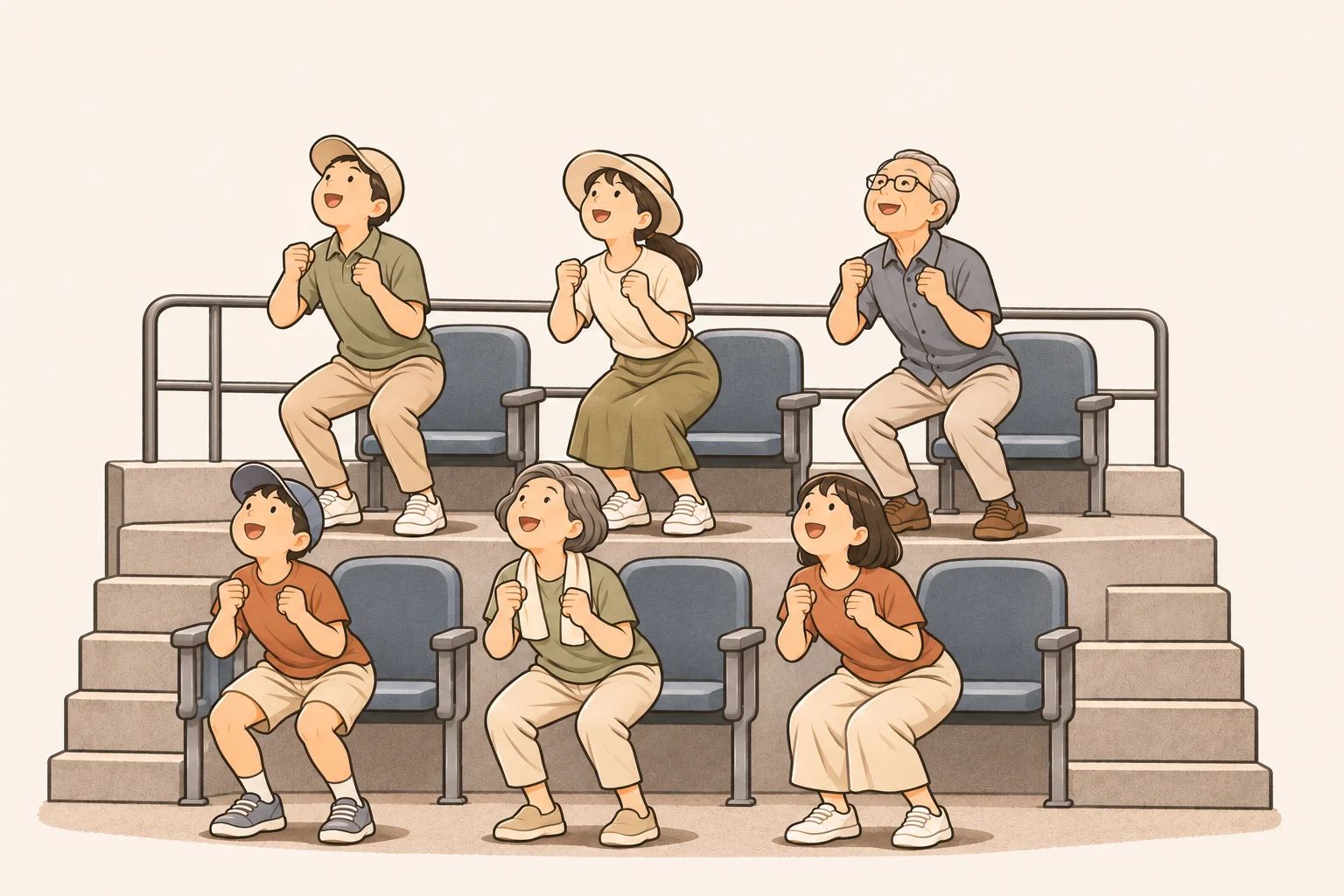
Carp fans in Hiroshima do a mass squat-and-rise cheer at key moments.
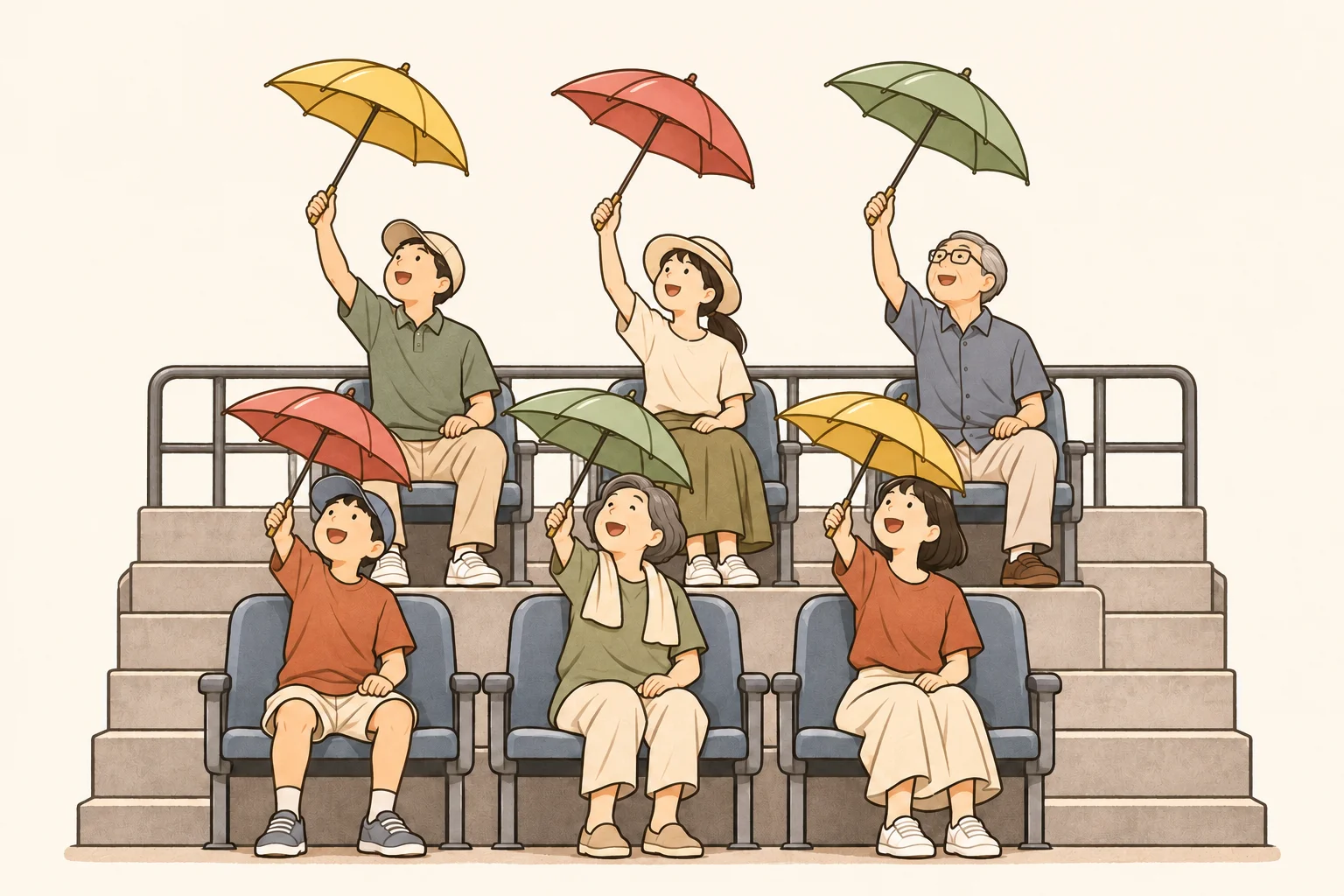
Swallows fans open small umbrellas and bob them to "Tokyo Ondo" whenever their team scores.
Then there is the beer. Young vendors, mostly women, carry kegs of more than ten kilograms on their backs and run up and down the steps of the stands; raise a hand and one will hurry over, kneel, and pour a cup from a tap on the keg, for about ¥800 to ¥900 as of 2025. Ballpark food is an attraction in itself, from Kōshien’s curry rice to bento boxes named after each team’s stars. Outside food is generally allowed, and many fans arrive with rice balls and snacks from the convenience store, but cans and bottles are usually poured into paper cups at the gate. Foul balls that land in the stands are yours to keep, and staff blow whistles to warn spectators when one is coming.
If you are in the Kansai region in August, spend a day at Kōshien watching the high school tournament. It usually opens in early August and runs for about two weeks, with three or four games a day from morning into the evening. Sit near the Alps stands to hear the two schools’ brass bands trade songs, or along the baselines to see every sprint to first. Bring a hat, a towel and plenty of water; the stands in Nishinomiya in August regularly pass 35°C. Afterward, visit the Kōshien History Museum beside the stadium, which displays championship banners, equipment, and relics of the famous games.
Out of season, the Japanese Baseball Hall of Fame and Museum next to Tokyo Dome tells the whole story from Horace Wilson to Ōtani. And for a sense of how Japanese people first fall in love with baseball, try the manga: Star of the Giants, about a father who drives his son to greatness; Adachi Mitsuru’s Touch, a story of twins, a childhood friend, and a promise to reach Kōshien; or Ace of Diamond, a detailed portrait of life in a high school baseball club. For many Japanese, the game begins there, and on the television every August.