
At a glance
How Kanō Jigorō rebuilt jūjutsu into judo, with breakfalls, free practice and black belts, how it reached the Olympics, and what to watch for at the Kōdōkan.
- Kanō Jigorō founded judo in 1882, starting the Kōdōkan on 12 tatami mats at Eishō-ji temple in Tokyo.
- As of 2025, judo is practiced in some two hundred countries and regions.
- Every throw follows kuzushi, tsukuri and kake: break the opponent’s balance, fit into position, then throw.
- Black belts begin at first dan; sixth to eighth dan may wear red-and-white, ninth and tenth dan red.
- Judo became an Olympic sport at the 1964 Tokyo Games, in the newly built Nippon Budōkan.
Judo is one of the most widely practiced of Japan’s martial arts, taught in some two hundred countries as of 2025 and an Olympic sport since 1964, missing only the 1968 Mexico City Games. Unlike most traditional arts, it has a clear founder and a clear birthday. In 1882 a young university graduate named Kanō Jigorō took the old grappling schools of the samurai, removed what was too dangerous to practice at full strength, organized the rest into a teachable system, and called it a "way" rather than a technique. This is the story of what he built, why it caught on, and how a visitor to Tokyo can watch it at the place where it began.
01From jūjutsu to judo
Before judo there was jūjutsu, the "gentle art": a family of Edo-period schools that taught how to throw, pin, choke and lock an opponent when weapons were lost or useless. Schools such as Tenjin Shin’yō-ryū and Kitō-ryū each had their own repertoire, passed down from teacher to student through prearranged forms. Real contests between schools happened, but they were rough and often injurious, and there was no shared system of rules.
The Meiji Restoration of 1868 abolished the samurai class, and with it the market for these skills. The new government looked to Western gymnastics and drill for physical education. Jūjutsu dojo closed, and the art that survived acquired a seedy reputation, associated with street fights and sideshows.
Kanō did not reject jūjutsu. He reframed it. Jutsu means technique or art; dō means road or way, the same character as the Chinese dao. By renaming the practice jūdō, "the gentle way," he signaled that the point was not merely winning fights but cultivating the person who trained. He later summed up judo’s purpose in two phrases that are still painted on dojo walls: seiryoku zen’yō, "maximum efficiency," the best use of one’s physical and mental energy; and jita kyōei, "mutual welfare and benefit," the idea that you and your partner improve together and that the same should hold for society.
The "gentle" in judo is also a mechanical principle. The Japanese proverb jū yoku gō o seisu, "softness controls hardness," describes it: when an opponent pushes, you do not push back. You yield, redirect his force, and throw him in the instant he is off balance. Kanō himself was small and slight, and he said he took up jūjutsu partly because he was bullied as a boy. The image of the small fighter throwing the big one has stayed at the heart of judo’s appeal.
02Kanō Jigorō and the founding of the Kōdōkan
Kanō was born in 1860 in Mikage, near present-day Kōbe, into a prosperous family of sake brewers and shippers. He moved to Tokyo as a boy, studied English intensively, and entered the newly founded University of Tokyo, where he read politics and economics. He was, in other words, a product of the Meiji modernizing elite, comfortable with Western ideas and interested in education.
While a student he sought out jūjutsu teachers, first Fukuda Hachinosuke and then Iso Masatomo of the Tenjin Shin’yō-ryū, a school strong in pins, chokes and joint locks. Later he trained in Kitō-ryū under Iikubo Tsunetoshi, whose throws relied on breaking an opponent’s balance at exactly the right moment. Kanō noticed a common principle beneath the two very different styles, and he also noticed what was wrong with how they were taught: too many dangerous techniques, too little system, and too much reliance on imitation.
In 1882, at the age of 21, he rented space at Eishō-ji, a Buddhist temple in the Shitaya district of Tokyo, laid down 12 tatami mats, and began teaching; nine students enrolled in the first year. He called the school the Kōdōkan, roughly "the hall for studying the way." It moved several times as it grew, settled in Kasuga, Bunkyō ward, in 1958, and in 1984 opened its present building there, the Kōdōkan International Judo Center, which remains the world center of judo.
The Kōdōkan’s key innovation was randori, free practice. Kanō took strikes, bone-breaking locks and other techniques that could not be safely used against a resisting partner and preserved them only in kata, the formal prearranged sequences. What remained could be applied at full speed and full strength every day. A jūjutsu student had mostly demonstrated techniques on a cooperative partner; a judo student tried to throw a partner who was trying to throw him back, hundreds of times a week. Kata preserved the principles, randori tested them, and that two-part structure still defines judo training.
The new school proved itself in contests. In the 1880s the Tokyo Metropolitan Police held martial arts tournaments in which Kōdōkan students faced established jūjutsu schools, and they won often enough that the police adopted Kōdōkan judo for training. Later retellings have embellished these matches, and the dates and scores vary from account to account, but the outcome is clear: the Kōdōkan became the leading grappling school in the capital. Its star students were remembered as the "Four Guardians" of the Kōdōkan: Saigō Shirō, Tomita Tsunejirō, Yokoyama Sakujirō and Yamashita Yoshitsugu. Saigō, very short and very fast, was famous for a throw called yama arashi, "mountain storm." Tomita’s son, the novelist Tomita Tsuneo, based the hero of his novel Sugata Sanshirō on Saigō, and in 1943 Kurosawa Akira adapted it as his first film.
03Learning to fall, then learning to throw
A beginner’s first weeks on the mat are spent being thrown, or rather learning how. Ukemi, breakfalling, teaches you to tuck your chin, slap the mat with your arms to spread the impact, and roll out of forward falls. The sharp slap of a good breakfall is the signature sound of any judo hall. Only when students can fall safely can they practice throwing each other at full intensity, and many Japanese who did judo at school say ukemi is the most useful thing they learned: when they slip on ice or come off a bicycle, their bodies protect their heads without thinking.
Judo techniques fall into two families. Nage-waza, throwing techniques, take a standing opponent to the ground: hand throws like the shoulder throw seoi-nage, hip throws like harai-goshi, foot and leg techniques like the big outer reap ō-soto-gari and the inner thigh throw uchi-mata, and sacrifice throws such as tomoe-nage, in which you fall backward and lift the opponent over you with a foot in the stomach. Katame-waza, grappling techniques, are used on the ground: pins, strangles and joint locks, with locks restricted to the elbow in competition. In 1895 Kanō organized the throws into the gokyō, five groups arranged by difficulty, originally 42 techniques in all; the 1920 revision set it at five groups of eight, 40 throws, still used as a syllabus.
Underlying every throw is a three-step principle: kuzushi, breaking the opponent’s balance; tsukuri, fitting your body into position; and kake, executing the throw. A good shoulder throw looks like a quick turn and lift, but it is won or lost before the turn, in the moment of kuzushi. The grip fighting that confuses many spectators, two competitors tugging at each other’s lapels and sleeves, is a contest over who will create that moment first.
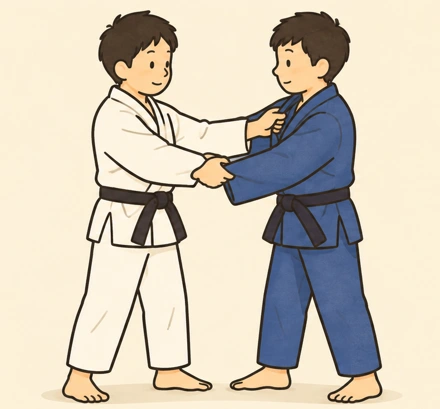
Both partners grip lapel and sleeve and stand balanced.
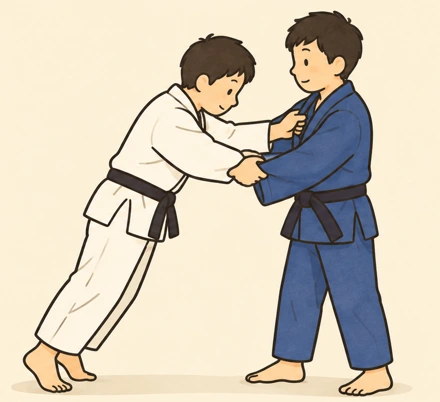
Pulled forward, the partner in white rises onto his toes; his balance is broken, and this is the moment to throw.
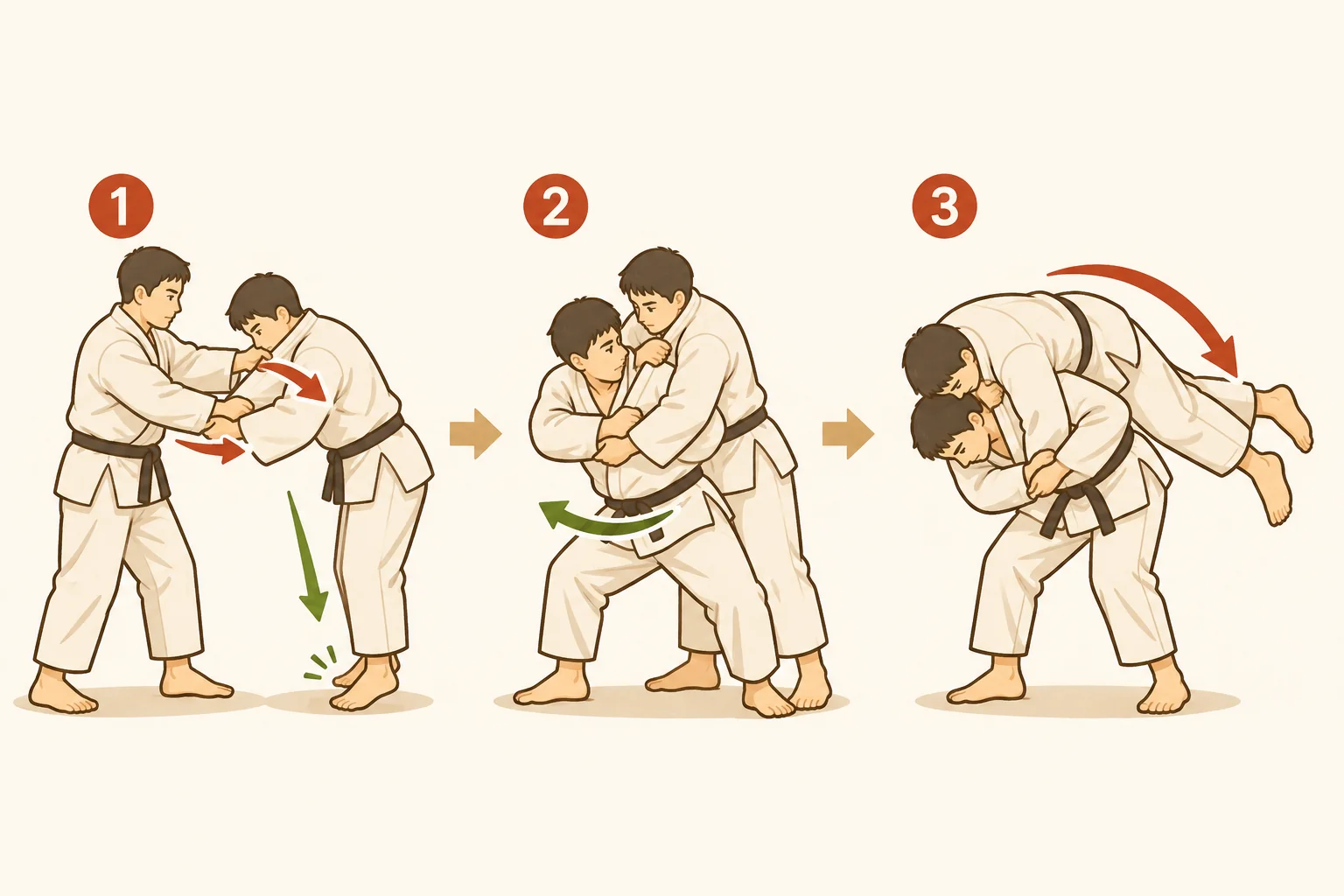
A seoi-nage in three stages: kuzushi, tsukuri and kake.
Scoring follows the same logic. The decisive result is ippon, a full point: a clean throw that lands the opponent largely on his back with force and control, a pin held for the required time, or a submission from a choke or armlock. Ippon ends the match on the spot. A lesser throw scores waza-ari, and two waza-ari make an ippon. The International Judo Federation has rewritten the rules repeatedly to reward attacking judo: kōka disappeared long ago and yūkō was abolished in 2017. Yūkō returned in 2025, but as of 2026 no number of yūkō adds up to a waza-ari or an ippon. In Japan the ideal is often called "ippon judo," winning by a decisive throw rather than by accumulating small advantages.
04White uniforms, black belts and schools
The Kōdōkan also gave judo its look. Early practice clothes were short in the sleeve and leg; they were lengthened and thickened so that partners could grip without tearing fabric or skin, producing the heavy cotton jacket, trousers and belt known as the jūdōgi. White was the only color until the IJF introduced blue uniforms for one competitor in international events in the late 1990s, to help spectators and referees tell the two apart. Japanese officials opposed the change at the time, and many domestic tournaments and dojo in Japan still use white only.
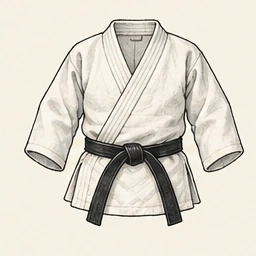
A heavy cotton jacket and belt, with sleeves long and cloth thick enough to grip.
Kanō’s most widely copied invention may be the ranking system. Borrowing the dan grades used in the board game go, he awarded the first shodan, first-degree rank, to Saigō Shirō and Tomita Tsunejirō around 1883, and later had dan holders wear black belts to distinguish them from beginners. Below the dan ranks are the kyū grades; sixth to eighth dan may wear a red-and-white belt, and ninth and tenth dan a red one. As of 2026, only 15 people in the Kōdōkan’s history have held tenth dan, most recently in 2006. Karate, kendo, aikido and countless other arts around the world adopted the same structure, which is why "black belt" has become English shorthand for expertise.
- Red beltninth and tenth dan
- Red-and-white beltsixth to eighth dan
- Black beltfrom shodan
- Dan ranks above
- Kyū gradesbelow the dan ranks
Red beltonly 15 people have held tenth dan
Kanō borrowed dan grades from go and had dan holders wear black to set them apart from beginners; higher still, the belt turns red-and-white, then red.
Kanō’s main career was in education rather than martial arts. He served for many years as principal of the Tokyo Higher Normal School, the country’s leading teacher-training college, and its graduates carried judo into middle schools across Japan. In the 1890s he founded a school for students from Qing China, later known as the Kōbun Gakuin, where the writer Lu Xun studied Japanese after arriving in 1902. In 1911 he founded the Japan Amateur Athletic Association and became its first president. To Kanō, judo belonged alongside track and swimming as part of a modern national education, a way to build sound bodies and characters.
That vision has proven durable. After World War II the American occupation briefly banned martial arts in schools; the ban was lifted within a few years. Since 2012 martial arts have been a compulsory part of the middle-school physical education curriculum, and judo is the most common choice. The same policy prompted a national debate about head injuries in school judo, which led to stricter training requirements for instructors and more emphasis on breakfalls for beginners.
05Judo goes abroad
Judo traveled early. Kanō himself went abroad many times, more than a dozen by some counts, to observe, lecture and demonstrate, and his students followed. Yamashita Yoshitsugu went to the United States in the early 1900s and taught President Theodore Roosevelt. Maeda Mitsuyo fought challenge matches across the Americas and Europe and settled in Brazil, where his teaching of the Gracie family became the seed of Brazilian jiu-jitsu. France became a judo stronghold in the mid-twentieth century and as of 2025 has more registered judoka than Japan.
In 1909 Kanō became the first Asian member of the International Olympic Committee. In 1912 he led Japan’s first Olympic team, two athletes, to Stockholm as head of delegation. He spent the following decades campaigning for a Tokyo Olympics, and in 1936 the IOC awarded the 1940 Games to Tokyo. Returning from an IOC session in Cairo in 1938, he died of pneumonia aboard the ship Hikawa Maru at the age of 77 (79 by traditional count). Just over two months later, with the war in China widening, Japan gave up the Games.
Tokyo finally hosted the Olympics in 1964, and judo made its debut as an Olympic sport in the Nippon Budōkan, an arena built for the occasion. Japan won three of the four weight classes. In the open category, the one that mattered most to Japanese pride, the Dutch giant Anton Geesink pinned Kaminaga Akio to take gold. As the hall fell silent, Geesink waved back Dutch teammates rushing onto the mat and bowed to his opponent. Many Japanese remember that day as the moment judo stopped belonging only to Japan.
Women had trained at the Kōdōkan since the founder’s day, and a women’s section was formally established in 1926, but competitive women’s judo was long discouraged in Japan and developed first in Europe and North America. It appeared as a demonstration event at the 1988 Seoul Olympics and became a full medal sport at Barcelona in 1992.
06Judo in Japan today
In Japan, judo is a sport that everyone knows and many have tried in school. It is often the first event to bring Japan gold at an Olympics, and the winning throws are replayed endlessly on television. Yamashita Yasuhiro, unbeaten in 203 consecutive matches, won gold at Los Angeles in 1984 despite a torn calf muscle. Nomura Tadahiro won three consecutive Olympic titles. Tani Ryōko, known affectionately as "Yawara-chan," was a household name for two decades. At the Tokyo Games held in 2021, siblings Abe Hifumi and Abe Uta won gold on the same day.
Everyday judo lives in neighborhood dojo, school clubs, universities and police stations. Children train two or three evenings a week, and parents often value the etiquette as much as the fitness. Students bow on entering and leaving the hall, kneel and bow to the teacher at the start and end of practice, and bow to each partner before and after randori. The year is marked by rituals: kagami biraki in January, and kangeiko, dawn training in the coldest weeks of winter. The police are a pillar of the sport, since officers must train in judo or kendo, and many elite competitors are employed by police forces or corporate teams.
Participation has been falling, however, with a shrinking youth population, concerns about injury and competition from other sports. Within Japanese judo there is also an ongoing argument about what the sport has become. As the IJF has shaped judo into a television-friendly scoring contest, some Japanese teachers worry that Kanō’s educational project is being lost.
Judo’s place among Japan’s martial arts is distinctive. Sumo retains Shinto ritual and a professional stage; kendo preserves the forms of swordsmanship; karate came from Okinawa; aikido does not hold competitions at all. Judo was the first to modernize and the first to reach the Olympics, and for many people abroad it is the entry point to the whole idea of budō.
07Visiting the Kōdōkan
The best place to see judo is the Kōdōkan itself, a few minutes’ walk from Kasuga station on the Toei lines or Kōrakuen station on the Tokyo Metro, not far from Tokyo Dome. A bronze statue of Kanō stands at the entrance. The gray eight-story building houses a library and a small judo museum displaying the founder’s belongings and photographs and documents from Kōdōkan history, reportedly including his calligraphy, early judo uniforms and portraits of famous judoka.
During general practice in the great dojo upstairs, visitors can watch from a spectators’ gallery. Dozens of pairs work at once across some 500 tatami mats: middle-aged black belts, high school students and foreign visitors in white jackets, falling, slapping the mat, getting up, bowing and gripping again. There is no music and very little talk, only the shuffle of bare feet, the crack of breakfalls and the occasional sharp exhale. Keep your voice down, check whether photography is allowed, and never step onto the mat in shoes.
Visitors with judo experience can also join practice under the Kōdōkan’s rules. People with no training should not step onto the mat: being thrown without knowing how to fall is a quick way to get hurt. Beyond the Kōdōkan, prefectural budō halls and universities host tournaments throughout the year. The most prestigious in Japan is the All Japan Judo Championships, held at the Nippon Budōkan each spring with no weight classes at all, the purest test of Kanō’s idea that skill can beat size.
Whatever you watch, look at the bows. Competitors bow at the edge of the mat, bow again at the center, and after even the most violent contest return to their marks, straighten their jackets and bow before leaving. Japanese winners rarely celebrate on the mat. It is the clearest everyday trace of jita kyōei.
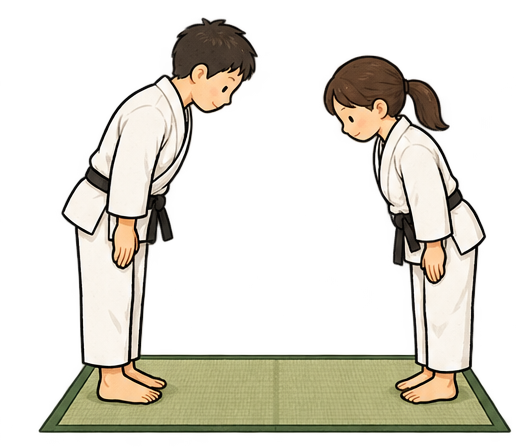
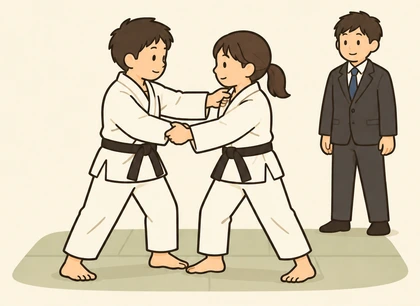
Partners bow to each other; however hard the contest, it ends with both back on their marks, bowing.